Friday, November 16, 2007

Don't Neglect the Heart

By Valerie Scher - The Union Tribune - San Diego, CA, U.S.A.
Thursday, November 15, 2007

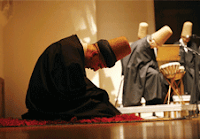
Spinning like human tops, with billowing skirts and rapt expressions, Turkey's whirling dervishes seem to defy physical limitations.

Unlike ballet dancers, they don't use the head-whipping “spotting” technique to avoid dizziness. Yet their spins – called “rounds” – can last for many minutes, far surpassing the famous 32 fouette turns in “Swan Lake.”

“Dervishes don't count their turns. Whatever they do, they feel it is not sufficient to express their love for God,” said tour manager Cenk Erdem, spokesman for the Istanbul-based Galata Dervishes, which appear tonight [16th] at UCSD's Mandeville Auditorium.

In celebration of the 800th anniversary of the birth of Rumi, the Galata Dervishes have embarked on a monthlong North American tour that includes UCSD's ArtPower! program, titled “Ecstasy of the Whirling Dervishes.”

Traveling with the company is Esin Celebi, a 67-year-old female descendent of Rumi's, who will make a speech before the event.

The 16 practitioners in the all-male ensemble – eight dancers, six instrumentalists and two vocalists – range from engineers and tourism managers to professional musicians.

“Being a dervish is just part of their lifestyle,” said Erdem, a psychologist. “They're not into extreme religion, you see? When we were in New York City, we went shopping and visited outlet malls.”

The dancers usually begin training when they're about 9 years old, though some don't start until they're teenagers. The basic technique involves raising the right foot while keeping the left foot on the ground.

Students strengthen their sense of balance by slowly revolving on a wooden board, with the toes of one foot positioned around a nail. It takes at least a year to become proficient at whirling.

“The dancers go into a trance. It's like meditation,” Erdem said. “That keeps them from getting dizzy. And the music gives them energy.”

The kudum – a small double drum – is crucial to the opening of the ritual, making a sound that he compares to “the Big Bang, the birth of the universe.”

Such cosmic associations help explain the enduring appeal of the dervishes.

“We are often slaves to our egos so the idea of leaving the ego really fascinates people,” said Erdem. “People are so ambitious and try to be so rational that they neglect the heart. Rumi believed that love gets us closer to God.”

Even if you don't whirl, watching and listening is beneficial, according to the dervishes.
“It's purifying not just for the dancers but for the audience,” said their spokesman. “If people concentrate on the movements and the music, they will feel the love.”

“Ecstasy of the Whirling Dervishes”
When: Tonight, Friday 16th, 8 p.m.; pre-performance discussion at 6:45 p.m.
Where: UCSD's Mandeville Auditorium, Mandeville Lane near GilmanDrive, La Jolla
Tickets: $34 and $38; $17 and $19 for UCSD students
Phone: (858) 534-TIXS
Online: www.artpower.ucsd.edu

Thursday, November 15, 2007

12-year-old Sufi Singer Captivates Audience

Chennai Online - Chennai, India
Monday, November 12, 2007


Can life be compared to a mobile phone! Yes, if 12-year-old Sufi singer Rais Anis Sabri is to be believed.

He says, life is like a SIM card of uncertain validity that needs frequent recharge, to connect to the Almighty through prayer - the outgoing calls - and receive the divine grace - the incoming calls.

He calls every earthquake or tsunami a missed call urging people to always remember their Lord.

A phenomenally talented artiste, Rais Anis Sabri is a sixth grade student from Jalalabad, Uttar Pradesh, who is currently making waves in the world of Sufi Qawwali music.

Son and disciple of Rais Sabri, who in turn is a disciple of famous Qawwal Aslam Sabri, Anis is one of the youngest performing sufiana qawwals in the subcontinent.

Gonabadi Sufi Site Destroyed

SF/GM/BGH - Press TV - Tehran, Iran

Monday, November 12, 2007

Sufi lodge has been destroyed following clashes between young worshippers of a mosque and followers of a Sufi sect in Boroujerd.

Eighty people were wounded and some 180 arrested in the two-day clashes between worshippers of the Al-Nabi Mosque and the followers of a Sufi order in the western Iranian city of Boroujerd.

The young worshippers issued a statement Sunday, describing the destruction of the gathering site, which belongs to the Gonabadi branch of Sufism, as a 'revolutionary act'.

The statement said that followers of the order had been threatening the local people, adding that in an irresponsible and brutal act, they had violated the sanctity of the mosque, breaking its window-panes and wounding a number of worshippers, including the mosque's prayer leader on Sunday.

Such acts of savagery obviously hurt the feelings of the city's pious people, who expressed their strong agony.

The Majlis deputy from Boroujerd, Mohsen Yahyavi, speaking to IRNA on Sunday, denounced the destruction of the Sufi lodge, saying, "Strife in any form between worshippers and the Sufis has deeply saddened the people of the city."

The main causes of the clashes have yet to be determined, Yahyavi said, stressing, "It is expected that security authorities will try to discover the reasons behind the sad event as soon as possible."

[Picture: MP from Boroujerd, Mr. Mohsen Yahyavi].

Ancestral Sufi Laments - Glow

By Kevin Le Gendre - The Guardian - U.K.
Tuesday, November 13, 2007

World music is a vague, pliable, record-industry term and its ambiguity is perfectly exhibited tonight.

While Tunisian singer and oud player Dhafer Youssef and Austrian guitarist Wolfgang Muthspiel create music that sounds deeply rooted in ancestral Sufi laments that would send Womad punters into raptures, they constantly pull apart, embroider and restitch the form of each piece. In other words, it is jazz.

Giving further credence to this sleight of genre is the fact that the repertoire, drawn largely from the duo's fine new album Glow, suffers in no way from the absence of the trumpet, bass, keys and drums featured on the studio recording.

As well as extensively improvising, both musicians - whose former collaborators include Miles Davis's percussionist Mino Cinelu and Wayne Shorter's drummer Brian Blade - sample, slice, loop and distort phrases to fashion off-the-cuff beats and swooning textures. In other words, it is ambient electronica.

Yet in the midst of their most technophile moments, both musicians retain an organic, sensual musicality.

Muthspiel, armed with electric and nylon string guitars, unfurls fleet, flickering arpeggios and tightly coiled, intricate solos that often segue into muscular, primal bass lines.

Youssef's oud improvisations, mostly favouring shorter, staccato lines that show the Moorish roots of flamenco, mark an effective contrast to Muthspiel's more loquacious approach. But his real virtuosity is his voice, a spellbinding instrument lying somewhere between Nusrat Fateh Ali Khan and Bobby McFerrin.

Like the latter, Youssef has elaborate methods of manipulating his tone, the high point of which sees him sing right into the bulbous body of the oud to turn the room into an enchanted echo chamber.

Iran-Kashmir Relations Revived


TE/HGH - Press TV - Tehran, Iran

Monday, November 12, 2007

An Iranian artist's innovative work has revived the ancient Iran-Kashmir relations at an international contemporary art workshop.

Touraj Khameneh-Zadeh hung old Sufi images on a Srinagar Chinar tree (the symbolic tree of Kashmir) to revive the ancient relationship of Iranians with the Kashmiris.

His work called, 'Seven Boughs of Chinars' presented seven portraits of Iranian Sufis superimposed on pictures of seven famous Sufi shrines in Kashmir.

The portraits show 700 years of Sufism history. International Artists Workshop, which ran until Nov. 11th, 2007 in Srinagar, is the first of its kind in the valley's history.

Local, Indian and international artists presented their art works during the 15-day workshop aimed at 'breaking the monotony of the traditional canvas painting'.

Kashmir valley lies between the Himalayas and the Pir Punjab mountain range. Called 'Paradise on Earth', Kashmir attracts millions of tourists with its many archeological sites and beautiful mountainous landscapes.

[More on this workshop: http://sufinews.blogspot.com/2007/11/seven-portraits-of-seven-sufi-saints-on.html].

Seven Books Banned

New Straits Times - Persekutuan, Malaysia
Monday, November 12, 2007

Seven books banned for distorting sanctity of Islam

Kuala Lumpur: The Internal Security Ministry has banned publication of seven books whose contents distorted the sanctity of Islam and its true teachings.

They are Tajul Muluk; Fiqh Perempuan; Tasawuf Perenial Kearifan Kritis Kaum Sufi; Kumpulan Ilmu Ghaib; The Muslim Jesus: Kisah dan Sabda Yesus dalam Literatur Islam; Penyembuhan Cara Sufi and Kitab Kaysf Al-Asrar.

The ban order, signed by Deputy Minister of Internal Security Datuk Mohd Johari Baharum, was gazetted under Section 7(1) of the Printing Presses and Publications Act 1984, the ministry’s publication control and Al-Quran Text Division said in a statement today.

Under Section 8(2) of the Act, it was an offence to print, import, produce, reproduce, publish, sell, issue, circulate, distribute and possess banned publications, it said.It said offenders are liable to a jail term of not more than three years or fined not more than RM20,000 or both, if convicted.

The books could create confusion and anxiety among Muslims and harm public peace if their publications are allowed to continue, it added.

Dozens Injured in Clash between Sufis and Officers

Record Searchlight - Redding, CA, U.S.A.
Monday, November 12, 2007

Tehran: Police and paramilitary officers traded fire with followers of the mystical Sufi branch of Islam who had clashed over religious differences with Shiite Muslims in southwest Iran, authorities and witnesses said Sunday.

Dozens of people were injured and arrested when the police, paramilitaries and special forces stormed the lodge of the Sufis, who had fought members of a nearby Shiite mosque in the city of Boroujerd, witnesses said.

Both sides shot at each other before authorities seized the lodge and set fire to Sufis' belongings, according to a student who said he witnessed the clash.

Sufi orders form a branch of Islam that emphasizes direct mystical experience over mainstream religious practice.

Unorthodox? Iran Police Battle Sufi Muslims

BBC News International - U.K./Middle East
Monday, November 12, 2007

Around 180 Sufi Muslims have been arrested in Iran after attacking a Shia mosque where a cleric labelled their religion "illegitimate", say reports.

The confrontation in the western city of Boroujerd led to a shootout between the Sufis and police that reportedly left about 80 people injured.

Sufis are tolerated in the Islamic Republic though some religious leaders have branded them "a danger to Islam".

About 1,000 Sufis were held last year in clashes at Iran's holy city of Qom.

The disorder in Boroujerd, about 320 km (200 miles) south-west of the capital, Tehran, broke out on Saturday morning, according to local news agencies.

Sufis attacked a Shia mosque after a cleric said their lodge should be shut down.

On Sunday, police reportedly raided the Sufi lodge to make arrests and bloody clashes ensued, resulting in the building being partially destroyed.

Sufism is Islamic mysticism. Sufis believe in a mystical path to God through prayer, dance and music.

There are Sunni and Shia Sufis. Their practices are often seen as unorthodox and illegitimate by more conservative Muslims.

Wednesday, November 14, 2007

Spiritual Liberty and Pakistan

By Ayeda Naqvi - Daily Times - Lahore, Pakistan
Tuesday, November 13, 2007

The human psyche is a microcosm of the universe: what works at a micro level also works at the macro level.

And Pakistan is no exception. When the exoteric fails, try the esoteric: you will wish you hadn’t wasted so much time in the first place.

For we have tried the legal, the political, the socio-economic and the analytical. We have been worn down by the cynical, the alarmist and the negative. And we are still confused. Isn’t it time for another approach?

One that is neither western nor eastern or limited to the consciousness that created the problem in the first place? Is it possible that the predicament we face is not the problem but a symptom of a larger malady that inflicts us all at an esoteric level?

Maybe it is time to step outside of ourselves and look at ourselves (and yes, we are part of the problem) from another perspective.

Sufism, or Islamic mysticism, is a path that allows us to do so. Also known as a “path to perfection”, Sufism is a discipline that leads us through the steps necessary to help shed the idea of the “false self” which stands between us and perfection.

And the main obstacle is our ego. Known as the nafs, the concept of the ego is central to Sufism. For associated with it are all things worldly — power, position, wealth and approval — that entice us, promising satisfaction but delivering only restlessness.

The lowest form of the nafs is known as Nafs al Amarra, or the bossy self. This part of the false self is impulsive, demanding, controlling and seeks nothing but its own gratification. It has been likened to Freud’s “Id” as it is wild, uncontrollable, uncompromising and always puts itself first.

The Nafs al Amarra can be seen in the little boy at the toy store who cries and screams and stamps his feet and holds his breath until he gets what he wants. But, more appropriately, it can be seen in Pakistan’s latest political crisis in which all the major actors see only their own benefit, lashing out desperately to mark what they consider their territory.

Musharraf is willing to do anything as long as he remains President, some judges are willing to sacrifice anything as long as they remain the supreme voice and our politicians are willing to say anything as long as they remain the sole beneficiaries.

Did I mention that this was the lowest, rawest form of the ego, also known as man’s animal nature?

The next level of the nafs is known as Nafs al Awamma, or the unsure self. Unlike the first stage, this stage is marred with self-doubt and self-criticism.

The Nafs al Awamma internalises rules and limitations. It can be depressed, hampered, restricted and inhibited because it considers the reactions of others. Like Freud’s “Ego”, this self is one that is easily suppressed because it lacks the belief in its own inner wisdom.

And so it is not surprising to see our religious establishment manipulating our doubting selves, instilling fear and guilt into insecure minds already plagued with self-doubts.

Take the literalist version of religion being exported to Pakistan and being taught in our madrassas (as well as by a very popular ladies religious group). That version sells because it ends all doubts and answers all questions.

The fact that it answers them wrongly is irrelevant to those plagued with doubts. The fact that it labels everyone as a sinner who is damned to hell until or unless he/she follows a narrow minded interpretation of religion is irrelevant.

All the Nafs al Awamma wants is certainty. And it will follow anyone who provides it.

So if Nafs al Amarra is our bossy, controlling self and Nafs al Awamma is our unsure, insecure, hesitant self that allows us to be manipulated, what do we aim for? Nafs al Mutmaina.

This is the natural self, which is not moved by the addictive compulsion of gratification (Id) or the restraining authoritarianism of self-doubt (Ego).

Likened to Freud’s “Super Ego,” the Nafs al Mutamaina is one that already exists within us; it just has to be recognised.This self is one that has broken free from the shackles of self-doubt as well as of self-righteousness.

And as the aspirant evolves towards higher levels of consciousness, he is able to achieve spiritual liberty, the aim of Sufism.

Freedom from oppression, both inner and outer, spiritual liberty refers to a state of consciousness in which man is able to recognise and overcome all obstacles that impede his spiritual growth.

This is a state in which man is no longer slave to materialism. The ephemeral binges — cars, houses, designer-wear and collagen laden lips — that Nafs al Amarra thrives on, are no longer dictated by the pleasure principle.

And free from the demands of his self-gratifying self, he is able to recognise the rights of others, be proactive and fight for a better world.

The human psyche is a microcosm of the universe: what works at a micro level also works at the macro level. And Pakistan is no exception.

Ayeda Naqvi has a double masters from a joint NYU and Princeton programme in Journalism and Near Eastern Studies. She has been a journalist for 16 years and a teacher of literature.

Sufism in Indian Culture

Pittsburgh Live - Pittsburgh, PA, U.S.A.
Monday, November 12, 2007

India: Culture and Religion. Below the Surface.

How do religion and the arts interact on the classical and popular levels in India?

What does Radha, a primary deity in Hinduism, have to do with Mother Meera and Bhakti Poets?

What is the significance of Sufism in Indian Culture?

A Panel Discussion within the exhibition "India, New Installations" at The Mattress Factory.

The Mattress Factory is a museum of contemporary art that presents art you can get into — room-sized environments, created by in-residence artists.

Moderator and Presenter: Dr. Fred Clothey, recently retired Professor and Chair of the Department of Religious Studies at the University of Pittsburgh.

Presenter: Prajna Paramita Parasher, Associate Professor, Director, Film & Digital Technology, Chatham University

Jameela Alter, author of On Clipped Wings

Thursday, November 15, 2007 at 07:00pm (guided tour at 6PM)
Admission: $10.00 ($5.00 Students/MF Members)
Mattress Factory 500 Sampsonia WayPittsburgh, PA 15212

Email: info@mattress.org 412-231-3169 http://www.mattress.org/

http://www.mattress.org/index.cfm?event=Exhibitions

Is Religious Education a Remedy to Violence?

[From the French language press]:

L’éducation religieuse suscite encore et toujours un vif débat notamment ces jours-ci où l’Algérie en particulier et le monde islamique en général subissent de plein fouet la violence extrémiste.

Le Mague Journal, France - vendredi 5 Octobre 2007 - par Semmar Abderrahmane

Religious education raises still a lively debate these days especially when Algeria in particular and the Islamic world in general suffer the brunt of extremist violence.

Algeria, facing the excesses and dangers of extremism asks: can religious education -opposed to indoctrination- be a remedy? The subject is a hot topic.

The Konrad Adenauer Foundation has recently organized a conference-forum on "Religion and Education today".

Algerian researcher and islamologue, Mr. Khenchelaoui Zaïm, stressed that the teaching of religious education exists throughout the world, even in polytheist countries, and emphasized the "harmful effects of extremism," arguing that "Sufism is a valuable opportunity because of its initiatory experience. "

Speaking in turn, Dr. Janjar Mohamed Sghir, Deputy Director of the Foundation of King Abdulaziz Saud (Morocco), underlined the importance of returning to the teaching of religious education.

He cited the example of France, "a secular country which seeks ways and means to reintroduce religious education in its educational system".

Tuesday, November 13, 2007

The Legacy Continues

The Malaysian Star - Kuala Lumpur, Malaysia
Monday, November 11, 2007

Dewan Filharmonik Petronas presents a rare offering of Pakistan’s vibrant qawwali music on Nov 20 and 21

Under its “Celebration Series”, the performances will be presented by Rizwan-Muazzam Qawwali as a tribute to the legendary Ustad Nusrat Fateh Ali Khan.

When he died in 1997, Nusrat Fateh left a musical vacuum into which stepped his two teenage nephews, who formed the group Rizwan-Muazzam Qawwali.

Despite their youth, they were determined to continue their uncle’s pioneering efforts to transcend cultural, language and religious barriers and bring to the world the devotional qawwali vocal music of the Sufi mystics of Islam.

The word qawwali simply means “utterance” and the music and style of performance it describes has been a feature of Islamic culture since the 12th century. It is religious music that uses the human voice as a vehicle for enlightenment.

Due to its strong folk and classical traditions, qawwali has evolved and become one of the great classical musical genres of world music.

The group’s third album, Day of Colours, finds them coming into their own with new-found maturity in their voices and approach. Not only does it maintain a family tradition but it also demonstrates their identity as singers and breathes fresh life into a centuries-old style which has become one of the glories of modern world music.

Rizwan-Muazzam Qawwali inventively reinterprets spiritual love songs based upon classical Islamic and Sufi texts.

The two brothers who lend their name to the group, Rizwan Mujahid Ali Khan and Muazzam Mujahid Ali Khan, come from a direct line of qawwali singers that can trace its pedigree back over five centuries. Their grandfather was an uncle of Nusrat Fateh Ali Khan, who taught him the art of qawwali vocal music.

They themselves studied under their father and were tutored by Nusrat. A decade into their career, the musicians of Rizwan-Muazzam Qawwali are already proving to be masters of Sufi devotional music.

The broadening of qawwali’s appeal was central to Nusrat’s mission and it is an approach shared by the group. Its debut album, Sacrifice to Love, released in 1999, was an entirely traditional album. So was its 2001 follow-up, A Better Destiny. It has also released a remix fusion album with Temple of Sound.

The group is a mainstay on Peter Gabriel’s influential Real World record label.

Rizwan and Muazzam lead five back-up singers in repeated chanting, usually to the accompaniment of rhythmic handclapping, percussion and harmonium music.

The lead singer adds elaborate vocal lines, and the tempo and volume are gradually increased with each singer trying to outdo the other in terms of vocal acrobatics as the piece progresses to a heightened trance-like state.

Tickets are priced from RM25 to RM95. Call the box office (tel: 03-20517007) / fax bookings (tel: 03-20517077) / e-mail: dfp_boxoffice@petronas.com.my.

Seven Portraits of Seven Sufi Saints on Seven Mosques and Shrines of Kashmir

By Arshad Me'raj - Greater Kashmir - Srinagar, J&K, India

Sunday, November 11, 2007

15-day international workshop concludes
Srinagar: A Shikara [traditional wooden boat] buried half inside the earth and rest coaxed with barbed wire.

A dark room containing the pictures of disappeared persons of the Kashmir on one wall faced by a painting of a woman.

Display of scrap collected from abandoned houses occupied by paramilitary forces and of migrant Kashmiri pandits.

Superimposition of seven photographs of Sufi saints of Iran on seven different shrines and mosques of Kashmir.

These are some of the installations and art works exhibited during the exhibition on the concluding day of 15-day international workshop organised by Khoj and KASHYAPS* here Sunday.

Sujan Chitrakar of Kathmandu Nepal who had buried half of the Shikara inside the earth titled “Barbed Wires Coax The Boat As It Tries To Fly,” while speaking to Greater Kashmir said, “The Shikara coaxed with barbed wire, which symbolises torture and is seen everywhere in Kashmir, depicts the pain most Kashmiris are suffering from.”

“My work also depicts the pain which still haunts the Kashmiris,” Sujan.

About the famous couplet of Mughal Emperor Jehangir:
Agar Firdous Ba Rueye Zamin Ast,
Hamein Asto, Hamein Asto Hamien Ast

(If there is paradise on earth, it is here, it is here, it is here) written on the Shikara with an image effect, Sujan said, “The couplet is written in the style so the people could thoroughly concentrate on the verses, which calls Kashmir as a paradise on earth.”

Gargi Raina of Baroda displayed the pictures of disappeared persons inside a dark room, the entrance of which is covered by a colourful drape (Kashmir, beautiful from outside and troubled inside).

The people interested in watching the work had to pick up a torch and walk towards the room.

“The torch is needed to search the things in dark. On one wall there are photographs of disappeared persons and on the facing wall there is a painting of a woman, who depicts as their mother. One can also find emptiness inside the room as there are shelves which are empty,” Gargi told Greater Kashmir.

Sonal Jain of Assam who had collected scraps from the abandoned houses of Srinagar city said the collected items narrate their own stories.

“Titled Box full of (Someone Elses) Memories, these stories need to be told through the objects which were left behind by the people,” Sonal said adding that these left over objects were considered by those people as not so useful.

Most of scrap material comprised of newspaper pages, calendars, paintings, notebooks of children and other house articles. Sonal had also recorded the statements of people about their experiences during the turmoil.

Tooraj Khamenezade of Iran had made an installation in which he had superimposed seven portraits of seven Sufi saints on seven mosques and shrines of Kashmir valley depicting the relation between Kashmir and Iran.

The seven pictures were hanging on seven branches of a Chinar** also showing 700 years of Sufism as well.

Hannah Mathews of England, Fiel Dos Santos Rafael of Mozambique, Shambhavi Singh of New Delhi/Patna, Nikhil Chopra of Mumbai, Wasim Wani of Srinagar, Ravinder Jamwal and Archinder Kumar of Jammu, Shawkat Kadjoo, Shafi Chaman and GK Cartoonist Malik Sajjad*** also depicted their works during the exhibition.

The workshop coordinator and renowned artist Masood Hussain while talking to Greater Kashmir said: “This workshop organised for the first time in cultural history of Kashmir was altogether different from canvas painting”.

He said that, unlike traditional art workshops wherein artists work is restricted on canvas and use of conventional material for making sculptures, the participants in this workshop experimented on different art forms.

* Khoj Kasheer is the national organisation engaged in bridging the gap between artist communities at national and international level, through workshops and exchange programmes. KASHYAPS is the Srinagar-based contemporary artist community.

About this workshop, you can also read: http://etalaat.net/english/index.php?option=com_content&task=view&id=3194&Itemid=27

** A Chinar is a gigantic sized tree, found growing throughout the valley. Its scientific name is Platanus orientalis. Its family is plataneae. A deciduous tree, Chinar traces its origin to Greece. Its incredible beauty has to be seen to be believed.

The tree is at its most elegance and exuberance during autumn. Though its majesty can be seen all through the year. Iqbal, the poet of the East, traces the warmth of the Kashmir soil to the "blaze of Chinars it nurses in its bosom".

A Chinar grows up to a height of 25 meters and a girth exceeding 50 feet in certain cases. The tree with the largest circumference of 60 feet is located at a village named Chattergam in central Kashmir (from: http://www.kashmirhub.com/plants-of-kashmir/chinar.html).

***Visit Sajjad at http://www.kashmirblackandwhite.com/

Monday, November 12, 2007

A Study on the Personality of Sidi Ali Lembarek

[From the French language press]:
L’association Arts et Expositions de Tipasa a organisé du 6 au 8 Novembre 2007 une journée d’étude sur la personnalité de Sidi Ali Lembarek, neveu de Si Benallel, lieutenant de l’Emir Abdelkader.

La Nouvelle République - Alger, Algérie - par Mohamed El-Ouahed

The association Arts and Exhibitions of Tipasa held from 6 to 8 November 2007 a study on the personality of Sidi Ali Lembarek, nephew of Si Benallel, lieutenant of Emir Abdelkader.

We noted the presence of Qadiris, Tidjani, Shaduli, El-Habria and Rahmania Brotherhoods and of speakers such as Sidi El-Habib El-Tidjani, president of the national observatory of Brotherhoods; El Hadj Ahmed Kourami and Dr. Mohamed Benbrika, a professor at the University of Algiers, researcher and man of letters.

The participants, from 15 provinces of the country, during these two days spoke of the life of Sidi Ali Lembarek as well as of his contribution to Sufism.

Four workshops have been scheduled: on the life of Sidi Ali Lembarek, on Sufism as devotion to the One God, on the contribution of Sufism in the different lineages and finally on Sufism in Kabylie.

These talks were conducted by Professor Mohamed Benbrika, by Ali Khelassi, by Maâmoune Benmihoub and by Tahar Baik.

Sufis Clash with Iranian Troops


Nasser Karimi - The Associated Press - Tehran, Iran
Sunday, November 11, 2007

Police and paramilitary officers traded fire with followers of the mystical Sufi branch of Islam who had clashed over religious differences with Shiite Muslims in southwest Iran, authorities and witnesses said Sunday.

Dozens of people were injured and arrested when the police, paramilitaries and special forces stormed the lodge of the Sufis, who had fought members of a nearby Shiite mosque in the city of Boroujerd, witnesses said.

Both sides shot at each other before authorities seized the lodge and set fire to Sufis' belongings, according to a student who said he witnessed the clash, and spoke on condition of anonymity because of the issue's sensitivity.

Sufi orders form a branch of Islam that emphasizes direct mystical experience over mainstream religious practice. Sufis have had increasingly uneasy relations with Iran's Shiite clerical regime, and authorities closed down a Sufi lodge in the holy Shiite city of Qom last year.

Local journalist Morteza Bourbour said the violence in Boroujerd began Saturday morning when Sufis attacked a nearby mosque, injuring several Shiite Muslim clerics who had urged their followers to shut down the Sufi lodge because it was "illegitimate."

The semiofficial Mehr news agency quoted Hossein Saberi, governor general of Lorestan province, as saying that police had been ordered to take control in case of any clash between members of the Sufi lodge and the mosque, which were in the same neighborhood.

The student, who is not a Sufi, said Iranian special forces were involved in the fighting along with police and the paramilitary unit, known as the Basij.

"Sufis resisted and pelted Basij members with bricks and stones," injuring some 50 member of the paramilitary group after they tried to enter the lodge along with police, Bourbour told The Associated Press.

"Some 80 people were injured and a part of the Sufis' lodge was destroyed during the clashes," town governor Mohammad Ali Tohidi told the AP by telephone from Boroujerd. He said 180 Sufis were arrested.

The independent news web site Advarnews said some 100 Sufis were injured and another 500 arrested "after an unidentified group captured the lodge, setting fire to it and flattening it by bulldozer."

Mehr reported that six Basijs were injured during the clashes in Boroujerd, a city of 230,000 some 300 miles southwest of the capital, Tehran.

Iranian state radio briefly mentioned the news on Sunday, saying "clashes between people and Sufis ended in Boroujerd after police intervention."

Authorities did not comment on how many civilians, police and military were among the injured. Calls to local hospitals were unanswered, and the AP could not reach any Sufis in the town.

Although Sufis have been influential in various Muslim countries over the centuries, they have at times been persecuted by both Sunni and Shiite religious establishments.

Iran's Islamic government does not welcome religious sects and cults. However, major religions are recognized officially and their followers have representatives in parliament.

Iranian Sufis mainly belong to an order known as the Nematollahi-Gonabadi.

[Caption to the pictures: Iranian people inspect the heavy damage to a Sufi lodge following a shoot out in the town of Boroujerd southwestern of Tehran, Iran, on Sunday, Nov. 11, 2007.

Some 80 people were injured when police and special elite Revolutionary Guard forces stormed the Muslim Sufi lodge, after a clash between Sufis and members of a nearby Shiite mosque, authorities and witnesses said Sunday. (AP Photo / STR)].

Police Hold 180 in Iran Religious Clash

By E. Blair and C. Dick - Reuters - U.S.A.
Sunday, November 11, 2007

Tehran: Police detained 180 people in a western Iranian city after unrest involving Sufi Muslims, the semi-official Fars News Agency reported on Sunday.

Details about Saturday night's incident were unclear and could not be independently confirmed.

Sufi Muslims have in the past clashed with the authorities in predominantly Shi'ite Muslim Iran.

Sufism, a form of mystical Islam, is tolerated in Iran but some of its religious leaders have called for a clampdown on the group.

Fars News Agency said the trouble began when Sufis attacked a mosque in Boroujerd, about 320 km (200 miles) southwest of Tehran, prompting scuffles between Sufis and their opponents.

"The region's security forces strove to prevent the tension from escalating and, to this end, 180 people were also detained and handed over to the judicial authorities," Fars reported, as monitored by the BBC.

It quoted a senior provincial governor as saying about 80 people were hurt but said most injuries were light.

Around 1,000 Sufis were arrested last year during clashes with authorities over the closure of a Sufi prayer house in the holy city of Qom. Fifty-two of them were sentenced to a year in jail, 74 lashes, and fines on various charges.

Although Sufis are tolerated, their belief in the mystical path to God through dance and music can rankle some within the religious establishment of the Islamic Republic.

Some religious leaders have called Sufis a "danger to Islam".

Sufism is best known in the West for its "whirling dervish" dances and for the mystical poetry of 13th-century Persian poet Jalal ad-din Rumi whose works have been bestsellers in the United States.

No Place for Sufism in Our Shia Country: Official

TT Culture Desk - Tehran Times - Tehran, Iran

Saturday, November 3, 2007

There is no place for the promotion of Sufism in Iran, the executive director of the committee for the Rumi international congress Mohsen Parviz said in a press release published on Friday.

The congress was held in Tehran and Tabriz last week to commemorate the 800th birth anniversary of the Persian poet and mystic Molana Jalal ad-Din Rumi.

The press release was published after the congress was allegedly criticized for staging performances of Sama, the Sufi practice of gathering to listen to religious poetry that is sung, often accompanied by ecstatic dance or other rituals.

“There is no place in the congress schedule for these types of dramatic movements which promote or approve Sufi behavior. Only two ten-minute reed flute and setar performances had been arranged for the event, none of which were related to Sufi philosophy,” Parviz, who is also the Deputy Culture Minister for Cultural Affairs, stated.

“There is no place for the promotion of the Mevlevi sect and Sufism in our Shia country,” he noted.

Parviz said that the objections refer to the scenes of Sama performances, which had been broadcast from the IRIB’s TV channels during reports of the congress programs. However he gave no details about the alleged protesters.

He said that these pictures were not related to the congress and had been taken from Sama performances abroad.

However, the Iranian traditional music band Shams gave a series of concerts, combining their music with Sama performances by dervishes from Konya, at the Sadabad Palace in August which were most warmly received by the audiences.

Sunday, November 11, 2007

Professor Mohammad H. Faghfoory's Correction on Rumi Translation

TT Culture Desk - Tehran, Iran
Monday, November 12, 2007


The Tehran Times recently published an excerpt of a lecture on Molana Jalal ad-Din Rumi delivered by the Iranian professor of Islamic studies at George Washington University, Mohammad H. Faghfoory, at a conference held in Tehran to commemorate the 800th birth anniversary of the Persian poet and mystic on October 28.

Professor Faghfoory has sent a letter to the daily’s office with the following correction of his lecture: “Coleman Barks’ translation of the Masnavi and selection from the Divan-i Kabir is currently the bestselling translation of Rumi’s work, but still Nicholson’s translation and commentary is by far the best available translation of Rumi’s work".

[see Sufi News of Wednesday, October 31 "Voices from the International Congress"; click on this link, then scroll down: http://sufinews.blogspot.com/search?q=faghfoory]

[Picture of Professor Mohammad H. Faghfoory from Mazda Publishers: http://www.mazdapub.com/BookDetails.aspx?BookID=206].

Saturday, November 10, 2007

Worthy of Being Repeated

By Laura Maddock - Dawgnet- Butler University - Indianapolis, IN, U.S.A.
Thursday, November 8

Visiting Writer talks about history and ethics of Islam

Carl Ernst, author of several works about the Islamic religion, spoke about "Islamic Ethics from the Pre-Modern to Post-Colonial" at Butler on Nov. 5.

The event was co-sponsored by the change and tradition department and the Visiting Writers Series.

Ernst first discussed the process of writing his most recent book, the award-winning "Following Muhammad: Rethinking Islam in the Contemporary World."

He chose as his editor a poet, who was ruthless in improving his work and the language he used.

"It made me think that writing in a clear and direct fashion is an important goal," Ernst said of the experience.

The book was written for Americans and Europeans who wanted to learn more about Islam. Ernst realized in the process that many Muslims are deeply concerned with how Americans view the religion.

"Ethics…would be a term for a right or correct behavior," Ernst said. He further defined this as "the practices, the habits, and the customs that are correct, admirable and worthy of being repeated."

Ernst identified two basic aspects of ethics: authority and reason. Ethics based on reason are deemed correct because they make sense. Ethics based on authority are correct because an authority, such as God, the Prophet or Jesus, said that they were correct.

The Quran, a major Islamic text, deals with ethics. Ernst identified the Quran as one of the most influential books in world history. He also said that history is essential in understanding religion.

The thesis of Ernst's lecture was -- even when people look to the same authorities to determine ethics, or what is right and wrong, they can come to different conclusions.

One interesting fact that Ernst mentioned is that 15 percent of American slaves were Muslims. In fact, one of these Muslim slaves in the Carolinas wrote an autobiography in the Arabic language. Ernst also spoke about the history of coffee.

"Mocha" is actually a place in Yemen, an Arabic country, and "Java" is a predominately Muslim island in Indonesia.

According to legend, a shepherd in an Islamic civilization discovered that his goats became unusually energetic after eating coffee leaves.

People who practiced Sufism, a branch of Islam, later began to use coffee to stay awake longer into the night so that they could meditate.

"This is an interesting question about ethics," Ernst said.

Muslims debate whether or not coffee should be considered an intoxicant and therefore banned. Some Muslims believe that coffee, like alcohol, causes an alteration of the mind, and its use should not be allowed. Others feel that if it is not expressly forbidden in the Quran it is allowed.

However, coffee is not banned in Islamic societies today.

Ernst's books, including "Sufi Martyrs of Love," "Sufism" and "Following Muhammad: Rethinking Islam in the Contemporary World" were available for purchase at the event. Ernst held an informal question and answer session on Nov. 6, as well.


Sufi Books at: The Sufi Book Store http://astore.amazon.com/wilderwri-20

Rumi and His Ecstatic Dance

Londra Gazete - London, U.K. Thursday, November 8, 2007

CADOGAN Hall, London, hosted a special whirling dervish performance to celebrate the 800th anniversary of the birth of Islamic mystic and philosopher Mevlana Rumi.

The event featured Istanbul Tarihi Turk Müziçi Toplulugu who performed the special Sema ceremony in which dervishes spin as part of their ecstatic dance and devotion to God.

UNESCO named 2007 as the International Year of Mevlana Celaledin Rumi and the London event was one of many being organised worldwide by the Republic of Turkey’s Ministry of Culture and Tourism.

A packed 900 person capacity auditorium at London’s Cadogan Hall bore witness to a spectacular performance last month that started with a speech from Celil Güngör, Director General for Research and Training, Turkish Ministry of Culture and Tourism.

This was followed by Professor Mahmud Erol Kiliç’s talk about “Rumi and his Ecstatic Dance”.

Then it was the Sema ceremony performed by the Mevlevi group, including 11 musicians, eight singers and eight dervishes – a presentation on this scale is rarely seen outside of Turkey.

The diverse audience included members of the British, Turkish, and international communities.

The London event is part of a series of Sema performances worldwide. Istanbul Tarihi Türk Müziçi Toplulugu are travelling next to Indonesia and Singapore.

Friday, November 16, 2007

Don't Neglect the Heart
No comments:
By Valerie Scher - The Union Tribune - San Diego, CA, U.S.A.
Thursday, November 15, 2007

Spinning like human tops, with billowing skirts and rapt expressions, Turkey's whirling dervishes seem to defy physical limitations.

Unlike ballet dancers, they don't use the head-whipping “spotting” technique to avoid dizziness. Yet their spins – called “rounds” – can last for many minutes, far surpassing the famous 32 fouette turns in “Swan Lake.”

“Dervishes don't count their turns. Whatever they do, they feel it is not sufficient to express their love for God,” said tour manager Cenk Erdem, spokesman for the Istanbul-based Galata Dervishes, which appear tonight [16th] at UCSD's Mandeville Auditorium.

In celebration of the 800th anniversary of the birth of Rumi, the Galata Dervishes have embarked on a monthlong North American tour that includes UCSD's ArtPower! program, titled “Ecstasy of the Whirling Dervishes.”

Traveling with the company is Esin Celebi, a 67-year-old female descendent of Rumi's, who will make a speech before the event.

The 16 practitioners in the all-male ensemble – eight dancers, six instrumentalists and two vocalists – range from engineers and tourism managers to professional musicians.

“Being a dervish is just part of their lifestyle,” said Erdem, a psychologist. “They're not into extreme religion, you see? When we were in New York City, we went shopping and visited outlet malls.”

The dancers usually begin training when they're about 9 years old, though some don't start until they're teenagers. The basic technique involves raising the right foot while keeping the left foot on the ground.

Students strengthen their sense of balance by slowly revolving on a wooden board, with the toes of one foot positioned around a nail. It takes at least a year to become proficient at whirling.

“The dancers go into a trance. It's like meditation,” Erdem said. “That keeps them from getting dizzy. And the music gives them energy.”

The kudum – a small double drum – is crucial to the opening of the ritual, making a sound that he compares to “the Big Bang, the birth of the universe.”

Such cosmic associations help explain the enduring appeal of the dervishes.

“We are often slaves to our egos so the idea of leaving the ego really fascinates people,” said Erdem. “People are so ambitious and try to be so rational that they neglect the heart. Rumi believed that love gets us closer to God.”

Even if you don't whirl, watching and listening is beneficial, according to the dervishes.
“It's purifying not just for the dancers but for the audience,” said their spokesman. “If people concentrate on the movements and the music, they will feel the love.”

“Ecstasy of the Whirling Dervishes”
When: Tonight, Friday 16th, 8 p.m.; pre-performance discussion at 6:45 p.m.
Where: UCSD's Mandeville Auditorium, Mandeville Lane near GilmanDrive, La Jolla
Tickets: $34 and $38; $17 and $19 for UCSD students
Phone: (858) 534-TIXS
Online: www.artpower.ucsd.edu
Read More

Thursday, November 15, 2007

12-year-old Sufi Singer Captivates Audience
No comments:
Chennai Online - Chennai, India
Monday, November 12, 2007


Can life be compared to a mobile phone! Yes, if 12-year-old Sufi singer Rais Anis Sabri is to be believed.

He says, life is like a SIM card of uncertain validity that needs frequent recharge, to connect to the Almighty through prayer - the outgoing calls - and receive the divine grace - the incoming calls.

He calls every earthquake or tsunami a missed call urging people to always remember their Lord.

A phenomenally talented artiste, Rais Anis Sabri is a sixth grade student from Jalalabad, Uttar Pradesh, who is currently making waves in the world of Sufi Qawwali music.

Son and disciple of Rais Sabri, who in turn is a disciple of famous Qawwal Aslam Sabri, Anis is one of the youngest performing sufiana qawwals in the subcontinent.
Read More
Gonabadi Sufi Site Destroyed
No comments:
SF/GM/BGH - Press TV - Tehran, Iran

Monday, November 12, 2007

Sufi lodge has been destroyed following clashes between young worshippers of a mosque and followers of a Sufi sect in Boroujerd.

Eighty people were wounded and some 180 arrested in the two-day clashes between worshippers of the Al-Nabi Mosque and the followers of a Sufi order in the western Iranian city of Boroujerd.

The young worshippers issued a statement Sunday, describing the destruction of the gathering site, which belongs to the Gonabadi branch of Sufism, as a 'revolutionary act'.

The statement said that followers of the order had been threatening the local people, adding that in an irresponsible and brutal act, they had violated the sanctity of the mosque, breaking its window-panes and wounding a number of worshippers, including the mosque's prayer leader on Sunday.

Such acts of savagery obviously hurt the feelings of the city's pious people, who expressed their strong agony.

The Majlis deputy from Boroujerd, Mohsen Yahyavi, speaking to IRNA on Sunday, denounced the destruction of the Sufi lodge, saying, "Strife in any form between worshippers and the Sufis has deeply saddened the people of the city."

The main causes of the clashes have yet to be determined, Yahyavi said, stressing, "It is expected that security authorities will try to discover the reasons behind the sad event as soon as possible."

[Picture: MP from Boroujerd, Mr. Mohsen Yahyavi].
Read More
Ancestral Sufi Laments - Glow
No comments:
By Kevin Le Gendre - The Guardian - U.K.
Tuesday, November 13, 2007

World music is a vague, pliable, record-industry term and its ambiguity is perfectly exhibited tonight.

While Tunisian singer and oud player Dhafer Youssef and Austrian guitarist Wolfgang Muthspiel create music that sounds deeply rooted in ancestral Sufi laments that would send Womad punters into raptures, they constantly pull apart, embroider and restitch the form of each piece. In other words, it is jazz.

Giving further credence to this sleight of genre is the fact that the repertoire, drawn largely from the duo's fine new album Glow, suffers in no way from the absence of the trumpet, bass, keys and drums featured on the studio recording.

As well as extensively improvising, both musicians - whose former collaborators include Miles Davis's percussionist Mino Cinelu and Wayne Shorter's drummer Brian Blade - sample, slice, loop and distort phrases to fashion off-the-cuff beats and swooning textures. In other words, it is ambient electronica.

Yet in the midst of their most technophile moments, both musicians retain an organic, sensual musicality.

Muthspiel, armed with electric and nylon string guitars, unfurls fleet, flickering arpeggios and tightly coiled, intricate solos that often segue into muscular, primal bass lines.

Youssef's oud improvisations, mostly favouring shorter, staccato lines that show the Moorish roots of flamenco, mark an effective contrast to Muthspiel's more loquacious approach. But his real virtuosity is his voice, a spellbinding instrument lying somewhere between Nusrat Fateh Ali Khan and Bobby McFerrin.

Like the latter, Youssef has elaborate methods of manipulating his tone, the high point of which sees him sing right into the bulbous body of the oud to turn the room into an enchanted echo chamber.
Read More
Iran-Kashmir Relations Revived
No comments:

TE/HGH - Press TV - Tehran, Iran

Monday, November 12, 2007

An Iranian artist's innovative work has revived the ancient Iran-Kashmir relations at an international contemporary art workshop.

Touraj Khameneh-Zadeh hung old Sufi images on a Srinagar Chinar tree (the symbolic tree of Kashmir) to revive the ancient relationship of Iranians with the Kashmiris.

His work called, 'Seven Boughs of Chinars' presented seven portraits of Iranian Sufis superimposed on pictures of seven famous Sufi shrines in Kashmir.

The portraits show 700 years of Sufism history. International Artists Workshop, which ran until Nov. 11th, 2007 in Srinagar, is the first of its kind in the valley's history.

Local, Indian and international artists presented their art works during the 15-day workshop aimed at 'breaking the monotony of the traditional canvas painting'.

Kashmir valley lies between the Himalayas and the Pir Punjab mountain range. Called 'Paradise on Earth', Kashmir attracts millions of tourists with its many archeological sites and beautiful mountainous landscapes.

[More on this workshop: http://sufinews.blogspot.com/2007/11/seven-portraits-of-seven-sufi-saints-on.html].
Read More
Seven Books Banned
No comments:
New Straits Times - Persekutuan, Malaysia
Monday, November 12, 2007

Seven books banned for distorting sanctity of Islam

Kuala Lumpur: The Internal Security Ministry has banned publication of seven books whose contents distorted the sanctity of Islam and its true teachings.

They are Tajul Muluk; Fiqh Perempuan; Tasawuf Perenial Kearifan Kritis Kaum Sufi; Kumpulan Ilmu Ghaib; The Muslim Jesus: Kisah dan Sabda Yesus dalam Literatur Islam; Penyembuhan Cara Sufi and Kitab Kaysf Al-Asrar.

The ban order, signed by Deputy Minister of Internal Security Datuk Mohd Johari Baharum, was gazetted under Section 7(1) of the Printing Presses and Publications Act 1984, the ministry’s publication control and Al-Quran Text Division said in a statement today.

Under Section 8(2) of the Act, it was an offence to print, import, produce, reproduce, publish, sell, issue, circulate, distribute and possess banned publications, it said.It said offenders are liable to a jail term of not more than three years or fined not more than RM20,000 or both, if convicted.

The books could create confusion and anxiety among Muslims and harm public peace if their publications are allowed to continue, it added.
Read More
Dozens Injured in Clash between Sufis and Officers
No comments:
Record Searchlight - Redding, CA, U.S.A.
Monday, November 12, 2007

Tehran: Police and paramilitary officers traded fire with followers of the mystical Sufi branch of Islam who had clashed over religious differences with Shiite Muslims in southwest Iran, authorities and witnesses said Sunday.

Dozens of people were injured and arrested when the police, paramilitaries and special forces stormed the lodge of the Sufis, who had fought members of a nearby Shiite mosque in the city of Boroujerd, witnesses said.

Both sides shot at each other before authorities seized the lodge and set fire to Sufis' belongings, according to a student who said he witnessed the clash.

Sufi orders form a branch of Islam that emphasizes direct mystical experience over mainstream religious practice.
Read More
Unorthodox? Iran Police Battle Sufi Muslims
No comments:
BBC News International - U.K./Middle East
Monday, November 12, 2007

Around 180 Sufi Muslims have been arrested in Iran after attacking a Shia mosque where a cleric labelled their religion "illegitimate", say reports.

The confrontation in the western city of Boroujerd led to a shootout between the Sufis and police that reportedly left about 80 people injured.

Sufis are tolerated in the Islamic Republic though some religious leaders have branded them "a danger to Islam".

About 1,000 Sufis were held last year in clashes at Iran's holy city of Qom.

The disorder in Boroujerd, about 320 km (200 miles) south-west of the capital, Tehran, broke out on Saturday morning, according to local news agencies.

Sufis attacked a Shia mosque after a cleric said their lodge should be shut down.

On Sunday, police reportedly raided the Sufi lodge to make arrests and bloody clashes ensued, resulting in the building being partially destroyed.

Sufism is Islamic mysticism. Sufis believe in a mystical path to God through prayer, dance and music.

There are Sunni and Shia Sufis. Their practices are often seen as unorthodox and illegitimate by more conservative Muslims.
Read More

Wednesday, November 14, 2007

Spiritual Liberty and Pakistan
No comments:
By Ayeda Naqvi - Daily Times - Lahore, Pakistan
Tuesday, November 13, 2007

The human psyche is a microcosm of the universe: what works at a micro level also works at the macro level.

And Pakistan is no exception. When the exoteric fails, try the esoteric: you will wish you hadn’t wasted so much time in the first place.

For we have tried the legal, the political, the socio-economic and the analytical. We have been worn down by the cynical, the alarmist and the negative. And we are still confused. Isn’t it time for another approach?

One that is neither western nor eastern or limited to the consciousness that created the problem in the first place? Is it possible that the predicament we face is not the problem but a symptom of a larger malady that inflicts us all at an esoteric level?

Maybe it is time to step outside of ourselves and look at ourselves (and yes, we are part of the problem) from another perspective.

Sufism, or Islamic mysticism, is a path that allows us to do so. Also known as a “path to perfection”, Sufism is a discipline that leads us through the steps necessary to help shed the idea of the “false self” which stands between us and perfection.

And the main obstacle is our ego. Known as the nafs, the concept of the ego is central to Sufism. For associated with it are all things worldly — power, position, wealth and approval — that entice us, promising satisfaction but delivering only restlessness.

The lowest form of the nafs is known as Nafs al Amarra, or the bossy self. This part of the false self is impulsive, demanding, controlling and seeks nothing but its own gratification. It has been likened to Freud’s “Id” as it is wild, uncontrollable, uncompromising and always puts itself first.

The Nafs al Amarra can be seen in the little boy at the toy store who cries and screams and stamps his feet and holds his breath until he gets what he wants. But, more appropriately, it can be seen in Pakistan’s latest political crisis in which all the major actors see only their own benefit, lashing out desperately to mark what they consider their territory.

Musharraf is willing to do anything as long as he remains President, some judges are willing to sacrifice anything as long as they remain the supreme voice and our politicians are willing to say anything as long as they remain the sole beneficiaries.

Did I mention that this was the lowest, rawest form of the ego, also known as man’s animal nature?

The next level of the nafs is known as Nafs al Awamma, or the unsure self. Unlike the first stage, this stage is marred with self-doubt and self-criticism.

The Nafs al Awamma internalises rules and limitations. It can be depressed, hampered, restricted and inhibited because it considers the reactions of others. Like Freud’s “Ego”, this self is one that is easily suppressed because it lacks the belief in its own inner wisdom.

And so it is not surprising to see our religious establishment manipulating our doubting selves, instilling fear and guilt into insecure minds already plagued with self-doubts.

Take the literalist version of religion being exported to Pakistan and being taught in our madrassas (as well as by a very popular ladies religious group). That version sells because it ends all doubts and answers all questions.

The fact that it answers them wrongly is irrelevant to those plagued with doubts. The fact that it labels everyone as a sinner who is damned to hell until or unless he/she follows a narrow minded interpretation of religion is irrelevant.

All the Nafs al Awamma wants is certainty. And it will follow anyone who provides it.

So if Nafs al Amarra is our bossy, controlling self and Nafs al Awamma is our unsure, insecure, hesitant self that allows us to be manipulated, what do we aim for? Nafs al Mutmaina.

This is the natural self, which is not moved by the addictive compulsion of gratification (Id) or the restraining authoritarianism of self-doubt (Ego).

Likened to Freud’s “Super Ego,” the Nafs al Mutamaina is one that already exists within us; it just has to be recognised.This self is one that has broken free from the shackles of self-doubt as well as of self-righteousness.

And as the aspirant evolves towards higher levels of consciousness, he is able to achieve spiritual liberty, the aim of Sufism.

Freedom from oppression, both inner and outer, spiritual liberty refers to a state of consciousness in which man is able to recognise and overcome all obstacles that impede his spiritual growth.

This is a state in which man is no longer slave to materialism. The ephemeral binges — cars, houses, designer-wear and collagen laden lips — that Nafs al Amarra thrives on, are no longer dictated by the pleasure principle.

And free from the demands of his self-gratifying self, he is able to recognise the rights of others, be proactive and fight for a better world.

The human psyche is a microcosm of the universe: what works at a micro level also works at the macro level. And Pakistan is no exception.

Ayeda Naqvi has a double masters from a joint NYU and Princeton programme in Journalism and Near Eastern Studies. She has been a journalist for 16 years and a teacher of literature.
Read More
Sufism in Indian Culture
No comments:
Pittsburgh Live - Pittsburgh, PA, U.S.A.
Monday, November 12, 2007

India: Culture and Religion. Below the Surface.

How do religion and the arts interact on the classical and popular levels in India?

What does Radha, a primary deity in Hinduism, have to do with Mother Meera and Bhakti Poets?

What is the significance of Sufism in Indian Culture?

A Panel Discussion within the exhibition "India, New Installations" at The Mattress Factory.

The Mattress Factory is a museum of contemporary art that presents art you can get into — room-sized environments, created by in-residence artists.

Moderator and Presenter: Dr. Fred Clothey, recently retired Professor and Chair of the Department of Religious Studies at the University of Pittsburgh.

Presenter: Prajna Paramita Parasher, Associate Professor, Director, Film & Digital Technology, Chatham University

Jameela Alter, author of On Clipped Wings

Thursday, November 15, 2007 at 07:00pm (guided tour at 6PM)
Admission: $10.00 ($5.00 Students/MF Members)
Mattress Factory 500 Sampsonia WayPittsburgh, PA 15212

Email: info@mattress.org 412-231-3169 http://www.mattress.org/

http://www.mattress.org/index.cfm?event=Exhibitions

Read More
Is Religious Education a Remedy to Violence?
No comments:
[From the French language press]:

L’éducation religieuse suscite encore et toujours un vif débat notamment ces jours-ci où l’Algérie en particulier et le monde islamique en général subissent de plein fouet la violence extrémiste.

Le Mague Journal, France - vendredi 5 Octobre 2007 - par Semmar Abderrahmane

Religious education raises still a lively debate these days especially when Algeria in particular and the Islamic world in general suffer the brunt of extremist violence.

Algeria, facing the excesses and dangers of extremism asks: can religious education -opposed to indoctrination- be a remedy? The subject is a hot topic.

The Konrad Adenauer Foundation has recently organized a conference-forum on "Religion and Education today".

Algerian researcher and islamologue, Mr. Khenchelaoui Zaïm, stressed that the teaching of religious education exists throughout the world, even in polytheist countries, and emphasized the "harmful effects of extremism," arguing that "Sufism is a valuable opportunity because of its initiatory experience. "

Speaking in turn, Dr. Janjar Mohamed Sghir, Deputy Director of the Foundation of King Abdulaziz Saud (Morocco), underlined the importance of returning to the teaching of religious education.

He cited the example of France, "a secular country which seeks ways and means to reintroduce religious education in its educational system".
Read More

Tuesday, November 13, 2007

The Legacy Continues
No comments:
The Malaysian Star - Kuala Lumpur, Malaysia
Monday, November 11, 2007

Dewan Filharmonik Petronas presents a rare offering of Pakistan’s vibrant qawwali music on Nov 20 and 21

Under its “Celebration Series”, the performances will be presented by Rizwan-Muazzam Qawwali as a tribute to the legendary Ustad Nusrat Fateh Ali Khan.

When he died in 1997, Nusrat Fateh left a musical vacuum into which stepped his two teenage nephews, who formed the group Rizwan-Muazzam Qawwali.

Despite their youth, they were determined to continue their uncle’s pioneering efforts to transcend cultural, language and religious barriers and bring to the world the devotional qawwali vocal music of the Sufi mystics of Islam.

The word qawwali simply means “utterance” and the music and style of performance it describes has been a feature of Islamic culture since the 12th century. It is religious music that uses the human voice as a vehicle for enlightenment.

Due to its strong folk and classical traditions, qawwali has evolved and become one of the great classical musical genres of world music.

The group’s third album, Day of Colours, finds them coming into their own with new-found maturity in their voices and approach. Not only does it maintain a family tradition but it also demonstrates their identity as singers and breathes fresh life into a centuries-old style which has become one of the glories of modern world music.

Rizwan-Muazzam Qawwali inventively reinterprets spiritual love songs based upon classical Islamic and Sufi texts.

The two brothers who lend their name to the group, Rizwan Mujahid Ali Khan and Muazzam Mujahid Ali Khan, come from a direct line of qawwali singers that can trace its pedigree back over five centuries. Their grandfather was an uncle of Nusrat Fateh Ali Khan, who taught him the art of qawwali vocal music.

They themselves studied under their father and were tutored by Nusrat. A decade into their career, the musicians of Rizwan-Muazzam Qawwali are already proving to be masters of Sufi devotional music.

The broadening of qawwali’s appeal was central to Nusrat’s mission and it is an approach shared by the group. Its debut album, Sacrifice to Love, released in 1999, was an entirely traditional album. So was its 2001 follow-up, A Better Destiny. It has also released a remix fusion album with Temple of Sound.

The group is a mainstay on Peter Gabriel’s influential Real World record label.

Rizwan and Muazzam lead five back-up singers in repeated chanting, usually to the accompaniment of rhythmic handclapping, percussion and harmonium music.

The lead singer adds elaborate vocal lines, and the tempo and volume are gradually increased with each singer trying to outdo the other in terms of vocal acrobatics as the piece progresses to a heightened trance-like state.

Tickets are priced from RM25 to RM95. Call the box office (tel: 03-20517007) / fax bookings (tel: 03-20517077) / e-mail: dfp_boxoffice@petronas.com.my.

Read More
Seven Portraits of Seven Sufi Saints on Seven Mosques and Shrines of Kashmir
No comments:
By Arshad Me'raj - Greater Kashmir - Srinagar, J&K, India

Sunday, November 11, 2007

15-day international workshop concludes
Srinagar: A Shikara [traditional wooden boat] buried half inside the earth and rest coaxed with barbed wire.

A dark room containing the pictures of disappeared persons of the Kashmir on one wall faced by a painting of a woman.

Display of scrap collected from abandoned houses occupied by paramilitary forces and of migrant Kashmiri pandits.

Superimposition of seven photographs of Sufi saints of Iran on seven different shrines and mosques of Kashmir.

These are some of the installations and art works exhibited during the exhibition on the concluding day of 15-day international workshop organised by Khoj and KASHYAPS* here Sunday.

Sujan Chitrakar of Kathmandu Nepal who had buried half of the Shikara inside the earth titled “Barbed Wires Coax The Boat As It Tries To Fly,” while speaking to Greater Kashmir said, “The Shikara coaxed with barbed wire, which symbolises torture and is seen everywhere in Kashmir, depicts the pain most Kashmiris are suffering from.”

“My work also depicts the pain which still haunts the Kashmiris,” Sujan.

About the famous couplet of Mughal Emperor Jehangir:
Agar Firdous Ba Rueye Zamin Ast,
Hamein Asto, Hamein Asto Hamien Ast

(If there is paradise on earth, it is here, it is here, it is here) written on the Shikara with an image effect, Sujan said, “The couplet is written in the style so the people could thoroughly concentrate on the verses, which calls Kashmir as a paradise on earth.”

Gargi Raina of Baroda displayed the pictures of disappeared persons inside a dark room, the entrance of which is covered by a colourful drape (Kashmir, beautiful from outside and troubled inside).

The people interested in watching the work had to pick up a torch and walk towards the room.

“The torch is needed to search the things in dark. On one wall there are photographs of disappeared persons and on the facing wall there is a painting of a woman, who depicts as their mother. One can also find emptiness inside the room as there are shelves which are empty,” Gargi told Greater Kashmir.

Sonal Jain of Assam who had collected scraps from the abandoned houses of Srinagar city said the collected items narrate their own stories.

“Titled Box full of (Someone Elses) Memories, these stories need to be told through the objects which were left behind by the people,” Sonal said adding that these left over objects were considered by those people as not so useful.

Most of scrap material comprised of newspaper pages, calendars, paintings, notebooks of children and other house articles. Sonal had also recorded the statements of people about their experiences during the turmoil.

Tooraj Khamenezade of Iran had made an installation in which he had superimposed seven portraits of seven Sufi saints on seven mosques and shrines of Kashmir valley depicting the relation between Kashmir and Iran.

The seven pictures were hanging on seven branches of a Chinar** also showing 700 years of Sufism as well.

Hannah Mathews of England, Fiel Dos Santos Rafael of Mozambique, Shambhavi Singh of New Delhi/Patna, Nikhil Chopra of Mumbai, Wasim Wani of Srinagar, Ravinder Jamwal and Archinder Kumar of Jammu, Shawkat Kadjoo, Shafi Chaman and GK Cartoonist Malik Sajjad*** also depicted their works during the exhibition.

The workshop coordinator and renowned artist Masood Hussain while talking to Greater Kashmir said: “This workshop organised for the first time in cultural history of Kashmir was altogether different from canvas painting”.

He said that, unlike traditional art workshops wherein artists work is restricted on canvas and use of conventional material for making sculptures, the participants in this workshop experimented on different art forms.

* Khoj Kasheer is the national organisation engaged in bridging the gap between artist communities at national and international level, through workshops and exchange programmes. KASHYAPS is the Srinagar-based contemporary artist community.

About this workshop, you can also read: http://etalaat.net/english/index.php?option=com_content&task=view&id=3194&Itemid=27

** A Chinar is a gigantic sized tree, found growing throughout the valley. Its scientific name is Platanus orientalis. Its family is plataneae. A deciduous tree, Chinar traces its origin to Greece. Its incredible beauty has to be seen to be believed.

The tree is at its most elegance and exuberance during autumn. Though its majesty can be seen all through the year. Iqbal, the poet of the East, traces the warmth of the Kashmir soil to the "blaze of Chinars it nurses in its bosom".

A Chinar grows up to a height of 25 meters and a girth exceeding 50 feet in certain cases. The tree with the largest circumference of 60 feet is located at a village named Chattergam in central Kashmir (from: http://www.kashmirhub.com/plants-of-kashmir/chinar.html).

***Visit Sajjad at http://www.kashmirblackandwhite.com/
Read More

Monday, November 12, 2007

A Study on the Personality of Sidi Ali Lembarek
No comments:
[From the French language press]:
L’association Arts et Expositions de Tipasa a organisé du 6 au 8 Novembre 2007 une journée d’étude sur la personnalité de Sidi Ali Lembarek, neveu de Si Benallel, lieutenant de l’Emir Abdelkader.

La Nouvelle République - Alger, Algérie - par Mohamed El-Ouahed

The association Arts and Exhibitions of Tipasa held from 6 to 8 November 2007 a study on the personality of Sidi Ali Lembarek, nephew of Si Benallel, lieutenant of Emir Abdelkader.

We noted the presence of Qadiris, Tidjani, Shaduli, El-Habria and Rahmania Brotherhoods and of speakers such as Sidi El-Habib El-Tidjani, president of the national observatory of Brotherhoods; El Hadj Ahmed Kourami and Dr. Mohamed Benbrika, a professor at the University of Algiers, researcher and man of letters.

The participants, from 15 provinces of the country, during these two days spoke of the life of Sidi Ali Lembarek as well as of his contribution to Sufism.

Four workshops have been scheduled: on the life of Sidi Ali Lembarek, on Sufism as devotion to the One God, on the contribution of Sufism in the different lineages and finally on Sufism in Kabylie.

These talks were conducted by Professor Mohamed Benbrika, by Ali Khelassi, by Maâmoune Benmihoub and by Tahar Baik.
Read More
Sufis Clash with Iranian Troops
No comments:

Nasser Karimi - The Associated Press - Tehran, Iran
Sunday, November 11, 2007

Police and paramilitary officers traded fire with followers of the mystical Sufi branch of Islam who had clashed over religious differences with Shiite Muslims in southwest Iran, authorities and witnesses said Sunday.

Dozens of people were injured and arrested when the police, paramilitaries and special forces stormed the lodge of the Sufis, who had fought members of a nearby Shiite mosque in the city of Boroujerd, witnesses said.

Both sides shot at each other before authorities seized the lodge and set fire to Sufis' belongings, according to a student who said he witnessed the clash, and spoke on condition of anonymity because of the issue's sensitivity.

Sufi orders form a branch of Islam that emphasizes direct mystical experience over mainstream religious practice. Sufis have had increasingly uneasy relations with Iran's Shiite clerical regime, and authorities closed down a Sufi lodge in the holy Shiite city of Qom last year.

Local journalist Morteza Bourbour said the violence in Boroujerd began Saturday morning when Sufis attacked a nearby mosque, injuring several Shiite Muslim clerics who had urged their followers to shut down the Sufi lodge because it was "illegitimate."

The semiofficial Mehr news agency quoted Hossein Saberi, governor general of Lorestan province, as saying that police had been ordered to take control in case of any clash between members of the Sufi lodge and the mosque, which were in the same neighborhood.

The student, who is not a Sufi, said Iranian special forces were involved in the fighting along with police and the paramilitary unit, known as the Basij.

"Sufis resisted and pelted Basij members with bricks and stones," injuring some 50 member of the paramilitary group after they tried to enter the lodge along with police, Bourbour told The Associated Press.

"Some 80 people were injured and a part of the Sufis' lodge was destroyed during the clashes," town governor Mohammad Ali Tohidi told the AP by telephone from Boroujerd. He said 180 Sufis were arrested.

The independent news web site Advarnews said some 100 Sufis were injured and another 500 arrested "after an unidentified group captured the lodge, setting fire to it and flattening it by bulldozer."

Mehr reported that six Basijs were injured during the clashes in Boroujerd, a city of 230,000 some 300 miles southwest of the capital, Tehran.

Iranian state radio briefly mentioned the news on Sunday, saying "clashes between people and Sufis ended in Boroujerd after police intervention."

Authorities did not comment on how many civilians, police and military were among the injured. Calls to local hospitals were unanswered, and the AP could not reach any Sufis in the town.

Although Sufis have been influential in various Muslim countries over the centuries, they have at times been persecuted by both Sunni and Shiite religious establishments.

Iran's Islamic government does not welcome religious sects and cults. However, major religions are recognized officially and their followers have representatives in parliament.

Iranian Sufis mainly belong to an order known as the Nematollahi-Gonabadi.

[Caption to the pictures: Iranian people inspect the heavy damage to a Sufi lodge following a shoot out in the town of Boroujerd southwestern of Tehran, Iran, on Sunday, Nov. 11, 2007.

Some 80 people were injured when police and special elite Revolutionary Guard forces stormed the Muslim Sufi lodge, after a clash between Sufis and members of a nearby Shiite mosque, authorities and witnesses said Sunday. (AP Photo / STR)].
Read More
Police Hold 180 in Iran Religious Clash
No comments:
By E. Blair and C. Dick - Reuters - U.S.A.
Sunday, November 11, 2007

Tehran: Police detained 180 people in a western Iranian city after unrest involving Sufi Muslims, the semi-official Fars News Agency reported on Sunday.

Details about Saturday night's incident were unclear and could not be independently confirmed.

Sufi Muslims have in the past clashed with the authorities in predominantly Shi'ite Muslim Iran.

Sufism, a form of mystical Islam, is tolerated in Iran but some of its religious leaders have called for a clampdown on the group.

Fars News Agency said the trouble began when Sufis attacked a mosque in Boroujerd, about 320 km (200 miles) southwest of Tehran, prompting scuffles between Sufis and their opponents.

"The region's security forces strove to prevent the tension from escalating and, to this end, 180 people were also detained and handed over to the judicial authorities," Fars reported, as monitored by the BBC.

It quoted a senior provincial governor as saying about 80 people were hurt but said most injuries were light.

Around 1,000 Sufis were arrested last year during clashes with authorities over the closure of a Sufi prayer house in the holy city of Qom. Fifty-two of them were sentenced to a year in jail, 74 lashes, and fines on various charges.

Although Sufis are tolerated, their belief in the mystical path to God through dance and music can rankle some within the religious establishment of the Islamic Republic.

Some religious leaders have called Sufis a "danger to Islam".

Sufism is best known in the West for its "whirling dervish" dances and for the mystical poetry of 13th-century Persian poet Jalal ad-din Rumi whose works have been bestsellers in the United States.
Read More
No Place for Sufism in Our Shia Country: Official
No comments:
TT Culture Desk - Tehran Times - Tehran, Iran

Saturday, November 3, 2007

There is no place for the promotion of Sufism in Iran, the executive director of the committee for the Rumi international congress Mohsen Parviz said in a press release published on Friday.

The congress was held in Tehran and Tabriz last week to commemorate the 800th birth anniversary of the Persian poet and mystic Molana Jalal ad-Din Rumi.

The press release was published after the congress was allegedly criticized for staging performances of Sama, the Sufi practice of gathering to listen to religious poetry that is sung, often accompanied by ecstatic dance or other rituals.

“There is no place in the congress schedule for these types of dramatic movements which promote or approve Sufi behavior. Only two ten-minute reed flute and setar performances had been arranged for the event, none of which were related to Sufi philosophy,” Parviz, who is also the Deputy Culture Minister for Cultural Affairs, stated.

“There is no place for the promotion of the Mevlevi sect and Sufism in our Shia country,” he noted.

Parviz said that the objections refer to the scenes of Sama performances, which had been broadcast from the IRIB’s TV channels during reports of the congress programs. However he gave no details about the alleged protesters.

He said that these pictures were not related to the congress and had been taken from Sama performances abroad.

However, the Iranian traditional music band Shams gave a series of concerts, combining their music with Sama performances by dervishes from Konya, at the Sadabad Palace in August which were most warmly received by the audiences.
Read More

Sunday, November 11, 2007

Professor Mohammad H. Faghfoory's Correction on Rumi Translation
No comments:
TT Culture Desk - Tehran, Iran
Monday, November 12, 2007


The Tehran Times recently published an excerpt of a lecture on Molana Jalal ad-Din Rumi delivered by the Iranian professor of Islamic studies at George Washington University, Mohammad H. Faghfoory, at a conference held in Tehran to commemorate the 800th birth anniversary of the Persian poet and mystic on October 28.

Professor Faghfoory has sent a letter to the daily’s office with the following correction of his lecture: “Coleman Barks’ translation of the Masnavi and selection from the Divan-i Kabir is currently the bestselling translation of Rumi’s work, but still Nicholson’s translation and commentary is by far the best available translation of Rumi’s work".

[see Sufi News of Wednesday, October 31 "Voices from the International Congress"; click on this link, then scroll down: http://sufinews.blogspot.com/search?q=faghfoory]

[Picture of Professor Mohammad H. Faghfoory from Mazda Publishers: http://www.mazdapub.com/BookDetails.aspx?BookID=206].
Read More

Saturday, November 10, 2007

Worthy of Being Repeated
1 comment:
By Laura Maddock - Dawgnet- Butler University - Indianapolis, IN, U.S.A.
Thursday, November 8

Visiting Writer talks about history and ethics of Islam

Carl Ernst, author of several works about the Islamic religion, spoke about "Islamic Ethics from the Pre-Modern to Post-Colonial" at Butler on Nov. 5.

The event was co-sponsored by the change and tradition department and the Visiting Writers Series.

Ernst first discussed the process of writing his most recent book, the award-winning "Following Muhammad: Rethinking Islam in the Contemporary World."

He chose as his editor a poet, who was ruthless in improving his work and the language he used.

"It made me think that writing in a clear and direct fashion is an important goal," Ernst said of the experience.

The book was written for Americans and Europeans who wanted to learn more about Islam. Ernst realized in the process that many Muslims are deeply concerned with how Americans view the religion.

"Ethics…would be a term for a right or correct behavior," Ernst said. He further defined this as "the practices, the habits, and the customs that are correct, admirable and worthy of being repeated."

Ernst identified two basic aspects of ethics: authority and reason. Ethics based on reason are deemed correct because they make sense. Ethics based on authority are correct because an authority, such as God, the Prophet or Jesus, said that they were correct.

The Quran, a major Islamic text, deals with ethics. Ernst identified the Quran as one of the most influential books in world history. He also said that history is essential in understanding religion.

The thesis of Ernst's lecture was -- even when people look to the same authorities to determine ethics, or what is right and wrong, they can come to different conclusions.

One interesting fact that Ernst mentioned is that 15 percent of American slaves were Muslims. In fact, one of these Muslim slaves in the Carolinas wrote an autobiography in the Arabic language. Ernst also spoke about the history of coffee.

"Mocha" is actually a place in Yemen, an Arabic country, and "Java" is a predominately Muslim island in Indonesia.

According to legend, a shepherd in an Islamic civilization discovered that his goats became unusually energetic after eating coffee leaves.

People who practiced Sufism, a branch of Islam, later began to use coffee to stay awake longer into the night so that they could meditate.

"This is an interesting question about ethics," Ernst said.

Muslims debate whether or not coffee should be considered an intoxicant and therefore banned. Some Muslims believe that coffee, like alcohol, causes an alteration of the mind, and its use should not be allowed. Others feel that if it is not expressly forbidden in the Quran it is allowed.

However, coffee is not banned in Islamic societies today.

Ernst's books, including "Sufi Martyrs of Love," "Sufism" and "Following Muhammad: Rethinking Islam in the Contemporary World" were available for purchase at the event. Ernst held an informal question and answer session on Nov. 6, as well.


Sufi Books at: The Sufi Book Store http://astore.amazon.com/wilderwri-20
Read More
Rumi and His Ecstatic Dance
No comments:
Londra Gazete - London, U.K. Thursday, November 8, 2007

CADOGAN Hall, London, hosted a special whirling dervish performance to celebrate the 800th anniversary of the birth of Islamic mystic and philosopher Mevlana Rumi.

The event featured Istanbul Tarihi Turk Müziçi Toplulugu who performed the special Sema ceremony in which dervishes spin as part of their ecstatic dance and devotion to God.

UNESCO named 2007 as the International Year of Mevlana Celaledin Rumi and the London event was one of many being organised worldwide by the Republic of Turkey’s Ministry of Culture and Tourism.

A packed 900 person capacity auditorium at London’s Cadogan Hall bore witness to a spectacular performance last month that started with a speech from Celil Güngör, Director General for Research and Training, Turkish Ministry of Culture and Tourism.

This was followed by Professor Mahmud Erol Kiliç’s talk about “Rumi and his Ecstatic Dance”.

Then it was the Sema ceremony performed by the Mevlevi group, including 11 musicians, eight singers and eight dervishes – a presentation on this scale is rarely seen outside of Turkey.

The diverse audience included members of the British, Turkish, and international communities.

The London event is part of a series of Sema performances worldwide. Istanbul Tarihi Türk Müziçi Toplulugu are travelling next to Indonesia and Singapore.
Read More