Tuesday, March 15, 2011

Mystical Sources

By Ivan Hewett, *Salisbury International Arts Festival: Fanfare for the common ground* - The Telegraph - London, UK; Tuesday, March 8, 2011

Christianity and Islam meet in a new oratorio written for the city’s cathedral. Hallelujah, says Ivan Hewett.

'The lamps are different but the light is one.” So wrote the great Sufi poet Jalal ad-Din Rumi, expressing the idea that all religions are really one and that praise offered to one deity praises all. It’s the guiding idea behind a new work, best described as a multi-faith oratorio, which will be unveiled at Salisbury International Festival.

Maria Bota, the festival’s director, has this year chosen “Bridges” as her theme – bridges between genres, cultures and religions. The great medieval cathedral of Salisbury is always at the centre of the festival, and so a work which threw a bridge between Christianity and another great world religion seemed essential.

By a happy coincidence, it turns out that Rumi was embarking on his life as poet and philosopher at the same time as the foundation stone of the medieval cathedral of Salisbury was being laid, in 1240. That initial idea has now blossomed into a 75-minute work entitled Where Two Worlds Touch, involving a professional choir of 70, a community choir of 130, four vocal soloists, a brass quintet, and a percussionist.

It’s the brainchild of author and storyteller Ashley Holland, who also chose the texts, which are spread across Christian and Islamic mystical sources. Musically it’s the joint creation of Howard Moody and Helen Chadwick, two composers from very different backgrounds.

For Moody, a keyboard player who’s worked with top-flight performers of Baroque music like John Eliot Gardiner and jazz musicians including John Surman, the piece was a homecoming. “I grew up as a chorister in Salisbury Cathedral, so this project is special to me,” he says. “The overriding factor in this piece was the cathedral and its fabulous acoustic, which I wanted to celebrate.”

Chadwick comes at the project having sat at the feet of traditional singers in Ghana and Corsica, and worked in community opera. “The solo voice is my focus,” she says, “although I’m interested in choral singing, too. There’s a tradition of Gaelic psalm-singing on the Isle of Lewis which to me seems exactly right for this big space, as it’s a way of creating polyphony without having to be exact about the rhythmic co-ordination.”

And the poetry? “I’ve loved Rumi’s poetry for years, so I’m setting most of those, though I’ve also bagged a line from St John of the Cross that I love.”

While Chadwick is setting her share of the texts in English, Moody is setting his in the original. “I’m fascinated by the music of each language,” he says, “and also by the way the language affects the meaning. For example in Hebrew there’s no conditional tense, which helps to explain why [the] Jewish belief system is so rooted in certainty. In Arabic the phrase 'peace process’ is hard to translate because there are so many ways of saying 'peace’.”

The songs are almost all written, so now comes the business of knitting them together. “We’re having a trial run-through to see if the order works,” Chadwick says. “That’s when we’ll find out if there are any odd key shifts we need to change.”

The composers also face another logistical challenge, to do with the way the physical location of the performers changes during the course of the piece. “There’s a symbolic coming together of the two choirs,” Moody says, “which reflects the idea of the meeting of two traditions. At the beginning the professional choir is on the platform and the community choir is at the back, but by the end they’ve come together.”

In a world where tensions between Christian and Muslim are becoming more acute, this admirable attempt to illuminate the common ground between two faiths, is much to be welcomed.

Where Two Worlds Touch is at Salisbury Cathedral on May 21

Monday, March 14, 2011

An Abhorrent Act

ABNA Staff Writer, *Wahhabis targeted Sufi shrine in NW Pakistan, 35 died, Injured* Ahlul Bayt News Agency - Tehran, Iran; Saturday, March 5, 2011

At least ten worshippers were killed and 25 others injured in a bomb blast in mosque in the premises of a Sufi shrine in northwest Pakistan on Friday, police said.

The blast ripped through the mosque in Nowshera, a district some km from Peshawar, the capital of Khyber Pakhtookhwa, shortly after Friday prayers.

A police officer said that nine people were killed. Witnesses said they saw ten bodies. A child was among the victims, doctors said.

Nearly 25 people were injured and doctors said eight were in critical condition. The injured were transferred to hospitals in Peshawar and nearby towns.

Witnesses said the blast took place as the worshippers ended prayers and were sitting for the traditions food called ‘langar’.

No group claimed responsibility for the blast. The provincial ministers pointed finger at the Taliban militants, who in the past attacked Sufi shrines.

Police sources said the bomb was attached to a cupboard inside the mosque and was detonated with the help of remote control.

TV footage showed scattered shoes and caps of the victims in the mosque. Windows were blown out by the blast, which also caused extensive damage to the walls of the mosque.

Locals said there had been no security in the shrine premises despite several recent attacks in parts of the country.

Pakistani Taliban oppose visiting Sufi shrine and consider it as ‘un-Islamic’.

The Taliban have claimed responsibility for several recent attacks on Sufi shrines in cities across Pakistan, including Lahore and Karachi.

President Asif Ali Zardari and Prime Minister Yousuf Raza Gilani condemned the bomb blast in the mosque.

In a message, Zardari described the attack as an 'abhorrent act' and said its perpetrators were the enemies of Islam.

'The government would continue to take a firm stand against extremist and terrorist elements across the country and would not be cowed down by such acts of violence,' he said.

On June 12, 2009, at least six persons were killed and over 90 injured when a suicide bomber rammed his explosives-laden truck into a mosque within an army supply depot in the city.

Sunday, March 13, 2011

Blasphemy

By Mohammad Nafees, *Is desecration of holy places blasphemy?* - Daily Times - Lahore, Pakistan; Saturday, March 5, 2011

Twenty-four lethal attacks on worship places took place throughout the country from 2001 to January 2008, resulting in the deaths of 354 persons and injuring nearly 721 persons. The worship places involved in these attacks were one Ahmedi worship place, eight churches, nine imambargahs, three mosques, and three Sufi shrines

In Pakistan, throwing a burning matchstick into a madrassa is a bigger crime than carrying out a suicide or bomb attack on any worship place. Is it surprising and unbelievable? Take a look at the list of blasphemy cases that appeared in a new report of August 6, 2009 that says: “In 2005, Pervez Aslam Choudhry, a lawyer, was allegedly charged with blasphemy for flinging a burning matchstick on an Islamic school in the Sangla Hill stadium in Punjab, which caught fire.” Another blasphemous crime attributed to him was that, being an advocate, he used to appear as a lawyer for those accused of blasphemy.

Several other blasphemy cases can also be cited wherein people were accused of desecrating the Holy Quran but nowhere in the recent history of the country do we find a single charge of blasphemy against the desecration of the holy places that resulted from bomb or suicidal attacks by terrorists.

The Taliban have, quite often, admitted their involvement in such attacks but nobody dared to accuse them of committing blasphemy.

Since 2001, we allowed this kind of blasphemy to go unchecked and unquestioned, most probably for the reason that the perpetrators were strong enough to scare all those who dared to raise a finger at them.

Reliable data shows that nearly 52 holy places were desecrated in the country during the last 10 years in terrorist attacks. Neither the clergy nor the judiciary could find these acts blasphemous so far. No prayer leader of any mosque ever called out the faithful for saving the sanctity of Islam and its religious places. Everybody watched silently and solemnly all these blasphemous events without feeling an urge to either counter or denounce them.

Marvi Memon of the PML-Q is the only woman among the whole clan of parliamentarians who dared to submit a white paper to the government and highlighted the 46 lethal attacks on worship places that took place during the time of the present regime. She asked what action the government has taken so far to protect such holy places and the people of Pakistan in future.

To seek an action from a government squeezed from all sides is too wishful an expectation, especially when we all know that the lethal attacks on worship places have been going on since 2001 and similar attacks could not be averted even during the time when Ms Memon’s own political party, the PML-Q, ruled the country.

Twenty-four lethal attacks on worship places took place throughout the country from 2001 to January 2008, resulting in the deaths of 354 persons and injuring nearly 721 persons. The worship places involved in these attacks were one Ahmedi worship place, eight churches, nine imambargahs, three mosques, and three Sufi shrines. What led or misled Ms Memon not to show her concern on these attacks during the time when her own party was in power is a question that she alone can answer. It does not mean that the present government has to be absolved of its responsibility of addressing this problem. No way! They are as much responsible as the previous government was and an equal responsibility lies with the opposition parties and other segments of society.

Another point she missed in her white paper is the condemnation of those who commit these violent and blasphemous acts in the country. If we add up all those lethal attacks on holy places that took place during the last 10 years, the number goes up to 51 and the holy places that got desecrated are 17 mosques, 16 imambargahs, four Shia religious processions, six churches, seven Sufi shrines, and one Muslim seminary.

Nearly 1,146 persons died and 2,780 persons were injured as a result of 20 suicidal attacks, 14 bomb explosions, and 17 militant attacks on these holy places.

The Pakistan Penal Code (PPC) 295 calls for punishment with imprisonment for “whoever destroys, damages or defiles any place of worship” but it remains inapplicable to these blasphemous acts for reasons known only to the ‘believers’ like the former Federal Minister for Tourism Maulana Attaur Rehman who, as per a news report on November 24, 2010, said that the Taliban are the true followers of the Islamic ideology.

Saturday, March 12, 2011

A Modern Design

By Garima Pant, *Divine music, material issues* - The Financial Express - New Delhi, India; Sunday, March 6, 2011

Finding adequate funding has always been a challenge for Muzaffer Ali, filmmaker, poet, designer and the man behind the Sufi music festival Jahan-E-Khusrau.

In it’s ninth edition, the festival, which began in the Capital in 2001, is part of a campaign to promote the poetry and music of Khusrau by the Rumi Foundation.

“We get 30-35% funding from the Delhi Government and a similar amount from ICCR. But we fall short by 30-40% every year,” says Ali. The festival will bring together Sufi musicians from India, Pakistan, Iran and Canada to revisit the music and poetry of the Sufi saint at the 14th century Arab Ki Sarai, adjacent to the Humayun tomb in Delhi. A blend of sufiana kalam that brings out the flavours of Basant and the festival of Holi along with Persian ghazals will aim to enthral music lovers.

The festival will host musicians Azalea Ray from Canada, Masood Habibi from Iran, Hans Raj Hans from Punjab, Malini Awasthi from Delhi, Saami Brothers, Wajahat Hussain Badayuni, Ustaad Shujaat Hussain Khan and Shafqat Ali Khan from Pakistan. The festival will be also travelling to London this year for the first time. Only Indian artistes will perform during the London festival and the event will also include two films directed by Muzaffar Ali, Umrao Jaan and Breathe Into Me.

In Delhi, the artistes will perform on the poetry and compositions chosen and composed by Ali who believes that Sufi poetry can only survive if the youth connect to it in India as has happened in the west.

“It is happening big time in the west. In India, it’s still slow as Urdu as a language is not easy to understand. There is not enough translation work being done from Urdu to Hindi and English, as happened with Rumi’s work in the US,” he says. What is required is more such festivals for the fervour to grow. “We need to give poetry a modern design and feel. That buoyancy is missing,” says Ali.

He feels that once that connect is made and Sufi music is able to find place in people's hearts, funding will cease to be an issue. “But we need money to organise a good show to draw the audience now as well,” he adds. The festival will be on from March 11-13.

[For the Programme, visit the Festival website]

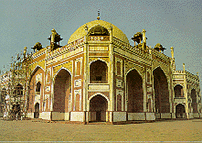
[Picture: Humayun's Tomb. Photo: India for Visitors.]

Friday, March 11, 2011

Not Tolerated

By Emily Shearing, *Teens accused of harassing worshippers at mosque offered plea deals* - Democrat AND Chronicle - NY, USA; Tuesday, March 8, 2011

Five Holley teens accused of harassing worshippers at an Orleans County mosque in August were offered plea deals after appearing in court Monday night.

Authorities allege the teens drove past the World Sufi Foundation Mosque in Carlton, firing a gun, shouting obscenities and beeping the horn. One worshipper was allegedly struck by the vehicle at the mosque.

Jeff Donahue, Anthony Ogden and Dylan Phillips, all 18; and Mark Vendetti and Tim Weader, both 17, were charged with harassment and disrupting a religious service, a misdemeanor. Vendetti was also charged with criminal possession of a weapon, a felony.

“This is not something that we feel that can be tolerated out here,” said Joseph Cardone, Orleans County district attorney.

“Having said that, I don’t believe from what involvement I’ve had in the case, that anyone believes there’s any organized anti-Muslim effort out here, and that these were young people who used extremely bad judgment. This is a case we’re taking very seriously … and one I’d like the community to know about.”

Cardone said that because all five are under the age of 19, they are qualified as youth offenders, and subsequently most of the details from the proceedings were closed. Cardone said he does not expect the case to go to trial.

The teens are scheduled to appear in court in early April for a final determination.

Thursday, March 10, 2011

The Mystical Wonder

By Anthony Tommasini, *Conductor Makes Philharmonic Debut With Sufi Poetry and Celestial Yearnings* - The New York Times - New York, NY, USA; Friday, March 4, 2011

Few conductors the age of Daniel Harding have had his extensive international experience.

Currently this 35-year-old British artist is the music director of the Swedish Radio Symphony Orchestra, the principal conductor of the Mahler Chamber Orchestra, the principal guest conductor of the London Symphony Orchestra and a presence on opera podiums including La Scala and Covent Garden.

He proved himself to New Yorkers last fall when he opened Lincoln Center’s Great Performers season, conducting two impressive programs with the Dresden Staatskapelle.

But intangible things make the relationship between a conductor and an orchestra click, or not. On Thursday night, when Mr. Harding made his highly anticipated debut with the New York Philharmonic in a program of Mahler and the Polish composer Karol Szymanowski, the performances, though fascinating, seemed not quite settled. Mr. Harding has a record of needing some time for particular orchestra musicians to figure him out. That seemed to be happening here, especially during an uneven though involving account of Mahler’s Fourth Symphony.

Mr. Harding began the program at Avery Fisher Hall with a challenging assignment. Glenn Dicterow, the orchestra’s veteran concertmaster, was the soloist in Szymanowski’s Violin Concerto No. 1.

Composed in 1916, it is an elusive, mystical and seldom-heard work, though a Dicterow specialty. The Philharmonic had last played the piece in 2004, with Mr. Dicterow as soloist and Kurt Masur conducting.

When he wrote this work, Szymanowski was equally entranced by musical Impressionism and Eastern mysticism, especially the allegorical love poems of the Sufi poet Hafiz.

Though written in one movement, the concerto is episodic and fitful. It begins with flittering, quietly bustling orchestral music. Imagine the opening of Stravinsky’s “Petrushka,” turned a little cosmic, with the setting moved to a Persian city.

The violin enters and calms things down with questioning melodic lines that skirt stable harmonies.

For 25 minutes the concerto surges through passages of bucolic serenity, complete with exotic birdcalls, ominous Wagnerian outbursts and frenzies of sensuality right out of Scriabin.

The violin has long stretches of ruminatively lyrical, restless music, which Mr. Dicterow played with a warm, throbbing tone and supple phrasing. But during the more crazed passages of the piece, his playing lacked incisive attack and sinewy power.

Mr. Harding’s challenge was to convey the mystical wonder of the music while bringing shape to the score and providing support to Mr. Dicterow without overwhelming him, all of which he did with sensitivity and skill.

With the Mahler Fourth, Mr. Harding seemed intent on rattling the perception of this piece as the composer’s most easygoing and pastoral symphony. Mr. Harding emphasized the restlessness of the first movement, laying out the overlapping strands and discontinuities of the music, especially in his feisty handling of the development section.

Still, at the start, when Mr. Harding stretched the rising notes in the violins that lead to the downbeat of the main melody, the landing was not quite coordinated. Here and there, passages of solid, compelling music making were marred by tentative, uncertain moments.

And yet I was drawn in. There was nothing cute about Mr. Harding’s approach to the rustic second movement, which had snap and crackle. Amid the wistful serenity of the great slow movement, Mr. Harding drew out the subdued tension and conflict below the surface.

And with the fine young soprano Lisa Milne as an animated and beguiling vocal soloist, Mahler’s portrait of heaven, as reported by an angel, worked its magic. Who would not want to spend eternity in a place where wine from the cellar does not cost a penny, the kitchen is headed by St. Martha, and splendid music is courtesy of St. Cecilia and her kin?

Mr. Harding’s first outing at the Philharmonic may not tell all. He is a consequential conductor who should return.

Picture: Daniel Harding leading the New York Philharmonic for the first time at Avery Fisher Hall. Photo: Hiroko Masuike for The New York Times.

Wednesday, March 09, 2011

Promotion In Education

By Shahnawaz A. Malik Warsi (Advocate), *MSO presented Memorandum to Minister for Human Resource and Developement govt of India to demand promotion of Sufi based teachings in the education of the Country* - Muslim Students Organization - New Delhi, India; Sunday, March 6, 2011

MSO presented Memorandum to Minister for Human Resource and Developement govt of India to demand promotion of Sufi based teachings in the education of the Country

On 6th March Evening MSO Presented Memorandum to Shri Kapil Sibal Ji specially to demand irregularities in Minority Scholarship and for the Promotion of Sufism based teachings in the syllabus.

To
Shri Kapil Sibal Ji
Minister for Human Resource and Development
Govt of India,New Delhi

Muslim Students Organization of India (MSO), a representative body of Muslim Students demands from the Govt. that:

1. Government should promote the Peaceful Ideology of Islam i.e Sufism for the establishment of Communal Harmony and Brotherhood in the country.

2. A Central Minority University in the name of Hazrat Khawaja Gharib Nawaz University should be established as early as possible in and around Ajmer Sharif.

3. Hazrat Khawaja Gharib Nawaz Chair,Hazrat Nizamuddin Aulia Chair for the research and promotion of their sufi teachings should be established in Aligarh Muslim University and in Jamia Millia Islamia, New Delh ,respectively.

4. For Promotion of morality, values and brotherhood, among the students the CBSE and ICSE syllabus books should contains the chapters on the Sufism and Sufi preachers.

5. The benefit of P.M’s 15 pint Programme is not reaching to community properly. The Govt. must check and monitor the corruption in these schemes, specially the Minority Scholarship schemes must be distributed directly in the account of students.

6. There are several complaints regarding harassment of Naqab (veil) wearing girls students and male students having beard only on religious grounds by the criminal groups and in some cases even by the college administration. Kindly take action to stop this discrimination in educational Institutes.

7. Reservation for the Muslim community in educational Institutions must be given in accordance with the Ranganath Commission Report.

8. UP Madrasa Board has not granted regular 700/-month Scholarship to its Students of Munshi, Maulvi and the Moallim Urdu Degree Holders of Uttar Pradesh must be given Job despite as Urdu teachers.

9. Delhi Urdu Academy has not invited application for this current year from the Urdu teachers.

10. The ministry should establish Imam training Centers to teach them all basic subjects with computers. MSO with its other parent Organization like Raza Academy, All India Ulema Mashaikh Board is ready to cooperate with the ministry in this project.

11. Jamia Ashrafia Mubarakpur Azamgarh, the highest seat of Islamic learning of Indian Sufi Muslims has been removed from the list of recognized Madrasas by the Jawaharlal Nehru University administration without any Justification. This recognition should be granted and the Govt. should establish a Central Board or Central committee to affiliate Madrasas which wish to be recognized by the Government Universities.

[Visit the Muslim Students Organization of India; Read Sunni News, a true Media Resource of Ahle Sunnah wa'l jama'ah.]

Tuesday, March 08, 2011

On Which Side He Would Be

By H. A. Hellyer, *Libya’s Religious Leaders Take Surprising Position:* - Religion Dispatches - USA; Thursday, March 3, 2011

The Arab world is like a genie out of the bottle right now—it just won’t be put back in. First it was Tunisia, then it was Egypt, and now it’s as though the entire Arab world is stirring.

Nothing is certain in Libya, except that violence will continue. But in a country that bred the likes of Omar al-Mukhtar, the famed 20th century resistance leader who struggled against Italian fascist occupation for so long, there’s no lack of courage or a taste for defeat.

One interesting aspect of the revolt in Libya is how different the public perception of the religious establishment has been. The Network of Free Ulema, a recently formed group of Muslim scholars, has wasted no time in ensuring that it is on the side of the people.

To begin with, it was clear in its support of the right of people to protest against, if not overthrow, the regime. As the regime-backed violence escalated, the Network denounced it; and when the regime went beyond a certain point, the Network took the remarkable step of withdrawing completely from tolerating the very legitimacy of the state, issuing a fatwa telling Muslims that it is their duty to rebel.

External observers to the Muslim world may not quite see how significant this is. Its not entirely clear what difference it made to the people of Libya on the ground, who probably would have revolted regardless of what their religious leadership had or had not said, but those who take institutions of spiritual authority seriously, this was something that has very little precedent in Islamic history.

Traditionally, Muslim scholarship has been overwhelmingly in favor of tolerating a less than perfect regime, in order to avoid chaos and anarchy. There are, nevertheless, some cases, at least from a theoretical, dogmatic point of view, where religious authorities will recognize the right to overthrow a ruler. It just happens very, very rarely.

And while we’re discussing Libya as one of those rare cases it should be pointed out that these figures are not al-Qa’eda, or radicals of any stripe, but count among their ranks some of the most noted Sufi shaykhs of the country. But is this such a rarity in Libya? One could argue not. After all, Umar al-Mukhtar was not a forerunner of the likes of al-Qa’eda, but a shaykh in the Sanusi Sufi order. Its hard not to be able to predict on which side of this rebellion he would be.

[Picture: Omar al-Mukhtar. Photo: Wiki.]

Monday, March 07, 2011

Of Gods And Men

By Giovanni Fazio, *What happens when faith is stretched too far?* - The Japan Times - Tokyo, Japan; Frday, March 4, 2011

Just a quick glance at the headlines will reveal how many conflicts and massacres in our world find their roots in religious differences. While believers of any given faith are quick to blame the misguided and evil intentions of all those other religions, the wise will assert that all religions have blood on their hands. (Well, maybe not the Jains.)

And yet, the same religion can inspire both the Thirty Years' War and Bach's cantatas, suicide bombers and the Sufi poetry of Rumi. Religion is the repository of man's highest and lowest impulses, and time has proven it's nearly impossible to separate the two.

We find both extremes in a pair of films on offer this month: "Of Gods and Men" is a profoundly sympathetic look at the true story of a small French monastery in Algeria caught up in the civil war of the 1990s; "Agora" is a historical drama that is set in Egypt in the days of the Roman Empire and finds pagans, Christians and Jews trying to convert or slaughter each other.

"Of Gods and Men" — which won the Grand Prix at Cannes in 2010, perhaps as penance for recognizing "Antichrist" the year before — is a quiet and rapturous ode to religious faith and courage in the face of terror. Eight Cistercian monks live near a village in the mountainous Maghreb, and while their presence may be a colonial remnant, they've managed to embrace their surroundings, running a free medical clinic, working the fields with the locals and attending village festivals. Rather than proselytize, the monks show a kind respect for their neighbors' Islamic traditions, and are rewarded with the same.

As directed by Xavier Beauvois ("Don't Forget You're Going to Die"), the film spends its first half slowly sinking into the quiet rhythms of monastic life. The director frequently cuts from the stillness of prayer and hymn in the monastery to the noise of bulldozers or helicopters outside, emphasizing both the monks' withdrawal from the world and their vulnerability to encroachment. Sure enough, their idyll is disrupted by news that the wave of extremist violence is drawing closer. (Algeria's annulled elections of 1991 incited a rebellion by fundamentalist groups that soon metastasized into butchery.)

The precariousness of the monks' situation soon becomes clear: the rebels are explicitly targeting foreigners, but the abbot, Christian (Lambert Wilson), rejects army protection, hoping to remain above the fray. The other monks, particularly Celestin (Philippe Laudenbach), are worried that his decision has condemned them to death, a feeling that grows after a menacing nighttime visit from some rebels.

What follows is an agonized, if restrained, debate about whether to stay or flee. Few films have so clearly rendered the fear that terrorists seek to instill, and the individual courage needed by the average person (not the Hollywood action hero) to stand up to it. "Of Gods and Men" knows clearly what it wants to say: that freedom ultimately comes from freeing oneself from the fear of death, and the strength to do so comes not just from faith, but from brotherhood.

Religious intolerance is nothing new, nor — despite what American neo-conservatives like to say — is it unique to Islam. "Agora," released in Japan as "Alexandria," looks at the life and death of fourth-century philosopher and scientist Hypatia of Alexandria, a pagan who wound up being flayed alive and dragged naked through the streets by a mob of Christian zealots.

"Agora" looks very much like your average sword-and-sandal epic — it was even filmed on some of the same locations as "Gladiator" — but it contains much more explosive content. Director Alejandro Amenabar ("The Others," "Open Your Eyes") seeks to fashion a secular parable on reason and tolerance, as contrasted with the feuding and essentially incompatible belief systems of religion.

We first meet Hypatia (Rachel Weisz) as she teaches a class in astronomy at the library of Alexandria, located within the grounds of a temple to the pagan god Serapis. Christians and pagans — such as her students Orestes (Oscar Isaac) and Synesius (Rupert Evans) — may argue within her class, but she admonishes them to put aside their differences and recognize their commonality.

When street clashes between the rival religions break out into full-scale ethnic cleansing, Hypatia and her students are besieged within the temple, and personal loyalties are frayed. Hypatia's slave and admirer, Davus (Max Minghella), throws his lot in with the Christians, whose charity and good works he admires, but he's soon recruited into the Parabalani, a fanatical religious militia.

Like a lot of films set in a time of antiquity, the performances here can be hokey — none more than Weisz, as she jabbers along excitedly on the perpetual brink of a scientific breakthrough — but the history is absolutely compelling. Amenabar's boldest move is to portray early Christianity as something not dissimilar to Hamas or Hezbollah, a social movement that can deliver bread to the hungry and give hope to the downtrodden . . . or organize enraged mobs who seem to have forgotten Christ's teachings about casting the first stone.

Some time after a seemingly random shot of a bunch of ants swarming on the ground, the camera rises high above the sacking of the library at the Serapeum, and we see the black-robed Christians engaged in their pillage reduced to tiny, scurrying specks. If there is a god, suggests Amenabar, this is how he sees us.

Sunday, March 06, 2011

A Bridge

By Staff Writer, *Sufi centre will act as bridge between India, Pak: Chishti* - Indian Express - India; Saturday, February 26, 2011

The establishment of Baba Farid Centre for Sufi Studies at Punjabi University (PU) will act as an eternal and enduring bridge between India and Pakistan as well as the two hoary religious traditions of Sikhism and Islam, said Gaddi Nashin Hazrat Khwaza Garib Nawaz Sarwar Chishti of Ajmer on Friday.

He was speaking at a special lecture on “Sufism and its Chisti Tradition”, organised by PU’s Baba Farid Centre for Sufi Studies.

Being the first centre of its kind in the world, it will help promote common heritage, history and culture of East and West Punjab, in addition to promoting the values of Islamic mysticism and Sikh religious pluralism, he said.

The new building of the Centre will be inaugurated on the PU foundation day on April 30, said Vice-Chancellor Jaspal Singh. The university will extend all kinds of financial help to promote Sufism and carry out research to trace the symbiotic relationship between Sikhism and Islam, he added.

[Picture: Central Library. Photo: Punjab University, Patiala, India.]

Saturday, March 05, 2011

The Light In Her

By Veenu Sandhu, *Setting the tone* - Business Standard - New Delhi, India; Saturday, February 26, 2011

This year’s edition of Jahan-e-Khusrau will feature a Toronto-based singer who once lost her voice. Festival director Muzaffar Ali saw the light in her.

On March 11, when Jahan-e-Khusrau returns to Delhi, the voice that will open the annual Sufi music festival will be a voice that was lost for five years. Muzaffar Ali, the man who has been directing Jahan-e-Khusrau since 2001 as a tribute to Sufi poet, scholar and musician Amir Khusrau, chanced upon this voice last year and knew he wanted it in his festival.

Being introduced as the “voice of the East”, 40-year-old Azalea Ray, who is from Canada, says it's a dream come true to sing near the dargah of Nizamuddin Auliya, “if not in the dargah” which is not allowed because she’s a woman. And she credits Ali for that. “He sees the light in you, ahead of time, even before you have seen it.”

For Ray, being part of Jahan-e-Khusrau — she’s singing at the festival for the first time — is also a step forward in a bigger journey and a larger struggle. In December 2003, a surgical accident had cut her right vocal tract. “With that, my singing voice, my Lata and Julie Andrews voice, was gone,” she says. Ray, who performed and also taught Hindusthani classical music in her hometown, Toronto, says for the first time in her life she found herself without her companion, music, and without a livelihood.

The next five years were plunged in darkness. Until a group of Pakistani friends told her that she sounded somewhat like Abida Parveen. A thirst for another kind of music developed — from Indian classical to Sufi. “I heard Parveen and Farida Khanum over and over again,” she says. “Khanum became poetry for me.” And then one day, she got the chance to sing to her on the phone, from Toronto. A trip to Pakistan, a stage performance with Khanum sitting next to her holding her hand and then accepting her as her disciple followed. This was exactly five years after the accident, in December 2008.

Next were performances before select audiences in India. This is when Ali heard her on a demo CD singing the poetry of Khusrau, Faiz Ahmed Faiz and Bulle Shah. And the film maker-poet-artist, who at one point of time even got Shabana Azmi to sing in his film Anjuman, recognised the power in the voice. “Like every year,” Ali says, “I hope to give something fresh and sensitive to people.” Ray will be singing Khusrau, Bedam Shah Warsi and a fusion of Kamil Hyderabadi’s poetry with baul (Bengali sufi) music.

As the festival’s director and designer, Ali works for weeks on the compositions. “I like to work with a few artistes in depth and arrive at a new repertoire,” he says. “He also designs the venue and often, the artistes’ outfits,” says Ray. The venue, Humayun’s tomb, has been a constant ever since the festival started. “I saw the magic in it and that magic has only grown. I have not yet found a replacement for this venue,” says Ali. “To take forward Khusrau's legacy,” he says this time the festival will also include qawwals from Pakistan and India, and “echoes from Iran”.

“Khusrau’s has been a great contribution to spiritualism and music,” says Hans Raj Hans who will bring “Sufiana from Punjab” to the festival. For Ali, Hans, who will sing for over an hour at Jahan-e-Khusrau, “is one of the few people who are temperamentally Sufi.”

“This year in April, Jahan-e-Khusrau will be going to London for the first time,” says Ali. Ray could be among those who perform in London. It’s a journey she wants to continue. She cannot speak Hindi, Punjabi or Urdu. And the throat in which a tumour keeps recurring sometimes threatens to let her down. But she continues to sing the poetry of the Sufi saints, “connecting the sur to my body, my gut and my heart.”

[Visit the Festival website]

Friday, March 04, 2011

Growing Separatism

By Mairbek Vatchagaev, *The Separation of the North Caucasus from Russia: Is it A Growing Possibility?* - The Jamestown Foundation - Washington, D.C., USA; North Caucasus Analysis Volume: 12 Issue: 4 - Thursday, February 24, 2011

The new act of terror committed by suicide bombers in Dagestan on February 14 appears to have been a continuation of a series of attacks across Russia carried out by the North Caucasus armed resistance movement, which over the years has become increasingly capable of striking across the entire country.

On the evening of February 14, Valentine’s Day, a suicide bomber trying to get inside a police station in the Dagestani village of Gubden was stopped at a barrier outside the building. Asked by security officers to provide identification documents, the female suicide bomber detonated an explosive device, killing one person and wounding four others.

While that seemed like the end of the story, that same evening another explosion occurred at the same police station, this time killing one officer and injuring 22 others. A male bomber apparently drove up to the same police station in a Lada Priora automobile at around 11:35 p.m., local time, exactly two hours after the first blast. By that time, a few investigators had already started to probe the first explosion. The Russian Internet newspaper Gazeta.ru reported that a policeman stopped the vehicle for a document check and that an explosive device was detonated as soon as he approached the car. In total, two police officers were killed and 26 injured in the tragic events of that deadly Valentine’s Day evening.

The village of Gubden, located in Dagestan’s Karabudakhkent district, is by far the most famous and, arguably, the most troubled village in that Russian republic. Populated by ethnic Dargins, one of the multiethnic republic’s indigenous peoples, Gubden is one of the oldest and richest villages in Dagestan. According to some accounts, Gubden is 5,000 years old and currently has more than 35,000 inhabitants. However, it is commonly known today as a village where security forces incessantly conduct special operations against the leaders of the armed underground. Magomedali Vagabov, the leader of Dagestan’s Sharia Jamaat who was killed last summer, also came from this village. It is completely wrong when journalists present Gubden as a stronghold of Salafism in Dagestan. There are, of course, some followers of Salafism in Gubden, as in other villages, but most of the population there are Tariqas. Incidentally, it was as the result of a standoff between proponents of Salafism and Sufism that Nurmuhammad Gadzhimagomedov, the imam of the village, was killed.

It is worth noting that according to Kavkazsky Uzel, the website covering developments in the Caucasus, 22 terrorist acts were perpetrated in Moscow and the North Caucasus in 2010, in which 108 people were killed and more than 652 injured. Out of those 22 attacks, 16 were carried out by suicide bombers, including six bombings on the territory of Dagestan.

Meanwhile, Chechen authorities are growing worried about the image that they themselves created. After admitting the bombing these officials then tried to disprove a series of strange explosions that occurred in Chechnya’s capital Grozny were actually bombings. All the explosions were declared to have been accidental natural gas explosions in residential buildings. After one of the explosions, Chechnya’s pro-Russian leader Ramzan Kadyrov personally tried to demonstrate at the scene of the blast that it was too small to have been the result of a bomb or grenade.

Unexplained is why those explosions affected mainly security forces: the blasts injured four police officers but only one civilian. The explosions still could have been viewed as accidental had not a troubling series of events occurred concurrently in southern Chechnya.

On Kadyrov’s orders, a large-scale special operation began in that area on February 8 against members of the armed underground following attacks on a Chechen police outpost in the vicinity of the mountainous village of Kharsenoi in the Shatoi district and on a Russian Internal Troops’ military helicopter at the juncture of the Shatoi and Urus-Martan districts on February 7. An alleged militant was killed during the special operation on February 10. The rebels in area are led by Tarkhan Gaziev, one of the Chechen rebel leaders who, together with two other leading Chechen commanders, Aslanbek Vadalov and Hussein Gakaev, recently renounced their oaths of loyalty to Doku Umarov, the “emir” of the Caucasus Emirate.

Moreover, the decision taken on February 10 to terminate all rail transport on the territory of Chechnya and Dagestan from 6:00 p.m. to 6:00 a.m. is additional proof that the situation in the region can hardly be characterized as calm.

A similar regulation was in effect in Chechnya during the fierce fighting that occurred there in 1999-2002. Almost ten years later, the Russian leadership has had to admit that it has gone back to measures that first were introduced in the region by Vladimir Putin, the then Russian president, at the beginning of the second Russo-Chechen war. This decision was a further response to the numerous train bombings perpetrated by militants throughout Dagestan for most of last year, including the reintroduction of Russian armored trains. The newly enacted measure will affect rail connections not only between Dagestan and Chechnya, but to and from Azerbaijan as well.

Meanwhile, the situation remains particularly tense in Ingushetia and Kabardino-Balkaria. For instance, on the evening of February 12 law enforcement officers attempted to stop a suspicious car in the Ingush town of Nazran, but unidentified men driving in the car opened fire on them. Two men in the car were killed and were later declared to be “possible perpetrators” of the murder of the head of one of Nazran’s districts, Alikhan Tsoroev. The next day a retired police colonel was attacked and a local resident, A. Kostoev, was killed in downtown Nazran. Also, there are continuous reports of young men being abducted by undisclosed entities, making the situation in this tiny republic extremely tense.

In neighboring Kabardino-Balkaria, the Russian president’s envoy to the North Caucasus Federal District, Aleksandr Khloponin, held meetings with local residents, students and the republic’s leadership in an attempt to reduce tensions there. Khloponin cited four reasons contributing to the unfavorable situation in the region: the malfunctioning of the authorities at all levels of the power vertical, as well as corruption; crime; a lack of understanding of the essence of Islam; and unemployment and other economic factors. What is missing in Khloponin’s list is the main reason for instability in the region –growing separatism, which is the result not of the four factors Khloponin mentioned, but of the very essence of the Kremlin's policy in the Caucasus.

Against this background, it is hard not to notice that there has been some discussion of the possibility of the Northern Caucasus seceding from the Russian Federation, although few so far believe it is likely. But, unlike the earlier period, when only chauvinistic Russian leaders like Vladimir Zhirinovsky and the like talked about this possibility, today the discussion is gradually turning into a mainstream exchange of views, which is encouraging.

The fact that such a discussion is even taking place and that there is the desire to even discuss this option in some Russian circles –as long as it is not soon cut off by the authorities– raises the possibility of a future in which there are not warring camps, but the possibility of two peacefully coexisting countries.

[Picture: North Caucasus regions within the Russian Federation. Photo: Wiki.]

Thursday, March 03, 2011

A Magical Effect

By Saleha Rauf, *Painting exhibition: Link between creation, Divine depicted* - The Express Tribune - Karachi, Pakistan; Thursday, February 24, 2011

Dr Rahat Masud has beautifully painted the spiritual link of the creation with the Supreme Being through her work.

This was stated by Designer Mohsin Pervez at the inauguration of the artist’s solo exhibition at Ejaz Gallery. The work, titled The Ishq Series, is based on her PhD research and includes 27 paintings and a video loop.

Pervez said the use of locks and cages in the paintings depicted how the spirit of a sufi was freed once it left the body. He said the painting Bliss-I had had a magical effect on him.

Quddus Mirza, a critic and a painter, said the combination of colours Masud had used in her work reflected her grasp of the local culture.

“Poetry and painting can be used to convey a wide range of messages,” Masud said. She said people could relate their own condition to the situations portrayed in the paintings. “Different people take different meanings out of the different layers of a painting,” she said.

In Light and the Moth, the moth symbolises the artist who wanders in search of light but dies as soon as it comes in contact with its beloved.

The painting implies that death is like a reunion with the Supreme Being.

The painter also uses Red bridal dress and plays upon the concept of urs of sufi saints in her work.

Saeed Akhter admired the treatment of colours. He said in one of the paintings, Aye Arz-e-Watan, Masud had shown the reflection of objects on the woman’s face with dexterity. “She is an expert in painting the spread of colours around objects.”

A 50-second video loop, Annihilation, was also screened at the gallery. It was a compilation of several shots from different shrines showing malangs dancing to the music of dhols.

The artist had extensively used oil, pastels and gold and silver leafs on canvas or hand-made papers in her paintings. Most of the paintings were self-portraits. The exhibition will continue till March 2, 2011.

Biography

Dr Rahat Masud obtained her PhD in 2010 from Kingston University, United Kingdom, in Fine Arts Practice. Her research title was Materialising the Spiritual in Contemporary Painting in Pakistan: An Artist’s Exploration of Figurative Art and Sufism.

She has displayed her work in 44 exhibitions in places including the UAE, the UK, the US, Iran, India and Korea. She earlier displayed the same work at Art Scene Gallery in Karachi.

Wednesday, March 02, 2011

Pollution Of Religion

By Dr. Manzur Ejaz, *WASHINGTON DIARY: Pollution of religion* — Daily Times - Lahore, Pakistan; Wednesday, February 23, 2011

The spirit of religion has been polluted so much that every sect considers the other as non-Muslim. Instead of spiritually uplifting individuals, irrespective of their religion and sect, religion has been turned into a power game, a political circus

Allama Iqbal himself probably did not appreciate the depth and practical dimension of his statement, “Deen-i-mullah fee sabeel Allah fasad” (the mullah’s religion is just creating frictions). And, when he preached that “Judaa ho deen siasat se to reh jati hai changezi” (if religion is separated from politics, it becomes barbarism), he was advocating being ruled by the mullahs. However, what he did not foresee was that mixing religion with politics would turn the socio-political discourse into the mullah’s domain, which would not bring anything but inter-sect conflicts, hatred and friction.

After daily repetition of “Judaa ho deen siasat se to reh jati hai changezi”, the Jamaat-e-Islami (JI) was able to massively infuse religion into politics. Additional help from the US for international jihad created the exact situation that Iqbal had implied in his poetry. There were thousands of shaheens (eagles) who wanted to run their horses into the Black Sea and beyond. These eagles ran their horses into the World Trade Centre, the Pentagon, and all other pagan lands. But what has come of it all at the end of the day?

After heavily mixing doses of religion with politics, have we defeated the changezi (barbarism) system or have we, inadvertently, created just that? Just count the number of dead in suicide attacks and the destruction as a result of security operations against jihadi mullahs. Then, scan the religious landscape and see how many sects consider one another non-Muslims now, as opposed to before the Islamisation movement, how the poor non-Muslims have suffered under mullah shahi (rule of the clerics) and how social anarchy has wrecked Pakistani society.

Under the sway of mullah shahi, the rich and powerful have skimmed off the people with corruption and plundering. Some may ask what Islamisation has to do with corruption; the answer is that if two things happen simultaneously, there must be some correlation between them. In this case, the emergence of mullah shahi has changed societal priorities as allegations of blasphemy now become more important than discussing corruption and injustice. Have you seen any religious party demonstrating against the corruption of billions in almost every department?

By now it is clear that, most importantly, the spirit of religion has been polluted so much so that every sect considers the other as being non-Muslim. Instead of spiritually uplifting individuals, irrespective of their religion and sect, religion has been turned into a power game, a political circus. One can appreciate the wisdom of the founders of the US constitution, George Washington in particular, who argued that purity and spiritualism of religion can be maintained only by keeping it separate from politics. They wanted to save religion from trickeries, hypocrisies and the wheeling-dealing of politics. However, this point cannot be appreciated by our mullahs for whom religion is a profession as they have tasted the power of their political blackmailing.

The early proponents of secularist philosophy were the Sufis of the subcontinent who understood the dangers of the pollution of religion if it is mixed with politics. Therefore, on the one hand, they severely condemned the mullah’s profession and its damaging role in society and, on the other, they developed a strict policy, particularly the Chishtias, never to meet or relate to the royals. Their emphasis on a personal relationship with God or other deities was meant to eliminate the role of intermediaries, i.e. theocracy. Baba Farid and his disciple Nizamuddin are known to have refused to meet with the kings even when they were threatened with dire consequences.

These Sufis did not further any overt political agenda by design and emphasised the universal humanistic values that can create a better society. Like George Washington, they wanted to preserve the religious spiritualism of every religion. They knew this could be done only if they preached irrespective of religious denominations.

However, the tradition was diverse. The Chishtia were anti-establishment and the Bahauddin-led Suharwardia (headed by Shah Mahmood Qureshi these days) were pro the Delhi kings. Both schools adhered to the basic tenants of Islam, i.e. praying five times and performing all other mandatory Islamic duties. Wahabi propaganda that said the Sufis were bhangi charsi (drug addicts) had and has no basis. Only the Malamtia sect to whom Shah Hussain belonged was against the entire ambit of ritualistic religion. Shah Hussain’s pre-condition for initiation (mureedi) was to drink alcohol and shave the beard, moustaches, head hair and even eyebrows. In most cases, many were just intellectuals and thinkers following a certain mode of life that resembled Sufism. Many of us confuse the great classical Punjabi poets with the Sufi tradition.

By the end of the 18th or 19th century, the Sufi movement had come to a close and what were left were the rituals of the Barelvi mullahs and sajjada nasheens (holders of the saintly seat). The Sufi tradition could only survive in a multi-religious society, which Punjab and Sindh had before 1947. The purging of Hindus and Sikhs from Pakistan created an anti-Sufi environment. Therefore, it is not surprising at all that the followers of the Sufis, namely the Barelvis, have become just like the Wahabi and Deobandi maulvis. They could not avoid the dictates of the environment they lived in. In contrast, the Barelvis in India are much more tolerant of other religions because they have to live with them. More Hindus visit the Ajmer shrine of Moeenuddin Chishti than Muslims.

As a matter of fact, the Barelvis had abandoned the Sufi tradition long ago. They had become a ritualistic sect that considered khatam darood (rituals) as their basic distinction. The Sufi shrines had become the jagirs (estates) of sajjada nashins who were running them like feudal dynasties. This trend had started much earlier in history. Baba Farid and his ilk had refused to see kings and their men but his great grandsons joined the Tughlaqs and were awarded a huge estate in Pakpattan. It was a noteworthy estate when Ranjeet Singh conquered Punjab and he had to negotiate with the then sajjada nasheen.

Tuesday, March 01, 2011

Sufism Returns To Afghanistan

By Dawood Azami, *Sufism returns to Afghanistan after years of repression* - BBC World Service - UK /Afghanistan; Wed, Feb 23, 2011

As the Afghan government and its international allies intensify efforts to bring the conflict to an end, the role and influence of mystics is being sought to help bring the Taliban into talks on a political solution.

Sufism or Islamic mysticism was once suppressed by the Taliban, but the sect is recovering its place in the country and its millions of followers are once more emerging from the shadows.

Sufis have considerable influence in both rural and urban settings - they are an effective popular force to bring change into society - and people consider them as disinterested mediators in disputes.

''The influence of Sufis will be very significant in bringing peace and tranquillity,'' says Sayed Mahmood Gailani, a Sufi master.

''There are a few people with Sufi backgrounds who are involved in the peace process. But there hasn't been any concerted effort to give the Sufis a systematic and prominent role in it.''

Sufism in Afghanistan is considered an integral part of Islam. People in general respect Sufis for their learning and believe they possess "karamat" - a miraculous spiritual power that enables Sufi masters to perform acts of generosity and bestow blessings.

Ziyarats - Sufi shrines - are popular pilgrimage sites all over the country.

In addition to Afghanistan, Sufi orders have millions of followers in both Pakistan and India too.

The Soviet invasion of Afghanistan in 1979 and the following armed resistance by the mujahideen resulted in the arrival of thousands of Middle Eastern fighters and the introduction of foreign ideologies including Wahabism.

Wahabism insists on a literal interpretation of Islam and sees Sufism and its ideas as anathema. This created tension between Sufis and Ulamas (religious scholars) in some parts of the country.

But it was during the Taliban's rule (1996-2001) when many Sufis were driven underground.

A number were initially part of the Taliban movement but gradually people influenced by the Wahabi ideology became more prominent. Sufis were silenced.

Some Sufis, especially members of the Chishtiyya Sufi Order which considers music to be an effective route to reach Allah, were prosecuted.

"The Taliban invaded Sufi gatherings, humiliated and beat up many of them and their musical instruments were smashed,'' said Afghan Culture Minister Sayed Makhdoom Rahin, who has a Sufi background.

''Sufis are free to hold their ceremonies once again with the same old exuberance denied to them by the Taliban.''

'Home of saints'

Given the respect and influence Sufis enjoy among the local population, their involvement at the grass roots level could help the peace process in war-torn Afghanistan.

Although Taliban members come from various backgrounds, some have great respect for Sufis and are even followers of Sufism.

"Influential and knowledgeable Sufis can persuade a large number of Taliban to lay down their arms and can also provide guarantees to the Taliban about their safety and peaceful future,'' a Sufi leader, Ahmad Shah Maududi, said.

''But we need to be careful and vigilant because many so-called Sufis have exploited and fooled ordinary people in the garb of Sufism.''

Sufism has been part of Afghanistan almost as long as Islam itself - more than 1,300 years. Afghanistan is commonly called "the home of Sufi saints". The mystics have been an integral part of the life of the people for centuries.

The word Sufism is derived from "suf", the Arabic wood for wool, and refers to woollen robes worn by early ascetics.

Sufis seek to achieve communion with God during mystic moments of union brought about by various methods, including meditation, Zikr (reciting the names of God and other sacred phrases), dancing, hymn singing, music and physical gyrations.

Sufis maintain that human beings are creatures of Allah and they should be served and respected.

''Tolerance, kindness and love to all and malice towards none are the virtues of Sufis,'' says Maulana Obaidullah Nahrkarizi, a prominent Afghan Sufi master from Kandahar province.

''This is the solution to the nation's trauma and battle of the past 30 years''.

Many Afghan cities are among the most important centres of Sufism. Herat is called "the soil of Sufi saints" while Ghazni is known as "the place of Sufi saints".

Some of the greatest Sufi sages of the Muslim world originated from Afghanistan. They refined their insights in the country's lush plains and hidden valleys - and spread their message of peace and love to other parts of the world.

The intensely personal poetry of Sufis has been expressed in Dari, Persian and Pashto, the main languages spoken in Afghanistan.

There are several prominent Sufis in contemporary Afghanistan including Ali Hujwiri, Khwaja Moinuddin Chishti and Jalaluddin Balkhi Rumi - founder of the famous Mawlawiya (the Order of Whirling Dervishes).

Another famous Sufi is Pir Roshan, the founder of the Roshaniya Sufi Order, now known as Arzan Shahi - which has a big following in India.

Three Sufi orders are prominent in Afghanistan today - Naqshbandiya founded in Bokhara (Uzbekistan), Qadiriya founded in Baghdad and Chishtiya originated at Chisht-e-Sharif in the western province of Herat.

Their continued growth is arguably a major bonus in Afghanistan's continuing search for peace.

Sufism In Afghanistan

By Dawood Azami, *Sufism in Afghanistan explored* - BBC World - UK; Monday, February 21, 2011

Kabul: As BBC Pashto and Persian launch a four-part series on the future of Sufism in Afghanistan, Kabul Bureau Editor Dawood Azami explains how his team went about reporting on a highly secretive group of mystics.

Travelling is not easy or risk-free in Afghanistan.

Although we collected most of our material – including interviews with experts, historians and a number of Sufis – in the capital Kabul, a lot of material also came from the provinces.

Colleagues based in different provinces were asked to attend Sufi ceremonies, talk to Sufi masters there and send the material back to Kabul.

Video clips came back from Kandahar, Mazar and Herat, with additional photos from Sufi sites in Kabul and Peshawar.

The result is four 15-minute documentaries, each focused on one particular topic – Sufism’s origin and history; Orders and brotherhoods; Wahhabi-Sufi relations; and Sufism in present-day Afghanistan.

Secretive group

Sufism – or Tasawwuf – is the mystical dimension of Islam. As one of the biggest centres of Sufism in the Muslim world, Afghanistan is commonly called ‘the home of Sufi saints’.

The word derives from ‘suf’, the Arabic for wool, referring to the woollen robes worn by early Muslim ascetics.

There is a general belief that Sufis possess ‘karamat’ – a miraculous psychic spiritual power that enables masters to perform acts of generosity and bestow blessings. People visit their tombs when they die and hundreds of ziyarats (shrines) have been popular pilgrimage sites for centuries.

Sufis are considered a secretive group of people, but they exist in all parts of the Muslim world and now even in many Western countries.

Some members of certain Sufi brotherhoods became anxious and even nervous when they saw a radio mic, and many of them didn’t want to be filmed or photographed during their ceremonies and colourful rituals.

While many Afghans believe that Sufis possess hidden knowledge and that they can read other people’s minds, Sufis themselves generally avoid talking about such things and see it as a matter between the individual and his creator, Allah.

Showing respect

Although Sufis are generally very welcoming to outsiders and non-Muslims, there seems to be a suspicion and an issue of trust when it comes to non-members.

But usually after a brief conversation, they are convinced that we journalists don’t have any bad intentions.

I remember facing similar problems on a bigger scale when I was doing my research on the survival of Sufism in Turkey back in 2003.

Even more difficult was recording interviews and taping rituals during special ceremonies – Sufis maintain that human beings are creatures of Allah and they should be shown respect.

Lessons learned

In making these documentaries, I have learned two things in particular:

Firstly, that many people – both inside and outside of Afghanistan – have little or no knowledge that many Afghan cities have been among the most important centres of Sufism throughout its history.

Secondly, I have learned that there is also a growing belief in many quarters that Sufis – who could potentially persuade a large number of Taliban fighters to lay down their arms – need to be given a more prominent role in the country’s ongoing peace process.

BBC Pashto and Dari/Persian services will start broadcasting a four-part series of radio documentaries about Sufism in Afghanistan each week from Tuesday 22 February in its evening transmissions (1400 GMT (Dari) and 1500 GMT (Pashto)).

The series will also be available on www.bbcpersian.com/afghanistan and www.bbcpashto.com.

Presenters are Safiullah Aminzadah (Dari) and Freba Zaher (Pashto).

Monday, February 28, 2011

"Unfortunate".

By Shuriah Niazi, *INDIA: Liberals vs reformists at top Islamic university* - University World News - UK/India; Sunday, February 20, 2011

In a dispute that could have repercussions at other large Islamic universities and seminaries in the Muslim world, a clash between liberal ideas and religious orthodoxy has engulfed India's Darul Uloom Deoband University - South Asia's largest Muslim seminary, which sought to appoint a 'modern' vice-chancellor.

Maulana Ghulam Mohammed Vastanvi (pictured), the new mohatmim (vice-chancellor) of Darul Uloom Deoband, regarded as the world's largest and most powerful school for the dissemination and propagation of Islam, was appointed on 10 January.

He was forced to resign within weeks, then retracted his resignation, in a tangled web of allegations and accusations as a dispute between hardline and liberal groups erupted over his appointment.

Only Al Azhar University in Cairo has comparable importance in the Islamic world, with some commentators saying the crisis at Darul Uloom Deoband could lead to Al Azhar emerging as the leading centre for Islamic learning.

Deoband's 300-year-old core curriculum teaches Islamic law, Islamic jurisprudence and traditional Islamic spirituality (known as Tasawwuf, which is the focus of Sufism). However at a time when seminaries in India are portrayed as being out of touch with the modern world, there is a need for reform while assuring preservation of Islamic ethics.

It was felt Vastanvi would modernise education in Deoband. The new vice-chancellor, who holds an MBA, announced plans to acquire 250 hectares of land for medical, pharmaceutical and engineering colleges as one of his first acts in office.

Vastanvi himself had set up a model madrassa (educational institution), Jamia Islamia Ishaatul Uloom, in the west Indian state of Maharashtra, providing modern and technical education alongside religious education.

However Vastanvi has become embroiled in a dispute over comments he allegedly made on the highly emotive 2002 Gujarat violence, in which more than 1,000 Muslims were killed by a Hindu mob. The massacre triggered major controversy among Muslim scholars and students, particularly on the role of the state and police in fanning the violence.

In an interview in The Times of India after assuming office, Vastanvi reportedly called on the Muslim community to move on and look beyond the Gujarat violence.

He was also quoted as saying the Muslim community had become better off during Narendra Modi's rule as Chief Minister of Gujarat state, a comment that caused outrage among Muslims who have not forgiven Modi for his support of Hindu hardliners, seen as the principal instigators of the 2002 violence.

Vastanvi offered to resign over his comments. Later he backtracked, saying he had been misquoted and insisting he had not quit.

The incident has split the Muslim community. Haseeb Ahmed Siddiqui, administrator at Darul Uloom Deoband, feels Vastanvi failed to follow the Islamic principles of the university and should quit.

But a section of liberal Muslim clerics said the controversy was "unfortunate". They want Vastanvi to continue. Islamic scholar Maulana Wahiduddin Khan said Vastanvi "is a liberal Muslim face, who could bring change in the madrassa curriculum".

As a religious school, Deoband has tried to remain apolitical, unlike its followers in Pakistan and Afghanistan. It has denounced the Taliban's extremist political ideology, even though many Taliban were educated according to Deobandi principles.

However, in recent years Darul Uloom has been in the news for issuing controversial fatwas or decrees, like asking Muslim women to refrain from working with men and prohibiting all Muslims to work in banks.

Writer and journalist Rasheed Kidwai believes Vastanvi is not a true reformist. "Darul Uloom Deoband is India's oldest and most conservative seminary. The media labelling of 'reformist' Vastanvi as its vice-chancellor is misleading," he said.

"Vastanvi has been a member of Deoband's governing council - majil-e-shoora - since 1998. So, theoretically speaking, he is party to all measures including the fatwa against terrorism and the disapproval of watching TV even if it means the live telecast of the Haj and wearing of jeans by women."

Kidwai added: "The key point is that as an orthodox religious institution, Deoband has been opposed to the idea of ishtehad [reforms]."

"It is not clear if Vastanvi supports the case for ishtehad, or the clergy's ability to permit any concessions into the way of life as it was practiced 1,400 years ago."

Some say the present crisis has more to do with the politics of the Jamiat-e-Ulema, a body of nationalist Deobandi clerics who have a strong influence over Darul Uloom Deoband, where one faction is intent on ousting an 'outsider' like Vastanvi.

Some Muslim scholars believe Arshad Madani, of the Madani family that has controlled the affairs of Deoband for many decades, is behind the opposition to Vastanvi. It was reported that Madani wanted the job after the death of former vice-chancellor Maulana Margboor Rahman.

Madani and Vastanvi are also at loggerheads over the proposal of the Indian government to improve and modernise madrassa education in India. While Madani is apprehensive of any changes might damage the religious identity of madrassas, Vastanvi has a more accommodating approach.

Vastanvi's fate will be decided by Deoband's executive body later this month. But if the dispute takes deeper roots it could have wider repercussions.

Kidwai said students may be "forced to take a stand and in many cases divide themselves as 'hardliners' and 'moderates' at an impressionable stage of their lives. Subsequently political parties step in, making things go from bad to worse."

Sunday, February 27, 2011

Friends Of God

By Sevim Şentürk,*Something’s happening at the dervish lodge of Sümbül Efendi* - Today's Zaman - Istanbul, Turkey; Sunday, February 20, 2011

İstanbul is a city whose streets are filled with friends of God. Whichever suburb a person visits, they will encounter a dervish lodge or the türbe of a Sufi saint.

At times, they are befuddled as to whose station they will call on, or upon whose soul will they send their supplications. But if the intention is set to tour a türbe, then, naturally, roads will lead to those best known. To Eyüp Sultan, for example. Or to Aziz Mahmut Hüdai’ye, or to Sümbül Efendi. The fact that the türbe of Sümbül Efendi -- an esteemed Ottoman scholar honoring Kocamustafapaşa’s Ali Fakih district with his presence for almost 500 years -- has always been a center of attraction notwithstanding, it has begun to host an even greater number of visitors in recent years.

Whether it be through the efforts of the Fatih Municipal Council to renew the dergah, the Mevlevi dervish lodge, and its surroundings -- the one-time center of Sufism -- or through the videos of the young imam of the Sümbül Efendi Mosque, Hafız İbrahim Yıldız’s recital of the Quran being broadcast over the Internet, this place has come to life. In particular, the serving of soup to the mosque’s congregation following morning prayer on Sundays, as was the case during Sümbül Efendi’s time, has heightened interest in the mosque and türbe. The people wanting to prostrate in ritual prayer at Sümbül Efendi’s türbe and ask him to pray for them are filling the mosque’s courtyard. So what awaits us in a visit to Sümbül Efendi?

The spiritual master of the Sümbüliye branch of the Halveti Sufi spiritual order, Sümbül Efendi, whose real name was Yusuf Bin Ali, was born in 1452 in Merzifon. He was educated from a very young age in İsparta and travelled to İstanbul to learn from the famous scholar of the Fatih Sultan Mehmet and Sultan Bayezid II era Efdalzâde Hamîdüddîn Efendi. Through the initiative of Grand Vizier Koca Mustafa Paşa, he later established his dergah in what is now the Ali Fakir district adjacent to a church converted into a mosque. He contributed to the education and training of many scholars and Sufi saints. One of them was his son-in-law Merkez Efendi, whose türbe is situated in Zeytinburnu. Sümbül Efendi is at the same time the spiritual master of the Sümbüliye branch of the Halveti Sufi spiritual order. There are many treatises describing the Halveti order in his name. He is also one from whom Ottoman sultans frequently requested prayers. According to one narration, he told Sultan Yavuz Selim that he would conquer Egypt. He passed away in the year 1529 and was buried in the courtyard of his dergah. Come along to Sümbül Efendi’s dergah.

Let me explain what you will encounter, if indeed you set out with the wish to visit Sümbül Efendi. Sümbül Efendi’s dergah is positioned right at the center of Kocamustafapaşa, built up around an expansive courtyard. Three separate doors lead from the courtyard to the outside suburb. The entrance of one of the doors is surrounded by a cemetery on both the right and left sides. The grave of one of the esteemed calligraphers of the day, Hafız Osman Efendi, is here. Just beyond the cemetery is Sümbül Efendi’s türbe. It is very clean and well-looked after. Further along lies Şeyh Yakup Efendi, and to the north is Şeyh Hasan Adli Efendi’s grave. One must not forget to read the Fatiha while here. At the foot of Sümbül Efendi’s türbe lie the grandchildren of Caliph Ali, descended from his son Hüseyin. According to one narration, these twin sultans, as they are called, came to İstanbul with the Prophet’s companions for the conquest of İstanbul and passed away here. According to another story, they were captured as prisoners of war by the Byzantines and thus came to İstanbul. The graves of these two sultans, Fatma and Sakine, were lost over time. Sümbül Efendi discovered that they were buried here. Their current türbe was subsequently constructed by Sultan Mahmud II. At the head of their türbe is a centuries-old cypress protected by a wooden structure. It is believed that this cypress was planted after their burial by Jabir, a companion of the Prophet. The dergah has become a place frequented by Alevis due to the presence of these twin sultans. In the middle of the courtyard is the Sümbül Efendi Mosque. The mosque was in fact originally a Byzantine church. The church was converted into a mosque by Koca Mustafa Paşa upon the request of Bayezid II. The mosque has a constantly changing congregation. The last few years in particular, and with the influence of the mosque’s imam, the congregation has been teeming, even during morning prayers. The mosque itself, however, is in need of a restoration.

On both sides of the mosque is a medrese (school). These medreses are currently in use for the purpose of teaching the Quran to both boys and girls and raising hafız (those who memorize the entire Quran). It is an interesting fact that previously in the courtyard facing the türbes were gecekondus (shanty settlements) and some people who did not find these pleasant endeavored to remove them all. In addition to this, they constructed a tea garden and a library, all proceeds of which were to be used for the mosque. Now anyone who visits does not leave without having a glass of tea first. Lastly, in the külliye (social complex) is the Sümbül Sinan Dergah. The dergah was restored by the Fatih Municipal Council this year and was officially opened by Deputy Prime Minister Bülent Arınç. This wooden building is currently used as center that provides classes in classical Islamic arts.

Upon exiting the dergah, one finds streets filled with traces of Sufism and the district’s old Ottoman past.

Saturday, February 26, 2011

Religious Fraternity

By ABNA Staff Writer, *Christian-Muslim Music Celebrating Prophet Mohammad's Birthday in Syria* - Ahlul Bayt News Agency - Tehran, Iran; Saturday, February 19, 2011

As a sign of religious fraternity in Syria, Muslim and Christian chanters shared the Opera House stage on Thursday marking the anniversary of the Birthday of Prophet Mohammad (peace be upon him).

Damascus: In their first joint presentation, the voices of the members of Tahlila Group for Sufi Chanting and the Christian al-Farah Choir filled the Opera House stage in an special evening of religious songs.

During the evening, the singers chanted religious liturgical poems illustrating the prophetic values, such as "Ya Ajmal Alanbia'", "Malik al-Mulk", "Al-Hamdo Lak", etc..

The singers were keen to give their songs a heart and soul touching humanitarian aesthetic character with a sophisticated vocabulary filled with sublime spirituality.

"It is an unquestionable and absolute reality that we are in Syria, Muslims and Christians, are equal regardless of the different paths we walk toward God," said Father Elias Zahlawi, the founder of al-Farah Choir.

"To translate our faith in God," he added, "we must love each other and cooperate to build a worthy humane society."

Leader of Tahlila Group, Mr. Hisham Al-Khatib, for his part, said that the anchoring of the spirit of religious fraternity is one of the primary goals of his group, hoping to organize other such ceremonies and celebrate religious occasions with al-Farah choir in the future.

Founded in 2000, Tahlila Group specialized in Sufi music and recitation seeks to promote the genuine Arab Islamic cultural heritage, particularly in Europe, through a methodology based on modern melodic songs.

As for the al-Farah (Joy) Choir, it first saw the light in 1977 at the hand of Father Elias Zahlawi with a group of 55 children, and has now come to include 500 singers.

Friday, February 25, 2011

A Moral Message

By ANA Staff Writer, *Pop stars of Muslim world continuing rise up charts* - Hürriyet Daily News - Ankara, Turkey; Wednesday, February 16, 2011

Muslim pop stars, who give religious messages in their songs, are very popular on video-sharing websites. While some of the stars were brought up as Muslims, others converted to Islam later in life. Their music has been termed 'green pop' by some, yet the musicians prefer to see their music as fitting more authentically into Muslim musical traditions

Bringing a moral message to their music, a new generation of Muslim singers is following the legendary Yusuf Islam, formerly Cat Stevens, in smashing album sales and video-sharing records with their religiously themed work.

In addition to the singer Islam, stars such as Sami Yusuf, Hamza Robertson, Zain Bhinka and hip-hop group Native Deen have sold millions of albums. Their music is termed “green pop” by some circles, but they call their style “nasheed” (Muslim vocal music).

Yusuf was born in 1980 in London to a musical family of Iranian Azerbaijanis. At the age of 18, he received a scholarship from one of the world’s most prestigious music institutes, the Royal Academy of Music in London, and gained many fans within a short time around the world, particularly in Muslim countries. He sings in English, Turkish, Arabic and Persian on his albums.

He released his first album, “Al-Mu’allim,” in 2003 and second album, “My Ummah,” in 2005. Later, he performed a concert in Istanbul in 2007 that drew 250,000 people. Yusuf, who has appeared on the cover of many popular magazines, including Time Magazine, is working for young people to be proud of their own identity by providing messages of tolerance and peace in his songs.

Yusuf’s latest album, “Wherever You Are,” which was released in 2010, has also broken sales records. Among his most popular songs are “Al-Mu'allim,” “Hasbi Rabbi,” “You Came To Me,” “Healing,” “My Ummah,” “Eid Song” and “Supplication.”

The singer, who appeared on a list of the world’s 500 most influential Muslims in 2009, has also made his name known with social responsibility projects. He took the stage at the “Muslim Live 8” event which was organized at Wembley in London to help Darfur. Tickets for the concert were sold out.

Yusuf Islam, a.k.a. Cat Stevens

At the beginning of his successful musical career, Stephen Demetre Georgiou assumed the name of Cat Stevens. Born in 1948 as the third child of a Greek father and Swedish mother, Stevens attended Catholic school although his father was Greek Orthodox. He left the school at age 16 and released his first hit song “I Love My Dog” at the age of 18, taking the new moniker when he released his album, “Matthew and Son,” in 1966.

Stevens converted to Islam in 1977 after nearly drowning in an accident. During his recovery from the accident, his brother had given him a copy of the Quran, which he credited with helping him to find peace and recover from the incident. As is customary when one converts to Islam, Stevens changed his name, calling himself Yusuf Islam after the prophet Joseph, interpreter of dreams.

In later years, he left the musical world and asked music companies to no longer distribute his albums but he was rejected. After a public absence of many years, he re-appeared on stage to perform some English-language nasheeds, and has ultimately released another five albums under the name of Yusuf Islam in addition to the 14 he released as Stevens. He is now married with five children and lives in London.

His Arabic song “Taleal Bedru Aleyna” and the English-language “A Is For Allah” broke records on the Internet.

Tom Robertson chose Islam at age 21

Tom Robertson, who was born in Oldham, England, in 1982, took music and drama classes until the age 20 before converting to Islam a year later and changing his name to Hamza. Since then, Robertson has invited many people to Islam through his songs.

Robertson, who turned to Sufism because of his Muslim friends, was discovered by the singer Islam at an event where he performed in London. Known for his support for poor women and children, Robertson released his first album “Something About Life” in 2009 and has become very popular in Turkey and abroad.

The song “Your Beauty,” which he composed with Yusuf, is very popular on video-sharing websites.

Another Muslim pop singer, Zain Bhinka, was born in 1974 in South Africa. He gained success in a song competition in 1994, started making music in 1996 and has since composed many songs with the singer Islam. His albums “Mountains of Makkah,” “Allah Knows,” “1415 The Beginning,” “First We Need Love” and “A Way of Life” are very popular in the Islamic world.

Bhinka’s name dropped like a bombshell in the virtual world with the death of Michael Jackson in 2009 as there were claims that the former’s song, “Give thanks to Allah,” was actually performed by Jackson and that Jackson had converted to Islam before his death. When the truth was revealed, Jackson fans said Bhinka had put the video on the Internet to promote himself. Bhinka remained silent for some time but later said he was not a Jackson fan and that their voices were not similar.

Bhinka has performed concerts in 18 U.S. cities with the support of the North American Islamic Union as well as in his own country, European countries and Australia. He gives priority to television programs for children.

World’s first hip-hop-style nasheeds

Hip-hop, which became a life style for African-Americans at the end of the 1970s in the United States, was the starting point of the band Native Deen, which was formed in 2000 in Washington, D.C.

Naim Mohammed, Joush Salam and Abdul Malik Ahmed, who chose to infuse their hip-hop songs with Islamic messages, became very popular among Muslims living in the U.S. within a very short time.

What makes the group different from other hip-hop musicians is the instruments they play; they use percussion instruments only, as some Muslims believe that playing musical instruments is impermissible in the faith.

The group members have also made common projects with the singer Islam, Bhinka and Yusuf. Their song “Not Afraid to Stand Alone” is a very popular video on the Internet

Picture: Yusuf Islam is among the best-known pop singers in the Islamic world. Photo: HDN.

Tuesday, March 15, 2011

Mystical Sources
No comments:
By Ivan Hewett, *Salisbury International Arts Festival: Fanfare for the common ground* - The Telegraph - London, UK; Tuesday, March 8, 2011

Christianity and Islam meet in a new oratorio written for the city’s cathedral. Hallelujah, says Ivan Hewett.

'The lamps are different but the light is one.” So wrote the great Sufi poet Jalal ad-Din Rumi, expressing the idea that all religions are really one and that praise offered to one deity praises all. It’s the guiding idea behind a new work, best described as a multi-faith oratorio, which will be unveiled at Salisbury International Festival.

Maria Bota, the festival’s director, has this year chosen “Bridges” as her theme – bridges between genres, cultures and religions. The great medieval cathedral of Salisbury is always at the centre of the festival, and so a work which threw a bridge between Christianity and another great world religion seemed essential.

By a happy coincidence, it turns out that Rumi was embarking on his life as poet and philosopher at the same time as the foundation stone of the medieval cathedral of Salisbury was being laid, in 1240. That initial idea has now blossomed into a 75-minute work entitled Where Two Worlds Touch, involving a professional choir of 70, a community choir of 130, four vocal soloists, a brass quintet, and a percussionist.

It’s the brainchild of author and storyteller Ashley Holland, who also chose the texts, which are spread across Christian and Islamic mystical sources. Musically it’s the joint creation of Howard Moody and Helen Chadwick, two composers from very different backgrounds.

For Moody, a keyboard player who’s worked with top-flight performers of Baroque music like John Eliot Gardiner and jazz musicians including John Surman, the piece was a homecoming. “I grew up as a chorister in Salisbury Cathedral, so this project is special to me,” he says. “The overriding factor in this piece was the cathedral and its fabulous acoustic, which I wanted to celebrate.”

Chadwick comes at the project having sat at the feet of traditional singers in Ghana and Corsica, and worked in community opera. “The solo voice is my focus,” she says, “although I’m interested in choral singing, too. There’s a tradition of Gaelic psalm-singing on the Isle of Lewis which to me seems exactly right for this big space, as it’s a way of creating polyphony without having to be exact about the rhythmic co-ordination.”

And the poetry? “I’ve loved Rumi’s poetry for years, so I’m setting most of those, though I’ve also bagged a line from St John of the Cross that I love.”

While Chadwick is setting her share of the texts in English, Moody is setting his in the original. “I’m fascinated by the music of each language,” he says, “and also by the way the language affects the meaning. For example in Hebrew there’s no conditional tense, which helps to explain why [the] Jewish belief system is so rooted in certainty. In Arabic the phrase 'peace process’ is hard to translate because there are so many ways of saying 'peace’.”

The songs are almost all written, so now comes the business of knitting them together. “We’re having a trial run-through to see if the order works,” Chadwick says. “That’s when we’ll find out if there are any odd key shifts we need to change.”

The composers also face another logistical challenge, to do with the way the physical location of the performers changes during the course of the piece. “There’s a symbolic coming together of the two choirs,” Moody says, “which reflects the idea of the meeting of two traditions. At the beginning the professional choir is on the platform and the community choir is at the back, but by the end they’ve come together.”

In a world where tensions between Christian and Muslim are becoming more acute, this admirable attempt to illuminate the common ground between two faiths, is much to be welcomed.

Where Two Worlds Touch is at Salisbury Cathedral on May 21
Read More

Monday, March 14, 2011

An Abhorrent Act
No comments:
ABNA Staff Writer, *Wahhabis targeted Sufi shrine in NW Pakistan, 35 died, Injured* Ahlul Bayt News Agency - Tehran, Iran; Saturday, March 5, 2011

At least ten worshippers were killed and 25 others injured in a bomb blast in mosque in the premises of a Sufi shrine in northwest Pakistan on Friday, police said.

The blast ripped through the mosque in Nowshera, a district some km from Peshawar, the capital of Khyber Pakhtookhwa, shortly after Friday prayers.

A police officer said that nine people were killed. Witnesses said they saw ten bodies. A child was among the victims, doctors said.

Nearly 25 people were injured and doctors said eight were in critical condition. The injured were transferred to hospitals in Peshawar and nearby towns.

Witnesses said the blast took place as the worshippers ended prayers and were sitting for the traditions food called ‘langar’.

No group claimed responsibility for the blast. The provincial ministers pointed finger at the Taliban militants, who in the past attacked Sufi shrines.

Police sources said the bomb was attached to a cupboard inside the mosque and was detonated with the help of remote control.

TV footage showed scattered shoes and caps of the victims in the mosque. Windows were blown out by the blast, which also caused extensive damage to the walls of the mosque.

Locals said there had been no security in the shrine premises despite several recent attacks in parts of the country.

Pakistani Taliban oppose visiting Sufi shrine and consider it as ‘un-Islamic’.

The Taliban have claimed responsibility for several recent attacks on Sufi shrines in cities across Pakistan, including Lahore and Karachi.

President Asif Ali Zardari and Prime Minister Yousuf Raza Gilani condemned the bomb blast in the mosque.

In a message, Zardari described the attack as an 'abhorrent act' and said its perpetrators were the enemies of Islam.

'The government would continue to take a firm stand against extremist and terrorist elements across the country and would not be cowed down by such acts of violence,' he said.

On June 12, 2009, at least six persons were killed and over 90 injured when a suicide bomber rammed his explosives-laden truck into a mosque within an army supply depot in the city.
Read More

Sunday, March 13, 2011

Blasphemy
No comments:
By Mohammad Nafees, *Is desecration of holy places blasphemy?* - Daily Times - Lahore, Pakistan; Saturday, March 5, 2011

Twenty-four lethal attacks on worship places took place throughout the country from 2001 to January 2008, resulting in the deaths of 354 persons and injuring nearly 721 persons. The worship places involved in these attacks were one Ahmedi worship place, eight churches, nine imambargahs, three mosques, and three Sufi shrines

In Pakistan, throwing a burning matchstick into a madrassa is a bigger crime than carrying out a suicide or bomb attack on any worship place. Is it surprising and unbelievable? Take a look at the list of blasphemy cases that appeared in a new report of August 6, 2009 that says: “In 2005, Pervez Aslam Choudhry, a lawyer, was allegedly charged with blasphemy for flinging a burning matchstick on an Islamic school in the Sangla Hill stadium in Punjab, which caught fire.” Another blasphemous crime attributed to him was that, being an advocate, he used to appear as a lawyer for those accused of blasphemy.

Several other blasphemy cases can also be cited wherein people were accused of desecrating the Holy Quran but nowhere in the recent history of the country do we find a single charge of blasphemy against the desecration of the holy places that resulted from bomb or suicidal attacks by terrorists.

The Taliban have, quite often, admitted their involvement in such attacks but nobody dared to accuse them of committing blasphemy.

Since 2001, we allowed this kind of blasphemy to go unchecked and unquestioned, most probably for the reason that the perpetrators were strong enough to scare all those who dared to raise a finger at them.

Reliable data shows that nearly 52 holy places were desecrated in the country during the last 10 years in terrorist attacks. Neither the clergy nor the judiciary could find these acts blasphemous so far. No prayer leader of any mosque ever called out the faithful for saving the sanctity of Islam and its religious places. Everybody watched silently and solemnly all these blasphemous events without feeling an urge to either counter or denounce them.

Marvi Memon of the PML-Q is the only woman among the whole clan of parliamentarians who dared to submit a white paper to the government and highlighted the 46 lethal attacks on worship places that took place during the time of the present regime. She asked what action the government has taken so far to protect such holy places and the people of Pakistan in future.

To seek an action from a government squeezed from all sides is too wishful an expectation, especially when we all know that the lethal attacks on worship places have been going on since 2001 and similar attacks could not be averted even during the time when Ms Memon’s own political party, the PML-Q, ruled the country.

Twenty-four lethal attacks on worship places took place throughout the country from 2001 to January 2008, resulting in the deaths of 354 persons and injuring nearly 721 persons. The worship places involved in these attacks were one Ahmedi worship place, eight churches, nine imambargahs, three mosques, and three Sufi shrines. What led or misled Ms Memon not to show her concern on these attacks during the time when her own party was in power is a question that she alone can answer. It does not mean that the present government has to be absolved of its responsibility of addressing this problem. No way! They are as much responsible as the previous government was and an equal responsibility lies with the opposition parties and other segments of society.

Another point she missed in her white paper is the condemnation of those who commit these violent and blasphemous acts in the country. If we add up all those lethal attacks on holy places that took place during the last 10 years, the number goes up to 51 and the holy places that got desecrated are 17 mosques, 16 imambargahs, four Shia religious processions, six churches, seven Sufi shrines, and one Muslim seminary.

Nearly 1,146 persons died and 2,780 persons were injured as a result of 20 suicidal attacks, 14 bomb explosions, and 17 militant attacks on these holy places.

The Pakistan Penal Code (PPC) 295 calls for punishment with imprisonment for “whoever destroys, damages or defiles any place of worship” but it remains inapplicable to these blasphemous acts for reasons known only to the ‘believers’ like the former Federal Minister for Tourism Maulana Attaur Rehman who, as per a news report on November 24, 2010, said that the Taliban are the true followers of the Islamic ideology.
Read More

Saturday, March 12, 2011

A Modern Design
No comments:
By Garima Pant, *Divine music, material issues* - The Financial Express - New Delhi, India; Sunday, March 6, 2011

Finding adequate funding has always been a challenge for Muzaffer Ali, filmmaker, poet, designer and the man behind the Sufi music festival Jahan-E-Khusrau.

In it’s ninth edition, the festival, which began in the Capital in 2001, is part of a campaign to promote the poetry and music of Khusrau by the Rumi Foundation.

“We get 30-35% funding from the Delhi Government and a similar amount from ICCR. But we fall short by 30-40% every year,” says Ali. The festival will bring together Sufi musicians from India, Pakistan, Iran and Canada to revisit the music and poetry of the Sufi saint at the 14th century Arab Ki Sarai, adjacent to the Humayun tomb in Delhi. A blend of sufiana kalam that brings out the flavours of Basant and the festival of Holi along with Persian ghazals will aim to enthral music lovers.

The festival will host musicians Azalea Ray from Canada, Masood Habibi from Iran, Hans Raj Hans from Punjab, Malini Awasthi from Delhi, Saami Brothers, Wajahat Hussain Badayuni, Ustaad Shujaat Hussain Khan and Shafqat Ali Khan from Pakistan. The festival will be also travelling to London this year for the first time. Only Indian artistes will perform during the London festival and the event will also include two films directed by Muzaffar Ali, Umrao Jaan and Breathe Into Me.

In Delhi, the artistes will perform on the poetry and compositions chosen and composed by Ali who believes that Sufi poetry can only survive if the youth connect to it in India as has happened in the west.

“It is happening big time in the west. In India, it’s still slow as Urdu as a language is not easy to understand. There is not enough translation work being done from Urdu to Hindi and English, as happened with Rumi’s work in the US,” he says. What is required is more such festivals for the fervour to grow. “We need to give poetry a modern design and feel. That buoyancy is missing,” says Ali.

He feels that once that connect is made and Sufi music is able to find place in people's hearts, funding will cease to be an issue. “But we need money to organise a good show to draw the audience now as well,” he adds. The festival will be on from March 11-13.

[For the Programme, visit the Festival website]

[Picture: Humayun's Tomb. Photo: India for Visitors.]
Read More

Friday, March 11, 2011

Not Tolerated
No comments:
By Emily Shearing, *Teens accused of harassing worshippers at mosque offered plea deals* - Democrat AND Chronicle - NY, USA; Tuesday, March 8, 2011

Five Holley teens accused of harassing worshippers at an Orleans County mosque in August were offered plea deals after appearing in court Monday night.

Authorities allege the teens drove past the World Sufi Foundation Mosque in Carlton, firing a gun, shouting obscenities and beeping the horn. One worshipper was allegedly struck by the vehicle at the mosque.

Jeff Donahue, Anthony Ogden and Dylan Phillips, all 18; and Mark Vendetti and Tim Weader, both 17, were charged with harassment and disrupting a religious service, a misdemeanor. Vendetti was also charged with criminal possession of a weapon, a felony.

“This is not something that we feel that can be tolerated out here,” said Joseph Cardone, Orleans County district attorney.

“Having said that, I don’t believe from what involvement I’ve had in the case, that anyone believes there’s any organized anti-Muslim effort out here, and that these were young people who used extremely bad judgment. This is a case we’re taking very seriously … and one I’d like the community to know about.”

Cardone said that because all five are under the age of 19, they are qualified as youth offenders, and subsequently most of the details from the proceedings were closed. Cardone said he does not expect the case to go to trial.

The teens are scheduled to appear in court in early April for a final determination.
Read More

Thursday, March 10, 2011

The Mystical Wonder
No comments:
By Anthony Tommasini, *Conductor Makes Philharmonic Debut With Sufi Poetry and Celestial Yearnings* - The New York Times - New York, NY, USA; Friday, March 4, 2011

Few conductors the age of Daniel Harding have had his extensive international experience.

Currently this 35-year-old British artist is the music director of the Swedish Radio Symphony Orchestra, the principal conductor of the Mahler Chamber Orchestra, the principal guest conductor of the London Symphony Orchestra and a presence on opera podiums including La Scala and Covent Garden.

He proved himself to New Yorkers last fall when he opened Lincoln Center’s Great Performers season, conducting two impressive programs with the Dresden Staatskapelle.

But intangible things make the relationship between a conductor and an orchestra click, or not. On Thursday night, when Mr. Harding made his highly anticipated debut with the New York Philharmonic in a program of Mahler and the Polish composer Karol Szymanowski, the performances, though fascinating, seemed not quite settled. Mr. Harding has a record of needing some time for particular orchestra musicians to figure him out. That seemed to be happening here, especially during an uneven though involving account of Mahler’s Fourth Symphony.

Mr. Harding began the program at Avery Fisher Hall with a challenging assignment. Glenn Dicterow, the orchestra’s veteran concertmaster, was the soloist in Szymanowski’s Violin Concerto No. 1.

Composed in 1916, it is an elusive, mystical and seldom-heard work, though a Dicterow specialty. The Philharmonic had last played the piece in 2004, with Mr. Dicterow as soloist and Kurt Masur conducting.

When he wrote this work, Szymanowski was equally entranced by musical Impressionism and Eastern mysticism, especially the allegorical love poems of the Sufi poet Hafiz.

Though written in one movement, the concerto is episodic and fitful. It begins with flittering, quietly bustling orchestral music. Imagine the opening of Stravinsky’s “Petrushka,” turned a little cosmic, with the setting moved to a Persian city.

The violin enters and calms things down with questioning melodic lines that skirt stable harmonies.

For 25 minutes the concerto surges through passages of bucolic serenity, complete with exotic birdcalls, ominous Wagnerian outbursts and frenzies of sensuality right out of Scriabin.

The violin has long stretches of ruminatively lyrical, restless music, which Mr. Dicterow played with a warm, throbbing tone and supple phrasing. But during the more crazed passages of the piece, his playing lacked incisive attack and sinewy power.

Mr. Harding’s challenge was to convey the mystical wonder of the music while bringing shape to the score and providing support to Mr. Dicterow without overwhelming him, all of which he did with sensitivity and skill.

With the Mahler Fourth, Mr. Harding seemed intent on rattling the perception of this piece as the composer’s most easygoing and pastoral symphony. Mr. Harding emphasized the restlessness of the first movement, laying out the overlapping strands and discontinuities of the music, especially in his feisty handling of the development section.

Still, at the start, when Mr. Harding stretched the rising notes in the violins that lead to the downbeat of the main melody, the landing was not quite coordinated. Here and there, passages of solid, compelling music making were marred by tentative, uncertain moments.

And yet I was drawn in. There was nothing cute about Mr. Harding’s approach to the rustic second movement, which had snap and crackle. Amid the wistful serenity of the great slow movement, Mr. Harding drew out the subdued tension and conflict below the surface.

And with the fine young soprano Lisa Milne as an animated and beguiling vocal soloist, Mahler’s portrait of heaven, as reported by an angel, worked its magic. Who would not want to spend eternity in a place where wine from the cellar does not cost a penny, the kitchen is headed by St. Martha, and splendid music is courtesy of St. Cecilia and her kin?

Mr. Harding’s first outing at the Philharmonic may not tell all. He is a consequential conductor who should return.

Picture: Daniel Harding leading the New York Philharmonic for the first time at Avery Fisher Hall. Photo: Hiroko Masuike for The New York Times.
Read More

Wednesday, March 09, 2011

Promotion In Education
No comments:
By Shahnawaz A. Malik Warsi (Advocate), *MSO presented Memorandum to Minister for Human Resource and Developement govt of India to demand promotion of Sufi based teachings in the education of the Country* - Muslim Students Organization - New Delhi, India; Sunday, March 6, 2011

MSO presented Memorandum to Minister for Human Resource and Developement govt of India to demand promotion of Sufi based teachings in the education of the Country

On 6th March Evening MSO Presented Memorandum to Shri Kapil Sibal Ji specially to demand irregularities in Minority Scholarship and for the Promotion of Sufism based teachings in the syllabus.

To
Shri Kapil Sibal Ji
Minister for Human Resource and Development
Govt of India,New Delhi

Muslim Students Organization of India (MSO), a representative body of Muslim Students demands from the Govt. that:

1. Government should promote the Peaceful Ideology of Islam i.e Sufism for the establishment of Communal Harmony and Brotherhood in the country.

2. A Central Minority University in the name of Hazrat Khawaja Gharib Nawaz University should be established as early as possible in and around Ajmer Sharif.

3. Hazrat Khawaja Gharib Nawaz Chair,Hazrat Nizamuddin Aulia Chair for the research and promotion of their sufi teachings should be established in Aligarh Muslim University and in Jamia Millia Islamia, New Delh ,respectively.

4. For Promotion of morality, values and brotherhood, among the students the CBSE and ICSE syllabus books should contains the chapters on the Sufism and Sufi preachers.

5. The benefit of P.M’s 15 pint Programme is not reaching to community properly. The Govt. must check and monitor the corruption in these schemes, specially the Minority Scholarship schemes must be distributed directly in the account of students.

6. There are several complaints regarding harassment of Naqab (veil) wearing girls students and male students having beard only on religious grounds by the criminal groups and in some cases even by the college administration. Kindly take action to stop this discrimination in educational Institutes.

7. Reservation for the Muslim community in educational Institutions must be given in accordance with the Ranganath Commission Report.

8. UP Madrasa Board has not granted regular 700/-month Scholarship to its Students of Munshi, Maulvi and the Moallim Urdu Degree Holders of Uttar Pradesh must be given Job despite as Urdu teachers.

9. Delhi Urdu Academy has not invited application for this current year from the Urdu teachers.

10. The ministry should establish Imam training Centers to teach them all basic subjects with computers. MSO with its other parent Organization like Raza Academy, All India Ulema Mashaikh Board is ready to cooperate with the ministry in this project.

11. Jamia Ashrafia Mubarakpur Azamgarh, the highest seat of Islamic learning of Indian Sufi Muslims has been removed from the list of recognized Madrasas by the Jawaharlal Nehru University administration without any Justification. This recognition should be granted and the Govt. should establish a Central Board or Central committee to affiliate Madrasas which wish to be recognized by the Government Universities.

[Visit the Muslim Students Organization of India; Read Sunni News, a true Media Resource of Ahle Sunnah wa'l jama'ah.]
Read More

Tuesday, March 08, 2011

On Which Side He Would Be
No comments:
By H. A. Hellyer, *Libya’s Religious Leaders Take Surprising Position:* - Religion Dispatches - USA; Thursday, March 3, 2011

The Arab world is like a genie out of the bottle right now—it just won’t be put back in. First it was Tunisia, then it was Egypt, and now it’s as though the entire Arab world is stirring.

Nothing is certain in Libya, except that violence will continue. But in a country that bred the likes of Omar al-Mukhtar, the famed 20th century resistance leader who struggled against Italian fascist occupation for so long, there’s no lack of courage or a taste for defeat.

One interesting aspect of the revolt in Libya is how different the public perception of the religious establishment has been. The Network of Free Ulema, a recently formed group of Muslim scholars, has wasted no time in ensuring that it is on the side of the people.

To begin with, it was clear in its support of the right of people to protest against, if not overthrow, the regime. As the regime-backed violence escalated, the Network denounced it; and when the regime went beyond a certain point, the Network took the remarkable step of withdrawing completely from tolerating the very legitimacy of the state, issuing a fatwa telling Muslims that it is their duty to rebel.

External observers to the Muslim world may not quite see how significant this is. Its not entirely clear what difference it made to the people of Libya on the ground, who probably would have revolted regardless of what their religious leadership had or had not said, but those who take institutions of spiritual authority seriously, this was something that has very little precedent in Islamic history.

Traditionally, Muslim scholarship has been overwhelmingly in favor of tolerating a less than perfect regime, in order to avoid chaos and anarchy. There are, nevertheless, some cases, at least from a theoretical, dogmatic point of view, where religious authorities will recognize the right to overthrow a ruler. It just happens very, very rarely.

And while we’re discussing Libya as one of those rare cases it should be pointed out that these figures are not al-Qa’eda, or radicals of any stripe, but count among their ranks some of the most noted Sufi shaykhs of the country. But is this such a rarity in Libya? One could argue not. After all, Umar al-Mukhtar was not a forerunner of the likes of al-Qa’eda, but a shaykh in the Sanusi Sufi order. Its hard not to be able to predict on which side of this rebellion he would be.

[Picture: Omar al-Mukhtar. Photo: Wiki.]
Read More

Monday, March 07, 2011

Of Gods And Men
No comments:
By Giovanni Fazio, *What happens when faith is stretched too far?* - The Japan Times - Tokyo, Japan; Frday, March 4, 2011

Just a quick glance at the headlines will reveal how many conflicts and massacres in our world find their roots in religious differences. While believers of any given faith are quick to blame the misguided and evil intentions of all those other religions, the wise will assert that all religions have blood on their hands. (Well, maybe not the Jains.)

And yet, the same religion can inspire both the Thirty Years' War and Bach's cantatas, suicide bombers and the Sufi poetry of Rumi. Religion is the repository of man's highest and lowest impulses, and time has proven it's nearly impossible to separate the two.

We find both extremes in a pair of films on offer this month: "Of Gods and Men" is a profoundly sympathetic look at the true story of a small French monastery in Algeria caught up in the civil war of the 1990s; "Agora" is a historical drama that is set in Egypt in the days of the Roman Empire and finds pagans, Christians and Jews trying to convert or slaughter each other.

"Of Gods and Men" — which won the Grand Prix at Cannes in 2010, perhaps as penance for recognizing "Antichrist" the year before — is a quiet and rapturous ode to religious faith and courage in the face of terror. Eight Cistercian monks live near a village in the mountainous Maghreb, and while their presence may be a colonial remnant, they've managed to embrace their surroundings, running a free medical clinic, working the fields with the locals and attending village festivals. Rather than proselytize, the monks show a kind respect for their neighbors' Islamic traditions, and are rewarded with the same.

As directed by Xavier Beauvois ("Don't Forget You're Going to Die"), the film spends its first half slowly sinking into the quiet rhythms of monastic life. The director frequently cuts from the stillness of prayer and hymn in the monastery to the noise of bulldozers or helicopters outside, emphasizing both the monks' withdrawal from the world and their vulnerability to encroachment. Sure enough, their idyll is disrupted by news that the wave of extremist violence is drawing closer. (Algeria's annulled elections of 1991 incited a rebellion by fundamentalist groups that soon metastasized into butchery.)

The precariousness of the monks' situation soon becomes clear: the rebels are explicitly targeting foreigners, but the abbot, Christian (Lambert Wilson), rejects army protection, hoping to remain above the fray. The other monks, particularly Celestin (Philippe Laudenbach), are worried that his decision has condemned them to death, a feeling that grows after a menacing nighttime visit from some rebels.

What follows is an agonized, if restrained, debate about whether to stay or flee. Few films have so clearly rendered the fear that terrorists seek to instill, and the individual courage needed by the average person (not the Hollywood action hero) to stand up to it. "Of Gods and Men" knows clearly what it wants to say: that freedom ultimately comes from freeing oneself from the fear of death, and the strength to do so comes not just from faith, but from brotherhood.

Religious intolerance is nothing new, nor — despite what American neo-conservatives like to say — is it unique to Islam. "Agora," released in Japan as "Alexandria," looks at the life and death of fourth-century philosopher and scientist Hypatia of Alexandria, a pagan who wound up being flayed alive and dragged naked through the streets by a mob of Christian zealots.

"Agora" looks very much like your average sword-and-sandal epic — it was even filmed on some of the same locations as "Gladiator" — but it contains much more explosive content. Director Alejandro Amenabar ("The Others," "Open Your Eyes") seeks to fashion a secular parable on reason and tolerance, as contrasted with the feuding and essentially incompatible belief systems of religion.

We first meet Hypatia (Rachel Weisz) as she teaches a class in astronomy at the library of Alexandria, located within the grounds of a temple to the pagan god Serapis. Christians and pagans — such as her students Orestes (Oscar Isaac) and Synesius (Rupert Evans) — may argue within her class, but she admonishes them to put aside their differences and recognize their commonality.

When street clashes between the rival religions break out into full-scale ethnic cleansing, Hypatia and her students are besieged within the temple, and personal loyalties are frayed. Hypatia's slave and admirer, Davus (Max Minghella), throws his lot in with the Christians, whose charity and good works he admires, but he's soon recruited into the Parabalani, a fanatical religious militia.

Like a lot of films set in a time of antiquity, the performances here can be hokey — none more than Weisz, as she jabbers along excitedly on the perpetual brink of a scientific breakthrough — but the history is absolutely compelling. Amenabar's boldest move is to portray early Christianity as something not dissimilar to Hamas or Hezbollah, a social movement that can deliver bread to the hungry and give hope to the downtrodden . . . or organize enraged mobs who seem to have forgotten Christ's teachings about casting the first stone.

Some time after a seemingly random shot of a bunch of ants swarming on the ground, the camera rises high above the sacking of the library at the Serapeum, and we see the black-robed Christians engaged in their pillage reduced to tiny, scurrying specks. If there is a god, suggests Amenabar, this is how he sees us.
Read More

Sunday, March 06, 2011

A Bridge
No comments:
By Staff Writer, *Sufi centre will act as bridge between India, Pak: Chishti* - Indian Express - India; Saturday, February 26, 2011

The establishment of Baba Farid Centre for Sufi Studies at Punjabi University (PU) will act as an eternal and enduring bridge between India and Pakistan as well as the two hoary religious traditions of Sikhism and Islam, said Gaddi Nashin Hazrat Khwaza Garib Nawaz Sarwar Chishti of Ajmer on Friday.

He was speaking at a special lecture on “Sufism and its Chisti Tradition”, organised by PU’s Baba Farid Centre for Sufi Studies.

Being the first centre of its kind in the world, it will help promote common heritage, history and culture of East and West Punjab, in addition to promoting the values of Islamic mysticism and Sikh religious pluralism, he said.

The new building of the Centre will be inaugurated on the PU foundation day on April 30, said Vice-Chancellor Jaspal Singh. The university will extend all kinds of financial help to promote Sufism and carry out research to trace the symbiotic relationship between Sikhism and Islam, he added.

[Picture: Central Library. Photo: Punjab University, Patiala, India.]
Read More

Saturday, March 05, 2011

The Light In Her
No comments:
By Veenu Sandhu, *Setting the tone* - Business Standard - New Delhi, India; Saturday, February 26, 2011

This year’s edition of Jahan-e-Khusrau will feature a Toronto-based singer who once lost her voice. Festival director Muzaffar Ali saw the light in her.

On March 11, when Jahan-e-Khusrau returns to Delhi, the voice that will open the annual Sufi music festival will be a voice that was lost for five years. Muzaffar Ali, the man who has been directing Jahan-e-Khusrau since 2001 as a tribute to Sufi poet, scholar and musician Amir Khusrau, chanced upon this voice last year and knew he wanted it in his festival.

Being introduced as the “voice of the East”, 40-year-old Azalea Ray, who is from Canada, says it's a dream come true to sing near the dargah of Nizamuddin Auliya, “if not in the dargah” which is not allowed because she’s a woman. And she credits Ali for that. “He sees the light in you, ahead of time, even before you have seen it.”

For Ray, being part of Jahan-e-Khusrau — she’s singing at the festival for the first time — is also a step forward in a bigger journey and a larger struggle. In December 2003, a surgical accident had cut her right vocal tract. “With that, my singing voice, my Lata and Julie Andrews voice, was gone,” she says. Ray, who performed and also taught Hindusthani classical music in her hometown, Toronto, says for the first time in her life she found herself without her companion, music, and without a livelihood.

The next five years were plunged in darkness. Until a group of Pakistani friends told her that she sounded somewhat like Abida Parveen. A thirst for another kind of music developed — from Indian classical to Sufi. “I heard Parveen and Farida Khanum over and over again,” she says. “Khanum became poetry for me.” And then one day, she got the chance to sing to her on the phone, from Toronto. A trip to Pakistan, a stage performance with Khanum sitting next to her holding her hand and then accepting her as her disciple followed. This was exactly five years after the accident, in December 2008.

Next were performances before select audiences in India. This is when Ali heard her on a demo CD singing the poetry of Khusrau, Faiz Ahmed Faiz and Bulle Shah. And the film maker-poet-artist, who at one point of time even got Shabana Azmi to sing in his film Anjuman, recognised the power in the voice. “Like every year,” Ali says, “I hope to give something fresh and sensitive to people.” Ray will be singing Khusrau, Bedam Shah Warsi and a fusion of Kamil Hyderabadi’s poetry with baul (Bengali sufi) music.

As the festival’s director and designer, Ali works for weeks on the compositions. “I like to work with a few artistes in depth and arrive at a new repertoire,” he says. “He also designs the venue and often, the artistes’ outfits,” says Ray. The venue, Humayun’s tomb, has been a constant ever since the festival started. “I saw the magic in it and that magic has only grown. I have not yet found a replacement for this venue,” says Ali. “To take forward Khusrau's legacy,” he says this time the festival will also include qawwals from Pakistan and India, and “echoes from Iran”.

“Khusrau’s has been a great contribution to spiritualism and music,” says Hans Raj Hans who will bring “Sufiana from Punjab” to the festival. For Ali, Hans, who will sing for over an hour at Jahan-e-Khusrau, “is one of the few people who are temperamentally Sufi.”

“This year in April, Jahan-e-Khusrau will be going to London for the first time,” says Ali. Ray could be among those who perform in London. It’s a journey she wants to continue. She cannot speak Hindi, Punjabi or Urdu. And the throat in which a tumour keeps recurring sometimes threatens to let her down. But she continues to sing the poetry of the Sufi saints, “connecting the sur to my body, my gut and my heart.”

[Visit the Festival website]
Read More

Friday, March 04, 2011

Growing Separatism
No comments:
By Mairbek Vatchagaev, *The Separation of the North Caucasus from Russia: Is it A Growing Possibility?* - The Jamestown Foundation - Washington, D.C., USA; North Caucasus Analysis Volume: 12 Issue: 4 - Thursday, February 24, 2011

The new act of terror committed by suicide bombers in Dagestan on February 14 appears to have been a continuation of a series of attacks across Russia carried out by the North Caucasus armed resistance movement, which over the years has become increasingly capable of striking across the entire country.

On the evening of February 14, Valentine’s Day, a suicide bomber trying to get inside a police station in the Dagestani village of Gubden was stopped at a barrier outside the building. Asked by security officers to provide identification documents, the female suicide bomber detonated an explosive device, killing one person and wounding four others.

While that seemed like the end of the story, that same evening another explosion occurred at the same police station, this time killing one officer and injuring 22 others. A male bomber apparently drove up to the same police station in a Lada Priora automobile at around 11:35 p.m., local time, exactly two hours after the first blast. By that time, a few investigators had already started to probe the first explosion. The Russian Internet newspaper Gazeta.ru reported that a policeman stopped the vehicle for a document check and that an explosive device was detonated as soon as he approached the car. In total, two police officers were killed and 26 injured in the tragic events of that deadly Valentine’s Day evening.

The village of Gubden, located in Dagestan’s Karabudakhkent district, is by far the most famous and, arguably, the most troubled village in that Russian republic. Populated by ethnic Dargins, one of the multiethnic republic’s indigenous peoples, Gubden is one of the oldest and richest villages in Dagestan. According to some accounts, Gubden is 5,000 years old and currently has more than 35,000 inhabitants. However, it is commonly known today as a village where security forces incessantly conduct special operations against the leaders of the armed underground. Magomedali Vagabov, the leader of Dagestan’s Sharia Jamaat who was killed last summer, also came from this village. It is completely wrong when journalists present Gubden as a stronghold of Salafism in Dagestan. There are, of course, some followers of Salafism in Gubden, as in other villages, but most of the population there are Tariqas. Incidentally, it was as the result of a standoff between proponents of Salafism and Sufism that Nurmuhammad Gadzhimagomedov, the imam of the village, was killed.

It is worth noting that according to Kavkazsky Uzel, the website covering developments in the Caucasus, 22 terrorist acts were perpetrated in Moscow and the North Caucasus in 2010, in which 108 people were killed and more than 652 injured. Out of those 22 attacks, 16 were carried out by suicide bombers, including six bombings on the territory of Dagestan.

Meanwhile, Chechen authorities are growing worried about the image that they themselves created. After admitting the bombing these officials then tried to disprove a series of strange explosions that occurred in Chechnya’s capital Grozny were actually bombings. All the explosions were declared to have been accidental natural gas explosions in residential buildings. After one of the explosions, Chechnya’s pro-Russian leader Ramzan Kadyrov personally tried to demonstrate at the scene of the blast that it was too small to have been the result of a bomb or grenade.

Unexplained is why those explosions affected mainly security forces: the blasts injured four police officers but only one civilian. The explosions still could have been viewed as accidental had not a troubling series of events occurred concurrently in southern Chechnya.

On Kadyrov’s orders, a large-scale special operation began in that area on February 8 against members of the armed underground following attacks on a Chechen police outpost in the vicinity of the mountainous village of Kharsenoi in the Shatoi district and on a Russian Internal Troops’ military helicopter at the juncture of the Shatoi and Urus-Martan districts on February 7. An alleged militant was killed during the special operation on February 10. The rebels in area are led by Tarkhan Gaziev, one of the Chechen rebel leaders who, together with two other leading Chechen commanders, Aslanbek Vadalov and Hussein Gakaev, recently renounced their oaths of loyalty to Doku Umarov, the “emir” of the Caucasus Emirate.

Moreover, the decision taken on February 10 to terminate all rail transport on the territory of Chechnya and Dagestan from 6:00 p.m. to 6:00 a.m. is additional proof that the situation in the region can hardly be characterized as calm.

A similar regulation was in effect in Chechnya during the fierce fighting that occurred there in 1999-2002. Almost ten years later, the Russian leadership has had to admit that it has gone back to measures that first were introduced in the region by Vladimir Putin, the then Russian president, at the beginning of the second Russo-Chechen war. This decision was a further response to the numerous train bombings perpetrated by militants throughout Dagestan for most of last year, including the reintroduction of Russian armored trains. The newly enacted measure will affect rail connections not only between Dagestan and Chechnya, but to and from Azerbaijan as well.

Meanwhile, the situation remains particularly tense in Ingushetia and Kabardino-Balkaria. For instance, on the evening of February 12 law enforcement officers attempted to stop a suspicious car in the Ingush town of Nazran, but unidentified men driving in the car opened fire on them. Two men in the car were killed and were later declared to be “possible perpetrators” of the murder of the head of one of Nazran’s districts, Alikhan Tsoroev. The next day a retired police colonel was attacked and a local resident, A. Kostoev, was killed in downtown Nazran. Also, there are continuous reports of young men being abducted by undisclosed entities, making the situation in this tiny republic extremely tense.

In neighboring Kabardino-Balkaria, the Russian president’s envoy to the North Caucasus Federal District, Aleksandr Khloponin, held meetings with local residents, students and the republic’s leadership in an attempt to reduce tensions there. Khloponin cited four reasons contributing to the unfavorable situation in the region: the malfunctioning of the authorities at all levels of the power vertical, as well as corruption; crime; a lack of understanding of the essence of Islam; and unemployment and other economic factors. What is missing in Khloponin’s list is the main reason for instability in the region –growing separatism, which is the result not of the four factors Khloponin mentioned, but of the very essence of the Kremlin's policy in the Caucasus.

Against this background, it is hard not to notice that there has been some discussion of the possibility of the Northern Caucasus seceding from the Russian Federation, although few so far believe it is likely. But, unlike the earlier period, when only chauvinistic Russian leaders like Vladimir Zhirinovsky and the like talked about this possibility, today the discussion is gradually turning into a mainstream exchange of views, which is encouraging.

The fact that such a discussion is even taking place and that there is the desire to even discuss this option in some Russian circles –as long as it is not soon cut off by the authorities– raises the possibility of a future in which there are not warring camps, but the possibility of two peacefully coexisting countries.

[Picture: North Caucasus regions within the Russian Federation. Photo: Wiki.]
Read More

Thursday, March 03, 2011

A Magical Effect
No comments:
By Saleha Rauf, *Painting exhibition: Link between creation, Divine depicted* - The Express Tribune - Karachi, Pakistan; Thursday, February 24, 2011

Dr Rahat Masud has beautifully painted the spiritual link of the creation with the Supreme Being through her work.

This was stated by Designer Mohsin Pervez at the inauguration of the artist’s solo exhibition at Ejaz Gallery. The work, titled The Ishq Series, is based on her PhD research and includes 27 paintings and a video loop.

Pervez said the use of locks and cages in the paintings depicted how the spirit of a sufi was freed once it left the body. He said the painting Bliss-I had had a magical effect on him.

Quddus Mirza, a critic and a painter, said the combination of colours Masud had used in her work reflected her grasp of the local culture.

“Poetry and painting can be used to convey a wide range of messages,” Masud said. She said people could relate their own condition to the situations portrayed in the paintings. “Different people take different meanings out of the different layers of a painting,” she said.

In Light and the Moth, the moth symbolises the artist who wanders in search of light but dies as soon as it comes in contact with its beloved.

The painting implies that death is like a reunion with the Supreme Being.

The painter also uses Red bridal dress and plays upon the concept of urs of sufi saints in her work.

Saeed Akhter admired the treatment of colours. He said in one of the paintings, Aye Arz-e-Watan, Masud had shown the reflection of objects on the woman’s face with dexterity. “She is an expert in painting the spread of colours around objects.”

A 50-second video loop, Annihilation, was also screened at the gallery. It was a compilation of several shots from different shrines showing malangs dancing to the music of dhols.

The artist had extensively used oil, pastels and gold and silver leafs on canvas or hand-made papers in her paintings. Most of the paintings were self-portraits. The exhibition will continue till March 2, 2011.

Biography

Dr Rahat Masud obtained her PhD in 2010 from Kingston University, United Kingdom, in Fine Arts Practice. Her research title was Materialising the Spiritual in Contemporary Painting in Pakistan: An Artist’s Exploration of Figurative Art and Sufism.

She has displayed her work in 44 exhibitions in places including the UAE, the UK, the US, Iran, India and Korea. She earlier displayed the same work at Art Scene Gallery in Karachi.
Read More

Wednesday, March 02, 2011

Pollution Of Religion
No comments:
By Dr. Manzur Ejaz, *WASHINGTON DIARY: Pollution of religion* — Daily Times - Lahore, Pakistan; Wednesday, February 23, 2011

The spirit of religion has been polluted so much that every sect considers the other as non-Muslim. Instead of spiritually uplifting individuals, irrespective of their religion and sect, religion has been turned into a power game, a political circus

Allama Iqbal himself probably did not appreciate the depth and practical dimension of his statement, “Deen-i-mullah fee sabeel Allah fasad” (the mullah’s religion is just creating frictions). And, when he preached that “Judaa ho deen siasat se to reh jati hai changezi” (if religion is separated from politics, it becomes barbarism), he was advocating being ruled by the mullahs. However, what he did not foresee was that mixing religion with politics would turn the socio-political discourse into the mullah’s domain, which would not bring anything but inter-sect conflicts, hatred and friction.

After daily repetition of “Judaa ho deen siasat se to reh jati hai changezi”, the Jamaat-e-Islami (JI) was able to massively infuse religion into politics. Additional help from the US for international jihad created the exact situation that Iqbal had implied in his poetry. There were thousands of shaheens (eagles) who wanted to run their horses into the Black Sea and beyond. These eagles ran their horses into the World Trade Centre, the Pentagon, and all other pagan lands. But what has come of it all at the end of the day?

After heavily mixing doses of religion with politics, have we defeated the changezi (barbarism) system or have we, inadvertently, created just that? Just count the number of dead in suicide attacks and the destruction as a result of security operations against jihadi mullahs. Then, scan the religious landscape and see how many sects consider one another non-Muslims now, as opposed to before the Islamisation movement, how the poor non-Muslims have suffered under mullah shahi (rule of the clerics) and how social anarchy has wrecked Pakistani society.

Under the sway of mullah shahi, the rich and powerful have skimmed off the people with corruption and plundering. Some may ask what Islamisation has to do with corruption; the answer is that if two things happen simultaneously, there must be some correlation between them. In this case, the emergence of mullah shahi has changed societal priorities as allegations of blasphemy now become more important than discussing corruption and injustice. Have you seen any religious party demonstrating against the corruption of billions in almost every department?

By now it is clear that, most importantly, the spirit of religion has been polluted so much so that every sect considers the other as being non-Muslim. Instead of spiritually uplifting individuals, irrespective of their religion and sect, religion has been turned into a power game, a political circus. One can appreciate the wisdom of the founders of the US constitution, George Washington in particular, who argued that purity and spiritualism of religion can be maintained only by keeping it separate from politics. They wanted to save religion from trickeries, hypocrisies and the wheeling-dealing of politics. However, this point cannot be appreciated by our mullahs for whom religion is a profession as they have tasted the power of their political blackmailing.

The early proponents of secularist philosophy were the Sufis of the subcontinent who understood the dangers of the pollution of religion if it is mixed with politics. Therefore, on the one hand, they severely condemned the mullah’s profession and its damaging role in society and, on the other, they developed a strict policy, particularly the Chishtias, never to meet or relate to the royals. Their emphasis on a personal relationship with God or other deities was meant to eliminate the role of intermediaries, i.e. theocracy. Baba Farid and his disciple Nizamuddin are known to have refused to meet with the kings even when they were threatened with dire consequences.

These Sufis did not further any overt political agenda by design and emphasised the universal humanistic values that can create a better society. Like George Washington, they wanted to preserve the religious spiritualism of every religion. They knew this could be done only if they preached irrespective of religious denominations.

However, the tradition was diverse. The Chishtia were anti-establishment and the Bahauddin-led Suharwardia (headed by Shah Mahmood Qureshi these days) were pro the Delhi kings. Both schools adhered to the basic tenants of Islam, i.e. praying five times and performing all other mandatory Islamic duties. Wahabi propaganda that said the Sufis were bhangi charsi (drug addicts) had and has no basis. Only the Malamtia sect to whom Shah Hussain belonged was against the entire ambit of ritualistic religion. Shah Hussain’s pre-condition for initiation (mureedi) was to drink alcohol and shave the beard, moustaches, head hair and even eyebrows. In most cases, many were just intellectuals and thinkers following a certain mode of life that resembled Sufism. Many of us confuse the great classical Punjabi poets with the Sufi tradition.

By the end of the 18th or 19th century, the Sufi movement had come to a close and what were left were the rituals of the Barelvi mullahs and sajjada nasheens (holders of the saintly seat). The Sufi tradition could only survive in a multi-religious society, which Punjab and Sindh had before 1947. The purging of Hindus and Sikhs from Pakistan created an anti-Sufi environment. Therefore, it is not surprising at all that the followers of the Sufis, namely the Barelvis, have become just like the Wahabi and Deobandi maulvis. They could not avoid the dictates of the environment they lived in. In contrast, the Barelvis in India are much more tolerant of other religions because they have to live with them. More Hindus visit the Ajmer shrine of Moeenuddin Chishti than Muslims.

As a matter of fact, the Barelvis had abandoned the Sufi tradition long ago. They had become a ritualistic sect that considered khatam darood (rituals) as their basic distinction. The Sufi shrines had become the jagirs (estates) of sajjada nashins who were running them like feudal dynasties. This trend had started much earlier in history. Baba Farid and his ilk had refused to see kings and their men but his great grandsons joined the Tughlaqs and were awarded a huge estate in Pakpattan. It was a noteworthy estate when Ranjeet Singh conquered Punjab and he had to negotiate with the then sajjada nasheen.
Read More

Tuesday, March 01, 2011

Sufism Returns To Afghanistan
No comments:
By Dawood Azami, *Sufism returns to Afghanistan after years of repression* - BBC World Service - UK /Afghanistan; Wed, Feb 23, 2011

As the Afghan government and its international allies intensify efforts to bring the conflict to an end, the role and influence of mystics is being sought to help bring the Taliban into talks on a political solution.

Sufism or Islamic mysticism was once suppressed by the Taliban, but the sect is recovering its place in the country and its millions of followers are once more emerging from the shadows.

Sufis have considerable influence in both rural and urban settings - they are an effective popular force to bring change into society - and people consider them as disinterested mediators in disputes.

''The influence of Sufis will be very significant in bringing peace and tranquillity,'' says Sayed Mahmood Gailani, a Sufi master.

''There are a few people with Sufi backgrounds who are involved in the peace process. But there hasn't been any concerted effort to give the Sufis a systematic and prominent role in it.''

Sufism in Afghanistan is considered an integral part of Islam. People in general respect Sufis for their learning and believe they possess "karamat" - a miraculous spiritual power that enables Sufi masters to perform acts of generosity and bestow blessings.

Ziyarats - Sufi shrines - are popular pilgrimage sites all over the country.

In addition to Afghanistan, Sufi orders have millions of followers in both Pakistan and India too.

The Soviet invasion of Afghanistan in 1979 and the following armed resistance by the mujahideen resulted in the arrival of thousands of Middle Eastern fighters and the introduction of foreign ideologies including Wahabism.

Wahabism insists on a literal interpretation of Islam and sees Sufism and its ideas as anathema. This created tension between Sufis and Ulamas (religious scholars) in some parts of the country.

But it was during the Taliban's rule (1996-2001) when many Sufis were driven underground.

A number were initially part of the Taliban movement but gradually people influenced by the Wahabi ideology became more prominent. Sufis were silenced.

Some Sufis, especially members of the Chishtiyya Sufi Order which considers music to be an effective route to reach Allah, were prosecuted.

"The Taliban invaded Sufi gatherings, humiliated and beat up many of them and their musical instruments were smashed,'' said Afghan Culture Minister Sayed Makhdoom Rahin, who has a Sufi background.

''Sufis are free to hold their ceremonies once again with the same old exuberance denied to them by the Taliban.''

'Home of saints'

Given the respect and influence Sufis enjoy among the local population, their involvement at the grass roots level could help the peace process in war-torn Afghanistan.

Although Taliban members come from various backgrounds, some have great respect for Sufis and are even followers of Sufism.

"Influential and knowledgeable Sufis can persuade a large number of Taliban to lay down their arms and can also provide guarantees to the Taliban about their safety and peaceful future,'' a Sufi leader, Ahmad Shah Maududi, said.

''But we need to be careful and vigilant because many so-called Sufis have exploited and fooled ordinary people in the garb of Sufism.''

Sufism has been part of Afghanistan almost as long as Islam itself - more than 1,300 years. Afghanistan is commonly called "the home of Sufi saints". The mystics have been an integral part of the life of the people for centuries.

The word Sufism is derived from "suf", the Arabic wood for wool, and refers to woollen robes worn by early ascetics.

Sufis seek to achieve communion with God during mystic moments of union brought about by various methods, including meditation, Zikr (reciting the names of God and other sacred phrases), dancing, hymn singing, music and physical gyrations.

Sufis maintain that human beings are creatures of Allah and they should be served and respected.

''Tolerance, kindness and love to all and malice towards none are the virtues of Sufis,'' says Maulana Obaidullah Nahrkarizi, a prominent Afghan Sufi master from Kandahar province.

''This is the solution to the nation's trauma and battle of the past 30 years''.

Many Afghan cities are among the most important centres of Sufism. Herat is called "the soil of Sufi saints" while Ghazni is known as "the place of Sufi saints".

Some of the greatest Sufi sages of the Muslim world originated from Afghanistan. They refined their insights in the country's lush plains and hidden valleys - and spread their message of peace and love to other parts of the world.

The intensely personal poetry of Sufis has been expressed in Dari, Persian and Pashto, the main languages spoken in Afghanistan.

There are several prominent Sufis in contemporary Afghanistan including Ali Hujwiri, Khwaja Moinuddin Chishti and Jalaluddin Balkhi Rumi - founder of the famous Mawlawiya (the Order of Whirling Dervishes).

Another famous Sufi is Pir Roshan, the founder of the Roshaniya Sufi Order, now known as Arzan Shahi - which has a big following in India.

Three Sufi orders are prominent in Afghanistan today - Naqshbandiya founded in Bokhara (Uzbekistan), Qadiriya founded in Baghdad and Chishtiya originated at Chisht-e-Sharif in the western province of Herat.

Their continued growth is arguably a major bonus in Afghanistan's continuing search for peace.
Read More
Sufism In Afghanistan
No comments:
By Dawood Azami, *Sufism in Afghanistan explored* - BBC World - UK; Monday, February 21, 2011

Kabul: As BBC Pashto and Persian launch a four-part series on the future of Sufism in Afghanistan, Kabul Bureau Editor Dawood Azami explains how his team went about reporting on a highly secretive group of mystics.

Travelling is not easy or risk-free in Afghanistan.

Although we collected most of our material – including interviews with experts, historians and a number of Sufis – in the capital Kabul, a lot of material also came from the provinces.

Colleagues based in different provinces were asked to attend Sufi ceremonies, talk to Sufi masters there and send the material back to Kabul.

Video clips came back from Kandahar, Mazar and Herat, with additional photos from Sufi sites in Kabul and Peshawar.

The result is four 15-minute documentaries, each focused on one particular topic – Sufism’s origin and history; Orders and brotherhoods; Wahhabi-Sufi relations; and Sufism in present-day Afghanistan.

Secretive group

Sufism – or Tasawwuf – is the mystical dimension of Islam. As one of the biggest centres of Sufism in the Muslim world, Afghanistan is commonly called ‘the home of Sufi saints’.

The word derives from ‘suf’, the Arabic for wool, referring to the woollen robes worn by early Muslim ascetics.

There is a general belief that Sufis possess ‘karamat’ – a miraculous psychic spiritual power that enables masters to perform acts of generosity and bestow blessings. People visit their tombs when they die and hundreds of ziyarats (shrines) have been popular pilgrimage sites for centuries.

Sufis are considered a secretive group of people, but they exist in all parts of the Muslim world and now even in many Western countries.

Some members of certain Sufi brotherhoods became anxious and even nervous when they saw a radio mic, and many of them didn’t want to be filmed or photographed during their ceremonies and colourful rituals.

While many Afghans believe that Sufis possess hidden knowledge and that they can read other people’s minds, Sufis themselves generally avoid talking about such things and see it as a matter between the individual and his creator, Allah.

Showing respect

Although Sufis are generally very welcoming to outsiders and non-Muslims, there seems to be a suspicion and an issue of trust when it comes to non-members.

But usually after a brief conversation, they are convinced that we journalists don’t have any bad intentions.

I remember facing similar problems on a bigger scale when I was doing my research on the survival of Sufism in Turkey back in 2003.

Even more difficult was recording interviews and taping rituals during special ceremonies – Sufis maintain that human beings are creatures of Allah and they should be shown respect.

Lessons learned

In making these documentaries, I have learned two things in particular:

Firstly, that many people – both inside and outside of Afghanistan – have little or no knowledge that many Afghan cities have been among the most important centres of Sufism throughout its history.

Secondly, I have learned that there is also a growing belief in many quarters that Sufis – who could potentially persuade a large number of Taliban fighters to lay down their arms – need to be given a more prominent role in the country’s ongoing peace process.

BBC Pashto and Dari/Persian services will start broadcasting a four-part series of radio documentaries about Sufism in Afghanistan each week from Tuesday 22 February in its evening transmissions (1400 GMT (Dari) and 1500 GMT (Pashto)).

The series will also be available on www.bbcpersian.com/afghanistan and www.bbcpashto.com.

Presenters are Safiullah Aminzadah (Dari) and Freba Zaher (Pashto).
Read More

Monday, February 28, 2011

"Unfortunate".
No comments:
By Shuriah Niazi, *INDIA: Liberals vs reformists at top Islamic university* - University World News - UK/India; Sunday, February 20, 2011

In a dispute that could have repercussions at other large Islamic universities and seminaries in the Muslim world, a clash between liberal ideas and religious orthodoxy has engulfed India's Darul Uloom Deoband University - South Asia's largest Muslim seminary, which sought to appoint a 'modern' vice-chancellor.

Maulana Ghulam Mohammed Vastanvi (pictured), the new mohatmim (vice-chancellor) of Darul Uloom Deoband, regarded as the world's largest and most powerful school for the dissemination and propagation of Islam, was appointed on 10 January.

He was forced to resign within weeks, then retracted his resignation, in a tangled web of allegations and accusations as a dispute between hardline and liberal groups erupted over his appointment.

Only Al Azhar University in Cairo has comparable importance in the Islamic world, with some commentators saying the crisis at Darul Uloom Deoband could lead to Al Azhar emerging as the leading centre for Islamic learning.

Deoband's 300-year-old core curriculum teaches Islamic law, Islamic jurisprudence and traditional Islamic spirituality (known as Tasawwuf, which is the focus of Sufism). However at a time when seminaries in India are portrayed as being out of touch with the modern world, there is a need for reform while assuring preservation of Islamic ethics.

It was felt Vastanvi would modernise education in Deoband. The new vice-chancellor, who holds an MBA, announced plans to acquire 250 hectares of land for medical, pharmaceutical and engineering colleges as one of his first acts in office.

Vastanvi himself had set up a model madrassa (educational institution), Jamia Islamia Ishaatul Uloom, in the west Indian state of Maharashtra, providing modern and technical education alongside religious education.

However Vastanvi has become embroiled in a dispute over comments he allegedly made on the highly emotive 2002 Gujarat violence, in which more than 1,000 Muslims were killed by a Hindu mob. The massacre triggered major controversy among Muslim scholars and students, particularly on the role of the state and police in fanning the violence.

In an interview in The Times of India after assuming office, Vastanvi reportedly called on the Muslim community to move on and look beyond the Gujarat violence.

He was also quoted as saying the Muslim community had become better off during Narendra Modi's rule as Chief Minister of Gujarat state, a comment that caused outrage among Muslims who have not forgiven Modi for his support of Hindu hardliners, seen as the principal instigators of the 2002 violence.

Vastanvi offered to resign over his comments. Later he backtracked, saying he had been misquoted and insisting he had not quit.

The incident has split the Muslim community. Haseeb Ahmed Siddiqui, administrator at Darul Uloom Deoband, feels Vastanvi failed to follow the Islamic principles of the university and should quit.

But a section of liberal Muslim clerics said the controversy was "unfortunate". They want Vastanvi to continue. Islamic scholar Maulana Wahiduddin Khan said Vastanvi "is a liberal Muslim face, who could bring change in the madrassa curriculum".

As a religious school, Deoband has tried to remain apolitical, unlike its followers in Pakistan and Afghanistan. It has denounced the Taliban's extremist political ideology, even though many Taliban were educated according to Deobandi principles.

However, in recent years Darul Uloom has been in the news for issuing controversial fatwas or decrees, like asking Muslim women to refrain from working with men and prohibiting all Muslims to work in banks.

Writer and journalist Rasheed Kidwai believes Vastanvi is not a true reformist. "Darul Uloom Deoband is India's oldest and most conservative seminary. The media labelling of 'reformist' Vastanvi as its vice-chancellor is misleading," he said.

"Vastanvi has been a member of Deoband's governing council - majil-e-shoora - since 1998. So, theoretically speaking, he is party to all measures including the fatwa against terrorism and the disapproval of watching TV even if it means the live telecast of the Haj and wearing of jeans by women."

Kidwai added: "The key point is that as an orthodox religious institution, Deoband has been opposed to the idea of ishtehad [reforms]."

"It is not clear if Vastanvi supports the case for ishtehad, or the clergy's ability to permit any concessions into the way of life as it was practiced 1,400 years ago."

Some say the present crisis has more to do with the politics of the Jamiat-e-Ulema, a body of nationalist Deobandi clerics who have a strong influence over Darul Uloom Deoband, where one faction is intent on ousting an 'outsider' like Vastanvi.

Some Muslim scholars believe Arshad Madani, of the Madani family that has controlled the affairs of Deoband for many decades, is behind the opposition to Vastanvi. It was reported that Madani wanted the job after the death of former vice-chancellor Maulana Margboor Rahman.

Madani and Vastanvi are also at loggerheads over the proposal of the Indian government to improve and modernise madrassa education in India. While Madani is apprehensive of any changes might damage the religious identity of madrassas, Vastanvi has a more accommodating approach.

Vastanvi's fate will be decided by Deoband's executive body later this month. But if the dispute takes deeper roots it could have wider repercussions.

Kidwai said students may be "forced to take a stand and in many cases divide themselves as 'hardliners' and 'moderates' at an impressionable stage of their lives. Subsequently political parties step in, making things go from bad to worse."
Read More

Sunday, February 27, 2011

Friends Of God
No comments:
By Sevim Şentürk,*Something’s happening at the dervish lodge of Sümbül Efendi* - Today's Zaman - Istanbul, Turkey; Sunday, February 20, 2011

İstanbul is a city whose streets are filled with friends of God. Whichever suburb a person visits, they will encounter a dervish lodge or the türbe of a Sufi saint.

At times, they are befuddled as to whose station they will call on, or upon whose soul will they send their supplications. But if the intention is set to tour a türbe, then, naturally, roads will lead to those best known. To Eyüp Sultan, for example. Or to Aziz Mahmut Hüdai’ye, or to Sümbül Efendi. The fact that the türbe of Sümbül Efendi -- an esteemed Ottoman scholar honoring Kocamustafapaşa’s Ali Fakih district with his presence for almost 500 years -- has always been a center of attraction notwithstanding, it has begun to host an even greater number of visitors in recent years.

Whether it be through the efforts of the Fatih Municipal Council to renew the dergah, the Mevlevi dervish lodge, and its surroundings -- the one-time center of Sufism -- or through the videos of the young imam of the Sümbül Efendi Mosque, Hafız İbrahim Yıldız’s recital of the Quran being broadcast over the Internet, this place has come to life. In particular, the serving of soup to the mosque’s congregation following morning prayer on Sundays, as was the case during Sümbül Efendi’s time, has heightened interest in the mosque and türbe. The people wanting to prostrate in ritual prayer at Sümbül Efendi’s türbe and ask him to pray for them are filling the mosque’s courtyard. So what awaits us in a visit to Sümbül Efendi?

The spiritual master of the Sümbüliye branch of the Halveti Sufi spiritual order, Sümbül Efendi, whose real name was Yusuf Bin Ali, was born in 1452 in Merzifon. He was educated from a very young age in İsparta and travelled to İstanbul to learn from the famous scholar of the Fatih Sultan Mehmet and Sultan Bayezid II era Efdalzâde Hamîdüddîn Efendi. Through the initiative of Grand Vizier Koca Mustafa Paşa, he later established his dergah in what is now the Ali Fakir district adjacent to a church converted into a mosque. He contributed to the education and training of many scholars and Sufi saints. One of them was his son-in-law Merkez Efendi, whose türbe is situated in Zeytinburnu. Sümbül Efendi is at the same time the spiritual master of the Sümbüliye branch of the Halveti Sufi spiritual order. There are many treatises describing the Halveti order in his name. He is also one from whom Ottoman sultans frequently requested prayers. According to one narration, he told Sultan Yavuz Selim that he would conquer Egypt. He passed away in the year 1529 and was buried in the courtyard of his dergah. Come along to Sümbül Efendi’s dergah.

Let me explain what you will encounter, if indeed you set out with the wish to visit Sümbül Efendi. Sümbül Efendi’s dergah is positioned right at the center of Kocamustafapaşa, built up around an expansive courtyard. Three separate doors lead from the courtyard to the outside suburb. The entrance of one of the doors is surrounded by a cemetery on both the right and left sides. The grave of one of the esteemed calligraphers of the day, Hafız Osman Efendi, is here. Just beyond the cemetery is Sümbül Efendi’s türbe. It is very clean and well-looked after. Further along lies Şeyh Yakup Efendi, and to the north is Şeyh Hasan Adli Efendi’s grave. One must not forget to read the Fatiha while here. At the foot of Sümbül Efendi’s türbe lie the grandchildren of Caliph Ali, descended from his son Hüseyin. According to one narration, these twin sultans, as they are called, came to İstanbul with the Prophet’s companions for the conquest of İstanbul and passed away here. According to another story, they were captured as prisoners of war by the Byzantines and thus came to İstanbul. The graves of these two sultans, Fatma and Sakine, were lost over time. Sümbül Efendi discovered that they were buried here. Their current türbe was subsequently constructed by Sultan Mahmud II. At the head of their türbe is a centuries-old cypress protected by a wooden structure. It is believed that this cypress was planted after their burial by Jabir, a companion of the Prophet. The dergah has become a place frequented by Alevis due to the presence of these twin sultans. In the middle of the courtyard is the Sümbül Efendi Mosque. The mosque was in fact originally a Byzantine church. The church was converted into a mosque by Koca Mustafa Paşa upon the request of Bayezid II. The mosque has a constantly changing congregation. The last few years in particular, and with the influence of the mosque’s imam, the congregation has been teeming, even during morning prayers. The mosque itself, however, is in need of a restoration.

On both sides of the mosque is a medrese (school). These medreses are currently in use for the purpose of teaching the Quran to both boys and girls and raising hafız (those who memorize the entire Quran). It is an interesting fact that previously in the courtyard facing the türbes were gecekondus (shanty settlements) and some people who did not find these pleasant endeavored to remove them all. In addition to this, they constructed a tea garden and a library, all proceeds of which were to be used for the mosque. Now anyone who visits does not leave without having a glass of tea first. Lastly, in the külliye (social complex) is the Sümbül Sinan Dergah. The dergah was restored by the Fatih Municipal Council this year and was officially opened by Deputy Prime Minister Bülent Arınç. This wooden building is currently used as center that provides classes in classical Islamic arts.

Upon exiting the dergah, one finds streets filled with traces of Sufism and the district’s old Ottoman past.
Read More

Saturday, February 26, 2011

Religious Fraternity
No comments:
By ABNA Staff Writer, *Christian-Muslim Music Celebrating Prophet Mohammad's Birthday in Syria* - Ahlul Bayt News Agency - Tehran, Iran; Saturday, February 19, 2011

As a sign of religious fraternity in Syria, Muslim and Christian chanters shared the Opera House stage on Thursday marking the anniversary of the Birthday of Prophet Mohammad (peace be upon him).

Damascus: In their first joint presentation, the voices of the members of Tahlila Group for Sufi Chanting and the Christian al-Farah Choir filled the Opera House stage in an special evening of religious songs.

During the evening, the singers chanted religious liturgical poems illustrating the prophetic values, such as "Ya Ajmal Alanbia'", "Malik al-Mulk", "Al-Hamdo Lak", etc..

The singers were keen to give their songs a heart and soul touching humanitarian aesthetic character with a sophisticated vocabulary filled with sublime spirituality.

"It is an unquestionable and absolute reality that we are in Syria, Muslims and Christians, are equal regardless of the different paths we walk toward God," said Father Elias Zahlawi, the founder of al-Farah Choir.

"To translate our faith in God," he added, "we must love each other and cooperate to build a worthy humane society."

Leader of Tahlila Group, Mr. Hisham Al-Khatib, for his part, said that the anchoring of the spirit of religious fraternity is one of the primary goals of his group, hoping to organize other such ceremonies and celebrate religious occasions with al-Farah choir in the future.

Founded in 2000, Tahlila Group specialized in Sufi music and recitation seeks to promote the genuine Arab Islamic cultural heritage, particularly in Europe, through a methodology based on modern melodic songs.

As for the al-Farah (Joy) Choir, it first saw the light in 1977 at the hand of Father Elias Zahlawi with a group of 55 children, and has now come to include 500 singers.
Read More

Friday, February 25, 2011

A Moral Message
No comments:
By ANA Staff Writer, *Pop stars of Muslim world continuing rise up charts* - Hürriyet Daily News - Ankara, Turkey; Wednesday, February 16, 2011

Muslim pop stars, who give religious messages in their songs, are very popular on video-sharing websites. While some of the stars were brought up as Muslims, others converted to Islam later in life. Their music has been termed 'green pop' by some, yet the musicians prefer to see their music as fitting more authentically into Muslim musical traditions

Bringing a moral message to their music, a new generation of Muslim singers is following the legendary Yusuf Islam, formerly Cat Stevens, in smashing album sales and video-sharing records with their religiously themed work.

In addition to the singer Islam, stars such as Sami Yusuf, Hamza Robertson, Zain Bhinka and hip-hop group Native Deen have sold millions of albums. Their music is termed “green pop” by some circles, but they call their style “nasheed” (Muslim vocal music).

Yusuf was born in 1980 in London to a musical family of Iranian Azerbaijanis. At the age of 18, he received a scholarship from one of the world’s most prestigious music institutes, the Royal Academy of Music in London, and gained many fans within a short time around the world, particularly in Muslim countries. He sings in English, Turkish, Arabic and Persian on his albums.

He released his first album, “Al-Mu’allim,” in 2003 and second album, “My Ummah,” in 2005. Later, he performed a concert in Istanbul in 2007 that drew 250,000 people. Yusuf, who has appeared on the cover of many popular magazines, including Time Magazine, is working for young people to be proud of their own identity by providing messages of tolerance and peace in his songs.

Yusuf’s latest album, “Wherever You Are,” which was released in 2010, has also broken sales records. Among his most popular songs are “Al-Mu'allim,” “Hasbi Rabbi,” “You Came To Me,” “Healing,” “My Ummah,” “Eid Song” and “Supplication.”

The singer, who appeared on a list of the world’s 500 most influential Muslims in 2009, has also made his name known with social responsibility projects. He took the stage at the “Muslim Live 8” event which was organized at Wembley in London to help Darfur. Tickets for the concert were sold out.

Yusuf Islam, a.k.a. Cat Stevens

At the beginning of his successful musical career, Stephen Demetre Georgiou assumed the name of Cat Stevens. Born in 1948 as the third child of a Greek father and Swedish mother, Stevens attended Catholic school although his father was Greek Orthodox. He left the school at age 16 and released his first hit song “I Love My Dog” at the age of 18, taking the new moniker when he released his album, “Matthew and Son,” in 1966.

Stevens converted to Islam in 1977 after nearly drowning in an accident. During his recovery from the accident, his brother had given him a copy of the Quran, which he credited with helping him to find peace and recover from the incident. As is customary when one converts to Islam, Stevens changed his name, calling himself Yusuf Islam after the prophet Joseph, interpreter of dreams.

In later years, he left the musical world and asked music companies to no longer distribute his albums but he was rejected. After a public absence of many years, he re-appeared on stage to perform some English-language nasheeds, and has ultimately released another five albums under the name of Yusuf Islam in addition to the 14 he released as Stevens. He is now married with five children and lives in London.

His Arabic song “Taleal Bedru Aleyna” and the English-language “A Is For Allah” broke records on the Internet.

Tom Robertson chose Islam at age 21

Tom Robertson, who was born in Oldham, England, in 1982, took music and drama classes until the age 20 before converting to Islam a year later and changing his name to Hamza. Since then, Robertson has invited many people to Islam through his songs.

Robertson, who turned to Sufism because of his Muslim friends, was discovered by the singer Islam at an event where he performed in London. Known for his support for poor women and children, Robertson released his first album “Something About Life” in 2009 and has become very popular in Turkey and abroad.

The song “Your Beauty,” which he composed with Yusuf, is very popular on video-sharing websites.

Another Muslim pop singer, Zain Bhinka, was born in 1974 in South Africa. He gained success in a song competition in 1994, started making music in 1996 and has since composed many songs with the singer Islam. His albums “Mountains of Makkah,” “Allah Knows,” “1415 The Beginning,” “First We Need Love” and “A Way of Life” are very popular in the Islamic world.

Bhinka’s name dropped like a bombshell in the virtual world with the death of Michael Jackson in 2009 as there were claims that the former’s song, “Give thanks to Allah,” was actually performed by Jackson and that Jackson had converted to Islam before his death. When the truth was revealed, Jackson fans said Bhinka had put the video on the Internet to promote himself. Bhinka remained silent for some time but later said he was not a Jackson fan and that their voices were not similar.

Bhinka has performed concerts in 18 U.S. cities with the support of the North American Islamic Union as well as in his own country, European countries and Australia. He gives priority to television programs for children.

World’s first hip-hop-style nasheeds

Hip-hop, which became a life style for African-Americans at the end of the 1970s in the United States, was the starting point of the band Native Deen, which was formed in 2000 in Washington, D.C.

Naim Mohammed, Joush Salam and Abdul Malik Ahmed, who chose to infuse their hip-hop songs with Islamic messages, became very popular among Muslims living in the U.S. within a very short time.

What makes the group different from other hip-hop musicians is the instruments they play; they use percussion instruments only, as some Muslims believe that playing musical instruments is impermissible in the faith.

The group members have also made common projects with the singer Islam, Bhinka and Yusuf. Their song “Not Afraid to Stand Alone” is a very popular video on the Internet

Picture: Yusuf Islam is among the best-known pop singers in the Islamic world. Photo: HDN.
Read More