Showing posts with label people. Show all posts

Tuesday, August 28, 2012

Prominent Sufi dies in Dagestan suicide bombing


              Russian President Vladimir Putin, right, gives a medal to Tatarstan's chief mufti Ildus Faizov in mufti's residence in Bolgar, about 700 kilometers (450 miles) east of Moscow, central Russia, Tuesday, Aug. 28, 2012. Chief mufti Ildus Faizov was wounded in the leg after an explosive device ripped through his car in central Kazan in July. (AP Photo/RIA-Novosti, Alexei Nikolsky, Presidential Press Service)


Prominent Sufi dies in Dagestan suicide bombing

Boston.Com Globe Newspaper Company, August 28 2012

MAKHACHKALA, Russia (AP) — Thousands of mourners converged on a cemetery in Russia’s republic of Dagestan on Tuesday night for the burial of a top Muslim religious leader who was killed in a suicide bombing hours earlier, Russian news agencies said. Said Afandi, a leader of Sufi Muslims in the region, and five of his followers were killed by a female suicide bomber in an attack at Afandi’s home in the village of Chirkei, said Dagestan Interior Ministry spokesman, Vyachelav Gasanov.
There was no immediate claim of responsibility or identification of the bomber, but the attack could be linked to tensions between Sufis and the Wahhabi sect that is the core of the insurgency in the republic. Afandi was a frequent public critic of Wahhabism. In July, a top Muslim cleric in the Volga River republic of Tatarstan was gunned down and the republic’s chief mufti was wounded when a bomb ripped through his car. Both victims had been vocal critics of radical groups that advocate a strict and puritan version of Islam known as Salafism.
In a visit to Tatarstan on Tuesday, Russian President Vladimir Putin presented state awards to the wounded mufti, Ildus Faizov, and relatives of the slain cleric Valiullah Yakupov.
Putin called for interethnic harmony and said of extremists: ‘‘You cannot defeat a unified, multinational, strong Russian nation because on the side of truth and justice are millions of people who fear nothing, who cannot be intimidated and know the price of peace.’’
The killing of Afandi highlighted the violent tensions that persist in Dagestan, even as neighboring Chechnya has become relatively pacified and orderly after two wars in the last 20 years between separatists and Russian forces. Clashes with militants and attacks on police occur almost daily in Dagestan.
The Interfax and RIA Novosti news agencies said witnesses reported tens of thousands of mourners came to Afandi’s burial. Also Tuesday in Dagestan, a border guard opened fire on colleagues at a barracks, killing seven before being shot to death himself, Gasanov said. There was no indication of motivation.

Saturday, August 04, 2012

A Late-Night Sufi Music Lesson from Istanbul with Oreç Guvenç

A Late Night Sufi Music Lesson from Istanbul by Chris Heagle, On Being August 3 2012
Sufi Music WorkshopPhoto by Emily Heagle
"These songs are poems, the bulk of them are from the 1600-1700 time period. They were a central part of Islamic piety in the Turkish context, and immensely popular in both the urban and the rural context. It was after Ataturk's forced secularization that they disappeared from the public sphere in Turkey, and went underground. People like Oruç Guvenç are central in recovering them not only as pieces of literature, but also as lived, practiced, embodied traditions." ~Omid Safi
At the end of a long day of production in Istanbul, our guide Omid Safi, a professor of Islamic Studies at the University of North Carolina at Chapel Hill (he specializes in Islamic mysticism and contemporary Islamic thought) led us off the beaten path. Barely a block from the tourist-filled Hippodrome and Hagia Sofia is the studio of Oreç Guvenç.
Oreç Guvenç's StudioFour floors up a spiral staircase, and beyond a pile of shoes respectfully left at the door, is a modest room lit with florescent tubes.
The walls are lined with traditional stringed instruments and drums, most of which look handmade. One open window to the street below unsuccessfully attempts to offset the heat generated by the 20 people who gathered to play and sing.
We are welcomed, as usual, with hot tea and treated to a remarkable evening. For nearly 30 years, the ethnomusicologist has been a leader in preserving and advancing traditional Sufi music, focusing especially on music as a tool for healing. This is what we heard at this evening's monthly workshop: To listen to samples of the music go here

Benevolent lecturer and scholar who was an authority on Islam in Africa

Benevolent lecturer and scholar who was an authority on Islam in Africa The Irish Times August 4, 2012 

DONAL CRUISE O’Brien, who has died aged 71, was Emeritus Professor of Political Studies (Africa) at the School of Oriental and African Studies, University of London and a leading authority on Islam in Africa.
His interest in Africa was sparked by holidays he spent as a student in Katanga, where his father Conor was the UN representative. When his father served as vice-chancellor of the University of Accra, he visited Ghana.
He chose for his PhD thesis the political situation of the Sufi Muslims in Senegal. He was attracted by the idea of dealing with religious communities, with believers, and reaching people whose organisation had little or nothing to do with European principles.
Also, since the leadership of Senegal’s Sufi communities, marabouts, had established their hierarchies in parallel with the structure of the colonial state, he saw the possibility of a comparison with the role of Christian monasteries in Ireland.
And, in terms of nationalist politics, he was intrigued by the question as to whether the marabouts were lackeys of colonialism or defenders of their own turf.
In Paris he outlined his ideas to the eminent anthropologist Georges Balandier, who suggested that he confine his study to the Muridiyya (Mouride brotherhood): “They are the most interesting ones.” O’Brien adopted Balandier’s suggestion; it made his career, he later said.
The thesis was published as The Mourides of Senegal: a descriptive and analytical study of a Muslim brotherhood (1971). It focuses on the origin and development of the order among the Wolof peoples, the largest and most powerful of Senegal’s “tribal groups”. It examines its structure as well as its economic and political significance.
Read more here

Thursday, August 02, 2012

Kashmir: A Breeding Ground for Spirituality


Shrine

Kashmir: A Breeding Ground for Spirituality
 Free Press Kashmir 2 Aug 2012
by Sahar-ul-Nisa Haroon

In Kashmir a large number of great Sufis have lived and now we have shrines dedicated to them thronged by thousands; Kashmir is Peer Waer, a land of saints. This paradise on earth is bestowed not only with the beauty of nature but also with religious wealth.

The Sufi tradition has played a great role in the lives of people living in this region ringed by lofty snow-clad mountains. The earliest known Sufi in Kashmir was a thirteenth Century Suhrawardi saint from Turkistan, Syed Sharfuddin Abdur Rahman, fondly remembered as Bulbul Shah. Click here to read more of this excellent article.

Monday, April 02, 2012

A People-friendly Person

By Staff Writer, *Perak prince Raja Ashman Shah dies* - Free Malaysia Today/Bernama - Kuala Lumpur, Malaysia; Friday, March 30, 2012

Perak prince Raja Ashman Shah dies: Raja Ashman, a son of Sultan Azlan Shah, died following an asthma attack.

Kuala Lumpur: Raja Ashman Shah ibni Sultan Azlan Shah, a son of the Sultan of Perak, passed away early today following an asthma attack at his residence in Kuala Lumpur.

The sultan’s private secretary, Col Abdul Rahim Mohamad Nor, when contacted by Bernama, said Raja Ashman died at 1.30 am at his residence in Bukit Damansara.

He said the remains of Raja Ashman were brought to the Ubudiah Mosque in Bukit Chandan, Kuala Kangsar, for prayers before the burial at the royal mausoleum adjacent to the mosque after the ‘Asar’ prayers.

Raja Ashman, who was known to be a people-friendly person, leaves a wife, Noraini Jane Kamarul Ariffin, a son, Ahmad Nazim Azlan Shah and two daughters, Raja Eminah Alliyah and Raja Bainunisa Safia.

He was the third of five children of the Sultan of Perak, the others being the Raja Muda of Perak, Raja Dr Nazrin Shah; Raja Azureen; Raja Eleena and Yong Sofia.

Raja Ashman was appointed the Raja Kechil Sulong of Perak on March 16, 2010.

A Pious Prince

By Roshidi Abu Samah, *Raja Ashman laid to rest after succumbing to asthma attack* - The Star - Kuala Lumpur, Malaysia; Saturday, March 31, 2012

Raja Ashman laid to rest after succumbing to asthma attack

Kuala Kangsar: The Raja Kecil Sulong of Perak, Datuk Seri Raja Ashman Shah Sultan Azlan Shah, who passed away after an asthma attack, was laid to rest at the Bukit Chandan Royal Mausoleum here.

The 54-year-old prince, the second son of Sultan of Perak Sultan Azlan Shah, died at his home in Bukit Damansara, Kuala Lumpur, at 1.30am yesterday.

His remains were brought to the Ubudiah Mosque in Bukit Chandan, Kuala Kangsar for prayers before the burial at the Royal Mausoleum located next to the mosque.

Earlier, at about 6.15pm, his remains were transported on a royal dais by Armed Forces personnel from the Istana Iskandariah grounds to the Royal Mausoleum about 1km away.

Members of the Kedah and Johor royal families were among those who paid their last respects.

National leaders in attendance included Prime Minister Datuk Seri Najib Tun Razak, Home Minister Datuk Seri Hishammuddin Tun Hussein, Defence Minister Datuk Seri Dr Ahmad Zahid Hamidi, Minister in the Prime Minister's Department Datuk Seri Nazri Aziz and Rural and Regional Development Minister Datuk Seri Mohd Shafie Apdal.

Raja Ashman was known to commoners as a pious prince who kept a low profile.

A businessman, he had a degree in economics from the University of Nottingham and a Masters of Law from Cambridge University.

He also held the ijazah or permission of investure in the Naqshbandiya Haqqaniya Order of Sufism from Shaykh as-Sayyid Muhammad Nazim Adil al-Haqqani, the Grand Mufti of Cyprus and Imam of the Naqshbandiya Haqqani Order of Sufism.

Raja Ashman was a hockey fan and often accompanied Sultan Azlan Shah, the Asian Hockey Federation president, to various matches.

He was appointed as Raja Kecil Sulong on March 16, 2010.

He leaves behind wife Datin Seri Noraini Jane Kamarul Ariffin, 53, son Datuk Raja Ahmad Nazim Azlan Shah, 20, and daughters Raja Emina Aliyyah, 18, and Raja Bainunnisa Safia, 17.

Picture: Final farewell: Raja Muda of Perak Raja Nazrin Shah paying last respects to his late brother Raja Ashman (inset) at Balairong Seri Istana Iskandariah. Photo: The Star.

In Honor of HRH Raja Ashman

By Staff Reporter, *Watch now: Suhbat in memoriam of the late HRH Raja Ashman Shah and his legacy* Sufi Live - Burton, MI, USA; Friday, March 30, 2012

Suhbat in memoriam of the late HRH Raja Ashman Shah and his legacy

A`udhu billah mina 'sh-shaytani 'r-rajeem
Bismillahi 'r-Rahmani 'r-Raheem

Shaykh Hisham Kabbani lead Khatm ul-Khawajagan [weekly congregational dhikr] in honor of His Royal Highness Raja Ashman ibn Sultan Azlan Shah and donated its rewards to his soul, followed by a Suhbat in memoriam of HRH Raja Ashman and his legacy.

Watch them now:

Main Suhbat
Khatm ul-Khawajagan
The Spiritual Dressings of HRH the Late Raja Ashman Shah

Wednesday, March 28, 2012

Surely we belong to Allah

By Staff Reporter, *Sufi singer Bahu dies* The Nation - Lahore, Pakistan; Sunday, March 25, 2012

Lahore: Renowned Sufi singer Iqbal Bahu passed away after protracted illness here on Saturday. He was 60.

Bahu, known for his ‘Sufiana’ and Arifana Kalam (poetry of saints) was shifted to a local hospital where he died of cardiac arrest. His funeral was offered in Iqbal Town near his residence in Satluj Block.

Mohammad Iqbal Bahu began his career from Radio Pakistan and later performed for Pakistan Television. He was famous for singing Heer (poetry of Waris Shah).

Born in Gurdaspur, Indian Punjab, his family migrated to Pakistan after independence and settled in Lahore.

He mastered the Sufi tradition of well-known Sufi saint Hazrat Sultan Bahu and was awarded the Tamgha-e-Imtaiz in 2008. Literary Originations expressed grief over the demise of famous Sufi singer.

إِنَّا لِلّهِ وَإِنَّـا إِلَيْهِ رَاجِعونَ
Inna lillahi wa inna ilayhi raji`un; Qur'an 2:156
'Surely we belong to Allah and to Him shall we return'

Wednesday, March 21, 2012

An Absolute Refutation

By Mohammed Wajihuddin, *The Muslim whom Qaida loves to hate* - The Times of India - India; Sunday, March 18, 2012

Mumbai: There are two types of Islamic preachers: the incendiary supremacists who justify violence in the name of avenging real or imagined injustice and the pacifist moderates who hail forgiveness as the best human virtue.

Muhammad Tahir-ul-Qadri belongs to the second category. Based in Canada since 2006, the Pakistan-born eminent Sufi scholar and preacher has been on al-Qaida's hit list ever since he issued a 600-page fatwa against terrorism on March 20, 2010.

He has also drawn flak from a group of orthodox fellow religionists for propagating an Islam which, his detractors say, is too "inclusive" and "forward-looking".

This past week, Qadri, who was in the city on the invitation of Minhaj-ul-Quran , addressed two gatherings in the city. Fundamentalist organisations did everything in their power to stop him -the Raza Academy even approached the Bombay High Court, demanding a ban on his sermons in the city as that could cause trouble.

The court admitted the petition, but allowed Qadri to deliver his lectures, saying it would hear the tapes later.

Part of the fundamentalists' ammunition against the preacher was that two weeks earlier, while addressing a crowd in Kutch, he had allegedly "thanked" Narendra Modi -an act which raised a storm in Gujarat's Urdu press. So, does he really admire Modi?

"I didn't even utter Modi's name," says Qadri. "I just thanked the state government which provided me with ZPlus security and facilitated my address. It was my moral responsibility to thank them."

Many scholars before Qadri have issued fatwas against terrorism. But Qadri's fatwa, given greater legitimacy by the endorsement of the famous Cairo based seminary Al-Azhar University, is an absolute refutation of all terrorism without any excuses.

Perhaps the al-Qaida got offended and marked him because of the line in the fatwa which said:

"It can in no way be permissible to keep foreign delegates under unlawful custody and murder them and other peaceful non-Muslim citizens in retaliation for the interference, unjust activities and aggressive advances of their countries. The one who does has no relation to Islam and the Holy Prophet."

In Mumbai, addressing the packed Birla Matoshri Sabhagar hall, Qadri had declared: "I am not saying anything new. I am just communicating the true spirit of Islam which is tolerant, inclusive and forgiving." Raising his fist, the frail preacher in black robe and Sufi-style skull cap said: "I am an enemy of terrorism and don't care if I am killed saving humanity from this scourge."

The preacher challenges critics to counter the anti-terrorism fatwa he issued.

"Why hasn't anybody written even a pamphlet rebutting what I said in the fatwa?" he asks. However, he says he prefers not to reply to personal attack and goes on to recall his days in Pakistan when a maulvi wrote against him in a journal for years.

"On my silence, the maulvi once shouted at a meeting, 'What did I get from attacking him all these years? He has not replied even once.'"

Qadri terms as "criminal" the silence of the majority on the depredations of a handful of misguided youth. "If there were a dozen voices like mine within the Muslim community, things would have been different," he says.

The preacher has written over 1,000 books, and the DVDs and CDs of his sermons sell like hot cakes in Muslim pockets, from the markets of Multan to the bylanes of Bhendi Bazaar. No wonder, thousands turned out to hear him live.

[Picture: Shaykh Tahir ul-Qadri addressing people in Bangalore, India, Saturday, March 10. Photo: Minhaj-ul-Quran. ]

Sunday, February 26, 2012

إِنَّا لِلّهِ وَإِنَّـا إِلَيْهِ رَاجِعونَ

Inna lillahi wa inna ilayhi raji`un; Qur'an 2:156
'Surely we belong to Allah and to Him shall we return'

Shekhe Azam Syed Maulana Izhar Ashraf died in Mumbai

Chief Patron of All Indian Ulama and Mashaikh Board (AIUMB) and a great Sufi Islamic Scholar of International repute, Shaykh E Azam Hazrat Sayyedinah Syed Muhammed Izhar Ashraf Ashrafi Jilani Alayhir Rahmah, the eldest son of Sarkar E Kalan Has passed away at 11:45 pm on the Wednesday 22nd February 2012.

His Namaz e Janaza [Funeral prayers] was lead by his elder son and President of Board Hazrat Syed Mehmood Ashraf Kichochawi Al Jilani on 24th Feb 2012 at Kichocha Shareef Ambedkar Nagar U.P. in the presence of thousands of Shaikhs, Ulemas and Murideen.

Hazrat Syed Izhar Mian was getting treatment in Ismailia Hospital in Mumbai and he took his last breathe there.

[Visit the AIUMB website.]

Wednesday, February 15, 2012

Heading to Lefka

By Staff Reporter, *Revered Turkish Cypriot religious leader ailing* Cyprus Mail - Nicosia, Cyprus; Wednesday, February 8, 2012

Revered Turkish Cypriot religious leader ailing

Hundreds of followers gathered outside the commune of Turkish Cypriot Sufi mystic Sheikh Nazim Kibrisli in Lefka yesterday after a sudden decline in the religious leader’s health Monday night.

Nazim, 89, leads the Naqshbandi Haqqani Sufi Islamic order that boasts hundreds of thousands of followers worldwide. He claims to be the direct descendent of the 11th century Sufi saint Abdul Qadir Jilani and 13th century mystical poet Jalauddin Rumi.

According to reports, doctors were called to Nazim’s dergah, or religious commune, after an embolism in one of his lungs caused him breathing difficulties. Despite efforts to move him to hospital on Monday night, the still-conscious Sheikh refused to go. Doctors are believed to be at his side.

Last night, well-wishers from around the world were said to be heading to Lefka to join prayers for the Sheikh’s wellbeing.

Despite his international appeal, Nazim has been widely shunned by the staunchly secular Turkish Cypriot community. Since the 1950s he has been barred from preaching in mosques in Cyprus. However, to his international audience he is revered as a saint.

It is unclear who will succeed him as leader of the Naqshbandi order.

[Picture from Sufilive, the Official Media Library of Mawlana Shaykh Nazim Adil al-Haqqani and the Naqshbandi-Haqqani Sufi Order.]

Friday, January 13, 2012

I’m No Sufi Singer

By Staff Writer, *Singer-songwriter Rabbi Shergill* - IBN Live - India; Tuesday, January 10, 2012

Singer-songwriter Rabbi Shergill: A graduate from Delhi’s Khalsa College, Rabbi was part of the local hard-rock music scene in his graduation days. Inspired by Led Zeppelin, Aerosmith and Jimmy Page, Rabbi started writing his own songs and made a few demos too.

“I grew up in the 80’s, when the whole concept of western was like a zenith and one could not escape being a wannabe.”

He saw Springsteen perform in Delhi and after that, he says, “I always wanted to be him.”

Rabbi dropped out of his management course in the first year itself. “I went to school just to please my mother and like all the Punjabi parents, even she had academic aspirations for me. I went along with it but deep down I hated it. And so, I dropped out of it and started creating music,” he recalls.

I’m no Sufi singer

Defining his music, Rabbi clarifies, “Sufi is a misnomer for my music. I have just sung one Sufi song! My music is ‘rock and roll’ and ‘funk’ and I always keep thinking of ways to implement the funk into them.”

His latest album ‘Ganga’ also has a few of these elements. The album is all about a guy singing to a girl and telling her not to be deterred by the world and do her own thing. Listing his contemporary favourites, he reveals,

“I love Shruti Haasan, I think she is a decent musician. I really like John Mayer. Shankar-Ehsaan-Loy’s music and a Bengali singer called Mou.”

Commenting on the rock culture scene in India, he opines, “Kids at college just learn to play guitar and form rock bands, which stick for a year or two. Then they either split or get into Bollywood. A lot of their music is not compelling, which is why they don’t last long.”

Thinking out of box

Explaining his creative process, he says, “I’m constantly trying to understand how I can step out of my own box. I think about all the things I want to talk about, get an idea and then somehow, magically some line appears. You can have a general idea about how to get there, but ultimately, it’s just pure magic.”

Rabbi’s flair for poetry can be traced back to his mother, who is a Punjabi poetess. “Her poetry is amazing and yes, there’s a lot of poetry in my songs, which I would like to be considered as something that aspires to be poetry,” he explains.

Rabbi has given music for a Bollywood film, ‘Delhi Heights’. Though he loves composing original music tracks, he says performing has always been his first love. “Making music for films is a different area and I like doing it. But, performing will always be my first love. It depends on how things work out,” he adds.

Stint with Dewarists

Sharing his experience on the music show called the ‘Dewarists’, Rabbi recalls, “It was a fantastic experience and singing with Papon was an amazing experience. It was set in a very beautiful location in Kaziranga. I guess it will be one of the most beautiful experiences of my life.”

And like the romantics of old, he believes we are increasingly living in an artificial world. “We have to get out on to the streets, live in nature and discover ourselves. Big cities act like a pump that drains out everything. It is very irreconcilable,” he points out.

Music and drugs

Expressing his views on musicians, who die of drug overdose, Rabbi says, “We have had many great musicians in the past, who have died of drug overdose, which is really sad. Even I need a relaxed state of mind to write songs. I like my scotch and have never done drugs. I think it’s too much work.”

Thursday, December 01, 2011

A Mediator

By David Tresilian, *Robert Irwin: anti anti-orientalist* - Al-Ahram - Cairo, Egypt; 24-30 November 2011 / Issue No. 1073

Robert Irwin: anti anti-orientalist: The author of many books on the Arab world and of a defense of European orientalism, the British writer Robert Irwin has recently published an intriguing autobiography. He spoke to David Tresilian in Paris

At an age when many people are beginning to think about writing their memoirs, the British writer on the Arab world Robert Irwin, who is also a well-known journalist, academic and novelist, still keeps a very full schedule. Though Irwin's memoirs, entitled Memoirs of a Dervish and a record of his early life, spent, among other places, in Algeria, in fact appeared earlier this year, he must surely have enough material for many other volumes.

Irwin has published a number of other books over recent years, most relating to the Arab world, his field of study and a subject on which he has achieved considerable expertise. He is regularly called upon as a reviewer and commentator on Arab literature and culture for various international publications, and his characteristic mix of scholarship and hard-won clarity tend to make his writings first ports of call for English-speaking readers looking for guidance on topics as diverse as the Arabian Nights, the subject of a book-length introduction published in 1994, classical Arabic literature, a 1999 anthology of extracts in translation, and the modern history of Islam.

Such has Irwin's success been in introducing Arab culture to general audiences in the English-speaking world that it has been almost possible to forget his previous, and second, career as an academic. Volume Four of the New Cambridge History of Islam, covering Islamic cultures and societies to the end of the 18th century and edited by Irwin, appeared late last year. Before that there was Irwin's own Early Mamluke Sultanate, 1250-1382, a scholarly investigation first published in 1977 and still in print.

In addition to being an accomplished academic, journalist and novelist, Irwin has recently emerged as a polemicist, notably on the thorny subject of European orientalism. Ever since the publication of the late Palestinian- American writer and academic Edward Said's book on the subject, entitled simply Orientalism, over three decades ago, many people, perhaps particularly in the Arab world, have been prepared to accept Said's characterisation of the work of the European orientalists -- past European writers, scholars and commentators on Islam and the Arab world -- as having been vitiated by colonialist attitudes and complicity in the European colonisation of Arab societies.

This is an argument that Irwin strenuously rejected in his own book on the history of European orientalism, entitled For Lust of Knowing: the Orientalists and their Enemies and published in 2006. In part designed as a rebuttal of Said's views, the book argued that European orientalism, pace Said, cannot be seen as a kind of blanket discourse that falsely represented its field of study. Far from being a sinister or monolithic affair connected to power and domination, it could in fact just as accurately be characterised for at least portions of its history as the harmless pastime of other- worldly clergyman.

Somewhere near the beginning of his book, Irwin warns that those coming to For Lust of Knowing in search of some general thesis on the historical relations between east and west may well be disappointed. Orientalism, in Irwin's view, bears more relation to academic disciplines like classics than it does to US- style geopolitics or area studies, and as a result much of it consists of worthy, if unexciting, activities such as "cataloguing the coins of Fatimid Egypt, or establishing the chronology of Harun al-Rashid's military campaigns against Byzantium." These are undoubtedly fascinating endeavours, but they do not seem obviously related to European colonialism.

Speaking to the Ahram Weekly on his way to give a lecture on the "true discourse of orientalism" in Paris recently, Irwin elaborated on his disagreements with Said, explaining why he, at least, is happy to be called an orientalist in the original, pre-Saidian sense of the word.

What Said did in Orientalism, Irwin says, was "consistently to misrepresent and effectively libel people, putting forward an essentially false picture of the study of the Middle East and Islam as it was conducted in the 17th, 18th, 19th and early 20th centuries in Europe. Even from a more positive point of view, Said's book does not open up an area of enquiry. What it does is to narrow the area of enquiry, such that we miss important aspects of how the West in fact interpreted the Middle East, including in terms of issues such as class and money -- terribly important when we are considering who traveled in the Middle East and what they saw when they went there."

For Lust of Knowing might more accurately be described as a history of European orientalists than of European orientalism, and Irwin's book contains many details of the research programmes, and sometimes of the personal habits, of most of its leading figures. The "sombre, severe and polemical figure" of the Frenchman Antoine Isaac Silvestre de Sacy, for example ("founder of modern orientalism"), is described in detail, de Sacy having been the first professor of Arabic at the Ecole spéciale des langues orientales vivantes when it was founded in Paris in 1795, as are later figures such as the Hungarian Ignaz Goldziher ("greatest of the orientalists") and, from the last century, well- known French orientalists like Louis Massignon (a "holy madman"), Jacques Berque ("fanatically francophone") and Maxime Rodinson ("reacting against Massignon's flamboyant spirituality," he published "a series of articles on mediaeval Arab cookery"), among others.

This emphasis on individual figures rather than on the field of study to which they belonged also characterises Irwin's spoken discourse, and in person he is eager to explain how Said, in "back-projecting from the concerns of contemporary academia," often missed what in fact motivated the European orientalists. For these people, often clergyman, always members of the educated elite, and, especially in the English case, usually dependent on leisured or aristocratic patrons, the East was very far from being "a career," as the epigraph, quoted by Said, to one of the 19th- century British novelist, and later prime minister, Benjamin Disraeli's novels puts it.

Far from looking to advance European political or economic control of the Middle East in their investigations of Arab and Middle Eastern culture or advance their own careers, Europeans who traveled in the Arab world in past centuries could often more accurately be described as having been in the grip of an all-consuming hobby. Most often, they were interested in "adventure, romance and colour," Irwin says. Academic orientalists may very well have had peculiar interests of their own, even obsessions in the case of the early 20th-century British orientalist David Margoliouth, "who treated everything in Arabic studies as a kind of Times crossword," but these interests were not necessarily related to advancing the political or other interests of the countries from which they came.

"Some people went out to the Middle East, it could even have been true of me, in search of material for a good book," Irwin comments. "One's always looking for a pretext for a book that will read interestingly. One's looking for material that people will want to read."

While Irwin's writings on Arab culture may have become familiar to the English-speaking public over only the past two decades or so, his autobiography shows that he has been involved in Arab studies and the Middle East for far longer than that. In Memoirs of a Dervish, Irwin describes studying Arabic at London University's School of Oriental and African Studies in the early 1970s, where his thesis on Egypt's mediaeval Mamluke sultanate was supervised by the well-known Anglo-American academic Bernard Lewis, a target of Said's criticisms in Orientalism.

Irwin's descriptions of university and student life, first at Oxford in the late 1960s and then in London in the 1970s, are likely to strike contemporary readers as almost pre-lapsarian in character, with students, not burdened by the prospect of enormous debt, studying subjects that interested them, as opposed to what they had to study in order to establish themselves in a career, and professors, apparently not pressed to "publish or perish," having the time to interest themselves in the work of students.

Commenting on how public attitudes to the Arab world and Middle East have developed since then, Irwin says that one of the greatest changes has been in the expansion of possibilities for serious study of the Arab world. "When I published my book on the Mamlukes, people asked why we needed another book on the subject, as there was already a book in German from the 1860s," he says.

"Mine was the first proper history of the Mamlukes in English, but now Mamluke studies have exploded at universities worldwide. They are very big in the United States, where Chicago is a centre. There's been an explosion in this area, and the same has been true to a lesser extent for Abbasid studies, Fatimid studies, Qajar studies and so on. There are now academic journals and regular conferences. The situation has been totally transformed from what it was, when there was just one scholar dealing with the subject in any given country."

Irwin also sees increases in the knowledge the wider European public has of the Arab world, as well as in Arab efforts to draw closer to Europe, notably through increased translation. "There has been a lot of effort to get Arabic novels translated, and publishers are enquiring what modern works they should be translating, as well as what classical Arabic works should appear in modern translations. However, at the moment there may be more interest among publishers than among the reading public, as sales can be disappointing: with the exception of Naguib Mahfouz, few Arab authors have done well in English translation, though Alaa al-Aswany did very well indeed [with the English translation of The Yacoubian Building ]."

"There is no doubt -- the statistics are there -- that more Arabic titles are being translated into English every year than used to be the case," Irwin continues. "But one of the problems the British reading public may have with Arabic fiction is that so much of it is heavily politicised: so much of it is veiled or open criticism of despotic Arab regimes, or of the oppression of women in the Middle East, or of the Palestine problem. On the whole, British fiction is not political. The British public likes a good plot, and what is being offered instead by Arab writers is disguised polemic."

One exception to this trend may be in classical Arabic literature, and particularly the Arabian Nights, where the interest of western readers has "come on wonderfully from what it was only two decades ago," Irwin says, partly as a result of improved translations. "I keep telling publishers they should do Jahiz," the polymath Abbasid writer, as "he's so witty and so interesting, or the pre-Islamic poets -- wonderful, bleak landscapes -- but they are not very receptive. They are interested in Sufi writers, but otherwise I think they don't really know where to start as far as the classical Arab writers are concerned. When I suggest Jahiz, people look blank."

"Some of the existing translations are also amazingly archaic, which doesn't help. When I did my anthology of classical Arabic literature for Penguin Books, my remit was to bring together extracts from existing translations -- I had no money to commission new translations, apart from those I did myself."

Of his recent memoir, which describes an undergraduate life spent between studying history at Oxford and vacations at a Sufi lodge in eastern Algeria, Irwin comments that "I wanted to recapture my youth and the period for people who weren't there. I'd got rather fed up of memoirs by people who were at the centre of the hippy scene in the 1960s, and I thought I'd like to do a memoir that wasn't purely secular. I became aware that what I was doing was a memoir of spiritual failure, a mystical quest that came unstuck."

Whatever it was that Irwin may have been looking for among the Sufis in Algeria, it was not necessarily the same as what other western young people of his generation were looking for elsewhere at the same time, spurred on by the counter-culture of the period and what Irwin describes in his book as "ghastly iconic sixties people" like Yoko Ono, Herbert Marcuse and R.D. Laing.

"The Arabs didn't stand for anything very much for European young people in the sixties. The truth was that almost everyone was going to India, and very few people chose the Arab option. To go down the Sufi line was rare. Also, the Arab world was very different in the 1960s to what it is today. Those were the days of nationalism and secularism and of Nasser and Bourguiba. It was a different world. Islam was marginalised, and Sufis were persecuted in Algeria by the ruling FLN," the Front de libération nationale which had successfully fought the country's war of independence against French colonial rule.

"Muslims were not in the news in the 1960s in western countries, as they are now, sometimes negatively," Irwin comments, adding that in his view in Britain today there is "no serious Islamophobia, no serious anti-Islamic movement, as there may be in European countries like Holland, Switzerland, or France, where even some mainstream politicians have taken stands against Islam."

Irwin is supportive of the Arab Spring ("I'm looking forward to it"), though he is worried that its progress, at least in some countries, may have become stalled. He is planning to continue his career as a mediator between the Arab and the English-speaking worlds through further lectures, books and articles. A lecture course on western views of the Arab world is planned for the prestigious Ecole des hautes études en sciences sociales, a graduate school, in Paris in the spring, to be followed by a book- length second installment of his account of orientalism.

The first volume, For Lust of Knowing, only dealt with academic orientalism. The second volume, planned for 2013, will take in the history of the dealings of European artists, writers, filmmakers and poets with the Arab world. It is sure to be eagerly awaited.

Monday, November 14, 2011

The Spirit of Mawlawiyah

By Diya Chowdhury, *Rhythm motion* - Tehelka - New Delhi, India; Saturday, November 5, 2011

New Delhi: Amer El Tony put his hand to his chest and said, “It’s a search that lead me here. Singing is praying, and being a Mawlawai is a medium in soul and spirit to achieve that connection with my God.”

Amer is credited with the preservation and continuance of the tradition of the Egyptian Mawlawiyah (more popularly known as Whirling Dervish), when in 1994 he took upon himself the task of rejuvenating the dance form started during the pharaohnic times.

Since then, Amer has regaled the world to this exciting form of dance that rests on the tenets of sufism. Mawlawiyah starts with an ode to God on subtle musical notes produced through three percussion instruments and a flute.

It accelerates to a crescendo of whirling exhilaration and singing that combined together produces that perfect picture of rhythm in motion. To witness such euphoria, where any onlooking crowd cheers and applauds, is truly surrendering oneself to the pleasures of music.

But the journey wasn’t easy for Amer. Coming from a family of city dwellers (his father was a teacher, mother a homemaker), Amer took to Mawlawiyah during his twenties, just as a start to his personal search of a higher order.

“I was looking for something that made me truly happy, a form of meditation that could end my search,” he recalls.

“It was around this time that I discovered Mawlawiyah, which was still in tradition in Egypt, but on a very small scale being conducted by unknown singers and dancers in the villages of Egypt,” he elucidates.

Amer says, as his interest in Mawlawiyah grew, so did his hunger to learn more of its origin. He read through ancient texts and understood the ethos and logic behind the art form. It was several years of painstaking learning that he formed his troupe in 1994.

Amer very soon realised that for this art form to survive, he had to take it to the world outside. Thus, began his tryst with improvising with the Whirling Dervish.

He incorporated the 'tanoura', or the colour element in these dances that reflect in the dresses and skirts that the dancers wear. Traditionally, in the Turkish Dervish, the clothes are subdued, with off-white the preferred tone.

Amer also incorporated changes in music, adding a distinct note to his form. The instruments like the tabla and dohalla are used in repeated forms. So is the flute, which combines the longing the individual wishes to quell through the singing and whirling.

The dances can go one for hours, culminating in a heady mix of drum beats and aggressive singing.

Like our home-grown baul which also emanates from the doctrine of Sufism, the music and dance culminates into a space of its own.

Amer expresses the fondness for the art form. He says, “Mawlawiyah is played out in such a way, that the singer is the centre of attraction, and he acts as the thread between the whirling dancers and himself. With each song he delivers the spirit and speed of music and notes to the dancers in such a way that he is the sun in the a solar system. Once this symbiotic relationship is formed, it creates a divine composition.”

Amer and his troupe has performed the world over. But they have recently started performing in India, with a show in Kolkata earlier this year. “We were thrilled! A performance of an hour rolled out beyond that, and the audience wanted more! Such is the spirit of Mawlawiyah!” Amer says.

In New Delhi, for the Delhi International Arts Festival 2011, the troupe is set to return to the capital in February 2012 with the intention of conducting workshops.

“People want to know more on Mawlawiyah, its origin and what it encapsulates. So we decided to take this ahead,” he says.

Amer is currently employed with the Academy of Art, Cairo and has a PhD in Mawlawiyah, probably the only person with an expertise in the discipline.

Monday, November 07, 2011

Wisdom and Piety

By Staff Reporter, *Sufi Sheikh Assassinated In Southern Russia* - Radio Free Europe/Radio Liberty - Prague, Czech Republic; Saturday, October 29, 2011

A Sufi sheikh has been shot dead at his home in a village in southeastern part of the Russian republic of Daghestan, RFE/RL's North Caucasus Service reports.

Sirajudin Israfilov, 56, was imam of a Sufi mosque in the town of Derbent and reportedly had between 5,000-10,000 supporters. He was not recognized as a sheikh by Daghestan's official Muslim clergy.

Israfilov's brother said he was shot dead at close range on October 27 in the village of Khurik by two men in camouflage clothes who entered the yard of his home.

In a joint statement, Daghestani President Magomedsalam Magomedov and the republican parliament and government paid tribute to Israfilov's "wisdom and piety" and underscored his rejection of "extremism and terrorism."

The authorities said they believe Israfilov was murdered by members of the Islamic insurgency, which has killed a dozen local imams over the past two years.

But those killings were all in the northern and central districts of Daghestan. Khurik is in the southeastern Tabasaran district, close to the border with Azerbaijan.

Daghestan's Muslims are divided between adherents of canonical Sunni Islam represented by the Shafii legal school; a local form of Sufism; and the Salafi ("wahhabi") Islam professed by members of the North Caucasus insurgency.

Of Daghestan's 19 Sufi sheikhs, the official Spiritual Board of Muslims of Daghestan (DUMD) recognizes only four.

The DUMD website was inaccessible at the time of this report. RFE/RL was unable to contact the DUMD for comment on Israfilov's death.

Tuesday, November 01, 2011

Beyond Entertainment

By Indi, *The Sufi magic of Sain Zahoor* - Desi Blitz - UK; Wednesday, October 26, 2011

The Sufi magic of Sain Zahoor

Sain Zahoor is a Sufi street musician and wandering minstrel from Pakistan with an incredible vocal style that takes you beyond entertainment and embodies the cultural wealth and soul of Pakistan’s popular street culture. DESIblitz was present at his performance at The Drum in Birmingham (UK).

Sain Zahoor is an incredible Sufi musician from Pakistan. His recent performance on 8th October 2011 at The Drum in Birmingham captured the audience’s attention as soon as he walked on stage wearing bright colours and a Tumbi with colourful tassels. His presence was very self assured and comforting as he commenced singing tales from the folklore past.

Sain Zahoor is also known as Saieen Zahoor or Saeen Zahur Ahmad. Sain, which is not his first name but a Sindhi honorific title, spent most of his life singing in Sufi shrines and developing his magical voice which many times put listeners of his music into a trance.

Throughout his singing at The Drum he was inspired on by chants and shouting from the audience, who were mesmerised by his lyrics and hypnotising flow. Every once in a while in the chorus of a song, Sain span around, moving his Tumbi round in circles.

His dancing is of a frenzied style with the tassels on his instrument whirling around him. His singing style is unique, colourful and full of energy. His voice has an earthy tone, almost cracking at the edges, but capable of a strong vocal and emotional range.

Sufi singing is focused on poetry with themes of devotional love, which shares much with Persian mystic poets like Rumi and with other South Asian traditions such as the Bhakti cult.

Half way through the show Sain stamped his foot hard onto the stage floor and shattered his ankle bells, which were immediately brushed away by one of the backing singers so not to cause any harm to Sain.

At some points during the show people from the audience threw money onto the stage, a traditional way of showing a sense of appreciation for this magical Sufi artist.

Sain was born in the Okara district of the Sahiwal region in the province of Punjab, Pakistan. He was the youngest child in a rural peasant family. He started singing at a tender age of five and from that time he had dreamt of a hand beckoning him towards a shrine. He left home at the age of thirteen, roaming the Sufi shrines of Sindh, Punjab, and Azad Kashmir, making a living through singing.

Whilst walking past a small shrine in the south Punjab town of Uch Sharif (known for its Sufi traditions), Zahoor recalls seeing what he often dreamt about. He says, “Someone waved at me with his hand, inviting me in, and I suddenly realised that it was this hand which I saw in my dream.”

Subsequently, Zahoor studied music under his first teacher of Sufi verses, Raunka Ali of Patiala Gharana, whom he met at Bulleh Shah’s dargah (shrine). He also studied music with other Uch Sharif-based musicians.

Zahoor is illiterate but he is known for his memory of song lyrics; mostly he sings compositions of the major Sufi poets, Bulleh Shah, Shah Badakhshi and others.

He sang an ost in 2011 for *West Is West*, a British comedy-drama film which is a sequel to the 1999 comedy *East Is East*. He also acted and appeared in the film.

At the end of the show Sain and his band bowed down and left the stage but were called back by the crowds for an encore. Zahoor agreed to one more song and then finished off the show with a three minute prayer.

Before Sain had the opportunity to leave the stage for a second time, he was immediately surrounded by members of the audience who shook his hand, hugged him and had photographs taken with him on stage.

The magic of this Sufi singer brought a sense of uplift to the whole evening with a buzz in the atmosphere of The Drum amongst everyone who saw Sain Zahoor perform his repertoire of songs live and direct in Birmingham.

[Click on the title to the original article with many pictures (ed.)]

Sunday, October 02, 2011

Delivering Allah's Message

By Prabalika M. Borah, *Message delivered* - The Hindu - Chennai, India - Sunday, September 25, 2011

Sufi singer Fareed Ayaz loves his paan as much as he loves singing to deliver uparwala's message

Talking to Pakistani sufi singer and qawwal Fareed Ayaz is like sitting through an interesting class in music, general knowledge and a bit of math.

At an informal gathering in Lamakaan discussing music, Fareed takes turns to question the audience and test their general knowledge. His intention in doing so is “to explain what I am discussing better. I have a good command in various languages. But some things are best explained with examples,” says Fareed.

Ustad Ghulam Fariduddin Ayaz Al-Hussaini Qawwal better known as Fareed Ayaz is a Pakistani Qawwal but has his roots in apna Hyderabad.

“I was born in 1952 and in 1956 we shifted to Karachi. Since then I have been living there and visiting the city/country when I am invited to perform. In a way my music brings me back here,” he says.

Belonging to the Qawwal Bachchon Ka Gharana of Delhi, Fareed stresses that people take support of gharanas in the wrong way these days.

“Gharana is not a person or the famous person under whom you have been tutoring. Gharana is a school of thought. I don't feel the need to flaunt my gharana because I believe in my music and I have absolutely no ghalat feimi about myself and my performance. That's because as a child I was told by my father and guru, ‘leave music for one day, music will leave you for a month.'

Those who lack confidence in their work take the support of gharanas. I was awarded the title of ‘Pride of Performance' in Pakistan. At the award function I said, ‘my audience bestows me with this title at every performance, this title for me is a piece of gold,'”

Fareed explains as he sips chai. Dressed in his signature simple kurta and pyjama with a teliya rumal hanging from his neck and Fareed's stone studded sindhi topi, the singer also says, “while we are performing we are doing nothing but delivering Allah's message to the listeners. Qawwali or sufi music should be able to touch senses in a human being. Only then the singers know what they are singing,” he stresses and says he believes there is no language to Sufi music —“hain toh bas message.”

A heavy paan [betel leaf] chewer, on being asked how many paans he chews on an average, Fareed says, “A few years ago it was 150-200 a day. Now I don't count. Maybe this will give everyone a rough idea —‘I am awake for 12 hours but chew paan for 24 hours. How? When I sleep I nudge my wife, she understands, wakes from her sleep, makes my paan and nudges me back, then I understand and simply open my mouth, once the paan is in I fall back to sleep',” he laughs.

Along with his music and clothes, Fareed travels with his paan, because according to him God has only promised us food “uparwala Karachi paan ka wada toh nahin kiya, so I carry them with me.”

Thursday, September 08, 2011

إِنَّا لِلّهِ وَإِنَّـا إِلَيْهِ رَاجِعونَ 2:156

By Staff Writer, *Sufi researcher Ahmadul Huq dies* - BDNews24.com - Dhaka, Bangladesh; Monday, September 5, 2011

إِنَّا لِلّهِ وَإِنَّـا إِلَيْهِ رَاجِعونَ Inna lillahi wa inna ilaihi raji'un; Qur'an 2:156
'Surely we belong to Allah and to Him shall we return'


Dhaka: Noted Sufi researcher Syed Ahmadul Haq has passed away. He was 93.

He died of old age in a Chittagong hospital on Monday. He left two sons and six daughters to mourn his loss.

His janaza will be held at Jamiatul Falah Mosque on Tuesday after the Zohr prayer.

Born on Sep 1, 1918, at Jaynagar village under Padua union council of Rangunia Upazila in Chittagong, Haq did his MA in English from Dhaka University in 1942 and MA in Public Administration from American University of Beirut.

Haq started his career as a teacher at Chittagong College and later joined in government service. He was secretary of Bangladesh Small and Cottage Industries Corporation (BSCIC), deputy director of the Education Department and director of the Export Promotion Bureau (EPB).

He wrote a number of books including "Tales from Masnavi by Jalaluddin Rumi & their inner thoughts", Prabandha Bichitra.

He also founded Alamma Rumi Society in Chittagong.

Thursday, September 01, 2011

Chilla Kashi

By TNN Staff Writer, *Doubts over Anna's 12-day fast unfounded* - The Times of India - India; Tuesday, August 30, 2011

Jaipur: Doubts about Anna Hazare's 12-day fast are baseless, feel experts and religious followers even as Anna Hazare has explained to the likes of Lalu Yadav that it is the power of "brahmcharya" [follower of the Absolute] that helps him keep fast for longer durations.

While breaking his fast at the Ramlila ground on Sunday, Anna had said a few politicians who doubt his fast should understand the power of "brahmcharya" that helps him stay without food for several days. Besides, Anna is certainly not to first to observe a long fast. Under various customs and traditions, people are known to observe fast for over a month.

Both the sects of Jain community--Shwetambar and Digambar observe eight-day fast during Paryushan Parva. "During these days, people only take water and that too, in a controlled manner," says Rajendra Bhandari, a follower of the Shwetambar sect, and secretary of Rajasthan Khadi Federation. Throughout the day, the community members perfom bhajan kirtan, and it is only after sunset that they drink water. Bhandari says his sister Chandrakanta, also a Jaipur resident, had once fasted for 30 days.

Followers of Khwaja Moinuddin Chishti, 12th century sufi saint, are known to fast for 40 days, and survive on just water. The custom is known as chilla kashi. Hazrat Nizamuddin, the famous 14th century sufi saint, used to observe chilla kashi. The chilla, or retreat of Baba Farid is a revered place among Chishti followers at the Ajmer dargah.

"Chilla kashi is observed under the supervision of a peer at a designated place and the followers are given either water or tea depending on the body requirement," says sufi scholar Syed Jazmul Hasan, who has worked extensively on Chishti philosophy.

It's not just religion, but science too backs Anna's fast. Gastroenterologist at SMS Medical College, Dr Subhash Nepalia, says that keeping a long fast by a healthy person is quite possible. "The feedback mechanism in human brain keeps feeding your appetite centres, but once you stop taking meals the mechanism doesn't work, so one can stay without meals. The duration depends on the support system of one's body," he explains.

Nutritionist, Asha Khumgar says that with an Army background, Anna Hazare can easily manage to remain without food for more than 15 days. "Anna Hazare comes from an Army background where men are trained to live without food in war times. Moreover, he is a brahmchari that also helps in revitalizing his body." Besides, it is his immense will power that has helped him stay without food for such a long time, adds Khumgar.

[Picture: Anna Hazare. Photo: Wiki.]

Tuesday, August 30, 2011

Heart-warming

By Rauf Parekh, *Urdu, mysticism and Japanese scholars* - Dawn.Com - Karachi, Pakistan; Monday, August 29, 2011

Last week was not particularly a very pleasant one for Karachi and Karachiites as the fallout of the recent disturbances in the city continued in one way or the other. However, some Japanese scholars and their students dared it out and landed in the city to gather some material for their ongoing research projects.

The visitors included three scholars, two from the Kyoto University and one from the Osaka University. And accompanying them was a PhD student from the Kyoto University and a research student from the Osaka University. It was nice to see that both the young students were very keen to learn more and more about Urdu language and Pakistani culture.

Talking to them — amidst the rare books and manuscripts they were poring over at Prof Dr Moinuddin Aqeel’s huge personal library — was an enlightening experience. Discussions with them on several topics continued as this writer rejoined them later in the evening at an Iftar dinner writer Muhammad Hamza Farooqi had arranged in their honour.

It was a pleasant surprise to know that it is considered quite normal in Japan for a scholar to know several languages and one can expect a Japanese scholar to know as many as ten languages. For instance, one of the visitors, Dr Tonaga Yasushi, a professor of the Study of the Islamic World and the deputy director of the Centre for Islamic Area Studies at the Kyoto University, knows Turkish, Persian, Arabic, Chinese, German and Italian, not to mention English and his native Japanese.

In addition to Islamic Studies, he is an expert on the history, cultures and languages of the Islamic world. Another area of study that fascinates him is mysticism and Sufism. When asked how he became interested in Islamic mysticism, he said that he was keenly interested in mysticism since his childhood. Later, he studied Chinese mysticism, Taoism and Sufism and graduated in Islamic Studies from Tokyo University. Here he met and was deeply impressed by Prof Toshihiko Izutsu, an expert on Islamic Studies who had profoundly studied Imam Ghazali’s philosophies and the aspects of Islamic mysticism. Prof Izutsu later supervised his PhD thesis.

Born in 1960 in Japan’s Mie prefecture, considered cradle of Shintoism, Prof Tonaga went to Egypt for higher studies and also carried out research on Ibn-i-Arabi’s theories on Islamic mysticism and ‘tariqat’. His works include a research on ‘Tariqah Movement’. He feels there are many aspects of Islamic Sufism that must be brought before the Japanese people as tolerance is one of the virtues and lures of Sufism. An interesting aspect of Prof Tonaga’s research is that he did not confine himself to sheer academic interest in Sufism and learned different ways of meditation. He practised Islamic Sufism while in Egypt and wanted to be admitted into a ‘silsila’ (order of Sufis).

One of Dr Tonaga’s recent research works is a bibliography of the books written on Ibn-i-Arabi all over the world.

Prof Dr Imamatsu Yasushi is another scholar who has a deep interest in Islamic mysticism. A visiting professor at the Centre for Islamic Area Studies at Kyoto University, he is also an expert on Turkey, its culture, language and history.

Born in Osaka in 1963, he received his early education in Kobe and graduated in Oriental History from Kobe University. Later, he earned his master’s and doctoral degrees from the same university.

Prof Imamtsu had come to Pakistan some 11 years ago and during his first visit he had been to many Sufi shrines, comparing them with the shrines in Turkey.

Prof Yamane So is not a stranger to Pakistan neither is Pakistan an strange country to him. In fact, we can call him half-a-Pakistani as his impeccable Urdu and fluent Punjabi with a barely traceable Japanese accent make him appear quite at home in Pakistan. A very jolly and vivacious character, Prof Yamane got his diploma in Urdu from the Punjab University Oriental College and MA in Urdu from Osaka University in 1989.

His frequent visits and stay in Pakistan for many years has perfected his Urdu, so much so that he not only appreciates Urdu maxims and the nuances of Urdu idioms but can also enjoy Urdu’s latest slangy expressions and informal parlance. As a result of his huge reading and a deep love for poetry, he composes beautiful Urdu poetry under the penname of ‘Yasir’ and can discuss with you Urdu’s meters and prosody, a rarity even among many native scholars of Urdu.

His dissertation on Urdu short story writer Ghulam Abbas has been published and a mention of his works on Urdu would require a long list. His recent works include some research on Urdu orthography and Urdu script. Another work of his is the first volume on the Islamic history of South Asia, published in a series in the Japanese language, aimed at presenting the history of Islam for common Japanese readers.

Sunaga Emiko is a PhD candidate and a research fellow at the Graduate School of Asian and African Area Studies at Kyoto University. Having graduated in Urdu from Tokyo University of Foreign Studies, she is here to collect some research material for her doctoral dissertation that aims at discovering the impact of print media on Islam in South Asia.

Meeting these Japanese brimming with academic spirit was very refreshing as equally heart-warming was their love and appreciation for all things Pakistani.

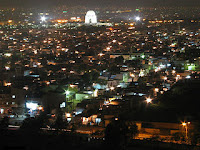
[Picture: Karachi with the Mazar-e-Quaid (Jinnah's Shrine). Photo: Wiki.]
Showing posts with label people. Show all posts

Tuesday, August 28, 2012

Prominent Sufi dies in Dagestan suicide bombing

No comments:


              Russian President Vladimir Putin, right, gives a medal to Tatarstan's chief mufti Ildus Faizov in mufti's residence in Bolgar, about 700 kilometers (450 miles) east of Moscow, central Russia, Tuesday, Aug. 28, 2012. Chief mufti Ildus Faizov was wounded in the leg after an explosive device ripped through his car in central Kazan in July. (AP Photo/RIA-Novosti, Alexei Nikolsky, Presidential Press Service)


Prominent Sufi dies in Dagestan suicide bombing

Boston.Com Globe Newspaper Company, August 28 2012

MAKHACHKALA, Russia (AP) — Thousands of mourners converged on a cemetery in Russia’s republic of Dagestan on Tuesday night for the burial of a top Muslim religious leader who was killed in a suicide bombing hours earlier, Russian news agencies said. Said Afandi, a leader of Sufi Muslims in the region, and five of his followers were killed by a female suicide bomber in an attack at Afandi’s home in the village of Chirkei, said Dagestan Interior Ministry spokesman, Vyachelav Gasanov.
There was no immediate claim of responsibility or identification of the bomber, but the attack could be linked to tensions between Sufis and the Wahhabi sect that is the core of the insurgency in the republic. Afandi was a frequent public critic of Wahhabism. In July, a top Muslim cleric in the Volga River republic of Tatarstan was gunned down and the republic’s chief mufti was wounded when a bomb ripped through his car. Both victims had been vocal critics of radical groups that advocate a strict and puritan version of Islam known as Salafism.
In a visit to Tatarstan on Tuesday, Russian President Vladimir Putin presented state awards to the wounded mufti, Ildus Faizov, and relatives of the slain cleric Valiullah Yakupov.
Putin called for interethnic harmony and said of extremists: ‘‘You cannot defeat a unified, multinational, strong Russian nation because on the side of truth and justice are millions of people who fear nothing, who cannot be intimidated and know the price of peace.’’
The killing of Afandi highlighted the violent tensions that persist in Dagestan, even as neighboring Chechnya has become relatively pacified and orderly after two wars in the last 20 years between separatists and Russian forces. Clashes with militants and attacks on police occur almost daily in Dagestan.
The Interfax and RIA Novosti news agencies said witnesses reported tens of thousands of mourners came to Afandi’s burial. Also Tuesday in Dagestan, a border guard opened fire on colleagues at a barracks, killing seven before being shot to death himself, Gasanov said. There was no indication of motivation.
Read More

Saturday, August 04, 2012

A Late-Night Sufi Music Lesson from Istanbul with Oreç Guvenç

No comments:
A Late Night Sufi Music Lesson from Istanbul by Chris Heagle, On Being August 3 2012
Sufi Music WorkshopPhoto by Emily Heagle
"These songs are poems, the bulk of them are from the 1600-1700 time period. They were a central part of Islamic piety in the Turkish context, and immensely popular in both the urban and the rural context. It was after Ataturk's forced secularization that they disappeared from the public sphere in Turkey, and went underground. People like Oruç Guvenç are central in recovering them not only as pieces of literature, but also as lived, practiced, embodied traditions." ~Omid Safi
At the end of a long day of production in Istanbul, our guide Omid Safi, a professor of Islamic Studies at the University of North Carolina at Chapel Hill (he specializes in Islamic mysticism and contemporary Islamic thought) led us off the beaten path. Barely a block from the tourist-filled Hippodrome and Hagia Sofia is the studio of Oreç Guvenç.
Oreç Guvenç's StudioFour floors up a spiral staircase, and beyond a pile of shoes respectfully left at the door, is a modest room lit with florescent tubes.
The walls are lined with traditional stringed instruments and drums, most of which look handmade. One open window to the street below unsuccessfully attempts to offset the heat generated by the 20 people who gathered to play and sing.
We are welcomed, as usual, with hot tea and treated to a remarkable evening. For nearly 30 years, the ethnomusicologist has been a leader in preserving and advancing traditional Sufi music, focusing especially on music as a tool for healing. This is what we heard at this evening's monthly workshop: To listen to samples of the music go here

Read More

Benevolent lecturer and scholar who was an authority on Islam in Africa

No comments:

Benevolent lecturer and scholar who was an authority on Islam in Africa The Irish Times August 4, 2012 

DONAL CRUISE O’Brien, who has died aged 71, was Emeritus Professor of Political Studies (Africa) at the School of Oriental and African Studies, University of London and a leading authority on Islam in Africa.
His interest in Africa was sparked by holidays he spent as a student in Katanga, where his father Conor was the UN representative. When his father served as vice-chancellor of the University of Accra, he visited Ghana.
He chose for his PhD thesis the political situation of the Sufi Muslims in Senegal. He was attracted by the idea of dealing with religious communities, with believers, and reaching people whose organisation had little or nothing to do with European principles.
Also, since the leadership of Senegal’s Sufi communities, marabouts, had established their hierarchies in parallel with the structure of the colonial state, he saw the possibility of a comparison with the role of Christian monasteries in Ireland.
And, in terms of nationalist politics, he was intrigued by the question as to whether the marabouts were lackeys of colonialism or defenders of their own turf.
In Paris he outlined his ideas to the eminent anthropologist Georges Balandier, who suggested that he confine his study to the Muridiyya (Mouride brotherhood): “They are the most interesting ones.” O’Brien adopted Balandier’s suggestion; it made his career, he later said.
The thesis was published as The Mourides of Senegal: a descriptive and analytical study of a Muslim brotherhood (1971). It focuses on the origin and development of the order among the Wolof peoples, the largest and most powerful of Senegal’s “tribal groups”. It examines its structure as well as its economic and political significance.
Read more here
Read More

Thursday, August 02, 2012

Kashmir: A Breeding Ground for Spirituality

No comments:

Shrine

Kashmir: A Breeding Ground for Spirituality
 Free Press Kashmir 2 Aug 2012
by Sahar-ul-Nisa Haroon

In Kashmir a large number of great Sufis have lived and now we have shrines dedicated to them thronged by thousands; Kashmir is Peer Waer, a land of saints. This paradise on earth is bestowed not only with the beauty of nature but also with religious wealth.

The Sufi tradition has played a great role in the lives of people living in this region ringed by lofty snow-clad mountains. The earliest known Sufi in Kashmir was a thirteenth Century Suhrawardi saint from Turkistan, Syed Sharfuddin Abdur Rahman, fondly remembered as Bulbul Shah. Click here to read more of this excellent article.
Read More

Monday, April 02, 2012

A People-friendly Person
No comments:
By Staff Writer, *Perak prince Raja Ashman Shah dies* - Free Malaysia Today/Bernama - Kuala Lumpur, Malaysia; Friday, March 30, 2012

Perak prince Raja Ashman Shah dies: Raja Ashman, a son of Sultan Azlan Shah, died following an asthma attack.

Kuala Lumpur: Raja Ashman Shah ibni Sultan Azlan Shah, a son of the Sultan of Perak, passed away early today following an asthma attack at his residence in Kuala Lumpur.

The sultan’s private secretary, Col Abdul Rahim Mohamad Nor, when contacted by Bernama, said Raja Ashman died at 1.30 am at his residence in Bukit Damansara.

He said the remains of Raja Ashman were brought to the Ubudiah Mosque in Bukit Chandan, Kuala Kangsar, for prayers before the burial at the royal mausoleum adjacent to the mosque after the ‘Asar’ prayers.

Raja Ashman, who was known to be a people-friendly person, leaves a wife, Noraini Jane Kamarul Ariffin, a son, Ahmad Nazim Azlan Shah and two daughters, Raja Eminah Alliyah and Raja Bainunisa Safia.

He was the third of five children of the Sultan of Perak, the others being the Raja Muda of Perak, Raja Dr Nazrin Shah; Raja Azureen; Raja Eleena and Yong Sofia.

Raja Ashman was appointed the Raja Kechil Sulong of Perak on March 16, 2010.
Read More
A Pious Prince
No comments:
By Roshidi Abu Samah, *Raja Ashman laid to rest after succumbing to asthma attack* - The Star - Kuala Lumpur, Malaysia; Saturday, March 31, 2012

Raja Ashman laid to rest after succumbing to asthma attack

Kuala Kangsar: The Raja Kecil Sulong of Perak, Datuk Seri Raja Ashman Shah Sultan Azlan Shah, who passed away after an asthma attack, was laid to rest at the Bukit Chandan Royal Mausoleum here.

The 54-year-old prince, the second son of Sultan of Perak Sultan Azlan Shah, died at his home in Bukit Damansara, Kuala Lumpur, at 1.30am yesterday.

His remains were brought to the Ubudiah Mosque in Bukit Chandan, Kuala Kangsar for prayers before the burial at the Royal Mausoleum located next to the mosque.

Earlier, at about 6.15pm, his remains were transported on a royal dais by Armed Forces personnel from the Istana Iskandariah grounds to the Royal Mausoleum about 1km away.

Members of the Kedah and Johor royal families were among those who paid their last respects.

National leaders in attendance included Prime Minister Datuk Seri Najib Tun Razak, Home Minister Datuk Seri Hishammuddin Tun Hussein, Defence Minister Datuk Seri Dr Ahmad Zahid Hamidi, Minister in the Prime Minister's Department Datuk Seri Nazri Aziz and Rural and Regional Development Minister Datuk Seri Mohd Shafie Apdal.

Raja Ashman was known to commoners as a pious prince who kept a low profile.

A businessman, he had a degree in economics from the University of Nottingham and a Masters of Law from Cambridge University.

He also held the ijazah or permission of investure in the Naqshbandiya Haqqaniya Order of Sufism from Shaykh as-Sayyid Muhammad Nazim Adil al-Haqqani, the Grand Mufti of Cyprus and Imam of the Naqshbandiya Haqqani Order of Sufism.

Raja Ashman was a hockey fan and often accompanied Sultan Azlan Shah, the Asian Hockey Federation president, to various matches.

He was appointed as Raja Kecil Sulong on March 16, 2010.

He leaves behind wife Datin Seri Noraini Jane Kamarul Ariffin, 53, son Datuk Raja Ahmad Nazim Azlan Shah, 20, and daughters Raja Emina Aliyyah, 18, and Raja Bainunnisa Safia, 17.

Picture: Final farewell: Raja Muda of Perak Raja Nazrin Shah paying last respects to his late brother Raja Ashman (inset) at Balairong Seri Istana Iskandariah. Photo: The Star.
Read More
In Honor of HRH Raja Ashman
No comments:
By Staff Reporter, *Watch now: Suhbat in memoriam of the late HRH Raja Ashman Shah and his legacy* Sufi Live - Burton, MI, USA; Friday, March 30, 2012

Suhbat in memoriam of the late HRH Raja Ashman Shah and his legacy

A`udhu billah mina 'sh-shaytani 'r-rajeem
Bismillahi 'r-Rahmani 'r-Raheem

Shaykh Hisham Kabbani lead Khatm ul-Khawajagan [weekly congregational dhikr] in honor of His Royal Highness Raja Ashman ibn Sultan Azlan Shah and donated its rewards to his soul, followed by a Suhbat in memoriam of HRH Raja Ashman and his legacy.

Watch them now:

Main Suhbat
Khatm ul-Khawajagan
The Spiritual Dressings of HRH the Late Raja Ashman Shah
Read More

Wednesday, March 28, 2012

Surely we belong to Allah
No comments:
By Staff Reporter, *Sufi singer Bahu dies* The Nation - Lahore, Pakistan; Sunday, March 25, 2012

Lahore: Renowned Sufi singer Iqbal Bahu passed away after protracted illness here on Saturday. He was 60.

Bahu, known for his ‘Sufiana’ and Arifana Kalam (poetry of saints) was shifted to a local hospital where he died of cardiac arrest. His funeral was offered in Iqbal Town near his residence in Satluj Block.

Mohammad Iqbal Bahu began his career from Radio Pakistan and later performed for Pakistan Television. He was famous for singing Heer (poetry of Waris Shah).

Born in Gurdaspur, Indian Punjab, his family migrated to Pakistan after independence and settled in Lahore.

He mastered the Sufi tradition of well-known Sufi saint Hazrat Sultan Bahu and was awarded the Tamgha-e-Imtaiz in 2008. Literary Originations expressed grief over the demise of famous Sufi singer.

إِنَّا لِلّهِ وَإِنَّـا إِلَيْهِ رَاجِعونَ
Inna lillahi wa inna ilayhi raji`un; Qur'an 2:156
'Surely we belong to Allah and to Him shall we return'
Read More

Wednesday, March 21, 2012

An Absolute Refutation
No comments:
By Mohammed Wajihuddin, *The Muslim whom Qaida loves to hate* - The Times of India - India; Sunday, March 18, 2012

Mumbai: There are two types of Islamic preachers: the incendiary supremacists who justify violence in the name of avenging real or imagined injustice and the pacifist moderates who hail forgiveness as the best human virtue.

Muhammad Tahir-ul-Qadri belongs to the second category. Based in Canada since 2006, the Pakistan-born eminent Sufi scholar and preacher has been on al-Qaida's hit list ever since he issued a 600-page fatwa against terrorism on March 20, 2010.

He has also drawn flak from a group of orthodox fellow religionists for propagating an Islam which, his detractors say, is too "inclusive" and "forward-looking".

This past week, Qadri, who was in the city on the invitation of Minhaj-ul-Quran , addressed two gatherings in the city. Fundamentalist organisations did everything in their power to stop him -the Raza Academy even approached the Bombay High Court, demanding a ban on his sermons in the city as that could cause trouble.

The court admitted the petition, but allowed Qadri to deliver his lectures, saying it would hear the tapes later.

Part of the fundamentalists' ammunition against the preacher was that two weeks earlier, while addressing a crowd in Kutch, he had allegedly "thanked" Narendra Modi -an act which raised a storm in Gujarat's Urdu press. So, does he really admire Modi?

"I didn't even utter Modi's name," says Qadri. "I just thanked the state government which provided me with ZPlus security and facilitated my address. It was my moral responsibility to thank them."

Many scholars before Qadri have issued fatwas against terrorism. But Qadri's fatwa, given greater legitimacy by the endorsement of the famous Cairo based seminary Al-Azhar University, is an absolute refutation of all terrorism without any excuses.

Perhaps the al-Qaida got offended and marked him because of the line in the fatwa which said:

"It can in no way be permissible to keep foreign delegates under unlawful custody and murder them and other peaceful non-Muslim citizens in retaliation for the interference, unjust activities and aggressive advances of their countries. The one who does has no relation to Islam and the Holy Prophet."

In Mumbai, addressing the packed Birla Matoshri Sabhagar hall, Qadri had declared: "I am not saying anything new. I am just communicating the true spirit of Islam which is tolerant, inclusive and forgiving." Raising his fist, the frail preacher in black robe and Sufi-style skull cap said: "I am an enemy of terrorism and don't care if I am killed saving humanity from this scourge."

The preacher challenges critics to counter the anti-terrorism fatwa he issued.

"Why hasn't anybody written even a pamphlet rebutting what I said in the fatwa?" he asks. However, he says he prefers not to reply to personal attack and goes on to recall his days in Pakistan when a maulvi wrote against him in a journal for years.

"On my silence, the maulvi once shouted at a meeting, 'What did I get from attacking him all these years? He has not replied even once.'"

Qadri terms as "criminal" the silence of the majority on the depredations of a handful of misguided youth. "If there were a dozen voices like mine within the Muslim community, things would have been different," he says.

The preacher has written over 1,000 books, and the DVDs and CDs of his sermons sell like hot cakes in Muslim pockets, from the markets of Multan to the bylanes of Bhendi Bazaar. No wonder, thousands turned out to hear him live.

[Picture: Shaykh Tahir ul-Qadri addressing people in Bangalore, India, Saturday, March 10. Photo: Minhaj-ul-Quran. ]
Read More

Sunday, February 26, 2012

إِنَّا لِلّهِ وَإِنَّـا إِلَيْهِ رَاجِعونَ

No comments:
Inna lillahi wa inna ilayhi raji`un; Qur'an 2:156
'Surely we belong to Allah and to Him shall we return'

Shekhe Azam Syed Maulana Izhar Ashraf died in Mumbai

Chief Patron of All Indian Ulama and Mashaikh Board (AIUMB) and a great Sufi Islamic Scholar of International repute, Shaykh E Azam Hazrat Sayyedinah Syed Muhammed Izhar Ashraf Ashrafi Jilani Alayhir Rahmah, the eldest son of Sarkar E Kalan Has passed away at 11:45 pm on the Wednesday 22nd February 2012.

His Namaz e Janaza [Funeral prayers] was lead by his elder son and President of Board Hazrat Syed Mehmood Ashraf Kichochawi Al Jilani on 24th Feb 2012 at Kichocha Shareef Ambedkar Nagar U.P. in the presence of thousands of Shaikhs, Ulemas and Murideen.

Hazrat Syed Izhar Mian was getting treatment in Ismailia Hospital in Mumbai and he took his last breathe there.

[Visit the AIUMB website.]
Read More

Wednesday, February 15, 2012

Heading to Lefka
No comments:
By Staff Reporter, *Revered Turkish Cypriot religious leader ailing* Cyprus Mail - Nicosia, Cyprus; Wednesday, February 8, 2012

Revered Turkish Cypriot religious leader ailing

Hundreds of followers gathered outside the commune of Turkish Cypriot Sufi mystic Sheikh Nazim Kibrisli in Lefka yesterday after a sudden decline in the religious leader’s health Monday night.

Nazim, 89, leads the Naqshbandi Haqqani Sufi Islamic order that boasts hundreds of thousands of followers worldwide. He claims to be the direct descendent of the 11th century Sufi saint Abdul Qadir Jilani and 13th century mystical poet Jalauddin Rumi.

According to reports, doctors were called to Nazim’s dergah, or religious commune, after an embolism in one of his lungs caused him breathing difficulties. Despite efforts to move him to hospital on Monday night, the still-conscious Sheikh refused to go. Doctors are believed to be at his side.

Last night, well-wishers from around the world were said to be heading to Lefka to join prayers for the Sheikh’s wellbeing.

Despite his international appeal, Nazim has been widely shunned by the staunchly secular Turkish Cypriot community. Since the 1950s he has been barred from preaching in mosques in Cyprus. However, to his international audience he is revered as a saint.

It is unclear who will succeed him as leader of the Naqshbandi order.

[Picture from Sufilive, the Official Media Library of Mawlana Shaykh Nazim Adil al-Haqqani and the Naqshbandi-Haqqani Sufi Order.]
Read More

Friday, January 13, 2012

I’m No Sufi Singer
No comments:
By Staff Writer, *Singer-songwriter Rabbi Shergill* - IBN Live - India; Tuesday, January 10, 2012

Singer-songwriter Rabbi Shergill: A graduate from Delhi’s Khalsa College, Rabbi was part of the local hard-rock music scene in his graduation days. Inspired by Led Zeppelin, Aerosmith and Jimmy Page, Rabbi started writing his own songs and made a few demos too.

“I grew up in the 80’s, when the whole concept of western was like a zenith and one could not escape being a wannabe.”

He saw Springsteen perform in Delhi and after that, he says, “I always wanted to be him.”

Rabbi dropped out of his management course in the first year itself. “I went to school just to please my mother and like all the Punjabi parents, even she had academic aspirations for me. I went along with it but deep down I hated it. And so, I dropped out of it and started creating music,” he recalls.

I’m no Sufi singer

Defining his music, Rabbi clarifies, “Sufi is a misnomer for my music. I have just sung one Sufi song! My music is ‘rock and roll’ and ‘funk’ and I always keep thinking of ways to implement the funk into them.”

His latest album ‘Ganga’ also has a few of these elements. The album is all about a guy singing to a girl and telling her not to be deterred by the world and do her own thing. Listing his contemporary favourites, he reveals,

“I love Shruti Haasan, I think she is a decent musician. I really like John Mayer. Shankar-Ehsaan-Loy’s music and a Bengali singer called Mou.”

Commenting on the rock culture scene in India, he opines, “Kids at college just learn to play guitar and form rock bands, which stick for a year or two. Then they either split or get into Bollywood. A lot of their music is not compelling, which is why they don’t last long.”

Thinking out of box

Explaining his creative process, he says, “I’m constantly trying to understand how I can step out of my own box. I think about all the things I want to talk about, get an idea and then somehow, magically some line appears. You can have a general idea about how to get there, but ultimately, it’s just pure magic.”

Rabbi’s flair for poetry can be traced back to his mother, who is a Punjabi poetess. “Her poetry is amazing and yes, there’s a lot of poetry in my songs, which I would like to be considered as something that aspires to be poetry,” he explains.

Rabbi has given music for a Bollywood film, ‘Delhi Heights’. Though he loves composing original music tracks, he says performing has always been his first love. “Making music for films is a different area and I like doing it. But, performing will always be my first love. It depends on how things work out,” he adds.

Stint with Dewarists

Sharing his experience on the music show called the ‘Dewarists’, Rabbi recalls, “It was a fantastic experience and singing with Papon was an amazing experience. It was set in a very beautiful location in Kaziranga. I guess it will be one of the most beautiful experiences of my life.”

And like the romantics of old, he believes we are increasingly living in an artificial world. “We have to get out on to the streets, live in nature and discover ourselves. Big cities act like a pump that drains out everything. It is very irreconcilable,” he points out.

Music and drugs

Expressing his views on musicians, who die of drug overdose, Rabbi says, “We have had many great musicians in the past, who have died of drug overdose, which is really sad. Even I need a relaxed state of mind to write songs. I like my scotch and have never done drugs. I think it’s too much work.”
Read More

Thursday, December 01, 2011

A Mediator
No comments:
By David Tresilian, *Robert Irwin: anti anti-orientalist* - Al-Ahram - Cairo, Egypt; 24-30 November 2011 / Issue No. 1073

Robert Irwin: anti anti-orientalist: The author of many books on the Arab world and of a defense of European orientalism, the British writer Robert Irwin has recently published an intriguing autobiography. He spoke to David Tresilian in Paris

At an age when many people are beginning to think about writing their memoirs, the British writer on the Arab world Robert Irwin, who is also a well-known journalist, academic and novelist, still keeps a very full schedule. Though Irwin's memoirs, entitled Memoirs of a Dervish and a record of his early life, spent, among other places, in Algeria, in fact appeared earlier this year, he must surely have enough material for many other volumes.

Irwin has published a number of other books over recent years, most relating to the Arab world, his field of study and a subject on which he has achieved considerable expertise. He is regularly called upon as a reviewer and commentator on Arab literature and culture for various international publications, and his characteristic mix of scholarship and hard-won clarity tend to make his writings first ports of call for English-speaking readers looking for guidance on topics as diverse as the Arabian Nights, the subject of a book-length introduction published in 1994, classical Arabic literature, a 1999 anthology of extracts in translation, and the modern history of Islam.

Such has Irwin's success been in introducing Arab culture to general audiences in the English-speaking world that it has been almost possible to forget his previous, and second, career as an academic. Volume Four of the New Cambridge History of Islam, covering Islamic cultures and societies to the end of the 18th century and edited by Irwin, appeared late last year. Before that there was Irwin's own Early Mamluke Sultanate, 1250-1382, a scholarly investigation first published in 1977 and still in print.

In addition to being an accomplished academic, journalist and novelist, Irwin has recently emerged as a polemicist, notably on the thorny subject of European orientalism. Ever since the publication of the late Palestinian- American writer and academic Edward Said's book on the subject, entitled simply Orientalism, over three decades ago, many people, perhaps particularly in the Arab world, have been prepared to accept Said's characterisation of the work of the European orientalists -- past European writers, scholars and commentators on Islam and the Arab world -- as having been vitiated by colonialist attitudes and complicity in the European colonisation of Arab societies.

This is an argument that Irwin strenuously rejected in his own book on the history of European orientalism, entitled For Lust of Knowing: the Orientalists and their Enemies and published in 2006. In part designed as a rebuttal of Said's views, the book argued that European orientalism, pace Said, cannot be seen as a kind of blanket discourse that falsely represented its field of study. Far from being a sinister or monolithic affair connected to power and domination, it could in fact just as accurately be characterised for at least portions of its history as the harmless pastime of other- worldly clergyman.

Somewhere near the beginning of his book, Irwin warns that those coming to For Lust of Knowing in search of some general thesis on the historical relations between east and west may well be disappointed. Orientalism, in Irwin's view, bears more relation to academic disciplines like classics than it does to US- style geopolitics or area studies, and as a result much of it consists of worthy, if unexciting, activities such as "cataloguing the coins of Fatimid Egypt, or establishing the chronology of Harun al-Rashid's military campaigns against Byzantium." These are undoubtedly fascinating endeavours, but they do not seem obviously related to European colonialism.

Speaking to the Ahram Weekly on his way to give a lecture on the "true discourse of orientalism" in Paris recently, Irwin elaborated on his disagreements with Said, explaining why he, at least, is happy to be called an orientalist in the original, pre-Saidian sense of the word.

What Said did in Orientalism, Irwin says, was "consistently to misrepresent and effectively libel people, putting forward an essentially false picture of the study of the Middle East and Islam as it was conducted in the 17th, 18th, 19th and early 20th centuries in Europe. Even from a more positive point of view, Said's book does not open up an area of enquiry. What it does is to narrow the area of enquiry, such that we miss important aspects of how the West in fact interpreted the Middle East, including in terms of issues such as class and money -- terribly important when we are considering who traveled in the Middle East and what they saw when they went there."

For Lust of Knowing might more accurately be described as a history of European orientalists than of European orientalism, and Irwin's book contains many details of the research programmes, and sometimes of the personal habits, of most of its leading figures. The "sombre, severe and polemical figure" of the Frenchman Antoine Isaac Silvestre de Sacy, for example ("founder of modern orientalism"), is described in detail, de Sacy having been the first professor of Arabic at the Ecole spéciale des langues orientales vivantes when it was founded in Paris in 1795, as are later figures such as the Hungarian Ignaz Goldziher ("greatest of the orientalists") and, from the last century, well- known French orientalists like Louis Massignon (a "holy madman"), Jacques Berque ("fanatically francophone") and Maxime Rodinson ("reacting against Massignon's flamboyant spirituality," he published "a series of articles on mediaeval Arab cookery"), among others.

This emphasis on individual figures rather than on the field of study to which they belonged also characterises Irwin's spoken discourse, and in person he is eager to explain how Said, in "back-projecting from the concerns of contemporary academia," often missed what in fact motivated the European orientalists. For these people, often clergyman, always members of the educated elite, and, especially in the English case, usually dependent on leisured or aristocratic patrons, the East was very far from being "a career," as the epigraph, quoted by Said, to one of the 19th- century British novelist, and later prime minister, Benjamin Disraeli's novels puts it.

Far from looking to advance European political or economic control of the Middle East in their investigations of Arab and Middle Eastern culture or advance their own careers, Europeans who traveled in the Arab world in past centuries could often more accurately be described as having been in the grip of an all-consuming hobby. Most often, they were interested in "adventure, romance and colour," Irwin says. Academic orientalists may very well have had peculiar interests of their own, even obsessions in the case of the early 20th-century British orientalist David Margoliouth, "who treated everything in Arabic studies as a kind of Times crossword," but these interests were not necessarily related to advancing the political or other interests of the countries from which they came.

"Some people went out to the Middle East, it could even have been true of me, in search of material for a good book," Irwin comments. "One's always looking for a pretext for a book that will read interestingly. One's looking for material that people will want to read."

While Irwin's writings on Arab culture may have become familiar to the English-speaking public over only the past two decades or so, his autobiography shows that he has been involved in Arab studies and the Middle East for far longer than that. In Memoirs of a Dervish, Irwin describes studying Arabic at London University's School of Oriental and African Studies in the early 1970s, where his thesis on Egypt's mediaeval Mamluke sultanate was supervised by the well-known Anglo-American academic Bernard Lewis, a target of Said's criticisms in Orientalism.

Irwin's descriptions of university and student life, first at Oxford in the late 1960s and then in London in the 1970s, are likely to strike contemporary readers as almost pre-lapsarian in character, with students, not burdened by the prospect of enormous debt, studying subjects that interested them, as opposed to what they had to study in order to establish themselves in a career, and professors, apparently not pressed to "publish or perish," having the time to interest themselves in the work of students.

Commenting on how public attitudes to the Arab world and Middle East have developed since then, Irwin says that one of the greatest changes has been in the expansion of possibilities for serious study of the Arab world. "When I published my book on the Mamlukes, people asked why we needed another book on the subject, as there was already a book in German from the 1860s," he says.

"Mine was the first proper history of the Mamlukes in English, but now Mamluke studies have exploded at universities worldwide. They are very big in the United States, where Chicago is a centre. There's been an explosion in this area, and the same has been true to a lesser extent for Abbasid studies, Fatimid studies, Qajar studies and so on. There are now academic journals and regular conferences. The situation has been totally transformed from what it was, when there was just one scholar dealing with the subject in any given country."

Irwin also sees increases in the knowledge the wider European public has of the Arab world, as well as in Arab efforts to draw closer to Europe, notably through increased translation. "There has been a lot of effort to get Arabic novels translated, and publishers are enquiring what modern works they should be translating, as well as what classical Arabic works should appear in modern translations. However, at the moment there may be more interest among publishers than among the reading public, as sales can be disappointing: with the exception of Naguib Mahfouz, few Arab authors have done well in English translation, though Alaa al-Aswany did very well indeed [with the English translation of The Yacoubian Building ]."

"There is no doubt -- the statistics are there -- that more Arabic titles are being translated into English every year than used to be the case," Irwin continues. "But one of the problems the British reading public may have with Arabic fiction is that so much of it is heavily politicised: so much of it is veiled or open criticism of despotic Arab regimes, or of the oppression of women in the Middle East, or of the Palestine problem. On the whole, British fiction is not political. The British public likes a good plot, and what is being offered instead by Arab writers is disguised polemic."

One exception to this trend may be in classical Arabic literature, and particularly the Arabian Nights, where the interest of western readers has "come on wonderfully from what it was only two decades ago," Irwin says, partly as a result of improved translations. "I keep telling publishers they should do Jahiz," the polymath Abbasid writer, as "he's so witty and so interesting, or the pre-Islamic poets -- wonderful, bleak landscapes -- but they are not very receptive. They are interested in Sufi writers, but otherwise I think they don't really know where to start as far as the classical Arab writers are concerned. When I suggest Jahiz, people look blank."

"Some of the existing translations are also amazingly archaic, which doesn't help. When I did my anthology of classical Arabic literature for Penguin Books, my remit was to bring together extracts from existing translations -- I had no money to commission new translations, apart from those I did myself."

Of his recent memoir, which describes an undergraduate life spent between studying history at Oxford and vacations at a Sufi lodge in eastern Algeria, Irwin comments that "I wanted to recapture my youth and the period for people who weren't there. I'd got rather fed up of memoirs by people who were at the centre of the hippy scene in the 1960s, and I thought I'd like to do a memoir that wasn't purely secular. I became aware that what I was doing was a memoir of spiritual failure, a mystical quest that came unstuck."

Whatever it was that Irwin may have been looking for among the Sufis in Algeria, it was not necessarily the same as what other western young people of his generation were looking for elsewhere at the same time, spurred on by the counter-culture of the period and what Irwin describes in his book as "ghastly iconic sixties people" like Yoko Ono, Herbert Marcuse and R.D. Laing.

"The Arabs didn't stand for anything very much for European young people in the sixties. The truth was that almost everyone was going to India, and very few people chose the Arab option. To go down the Sufi line was rare. Also, the Arab world was very different in the 1960s to what it is today. Those were the days of nationalism and secularism and of Nasser and Bourguiba. It was a different world. Islam was marginalised, and Sufis were persecuted in Algeria by the ruling FLN," the Front de libération nationale which had successfully fought the country's war of independence against French colonial rule.

"Muslims were not in the news in the 1960s in western countries, as they are now, sometimes negatively," Irwin comments, adding that in his view in Britain today there is "no serious Islamophobia, no serious anti-Islamic movement, as there may be in European countries like Holland, Switzerland, or France, where even some mainstream politicians have taken stands against Islam."

Irwin is supportive of the Arab Spring ("I'm looking forward to it"), though he is worried that its progress, at least in some countries, may have become stalled. He is planning to continue his career as a mediator between the Arab and the English-speaking worlds through further lectures, books and articles. A lecture course on western views of the Arab world is planned for the prestigious Ecole des hautes études en sciences sociales, a graduate school, in Paris in the spring, to be followed by a book- length second installment of his account of orientalism.

The first volume, For Lust of Knowing, only dealt with academic orientalism. The second volume, planned for 2013, will take in the history of the dealings of European artists, writers, filmmakers and poets with the Arab world. It is sure to be eagerly awaited.
Read More

Monday, November 14, 2011

The Spirit of Mawlawiyah
No comments:
By Diya Chowdhury, *Rhythm motion* - Tehelka - New Delhi, India; Saturday, November 5, 2011

New Delhi: Amer El Tony put his hand to his chest and said, “It’s a search that lead me here. Singing is praying, and being a Mawlawai is a medium in soul and spirit to achieve that connection with my God.”

Amer is credited with the preservation and continuance of the tradition of the Egyptian Mawlawiyah (more popularly known as Whirling Dervish), when in 1994 he took upon himself the task of rejuvenating the dance form started during the pharaohnic times.

Since then, Amer has regaled the world to this exciting form of dance that rests on the tenets of sufism. Mawlawiyah starts with an ode to God on subtle musical notes produced through three percussion instruments and a flute.

It accelerates to a crescendo of whirling exhilaration and singing that combined together produces that perfect picture of rhythm in motion. To witness such euphoria, where any onlooking crowd cheers and applauds, is truly surrendering oneself to the pleasures of music.

But the journey wasn’t easy for Amer. Coming from a family of city dwellers (his father was a teacher, mother a homemaker), Amer took to Mawlawiyah during his twenties, just as a start to his personal search of a higher order.

“I was looking for something that made me truly happy, a form of meditation that could end my search,” he recalls.

“It was around this time that I discovered Mawlawiyah, which was still in tradition in Egypt, but on a very small scale being conducted by unknown singers and dancers in the villages of Egypt,” he elucidates.

Amer says, as his interest in Mawlawiyah grew, so did his hunger to learn more of its origin. He read through ancient texts and understood the ethos and logic behind the art form. It was several years of painstaking learning that he formed his troupe in 1994.

Amer very soon realised that for this art form to survive, he had to take it to the world outside. Thus, began his tryst with improvising with the Whirling Dervish.

He incorporated the 'tanoura', or the colour element in these dances that reflect in the dresses and skirts that the dancers wear. Traditionally, in the Turkish Dervish, the clothes are subdued, with off-white the preferred tone.

Amer also incorporated changes in music, adding a distinct note to his form. The instruments like the tabla and dohalla are used in repeated forms. So is the flute, which combines the longing the individual wishes to quell through the singing and whirling.

The dances can go one for hours, culminating in a heady mix of drum beats and aggressive singing.

Like our home-grown baul which also emanates from the doctrine of Sufism, the music and dance culminates into a space of its own.

Amer expresses the fondness for the art form. He says, “Mawlawiyah is played out in such a way, that the singer is the centre of attraction, and he acts as the thread between the whirling dancers and himself. With each song he delivers the spirit and speed of music and notes to the dancers in such a way that he is the sun in the a solar system. Once this symbiotic relationship is formed, it creates a divine composition.”

Amer and his troupe has performed the world over. But they have recently started performing in India, with a show in Kolkata earlier this year. “We were thrilled! A performance of an hour rolled out beyond that, and the audience wanted more! Such is the spirit of Mawlawiyah!” Amer says.

In New Delhi, for the Delhi International Arts Festival 2011, the troupe is set to return to the capital in February 2012 with the intention of conducting workshops.

“People want to know more on Mawlawiyah, its origin and what it encapsulates. So we decided to take this ahead,” he says.

Amer is currently employed with the Academy of Art, Cairo and has a PhD in Mawlawiyah, probably the only person with an expertise in the discipline.
Read More

Monday, November 07, 2011

Wisdom and Piety
No comments:
By Staff Reporter, *Sufi Sheikh Assassinated In Southern Russia* - Radio Free Europe/Radio Liberty - Prague, Czech Republic; Saturday, October 29, 2011

A Sufi sheikh has been shot dead at his home in a village in southeastern part of the Russian republic of Daghestan, RFE/RL's North Caucasus Service reports.

Sirajudin Israfilov, 56, was imam of a Sufi mosque in the town of Derbent and reportedly had between 5,000-10,000 supporters. He was not recognized as a sheikh by Daghestan's official Muslim clergy.

Israfilov's brother said he was shot dead at close range on October 27 in the village of Khurik by two men in camouflage clothes who entered the yard of his home.

In a joint statement, Daghestani President Magomedsalam Magomedov and the republican parliament and government paid tribute to Israfilov's "wisdom and piety" and underscored his rejection of "extremism and terrorism."

The authorities said they believe Israfilov was murdered by members of the Islamic insurgency, which has killed a dozen local imams over the past two years.

But those killings were all in the northern and central districts of Daghestan. Khurik is in the southeastern Tabasaran district, close to the border with Azerbaijan.

Daghestan's Muslims are divided between adherents of canonical Sunni Islam represented by the Shafii legal school; a local form of Sufism; and the Salafi ("wahhabi") Islam professed by members of the North Caucasus insurgency.

Of Daghestan's 19 Sufi sheikhs, the official Spiritual Board of Muslims of Daghestan (DUMD) recognizes only four.

The DUMD website was inaccessible at the time of this report. RFE/RL was unable to contact the DUMD for comment on Israfilov's death.
Read More

Tuesday, November 01, 2011

Beyond Entertainment
No comments:
By Indi, *The Sufi magic of Sain Zahoor* - Desi Blitz - UK; Wednesday, October 26, 2011

The Sufi magic of Sain Zahoor

Sain Zahoor is a Sufi street musician and wandering minstrel from Pakistan with an incredible vocal style that takes you beyond entertainment and embodies the cultural wealth and soul of Pakistan’s popular street culture. DESIblitz was present at his performance at The Drum in Birmingham (UK).

Sain Zahoor is an incredible Sufi musician from Pakistan. His recent performance on 8th October 2011 at The Drum in Birmingham captured the audience’s attention as soon as he walked on stage wearing bright colours and a Tumbi with colourful tassels. His presence was very self assured and comforting as he commenced singing tales from the folklore past.

Sain Zahoor is also known as Saieen Zahoor or Saeen Zahur Ahmad. Sain, which is not his first name but a Sindhi honorific title, spent most of his life singing in Sufi shrines and developing his magical voice which many times put listeners of his music into a trance.

Throughout his singing at The Drum he was inspired on by chants and shouting from the audience, who were mesmerised by his lyrics and hypnotising flow. Every once in a while in the chorus of a song, Sain span around, moving his Tumbi round in circles.

His dancing is of a frenzied style with the tassels on his instrument whirling around him. His singing style is unique, colourful and full of energy. His voice has an earthy tone, almost cracking at the edges, but capable of a strong vocal and emotional range.

Sufi singing is focused on poetry with themes of devotional love, which shares much with Persian mystic poets like Rumi and with other South Asian traditions such as the Bhakti cult.

Half way through the show Sain stamped his foot hard onto the stage floor and shattered his ankle bells, which were immediately brushed away by one of the backing singers so not to cause any harm to Sain.

At some points during the show people from the audience threw money onto the stage, a traditional way of showing a sense of appreciation for this magical Sufi artist.

Sain was born in the Okara district of the Sahiwal region in the province of Punjab, Pakistan. He was the youngest child in a rural peasant family. He started singing at a tender age of five and from that time he had dreamt of a hand beckoning him towards a shrine. He left home at the age of thirteen, roaming the Sufi shrines of Sindh, Punjab, and Azad Kashmir, making a living through singing.

Whilst walking past a small shrine in the south Punjab town of Uch Sharif (known for its Sufi traditions), Zahoor recalls seeing what he often dreamt about. He says, “Someone waved at me with his hand, inviting me in, and I suddenly realised that it was this hand which I saw in my dream.”

Subsequently, Zahoor studied music under his first teacher of Sufi verses, Raunka Ali of Patiala Gharana, whom he met at Bulleh Shah’s dargah (shrine). He also studied music with other Uch Sharif-based musicians.

Zahoor is illiterate but he is known for his memory of song lyrics; mostly he sings compositions of the major Sufi poets, Bulleh Shah, Shah Badakhshi and others.

He sang an ost in 2011 for *West Is West*, a British comedy-drama film which is a sequel to the 1999 comedy *East Is East*. He also acted and appeared in the film.

At the end of the show Sain and his band bowed down and left the stage but were called back by the crowds for an encore. Zahoor agreed to one more song and then finished off the show with a three minute prayer.

Before Sain had the opportunity to leave the stage for a second time, he was immediately surrounded by members of the audience who shook his hand, hugged him and had photographs taken with him on stage.

The magic of this Sufi singer brought a sense of uplift to the whole evening with a buzz in the atmosphere of The Drum amongst everyone who saw Sain Zahoor perform his repertoire of songs live and direct in Birmingham.

[Click on the title to the original article with many pictures (ed.)]
Read More

Sunday, October 02, 2011

Delivering Allah's Message
No comments:
By Prabalika M. Borah, *Message delivered* - The Hindu - Chennai, India - Sunday, September 25, 2011

Sufi singer Fareed Ayaz loves his paan as much as he loves singing to deliver uparwala's message

Talking to Pakistani sufi singer and qawwal Fareed Ayaz is like sitting through an interesting class in music, general knowledge and a bit of math.

At an informal gathering in Lamakaan discussing music, Fareed takes turns to question the audience and test their general knowledge. His intention in doing so is “to explain what I am discussing better. I have a good command in various languages. But some things are best explained with examples,” says Fareed.

Ustad Ghulam Fariduddin Ayaz Al-Hussaini Qawwal better known as Fareed Ayaz is a Pakistani Qawwal but has his roots in apna Hyderabad.

“I was born in 1952 and in 1956 we shifted to Karachi. Since then I have been living there and visiting the city/country when I am invited to perform. In a way my music brings me back here,” he says.

Belonging to the Qawwal Bachchon Ka Gharana of Delhi, Fareed stresses that people take support of gharanas in the wrong way these days.

“Gharana is not a person or the famous person under whom you have been tutoring. Gharana is a school of thought. I don't feel the need to flaunt my gharana because I believe in my music and I have absolutely no ghalat feimi about myself and my performance. That's because as a child I was told by my father and guru, ‘leave music for one day, music will leave you for a month.'

Those who lack confidence in their work take the support of gharanas. I was awarded the title of ‘Pride of Performance' in Pakistan. At the award function I said, ‘my audience bestows me with this title at every performance, this title for me is a piece of gold,'”

Fareed explains as he sips chai. Dressed in his signature simple kurta and pyjama with a teliya rumal hanging from his neck and Fareed's stone studded sindhi topi, the singer also says, “while we are performing we are doing nothing but delivering Allah's message to the listeners. Qawwali or sufi music should be able to touch senses in a human being. Only then the singers know what they are singing,” he stresses and says he believes there is no language to Sufi music —“hain toh bas message.”

A heavy paan [betel leaf] chewer, on being asked how many paans he chews on an average, Fareed says, “A few years ago it was 150-200 a day. Now I don't count. Maybe this will give everyone a rough idea —‘I am awake for 12 hours but chew paan for 24 hours. How? When I sleep I nudge my wife, she understands, wakes from her sleep, makes my paan and nudges me back, then I understand and simply open my mouth, once the paan is in I fall back to sleep',” he laughs.

Along with his music and clothes, Fareed travels with his paan, because according to him God has only promised us food “uparwala Karachi paan ka wada toh nahin kiya, so I carry them with me.”
Read More

Thursday, September 08, 2011

إِنَّا لِلّهِ وَإِنَّـا إِلَيْهِ رَاجِعونَ 2:156
No comments:
By Staff Writer, *Sufi researcher Ahmadul Huq dies* - BDNews24.com - Dhaka, Bangladesh; Monday, September 5, 2011

إِنَّا لِلّهِ وَإِنَّـا إِلَيْهِ رَاجِعونَ Inna lillahi wa inna ilaihi raji'un; Qur'an 2:156
'Surely we belong to Allah and to Him shall we return'


Dhaka: Noted Sufi researcher Syed Ahmadul Haq has passed away. He was 93.

He died of old age in a Chittagong hospital on Monday. He left two sons and six daughters to mourn his loss.

His janaza will be held at Jamiatul Falah Mosque on Tuesday after the Zohr prayer.

Born on Sep 1, 1918, at Jaynagar village under Padua union council of Rangunia Upazila in Chittagong, Haq did his MA in English from Dhaka University in 1942 and MA in Public Administration from American University of Beirut.

Haq started his career as a teacher at Chittagong College and later joined in government service. He was secretary of Bangladesh Small and Cottage Industries Corporation (BSCIC), deputy director of the Education Department and director of the Export Promotion Bureau (EPB).

He wrote a number of books including "Tales from Masnavi by Jalaluddin Rumi & their inner thoughts", Prabandha Bichitra.

He also founded Alamma Rumi Society in Chittagong.
Read More

Thursday, September 01, 2011

Chilla Kashi
No comments:
By TNN Staff Writer, *Doubts over Anna's 12-day fast unfounded* - The Times of India - India; Tuesday, August 30, 2011

Jaipur: Doubts about Anna Hazare's 12-day fast are baseless, feel experts and religious followers even as Anna Hazare has explained to the likes of Lalu Yadav that it is the power of "brahmcharya" [follower of the Absolute] that helps him keep fast for longer durations.

While breaking his fast at the Ramlila ground on Sunday, Anna had said a few politicians who doubt his fast should understand the power of "brahmcharya" that helps him stay without food for several days. Besides, Anna is certainly not to first to observe a long fast. Under various customs and traditions, people are known to observe fast for over a month.

Both the sects of Jain community--Shwetambar and Digambar observe eight-day fast during Paryushan Parva. "During these days, people only take water and that too, in a controlled manner," says Rajendra Bhandari, a follower of the Shwetambar sect, and secretary of Rajasthan Khadi Federation. Throughout the day, the community members perfom bhajan kirtan, and it is only after sunset that they drink water. Bhandari says his sister Chandrakanta, also a Jaipur resident, had once fasted for 30 days.

Followers of Khwaja Moinuddin Chishti, 12th century sufi saint, are known to fast for 40 days, and survive on just water. The custom is known as chilla kashi. Hazrat Nizamuddin, the famous 14th century sufi saint, used to observe chilla kashi. The chilla, or retreat of Baba Farid is a revered place among Chishti followers at the Ajmer dargah.

"Chilla kashi is observed under the supervision of a peer at a designated place and the followers are given either water or tea depending on the body requirement," says sufi scholar Syed Jazmul Hasan, who has worked extensively on Chishti philosophy.

It's not just religion, but science too backs Anna's fast. Gastroenterologist at SMS Medical College, Dr Subhash Nepalia, says that keeping a long fast by a healthy person is quite possible. "The feedback mechanism in human brain keeps feeding your appetite centres, but once you stop taking meals the mechanism doesn't work, so one can stay without meals. The duration depends on the support system of one's body," he explains.

Nutritionist, Asha Khumgar says that with an Army background, Anna Hazare can easily manage to remain without food for more than 15 days. "Anna Hazare comes from an Army background where men are trained to live without food in war times. Moreover, he is a brahmchari that also helps in revitalizing his body." Besides, it is his immense will power that has helped him stay without food for such a long time, adds Khumgar.

[Picture: Anna Hazare. Photo: Wiki.]
Read More

Tuesday, August 30, 2011

Heart-warming
No comments:
By Rauf Parekh, *Urdu, mysticism and Japanese scholars* - Dawn.Com - Karachi, Pakistan; Monday, August 29, 2011

Last week was not particularly a very pleasant one for Karachi and Karachiites as the fallout of the recent disturbances in the city continued in one way or the other. However, some Japanese scholars and their students dared it out and landed in the city to gather some material for their ongoing research projects.

The visitors included three scholars, two from the Kyoto University and one from the Osaka University. And accompanying them was a PhD student from the Kyoto University and a research student from the Osaka University. It was nice to see that both the young students were very keen to learn more and more about Urdu language and Pakistani culture.

Talking to them — amidst the rare books and manuscripts they were poring over at Prof Dr Moinuddin Aqeel’s huge personal library — was an enlightening experience. Discussions with them on several topics continued as this writer rejoined them later in the evening at an Iftar dinner writer Muhammad Hamza Farooqi had arranged in their honour.

It was a pleasant surprise to know that it is considered quite normal in Japan for a scholar to know several languages and one can expect a Japanese scholar to know as many as ten languages. For instance, one of the visitors, Dr Tonaga Yasushi, a professor of the Study of the Islamic World and the deputy director of the Centre for Islamic Area Studies at the Kyoto University, knows Turkish, Persian, Arabic, Chinese, German and Italian, not to mention English and his native Japanese.

In addition to Islamic Studies, he is an expert on the history, cultures and languages of the Islamic world. Another area of study that fascinates him is mysticism and Sufism. When asked how he became interested in Islamic mysticism, he said that he was keenly interested in mysticism since his childhood. Later, he studied Chinese mysticism, Taoism and Sufism and graduated in Islamic Studies from Tokyo University. Here he met and was deeply impressed by Prof Toshihiko Izutsu, an expert on Islamic Studies who had profoundly studied Imam Ghazali’s philosophies and the aspects of Islamic mysticism. Prof Izutsu later supervised his PhD thesis.

Born in 1960 in Japan’s Mie prefecture, considered cradle of Shintoism, Prof Tonaga went to Egypt for higher studies and also carried out research on Ibn-i-Arabi’s theories on Islamic mysticism and ‘tariqat’. His works include a research on ‘Tariqah Movement’. He feels there are many aspects of Islamic Sufism that must be brought before the Japanese people as tolerance is one of the virtues and lures of Sufism. An interesting aspect of Prof Tonaga’s research is that he did not confine himself to sheer academic interest in Sufism and learned different ways of meditation. He practised Islamic Sufism while in Egypt and wanted to be admitted into a ‘silsila’ (order of Sufis).

One of Dr Tonaga’s recent research works is a bibliography of the books written on Ibn-i-Arabi all over the world.

Prof Dr Imamatsu Yasushi is another scholar who has a deep interest in Islamic mysticism. A visiting professor at the Centre for Islamic Area Studies at Kyoto University, he is also an expert on Turkey, its culture, language and history.

Born in Osaka in 1963, he received his early education in Kobe and graduated in Oriental History from Kobe University. Later, he earned his master’s and doctoral degrees from the same university.

Prof Imamtsu had come to Pakistan some 11 years ago and during his first visit he had been to many Sufi shrines, comparing them with the shrines in Turkey.

Prof Yamane So is not a stranger to Pakistan neither is Pakistan an strange country to him. In fact, we can call him half-a-Pakistani as his impeccable Urdu and fluent Punjabi with a barely traceable Japanese accent make him appear quite at home in Pakistan. A very jolly and vivacious character, Prof Yamane got his diploma in Urdu from the Punjab University Oriental College and MA in Urdu from Osaka University in 1989.

His frequent visits and stay in Pakistan for many years has perfected his Urdu, so much so that he not only appreciates Urdu maxims and the nuances of Urdu idioms but can also enjoy Urdu’s latest slangy expressions and informal parlance. As a result of his huge reading and a deep love for poetry, he composes beautiful Urdu poetry under the penname of ‘Yasir’ and can discuss with you Urdu’s meters and prosody, a rarity even among many native scholars of Urdu.

His dissertation on Urdu short story writer Ghulam Abbas has been published and a mention of his works on Urdu would require a long list. His recent works include some research on Urdu orthography and Urdu script. Another work of his is the first volume on the Islamic history of South Asia, published in a series in the Japanese language, aimed at presenting the history of Islam for common Japanese readers.

Sunaga Emiko is a PhD candidate and a research fellow at the Graduate School of Asian and African Area Studies at Kyoto University. Having graduated in Urdu from Tokyo University of Foreign Studies, she is here to collect some research material for her doctoral dissertation that aims at discovering the impact of print media on Islam in South Asia.

Meeting these Japanese brimming with academic spirit was very refreshing as equally heart-warming was their love and appreciation for all things Pakistani.

[Picture: Karachi with the Mazar-e-Quaid (Jinnah's Shrine). Photo: Wiki.]
Read More