Source: newindpress.com - Southern news- Karnataka
Saturday, March 25, 2006
CHIKMAGALUR: Karnataka Komu Sowharda Vedike leaders alleged that the district administration had restrained devotees from performing rituals as per the Sufi customs during the recently-concluded three-day Urs at the cave shrine Datta Peeta atop Bababudangiri hills.
Talking to reporters here on Thursday, Komu Sowharda Vedike state secretary K.L. Ashok pointed out that the district administration and State government had not permitted religious head Sha Quadri to smear sandal paste and cover tombs with new green cloth (gilf) as per the Sufi custom. K.L. Ashok complained that the Janata Dal-Secular was systematically attacking minorities with the backing of the Bharatiya Janata Party. The administration had restricted religious performances on the pretext of court direction, he added.
Recalling that the Court had asked the district administration to allow all customs that prevailed prior to 1975, he claimed that smearing sandal paste and covering the tomb with new cloth was the custom earlier too.
Without following these rites the Urs was not complete. So Sha Quadri was forced to postpone the Urs date. Gouse Moiddin clarified that another day for the Urs would be fixed after collecting the opinion of minority community.
Komu Sowharda Vedike leader Ahobalpathi, district secretary Puttaswamy and Mahila Jagarthi leader Shantha were present.
Thursday, October 12, 2006
Isabelle Wen the fabric speak
By Jules Quartly, staff reporter - Taipei Times
Thursday, Mar 23, 2006
The "Twirling Sofi" show at the designer's restaurant/lounge bar in Taipei was inspired by sufism and the dance of the whirling dervishes that is said to represent a spiritual journey to perfection. Isabelle Wen's (溫慶珠) latest spring/summer offering on the weekend was her favored combination of feminine frills and sequins; there was an edge that had observers saying it was one of her best collections yet.
And since this year is the 20th anniversary of the founding of her design company, the collection was an achievement that deserved all the applause it got. The Taipei fashionista has hit a high point in her career and the only problem is keeping up the momentum. But behind success there is sometimes sadness. A brush with a life-threatening illness and overcoming a creative hiatus six years ago has made Wen more appreciative of life's blessings and drove her to reach greater heights. Even so, she said her public image was "a shell."
"Though I may be sick and tired it is my job to make people happy. I don't want them to see just the horrible side of life, it is my job to reveal beauty," Wen said in an interview on Tuesday at her studio and workshop in Shihlin. Wen said her current collection was, to an extent, the result of overcoming problems. In fashion as in art, there is no gain without pain.
"I was listening to a midnight radio station called Ai Yue Diantai (愛樂電台) at my house. There was this music and the announcer said it was from a whirling dervish dance. It spoke to me of religion, prayers, layers of white and spirituality. There seemed to be a rainbow in my mind. It made me forget the pain."
Like the dervish who attains a zen-like state, Wen said the music had helped her put "spiritual and material together" to come up with a concept for her show, "which is a way of letting fabric tell the story."
Wednesday, October 11, 2006
Unless It's Value-Added, Religion's a Non-Starter These Days
By Russ Wellen - Freezerbox
Thursday, March 23, 2006
Worshippers are no longer content to take their religion straight anymore. They need a chaser. And that chaser is oppositional defiance.
Building a denomination or congregation today requires rallying it around the forces of evil -usually more imagined than real?
In America, congregations are pitted against other segments of America; the only religions where most of the worshippers commune with a higher power as opposed to raging against sinners are the activist and monastic branches of Christianity and the meditative traditions of Buddhism, Hinduism, and Islam (Sufism).
Sufism Symposium: Understanding Islam from the Sufi Perspective in San Jose, California
Press release from: IAS
Open PR - 03-23-2006
Learn about Islam at Sufism Symposium
Scholars from around the world will make presentations to promote the understanding of Islam at the International Sufism Symposium at the Hilton Hotel, 300 Almaden Boulevard, San Jose, Friday through Sunday, May 5 - 7.
The weekend will include a Sufi psychology panel presentation on Friday afternoon at 3:00 pm offering CEUs for therapists. Workshops and lectures will take place on Saturday and Sunday beginning at 9:00 am each day. A Saturday evening prayer gathering will include Sufi zekr. Taneen Sufi Music Ensemble will present an interfaith concert with Ya Elah, Jewish Music Ensemble, on Friday, May 5 at 8 pm.
The Sufi Women’s Organization will bring together women from many countries and the young adult program, “Voices for Justice” will hold an open meeting.
This multi-cultural celebration is sponsored by the International Association of Sufism, headquartered in Novato. The weekend is open to the public with registration available for one, two or three days. Discounts are available for students and seniors and all programs are wheelchair accessible.
Pakistani court sentences two militants to death
Bureau Report - Zeenews.com - Quetta, Pakistan
Thursday, March 23, 2006
A Pakistani court today sentenced to death two bomb-makers involved in a sectarian attack that killed 43 people at Muslim shrine in southwest Pakistan a year ago, lawyers said.
While receiving life terms for their role in the attack on the shrine near Gandhawa town in the southwestern province of Baluchistan, the two men were sentenced to death after being found guilty of a subsequent attempt to assemble a bomb.
The anti-terrorism court in Sibi district, where Gandhawa is located, also sentenced three other men to life in prison for the attack on the shrine dedicated to a Muslim saint.
The convicted men were all members of the banned Sipah-e-Sahaba Pakistan (Pakistan Army of the companions of the prophet) militant organisation. Sipah-e-Sahaba is a radical Sunni Muslim group which opposes Sufism, a mystical version of Islam propagated by saints. The group was banned by the government in 2002 as part of Pakistan's campaign to rein in Islamist militants.
Thousands of people had gathered at the shrine for an annual celebration when the blasts occurred.
Data’s anniversary celebrations end
Staff Report - Daily Times - Pakistan
Lahore, Wednesday, March 22, 2006
The annual three-day Urs (anniversary) of Lahore’s patron saint Data Gunj Buksh’s ended on Tuesday. Poetry, music, dance and love for humanity continue.
Thousands of devotees of the renowned Sufi saint, one of the major preachers of Islam in the subcontinent, visited his shrine from all over the country and abroad. Devotees participated in events featuring Sufi poetry, folk music and dance.
The weather remained pleasant and pilgrims were given free food and milk at the shrine.
A large number of visitors shopped at Lahore’s markets and went to parks and most cheap, small hotels and inns in the city were full. Several poor visitors spent the night in the open. The event also featured a large number of beggars coming to the city not only for free food and milk but also to collect alms from thousands of visitors.
The last day of the official celebration began with recitation from the Holy Quran. People laid chadors at the shrine and did the traditional dhamaal late into the night. A number of people spent the entire day at the shrine to pray and recite the Holy Quran. Punjab Religious Affairs and Auqaf Minister Sahabzada Saeedul Hasan Shah distributed prizes among the winners of Qawwali, Qirat and Naat competitions. The ceremony ended with prayers led by Allama Muhammad Maqsood Ahmad Qadri, khateeb of the Data Sahib Jamia Mosque.
Clerics participating in seminars and gatherings stressed the importance of peace and tolerance and said Sufi saints like Data Sahib played a key role in spreading Islam in the subcontinent. Prayers were offered for national security and prosperity. The district government had already announced a local holiday on the last day of the anniversary.
Poetry in every plate
By Charles Perry - Los Angeles Times
Wednesday, March 22, 2006
Sufi dishes are pleasing to the eye, such as a simple lettuce salad ringed with crimson rose petals.
In November Nevin Halici published "Sufi Cuisine," a book about this mystical food tradition, which includes recipes of dishes mentioned in Rumi's poems, of other dishes referred to in a history of the Mevlevis written a century after Rumi's time, and also of more recent dishes from a 19th century collection of Sufi recipes.
A dinner party brought life life to verse: the dishes that were appreciated most were the ones most closely drawn from the poetry: sour spinach and sweet spinach. These closely related one-bowl entrees combine, in the case of the former, spinach, lamb, bulgur and pomegranate molasses. The latter has garbanzos rather than bulgur and the sweeter pekmez rather than pomegranate molasses.
Tuesday, October 10, 2006
Composite culture: India’s mainstay
By Murali Krishna - Deccan Herald - India
Sunday, March 19, 2006
Composite culture has been the mainstay of our society for ages. Experts point out that this is our unity’s raison d’etre. This has made modern India a model nation. While some countries have suffered from the process of balkanization, India has remained on a strong edifice. Of course, before India became a nation-state, partition took place. But that was the result of divisive communal politics that ripped apart our polity, leaving deep scars. Even after this, India's composite culture remained largely intact. A foray into the making of this composite culture reveals its fascinating facets.
Scholars opine that composite culture took a definite and clear shape between 12th and 16th century AD. During this period, there was amalgamation of the Indian, Iranian and Arabian heritages. They represented Hinduism, Zorastrianism and Islam religions and philosophies respectively.
The intermingling of Hindu and Islamic religious beliefs gave rise to Sufism. Sufi saints and poets effectively established a bond among common people of both these communities. They were held in high esteem. Kabir, Sheikh Salim Chisti, Hazrat Baba Farid Ganj-Shakkar, Hazrat Nizam-ud din Auliya are some of the outstanding sufi saints of this period.
The Bhakti movement also endeared itself to large sections of people by questioning some of the obnoxious practices and beliefs prevailing in the society. Down south, the Adil Shahi sultans who ruled from Bijapur did not practice religious bigotry. Many Hindus held high posts in their courts. Ibrahim Adil Shah II was called ‘Jagadguru'. He was a connoisseur of the arts, sculpture, music and culture. Kitab-e-Nauras one of his works on music has hymns in praise of Saraswati and Ganesh. In Karnataka, there are many shrines which signify the religious amity between Hindus and Muslims. Shirahatti’s Fakiraswamy and Bababudan Giri shrines among many and most of the darghas attract devotees of both these communities in good numbers.
Raja Rammohan Roy, the social reformer of the 19th century, had deep knowledge of both Hindu and Islamic scriptures. In addition, he was attracted by Christian charity and European rationalism. The national liberation struggle also had ingredients of composite culture. Many people of various communities rallied around and participated in large numbers braving many odds.
In recent times, concerted efforts were made to topple this edifice of composite culture. They were represented by forces of communalism and fundamentalism. Throwing proper historical analysis to the wind, they distorted facts and incited communal passions for their nefarious interests. We need not see far to know the plight of people in such a state. It is necessary for progressive people to close ranks and combat forces opposed to composite culture. Only then, can our fledgling democracy hope to survive.
Kailash Kher singer on his debut album
By Mona Ramavat - The Times of India - Straight Answers
Hyderabad, Sunday, 19 March, 2006
'Popularity is a rather relative term'
Kailash Kehr, your first album is out finally. Will the title track Teri diwani become as popular as your Allah ke bande?
To begin with, popularity is a rather relative term. Allah ke bande was a different product with its own message and Teri diwani is unique in its own way.
You can't really compare the two. All I can say is that the latter is an experimental blend of a tune that will stay in one's mind for a long time and a treatment that will more than satisfy one's aesthetic needs.
Why did you choose Hyderabad to shoot the video?
Hyderabad is a beautiful city wrapped in an aura of the past. My music is tinged with some distinct old-time flavours and a Sufi style. Therefore, there couldn't have been locales better than the Charminar, the Qutub Shahi Tombs and the Tank Bund to shoot them at.
They have added immense value to the song. I am really looking forward to doing more such projects in Hyderabad...
What do you have to say about the growing popularity of the Sufi touch in Indian film and pop music?
Sufism is all about seeing love and romance at a level that is nothing less than divine. Its lyrics and rendition are such that they will make the audience feel spiritually connected to everything around them.
People are finding this genre of music quite appealing and music directors are adapting it to suit the popular Indian taste. I feel that experimental Sufi styles will go a long way.
Tell something about the projects you have lined up for the future?
For the present album, I worked with a band of two artistes, Paresh and Naresh, and plan to work on my next project with them again. It will be distinctly different from the present one.
Exploring various dimensions of Sufism
By Mandira Nayar - The Hindu
Friday, Mar 17, 2006
After the Capital's annual date with Sufi music -- the newest genre of music to become fashionable -- at Jahan-e-Khusro, it is time to move to more serious aspects of the music: the philosophy. Getting to the heart of the matter, it will give people a perspective on the music.
Celebrating the strong bonds of Sufism is the Foundation of SAARC Writers and Literature. Bringing together the inheritors and followers of this tradition to debate the philosophical issues at a conference, the Foundation hopes to be able to not only focus on mysticism and Sufism, but also highlight the composite culture of this region.
Titled "Sufi Traditions, Poetry and Philosophy'', the conference is a first ever, non-governmental initiative to explore various dimensions of Sufism. This three-day conference aims to strengthen dialogue between boundaries and people.
Besides looking at the historical perspective of the issue from the influence of the Bhakti movement, the conference also seeks to define the futuristic vision of Sufism. Widening the debate to include countries traditionally not in the Sufism "loop" there will be eminent scholars from France, the United States, Britain, Canada and Italy. There will also be scholars from Iran, Afghanistan, Iran and Turkey.
Like all great debates and deliberations, the conference will be held at in the Capital's intellectual hub -- the India International Centre. Beginning March 18, there will be special guests like, former Prime Minister V.P Singh, Omar Khiladi and Adib Hussain.
While the conference aims to give people a chance to get to know the philosophy involved in Sufism, there is an opportunity to enjoy the music too with a performance of Sufi music by Shanti Hiranand on the first day.
Chico, ex-goat herder, first Arab to top charts
By Talal Malik - Reuters - London, 16/03/2006
(Additional reporting by Omar Younis)
A former goat herder has sold twice as many records as Madonna in recent weeks, to become the first Arab to top the British pop singles chart since records began 44 years ago.
"Mashallah - it’s beyond dreams. To know that I’m the first Arab to do that, it’s a very proud moment," Chico told Reuters in an interview. His debut single, "It’s Chico Time", is enjoying its second week in the top spot.
Chico was raised in Morocco by his grandparents until the age of 13. During his childhood he worked as a goat herder before leaving for Britain. "I lived with my grandparents in Aroubia, in the mountains, and was a goat herder. What a life - I was brought up on a thousand-year tradition."
As well as pop music success, Chico and Madonna share an interest in mysticism -- Chico became a Sufi disciple 16 months ago and Madonna’s devotion to the Jewish school of mysticism, Kabbalah, is well-known.
The pop star says his new-found fame was the result of mentoring from Shaykh Nazim al-Qubrusi, an 83-year old Sufi mystic living in northern Cyprus. "Until I met Mawlana Shaykh Nazim, my whole life was in the wilderness, I was like a moth wondering aimlessly, waiting to be reunited with the Divine Ocean," he said.
To avoid being cast as a "one-hit wonder" like many of his talent-show peers, Chico -- the first Arab at the top spot on the Official UK charts for at least four decades -- said he will release an album with a Middle Eastern flavour.
Prior to becoming a singer, Chico and his brother also produced a short film which gained a British Film and Television Academy Award (BAFTA) nomination, and still harbours ambitions to make films.
"Ultimately, I would like to make spiritual films, such as about the Prophet Mohammed, his companions and people like the Sufi poet Jalaluddin Rumi. Whatever I’m going to be doing, it’s going to be spiritually involved."
It is an ambitious leap from "It’s Chico Time", which features the chorus: "Well, you can get delirious, if you take life too serious."
Ahmed Nadalian, an artist with a unique perspective
By Ershad Kamol - The Daily Star - Bangladesh
Thursday, March 16, 2006
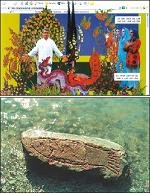
Exhibiting at the 12th Asian Art Biennial is an 'interactive multimedia' display, titled Paradise by Iranian artist Ahmed Nadalian. Artist, art critic, teacher, philosopher -- Nadalian's career makes fascinating reading.
After representing his country Iran in the last Venice biennial, he rose to fame. Since then, through his work Nadalian has communicated themes that he believes are fundamental for humanity: respect for the environment, new technologies and freedom of expression, blending of tradition and contemporary art forms, natural disasters, the vulnerability of humankind and the global issue of terrorism.
In his work Paradise, a viewer can visualise the composition of the flora and fauna of an imaginary heavenly atmosphere on digital system. To quote Nadalian, "Paradise presents the ideal state of the earth. I'm a believer of Sufism. I believe that the essence of Allah can be found in the beauty and harmony of man and nature. And my display represents the theme."
During his short visit to Dhaka, Nadalian has carved a few stones at Shilpakala Academy and later he has dropped them in a pond at Sonargaon, to preserve them in the midst of nature. Nadalian says, "Creative people incorporate elements from nature, while my approach is to enrich nature. This motivated me to carve stones and later hide or bury those in the midst of nature."
"I leave my contact numbers and website address (www.riverart.net) on these stones, yet have no inclination to disclose their exact whereabouts. What I intend is for the spectator searching for the artwork to perhaps discover something more valuable than my stones in nature. I consider myself a partner in the spectator's findings."
Film Fest's Coming Attraction: a Sufi Evening
By Sarah Phelan - MetroActive
March 15, 2006
Fifth annual Santa Cruz Film Festival
Rumi With a View: Filmmaker Tina Petrova's documentary on the mystic poet will be part of a March 24 Sufi celebration at the Rio.
Why did Canadian filmmaker Tina Petrova, who was brought up Roman Catholic and became a Tibetan Buddhist, make a documentary about Muslim mystic Rumi, a man born in Afghanistan at the time of Genghis Khan and whose astonishingly modern poetry continues to outsell Shakespeare, 9/11 notwithstanding?
The answer begins in the Mojave Desert, which is where Petrova was chanting a mantra while driving a mountain road when her car hit black ice in 1997. This confluence of events sent her hurtling off a 6,000-foot cliff--and toward the making of Rumi--Turning Ecstatic. The documentary, which weaves her personal journey into a planetary excursion, screens at the Rio Theatre on May 24 as part of an evening of Sufi music, film, poetry and dance.
Trapped upside-down in her seat belt, her ribs broken, Petrova, who was afraid her gas tank would explode, used her yoga skills to go into a full lotus position from which she was able to crawl through the spiderweb of glass that was once her car's windshield. Though she escaped with her life, rebirth was not easy. In a body brace and suffering pain so debilitating that she could not work, Petrova despairingly did a novena to the Virgin Mary on Dec. 23, 1998.
"That night, Rumi came to me in a dream and told me to bring together a group of world-class performers and create a live event," says Petrova of the odyssey that led her to world-renowned Rumi translator Coleman Barks and, from there, to a successful event in Toronto which Canada's Vision TV urged her to make into a documentary about Rumi and Sufism.
"They saw my personal story as a doorway into Sufism, they told me it was what made it accessible," recalls Petrova, who uses her personal experience as a portal into the poetry of Rumi, the ecstasy of Sufism and the oneness of God.
Along the way, Petrova met many Sufi luminaries, including the Santa Cruz-based Kabir Helminski, who directs the Threshold Society, which works to apply Sufi principles to modern life. On March 24, when Petrova's film screens, Helminski will direct a live performance by Baranka, a Sufi music ensemble, featuring Sonia Drakulic and Gari Haggedus, Hamed Nikpay, Daud Jerrahi and some of the Whirling Dervishes of the Threshold Society.
Call Of The Mystic from Bahramji & Maneesh De Moor

OpenPR - Amsterdam - 03-14-2006
Imagine this: 35º celsius, a warm breeze, the fragrance of the ocean … voices of people singing together – enjoying life as it is … they sing, chant, laugh and dance ‘till they drop! Who are these people?
Call them Sufi’s – and Bahramji is one of their number. He plays a magical instrument, the Persian Santoor, which – the Sufi’s say, creates the sound of emptiness. In addition, he is a fine singer, a channel for the divine … and a great cook!
Based in the urban jungle of Amsterdam, Maneesh de Moor is musician and producer, who specializes in the crossover between the ethnic and the ambient – the traditional and the contemporary … a magician, who brings the past into the present.
Different roots, but meeting in the same bliss, keyboard-wiz Maneesh and Sufi mystic Bahramji jump together into the studio and created for us this most precious music. Made in deep respect for each other’s amazing talents, from the heart, with no compromise. The lyrics are based on Rumi’s and other mystical poetry and the tracks carry an urban vibe rooted in meditation.
Call Of The Mystic - Bahramji & Maneesh De Moor
Tracklist: 01 Crazy Heart 7:13 // 02 Watch the Cat 9:24 // 03 La Illaha feat. Sudha 7:18 // 04 Moment With You 6:26 // 05 Dreamcatcher 7:54 // 06 Arambol Connection 1:41 // 07 Return of the Nightingale 11:03 /// Total Time: 50:20
BLUE FLAME Records
Zila Khan pays tribute to her father
NDTVmusic.com - New Delhi - India
Tuesday, 14 March, 2006
On Monday evening, Sufi singer Zila Khan brought together some musical moments to pay a tribute to her father, sitar maestro Ustad Vilayat Khan in the Capital.
“I feel honoured to be the daughter of a legendary person like my father and it’s a privilege to organize this evening,” said Zila Khan.
The rendition by Ustad Shahid Pervez on the sitar was followed by a documentary on Ustad Vilayat Khan's life and contribution to music.
With an impromptu vocal recital by Zila Khan, it was an evening to remember.
From Green Beret to Peace Activist: William T. Hathaway and His Books
By Daniela Rommel - Countercurrents.org
Tuesday, 14 March, 2006
"It took me years to overcome the warrior indoctrination I got in the Special Forces. It was very deeply ingrained. What finally brought me out of it was meditation and my wife's persistent love," says author William T. Hathaway. "Now I look back and ask, How could I have fallen for that military nonsense?"
A Special Forces combat veteran, Hathaway has answered that question in two novels about what attracts men to war and how they can be healed of the pathology of patriarchal machismo. His first novel, A WORLD OF HURT, won a Rinehart Foundation Award for its portrayal of the blocked sexuality and the need for paternal approval that draw men to the military.
"I was trying to uncover the psychological roots of war, the forces that so persistently drive our species to slaughter," says Hathaway. "Our culture has degraded masculinity into a deadly toxin. It's poisoned us all. Men have to confront this part of themselves before men and women together can heal it."
He is active in a group offering support and shelter to soldiers who have refused to be sent to Iraq and Afghanistan. "The real heroes in the military are the deserters," says Hathaway. He wrote the introduction to AMERICA SPEAKS OUT: Collected Essays from Dissident Writers and has published numerous shorter pieces, including "Sedition, Subversion, Sabotage" in CounterCurrents.
His writing won him a Fulbright professorship at universities in Germany, where he currently lives.
Hathaway sees spirituality as an essential component of a more peaceful world. "My military experience convinced me that to prevent war we need to raise human consciousness. A look at the history of revolutions shows that switching economic and political systems isn't enough. The same aggressive personality types take over and start another army. We have to change the basic unit, the individual.
"Many of my leftist colleagues ignore this because they see the individual as the product of social and material forces. But I think the human heart is deeper than that and can be changed.
"I've found Eastern meditation to be the most effective way to change people. Unlike prayer, it works on the physiological level, altering the brain waves and metabolism. It refines the nervous system and expands the awareness so that the unity of all human beings becomes a living reality, not just an idealistic concept.
After a while of meditation people stop wanting to consume things that increase aggression, such as meat, alcohol, and violent entertainment. They become more peaceful."
Hathaway's just-released novel, SUMMER SNOW, approaches peace from this meditative perspective. It is set amidst the war on terrorism as an American warrior falls in love with a Sufi Muslim and learns from her an alternative to the military mentality.
While Special Forces battle al-Qaeda, the escalating violence threatens their future together and the lives of thousands in her country. To save them, she shows him an ancient transcendental way to bring peace to the collective consciousness and prevent terrorism. But can they make it work in time?
The book's wisdom figure is a Sufi crone, the warrior's lover's teacher, who has survived by outsmarting male political and religious hierarchies. "This bin Laden, this Bush, all these leading men, they have highjacked us all with their violence," she states. "They have turned the whole world into their suicide airplane. These men are too primitive to have such power. Too ignorant of the underlying reality. We must stop them. We must take the boys' toys away from them...these terrible weapons."
How she does that becomes the climax of the novel.
The book's theme is that higher consciousness is more effective than violence and that women may be more able than men to lead us there.
Hathaway spent a year and a half in Central Asia researching and writing SUMMER SNOW. The first chapter is on the publisher's website, http://www.avatarpublication.com/books/?id=13
By overcoming his Special Forces indoctrination, William T. Hathaway became a defector from the warrior corps and an opponent of militarism. His books shine light into our civilization's heart of darkness and show us ways out of the violence.
Contours of a new terror matrix
By Wilson John - The Pioneer - India
March 14, 2006, New Delhi
The stage is set for a new terrorist confederation with the sole agenda of wreaking havoc across the heartland of India in the months to come. Ignorance or indifference to the clear signs of such an alliance - visible from Bangalore to Delhi, via Ayodhya, Nalgonda, Mulund and Varanasi - would prove suicidal for India.
One of the most dangerous terrorist groups in the world, Lashkar-e-Toiba (LeT), operating in Pakistan almost freely with the blessings of the Pakistan state, especially the Army and the Inter-Services Intelligence directorate, has been re-activated at several locations in India.
LeT is the only terrorist organisation in Pakistan that has been allowed to expand its network, recruit and gather funds, despite a worldwide ban. It works under the cover of Jamaat-ud-Dawa, its parent organisation, which claims to be a charitable and educational organisation committed to bring about an Islamic revolution by teaching and training students in the Islamic way of life, while imparting in them the spirit and content of modern, scientific education.
LeT's first forays into India began after the Babri Masjid demolition in December 1992, recruiting its first set of terror soldiers, Jalees Ansari, Azzam Ghauri and Abdul Karim Tunda, etc. Operational bases were set up in Mumbai, Delhi and Hyderabad, exploiting the widespread rage among Muslims in the wake of the demolition. The group exploits two sets of local support to execute its operations - the ISI assets and its ideological association with Ahl-e-Hadis, an Islamic school of thought, which emerged in India following the downfall of the Mughal empire with the objective of restoring Islam to its prior glory and power.
Hadis advocated return to the scriptures and called for purifying the religion of its external influences, like Hinduism and even Sufism. It was the followers of Hadis founding father, Shah Walilullah of Delhi, who launched their first jihad against Sikhs, and subsequently against the British, before being crushed by the British in 1857.
Naqshbandi and Kohr
By Milo Clark - Swans.com
March 13, 2006
(Swans - March 13, 2006) Sufism is often said to be the mysticism of Islam. Naqshbandi is a brand of Sufism. Few grok Sufism.
Leopold Kohr, a socio-economist philosopher, expounded the size theory of history. Smaller is better. Larger eventually implodes. Kohr may be described as a mystic of economics. Few grok Kohr.
Islam and Sufism incorporate strong requirements for belief. Naqshbandi (don't try to pronounce it, just accept a visualization based in the letters as given) is a belief system with a near thousand-year core.
A Naqshbandi Murshid will start you with simple instructions: With a broken shovel, empty the earth. With a leaky bucket, drain the oceans. With a direction, walk.
These essential instructions in faith are somewhat akin to grokking Zen's one hand clapping: you get it or you don't. Zen is a Japanese mysticism that sprung from the Chan Buddhisms of China. From small beginnings may come clarity.
My point here is to back quietly into the actuality that there are many mysticisms, many Islams, many Sufisms, just as there are many economics. All share degrees of arcane esoterica. The sauce is in the details. All open in small ways.
Certain Buddhist mysticisms evolved within the ancient Bon practices of the Tibetan plateau. The introduced Buddhisms came to overlay the indigenous Bon and thus Bon gave form to Tibetan Buddhisms. There are now several Bon/Buddhisms rampant within the Tibetan communities.
Sufisms, Buddhisms, and mysticisms have affinities for stark landscapes, rugged mountains, sere deserts. Wildness and winds create conditions testing human endurance as well as tending to keep people inside, separated, and alone for extended periods. Meditative, mindful, or mad by measures.
Disciplines virtually unknowable and unknown outside such regions evolve very strong people.
Outside Tibet, mystical whirlwinds affecting mind, body, and spirit have been unleashed by events since the 1959 invasion by the ChiComs of PRChina.
The Tibetans are upon us and personalized by the 14th Dalai Lama, Nobel Peace Laureate, et al. Rinpoches, Tulkus, and Lamas abound along with courses, retreats, seminars, workshops and immersions. Translations of texts and copies of thankas, mandalas, sutras, and mantras sprout like mushrooms in a fecund forest.
Bon/Buddhist practices involve elaborate visualizations of immensely complex details slammed into memories until integrated. Very unWestern in many ways. Their integration also provides definition for grok.
Similarly, yet very quietly by comparison, Sufi schools have come west. Given that Islam, per se, is a relatively recent monotheism, Sufi principles branching from Islam are also little more than seven to eight hundred years upon the spiritual landscape. Naqshbandi is one school that has expanded and enlisted Westerners.
All mysticisms appear to cover their core beliefs with elaborate processes that remain occult to the uninitiated, yet open up like a beautiful rose for those who will see. As Ram Das famously advocated, "Be Here Now!"
All mysticisms have a focus on breath as gateway to awareness of the moment. For Naqshbandi, awareness of breath in this moment is a first principle.
Leopold Kohr wrote a marvelous little book called The City of Man (The Duke of Buen Consejo). In its 70 pages, all that can be needed to plan vital communities is compacted in singing prose.
A city must breathe and exist now for those who choose it. Walking rather than riding opens the best of human processes and being. Shopkeepers with a personal investment in their premises and products are an inherent guide to quality. Human scale accommodations keep us close imbuing separations with inclusion. Fewer people lead to better acquaintance.
Kohr noted that a way to confront crisis was simply to step back, to regain perspective. Mysticisms lead us to confront through meditation. To see otherwise. Pythagoras, in Kohr's view, found the measure of all things in man as did Leonardo in his famous circle centered on the outreach of a man.
Kirkpatrick Sale, a small world protagonist, devotee of Kohr and Fritz Schumacher, wrote a wonderful volume on Human Scale.
Austrian physicist Erwin Schrödinger, of cats fame, wrote a small volume, What is Life? Which shows why things must be small. The bigger they are, the more they collide and impair freedom. By moving freely, new patterns and possibilities are always possible. Overcrowding, as proven by too many rats in a cage, leads to fighting, destruction, and implosion.
Taking Newton a step, Kohr says that everything, say potency, diminishes with the square of distance. The farther from seat of government, the less the authority and ability to compel much less administer, to follow rule of law. Thus, empires historically disintegrate at the fringes. To maintain control, bureaucracies flourish and military abounds, eventually imploding from lack of core. Feel like now, maybe?
Harbors, he says, provide shelter from uncontrollable oceans. Build harbors, create refuges, covet communities, give space to breathe, time to know awareness.
In smallness lies survival.
Breathe. And know that you are god
On a docu-film on Ustad Vilayat Khan: Interview
By Piyali Dasgupta - The Times of India - Straight Answers
Calcutta, Monday, 13 March, 2006
Zila Khan, Sufi singer, on making a documentary film on her father, Ustad Vilayat Khan.
You have made a docu-film on your father, Ustad Vilayat Khan...
I attribute my success to my late father, Ustad Vilayat Khan. It's his values that remain embedded in my heart. On his second death anniversary, I plan to release a docu-film called Spirit to Soul, which is a tribute to my father. It traces his life's journey and also talks about the inspiration that I continue to receive from him.
How did you feel when your father refused to let you sing in public?
At that time I was 12 and I asked my father's permission to sing on stage. He just refused. I belong to a conservative Muslim family in which women were not allowed to step out of their homes.
Singing in public was a complete no-no. I refused to consider that as the end of the road.
So how did your father finally agree?
I continued with my riyaz at home. In the meanwhile, I also got to assist my father in his concerts. When I came of age, my father decided it was time for me to get married. Actually, he was looking for a way out for me. So, he found me a boy Dr Khalim Anwar who wouldn't mind his wife singing on stage.
And then, just six days after my wedding, my father held a special ceremony, Gandha Bandhan, to make me his shaagird and told me to do 10 hours of riyaz everyday.
Monday, October 09, 2006
On Baul and Sufi singing: Interview
By Reetu Joshi - The Times of India - Straight Answers
Sunday, 12 March, 2006
Baul Singer Parvathy Baul, on Baul and Sufi singing.
Tell us something about Baul singing?
Baul is one of the widely known and appreciated kinds of folk music in Bengal and believed to date back to the 15th century. It's not only a kind of music but also a Bengali religious sect.
The persons belonging to that sect are commonly referred to as Bauls and the songs they sing is Baul gaan. Baul gaans are allegorical in nature, describing the state of separation existing between the souls of men and the spiritual ground.
Is there any connection between Baul and Sufi singing?
Baul singing is different from Sufi singing only in terms of its origin. The latter is basically Islamic in origin while the former has its roots in Hindu tradition. The attributes of both art-forms are very much similar in nature.
Both are pure and refined. They penetrate deep into the heart and have a healing power. Singing the two provides spiritual satisfaction not only to the singer but also to the audience.
At present, Sufi songs are a rage in Bollywood movies. What are the reasons for this?
I guess pop music, jazz and rock songs can provide only momentary pleasures. But, the folk and Sufi songs give you innate pleasure and peace of mind. That's why the younger generation is increasingly taking to it. It's a welcome change. But the upcoming artistes must not use this art-form only to earn money.
With a change in the outlook of people, are you happy with the current state of folk artistes?
The responses are encouraging yet I am not completely satisfied with the state of folk artistes. Especially, Baul singers are still confined to Bengal only. There is no dearth of talented artistes in our country but there is no backing from government and sponsors.
Subscribe to:
Posts (Atom)
Thursday, October 12, 2006
Devotees stopped from performing rituals


Source: newindpress.com - Southern news- Karnataka
Saturday, March 25, 2006
CHIKMAGALUR: Karnataka Komu Sowharda Vedike leaders alleged that the district administration had restrained devotees from performing rituals as per the Sufi customs during the recently-concluded three-day Urs at the cave shrine Datta Peeta atop Bababudangiri hills.
Talking to reporters here on Thursday, Komu Sowharda Vedike state secretary K.L. Ashok pointed out that the district administration and State government had not permitted religious head Sha Quadri to smear sandal paste and cover tombs with new green cloth (gilf) as per the Sufi custom. K.L. Ashok complained that the Janata Dal-Secular was systematically attacking minorities with the backing of the Bharatiya Janata Party. The administration had restricted religious performances on the pretext of court direction, he added.
Recalling that the Court had asked the district administration to allow all customs that prevailed prior to 1975, he claimed that smearing sandal paste and covering the tomb with new cloth was the custom earlier too.
Without following these rites the Urs was not complete. So Sha Quadri was forced to postpone the Urs date. Gouse Moiddin clarified that another day for the Urs would be fixed after collecting the opinion of minority community.
Komu Sowharda Vedike leader Ahobalpathi, district secretary Puttaswamy and Mahila Jagarthi leader Shantha were present.
Read More
Saturday, March 25, 2006
CHIKMAGALUR: Karnataka Komu Sowharda Vedike leaders alleged that the district administration had restrained devotees from performing rituals as per the Sufi customs during the recently-concluded three-day Urs at the cave shrine Datta Peeta atop Bababudangiri hills.
Talking to reporters here on Thursday, Komu Sowharda Vedike state secretary K.L. Ashok pointed out that the district administration and State government had not permitted religious head Sha Quadri to smear sandal paste and cover tombs with new green cloth (gilf) as per the Sufi custom. K.L. Ashok complained that the Janata Dal-Secular was systematically attacking minorities with the backing of the Bharatiya Janata Party. The administration had restricted religious performances on the pretext of court direction, he added.
Recalling that the Court had asked the district administration to allow all customs that prevailed prior to 1975, he claimed that smearing sandal paste and covering the tomb with new cloth was the custom earlier too.
Without following these rites the Urs was not complete. So Sha Quadri was forced to postpone the Urs date. Gouse Moiddin clarified that another day for the Urs would be fixed after collecting the opinion of minority community.
Komu Sowharda Vedike leader Ahobalpathi, district secretary Puttaswamy and Mahila Jagarthi leader Shantha were present.

Isabelle Wen the fabric speak
By Jules Quartly, staff reporter - Taipei Times
Thursday, Mar 23, 2006
The "Twirling Sofi" show at the designer's restaurant/lounge bar in Taipei was inspired by sufism and the dance of the whirling dervishes that is said to represent a spiritual journey to perfection. Isabelle Wen's (溫慶珠) latest spring/summer offering on the weekend was her favored combination of feminine frills and sequins; there was an edge that had observers saying it was one of her best collections yet.
And since this year is the 20th anniversary of the founding of her design company, the collection was an achievement that deserved all the applause it got. The Taipei fashionista has hit a high point in her career and the only problem is keeping up the momentum. But behind success there is sometimes sadness. A brush with a life-threatening illness and overcoming a creative hiatus six years ago has made Wen more appreciative of life's blessings and drove her to reach greater heights. Even so, she said her public image was "a shell."
"Though I may be sick and tired it is my job to make people happy. I don't want them to see just the horrible side of life, it is my job to reveal beauty," Wen said in an interview on Tuesday at her studio and workshop in Shihlin. Wen said her current collection was, to an extent, the result of overcoming problems. In fashion as in art, there is no gain without pain.
"I was listening to a midnight radio station called Ai Yue Diantai (愛樂電台) at my house. There was this music and the announcer said it was from a whirling dervish dance. It spoke to me of religion, prayers, layers of white and spirituality. There seemed to be a rainbow in my mind. It made me forget the pain."
Like the dervish who attains a zen-like state, Wen said the music had helped her put "spiritual and material together" to come up with a concept for her show, "which is a way of letting fabric tell the story."
Read More
Thursday, Mar 23, 2006
The "Twirling Sofi" show at the designer's restaurant/lounge bar in Taipei was inspired by sufism and the dance of the whirling dervishes that is said to represent a spiritual journey to perfection. Isabelle Wen's (溫慶珠) latest spring/summer offering on the weekend was her favored combination of feminine frills and sequins; there was an edge that had observers saying it was one of her best collections yet.
And since this year is the 20th anniversary of the founding of her design company, the collection was an achievement that deserved all the applause it got. The Taipei fashionista has hit a high point in her career and the only problem is keeping up the momentum. But behind success there is sometimes sadness. A brush with a life-threatening illness and overcoming a creative hiatus six years ago has made Wen more appreciative of life's blessings and drove her to reach greater heights. Even so, she said her public image was "a shell."
"Though I may be sick and tired it is my job to make people happy. I don't want them to see just the horrible side of life, it is my job to reveal beauty," Wen said in an interview on Tuesday at her studio and workshop in Shihlin. Wen said her current collection was, to an extent, the result of overcoming problems. In fashion as in art, there is no gain without pain.
"I was listening to a midnight radio station called Ai Yue Diantai (愛樂電台) at my house. There was this music and the announcer said it was from a whirling dervish dance. It spoke to me of religion, prayers, layers of white and spirituality. There seemed to be a rainbow in my mind. It made me forget the pain."
Like the dervish who attains a zen-like state, Wen said the music had helped her put "spiritual and material together" to come up with a concept for her show, "which is a way of letting fabric tell the story."
Wednesday, October 11, 2006
Unless It's Value-Added, Religion's a Non-Starter These Days
By Russ Wellen - Freezerbox
Thursday, March 23, 2006
Worshippers are no longer content to take their religion straight anymore. They need a chaser. And that chaser is oppositional defiance.
Building a denomination or congregation today requires rallying it around the forces of evil -usually more imagined than real?
In America, congregations are pitted against other segments of America; the only religions where most of the worshippers commune with a higher power as opposed to raging against sinners are the activist and monastic branches of Christianity and the meditative traditions of Buddhism, Hinduism, and Islam (Sufism).
Read More
Thursday, March 23, 2006
Worshippers are no longer content to take their religion straight anymore. They need a chaser. And that chaser is oppositional defiance.
Building a denomination or congregation today requires rallying it around the forces of evil -usually more imagined than real?
In America, congregations are pitted against other segments of America; the only religions where most of the worshippers commune with a higher power as opposed to raging against sinners are the activist and monastic branches of Christianity and the meditative traditions of Buddhism, Hinduism, and Islam (Sufism).
Sufism Symposium: Understanding Islam from the Sufi Perspective in San Jose, California
Press release from: IAS
Open PR - 03-23-2006
Learn about Islam at Sufism Symposium
Scholars from around the world will make presentations to promote the understanding of Islam at the International Sufism Symposium at the Hilton Hotel, 300 Almaden Boulevard, San Jose, Friday through Sunday, May 5 - 7.
The weekend will include a Sufi psychology panel presentation on Friday afternoon at 3:00 pm offering CEUs for therapists. Workshops and lectures will take place on Saturday and Sunday beginning at 9:00 am each day. A Saturday evening prayer gathering will include Sufi zekr. Taneen Sufi Music Ensemble will present an interfaith concert with Ya Elah, Jewish Music Ensemble, on Friday, May 5 at 8 pm.
The Sufi Women’s Organization will bring together women from many countries and the young adult program, “Voices for Justice” will hold an open meeting.
This multi-cultural celebration is sponsored by the International Association of Sufism, headquartered in Novato. The weekend is open to the public with registration available for one, two or three days. Discounts are available for students and seniors and all programs are wheelchair accessible.
Read More
Open PR - 03-23-2006
Learn about Islam at Sufism Symposium
Scholars from around the world will make presentations to promote the understanding of Islam at the International Sufism Symposium at the Hilton Hotel, 300 Almaden Boulevard, San Jose, Friday through Sunday, May 5 - 7.
The weekend will include a Sufi psychology panel presentation on Friday afternoon at 3:00 pm offering CEUs for therapists. Workshops and lectures will take place on Saturday and Sunday beginning at 9:00 am each day. A Saturday evening prayer gathering will include Sufi zekr. Taneen Sufi Music Ensemble will present an interfaith concert with Ya Elah, Jewish Music Ensemble, on Friday, May 5 at 8 pm.
The Sufi Women’s Organization will bring together women from many countries and the young adult program, “Voices for Justice” will hold an open meeting.
This multi-cultural celebration is sponsored by the International Association of Sufism, headquartered in Novato. The weekend is open to the public with registration available for one, two or three days. Discounts are available for students and seniors and all programs are wheelchair accessible.
Pakistani court sentences two militants to death
Bureau Report - Zeenews.com - Quetta, Pakistan
Thursday, March 23, 2006
A Pakistani court today sentenced to death two bomb-makers involved in a sectarian attack that killed 43 people at Muslim shrine in southwest Pakistan a year ago, lawyers said.
While receiving life terms for their role in the attack on the shrine near Gandhawa town in the southwestern province of Baluchistan, the two men were sentenced to death after being found guilty of a subsequent attempt to assemble a bomb.
The anti-terrorism court in Sibi district, where Gandhawa is located, also sentenced three other men to life in prison for the attack on the shrine dedicated to a Muslim saint.
The convicted men were all members of the banned Sipah-e-Sahaba Pakistan (Pakistan Army of the companions of the prophet) militant organisation. Sipah-e-Sahaba is a radical Sunni Muslim group which opposes Sufism, a mystical version of Islam propagated by saints. The group was banned by the government in 2002 as part of Pakistan's campaign to rein in Islamist militants.
Thousands of people had gathered at the shrine for an annual celebration when the blasts occurred.
Read More
Thursday, March 23, 2006
A Pakistani court today sentenced to death two bomb-makers involved in a sectarian attack that killed 43 people at Muslim shrine in southwest Pakistan a year ago, lawyers said.
While receiving life terms for their role in the attack on the shrine near Gandhawa town in the southwestern province of Baluchistan, the two men were sentenced to death after being found guilty of a subsequent attempt to assemble a bomb.
The anti-terrorism court in Sibi district, where Gandhawa is located, also sentenced three other men to life in prison for the attack on the shrine dedicated to a Muslim saint.
The convicted men were all members of the banned Sipah-e-Sahaba Pakistan (Pakistan Army of the companions of the prophet) militant organisation. Sipah-e-Sahaba is a radical Sunni Muslim group which opposes Sufism, a mystical version of Islam propagated by saints. The group was banned by the government in 2002 as part of Pakistan's campaign to rein in Islamist militants.
Thousands of people had gathered at the shrine for an annual celebration when the blasts occurred.
Data’s anniversary celebrations end
Staff Report - Daily Times - Pakistan
Lahore, Wednesday, March 22, 2006
The annual three-day Urs (anniversary) of Lahore’s patron saint Data Gunj Buksh’s ended on Tuesday. Poetry, music, dance and love for humanity continue.
Thousands of devotees of the renowned Sufi saint, one of the major preachers of Islam in the subcontinent, visited his shrine from all over the country and abroad. Devotees participated in events featuring Sufi poetry, folk music and dance.
The weather remained pleasant and pilgrims were given free food and milk at the shrine.
A large number of visitors shopped at Lahore’s markets and went to parks and most cheap, small hotels and inns in the city were full. Several poor visitors spent the night in the open. The event also featured a large number of beggars coming to the city not only for free food and milk but also to collect alms from thousands of visitors.
The last day of the official celebration began with recitation from the Holy Quran. People laid chadors at the shrine and did the traditional dhamaal late into the night. A number of people spent the entire day at the shrine to pray and recite the Holy Quran. Punjab Religious Affairs and Auqaf Minister Sahabzada Saeedul Hasan Shah distributed prizes among the winners of Qawwali, Qirat and Naat competitions. The ceremony ended with prayers led by Allama Muhammad Maqsood Ahmad Qadri, khateeb of the Data Sahib Jamia Mosque.
Clerics participating in seminars and gatherings stressed the importance of peace and tolerance and said Sufi saints like Data Sahib played a key role in spreading Islam in the subcontinent. Prayers were offered for national security and prosperity. The district government had already announced a local holiday on the last day of the anniversary.
Read More
Lahore, Wednesday, March 22, 2006
The annual three-day Urs (anniversary) of Lahore’s patron saint Data Gunj Buksh’s ended on Tuesday. Poetry, music, dance and love for humanity continue.
Thousands of devotees of the renowned Sufi saint, one of the major preachers of Islam in the subcontinent, visited his shrine from all over the country and abroad. Devotees participated in events featuring Sufi poetry, folk music and dance.
The weather remained pleasant and pilgrims were given free food and milk at the shrine.
A large number of visitors shopped at Lahore’s markets and went to parks and most cheap, small hotels and inns in the city were full. Several poor visitors spent the night in the open. The event also featured a large number of beggars coming to the city not only for free food and milk but also to collect alms from thousands of visitors.
The last day of the official celebration began with recitation from the Holy Quran. People laid chadors at the shrine and did the traditional dhamaal late into the night. A number of people spent the entire day at the shrine to pray and recite the Holy Quran. Punjab Religious Affairs and Auqaf Minister Sahabzada Saeedul Hasan Shah distributed prizes among the winners of Qawwali, Qirat and Naat competitions. The ceremony ended with prayers led by Allama Muhammad Maqsood Ahmad Qadri, khateeb of the Data Sahib Jamia Mosque.
Clerics participating in seminars and gatherings stressed the importance of peace and tolerance and said Sufi saints like Data Sahib played a key role in spreading Islam in the subcontinent. Prayers were offered for national security and prosperity. The district government had already announced a local holiday on the last day of the anniversary.
Poetry in every plate
By Charles Perry - Los Angeles Times
Wednesday, March 22, 2006
Sufi dishes are pleasing to the eye, such as a simple lettuce salad ringed with crimson rose petals.
In November Nevin Halici published "Sufi Cuisine," a book about this mystical food tradition, which includes recipes of dishes mentioned in Rumi's poems, of other dishes referred to in a history of the Mevlevis written a century after Rumi's time, and also of more recent dishes from a 19th century collection of Sufi recipes.
A dinner party brought life life to verse: the dishes that were appreciated most were the ones most closely drawn from the poetry: sour spinach and sweet spinach. These closely related one-bowl entrees combine, in the case of the former, spinach, lamb, bulgur and pomegranate molasses. The latter has garbanzos rather than bulgur and the sweeter pekmez rather than pomegranate molasses.
Read More
Wednesday, March 22, 2006
Sufi dishes are pleasing to the eye, such as a simple lettuce salad ringed with crimson rose petals.
In November Nevin Halici published "Sufi Cuisine," a book about this mystical food tradition, which includes recipes of dishes mentioned in Rumi's poems, of other dishes referred to in a history of the Mevlevis written a century after Rumi's time, and also of more recent dishes from a 19th century collection of Sufi recipes.
A dinner party brought life life to verse: the dishes that were appreciated most were the ones most closely drawn from the poetry: sour spinach and sweet spinach. These closely related one-bowl entrees combine, in the case of the former, spinach, lamb, bulgur and pomegranate molasses. The latter has garbanzos rather than bulgur and the sweeter pekmez rather than pomegranate molasses.
Tuesday, October 10, 2006
Composite culture: India’s mainstay
By Murali Krishna - Deccan Herald - India
Sunday, March 19, 2006
Composite culture has been the mainstay of our society for ages. Experts point out that this is our unity’s raison d’etre. This has made modern India a model nation. While some countries have suffered from the process of balkanization, India has remained on a strong edifice. Of course, before India became a nation-state, partition took place. But that was the result of divisive communal politics that ripped apart our polity, leaving deep scars. Even after this, India's composite culture remained largely intact. A foray into the making of this composite culture reveals its fascinating facets.
Scholars opine that composite culture took a definite and clear shape between 12th and 16th century AD. During this period, there was amalgamation of the Indian, Iranian and Arabian heritages. They represented Hinduism, Zorastrianism and Islam religions and philosophies respectively.
The intermingling of Hindu and Islamic religious beliefs gave rise to Sufism. Sufi saints and poets effectively established a bond among common people of both these communities. They were held in high esteem. Kabir, Sheikh Salim Chisti, Hazrat Baba Farid Ganj-Shakkar, Hazrat Nizam-ud din Auliya are some of the outstanding sufi saints of this period.
The Bhakti movement also endeared itself to large sections of people by questioning some of the obnoxious practices and beliefs prevailing in the society. Down south, the Adil Shahi sultans who ruled from Bijapur did not practice religious bigotry. Many Hindus held high posts in their courts. Ibrahim Adil Shah II was called ‘Jagadguru'. He was a connoisseur of the arts, sculpture, music and culture. Kitab-e-Nauras one of his works on music has hymns in praise of Saraswati and Ganesh. In Karnataka, there are many shrines which signify the religious amity between Hindus and Muslims. Shirahatti’s Fakiraswamy and Bababudan Giri shrines among many and most of the darghas attract devotees of both these communities in good numbers.
Raja Rammohan Roy, the social reformer of the 19th century, had deep knowledge of both Hindu and Islamic scriptures. In addition, he was attracted by Christian charity and European rationalism. The national liberation struggle also had ingredients of composite culture. Many people of various communities rallied around and participated in large numbers braving many odds.
In recent times, concerted efforts were made to topple this edifice of composite culture. They were represented by forces of communalism and fundamentalism. Throwing proper historical analysis to the wind, they distorted facts and incited communal passions for their nefarious interests. We need not see far to know the plight of people in such a state. It is necessary for progressive people to close ranks and combat forces opposed to composite culture. Only then, can our fledgling democracy hope to survive.
Read More
Sunday, March 19, 2006
Composite culture has been the mainstay of our society for ages. Experts point out that this is our unity’s raison d’etre. This has made modern India a model nation. While some countries have suffered from the process of balkanization, India has remained on a strong edifice. Of course, before India became a nation-state, partition took place. But that was the result of divisive communal politics that ripped apart our polity, leaving deep scars. Even after this, India's composite culture remained largely intact. A foray into the making of this composite culture reveals its fascinating facets.
Scholars opine that composite culture took a definite and clear shape between 12th and 16th century AD. During this period, there was amalgamation of the Indian, Iranian and Arabian heritages. They represented Hinduism, Zorastrianism and Islam religions and philosophies respectively.
The intermingling of Hindu and Islamic religious beliefs gave rise to Sufism. Sufi saints and poets effectively established a bond among common people of both these communities. They were held in high esteem. Kabir, Sheikh Salim Chisti, Hazrat Baba Farid Ganj-Shakkar, Hazrat Nizam-ud din Auliya are some of the outstanding sufi saints of this period.
The Bhakti movement also endeared itself to large sections of people by questioning some of the obnoxious practices and beliefs prevailing in the society. Down south, the Adil Shahi sultans who ruled from Bijapur did not practice religious bigotry. Many Hindus held high posts in their courts. Ibrahim Adil Shah II was called ‘Jagadguru'. He was a connoisseur of the arts, sculpture, music and culture. Kitab-e-Nauras one of his works on music has hymns in praise of Saraswati and Ganesh. In Karnataka, there are many shrines which signify the religious amity between Hindus and Muslims. Shirahatti’s Fakiraswamy and Bababudan Giri shrines among many and most of the darghas attract devotees of both these communities in good numbers.
Raja Rammohan Roy, the social reformer of the 19th century, had deep knowledge of both Hindu and Islamic scriptures. In addition, he was attracted by Christian charity and European rationalism. The national liberation struggle also had ingredients of composite culture. Many people of various communities rallied around and participated in large numbers braving many odds.
In recent times, concerted efforts were made to topple this edifice of composite culture. They were represented by forces of communalism and fundamentalism. Throwing proper historical analysis to the wind, they distorted facts and incited communal passions for their nefarious interests. We need not see far to know the plight of people in such a state. It is necessary for progressive people to close ranks and combat forces opposed to composite culture. Only then, can our fledgling democracy hope to survive.
Kailash Kher singer on his debut album
By Mona Ramavat - The Times of India - Straight Answers
Hyderabad, Sunday, 19 March, 2006
'Popularity is a rather relative term'
Kailash Kehr, your first album is out finally. Will the title track Teri diwani become as popular as your Allah ke bande?
To begin with, popularity is a rather relative term. Allah ke bande was a different product with its own message and Teri diwani is unique in its own way.
You can't really compare the two. All I can say is that the latter is an experimental blend of a tune that will stay in one's mind for a long time and a treatment that will more than satisfy one's aesthetic needs.
Why did you choose Hyderabad to shoot the video?
Hyderabad is a beautiful city wrapped in an aura of the past. My music is tinged with some distinct old-time flavours and a Sufi style. Therefore, there couldn't have been locales better than the Charminar, the Qutub Shahi Tombs and the Tank Bund to shoot them at.
They have added immense value to the song. I am really looking forward to doing more such projects in Hyderabad...
What do you have to say about the growing popularity of the Sufi touch in Indian film and pop music?
Sufism is all about seeing love and romance at a level that is nothing less than divine. Its lyrics and rendition are such that they will make the audience feel spiritually connected to everything around them.
People are finding this genre of music quite appealing and music directors are adapting it to suit the popular Indian taste. I feel that experimental Sufi styles will go a long way.
Tell something about the projects you have lined up for the future?
For the present album, I worked with a band of two artistes, Paresh and Naresh, and plan to work on my next project with them again. It will be distinctly different from the present one.
Read More
Hyderabad, Sunday, 19 March, 2006
'Popularity is a rather relative term'
Kailash Kehr, your first album is out finally. Will the title track Teri diwani become as popular as your Allah ke bande?
To begin with, popularity is a rather relative term. Allah ke bande was a different product with its own message and Teri diwani is unique in its own way.
You can't really compare the two. All I can say is that the latter is an experimental blend of a tune that will stay in one's mind for a long time and a treatment that will more than satisfy one's aesthetic needs.
Why did you choose Hyderabad to shoot the video?
Hyderabad is a beautiful city wrapped in an aura of the past. My music is tinged with some distinct old-time flavours and a Sufi style. Therefore, there couldn't have been locales better than the Charminar, the Qutub Shahi Tombs and the Tank Bund to shoot them at.
They have added immense value to the song. I am really looking forward to doing more such projects in Hyderabad...
What do you have to say about the growing popularity of the Sufi touch in Indian film and pop music?
Sufism is all about seeing love and romance at a level that is nothing less than divine. Its lyrics and rendition are such that they will make the audience feel spiritually connected to everything around them.
People are finding this genre of music quite appealing and music directors are adapting it to suit the popular Indian taste. I feel that experimental Sufi styles will go a long way.
Tell something about the projects you have lined up for the future?
For the present album, I worked with a band of two artistes, Paresh and Naresh, and plan to work on my next project with them again. It will be distinctly different from the present one.
Exploring various dimensions of Sufism
By Mandira Nayar - The Hindu
Friday, Mar 17, 2006
After the Capital's annual date with Sufi music -- the newest genre of music to become fashionable -- at Jahan-e-Khusro, it is time to move to more serious aspects of the music: the philosophy. Getting to the heart of the matter, it will give people a perspective on the music.
Celebrating the strong bonds of Sufism is the Foundation of SAARC Writers and Literature. Bringing together the inheritors and followers of this tradition to debate the philosophical issues at a conference, the Foundation hopes to be able to not only focus on mysticism and Sufism, but also highlight the composite culture of this region.
Titled "Sufi Traditions, Poetry and Philosophy'', the conference is a first ever, non-governmental initiative to explore various dimensions of Sufism. This three-day conference aims to strengthen dialogue between boundaries and people.
Besides looking at the historical perspective of the issue from the influence of the Bhakti movement, the conference also seeks to define the futuristic vision of Sufism. Widening the debate to include countries traditionally not in the Sufism "loop" there will be eminent scholars from France, the United States, Britain, Canada and Italy. There will also be scholars from Iran, Afghanistan, Iran and Turkey.
Like all great debates and deliberations, the conference will be held at in the Capital's intellectual hub -- the India International Centre. Beginning March 18, there will be special guests like, former Prime Minister V.P Singh, Omar Khiladi and Adib Hussain.
While the conference aims to give people a chance to get to know the philosophy involved in Sufism, there is an opportunity to enjoy the music too with a performance of Sufi music by Shanti Hiranand on the first day.
Read More
Friday, Mar 17, 2006
After the Capital's annual date with Sufi music -- the newest genre of music to become fashionable -- at Jahan-e-Khusro, it is time to move to more serious aspects of the music: the philosophy. Getting to the heart of the matter, it will give people a perspective on the music.
Celebrating the strong bonds of Sufism is the Foundation of SAARC Writers and Literature. Bringing together the inheritors and followers of this tradition to debate the philosophical issues at a conference, the Foundation hopes to be able to not only focus on mysticism and Sufism, but also highlight the composite culture of this region.
Titled "Sufi Traditions, Poetry and Philosophy'', the conference is a first ever, non-governmental initiative to explore various dimensions of Sufism. This three-day conference aims to strengthen dialogue between boundaries and people.
Besides looking at the historical perspective of the issue from the influence of the Bhakti movement, the conference also seeks to define the futuristic vision of Sufism. Widening the debate to include countries traditionally not in the Sufism "loop" there will be eminent scholars from France, the United States, Britain, Canada and Italy. There will also be scholars from Iran, Afghanistan, Iran and Turkey.
Like all great debates and deliberations, the conference will be held at in the Capital's intellectual hub -- the India International Centre. Beginning March 18, there will be special guests like, former Prime Minister V.P Singh, Omar Khiladi and Adib Hussain.
While the conference aims to give people a chance to get to know the philosophy involved in Sufism, there is an opportunity to enjoy the music too with a performance of Sufi music by Shanti Hiranand on the first day.
Chico, ex-goat herder, first Arab to top charts
By Talal Malik - Reuters - London, 16/03/2006
(Additional reporting by Omar Younis)
A former goat herder has sold twice as many records as Madonna in recent weeks, to become the first Arab to top the British pop singles chart since records began 44 years ago.
"Mashallah - it’s beyond dreams. To know that I’m the first Arab to do that, it’s a very proud moment," Chico told Reuters in an interview. His debut single, "It’s Chico Time", is enjoying its second week in the top spot.
Chico was raised in Morocco by his grandparents until the age of 13. During his childhood he worked as a goat herder before leaving for Britain. "I lived with my grandparents in Aroubia, in the mountains, and was a goat herder. What a life - I was brought up on a thousand-year tradition."
As well as pop music success, Chico and Madonna share an interest in mysticism -- Chico became a Sufi disciple 16 months ago and Madonna’s devotion to the Jewish school of mysticism, Kabbalah, is well-known.
The pop star says his new-found fame was the result of mentoring from Shaykh Nazim al-Qubrusi, an 83-year old Sufi mystic living in northern Cyprus. "Until I met Mawlana Shaykh Nazim, my whole life was in the wilderness, I was like a moth wondering aimlessly, waiting to be reunited with the Divine Ocean," he said.
To avoid being cast as a "one-hit wonder" like many of his talent-show peers, Chico -- the first Arab at the top spot on the Official UK charts for at least four decades -- said he will release an album with a Middle Eastern flavour.
Prior to becoming a singer, Chico and his brother also produced a short film which gained a British Film and Television Academy Award (BAFTA) nomination, and still harbours ambitions to make films.
"Ultimately, I would like to make spiritual films, such as about the Prophet Mohammed, his companions and people like the Sufi poet Jalaluddin Rumi. Whatever I’m going to be doing, it’s going to be spiritually involved."
It is an ambitious leap from "It’s Chico Time", which features the chorus: "Well, you can get delirious, if you take life too serious."
Read More
(Additional reporting by Omar Younis)
A former goat herder has sold twice as many records as Madonna in recent weeks, to become the first Arab to top the British pop singles chart since records began 44 years ago.
"Mashallah - it’s beyond dreams. To know that I’m the first Arab to do that, it’s a very proud moment," Chico told Reuters in an interview. His debut single, "It’s Chico Time", is enjoying its second week in the top spot.
Chico was raised in Morocco by his grandparents until the age of 13. During his childhood he worked as a goat herder before leaving for Britain. "I lived with my grandparents in Aroubia, in the mountains, and was a goat herder. What a life - I was brought up on a thousand-year tradition."
As well as pop music success, Chico and Madonna share an interest in mysticism -- Chico became a Sufi disciple 16 months ago and Madonna’s devotion to the Jewish school of mysticism, Kabbalah, is well-known.
The pop star says his new-found fame was the result of mentoring from Shaykh Nazim al-Qubrusi, an 83-year old Sufi mystic living in northern Cyprus. "Until I met Mawlana Shaykh Nazim, my whole life was in the wilderness, I was like a moth wondering aimlessly, waiting to be reunited with the Divine Ocean," he said.
To avoid being cast as a "one-hit wonder" like many of his talent-show peers, Chico -- the first Arab at the top spot on the Official UK charts for at least four decades -- said he will release an album with a Middle Eastern flavour.
Prior to becoming a singer, Chico and his brother also produced a short film which gained a British Film and Television Academy Award (BAFTA) nomination, and still harbours ambitions to make films.
"Ultimately, I would like to make spiritual films, such as about the Prophet Mohammed, his companions and people like the Sufi poet Jalaluddin Rumi. Whatever I’m going to be doing, it’s going to be spiritually involved."
It is an ambitious leap from "It’s Chico Time", which features the chorus: "Well, you can get delirious, if you take life too serious."
Ahmed Nadalian, an artist with a unique perspective

By Ershad Kamol - The Daily Star - Bangladesh
Thursday, March 16, 2006
Exhibiting at the 12th Asian Art Biennial is an 'interactive multimedia' display, titled Paradise by Iranian artist Ahmed Nadalian. Artist, art critic, teacher, philosopher -- Nadalian's career makes fascinating reading.
After representing his country Iran in the last Venice biennial, he rose to fame. Since then, through his work Nadalian has communicated themes that he believes are fundamental for humanity: respect for the environment, new technologies and freedom of expression, blending of tradition and contemporary art forms, natural disasters, the vulnerability of humankind and the global issue of terrorism.
In his work Paradise, a viewer can visualise the composition of the flora and fauna of an imaginary heavenly atmosphere on digital system. To quote Nadalian, "Paradise presents the ideal state of the earth. I'm a believer of Sufism. I believe that the essence of Allah can be found in the beauty and harmony of man and nature. And my display represents the theme."
During his short visit to Dhaka, Nadalian has carved a few stones at Shilpakala Academy and later he has dropped them in a pond at Sonargaon, to preserve them in the midst of nature. Nadalian says, "Creative people incorporate elements from nature, while my approach is to enrich nature. This motivated me to carve stones and later hide or bury those in the midst of nature."
"I leave my contact numbers and website address (www.riverart.net) on these stones, yet have no inclination to disclose their exact whereabouts. What I intend is for the spectator searching for the artwork to perhaps discover something more valuable than my stones in nature. I consider myself a partner in the spectator's findings."
Read More
By Ershad Kamol - The Daily Star - Bangladesh
Thursday, March 16, 2006
Exhibiting at the 12th Asian Art Biennial is an 'interactive multimedia' display, titled Paradise by Iranian artist Ahmed Nadalian. Artist, art critic, teacher, philosopher -- Nadalian's career makes fascinating reading.
After representing his country Iran in the last Venice biennial, he rose to fame. Since then, through his work Nadalian has communicated themes that he believes are fundamental for humanity: respect for the environment, new technologies and freedom of expression, blending of tradition and contemporary art forms, natural disasters, the vulnerability of humankind and the global issue of terrorism.
In his work Paradise, a viewer can visualise the composition of the flora and fauna of an imaginary heavenly atmosphere on digital system. To quote Nadalian, "Paradise presents the ideal state of the earth. I'm a believer of Sufism. I believe that the essence of Allah can be found in the beauty and harmony of man and nature. And my display represents the theme."
During his short visit to Dhaka, Nadalian has carved a few stones at Shilpakala Academy and later he has dropped them in a pond at Sonargaon, to preserve them in the midst of nature. Nadalian says, "Creative people incorporate elements from nature, while my approach is to enrich nature. This motivated me to carve stones and later hide or bury those in the midst of nature."
"I leave my contact numbers and website address (www.riverart.net) on these stones, yet have no inclination to disclose their exact whereabouts. What I intend is for the spectator searching for the artwork to perhaps discover something more valuable than my stones in nature. I consider myself a partner in the spectator's findings."
Film Fest's Coming Attraction: a Sufi Evening
By Sarah Phelan - MetroActive
March 15, 2006
Fifth annual Santa Cruz Film Festival
Rumi With a View: Filmmaker Tina Petrova's documentary on the mystic poet will be part of a March 24 Sufi celebration at the Rio.
Why did Canadian filmmaker Tina Petrova, who was brought up Roman Catholic and became a Tibetan Buddhist, make a documentary about Muslim mystic Rumi, a man born in Afghanistan at the time of Genghis Khan and whose astonishingly modern poetry continues to outsell Shakespeare, 9/11 notwithstanding?
The answer begins in the Mojave Desert, which is where Petrova was chanting a mantra while driving a mountain road when her car hit black ice in 1997. This confluence of events sent her hurtling off a 6,000-foot cliff--and toward the making of Rumi--Turning Ecstatic. The documentary, which weaves her personal journey into a planetary excursion, screens at the Rio Theatre on May 24 as part of an evening of Sufi music, film, poetry and dance.
Trapped upside-down in her seat belt, her ribs broken, Petrova, who was afraid her gas tank would explode, used her yoga skills to go into a full lotus position from which she was able to crawl through the spiderweb of glass that was once her car's windshield. Though she escaped with her life, rebirth was not easy. In a body brace and suffering pain so debilitating that she could not work, Petrova despairingly did a novena to the Virgin Mary on Dec. 23, 1998.
"That night, Rumi came to me in a dream and told me to bring together a group of world-class performers and create a live event," says Petrova of the odyssey that led her to world-renowned Rumi translator Coleman Barks and, from there, to a successful event in Toronto which Canada's Vision TV urged her to make into a documentary about Rumi and Sufism.
"They saw my personal story as a doorway into Sufism, they told me it was what made it accessible," recalls Petrova, who uses her personal experience as a portal into the poetry of Rumi, the ecstasy of Sufism and the oneness of God.
Along the way, Petrova met many Sufi luminaries, including the Santa Cruz-based Kabir Helminski, who directs the Threshold Society, which works to apply Sufi principles to modern life. On March 24, when Petrova's film screens, Helminski will direct a live performance by Baranka, a Sufi music ensemble, featuring Sonia Drakulic and Gari Haggedus, Hamed Nikpay, Daud Jerrahi and some of the Whirling Dervishes of the Threshold Society.
Read More
March 15, 2006
Fifth annual Santa Cruz Film Festival
Rumi With a View: Filmmaker Tina Petrova's documentary on the mystic poet will be part of a March 24 Sufi celebration at the Rio.
Why did Canadian filmmaker Tina Petrova, who was brought up Roman Catholic and became a Tibetan Buddhist, make a documentary about Muslim mystic Rumi, a man born in Afghanistan at the time of Genghis Khan and whose astonishingly modern poetry continues to outsell Shakespeare, 9/11 notwithstanding?
The answer begins in the Mojave Desert, which is where Petrova was chanting a mantra while driving a mountain road when her car hit black ice in 1997. This confluence of events sent her hurtling off a 6,000-foot cliff--and toward the making of Rumi--Turning Ecstatic. The documentary, which weaves her personal journey into a planetary excursion, screens at the Rio Theatre on May 24 as part of an evening of Sufi music, film, poetry and dance.
Trapped upside-down in her seat belt, her ribs broken, Petrova, who was afraid her gas tank would explode, used her yoga skills to go into a full lotus position from which she was able to crawl through the spiderweb of glass that was once her car's windshield. Though she escaped with her life, rebirth was not easy. In a body brace and suffering pain so debilitating that she could not work, Petrova despairingly did a novena to the Virgin Mary on Dec. 23, 1998.
"That night, Rumi came to me in a dream and told me to bring together a group of world-class performers and create a live event," says Petrova of the odyssey that led her to world-renowned Rumi translator Coleman Barks and, from there, to a successful event in Toronto which Canada's Vision TV urged her to make into a documentary about Rumi and Sufism.
"They saw my personal story as a doorway into Sufism, they told me it was what made it accessible," recalls Petrova, who uses her personal experience as a portal into the poetry of Rumi, the ecstasy of Sufism and the oneness of God.
Along the way, Petrova met many Sufi luminaries, including the Santa Cruz-based Kabir Helminski, who directs the Threshold Society, which works to apply Sufi principles to modern life. On March 24, when Petrova's film screens, Helminski will direct a live performance by Baranka, a Sufi music ensemble, featuring Sonia Drakulic and Gari Haggedus, Hamed Nikpay, Daud Jerrahi and some of the Whirling Dervishes of the Threshold Society.
Call Of The Mystic from Bahramji & Maneesh De Moor

OpenPR - Amsterdam - 03-14-2006
Imagine this: 35º celsius, a warm breeze, the fragrance of the ocean … voices of people singing together – enjoying life as it is … they sing, chant, laugh and dance ‘till they drop! Who are these people?
Call them Sufi’s – and Bahramji is one of their number. He plays a magical instrument, the Persian Santoor, which – the Sufi’s say, creates the sound of emptiness. In addition, he is a fine singer, a channel for the divine … and a great cook!
Based in the urban jungle of Amsterdam, Maneesh de Moor is musician and producer, who specializes in the crossover between the ethnic and the ambient – the traditional and the contemporary … a magician, who brings the past into the present.
Different roots, but meeting in the same bliss, keyboard-wiz Maneesh and Sufi mystic Bahramji jump together into the studio and created for us this most precious music. Made in deep respect for each other’s amazing talents, from the heart, with no compromise. The lyrics are based on Rumi’s and other mystical poetry and the tracks carry an urban vibe rooted in meditation.
Call Of The Mystic - Bahramji & Maneesh De Moor
Tracklist: 01 Crazy Heart 7:13 // 02 Watch the Cat 9:24 // 03 La Illaha feat. Sudha 7:18 // 04 Moment With You 6:26 // 05 Dreamcatcher 7:54 // 06 Arambol Connection 1:41 // 07 Return of the Nightingale 11:03 /// Total Time: 50:20
BLUE FLAME Records
Read More
OpenPR - Amsterdam - 03-14-2006
Imagine this: 35º celsius, a warm breeze, the fragrance of the ocean … voices of people singing together – enjoying life as it is … they sing, chant, laugh and dance ‘till they drop! Who are these people?
Call them Sufi’s – and Bahramji is one of their number. He plays a magical instrument, the Persian Santoor, which – the Sufi’s say, creates the sound of emptiness. In addition, he is a fine singer, a channel for the divine … and a great cook!
Based in the urban jungle of Amsterdam, Maneesh de Moor is musician and producer, who specializes in the crossover between the ethnic and the ambient – the traditional and the contemporary … a magician, who brings the past into the present.
Different roots, but meeting in the same bliss, keyboard-wiz Maneesh and Sufi mystic Bahramji jump together into the studio and created for us this most precious music. Made in deep respect for each other’s amazing talents, from the heart, with no compromise. The lyrics are based on Rumi’s and other mystical poetry and the tracks carry an urban vibe rooted in meditation.
Call Of The Mystic - Bahramji & Maneesh De Moor
Tracklist: 01 Crazy Heart 7:13 // 02 Watch the Cat 9:24 // 03 La Illaha feat. Sudha 7:18 // 04 Moment With You 6:26 // 05 Dreamcatcher 7:54 // 06 Arambol Connection 1:41 // 07 Return of the Nightingale 11:03 /// Total Time: 50:20
BLUE FLAME Records
Zila Khan pays tribute to her father
NDTVmusic.com - New Delhi - India
Tuesday, 14 March, 2006
On Monday evening, Sufi singer Zila Khan brought together some musical moments to pay a tribute to her father, sitar maestro Ustad Vilayat Khan in the Capital.
“I feel honoured to be the daughter of a legendary person like my father and it’s a privilege to organize this evening,” said Zila Khan.
The rendition by Ustad Shahid Pervez on the sitar was followed by a documentary on Ustad Vilayat Khan's life and contribution to music.
With an impromptu vocal recital by Zila Khan, it was an evening to remember.
Read More
Tuesday, 14 March, 2006
On Monday evening, Sufi singer Zila Khan brought together some musical moments to pay a tribute to her father, sitar maestro Ustad Vilayat Khan in the Capital.
“I feel honoured to be the daughter of a legendary person like my father and it’s a privilege to organize this evening,” said Zila Khan.
The rendition by Ustad Shahid Pervez on the sitar was followed by a documentary on Ustad Vilayat Khan's life and contribution to music.
With an impromptu vocal recital by Zila Khan, it was an evening to remember.
From Green Beret to Peace Activist: William T. Hathaway and His Books
By Daniela Rommel - Countercurrents.org
Tuesday, 14 March, 2006
"It took me years to overcome the warrior indoctrination I got in the Special Forces. It was very deeply ingrained. What finally brought me out of it was meditation and my wife's persistent love," says author William T. Hathaway. "Now I look back and ask, How could I have fallen for that military nonsense?"
A Special Forces combat veteran, Hathaway has answered that question in two novels about what attracts men to war and how they can be healed of the pathology of patriarchal machismo. His first novel, A WORLD OF HURT, won a Rinehart Foundation Award for its portrayal of the blocked sexuality and the need for paternal approval that draw men to the military.
"I was trying to uncover the psychological roots of war, the forces that so persistently drive our species to slaughter," says Hathaway. "Our culture has degraded masculinity into a deadly toxin. It's poisoned us all. Men have to confront this part of themselves before men and women together can heal it."
He is active in a group offering support and shelter to soldiers who have refused to be sent to Iraq and Afghanistan. "The real heroes in the military are the deserters," says Hathaway. He wrote the introduction to AMERICA SPEAKS OUT: Collected Essays from Dissident Writers and has published numerous shorter pieces, including "Sedition, Subversion, Sabotage" in CounterCurrents.
His writing won him a Fulbright professorship at universities in Germany, where he currently lives.
Hathaway sees spirituality as an essential component of a more peaceful world. "My military experience convinced me that to prevent war we need to raise human consciousness. A look at the history of revolutions shows that switching economic and political systems isn't enough. The same aggressive personality types take over and start another army. We have to change the basic unit, the individual.
"Many of my leftist colleagues ignore this because they see the individual as the product of social and material forces. But I think the human heart is deeper than that and can be changed.
"I've found Eastern meditation to be the most effective way to change people. Unlike prayer, it works on the physiological level, altering the brain waves and metabolism. It refines the nervous system and expands the awareness so that the unity of all human beings becomes a living reality, not just an idealistic concept.
After a while of meditation people stop wanting to consume things that increase aggression, such as meat, alcohol, and violent entertainment. They become more peaceful."
Hathaway's just-released novel, SUMMER SNOW, approaches peace from this meditative perspective. It is set amidst the war on terrorism as an American warrior falls in love with a Sufi Muslim and learns from her an alternative to the military mentality.
While Special Forces battle al-Qaeda, the escalating violence threatens their future together and the lives of thousands in her country. To save them, she shows him an ancient transcendental way to bring peace to the collective consciousness and prevent terrorism. But can they make it work in time?
The book's wisdom figure is a Sufi crone, the warrior's lover's teacher, who has survived by outsmarting male political and religious hierarchies. "This bin Laden, this Bush, all these leading men, they have highjacked us all with their violence," she states. "They have turned the whole world into their suicide airplane. These men are too primitive to have such power. Too ignorant of the underlying reality. We must stop them. We must take the boys' toys away from them...these terrible weapons."
How she does that becomes the climax of the novel.
The book's theme is that higher consciousness is more effective than violence and that women may be more able than men to lead us there.
Hathaway spent a year and a half in Central Asia researching and writing SUMMER SNOW. The first chapter is on the publisher's website, http://www.avatarpublication.com/books/?id=13
By overcoming his Special Forces indoctrination, William T. Hathaway became a defector from the warrior corps and an opponent of militarism. His books shine light into our civilization's heart of darkness and show us ways out of the violence.
Read More
Tuesday, 14 March, 2006
"It took me years to overcome the warrior indoctrination I got in the Special Forces. It was very deeply ingrained. What finally brought me out of it was meditation and my wife's persistent love," says author William T. Hathaway. "Now I look back and ask, How could I have fallen for that military nonsense?"
A Special Forces combat veteran, Hathaway has answered that question in two novels about what attracts men to war and how they can be healed of the pathology of patriarchal machismo. His first novel, A WORLD OF HURT, won a Rinehart Foundation Award for its portrayal of the blocked sexuality and the need for paternal approval that draw men to the military.
"I was trying to uncover the psychological roots of war, the forces that so persistently drive our species to slaughter," says Hathaway. "Our culture has degraded masculinity into a deadly toxin. It's poisoned us all. Men have to confront this part of themselves before men and women together can heal it."
He is active in a group offering support and shelter to soldiers who have refused to be sent to Iraq and Afghanistan. "The real heroes in the military are the deserters," says Hathaway. He wrote the introduction to AMERICA SPEAKS OUT: Collected Essays from Dissident Writers and has published numerous shorter pieces, including "Sedition, Subversion, Sabotage" in CounterCurrents.
His writing won him a Fulbright professorship at universities in Germany, where he currently lives.
Hathaway sees spirituality as an essential component of a more peaceful world. "My military experience convinced me that to prevent war we need to raise human consciousness. A look at the history of revolutions shows that switching economic and political systems isn't enough. The same aggressive personality types take over and start another army. We have to change the basic unit, the individual.
"Many of my leftist colleagues ignore this because they see the individual as the product of social and material forces. But I think the human heart is deeper than that and can be changed.
"I've found Eastern meditation to be the most effective way to change people. Unlike prayer, it works on the physiological level, altering the brain waves and metabolism. It refines the nervous system and expands the awareness so that the unity of all human beings becomes a living reality, not just an idealistic concept.
After a while of meditation people stop wanting to consume things that increase aggression, such as meat, alcohol, and violent entertainment. They become more peaceful."
Hathaway's just-released novel, SUMMER SNOW, approaches peace from this meditative perspective. It is set amidst the war on terrorism as an American warrior falls in love with a Sufi Muslim and learns from her an alternative to the military mentality.
While Special Forces battle al-Qaeda, the escalating violence threatens their future together and the lives of thousands in her country. To save them, she shows him an ancient transcendental way to bring peace to the collective consciousness and prevent terrorism. But can they make it work in time?
The book's wisdom figure is a Sufi crone, the warrior's lover's teacher, who has survived by outsmarting male political and religious hierarchies. "This bin Laden, this Bush, all these leading men, they have highjacked us all with their violence," she states. "They have turned the whole world into their suicide airplane. These men are too primitive to have such power. Too ignorant of the underlying reality. We must stop them. We must take the boys' toys away from them...these terrible weapons."
How she does that becomes the climax of the novel.
The book's theme is that higher consciousness is more effective than violence and that women may be more able than men to lead us there.
Hathaway spent a year and a half in Central Asia researching and writing SUMMER SNOW. The first chapter is on the publisher's website, http://www.avatarpublication.com/books/?id=13
By overcoming his Special Forces indoctrination, William T. Hathaway became a defector from the warrior corps and an opponent of militarism. His books shine light into our civilization's heart of darkness and show us ways out of the violence.
Contours of a new terror matrix
By Wilson John - The Pioneer - India
March 14, 2006, New Delhi
The stage is set for a new terrorist confederation with the sole agenda of wreaking havoc across the heartland of India in the months to come. Ignorance or indifference to the clear signs of such an alliance - visible from Bangalore to Delhi, via Ayodhya, Nalgonda, Mulund and Varanasi - would prove suicidal for India.
One of the most dangerous terrorist groups in the world, Lashkar-e-Toiba (LeT), operating in Pakistan almost freely with the blessings of the Pakistan state, especially the Army and the Inter-Services Intelligence directorate, has been re-activated at several locations in India.
LeT is the only terrorist organisation in Pakistan that has been allowed to expand its network, recruit and gather funds, despite a worldwide ban. It works under the cover of Jamaat-ud-Dawa, its parent organisation, which claims to be a charitable and educational organisation committed to bring about an Islamic revolution by teaching and training students in the Islamic way of life, while imparting in them the spirit and content of modern, scientific education.
LeT's first forays into India began after the Babri Masjid demolition in December 1992, recruiting its first set of terror soldiers, Jalees Ansari, Azzam Ghauri and Abdul Karim Tunda, etc. Operational bases were set up in Mumbai, Delhi and Hyderabad, exploiting the widespread rage among Muslims in the wake of the demolition. The group exploits two sets of local support to execute its operations - the ISI assets and its ideological association with Ahl-e-Hadis, an Islamic school of thought, which emerged in India following the downfall of the Mughal empire with the objective of restoring Islam to its prior glory and power.
Hadis advocated return to the scriptures and called for purifying the religion of its external influences, like Hinduism and even Sufism. It was the followers of Hadis founding father, Shah Walilullah of Delhi, who launched their first jihad against Sikhs, and subsequently against the British, before being crushed by the British in 1857.
Read More
March 14, 2006, New Delhi
The stage is set for a new terrorist confederation with the sole agenda of wreaking havoc across the heartland of India in the months to come. Ignorance or indifference to the clear signs of such an alliance - visible from Bangalore to Delhi, via Ayodhya, Nalgonda, Mulund and Varanasi - would prove suicidal for India.
One of the most dangerous terrorist groups in the world, Lashkar-e-Toiba (LeT), operating in Pakistan almost freely with the blessings of the Pakistan state, especially the Army and the Inter-Services Intelligence directorate, has been re-activated at several locations in India.
LeT is the only terrorist organisation in Pakistan that has been allowed to expand its network, recruit and gather funds, despite a worldwide ban. It works under the cover of Jamaat-ud-Dawa, its parent organisation, which claims to be a charitable and educational organisation committed to bring about an Islamic revolution by teaching and training students in the Islamic way of life, while imparting in them the spirit and content of modern, scientific education.
LeT's first forays into India began after the Babri Masjid demolition in December 1992, recruiting its first set of terror soldiers, Jalees Ansari, Azzam Ghauri and Abdul Karim Tunda, etc. Operational bases were set up in Mumbai, Delhi and Hyderabad, exploiting the widespread rage among Muslims in the wake of the demolition. The group exploits two sets of local support to execute its operations - the ISI assets and its ideological association with Ahl-e-Hadis, an Islamic school of thought, which emerged in India following the downfall of the Mughal empire with the objective of restoring Islam to its prior glory and power.
Hadis advocated return to the scriptures and called for purifying the religion of its external influences, like Hinduism and even Sufism. It was the followers of Hadis founding father, Shah Walilullah of Delhi, who launched their first jihad against Sikhs, and subsequently against the British, before being crushed by the British in 1857.
Naqshbandi and Kohr
By Milo Clark - Swans.com
March 13, 2006
(Swans - March 13, 2006) Sufism is often said to be the mysticism of Islam. Naqshbandi is a brand of Sufism. Few grok Sufism.
Leopold Kohr, a socio-economist philosopher, expounded the size theory of history. Smaller is better. Larger eventually implodes. Kohr may be described as a mystic of economics. Few grok Kohr.
Islam and Sufism incorporate strong requirements for belief. Naqshbandi (don't try to pronounce it, just accept a visualization based in the letters as given) is a belief system with a near thousand-year core.
A Naqshbandi Murshid will start you with simple instructions: With a broken shovel, empty the earth. With a leaky bucket, drain the oceans. With a direction, walk.
These essential instructions in faith are somewhat akin to grokking Zen's one hand clapping: you get it or you don't. Zen is a Japanese mysticism that sprung from the Chan Buddhisms of China. From small beginnings may come clarity.
My point here is to back quietly into the actuality that there are many mysticisms, many Islams, many Sufisms, just as there are many economics. All share degrees of arcane esoterica. The sauce is in the details. All open in small ways.
Certain Buddhist mysticisms evolved within the ancient Bon practices of the Tibetan plateau. The introduced Buddhisms came to overlay the indigenous Bon and thus Bon gave form to Tibetan Buddhisms. There are now several Bon/Buddhisms rampant within the Tibetan communities.
Sufisms, Buddhisms, and mysticisms have affinities for stark landscapes, rugged mountains, sere deserts. Wildness and winds create conditions testing human endurance as well as tending to keep people inside, separated, and alone for extended periods. Meditative, mindful, or mad by measures.
Disciplines virtually unknowable and unknown outside such regions evolve very strong people.
Outside Tibet, mystical whirlwinds affecting mind, body, and spirit have been unleashed by events since the 1959 invasion by the ChiComs of PRChina.
The Tibetans are upon us and personalized by the 14th Dalai Lama, Nobel Peace Laureate, et al. Rinpoches, Tulkus, and Lamas abound along with courses, retreats, seminars, workshops and immersions. Translations of texts and copies of thankas, mandalas, sutras, and mantras sprout like mushrooms in a fecund forest.
Bon/Buddhist practices involve elaborate visualizations of immensely complex details slammed into memories until integrated. Very unWestern in many ways. Their integration also provides definition for grok.
Similarly, yet very quietly by comparison, Sufi schools have come west. Given that Islam, per se, is a relatively recent monotheism, Sufi principles branching from Islam are also little more than seven to eight hundred years upon the spiritual landscape. Naqshbandi is one school that has expanded and enlisted Westerners.
All mysticisms appear to cover their core beliefs with elaborate processes that remain occult to the uninitiated, yet open up like a beautiful rose for those who will see. As Ram Das famously advocated, "Be Here Now!"
All mysticisms have a focus on breath as gateway to awareness of the moment. For Naqshbandi, awareness of breath in this moment is a first principle.
Leopold Kohr wrote a marvelous little book called The City of Man (The Duke of Buen Consejo). In its 70 pages, all that can be needed to plan vital communities is compacted in singing prose.
A city must breathe and exist now for those who choose it. Walking rather than riding opens the best of human processes and being. Shopkeepers with a personal investment in their premises and products are an inherent guide to quality. Human scale accommodations keep us close imbuing separations with inclusion. Fewer people lead to better acquaintance.
Kohr noted that a way to confront crisis was simply to step back, to regain perspective. Mysticisms lead us to confront through meditation. To see otherwise. Pythagoras, in Kohr's view, found the measure of all things in man as did Leonardo in his famous circle centered on the outreach of a man.
Kirkpatrick Sale, a small world protagonist, devotee of Kohr and Fritz Schumacher, wrote a wonderful volume on Human Scale.
Austrian physicist Erwin Schrödinger, of cats fame, wrote a small volume, What is Life? Which shows why things must be small. The bigger they are, the more they collide and impair freedom. By moving freely, new patterns and possibilities are always possible. Overcrowding, as proven by too many rats in a cage, leads to fighting, destruction, and implosion.
Taking Newton a step, Kohr says that everything, say potency, diminishes with the square of distance. The farther from seat of government, the less the authority and ability to compel much less administer, to follow rule of law. Thus, empires historically disintegrate at the fringes. To maintain control, bureaucracies flourish and military abounds, eventually imploding from lack of core. Feel like now, maybe?
Harbors, he says, provide shelter from uncontrollable oceans. Build harbors, create refuges, covet communities, give space to breathe, time to know awareness.
In smallness lies survival.
Breathe. And know that you are god
Read More
March 13, 2006
(Swans - March 13, 2006) Sufism is often said to be the mysticism of Islam. Naqshbandi is a brand of Sufism. Few grok Sufism.
Leopold Kohr, a socio-economist philosopher, expounded the size theory of history. Smaller is better. Larger eventually implodes. Kohr may be described as a mystic of economics. Few grok Kohr.
Islam and Sufism incorporate strong requirements for belief. Naqshbandi (don't try to pronounce it, just accept a visualization based in the letters as given) is a belief system with a near thousand-year core.
A Naqshbandi Murshid will start you with simple instructions: With a broken shovel, empty the earth. With a leaky bucket, drain the oceans. With a direction, walk.
These essential instructions in faith are somewhat akin to grokking Zen's one hand clapping: you get it or you don't. Zen is a Japanese mysticism that sprung from the Chan Buddhisms of China. From small beginnings may come clarity.
My point here is to back quietly into the actuality that there are many mysticisms, many Islams, many Sufisms, just as there are many economics. All share degrees of arcane esoterica. The sauce is in the details. All open in small ways.
Certain Buddhist mysticisms evolved within the ancient Bon practices of the Tibetan plateau. The introduced Buddhisms came to overlay the indigenous Bon and thus Bon gave form to Tibetan Buddhisms. There are now several Bon/Buddhisms rampant within the Tibetan communities.
Sufisms, Buddhisms, and mysticisms have affinities for stark landscapes, rugged mountains, sere deserts. Wildness and winds create conditions testing human endurance as well as tending to keep people inside, separated, and alone for extended periods. Meditative, mindful, or mad by measures.
Disciplines virtually unknowable and unknown outside such regions evolve very strong people.
Outside Tibet, mystical whirlwinds affecting mind, body, and spirit have been unleashed by events since the 1959 invasion by the ChiComs of PRChina.
The Tibetans are upon us and personalized by the 14th Dalai Lama, Nobel Peace Laureate, et al. Rinpoches, Tulkus, and Lamas abound along with courses, retreats, seminars, workshops and immersions. Translations of texts and copies of thankas, mandalas, sutras, and mantras sprout like mushrooms in a fecund forest.
Bon/Buddhist practices involve elaborate visualizations of immensely complex details slammed into memories until integrated. Very unWestern in many ways. Their integration also provides definition for grok.
Similarly, yet very quietly by comparison, Sufi schools have come west. Given that Islam, per se, is a relatively recent monotheism, Sufi principles branching from Islam are also little more than seven to eight hundred years upon the spiritual landscape. Naqshbandi is one school that has expanded and enlisted Westerners.
All mysticisms appear to cover their core beliefs with elaborate processes that remain occult to the uninitiated, yet open up like a beautiful rose for those who will see. As Ram Das famously advocated, "Be Here Now!"
All mysticisms have a focus on breath as gateway to awareness of the moment. For Naqshbandi, awareness of breath in this moment is a first principle.
Leopold Kohr wrote a marvelous little book called The City of Man (The Duke of Buen Consejo). In its 70 pages, all that can be needed to plan vital communities is compacted in singing prose.
A city must breathe and exist now for those who choose it. Walking rather than riding opens the best of human processes and being. Shopkeepers with a personal investment in their premises and products are an inherent guide to quality. Human scale accommodations keep us close imbuing separations with inclusion. Fewer people lead to better acquaintance.
Kohr noted that a way to confront crisis was simply to step back, to regain perspective. Mysticisms lead us to confront through meditation. To see otherwise. Pythagoras, in Kohr's view, found the measure of all things in man as did Leonardo in his famous circle centered on the outreach of a man.
Kirkpatrick Sale, a small world protagonist, devotee of Kohr and Fritz Schumacher, wrote a wonderful volume on Human Scale.
Austrian physicist Erwin Schrödinger, of cats fame, wrote a small volume, What is Life? Which shows why things must be small. The bigger they are, the more they collide and impair freedom. By moving freely, new patterns and possibilities are always possible. Overcrowding, as proven by too many rats in a cage, leads to fighting, destruction, and implosion.
Taking Newton a step, Kohr says that everything, say potency, diminishes with the square of distance. The farther from seat of government, the less the authority and ability to compel much less administer, to follow rule of law. Thus, empires historically disintegrate at the fringes. To maintain control, bureaucracies flourish and military abounds, eventually imploding from lack of core. Feel like now, maybe?
Harbors, he says, provide shelter from uncontrollable oceans. Build harbors, create refuges, covet communities, give space to breathe, time to know awareness.
In smallness lies survival.
Breathe. And know that you are god
On a docu-film on Ustad Vilayat Khan: Interview
By Piyali Dasgupta - The Times of India - Straight Answers
Calcutta, Monday, 13 March, 2006
Zila Khan, Sufi singer, on making a documentary film on her father, Ustad Vilayat Khan.
You have made a docu-film on your father, Ustad Vilayat Khan...
I attribute my success to my late father, Ustad Vilayat Khan. It's his values that remain embedded in my heart. On his second death anniversary, I plan to release a docu-film called Spirit to Soul, which is a tribute to my father. It traces his life's journey and also talks about the inspiration that I continue to receive from him.
How did you feel when your father refused to let you sing in public?
At that time I was 12 and I asked my father's permission to sing on stage. He just refused. I belong to a conservative Muslim family in which women were not allowed to step out of their homes.
Singing in public was a complete no-no. I refused to consider that as the end of the road.
So how did your father finally agree?
I continued with my riyaz at home. In the meanwhile, I also got to assist my father in his concerts. When I came of age, my father decided it was time for me to get married. Actually, he was looking for a way out for me. So, he found me a boy Dr Khalim Anwar who wouldn't mind his wife singing on stage.
And then, just six days after my wedding, my father held a special ceremony, Gandha Bandhan, to make me his shaagird and told me to do 10 hours of riyaz everyday.
Read More
Calcutta, Monday, 13 March, 2006
Zila Khan, Sufi singer, on making a documentary film on her father, Ustad Vilayat Khan.
You have made a docu-film on your father, Ustad Vilayat Khan...
I attribute my success to my late father, Ustad Vilayat Khan. It's his values that remain embedded in my heart. On his second death anniversary, I plan to release a docu-film called Spirit to Soul, which is a tribute to my father. It traces his life's journey and also talks about the inspiration that I continue to receive from him.
How did you feel when your father refused to let you sing in public?
At that time I was 12 and I asked my father's permission to sing on stage. He just refused. I belong to a conservative Muslim family in which women were not allowed to step out of their homes.
Singing in public was a complete no-no. I refused to consider that as the end of the road.
So how did your father finally agree?
I continued with my riyaz at home. In the meanwhile, I also got to assist my father in his concerts. When I came of age, my father decided it was time for me to get married. Actually, he was looking for a way out for me. So, he found me a boy Dr Khalim Anwar who wouldn't mind his wife singing on stage.
And then, just six days after my wedding, my father held a special ceremony, Gandha Bandhan, to make me his shaagird and told me to do 10 hours of riyaz everyday.
Monday, October 09, 2006
On Baul and Sufi singing: Interview
By Reetu Joshi - The Times of India - Straight Answers
Sunday, 12 March, 2006
Baul Singer Parvathy Baul, on Baul and Sufi singing.
Tell us something about Baul singing?
Baul is one of the widely known and appreciated kinds of folk music in Bengal and believed to date back to the 15th century. It's not only a kind of music but also a Bengali religious sect.
The persons belonging to that sect are commonly referred to as Bauls and the songs they sing is Baul gaan. Baul gaans are allegorical in nature, describing the state of separation existing between the souls of men and the spiritual ground.
Is there any connection between Baul and Sufi singing?
Baul singing is different from Sufi singing only in terms of its origin. The latter is basically Islamic in origin while the former has its roots in Hindu tradition. The attributes of both art-forms are very much similar in nature.
Both are pure and refined. They penetrate deep into the heart and have a healing power. Singing the two provides spiritual satisfaction not only to the singer but also to the audience.
At present, Sufi songs are a rage in Bollywood movies. What are the reasons for this?
I guess pop music, jazz and rock songs can provide only momentary pleasures. But, the folk and Sufi songs give you innate pleasure and peace of mind. That's why the younger generation is increasingly taking to it. It's a welcome change. But the upcoming artistes must not use this art-form only to earn money.
With a change in the outlook of people, are you happy with the current state of folk artistes?
The responses are encouraging yet I am not completely satisfied with the state of folk artistes. Especially, Baul singers are still confined to Bengal only. There is no dearth of talented artistes in our country but there is no backing from government and sponsors.
Read More
Sunday, 12 March, 2006
Baul Singer Parvathy Baul, on Baul and Sufi singing.
Tell us something about Baul singing?
Baul is one of the widely known and appreciated kinds of folk music in Bengal and believed to date back to the 15th century. It's not only a kind of music but also a Bengali religious sect.
The persons belonging to that sect are commonly referred to as Bauls and the songs they sing is Baul gaan. Baul gaans are allegorical in nature, describing the state of separation existing between the souls of men and the spiritual ground.
Is there any connection between Baul and Sufi singing?
Baul singing is different from Sufi singing only in terms of its origin. The latter is basically Islamic in origin while the former has its roots in Hindu tradition. The attributes of both art-forms are very much similar in nature.
Both are pure and refined. They penetrate deep into the heart and have a healing power. Singing the two provides spiritual satisfaction not only to the singer but also to the audience.
At present, Sufi songs are a rage in Bollywood movies. What are the reasons for this?
I guess pop music, jazz and rock songs can provide only momentary pleasures. But, the folk and Sufi songs give you innate pleasure and peace of mind. That's why the younger generation is increasingly taking to it. It's a welcome change. But the upcoming artistes must not use this art-form only to earn money.
With a change in the outlook of people, are you happy with the current state of folk artistes?
The responses are encouraging yet I am not completely satisfied with the state of folk artistes. Especially, Baul singers are still confined to Bengal only. There is no dearth of talented artistes in our country but there is no backing from government and sponsors.
Subscribe to:
Posts (Atom)

 Posts


