Showing posts with label tariqa. Show all posts

Thursday, October 18, 2012

Sufi orders: a vital part of Egyptian society

Sufi orders: a vital part of Egyptian society Al-Sayyed Hossein, Ahram Online, 9 Oct 2012
With an estimate 10 million members, Sufi orders are an under-reported influence in Egyptian life

Sufism
A march for Sufi Orders in Egypt(Photo: courtesy from sufi.net)
Sufi orders have chapters all over Egypt, which organise festivals on saints days, hold chanting events, and engage in community work. Several chapters offer free-of-charge funerary service and some organise accommodation for visitors.
Sufi sheikhs, or grand masters, have a reputation for austerity and wisdom and are held in great veneration by their murids, or disciples. The murids come from a cross section of society, and many hold high-status posts as academics, officers, doctors,and journalists.
Sheikh Alaa Abu Al-Azayem, the grand master of the Al-Azimiya order, says that many Sufi orders were formed by immigrants who had arrived in Egypt from other parts of the Islamic world centuries ago, which explains the different in approach and style from one order to another.
Abu Al-Azayem adds that the Egyptian Sufism is known for its moderation and easygoing manners.
Researcher Abul Fadl Al-Isnawi says that the most important of Egyptian Sufi orders is the Al-Rifa’iya, founded by Ahmad Al-Rifa’i Ibn Saleh Ibn Abbas (b. 512 hegira), who refused to accept any disciples who have no known profession, as he didn’t want his order to be filled with people who have no desire to work and be part of society.
Another major order is the Al-Badawiya, founded in Tanta by Al-Sayyed Ahmad al-Badawi in Tanta, who taught his disciples to be at peace with themselves and the world.
Sheikh Abdel Rahim Al-Qenawi, who founded the Al-Qenawiya order in Qena, also ordered his disciples to remain fully involved in daily life while seeking spiritual evolvement.
Sheikh Abul Hasan al-Shazli Al-Hoseini ibn Abdallah, founder of Al-Shazliya order, emphasised seclusion and self-control as a path for salvation. Al-Shazliya has served as a role model for several other orders in the country.
In every geographical area, some orders have gained more popularity than others. For example, the Al-Borhamiya and Al-Saadiya are widespread in Cairo; while the Al-Naqshabandiya, Al-Khodariya, Al-Hashemiya, Al-Sharnubia Al-Burhamiya are predominant in Alexandria.
In Al-Gharbiya, the leading orders are the Al-Qasabiya Al-Khelwatiya, Al-Shennawiya Al-Ahmadiya, and Al-Marwaniya. In Al-Menoufiya, the most popular orders are the Al-Zahidiya. Al-Ahmadiya and Al-Mosaylihiya Al-Khelwatiya.
In all, the members of Sufi orders outnumber the members of Egyptian political parties. Some researchers estimate membership of Sufi orders at 10 million in both rural and urban areas.
Over time, every order developed its own paraphernalia, including flags, insignia, music, and ritualised celebrations.
Despite their rivalry, in the sense of seeking to recruit more followers, Sufi orders are remarkably cooperative and hospitable to one another. In various festivals, Sufi orders invite each other and help organise accommodation for visitors, which adds to their visibility and boosts their collective popularity.

Tuesday, August 28, 2012

Prominent Sufi dies in Dagestan suicide bombing


              Russian President Vladimir Putin, right, gives a medal to Tatarstan's chief mufti Ildus Faizov in mufti's residence in Bolgar, about 700 kilometers (450 miles) east of Moscow, central Russia, Tuesday, Aug. 28, 2012. Chief mufti Ildus Faizov was wounded in the leg after an explosive device ripped through his car in central Kazan in July. (AP Photo/RIA-Novosti, Alexei Nikolsky, Presidential Press Service)


Prominent Sufi dies in Dagestan suicide bombing

Boston.Com Globe Newspaper Company, August 28 2012

MAKHACHKALA, Russia (AP) — Thousands of mourners converged on a cemetery in Russia’s republic of Dagestan on Tuesday night for the burial of a top Muslim religious leader who was killed in a suicide bombing hours earlier, Russian news agencies said. Said Afandi, a leader of Sufi Muslims in the region, and five of his followers were killed by a female suicide bomber in an attack at Afandi’s home in the village of Chirkei, said Dagestan Interior Ministry spokesman, Vyachelav Gasanov.
There was no immediate claim of responsibility or identification of the bomber, but the attack could be linked to tensions between Sufis and the Wahhabi sect that is the core of the insurgency in the republic. Afandi was a frequent public critic of Wahhabism. In July, a top Muslim cleric in the Volga River republic of Tatarstan was gunned down and the republic’s chief mufti was wounded when a bomb ripped through his car. Both victims had been vocal critics of radical groups that advocate a strict and puritan version of Islam known as Salafism.
In a visit to Tatarstan on Tuesday, Russian President Vladimir Putin presented state awards to the wounded mufti, Ildus Faizov, and relatives of the slain cleric Valiullah Yakupov.
Putin called for interethnic harmony and said of extremists: ‘‘You cannot defeat a unified, multinational, strong Russian nation because on the side of truth and justice are millions of people who fear nothing, who cannot be intimidated and know the price of peace.’’
The killing of Afandi highlighted the violent tensions that persist in Dagestan, even as neighboring Chechnya has become relatively pacified and orderly after two wars in the last 20 years between separatists and Russian forces. Clashes with militants and attacks on police occur almost daily in Dagestan.
The Interfax and RIA Novosti news agencies said witnesses reported tens of thousands of mourners came to Afandi’s burial. Also Tuesday in Dagestan, a border guard opened fire on colleagues at a barracks, killing seven before being shot to death himself, Gasanov said. There was no indication of motivation.

Thursday, August 16, 2012

A Sufi Festival organised by Amana Association

A Sufi Festival organised by Amana Association Sat 10 November 3pm onwards

£12 / £10 concession. Richmix

 Dervish

A SUFI ART FESTIVAL
Brought by the Qadiri-Boutchichi Order , this festival consists of a calligraphy workshop, poetry, spiritual songs and theatre, using art as a means of spiritual and personal upliftment.
Poetry will be delivered by Avaes Mohammad and Zahidah Dodwell. Contemporary calligraphy will be exhibited, with workshops lead by Muhammad al-Amine Eatwell.  Members of the Qadiri-Boutchichi order will perform Spiritual songs as well as the play, The Madjoub’s Box, along with special guests.  A talk introducing the Qadiri-Boutchichi Sufi order will also feature as part of the events.
The play, ‘The Majdoub’s Box‘ tells the tale of a Sufi’s death, prompting locals to gather at his grave and lay claim to his only possession - A Box. As they imagine what might be inside, often to comic effect, they discover a deeper secret waiting for them…
 Avaes Mohammad: www.avaesmohamad.com
Muhammad al-Amine Eatwell: www.al-ain.ma/about.php

Friday, August 10, 2012

Nazareth's Sufis bullied by fellow Muslims

Nazareth's Sufis bullied by fellow Muslims Haaretz  Saturday, August 11, 2012 Av 23, 5772 By Lauren Gelfond Feldinger, Aug.10, 2012

Sufi sitar

 For decades, the mystical Sufis in Nazareth have celebrated Islam through music and poetry without considering themselves in danger.But nowadays, local Salafis, who practice a more conservative and coercive Islam, bully and beat Sufi leaders to deter them from their practices, Muslim community leaders told Haaretz. "We visit tombs of holy peoples and they say it is forbidden; we chant and they say it is forbidden to use instruments; I say there should be dialogue with Israelis and Jews because the prophet Muhammed received delegations of Jewish tribes," but Salafis object, said Nazareth Sheikh Ghassan Menasra, 44, a leader of the Qadiri Sufi Order of the Holy Land.
Menasra says he and two of his five sons have been beaten in Nazareth and Jerusalem and his wife, an Islamic educator for women, was pushed. Shaken by threats and having tear gas thrown into his home, he spent two weeks in meditation to avoid the fate of Jerusalem Sheikh Abdul Aziz Bukhari, who suffered similar attacks and died of a heart attack in 2010 at age 61.
Such incidents may reflect a growing regional trend of clashes between progressive Muslims and their more fundamentalist brethren. Egyptian Salafis have razed Sufi shrines, Tunisian Salafis injured dozens in riots over work of art and political analysts blame Salafi Jihadis for the bloodshed in Syria.
But Salafis and Sufis are both tiny minorities here, with Salafi activity funded by countries like Saudi Arabia, Menasra says. According to research by Middle East expert professor Khaled Hroub of Cambridge University, the small Palestinian Salafi element includes violent radicals whose interpretation of Islam is linked to Saudi Wahabism, but most are nonviolent moderates focused on conservative social and religious programs.
Sufis are famed as whirling dervishes, but the Nazareth Sufis do not practice this tradition. They observe Islamic law, but also include reverent prayers, chanting (zikr), instruments and poetry in their worship. They are often compared to Jewish Kabbalists. The greatest jihad of Islam, according to the Qadiri order that Menasra and his father Abdel-al Salaam head, is overcoming ego, hatred and violent speech and behavior. 
Critics condemn them as "heretics" for their practices, which also include having women teach Islam.
They particularly attack them as "collaborators" for associating with Jews. Menasra is involved with numerous interfaith programs, joins rabbis for meetings with international political leaders and performs Sufi chants with Jewish musicians such as Yair Dalal. Menasra argues that interfaith cooperation was the Prophet Mohammad's way and later was the tradition of Muslim and Jewish mystics in Medieval Cairo, Baghdad, Damascus and Morocco. Interacting with other faiths also helps Arabs, he said.
"We need to talk [with Jews] about the problems of Arab rights in Israel and Palestinian rights," he said. "Muslims can also teach Jews the cultural codes of peacemaking in Islam – politics alone cannot build trust."
The threats started a decade ago, after 10 Nazareth Sufis reached out to other Muslims, teaching "moderate Islam" through op-eds and classes on Islamic text and tradition, led by Menasra, who holds a master's degree in Middle Eastern and Islamic studies, a bachelor's degree in Arabic literature, a teaching certificate in Islamic family law and ordination as a sheikh by the renowned Jerusalem Sheikh Baghdadi.
As they gained followers and began including Jewish communities, threats turned to violence.
Anat Lev-Or of Central Israel, a Jewish teacher of Sufi and Jewish philosophy, says two years ago she witnessed a mob beat Menasra's teenage son, while he shielded his younger brother.
Imam Mahmoud Abukhdeir, spiritual leader of an east Jerusalem mosque, condemned Salafi violence in Nazareth and Jerusalem.
"To many Muslims, the Sufi way is not acceptable, but in Islamic law, such violence is forbidden," he said. "Salafis are against many groups, not just Sufis. They beat everyone--they think they are the only real Muslims."
It is not clear how widespread the Sufi-Salafi conflict is in Israel, because Sufis say they would not report Salafi leaders to the police or Higher Arab Council for fear of retribution. Despite repeated inquiries, Haaretz was unable to locate a Salafi leader to respond. The Salafi movement in Israel is not centralized, but Itzhak Weismann, a professor and Sufi expert at Haifa University, says most Islamist movements subscribe to Salafi principles and consider Sufis "deviators from Islam."
But he noted, "Sufism is based on Islamic texts and tradition. Sufis are part of Islam since the beginning."
"We will not stop"
Scholars date Sufis in the Holy Land to eighth-century Ramle and Jerusalem, with centers developing later in Safed and Hebron. Jerusalem was always an important site of pilgrimage, and several dozen Sufi shrines and graves remain in Jerusalem and the West Bank.
Today in Israel there are a few hundred Sufi disciples and thousands of supporters who worship in their homes or houses of prayer, primarily in Jerusalem, Nazareth, Acre, Umm al-Fahm and Baqa al-Gharbiyye.
Sufism, with its many orders and varying customs, is not widespread in Israel because of the exile of Muslim leaders after the 1948 war, Weismann says.
"Since 1967, when communications resumed between Muslims in Israel with relatives in West Bank and Gaza, there was a renewal," he said.
In Nazareth, Sufis face not only the threat of extremists, but also difficult living conditions because of government prejudice against development in Arab neighborhoods, said Sufi teacher Khalid Abu Ras. Israel's largest Arab city, with nearly 74,000 residents – 69.5 percent of which are Muslim – is plagued by unemployment, overcrowding, lack of green spaces and, says Abu Ras, inadequate municipal services.
Despite struggles with poverty, threats and violence, the Sufis of Nazareth say that they will carry on as usual.
On a recent evening, twenty family and community members gathered in the Menasra home to break the Ramadan fast. After dinner, the older son played classical Egyptian oud, including works from Umm Kulthum and Mohamed Abdel Wahab. The elder community members chanted traditional songs about the prophet Mohammad. An infant moved with his arms to the music and a grandfather beat an oversized tambourine. The elder Menasra, wearing a traditional tunic and head covering, danced slowly into the inner circle, extending his arms to bless the guests.
Days later, on the Jewish day of mourning Tisha B'Av, several of Menasra's Jewish colleagues who were also fasting joined his family to break the fast.
"Our activity does not make us weaker -- it makes us strong," Menasra said.
There are three kinds of religious people, he explained, quoting Rabia al-Adawiya, a female Sufi saint: "Slaves who worship through fear, merchants who worship for profit and free people who worship through love – this is the way," he said. "The radicals think that they need to stop us in any way, but we will not stop."

Saturday, March 03, 2012

A Long Way Off

By Anthony Campisi, *Major setback for Muslim retirement community plan in Chesco* - The Inquirer - Philadelphia, PA, USA; Monday, February 27, 2012

Major setback for Muslim retirement community plan in Chesco

A Muslim congregation of mostly Main Line converts has been dealt a major legal setback in its effort to build a retirement community for aging members in southern Chester County.

A Chester County Court judge has ruled against the Bawa Muhaiyaddeen Fellowship in a long-standing zoning dispute with the East Fallowfield Township Board of Supervisors.

The 350-member congregation wants to build 43 carriage-style houses clustered on a 108-acre parcel that it bought in the 1980s. The rural property is occupied only by a small shrine, or mazar, that holds the remains of the fellowship's late, enigmatic founder.

Originally from Sri Lanka, Bawa Muhaiyaddeen settled in West Philadelphia's University City neighborhood in 1971 and began preaching a mystical form of Islam known as Sufism. He gained hundreds of adherents, many of them white converts to Islam, before his death in 1986.

Over time, the congregation dispersed - mostly to the inner Main Line, but still close to its mosque in the city's Wynnefield section.

The retirement development had been in the works for years and was moving into the final planning stages in 2009 when the township supervisors filed suit to halt the project.

In just the last decade, East Fallowfield's population has mushroomed 44 percent, to 7,400. The addition of high-density housing on downsize lots would, the board has argued, be another assault on the area's treasured rural charm.

Though smart-growth advocates argue that dense development best preserves rural land by keeping as much open space undeveloped as possible, the supervisors don't see things that way.

Several recently built and similar dense-housing developments have "just ruined the footprint" of the township, which features expanses of rolling hills and farmland, recently elected Supervisors Chairman Chris Makely said.

"One of our jobs was . . . to slow down on cluster developments," he said.

The supervisors challenged a crucial variance the township Zoning Hearing Board granted that would have allowed the project to proceed.

The parcel sits in a special development district designed to accommodate construction of the retirement homes. But, according to John E. Good, the fellowship's attorney, a flaw in the ordinance meant the project couldn't meet existing zoning requirements.

The Board of Supervisors and the fellowship tried for two years to reach a compromise.

In his opinion, Judge Ronald C. Nagle said the zoning board had overreached in allowing the fellowship's development to proceed and had ignored important parts of the zoning code.

In the fall, the fellowship had asked the judge to dismiss the supervisors' suit, contending that the board had decided to file it in a closed meeting in violation of the state Sunshine Act.

Nagle ruled that, though the supervisors had violated state law by deciding to file suit in a private meeting, there "was no harm to the public or Bawa."

Describing the members as "obviously disappointed" by the rulings, Good said the fellowship would file an appeal.

Any final decision in the case is a long way off.

Commonwealth Court, which would hear the fellowship's appeal, could take up to a year to rule.

[Visit the Bawa Fellowship]

Saturday, January 14, 2012

Bhinneka Tunggal Ika

By Dwi Lusiana, *SBY Challenges Muslims to Prove Islam is Peaceful* - The Jakarta Globe - Jakarta, Indonesia; Thursday, January 12, 2012

SBY Challenges Muslims to Prove Islam is Peaceful

Malang, East Java: President Susilo Bambang Yudhoyono, speaking on Wednesday at a a large Muslim Sufi order in Bululawang, East Java, called on Muslims to prove that Islam can live in harmony with a pluralistic nation and in a democratic society.

Yudhoyono made the call while opening the congress of the Jam’iyyah Ahlilth Thariqah Al-Mu’tabarah An-Nahdliyah (Jatman), a large Muslim Sufi order in Bululawang, East Java.

“Let us prove to the world that in Indonesia there is no discordance between religion and the state, between Islam and democracy. Islam can answer the various problems of nations and the world. Islam can become a blessing for the universe,” Yudhoyono told the thousands of people attending the congress.

He praised the Sufi’s approach, saying it was religious, calm and educative in broaching problems and therefore a suitable way to deal with disputes, conflicts and clashes in society and the nation.

“We all know that the Indonesian nation is a pluralistic one, it’s wishes and aspirations are numerous and varied,” he said, adding that in such a dynamic environment, clashes and conflict could erupt at any time.

The president called on all Muslims to abide by the four pillars of the state and nation. He cited them as the unitary nature of the country; the state ideology, Pancasila, which puts all religions on equal footing; the 1945 Constitution, which guarantees freedom of religion and of worship; and the national motto Bhinneka Tunggal Ika (Unity in Diversity) .

“As Muslims, let us lead a religious life. As citizens, let us implement those four pillars,” Yudhoyono said.

Yudhoyono’s government has been criticized by rights activists as failing to protect the rights of the minority and the freedom of religion or worship.

The country has in recent years been the site of attacks on minority sects and minority religions, with the perpetrators often receiving only light sentences, if any.

Yudhoyono, who was accompanied by his wife Ani, Religious Affairs Minister Suryadharma Ali, and other ministers, officials and religious leaders, is touring East Java for four days.

Abdul Mujib Sadzili, the secretary of the congress’ organizing committee, said that 10,800 people had registered for the event, but said that many more people were taking part in it.

Jatman is one of the key Sufi orders in the Nahdlatul Ulama, the country’s largest Islamic organization, which has about 40 million members. The event was held at one of its boarding schools.

Picture: President Susilo Bambang Yudhoyono, speaking on Wednesday at a a large Muslim Sufi order in Bululawang, East Java, called on Muslims to prove that Islam can live in harmony with a pluralistic nation and in a democratic society. Religious Affairs Minister Suryadharma Ali is pictured on the right. Photo: Antara Photo.

Thursday, December 29, 2011

In His Followers' Hearts

By Arun Ganapathy, *A different kind of Haj* -The Times of India - India; Monday, December 19, 2011

A different kind of Haj: Arun Ganapathy visits the shrine of Bahauddin Naqshbandi in Bukhara and is touched by the serenity of the place.

The woman was dressed in a colourful rumcha, a long, loose robe. Her husband and two little sons were wearing a great black kalpok, or skull cap. The boys looked like smaller versions of Genghis Khan.

"Hindustani?" the man turned to me and asked. "Yes. And you?"

"My name is Sherzodbek. I come from Karakalpakstan, close to the Uzbek-Kazakhstan border."

"That's a long way for you to come."

"Yes, but coming here is like going on Haj for us."

We were in a marshrutka, a shared taxi, driving swiftly through flat, melon farms towards the complex of Bahauddin Naqshbandi, just outside Bukhara in Uzbekistan.

Every now and then, the marshrutka would slow down to make way for rosy-cheeked Uzbek girls on the wayside, carrying buckets piled high with peaches and quinces.

Finally, the taxi took a turn off the highway and stopped. The driver announced that we'd arrived at our destination. I tumbled out of the taxi, still reading from the guide book that I was carrying.

Naqshbandi tradition

Bahauddin Naqshband Bukhari - also called Shah Naqshband - was the founder of the Naqshbandi order of Sufis. He was born in the village of Quasr-Al-Arifan, close to Bukhara, in the early 14th century.

When he was still young, he met and served his Sufi masters, Shaikh Muhammad Baba as-Samasi and Shaikh Sayyid Amir Kulal. During the time he was with the latter, he had a series of visionary experiences. In one such experience, according to the guidebook, he found himself in the Divine presence.

'O Bahauddin,' he heard a voice say, 'whatever you want, we will grant.' In response, Bahauddin said, 'I want to be given a path (tariqat) that will lead anyone who travels on it, straight to the Divine Presence.'

His wish was granted. And thus began the tariqat of Sufis known as Naqshbandis.

Not knowing where to start, I followed Sherzodbek and his family, and we walked along a flagstoned path that led, first through a high arch dressed in dazzling blue geometric tiles, and then through a garden of roses and fir trees.

We reached a large dun-coloured building complex, surrounded by ayvans, or covered courtyards, and was topped off by a great lotus dome. As I stepped in, through the heavily carved wooden doors at the entrance, I realised how big the place was and why the Uzbeks called it a ritual ensemble; inside, there was a mosque, a minaret, tombs of dervishes, a series of tanks and courtyards.

"Why did you say coming here is like a Haj?" I asked Sherzodbek.

"Praying to Shah Naqshband is like praying directly to Allah," he said. "He always takes up our requests and shows us the way. The Shah showed us the tariqa - the way to pray and meditate. He would write Allah on the wall and ask his followers to move their finger on the word, concentrating on the divinity within it. In this way, he engraved Allah in his followers' hearts. This is the meaning of 'Naqsh' in Naqshbandi."

By now we crossed a passageway and come to a courtyard, enclosed on three sides by an ayvan. Immediately in front was the tomb of Shah Naqshband - a solid marble platform with a carved fretwork fence running around its perimeter.

From where I was standing, it looked like a performing dais for artists rather than a place for veneration, but it was only my impression. The Sherzodbeks and the other Uzbek families suddenly stopped and fell silent; clearly, they were moved by the place. They kissed the tomb and walked around it thrice, anti-clockwise. All the time, they pleaded for the saint's support with raised palms. It was a touching moment.

Sherzodbek finished praying and we walked for the next 15 minutes along the pathway. It led us through a maze of tombs of Sufi dervishes. When we came to a dead end, we turned around and headed back with Sherzodbek continuing his story of the Shah's life.

Wish-fulfilling tree

"Shah Naqshband's life was full of miracles and you can see them for yourself here," he pointed into the distance. I followed his finger to see the huge tree trunk lying on its side on a platform. It was once a mulberry tree.

"During one of his visits to Mecca, Shah Naqshband was gifted a walking stick. One day, on his return to Bukhara, he was strolling in his garden carrying the walking stick. While walking, he jabbed the stick into the ground and a mulberry tree grew on the spot. It's been long dead and has fallen over, but it still has a lot of spiritual power. If you pray to it, your wishes would be granted," Sherzodbek continued.

As we walked towards the tree, more Uzbek families joined us. Some of them - especially the women - bent under the trunk, where it stretched over the platform and created a lintel, and circled the tree thrice. Each time they bent, they mumbled a little prayer. "Praying for children," said Sherzodbek and I understood this as a wish for fertility.

As the sun began to set over the arched entrance, the call for maghrib, the evening prayer, went up from the minaret to my right. Leaving his wife still praying at the tree, Sherzodbek headed back to the mosque and I joined him.

Inside the mosque, Sherzodbek joined a few Uzbeks who sat on the floor, praying. Together they said a few rakats, or units of prayer, and did the dhikr, or recitation that the Shah had shown.

Although it was silent, one could make out their Adam's Apples shuttling ever so slightly up and down their throats as they recited the name of Allah. For the next few minutes, there was complete silence, then Sherzodbek got up and we filed out one after the other into the chill desert wind outside.

Journey of a lifetime

It was time to leave, so we shook hands. Sherzodbek's family bowed and prayed one last time to the complex; and then turned towards the gate. As they did so, I noticed both husband and wife pulling out handkerchiefs from their pockets. For them this had been a journey of a lifetime; who knows they might never again see their beloved Shah's tomb again... they were wiping their tears.

Getting There
By Road: To get to the Naqshabandi shrine, you have to first get to Bukhara and then take a Marshrutka, or shared taxi from there. The shrine is just outside the city.

By Train: Bukhara is a short train ride from Tashkent. There are two daily trains connecting Tashkent with Bukhara via Samarkand.

By Air: Tashkent is only about two-and-a-half hours by flight from Delhi. Uzbek Air operates regular flights regularly between Delhi and Tashkent.

Friday, December 23, 2011

A Path that One Could Travel

By Staff Writer, *Mysticism in the Ottoman Empire* - Hürriyet Daily News - Istanbul, Turkey; Saturday, December 17, 2011

Mysticism in the Ottoman Empire

The Mevlevi Sufi order is probably the most famous mystical sect in Ottoman and Turkish history, especially because of Rumi, who is commemorated every Dec 17.

Mysticism, or Sufism as it was called among the Ottomans, was very much a part of Ottoman society in spite of a large, conservative religious establishment and an educational system that was based on the Quran and shariah law.

At its foundation was the idea that there was a path that one could travel to become a perfect human being or saint and, in many cases, achieve union with the divine truth or God. This of course differs from orthodox Islam in which God is the Creator and mankind the created and man could never reach him.

People who followed mystical paths were considered heretics at the beginning but over the centuries the teaching of the Sufis was accepted. Even members of the religious establishment joined these groups. Two schools arose – an Iranian mysticism based on ecstasy and divine love and an Iraqi school based on asceticism. Several sects followed the conquest of much of Anatolia by the Selçuk Turks and had established themselves there by 1299 when the Ottomans, under Osman, began expanding in force.

Each sect had differing paths by which one was to achieve perfection with different sets of rituals, practices and even wearing apparel including their headgear. Each sect, or “tariqa,” started from one teacher and usually had a permanent central location starting from where this particular person was. The main practitioners were men but women were also involved.

Several mystic sects were prominent in the Ottoman Empire, including the Bektaşi, Halveti, Mevlevi, Rifai, Qadiri, Naqshbandi and Bayrami. Of all of these, the Ottoman rulers were probably closest to the Mevlevis, undoubtedly from the time of Osman. It was the Mevlevi Sheik Edebali who girded him with a sword that became known as the Sword of Osman and every sultan after that had to be girded with it on his accession to the throne. The Mevlevi sheik who was leading the tariqa at the time would be summoned to Istanbul from Konya especially for that purpose.

Bektaşi order

The Mevlevis and the Bektaşis have their roots in 13th century Konya.

The Bektaşi order was founded on the teachings of Hacı Bektaş Veli, who was originally Persian. He drew followers in both rural areas in Anatolia and in the Ottoman military. In fact, the Bektaşis were the official sect of the Ottoman army’s famed Janissary corps. They also were popular in the southern Balkans where there are still followers.

The second important order was the Mevlevis whose founder, Mevlana Jalaladdin Rumi, taught “unlimited tolerance, positive reasoning, goodness, charity and awareness through love.” The day he died, Dec. 17, 1273, is still celebrated throughout the world as his wedding day, that is, the day he was united with God.

His followers are known for their whirling ceremony through which they attempt to reach union with the divine. In spite of the Turkish ban on Sufi sects in 1925, the Mevlevis were not persecuted to the extent that other sects were, and republican founder Mustafa Kemal Atatürk is thought to have been responsible for this.

For many years it was an open secret that they met in each other’s homes and held their whirling ceremonies; today they can carry this out in public.

The Naqshbandi order is the only Sufi sect that can trace its origins back to the first century of the Prophet Muhammad, making it the oldest tariqa. Today it still has followers in the millions around the world. As a sect it and the Halvetis were particularly popular among theologians and government officials.

During the years of conquest, Sufis, or dervishes as they were known, formed groups who fought in the numerous battles that occurred. Later the tariqas played an important role in the areas that were conquered, influencing the people there to accept Islam. One only has to glance through the vast literary output of the Ottomans to understand just how great the Sufi influence was; the concepts and vocabulary reflect the influence that it had on writers.

Picture: Each sect, or ‘tariqa,’ started from one teacher and usually had a permanent central location starting from where this particular person was. The main practitioners were men. Photo: HDN.

Wednesday, December 21, 2011

Like a Bridge to Nowhere

By Staff Writer, *The Abode of the Message* Harvard Magazine - Cambridge, MA, USA; January/February 2012 Issue

The Abode of the Message

The Abode of the Message is a Sufi retreat center located just over the Massachusetts border, in New Lebanon, New York. Built in 1785 as the Mount Lebanon South Family Shaker Village, The Abode is now a community of the Sufi Order International.

Many original structures and furnishings are still in use and the campus sits on 400 acres that include an organic farm, a pond, and hilly trails into the Berkshires.

“There are many ways to be here depending on what you are looking for,” notes programs manager Amalae McCloud. There are individual silent retreats, done alone or with experienced Sufi guides (many of whom live at The Abode), that last anywhere from three to 40 days; retreats run by outside groups—Catholic, Jewish, Tibetan, for example; or guests may also create their own “rest and relaxation” retreats. Massages and other body treatments are available.

No prior knowledge of Sufism is necessary, nor do guests need to be exclusively interested in that practice. “Love, peace, and harmony are the three most important things here,” says McCloud.

Classes and workshops on Sufism and other religious and spiritual practices are offered daily; all, as well as the universal worship on Sundays, are open to everyone.

The main house has guest rooms, but there are also cabins and huts. Silent retreaters have simple, mostly vegetarian, meals delivered to them, while others eat together in the dining hall.

The local natural beauty alone may be enough for some to book a stay at The Abode. Wooded hikes and mountain climbs offer majestic views. There is even a bridge suspended over a cliff, affording a sense of “standing in mid-air,” McCloud reports.

“Some like it as a meditation spot. It’s like a bridge to nowhere. Others are too scared to go out there.”

Picture: The Abode of the Message's Meditation Room.

[Visit the Abode of the Message website.]

Friday, December 02, 2011

A Sufi Study Centre

By Staff Writer, *Sufi centre to come up in Hyderabad* - Deccan Chronicle - Hyderabad, India; Sunday, November 27, 2011

A Sufi study centre will be set up in Hyderabad to promote the principles of brotherhood and humanity, according to Shaik Hashimuddin Gilani, the caretaker of the shrine of the revered Sufi saint Hazrat Shaik Abdul Qadir Jilani of Baghdad.

Shaik Hashim was in the city on Saturday as a part of the 12-day tour of India to spread the teachings of Sufism.

Talking to mediapersons here on Saturday, Shaik Hashim said, “India and Baghdad enjoy a very close relationship. During the time of my great-grandfather, Shaik Abdul Qadir Jilani, many sheiks were sent to Indian cities like Hyderabad. Sufism has been in this country since then with its diverse culture and tradition.”

“The very concept of Sufism is to show love and affection for fellow human beings and to spread it among all of humanity. Sufism can resolve all modern day social dilemmas,” Shaik Hashim added.

Shaik Hashim is running a centre for the study of Sufism in Baghdad, the ‘Ghousia Centre for Sufism.’ He said that he will set up a similar centre here in the city.

This is Shaik Hashim’s first trip to Hyderabad after he was selected as the caretaker of Shaik Abdul Qadir Jilani’s shrine. Prior to this, he had visited Hyderabad 10 years ago with his father.

After Hyderabad, Shaik Hashim will visit Mumbai, Mangalore, Chennai and finally Thiruvananthapuram.

[Picture: Tomb of Shaykh 'Abd al-Qadir Jilani in Baghdad. Photo: Qadiriya.]

Sunday, October 09, 2011

Spiritual Joyousness

By Maha El-Sanosi *Sufi Orders and Practices in Sudan* - Islam Online - Doha, Qatar; Sunday, October 2, 2011

Sufi Orders and Practices in Sudan: At The Heart of Sufism (Part 1)

There’s a common belief in Sudan, “If a family does not have at least one Sufi member, it’s not Sudanese.” This may indubitably be the case, granted that Sudan has more Sufi Muslims than any other country in the world, and the number is expanding.

Sufism is noticeably entrenched in the Sudanese community, and many think of it as a way of life.

‘Zikir’ (exercises of remembrance) and ‘madih nabawi’ (poems in praise of the Prophet) are often heard on the streets, in public buses and taxis, in shops and restaurants, and on local radio stations and television channels.

‘Zikir’ and other Sufi practices form part of the weekly Sufi rituals which bring together Sufis from all walks of life, regardless of class and other differences.

Although these rituals are at times lengthy and strenuous, many engage in them with the belief that it is the ultimate form of spiritual worship, which will lead them to draw closer to God and to more fully embrace His divine presence in their lives.

The Emergence of Sufism in Sudan

Many historic accounts suggest that Islam made its impact in Sudan through the activity of Sufi orders. The orders first came to Sudan in the 16th century, and began to expand and take root two centuries later.

There are as many as a dozen Sufi orders in Sudan. While some are restricted to Sudan, others are widespread in Africa and the Middle East. Several orders are derivatives of older orders, and were established by men who made major or minor alterations to the practices of the orders to which they had formerly been linked.

Sufi orders reached all parts of Sudan until, according to some commentators, they reached about five main orders and several secondary ones. The most common ones are al-Qadiriyya with its multiple branches, al-Samaniyya, al-Shazaliyya, al-Tijaniyya, al-Mirghaniyya (al-Khatmiyya), al-Mikashfiyya, al-Majzoubiyya, al-Burhaniyya, al-Idrisiyya-al-Ahmadiya, al-Rashidiyya, al-Ismailiyya, al-Mahdiyya (al-Ansar) and the Naqshbandiyya.

Sufi Orders in Sudan

1) Al-Qadiriyya Order: Al-Qadiriyya is the most widespread and popular order in Sudan. It was founded by Abdelqadir al-Jilani in Baghdad, in the 12th century and was introduced to Sudan by sheikh Tajeldin al-Buhari at the beginning of the Funj state (a loose confederation of sultanates and dependent tribal chieftaincies drawn together under the suzerainty of the Kingdom of in southern Nubia in 1504).

2) Al-Samaniyya Order: A branch of the al-Qadiriyya order, the al-Samaniyya order was founded by sheikh al-Samani who is now buried in Medina. The order emerged in Sudan during the early decades of the Funj state via al-Sayed Ahmed al-Tayeb Wad al-Bashir.

3) Al-Shazaliyya Order: Founded by Imam Abu Hassan al-Shazali, the teachings of al-Shazaliyya order spread in Sudan before the reign of the Funj state, through Sheikh Khojali Abdelrahman.

4) Al-Tijaniyya Order: This order was established by Sheikh Ahmed al-Tijani in Morocco. It eventually penetrated Sudan in the mid-19th century via the western Sahel. It reached Northern Sudan, particularly the city of Berber, by the end of the Turkish reign through Sheikh Ahmed Mukhtar. It also spread in Darfur, west of Sudan.

5) Al-Mirghaniyya Order: Also referred to as al-Khatmiyya, the al-Mirghaniyya order is derived from both the Naqshbandiyya and the al-Shazaliyya orders. It was established in the early 19th century by Mohamed Othman al-Mirghani and settled in Sudan by the end of the Funj state’s reign through al-Sayed Ali Mirghani.

The order originates from Sheikh Ahmed Bin Idris, a religious teacher in Mecca who sent his student Mirghani to Sudan to spread the teachings of Islam. This order was well-received by political parties in Sudan and played a major role in the political history of the country.

The Sheikh, the Massiad and the Khalwa

In Sufism, a sheikh, a master or a ‘wali-Allah’ is believed to be divinely-guided and incapable of sin. An early Sufi sheikh, named Abu Yazid Al Bistami, is frequently quoted as saying, “He who has no sheikh, his sheikh is shaytan (the devil)”.

This is a common belief among Sufis who condemn and harshly criticize self-proclaimed Sufis who do not belong to a specific order and do not follow a particular sheikh. No different from Sufis of other nationalities, Sudanese Sufis believe the sheikh acts as an intermediary between them and God.

The ‘massiad’, (the home of the sheikh of the order), and the ‘khalwa’ (which translates to solitude) where the Quran is memorized and the secrets of the order are learned, are the centers of the order.

Each order has its own hierarchy with the sheikh at the top of the pyramid, usually followed by his successors.

At the ‘khalwa’, the elite of dervishes or ‘hairan’ (followers) completely devote themselves to the order, and isolate themselves from the outside world for the sake of learning the secrets of the order, under the guidance of their sheikh.

Sufi Rituals and Celebrations

Zikir (remembrance) represents the essence of Sufi practices. Some historic accounts suggest that Sudanese Sufi orders introduced distinctive African elements (that are not present in other Sufi countries) into zikir rituals of Sudan.

The ‘zikir’ exercises include reciting prayers and passages of the Quran and repeating the names or attributes of God while performing physical movements.

Each order’s ‘zikir’ varies from the other according to the modus operandi established by the founder. Singing and dancing are also incorporated, and the outcome of an exercise, which may extend to hours, is often a state of ecstatic abandon.

Sufi rituals of the al-Samaniyya order, one of the largest orders in Sudan, are performed for hours every Friday.

The al-Samaniyya followers meet during Friday prayers, all of them dressed in white ‘jellabiyas’ (traditional male garments) with leather belts across their chests, denoting their dedication to the order.

The ritual, held at the al-Samaniyya mosque and led by sheikh Mohamed al-Tayeb, marks the presence of dozens of male followers lined up in a highly organized fashion, chanting the words ‘la ilaha illa Allah’ (there is no god but Allah) while the women join in upstairs.

While some Sudanese people choose to gain religious zeal through the al-Samaniyya order’s somewhat orthodox ‘zikir’ practices, others tend to lean towards non-traditional Sufi rituals that, on the surface, may seem more fun, entertaining and appealing.

The Hamad al-Neel cemetery —a vast, dun-colored cemetery in Omdurman— is the headquarters of the al-Qadiriya order in Sudan and was founded by sheikh Hamad al-Neel, who is buried at a nearby mosque. The expanse serves as an attraction for tourists and photographers due to the nature of the order’s rituals, which combine African heritage, dance, music and colorful attire.

On Friday at 5 pm, the cemetery fills up with people of all ages, ethnicities and walks of life who come to be a part of the rituals, while tea sellers and pamphlet vendors surround the area around the tomb site.

The dervishes are dressed in red and green, patchwork, leopard-prints or flowing white ‘jellabiyas’ and ‘immas’ (turbans). Some sport dreadlocks, amulets and talismans, and others don on colorful hats and enormous strings of prayer beads.

Standing barefoot above the sand and under the heat of a sizzling sun, a few men pick up the rhythm on their ‘tambours’ (drums) and chant ‘zikr’ melodically while the crowd swells palpably, grooving to the rhythm.

A fragrance of rich and distinctive frankincense fills up the atmosphere.

As they sing harmoniously, the dervishes build up into a ritual frenzy and other followers crouch, bob and pump their arms in synchronization with the chants. Some spin in trances, some freestyle and some dance side-by-side in large circles.

As sundown approaches, the dervishes reach a final sustained and jubilant tempo then stop for prayers. Lying flat on the ground in a reverie-like state, some of them embrace what they refer to as spiritual ecstasy.

Remembering the Prophet (PBUH)—the Sufi way

One of the largest gatherings in Sudan is the annual celebration of ‘al-Mawlid al-Nabawi’ (the Prophet’s birthday).

Celebrated by Muslim countries around the world and marked as an official holiday in many of them, the ‘Mawlid’ in Sudan is commemorated in a festive ambience and involves ‘zikir’, ‘madih’, drumming sessions and other forms of performances.

The open-air venues are decorated with lights, floors are furnished with prayer rugs and Sufi flags are positioned all around the area.

From children who enjoy the assorted sweets and candy in the shapes of brides and knights in horses, to adults who sip sweet tea and engage in the Sufi ceremonials, to travelers, tourists and photographers who attend to experience the local religious carnival, the ‘Mawlid’ is attended by people from all ages, orders and ethnicities.

The ‘Mawlid’ even welcomes non-Sufis, who are often present in large numbers. The richer members of the community donate food, and the less fortunate mingle with the rest, enjoy free meals, juice and tea, and join in the chants.

While each Sufi order has its own distinct style, all are, to an extent, similar in terms of their impeccable hospitality, generosity and provoking a mood of spiritual joyousness among the masses.

Saturday, October 01, 2011

The Intangible

By Nishaa Ishtiak, *Ta’wiz: an age-old delusion or science? * - The Express Tribune - Karachi, Pakistan; Saturday, September 24, 2011

Ta’wiz: an age-old delusion or science?

One man stood before 50 people on Thursday, in an attempt to prove to them that ta’wiz is a science.

It is not an offshoot of Sufism, insisted Asim Maharvi Chishti of the Chishtiya Ribbat Sufi Studies Centre, at the first of the four lectures organised by Kuch Khaas and Hast-o-Neest (Centre for Tradition Art and Culture in Lahore). The lecture was titled “Talismanic Science of Ta’wiz”.

Talismanic science (vajdani ilm) he explained, works at different levels of human existence or the five shells: there’s the outermost or the physical shell (treated with herbs or medicines), the electromagnetic, the psychic that invokes feelings such as fear and love, psycho astral and the innermost astral shell (Roh-e-Nisama).

The human body is surrounded by a certain “aura” that prevents negative energy from penetrating your body, although its intensity varies from person to person just like intelligence, Chishti said.

Modern science, he continued, is mostly concerned with the physical as it does not accept the concept of the intangible.

However, he continued, we often forget that the commonality that brings all humans together is the spirit – the essence of life which is not limited by time and space and still eludes the logic of modern day science.

Talismanic science is practiced through written numbers and alphabets. It’s foundations lay on Abjad numerals, a decimal numeral system in which the 28 letters of Arabic are assigned numerical values(Ibn-e-haroof) and numbers (1-9) that combine to form Ilm-e-Jaffar, explained the lecturer.

They are assigned values by spiritual leaders, and correspond to different elements; these cosmic and heavenly bodies have certain affects on the human existence.

Also universal shapes such as triangle, circle which have to be written down at prescribed time of the day, as for each shape only when the moon is the highest level will the ta’wiz have any effect.

He talked of the power embodied in Arabic alphabets such as ‘Alif’ which, he claimed, if repeatedly written can be destructive. This science, Chishti claimed, can reveal and treat illnesses at all levels of shells.

Ruqa, as referred to before the advent of Islam, existed since the time of Adam and was then taken up during Hazrat’s Idrees’s time, he said.

Resolute on his claim of ta’wiz being a science, he said it is being misused in our society and people have fallen prey to the pseudo professors of this science. The problem, he claimed, does not lie with ta’wiz but with its diagnosis.

The hows and whys

The lecture was followed by a question and answer session. Some of the questions:

Is ta’wiz a branch of magic?

No but it can be used to cure or remove destructive effects of the notorious black magic.

How do you receive this knowledge?

It is transferred in the four spiritual orders, Chishtia, Qadiriyya, Suhrawardiyya and Naqshbandi.

So are you saying this is a sectarian divide?

Not at all. It is a tailored solution which adopts different methods and has the same aims.

How much do you charge for one ta’wiz?

The question that was perhaps on most people’s mind was finally voiced amidst subtle laughter. That is a very important question. We are not allowed to charge anything, but we also cannot refuse whatever is being offered to us.

After the discussion

Chishti told The Express Tribune that the aim behind the talk was to educate the people and pave way for what he believed was an eventually imperative collaboration between modern and talismanic science.

Do alphabets and numbers contain the power to heal? How much truth lies in these cosmic and heavenly bodies affecting us? Will talismanic science ever be accepted by the modern scientist?

For some the answer will be a simple Google search; for others it will be a lifelong journey of exploration; some will not give it a second thought; others will swear by it; for those in between these two extremes, a proverbial question mark will hang over talismanic sciences, unwilling to submit to it, but vary of denying it outright.

Picture: The speaker explains ta’wiz in the light of work done by the early sufis or Islamic spiritual scientists. Photo: Kuch Khaas.

Monday, September 26, 2011

Matrah-ı Şerif

By Anatolia News Agency, *Istanbul’s old Galata Lodge readies for opening after a four-year restoration* Hürriyet Daily News - Istanbul, Turkey; Tuesday, September 20, 2011

One of the cultural landmarks in Istanbul, the Galata Mevlevihane in Beyoğlu has undergone a four-year restoration work and is ready for an official opening

Galata Mevlevihane, the lodge used by Mevlevi dervishes built in 1491 in Istanbul, the Ottoman capital city, has been restored and is anticipating its official opening.

“We are ready to open the museum,” Galata Mevlevihane Museum Director Yavuz Özdemir said, adding that the museum was expected to open this month. “We are waiting for the order from the Culture and Tourism Ministry.”

Located on Galip Dede Street near İstiklal Avenue, Istanbul’s unique original dervish lodge will open to visitors in the coming days with a new facelift after a four-year restoration process.

“The large garden of the dervish lodge has been restored for use as an area where people can escape the crowds of Beyoğlu,” he said. The Galata Mevlevihane was closed to visitors in 2007 and restored with contributions from the Istanbul 2010 European Capital of Culture Agency.

Speaking to the Anatolia news agency, Özdemir said the Ottoman traveler Evliya Çelebi mentioned in his travel books that the dervish lodge had included nearly 100 rooms.

The lodge was damaged in an earthquake in 1509. It has undergone restoration work since the early 17th century and additional structures turned the site into a social complex, according to a document from the museum’s archive, Özdemir said.

Further extensive damage occurred in the Tophane fire in 1765, he said, adding that the lodge was restored and took its current shape from restoration work in 1959-1960. The building served as a school from 1925 to 1957 and reopened as the Divan Literature Museum on Dec. 27, 1975.

Although the lodge had been restored for visitors, cultural events could be organized too, Özdemir said. “The dervish lodges on the lower floor of the semahane (the building where dervishes performed their whirling dance) have been opened to public visitors,” he said.

“Our semahane building is one of the most special buildings that still survive. This is thanks to the protection by the Culture and Tourism Ministry,” he said. The washhouse, Adile Sultan Şadırvan (water-tank with a fountain), is also among the cultural features of the lodge that still survive with the oldest structure being the Hasan Aga Fountain built in 1649, he added. Some unknown hand-carved works on the walls of the lodge had been discovered during restoration work, he said.

The museum

Entry to the Galata Mevlevihane museum is made through a narrow gate, at the end of the large courtyard, there is a three-story semahane building, Özdemir said. “We will organize sema [whirling dervish] performances and Turkish music concerts here,” he said, adding that showcase performances in the surrounding area took place before the restoration occurred. “Objects being displayed here have been removed and visitors will be able to view the original sema area,” he said.

The museum’s main exhibition rooms are the dervish lodges located on the lower floor and visitors will get information about Sufism (the dervish religion) while seeing related artworks, he said. The tools used in the kitchen are on displayed in another room next to Mevlevi dresses, Özdemir said. The most important feature of dervish lodges is their kitchen, called “matrah-ı şerif,” he said.

“Mesnevi,” the Persian religious text written by Rumi, is being exhibited and 18 couplets from the text are displayed in the museum.

Tuesday, September 06, 2011

Libyan Sanusis, Libyan Citizens

By Igor Cherstich, "A Brief Note on the Sanusiya Sufi Order in Libya" - SOAS - London, UK; Sunday, September 4, 2011

A Brief Note on the Sanusiya Sufi Order in Libya

The Sanusiya had a fundamental political role in Libyan modern history.

More specifically, the tariqa consolidated an important position within the tribal system of Eastern Libya, and as a consequence, a prominent role in leading the anti colonial struggle against the Italians.

There is a debate on whether the role of the Sanusiya was the consequence of an intrinsic political vocation of the order, or the result of historical circumstances that pushed the brotherhood to develop into (and to be recognised as) a political entity.

What is certain, nevertheless, is that the brotherhood had an important role in freeing Libya from the Fascist occupation, so that the head of the order was appointed as first (and last) king of unified Libya after the liberation.

After Khadafi's coup in 1969 the Sanusiya was practically disbanded, at least officially. The reasons for this are clear: the order was perceived as a source of support for the king.

Although it could be argued that, regardless of the fact that the king was a Sanusi, the order was already losing energy before 1969, it is pretty obvious that the regime actively attempted to eradicate it. During the Khadafi regime the Sanusi order practically disappeared from the public, but it did not die out.

The brotherhood still counts a number of members in the country, many of whom take their membership to the order only as a spiritual matter, and not as a political affiliation. As recently reported by some media, members of the order have publicly stated they do not wish for the monarchy to be restored, but for Libya to be a free and democratic country.

This should not come as a surprise. Even though a number of commentators have erroneously attempted to reduce Libya to a conglomerate of tribes and religious groups, Libyans have a strong sense of national identity. The fact that Sanusis speak out against a regime that has oppressed them should not be taken as the trace of a monarchist sentiment.

Libyan Sanusis are, amongst other things, Libyan citizens. Like many other Libyans today they envision a democratic future for their country.

Mr. Igor Cherstich is a PhD Student at SOAS, School of Oriental and African Studies, University of London, London, UK.

[Picture: Map of Libya. Photo: Wiki.]

***
[Editor's note: Given the past importance of Libya to Italy we are translating this article into Italian. / Nota del redattore: considerata l'importanza che la Libia ha avuto per l'Italia, traduciamo questo articolo in italiano.]


Una breve nota di Igor Cherstich sulla confraternita Sanusiya in Libia.

La Confraternita dei Senussi ha assunto un ruolo politico fondamentale nella storia moderna della Libia.

Più precisamente, la tariqa ha ottenuto una posizione importante all’interno del sistema tribale della Libia orientale, e per conseguenza ha assunto un ruolo prominente nel guidare la lotta anticoloniale contro gli italiani.

Non è chiaro se il ruolo dei Senussi sia stato la conseguenza di una vocazione politica intrinseca all’Ordine o se la confraternita si sia sviluppata come entità politica (e abbia quindi assunto tale ruolo) spinta dalle circostanze storiche.

Quel che è certo è che la confraternita ha avuto un ruolo importante nella liberazione della Libia dall’occupazione fascista, tanto che dopo la liberazione il Gran Maestro dell’Ordine divenne il primo (ed ultimo) re della Libia unificata.

Dopo il colpo di stato del 1969 -che portò Gheddafi al potere- la Sanusiya fu disciolta, perlomeno ufficialmente. Le ragioni sono chiare: l’Ordine era percepito quale fonte di appoggio al re.

Appare ovvio che il regime abbia tentato in ogni modo di sradicare l’Ordine, sebbene esso stesse comunque perdendo energia ben prima del 1969, e questo nonostante il re fosse un Senussi. Durante il regime di Gheddafi l’Ordine Sufi dei Senussi scomparve dalla scena pubblica, senza purtuttavia estinguersi.

La Confraternita in Libia conta ancora un considerevole numero di membri, molti dei quali vi si affiliano esclusivamente per scopi spirituali, senza alcun fine politico. Alcuni media hanno recentemente diffuso le dichiarazioni di membri dell'Ordine, secondo cui essi non desiderano la resturazione della monarchia, ma vogliono che la Libia sia una nazione libera e democratica.

Questo non dovrebbe sorprendere. Per quanto alcuni commentatori abbiano cercato erroneamente di ridurre la Libia ad un conglomerato di tribù e gruppi religiosi, i Libici hanno un forte senso di identità nazionale. Nella critica dei Senussi al regime che li ha oppressi non può essere rintracciato alcun sentimento monarchico.

I Senussi libici sono, fra le altre cose, cittadini libici. E come molti altri libici oggi, i Senussi immaginano per il loro paese un futuro democratico.

Igor Cherstich è dottorando al SOAS, l’Istituto di Studi Orientali e Africani dell’Università di Londra; Londra, UK.

[Immagine: Carta della Libia. Foto: Wiki.]

Monday, September 05, 2011

'Allah, Allah, Allah.'

By Dr M Aamer Sarfraz, *The Sufi method* - The Friday Times - Karachi, Pakistan; September 02-08, 2011 - Vol. XXIII, N° 29

Dr M Aamer Sarfraz gives an overview of the centuries-old Pir-Murid relationship

Sufi literally means 'someone with wool' but in reality it is a person who aspires to union with God through mystical contemplation. When someone seeks union with God, he travels the spiritual path that has seven stages (lata'if): the quest, love, understanding, detachment, unity, astonishment, and poverty and annihilation. During the spiritual journey (suluk), the seeker (salik) tries to conquer his Nafs (ego, self) by transformation of consciousness. He starts with nafs al-ammara (animal self - governed by greed and instincts) and progresses through the seven stages under the supervision of a shaykh (Pir, Murshid) to the level of nafs al-kamila (wholesome self - total union of God with the individual). The Pir is responsible for giving instructions, and then supporting, monitoring, and appraising the spiritual progress of Murid (disciple).

In order to become a Murid, one needs to do bayyat - an oath of allegiance taken by putting one's hand on the hand of Pir and repeating a prescribed oath. A Murid needs to have certain attributes (adab) including a belief that his Pir is the best and the Murid will follow his Pir's command. Each Murid's spiritual journey is different; therefore, he hands over his will to the Pir. The spiritual work given individually to Murids to meet their specific spiritual needs is called wird (plural - awrad). Wird (such as saying, 'Allah, Allah') is described as a unit of dhikr constructed to contain certain patterns of knowledge and self-awakening. The initial goal is to gradually improve concentration by learning to stop the flow of thoughts - 'living in the moment'.

Murid utters 'Allah, Allah' a number of times a day and at a specific time while keeping the Pir in tasawwer (view). The Murid attracts baraka (blessings of God) through the practice of dhikr. He is encouraged to live out in the world but also to do dhikr in solitude. Later he is directed to perform dhikr with each breath; soon realising that he cannot even breathe without dhikr. If progressing successfully, in due course, dhikr al-qalbi which operates automatically becomes activated. The Murid now notices that sitting in his office or on a prayer mat he is immersed in the remembrance of Allah. Once activated, dhikr may manifest as a beating of the heart which is so pronounced that it appears to beat on the outside of the body. Awrad become increasingly 'heavy' and it depends upon the himma (yearning, strength) of the Murid how quickly he can perform the prescribed awarad at specific times and in certain number daily while struggling against the body's desire to sleep, eat and take rest.

If dhikr takes place in the presence of the Pir, the Murid focuses his gaze on the Pir's face, relaxes and then concentrates on eliminating all distracting thoughts. Naqshbandis perform only silent dhikr, a practice that makes them unique among the orders. Mujaddidis employ two basic dhikrs; the first, dhikr-i ism-i dhat, entails pronouncing one of the names of God alone, "Allah," or "Hu," (He). The second, nafi wa ithbat, is an advanced practice in which the Murid sits cross-legged, hands joined together with his left hand clasping the right wrist. The optimum position is to sit directly in front of the Pir and gaze at his visage while repeating 'Allah, Allah, Allah.'.

Dreams are of great value on the Sufi Path. They are indicative of spiritual states and are kept secret only being relayed to the Pir who interprets them. The dreams may increase as the Murid struggles to wake up for Tahajjud (dawn prayer) and sit for dhikr. Frequently, the Pir appears in his dreams to clarify, admonish or praise. Murid is always alert to the ishara (signs) from Pir because teaching and signposting takes place through constant focus. Sometimes, Murids get stuck. The Pir uses different methods to move them to the next stage; these include fasting, whirling, change of milieu and exercises to improve concentration. If these methods do not work, they become stationary - this is the limit of their qualification. However, they continue to draw baraka from their attachment to the order.

The Murid gradually understands the reality that the Pir is his key to reaching Allah. The face of the Pir grows to become the most beautiful, powerful and penetrating. His is the face that the Murid wants to see everywhere and always. The intensity of feelings towards the beloved Pir grows - jealousy, possessiveness, and ambivalence are experienced. The Murid is not sure whether these feelings are a blessing or curse and tries to approach the Pir for clarifications. The Pir will sometimes meet but on other occasions avoids the Murid. On meeting, the Pir does not say much, which inflames these feelings more. The Murid ponders, meditates and eventually finds his own meanings. The profound love that the Murid has for his Pir reaches such a level that he perceives the Pir standing in front of him when he needs him. The Pir also searches in his visionary dreams whether the Murid with his soul and spirit has reached where they are bound to his own; fana fi-shaykh - self-annihilation in the shaykh.

When the seven stages (lata'if) have opened through dhikr and the heart is completely cleansed, with Pir's permission, the Murid undertakes the last stage of Sufi method: the Muraqabat. The muraqabat are advanced contemplative exercises to lead the Murid through the higher realm of wahdat (unity). They are performed usually after 'asr (afternoon prayer) in the presence of Pir or alone at night. The Murid is cautioned about the pitfalls of falling asleep during this exercise when alone. These continue for a number of days determined by the Pir, and the Murid cannot proceed to the next without permission. At each stage, he is obliged to inform the Pir regarding his experiences. In the first muraqaba, the Murid contemplates oneness (ahadiyya), and then proceeds to contemplate other specific attributes of God. In contemplating the various qualities and attributes of wahidiyya, the Murid's task is to invite baraka from the source of each latifa. The objective is to return each latifa to its origin, thereby achieving annihilation in it.

When the first four lata'if are returned to their origin, Murid enters the stage of wilayat alsughra or lesser sainthood. It is here in the 'unity of being' that the Sufi temporarily loses interest in the manifest world and experiences the annihilation of the ego or fana'. Following the remaining akhfa' latifa, being annihilated in the unity of being, he enters the stage of wilayat al-kubra or unity of essence. The state of wilayat al-kubra is one of calm and quiet union with God's unity of essence (baqa'). This is the maqam (station) of 'the expanded breast' (shar-i-sadr), indicating the perfection of the akhfa' latifa which means total elimination of bad habits and desires from the nafs.

A sense of calm and tranquility along with an immense feeling of power rests with the Pir when he qualifies. He believes he can achieve anything (tasarraf) with the reality he has experienced. At this stage, some go quiet while attempting further progress; others go out and provide moral and spiritual guidance to the community. In line with his pre-Sufi traits, the Pir may heal, solve problems, predict the future or try to modify outcomes through the power of his prayer. He would only find his niche after trial and error in good time. When the Pir eventually leaves this world after a lifetime of public service, the anniversary of his physical death (wisaal - union) is celebrated as urs (wedding - with Reality) by his Murids who also continue to get his faiz (blessings) by visiting him (his grave).

Dr M Aamer Sarfraz lives in London

Monday, August 29, 2011

Afghanistan Needs a Balance

By Iason Athanasiadis, *Afghanistan: Sufi Mysticism Makes a Comeback in Kabul* Eurasianet.org - Open Society Institute, New York, NY, USA; Friday, August 26, 2011

In a garden in Kabul’s Karte-Seh district, a group of Sufi musicians and poets gather for an evening of mystical melodies. Platters of rice pilau and fruit cover carpets spread across the lawn. This twice-weekly meeting is held at the home of a member of the ancient Chishti Sufi order who gathers together an all-male crème de la crème of Kabul’s Sufi society. Television preachers, renowned qawwali singers and prominent politicians with clandestine Sufi proclivities all flock to the garden to sample the ecstatic music.

Sufism is an ascetic spiritual tradition pioneered by Islam’s early warriors, who pushed outwards from the Arabian Peninsula into Central Asia and lived in all-male bands on the frontiers of the young empire. As they traveled, they adopted local traditions, even some that seemed to go against the mainstream tenants of Islam, including music. The Chishti blended qawwali music, a devotional melody that developed in south Asia, with the Persian whirling dervish dances, and acquired a reputation for being the most musical Sufi order.

As a result, they suffered more than other Afghan Sufis during the rule of the Taliban, who banned music and discouraged the gatherings. Whereas Sufi orders and pilgrimages to the shrines of mystics were long an integral part of Afghan devotional traditions, the Taliban’s harshly orthodox interpretation of Islam banned creative outlets, locking Afghan society into a half decade of spiritual austerity. Recently, Sufism has been on the defense in neighboring Pakistan, where local fundamentalists have killed hundreds in attacks on Sufi shrines.

Lutfullah Haqqparast was one of the few Sufi sheikhs who refused to submit to the Taliban’s restrictions on Sufism. The preacher – a suit-and-tie-wearing sociologist at a Kabul University who dons a white turban and green robe when officiating Sufi gatherings – was arrested for not caving to Taliban demands to stop his followers’ chanting. But when the Taliban tried to transfer him from Kabul to Kandahar, according to legend, there was such an outcry from religious elders that Haqqparast was released.

Today Haqqparast says Afghanistan needs a balance between Sufism’s mystical passion and the western rationality he teaches. “This traditional society needs Sufis to show it a more open-minded path but also the West to teach it logic,” he told EurasiaNet.org.

Haqqparast attends zikrs – devotional Sufi gatherings that often turn ecstatic – at Kabul’s historic Shah-Do Shamshira mosque, a stately yellow building topped by twin navy-blue minarets.

Worship at the shrine is precarious, though. On June 17, for example, suicide bombers targeted a police station in the area and a gun battle raged for hours nearby – another reminder of how confident the Taliban are becoming.

The Afghan government, too, is feeling the pressure. To that end, President Hamid Karzai pays greater reverence to the Ulema Shura (Council of Clerics) whose orthodox Muslim views are often opposed to women’s rights, free speech or mystical Islam. On the other hand, Minister of Information and Culture Sayeed Makhdoom Raheem seeks to use Sufism as a moderating force against the Taliban even as he pressures Sufis to tone down their theatrical devotions ahead of reconciliation talks.

“Raheem is reviving Sufism and restoring khaneqahs [lodges] that encourage mysticism exactly because he believes that it can act as a tool to stop political Islam and the Taliban,” said Nasir Farahmand, a Kabul-based professor of philosophy who is an avowed secularist.

After taking in the qawwali music, Haqqparast gets up and, escorted by a group of disciples, heads to his modest car. A supporter drives him through old Kabul’s twisting lanes to Sufism’s less-effete face.

At the entrance to a charity home, disabled Sufis bedecked with necklaces and hennaed beards cluster around a gate opening onto what was once a basement jail. Amid clouds of hashish smoke, semiconscious men loll against the metal bars of former cells. Others file upstairs into a makeshift temple of interconnected rooms. It is nearly 3 a.m., but the floor is packed with ecstatic dervishes listening to musicians on a raised dais.

Iason Athanasiadis is an Istanbul-based freelance journalist.

Click on the title to the video in the original article.

[Picture: Shah-Do Shamshira Mosque (built 1920). Photo: Wiki. More images of the Mosque at Asian Historical Architecture.]

Thursday, August 11, 2011

The Sanctity of Work

By Tim Judah, *Senegal's Mourides: Islam's mystical entrepreneurs* - BBC Africa - Uk/Africa; Thursday, August 4, 2011

Many of the street vendors commonly seen in Italy, France and Spain selling sunglasses, bags and souvenirs are members of a highly industrious, entrepreneurial branch of Sufi Islam, which has its roots in Senegal.

At the entrance to Touba, Senegal's second-largest city, is a gateway arching over the road under which a sign urges visitors to respect the orders of the local Islamic leader and to not smoke.

Touba, a four-hour drive east of the Senegalese capital Dakar, is the spiritual home of the Mouride Brotherhood, a branch of Islam which holds the sanctity of work as one of its core beliefs. Perhaps this explains why the city is covered in adverts for international banks and money transfer services.

I am taken on a tour of Touba's great mosque by Cheikh Sene, a Mouride scholar from nearby Bambey University.

In a quiet corner of the mosque men sit chatting, while in a nearby room younger men are busy, hunched over computers working on the mosque's website.

A constant stream of people come to the mosque to pay homage at the tomb of Amadou Bamba - a Sufi mystic and founder of the Mouride Brotherhood.

For true believers, says Mr Sene, the path laid down by Bamba is nothing short of "the real practice of Islam". It is also a path of which many other Muslims in the world strongly disapprove.

"They think we are nothing," says Mr Sene, referring to many Arab Muslims, whom he says have done much to rid their own countries and east Africa of Sufi traditions.

"They think we are crazy. They think they are superior."

However, without a flicker of a doubt, he adds that if they come to Touba, "they will be dazzled by the light of Amadou Bamba".

Saint-like status

Following his death in 1927, Amadou Bamba was buried in the then small settlement of Touba, which he founded in 1887.

Today, Bamba has achieved saint-like status among his followers, and the great mosque, with four towering minarets and a green dome over his mausoleum, has grown and grown.

It can accommodate more than 7,000 people for Friday prayers, and is constantly being improved. When I visited, crates containing air conditioning units sat ready to be unpacked, the gift of a wealthy follower.

Replacement marble slabs, which are cooler on the feet in the heat, were also being laid.

Like the mosque, Touba itself has grown exponentially. Hot and dusty, it is now Senegal's second city, with an estimated population of one million.

But this can double during the Mouride festival of the Grand Magal, which is held early every year, and which can bring more than a million visiting pilgrims on to the streets.

Amadou Bamba's vision of Islam was one which has at its very core the precepts of non-violence and hard work.

Since his death, Touba and the Mouride Brotherhood have been controlled by Bamba's sons, and grandsons, several of whom have held the position of Caliph - the spiritual head of the order.

Out of a population of some 14 million, there are thought to be anything between three and five million Mourides in Senegal.

Famous followers

They include the humblest of peasants to Senegal's now somewhat beleaguered president, Abdoulaye Wade, who has recently faced intense criticism amid recent protests against proposed changes to the constitution.

Perhaps the best-known follower of Mouridism is the musician Youssou N'Dour.

When I met him in the television station he owns in Dakar, he talked about his 2004 Grammy award-winning album Egypt, which celebrated Amadou Bamba and Mouridism.

He argues Mouridism is a counter to the post-9/11 stereotype of Muslims. "In the West, you read all about terrorism... we're all lumped together. But those of us who understand that it's a religion of peace, love and sharing mustn't give up.

"Mouridism is for me two paths - one is the way to God, the other path is the doctrine of work and dignity. Because if you don't work, you hold your hand out and lose your dignity."

Amadou Bamba was exiled by the French, the colonial power in Senegal during his lifetime. So as well as preaching the virtues of hard work, N'Dour says Bamba inspired his followers to travel.

Of course, like other migrants from poor countries, many Senegalese go abroad because they are looking for work and because they want to send money home to their families, but Mourides have an additional spiritual motivation.

Abroad and at home, Mouridism not only preaches self-help, but also the responsibility to look after others within the Brotherhood.

One of the things that distinguishes Sufism from other branches of Islam is the role of spiritual guides, known in Senegal as marabouts.

These marabouts help their followers make business deals and introduce their followers to important contacts.

After fighting through the choking traffic on the outskirts of Senegal's capital, Dakar, I visit Oumar Fall, the commercial director of Diprom, a major oil and gas firm.

It owns a chain of petrol stations called Touba Oil, whose logo is an image of the tallest minaret of Bamba's mosque.

He tells me that the firm has done well with contacts made through marabouts. Marabouts will even help negotiate and settle disputes, he says.

And if a business deal is successful, a marabout can expect financial compensation, and followers will usually donate money to the Brotherhood.

Political clout

Ninety five per cent of Senegal's population is Muslim, and the vast majority belong to one Sufi brotherhood or another.

Mouridism is the youngest, and said to be the most dynamic, not least because it is organised in a strict pyramid structure headed by the Caliph.

The structures of the others are far more dispersed and thus arguably weaker.

Another reason for the popularity of Mouridism is that it is the only brotherhood founded by a Senegalese. The image of Amadou Bamba is everywhere in Senegal, plastered on car and bus windscreens, in shops and carried in charms around people's necks. Giant portraits of him loom out at you from painted city walls.

But, says Latir Mane, the political editor of L'Observateur, a newspaper owned by Youssou N'dour, many non-Mourides chafe at what they see as the overweening economic and political power of the Mourides.

All politicians he says, even non-Mourides, look for endorsement from Touba because they want Mouride votes.

"Nowadays religion is deeply immersed in politics," he says.

If the Caliph issues an ndigel, or order, all Mourides are bound to follow, says Mr Mane, which gives the Caliph significant political clout.

However, he says, the fact that there are now so many Mourides, whose political interests are not all the same, means that the Caliph's power is less than it would have been in years gone by.

Still, with an aura of success about it, Mouridism is a growing movement and now says Mr Mane, many are joining, not because they believe in it as such, but because they see it as good way to get ahead in life.

Who is Amadou Bamba?

Amadou Bamba was born in Baol, in central Senegal, in 1853. A renowned poet, mystic, and prayer leader, he founded the Mouride Brotherhood in 1883. He was renowned for his emphasis on work, and his disciples are famous for their industriousness. Bamba led a peaceful struggle against French colonialism.

As his popularity grew, the French government sentenced Bamba to exile in Gabon and later in Mauritania. By 1910, the French recognised he was not a threat, and he was released. In 1918, he won the French Legion of Honour for enlisting his followers in World War I. He died in 1927.

Today, followers donate earnings to the Mouride Brotherhood, who in turn provide social services and business loans. This is the only surviving photo of Amadou Bamba. His image adorns buildings, buses and taxis all over Senegal.
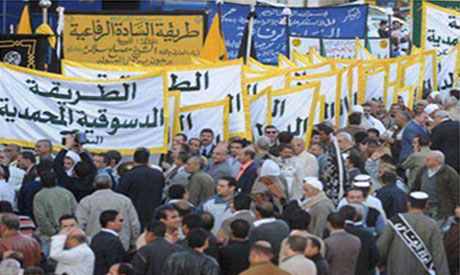
Wednesday, July 13, 2011

History of Tasawwuf

By Dr. Naseem Gul, *The significance of Tasawwuf* - Greater Kashmir - Srinagar, Kashmir, India; Friday, July 8, 2011

Prof. Syed Zaheer Hussain's lecture about Mysticism was enriching and enlightening, Dr. Naseem Gul sums up the proceedings

On 04-07-2011, an extension lecture was organized by Shah-i-Hamadan Institute of Islamic studies, university of Kashmir, Srinagar, on the topic History of Tasawwuf.

The lecture was delivered by Prof. Syed Zaheer Husain Ja’fari, former Ex-Head Department of History, Delhi University, and the joint secretary of Indian History Congress.

He said that Tasawwuf is a subject which has been included in the curriculum everywhere and is being taught in every Department of Islamic Studies, in Madrassas and in the subject of history in one way or the other, which shows its importance as an academic discipline.

He added that reformative movements which came to fore in the Muslim world during 19th and 20th century where actually started in response to the anti Islamic elements found in the prevalent Tasawwuf, and thus it provided the stimulus even to the reformation movements so to speak.

According to him, after the transition of khilafat into mulukiyat there were many Muslims who remained aloof from the state affairs thus begins the philosophy of Sufism in the Muslim world. He highlighted the contributions of Sufis to Hadith literature and Islamic reformation in a worldwide context. He stressed that we need to study Tasawwuf with a Muslim perspective, which will convince us that almost all the madrassas or khanqahs were attached to Sufi Dargahs and were centres of great learning and not just the bastions of superstitious and polytheistic practices as we find now very much common at these places.

It was due to this reason that the British snatched the awqaf which were endowed to the Khanqahs and thus rendered Muslims helpless and dejected as the Sufi centres were imparting education and helping Muslim community in many ways. He said that despite the staunch opposition to the Sufi institutions by many Muslim scholars and thinkers, Sufism remained a vital force in the whole history of Islam and accordingly to an Egyptian writer Manfaluti when a subject has many critics it also shows its importance and utility.

In his introductory remarks Prof Hamid Naseem Rafiabadi highlighted the role of positive Islamic Sufism to various spheres of life as we find in Shah-i-Hamadan who was not merely a sufi but a reformer scholar Muhaddith and a great benefactor of arts and crafts he introduced into Kashmir. Same was the case with Imam Ghazzali and Shah Wali Allah Dehalawi who were not merely sufis in technical sense but were personalities of different dimension contributing to all aspects of human development.

But their approach to human affairs was spiritual and not the materialist one as we find in some of the present day so called sufi people. It was perhaps in this sense that Mawlana Abul Hassan Nadwi has called even Ibn Taimiyah a sufi.

The reclusion and seclusion was added to Sufism when it came into contact with the monasticism of various religions like Buddhism and Hinduism.

He called Dr Ja’fari a practicing sufi who is well versed in the classical sources of the subject and has family roots in sufi silsilahs.

The session was chaired by Prof Muhammad Ashraf Wani, Dean Faculty of Social Sciences and Head Department of History. He said in his presidential remarks that the most important facet of sufi teachings was the capacity to build ones moral character which is lacking in modern times: despite our great erudition we lack moral uprightness.

He highlighted the need for going directly to original sources on Sufism and medieval history and Islam, for which we have to depend on Persian and Arabic languages respectively.

He lauded the scholars for being well versed in the classical literature on Tasawwuf.

Muhammad Ashraf Wani who during his address to the audience recommended the scholars to learn the language of the related subject to approach the primary sources. In addition to the students and scholars of the Dept., Dr. Ab. Rashid Bhat, Dr. Manzoor Ahmad Bhat, Dr. Jameil Ali and the other faculty members of the department were present during the lecture.

Moreover, Prof BA Khan former Head Department of History Kashmir University, Prof Parwaiz of History Department and many research scholars of Departments of History and Islamic studies participated in this lecture.

The lecture was followed by a live session of question and answer and interaction. The lecture was concluded by Dr Manzur Ahmad Bhat senior faculty by his vote of thanks.

(Dr Naseem Gul is Lecturer Department of Islamic Studies, KU)
Showing posts with label tariqa. Show all posts

Thursday, October 18, 2012

Sufi orders: a vital part of Egyptian society

No comments:
Sufi orders: a vital part of Egyptian society Al-Sayyed Hossein, Ahram Online, 9 Oct 2012
With an estimate 10 million members, Sufi orders are an under-reported influence in Egyptian life

Sufism
A march for Sufi Orders in Egypt(Photo: courtesy from sufi.net)
Sufi orders have chapters all over Egypt, which organise festivals on saints days, hold chanting events, and engage in community work. Several chapters offer free-of-charge funerary service and some organise accommodation for visitors.
Sufi sheikhs, or grand masters, have a reputation for austerity and wisdom and are held in great veneration by their murids, or disciples. The murids come from a cross section of society, and many hold high-status posts as academics, officers, doctors,and journalists.
Sheikh Alaa Abu Al-Azayem, the grand master of the Al-Azimiya order, says that many Sufi orders were formed by immigrants who had arrived in Egypt from other parts of the Islamic world centuries ago, which explains the different in approach and style from one order to another.
Abu Al-Azayem adds that the Egyptian Sufism is known for its moderation and easygoing manners.
Researcher Abul Fadl Al-Isnawi says that the most important of Egyptian Sufi orders is the Al-Rifa’iya, founded by Ahmad Al-Rifa’i Ibn Saleh Ibn Abbas (b. 512 hegira), who refused to accept any disciples who have no known profession, as he didn’t want his order to be filled with people who have no desire to work and be part of society.
Another major order is the Al-Badawiya, founded in Tanta by Al-Sayyed Ahmad al-Badawi in Tanta, who taught his disciples to be at peace with themselves and the world.
Sheikh Abdel Rahim Al-Qenawi, who founded the Al-Qenawiya order in Qena, also ordered his disciples to remain fully involved in daily life while seeking spiritual evolvement.
Sheikh Abul Hasan al-Shazli Al-Hoseini ibn Abdallah, founder of Al-Shazliya order, emphasised seclusion and self-control as a path for salvation. Al-Shazliya has served as a role model for several other orders in the country.
In every geographical area, some orders have gained more popularity than others. For example, the Al-Borhamiya and Al-Saadiya are widespread in Cairo; while the Al-Naqshabandiya, Al-Khodariya, Al-Hashemiya, Al-Sharnubia Al-Burhamiya are predominant in Alexandria.
In Al-Gharbiya, the leading orders are the Al-Qasabiya Al-Khelwatiya, Al-Shennawiya Al-Ahmadiya, and Al-Marwaniya. In Al-Menoufiya, the most popular orders are the Al-Zahidiya. Al-Ahmadiya and Al-Mosaylihiya Al-Khelwatiya.
In all, the members of Sufi orders outnumber the members of Egyptian political parties. Some researchers estimate membership of Sufi orders at 10 million in both rural and urban areas.
Over time, every order developed its own paraphernalia, including flags, insignia, music, and ritualised celebrations.
Despite their rivalry, in the sense of seeking to recruit more followers, Sufi orders are remarkably cooperative and hospitable to one another. In various festivals, Sufi orders invite each other and help organise accommodation for visitors, which adds to their visibility and boosts their collective popularity.
Read More

Tuesday, August 28, 2012

Prominent Sufi dies in Dagestan suicide bombing

No comments:


              Russian President Vladimir Putin, right, gives a medal to Tatarstan's chief mufti Ildus Faizov in mufti's residence in Bolgar, about 700 kilometers (450 miles) east of Moscow, central Russia, Tuesday, Aug. 28, 2012. Chief mufti Ildus Faizov was wounded in the leg after an explosive device ripped through his car in central Kazan in July. (AP Photo/RIA-Novosti, Alexei Nikolsky, Presidential Press Service)


Prominent Sufi dies in Dagestan suicide bombing

Boston.Com Globe Newspaper Company, August 28 2012

MAKHACHKALA, Russia (AP) — Thousands of mourners converged on a cemetery in Russia’s republic of Dagestan on Tuesday night for the burial of a top Muslim religious leader who was killed in a suicide bombing hours earlier, Russian news agencies said. Said Afandi, a leader of Sufi Muslims in the region, and five of his followers were killed by a female suicide bomber in an attack at Afandi’s home in the village of Chirkei, said Dagestan Interior Ministry spokesman, Vyachelav Gasanov.
There was no immediate claim of responsibility or identification of the bomber, but the attack could be linked to tensions between Sufis and the Wahhabi sect that is the core of the insurgency in the republic. Afandi was a frequent public critic of Wahhabism. In July, a top Muslim cleric in the Volga River republic of Tatarstan was gunned down and the republic’s chief mufti was wounded when a bomb ripped through his car. Both victims had been vocal critics of radical groups that advocate a strict and puritan version of Islam known as Salafism.
In a visit to Tatarstan on Tuesday, Russian President Vladimir Putin presented state awards to the wounded mufti, Ildus Faizov, and relatives of the slain cleric Valiullah Yakupov.
Putin called for interethnic harmony and said of extremists: ‘‘You cannot defeat a unified, multinational, strong Russian nation because on the side of truth and justice are millions of people who fear nothing, who cannot be intimidated and know the price of peace.’’
The killing of Afandi highlighted the violent tensions that persist in Dagestan, even as neighboring Chechnya has become relatively pacified and orderly after two wars in the last 20 years between separatists and Russian forces. Clashes with militants and attacks on police occur almost daily in Dagestan.
The Interfax and RIA Novosti news agencies said witnesses reported tens of thousands of mourners came to Afandi’s burial. Also Tuesday in Dagestan, a border guard opened fire on colleagues at a barracks, killing seven before being shot to death himself, Gasanov said. There was no indication of motivation.
Read More

Thursday, August 16, 2012

A Sufi Festival organised by Amana Association

1 comment:

A Sufi Festival organised by Amana Association Sat 10 November 3pm onwards

£12 / £10 concession. Richmix

 Dervish

A SUFI ART FESTIVAL
Brought by the Qadiri-Boutchichi Order , this festival consists of a calligraphy workshop, poetry, spiritual songs and theatre, using art as a means of spiritual and personal upliftment.
Poetry will be delivered by Avaes Mohammad and Zahidah Dodwell. Contemporary calligraphy will be exhibited, with workshops lead by Muhammad al-Amine Eatwell.  Members of the Qadiri-Boutchichi order will perform Spiritual songs as well as the play, The Madjoub’s Box, along with special guests.  A talk introducing the Qadiri-Boutchichi Sufi order will also feature as part of the events.
The play, ‘The Majdoub’s Box‘ tells the tale of a Sufi’s death, prompting locals to gather at his grave and lay claim to his only possession - A Box. As they imagine what might be inside, often to comic effect, they discover a deeper secret waiting for them…
 Avaes Mohammad: www.avaesmohamad.com
Muhammad al-Amine Eatwell: www.al-ain.ma/about.php
Read More

Friday, August 10, 2012

Nazareth's Sufis bullied by fellow Muslims

No comments:

Nazareth's Sufis bullied by fellow Muslims Haaretz  Saturday, August 11, 2012 Av 23, 5772 By Lauren Gelfond Feldinger, Aug.10, 2012

Sufi sitar

 For decades, the mystical Sufis in Nazareth have celebrated Islam through music and poetry without considering themselves in danger.But nowadays, local Salafis, who practice a more conservative and coercive Islam, bully and beat Sufi leaders to deter them from their practices, Muslim community leaders told Haaretz. "We visit tombs of holy peoples and they say it is forbidden; we chant and they say it is forbidden to use instruments; I say there should be dialogue with Israelis and Jews because the prophet Muhammed received delegations of Jewish tribes," but Salafis object, said Nazareth Sheikh Ghassan Menasra, 44, a leader of the Qadiri Sufi Order of the Holy Land.
Menasra says he and two of his five sons have been beaten in Nazareth and Jerusalem and his wife, an Islamic educator for women, was pushed. Shaken by threats and having tear gas thrown into his home, he spent two weeks in meditation to avoid the fate of Jerusalem Sheikh Abdul Aziz Bukhari, who suffered similar attacks and died of a heart attack in 2010 at age 61.
Such incidents may reflect a growing regional trend of clashes between progressive Muslims and their more fundamentalist brethren. Egyptian Salafis have razed Sufi shrines, Tunisian Salafis injured dozens in riots over work of art and political analysts blame Salafi Jihadis for the bloodshed in Syria.
But Salafis and Sufis are both tiny minorities here, with Salafi activity funded by countries like Saudi Arabia, Menasra says. According to research by Middle East expert professor Khaled Hroub of Cambridge University, the small Palestinian Salafi element includes violent radicals whose interpretation of Islam is linked to Saudi Wahabism, but most are nonviolent moderates focused on conservative social and religious programs.
Sufis are famed as whirling dervishes, but the Nazareth Sufis do not practice this tradition. They observe Islamic law, but also include reverent prayers, chanting (zikr), instruments and poetry in their worship. They are often compared to Jewish Kabbalists. The greatest jihad of Islam, according to the Qadiri order that Menasra and his father Abdel-al Salaam head, is overcoming ego, hatred and violent speech and behavior. 
Critics condemn them as "heretics" for their practices, which also include having women teach Islam.
They particularly attack them as "collaborators" for associating with Jews. Menasra is involved with numerous interfaith programs, joins rabbis for meetings with international political leaders and performs Sufi chants with Jewish musicians such as Yair Dalal. Menasra argues that interfaith cooperation was the Prophet Mohammad's way and later was the tradition of Muslim and Jewish mystics in Medieval Cairo, Baghdad, Damascus and Morocco. Interacting with other faiths also helps Arabs, he said.
"We need to talk [with Jews] about the problems of Arab rights in Israel and Palestinian rights," he said. "Muslims can also teach Jews the cultural codes of peacemaking in Islam – politics alone cannot build trust."
The threats started a decade ago, after 10 Nazareth Sufis reached out to other Muslims, teaching "moderate Islam" through op-eds and classes on Islamic text and tradition, led by Menasra, who holds a master's degree in Middle Eastern and Islamic studies, a bachelor's degree in Arabic literature, a teaching certificate in Islamic family law and ordination as a sheikh by the renowned Jerusalem Sheikh Baghdadi.
As they gained followers and began including Jewish communities, threats turned to violence.
Anat Lev-Or of Central Israel, a Jewish teacher of Sufi and Jewish philosophy, says two years ago she witnessed a mob beat Menasra's teenage son, while he shielded his younger brother.
Imam Mahmoud Abukhdeir, spiritual leader of an east Jerusalem mosque, condemned Salafi violence in Nazareth and Jerusalem.
"To many Muslims, the Sufi way is not acceptable, but in Islamic law, such violence is forbidden," he said. "Salafis are against many groups, not just Sufis. They beat everyone--they think they are the only real Muslims."
It is not clear how widespread the Sufi-Salafi conflict is in Israel, because Sufis say they would not report Salafi leaders to the police or Higher Arab Council for fear of retribution. Despite repeated inquiries, Haaretz was unable to locate a Salafi leader to respond. The Salafi movement in Israel is not centralized, but Itzhak Weismann, a professor and Sufi expert at Haifa University, says most Islamist movements subscribe to Salafi principles and consider Sufis "deviators from Islam."
But he noted, "Sufism is based on Islamic texts and tradition. Sufis are part of Islam since the beginning."
"We will not stop"
Scholars date Sufis in the Holy Land to eighth-century Ramle and Jerusalem, with centers developing later in Safed and Hebron. Jerusalem was always an important site of pilgrimage, and several dozen Sufi shrines and graves remain in Jerusalem and the West Bank.
Today in Israel there are a few hundred Sufi disciples and thousands of supporters who worship in their homes or houses of prayer, primarily in Jerusalem, Nazareth, Acre, Umm al-Fahm and Baqa al-Gharbiyye.
Sufism, with its many orders and varying customs, is not widespread in Israel because of the exile of Muslim leaders after the 1948 war, Weismann says.
"Since 1967, when communications resumed between Muslims in Israel with relatives in West Bank and Gaza, there was a renewal," he said.
In Nazareth, Sufis face not only the threat of extremists, but also difficult living conditions because of government prejudice against development in Arab neighborhoods, said Sufi teacher Khalid Abu Ras. Israel's largest Arab city, with nearly 74,000 residents – 69.5 percent of which are Muslim – is plagued by unemployment, overcrowding, lack of green spaces and, says Abu Ras, inadequate municipal services.
Despite struggles with poverty, threats and violence, the Sufis of Nazareth say that they will carry on as usual.
On a recent evening, twenty family and community members gathered in the Menasra home to break the Ramadan fast. After dinner, the older son played classical Egyptian oud, including works from Umm Kulthum and Mohamed Abdel Wahab. The elder community members chanted traditional songs about the prophet Mohammad. An infant moved with his arms to the music and a grandfather beat an oversized tambourine. The elder Menasra, wearing a traditional tunic and head covering, danced slowly into the inner circle, extending his arms to bless the guests.
Days later, on the Jewish day of mourning Tisha B'Av, several of Menasra's Jewish colleagues who were also fasting joined his family to break the fast.
"Our activity does not make us weaker -- it makes us strong," Menasra said.
There are three kinds of religious people, he explained, quoting Rabia al-Adawiya, a female Sufi saint: "Slaves who worship through fear, merchants who worship for profit and free people who worship through love – this is the way," he said. "The radicals think that they need to stop us in any way, but we will not stop."
Read More

Saturday, March 03, 2012

A Long Way Off
No comments:
By Anthony Campisi, *Major setback for Muslim retirement community plan in Chesco* - The Inquirer - Philadelphia, PA, USA; Monday, February 27, 2012

Major setback for Muslim retirement community plan in Chesco

A Muslim congregation of mostly Main Line converts has been dealt a major legal setback in its effort to build a retirement community for aging members in southern Chester County.

A Chester County Court judge has ruled against the Bawa Muhaiyaddeen Fellowship in a long-standing zoning dispute with the East Fallowfield Township Board of Supervisors.

The 350-member congregation wants to build 43 carriage-style houses clustered on a 108-acre parcel that it bought in the 1980s. The rural property is occupied only by a small shrine, or mazar, that holds the remains of the fellowship's late, enigmatic founder.

Originally from Sri Lanka, Bawa Muhaiyaddeen settled in West Philadelphia's University City neighborhood in 1971 and began preaching a mystical form of Islam known as Sufism. He gained hundreds of adherents, many of them white converts to Islam, before his death in 1986.

Over time, the congregation dispersed - mostly to the inner Main Line, but still close to its mosque in the city's Wynnefield section.

The retirement development had been in the works for years and was moving into the final planning stages in 2009 when the township supervisors filed suit to halt the project.

In just the last decade, East Fallowfield's population has mushroomed 44 percent, to 7,400. The addition of high-density housing on downsize lots would, the board has argued, be another assault on the area's treasured rural charm.

Though smart-growth advocates argue that dense development best preserves rural land by keeping as much open space undeveloped as possible, the supervisors don't see things that way.

Several recently built and similar dense-housing developments have "just ruined the footprint" of the township, which features expanses of rolling hills and farmland, recently elected Supervisors Chairman Chris Makely said.

"One of our jobs was . . . to slow down on cluster developments," he said.

The supervisors challenged a crucial variance the township Zoning Hearing Board granted that would have allowed the project to proceed.

The parcel sits in a special development district designed to accommodate construction of the retirement homes. But, according to John E. Good, the fellowship's attorney, a flaw in the ordinance meant the project couldn't meet existing zoning requirements.

The Board of Supervisors and the fellowship tried for two years to reach a compromise.

In his opinion, Judge Ronald C. Nagle said the zoning board had overreached in allowing the fellowship's development to proceed and had ignored important parts of the zoning code.

In the fall, the fellowship had asked the judge to dismiss the supervisors' suit, contending that the board had decided to file it in a closed meeting in violation of the state Sunshine Act.

Nagle ruled that, though the supervisors had violated state law by deciding to file suit in a private meeting, there "was no harm to the public or Bawa."

Describing the members as "obviously disappointed" by the rulings, Good said the fellowship would file an appeal.

Any final decision in the case is a long way off.

Commonwealth Court, which would hear the fellowship's appeal, could take up to a year to rule.

[Visit the Bawa Fellowship]
Read More

Saturday, January 14, 2012

Bhinneka Tunggal Ika
No comments:
By Dwi Lusiana, *SBY Challenges Muslims to Prove Islam is Peaceful* - The Jakarta Globe - Jakarta, Indonesia; Thursday, January 12, 2012

SBY Challenges Muslims to Prove Islam is Peaceful

Malang, East Java: President Susilo Bambang Yudhoyono, speaking on Wednesday at a a large Muslim Sufi order in Bululawang, East Java, called on Muslims to prove that Islam can live in harmony with a pluralistic nation and in a democratic society.

Yudhoyono made the call while opening the congress of the Jam’iyyah Ahlilth Thariqah Al-Mu’tabarah An-Nahdliyah (Jatman), a large Muslim Sufi order in Bululawang, East Java.

“Let us prove to the world that in Indonesia there is no discordance between religion and the state, between Islam and democracy. Islam can answer the various problems of nations and the world. Islam can become a blessing for the universe,” Yudhoyono told the thousands of people attending the congress.

He praised the Sufi’s approach, saying it was religious, calm and educative in broaching problems and therefore a suitable way to deal with disputes, conflicts and clashes in society and the nation.

“We all know that the Indonesian nation is a pluralistic one, it’s wishes and aspirations are numerous and varied,” he said, adding that in such a dynamic environment, clashes and conflict could erupt at any time.

The president called on all Muslims to abide by the four pillars of the state and nation. He cited them as the unitary nature of the country; the state ideology, Pancasila, which puts all religions on equal footing; the 1945 Constitution, which guarantees freedom of religion and of worship; and the national motto Bhinneka Tunggal Ika (Unity in Diversity) .

“As Muslims, let us lead a religious life. As citizens, let us implement those four pillars,” Yudhoyono said.

Yudhoyono’s government has been criticized by rights activists as failing to protect the rights of the minority and the freedom of religion or worship.

The country has in recent years been the site of attacks on minority sects and minority religions, with the perpetrators often receiving only light sentences, if any.

Yudhoyono, who was accompanied by his wife Ani, Religious Affairs Minister Suryadharma Ali, and other ministers, officials and religious leaders, is touring East Java for four days.

Abdul Mujib Sadzili, the secretary of the congress’ organizing committee, said that 10,800 people had registered for the event, but said that many more people were taking part in it.

Jatman is one of the key Sufi orders in the Nahdlatul Ulama, the country’s largest Islamic organization, which has about 40 million members. The event was held at one of its boarding schools.

Picture: President Susilo Bambang Yudhoyono, speaking on Wednesday at a a large Muslim Sufi order in Bululawang, East Java, called on Muslims to prove that Islam can live in harmony with a pluralistic nation and in a democratic society. Religious Affairs Minister Suryadharma Ali is pictured on the right. Photo: Antara Photo.
Read More

Thursday, December 29, 2011

In His Followers' Hearts
No comments:
By Arun Ganapathy, *A different kind of Haj* -The Times of India - India; Monday, December 19, 2011

A different kind of Haj: Arun Ganapathy visits the shrine of Bahauddin Naqshbandi in Bukhara and is touched by the serenity of the place.

The woman was dressed in a colourful rumcha, a long, loose robe. Her husband and two little sons were wearing a great black kalpok, or skull cap. The boys looked like smaller versions of Genghis Khan.

"Hindustani?" the man turned to me and asked. "Yes. And you?"

"My name is Sherzodbek. I come from Karakalpakstan, close to the Uzbek-Kazakhstan border."

"That's a long way for you to come."

"Yes, but coming here is like going on Haj for us."

We were in a marshrutka, a shared taxi, driving swiftly through flat, melon farms towards the complex of Bahauddin Naqshbandi, just outside Bukhara in Uzbekistan.

Every now and then, the marshrutka would slow down to make way for rosy-cheeked Uzbek girls on the wayside, carrying buckets piled high with peaches and quinces.

Finally, the taxi took a turn off the highway and stopped. The driver announced that we'd arrived at our destination. I tumbled out of the taxi, still reading from the guide book that I was carrying.

Naqshbandi tradition

Bahauddin Naqshband Bukhari - also called Shah Naqshband - was the founder of the Naqshbandi order of Sufis. He was born in the village of Quasr-Al-Arifan, close to Bukhara, in the early 14th century.

When he was still young, he met and served his Sufi masters, Shaikh Muhammad Baba as-Samasi and Shaikh Sayyid Amir Kulal. During the time he was with the latter, he had a series of visionary experiences. In one such experience, according to the guidebook, he found himself in the Divine presence.

'O Bahauddin,' he heard a voice say, 'whatever you want, we will grant.' In response, Bahauddin said, 'I want to be given a path (tariqat) that will lead anyone who travels on it, straight to the Divine Presence.'

His wish was granted. And thus began the tariqat of Sufis known as Naqshbandis.

Not knowing where to start, I followed Sherzodbek and his family, and we walked along a flagstoned path that led, first through a high arch dressed in dazzling blue geometric tiles, and then through a garden of roses and fir trees.

We reached a large dun-coloured building complex, surrounded by ayvans, or covered courtyards, and was topped off by a great lotus dome. As I stepped in, through the heavily carved wooden doors at the entrance, I realised how big the place was and why the Uzbeks called it a ritual ensemble; inside, there was a mosque, a minaret, tombs of dervishes, a series of tanks and courtyards.

"Why did you say coming here is like a Haj?" I asked Sherzodbek.

"Praying to Shah Naqshband is like praying directly to Allah," he said. "He always takes up our requests and shows us the way. The Shah showed us the tariqa - the way to pray and meditate. He would write Allah on the wall and ask his followers to move their finger on the word, concentrating on the divinity within it. In this way, he engraved Allah in his followers' hearts. This is the meaning of 'Naqsh' in Naqshbandi."

By now we crossed a passageway and come to a courtyard, enclosed on three sides by an ayvan. Immediately in front was the tomb of Shah Naqshband - a solid marble platform with a carved fretwork fence running around its perimeter.

From where I was standing, it looked like a performing dais for artists rather than a place for veneration, but it was only my impression. The Sherzodbeks and the other Uzbek families suddenly stopped and fell silent; clearly, they were moved by the place. They kissed the tomb and walked around it thrice, anti-clockwise. All the time, they pleaded for the saint's support with raised palms. It was a touching moment.

Sherzodbek finished praying and we walked for the next 15 minutes along the pathway. It led us through a maze of tombs of Sufi dervishes. When we came to a dead end, we turned around and headed back with Sherzodbek continuing his story of the Shah's life.

Wish-fulfilling tree

"Shah Naqshband's life was full of miracles and you can see them for yourself here," he pointed into the distance. I followed his finger to see the huge tree trunk lying on its side on a platform. It was once a mulberry tree.

"During one of his visits to Mecca, Shah Naqshband was gifted a walking stick. One day, on his return to Bukhara, he was strolling in his garden carrying the walking stick. While walking, he jabbed the stick into the ground and a mulberry tree grew on the spot. It's been long dead and has fallen over, but it still has a lot of spiritual power. If you pray to it, your wishes would be granted," Sherzodbek continued.

As we walked towards the tree, more Uzbek families joined us. Some of them - especially the women - bent under the trunk, where it stretched over the platform and created a lintel, and circled the tree thrice. Each time they bent, they mumbled a little prayer. "Praying for children," said Sherzodbek and I understood this as a wish for fertility.

As the sun began to set over the arched entrance, the call for maghrib, the evening prayer, went up from the minaret to my right. Leaving his wife still praying at the tree, Sherzodbek headed back to the mosque and I joined him.

Inside the mosque, Sherzodbek joined a few Uzbeks who sat on the floor, praying. Together they said a few rakats, or units of prayer, and did the dhikr, or recitation that the Shah had shown.

Although it was silent, one could make out their Adam's Apples shuttling ever so slightly up and down their throats as they recited the name of Allah. For the next few minutes, there was complete silence, then Sherzodbek got up and we filed out one after the other into the chill desert wind outside.

Journey of a lifetime

It was time to leave, so we shook hands. Sherzodbek's family bowed and prayed one last time to the complex; and then turned towards the gate. As they did so, I noticed both husband and wife pulling out handkerchiefs from their pockets. For them this had been a journey of a lifetime; who knows they might never again see their beloved Shah's tomb again... they were wiping their tears.

Getting There
By Road: To get to the Naqshabandi shrine, you have to first get to Bukhara and then take a Marshrutka, or shared taxi from there. The shrine is just outside the city.

By Train: Bukhara is a short train ride from Tashkent. There are two daily trains connecting Tashkent with Bukhara via Samarkand.

By Air: Tashkent is only about two-and-a-half hours by flight from Delhi. Uzbek Air operates regular flights regularly between Delhi and Tashkent.
Read More

Friday, December 23, 2011

A Path that One Could Travel
No comments:
By Staff Writer, *Mysticism in the Ottoman Empire* - Hürriyet Daily News - Istanbul, Turkey; Saturday, December 17, 2011

Mysticism in the Ottoman Empire

The Mevlevi Sufi order is probably the most famous mystical sect in Ottoman and Turkish history, especially because of Rumi, who is commemorated every Dec 17.

Mysticism, or Sufism as it was called among the Ottomans, was very much a part of Ottoman society in spite of a large, conservative religious establishment and an educational system that was based on the Quran and shariah law.

At its foundation was the idea that there was a path that one could travel to become a perfect human being or saint and, in many cases, achieve union with the divine truth or God. This of course differs from orthodox Islam in which God is the Creator and mankind the created and man could never reach him.

People who followed mystical paths were considered heretics at the beginning but over the centuries the teaching of the Sufis was accepted. Even members of the religious establishment joined these groups. Two schools arose – an Iranian mysticism based on ecstasy and divine love and an Iraqi school based on asceticism. Several sects followed the conquest of much of Anatolia by the Selçuk Turks and had established themselves there by 1299 when the Ottomans, under Osman, began expanding in force.

Each sect had differing paths by which one was to achieve perfection with different sets of rituals, practices and even wearing apparel including their headgear. Each sect, or “tariqa,” started from one teacher and usually had a permanent central location starting from where this particular person was. The main practitioners were men but women were also involved.

Several mystic sects were prominent in the Ottoman Empire, including the Bektaşi, Halveti, Mevlevi, Rifai, Qadiri, Naqshbandi and Bayrami. Of all of these, the Ottoman rulers were probably closest to the Mevlevis, undoubtedly from the time of Osman. It was the Mevlevi Sheik Edebali who girded him with a sword that became known as the Sword of Osman and every sultan after that had to be girded with it on his accession to the throne. The Mevlevi sheik who was leading the tariqa at the time would be summoned to Istanbul from Konya especially for that purpose.

Bektaşi order

The Mevlevis and the Bektaşis have their roots in 13th century Konya.

The Bektaşi order was founded on the teachings of Hacı Bektaş Veli, who was originally Persian. He drew followers in both rural areas in Anatolia and in the Ottoman military. In fact, the Bektaşis were the official sect of the Ottoman army’s famed Janissary corps. They also were popular in the southern Balkans where there are still followers.

The second important order was the Mevlevis whose founder, Mevlana Jalaladdin Rumi, taught “unlimited tolerance, positive reasoning, goodness, charity and awareness through love.” The day he died, Dec. 17, 1273, is still celebrated throughout the world as his wedding day, that is, the day he was united with God.

His followers are known for their whirling ceremony through which they attempt to reach union with the divine. In spite of the Turkish ban on Sufi sects in 1925, the Mevlevis were not persecuted to the extent that other sects were, and republican founder Mustafa Kemal Atatürk is thought to have been responsible for this.

For many years it was an open secret that they met in each other’s homes and held their whirling ceremonies; today they can carry this out in public.

The Naqshbandi order is the only Sufi sect that can trace its origins back to the first century of the Prophet Muhammad, making it the oldest tariqa. Today it still has followers in the millions around the world. As a sect it and the Halvetis were particularly popular among theologians and government officials.

During the years of conquest, Sufis, or dervishes as they were known, formed groups who fought in the numerous battles that occurred. Later the tariqas played an important role in the areas that were conquered, influencing the people there to accept Islam. One only has to glance through the vast literary output of the Ottomans to understand just how great the Sufi influence was; the concepts and vocabulary reflect the influence that it had on writers.

Picture: Each sect, or ‘tariqa,’ started from one teacher and usually had a permanent central location starting from where this particular person was. The main practitioners were men. Photo: HDN.
Read More

Wednesday, December 21, 2011

Like a Bridge to Nowhere
No comments:
By Staff Writer, *The Abode of the Message* Harvard Magazine - Cambridge, MA, USA; January/February 2012 Issue

The Abode of the Message

The Abode of the Message is a Sufi retreat center located just over the Massachusetts border, in New Lebanon, New York. Built in 1785 as the Mount Lebanon South Family Shaker Village, The Abode is now a community of the Sufi Order International.

Many original structures and furnishings are still in use and the campus sits on 400 acres that include an organic farm, a pond, and hilly trails into the Berkshires.

“There are many ways to be here depending on what you are looking for,” notes programs manager Amalae McCloud. There are individual silent retreats, done alone or with experienced Sufi guides (many of whom live at The Abode), that last anywhere from three to 40 days; retreats run by outside groups—Catholic, Jewish, Tibetan, for example; or guests may also create their own “rest and relaxation” retreats. Massages and other body treatments are available.

No prior knowledge of Sufism is necessary, nor do guests need to be exclusively interested in that practice. “Love, peace, and harmony are the three most important things here,” says McCloud.

Classes and workshops on Sufism and other religious and spiritual practices are offered daily; all, as well as the universal worship on Sundays, are open to everyone.

The main house has guest rooms, but there are also cabins and huts. Silent retreaters have simple, mostly vegetarian, meals delivered to them, while others eat together in the dining hall.

The local natural beauty alone may be enough for some to book a stay at The Abode. Wooded hikes and mountain climbs offer majestic views. There is even a bridge suspended over a cliff, affording a sense of “standing in mid-air,” McCloud reports.

“Some like it as a meditation spot. It’s like a bridge to nowhere. Others are too scared to go out there.”

Picture: The Abode of the Message's Meditation Room.

[Visit the Abode of the Message website.]
Read More

Friday, December 02, 2011

A Sufi Study Centre
No comments:
By Staff Writer, *Sufi centre to come up in Hyderabad* - Deccan Chronicle - Hyderabad, India; Sunday, November 27, 2011

A Sufi study centre will be set up in Hyderabad to promote the principles of brotherhood and humanity, according to Shaik Hashimuddin Gilani, the caretaker of the shrine of the revered Sufi saint Hazrat Shaik Abdul Qadir Jilani of Baghdad.

Shaik Hashim was in the city on Saturday as a part of the 12-day tour of India to spread the teachings of Sufism.

Talking to mediapersons here on Saturday, Shaik Hashim said, “India and Baghdad enjoy a very close relationship. During the time of my great-grandfather, Shaik Abdul Qadir Jilani, many sheiks were sent to Indian cities like Hyderabad. Sufism has been in this country since then with its diverse culture and tradition.”

“The very concept of Sufism is to show love and affection for fellow human beings and to spread it among all of humanity. Sufism can resolve all modern day social dilemmas,” Shaik Hashim added.

Shaik Hashim is running a centre for the study of Sufism in Baghdad, the ‘Ghousia Centre for Sufism.’ He said that he will set up a similar centre here in the city.

This is Shaik Hashim’s first trip to Hyderabad after he was selected as the caretaker of Shaik Abdul Qadir Jilani’s shrine. Prior to this, he had visited Hyderabad 10 years ago with his father.

After Hyderabad, Shaik Hashim will visit Mumbai, Mangalore, Chennai and finally Thiruvananthapuram.

[Picture: Tomb of Shaykh 'Abd al-Qadir Jilani in Baghdad. Photo: Qadiriya.]
Read More

Sunday, October 09, 2011

Spiritual Joyousness
No comments:
By Maha El-Sanosi *Sufi Orders and Practices in Sudan* - Islam Online - Doha, Qatar; Sunday, October 2, 2011

Sufi Orders and Practices in Sudan: At The Heart of Sufism (Part 1)

There’s a common belief in Sudan, “If a family does not have at least one Sufi member, it’s not Sudanese.” This may indubitably be the case, granted that Sudan has more Sufi Muslims than any other country in the world, and the number is expanding.

Sufism is noticeably entrenched in the Sudanese community, and many think of it as a way of life.

‘Zikir’ (exercises of remembrance) and ‘madih nabawi’ (poems in praise of the Prophet) are often heard on the streets, in public buses and taxis, in shops and restaurants, and on local radio stations and television channels.

‘Zikir’ and other Sufi practices form part of the weekly Sufi rituals which bring together Sufis from all walks of life, regardless of class and other differences.

Although these rituals are at times lengthy and strenuous, many engage in them with the belief that it is the ultimate form of spiritual worship, which will lead them to draw closer to God and to more fully embrace His divine presence in their lives.

The Emergence of Sufism in Sudan

Many historic accounts suggest that Islam made its impact in Sudan through the activity of Sufi orders. The orders first came to Sudan in the 16th century, and began to expand and take root two centuries later.

There are as many as a dozen Sufi orders in Sudan. While some are restricted to Sudan, others are widespread in Africa and the Middle East. Several orders are derivatives of older orders, and were established by men who made major or minor alterations to the practices of the orders to which they had formerly been linked.

Sufi orders reached all parts of Sudan until, according to some commentators, they reached about five main orders and several secondary ones. The most common ones are al-Qadiriyya with its multiple branches, al-Samaniyya, al-Shazaliyya, al-Tijaniyya, al-Mirghaniyya (al-Khatmiyya), al-Mikashfiyya, al-Majzoubiyya, al-Burhaniyya, al-Idrisiyya-al-Ahmadiya, al-Rashidiyya, al-Ismailiyya, al-Mahdiyya (al-Ansar) and the Naqshbandiyya.

Sufi Orders in Sudan

1) Al-Qadiriyya Order: Al-Qadiriyya is the most widespread and popular order in Sudan. It was founded by Abdelqadir al-Jilani in Baghdad, in the 12th century and was introduced to Sudan by sheikh Tajeldin al-Buhari at the beginning of the Funj state (a loose confederation of sultanates and dependent tribal chieftaincies drawn together under the suzerainty of the Kingdom of in southern Nubia in 1504).

2) Al-Samaniyya Order: A branch of the al-Qadiriyya order, the al-Samaniyya order was founded by sheikh al-Samani who is now buried in Medina. The order emerged in Sudan during the early decades of the Funj state via al-Sayed Ahmed al-Tayeb Wad al-Bashir.

3) Al-Shazaliyya Order: Founded by Imam Abu Hassan al-Shazali, the teachings of al-Shazaliyya order spread in Sudan before the reign of the Funj state, through Sheikh Khojali Abdelrahman.

4) Al-Tijaniyya Order: This order was established by Sheikh Ahmed al-Tijani in Morocco. It eventually penetrated Sudan in the mid-19th century via the western Sahel. It reached Northern Sudan, particularly the city of Berber, by the end of the Turkish reign through Sheikh Ahmed Mukhtar. It also spread in Darfur, west of Sudan.

5) Al-Mirghaniyya Order: Also referred to as al-Khatmiyya, the al-Mirghaniyya order is derived from both the Naqshbandiyya and the al-Shazaliyya orders. It was established in the early 19th century by Mohamed Othman al-Mirghani and settled in Sudan by the end of the Funj state’s reign through al-Sayed Ali Mirghani.

The order originates from Sheikh Ahmed Bin Idris, a religious teacher in Mecca who sent his student Mirghani to Sudan to spread the teachings of Islam. This order was well-received by political parties in Sudan and played a major role in the political history of the country.

The Sheikh, the Massiad and the Khalwa

In Sufism, a sheikh, a master or a ‘wali-Allah’ is believed to be divinely-guided and incapable of sin. An early Sufi sheikh, named Abu Yazid Al Bistami, is frequently quoted as saying, “He who has no sheikh, his sheikh is shaytan (the devil)”.

This is a common belief among Sufis who condemn and harshly criticize self-proclaimed Sufis who do not belong to a specific order and do not follow a particular sheikh. No different from Sufis of other nationalities, Sudanese Sufis believe the sheikh acts as an intermediary between them and God.

The ‘massiad’, (the home of the sheikh of the order), and the ‘khalwa’ (which translates to solitude) where the Quran is memorized and the secrets of the order are learned, are the centers of the order.

Each order has its own hierarchy with the sheikh at the top of the pyramid, usually followed by his successors.

At the ‘khalwa’, the elite of dervishes or ‘hairan’ (followers) completely devote themselves to the order, and isolate themselves from the outside world for the sake of learning the secrets of the order, under the guidance of their sheikh.

Sufi Rituals and Celebrations

Zikir (remembrance) represents the essence of Sufi practices. Some historic accounts suggest that Sudanese Sufi orders introduced distinctive African elements (that are not present in other Sufi countries) into zikir rituals of Sudan.

The ‘zikir’ exercises include reciting prayers and passages of the Quran and repeating the names or attributes of God while performing physical movements.

Each order’s ‘zikir’ varies from the other according to the modus operandi established by the founder. Singing and dancing are also incorporated, and the outcome of an exercise, which may extend to hours, is often a state of ecstatic abandon.

Sufi rituals of the al-Samaniyya order, one of the largest orders in Sudan, are performed for hours every Friday.

The al-Samaniyya followers meet during Friday prayers, all of them dressed in white ‘jellabiyas’ (traditional male garments) with leather belts across their chests, denoting their dedication to the order.

The ritual, held at the al-Samaniyya mosque and led by sheikh Mohamed al-Tayeb, marks the presence of dozens of male followers lined up in a highly organized fashion, chanting the words ‘la ilaha illa Allah’ (there is no god but Allah) while the women join in upstairs.

While some Sudanese people choose to gain religious zeal through the al-Samaniyya order’s somewhat orthodox ‘zikir’ practices, others tend to lean towards non-traditional Sufi rituals that, on the surface, may seem more fun, entertaining and appealing.

The Hamad al-Neel cemetery —a vast, dun-colored cemetery in Omdurman— is the headquarters of the al-Qadiriya order in Sudan and was founded by sheikh Hamad al-Neel, who is buried at a nearby mosque. The expanse serves as an attraction for tourists and photographers due to the nature of the order’s rituals, which combine African heritage, dance, music and colorful attire.

On Friday at 5 pm, the cemetery fills up with people of all ages, ethnicities and walks of life who come to be a part of the rituals, while tea sellers and pamphlet vendors surround the area around the tomb site.

The dervishes are dressed in red and green, patchwork, leopard-prints or flowing white ‘jellabiyas’ and ‘immas’ (turbans). Some sport dreadlocks, amulets and talismans, and others don on colorful hats and enormous strings of prayer beads.

Standing barefoot above the sand and under the heat of a sizzling sun, a few men pick up the rhythm on their ‘tambours’ (drums) and chant ‘zikr’ melodically while the crowd swells palpably, grooving to the rhythm.

A fragrance of rich and distinctive frankincense fills up the atmosphere.

As they sing harmoniously, the dervishes build up into a ritual frenzy and other followers crouch, bob and pump their arms in synchronization with the chants. Some spin in trances, some freestyle and some dance side-by-side in large circles.

As sundown approaches, the dervishes reach a final sustained and jubilant tempo then stop for prayers. Lying flat on the ground in a reverie-like state, some of them embrace what they refer to as spiritual ecstasy.

Remembering the Prophet (PBUH)—the Sufi way

One of the largest gatherings in Sudan is the annual celebration of ‘al-Mawlid al-Nabawi’ (the Prophet’s birthday).

Celebrated by Muslim countries around the world and marked as an official holiday in many of them, the ‘Mawlid’ in Sudan is commemorated in a festive ambience and involves ‘zikir’, ‘madih’, drumming sessions and other forms of performances.

The open-air venues are decorated with lights, floors are furnished with prayer rugs and Sufi flags are positioned all around the area.

From children who enjoy the assorted sweets and candy in the shapes of brides and knights in horses, to adults who sip sweet tea and engage in the Sufi ceremonials, to travelers, tourists and photographers who attend to experience the local religious carnival, the ‘Mawlid’ is attended by people from all ages, orders and ethnicities.

The ‘Mawlid’ even welcomes non-Sufis, who are often present in large numbers. The richer members of the community donate food, and the less fortunate mingle with the rest, enjoy free meals, juice and tea, and join in the chants.

While each Sufi order has its own distinct style, all are, to an extent, similar in terms of their impeccable hospitality, generosity and provoking a mood of spiritual joyousness among the masses.
Read More

Saturday, October 01, 2011

The Intangible
No comments:
By Nishaa Ishtiak, *Ta’wiz: an age-old delusion or science? * - The Express Tribune - Karachi, Pakistan; Saturday, September 24, 2011

Ta’wiz: an age-old delusion or science?

One man stood before 50 people on Thursday, in an attempt to prove to them that ta’wiz is a science.

It is not an offshoot of Sufism, insisted Asim Maharvi Chishti of the Chishtiya Ribbat Sufi Studies Centre, at the first of the four lectures organised by Kuch Khaas and Hast-o-Neest (Centre for Tradition Art and Culture in Lahore). The lecture was titled “Talismanic Science of Ta’wiz”.

Talismanic science (vajdani ilm) he explained, works at different levels of human existence or the five shells: there’s the outermost or the physical shell (treated with herbs or medicines), the electromagnetic, the psychic that invokes feelings such as fear and love, psycho astral and the innermost astral shell (Roh-e-Nisama).

The human body is surrounded by a certain “aura” that prevents negative energy from penetrating your body, although its intensity varies from person to person just like intelligence, Chishti said.

Modern science, he continued, is mostly concerned with the physical as it does not accept the concept of the intangible.

However, he continued, we often forget that the commonality that brings all humans together is the spirit – the essence of life which is not limited by time and space and still eludes the logic of modern day science.

Talismanic science is practiced through written numbers and alphabets. It’s foundations lay on Abjad numerals, a decimal numeral system in which the 28 letters of Arabic are assigned numerical values(Ibn-e-haroof) and numbers (1-9) that combine to form Ilm-e-Jaffar, explained the lecturer.

They are assigned values by spiritual leaders, and correspond to different elements; these cosmic and heavenly bodies have certain affects on the human existence.

Also universal shapes such as triangle, circle which have to be written down at prescribed time of the day, as for each shape only when the moon is the highest level will the ta’wiz have any effect.

He talked of the power embodied in Arabic alphabets such as ‘Alif’ which, he claimed, if repeatedly written can be destructive. This science, Chishti claimed, can reveal and treat illnesses at all levels of shells.

Ruqa, as referred to before the advent of Islam, existed since the time of Adam and was then taken up during Hazrat’s Idrees’s time, he said.

Resolute on his claim of ta’wiz being a science, he said it is being misused in our society and people have fallen prey to the pseudo professors of this science. The problem, he claimed, does not lie with ta’wiz but with its diagnosis.

The hows and whys

The lecture was followed by a question and answer session. Some of the questions:

Is ta’wiz a branch of magic?

No but it can be used to cure or remove destructive effects of the notorious black magic.

How do you receive this knowledge?

It is transferred in the four spiritual orders, Chishtia, Qadiriyya, Suhrawardiyya and Naqshbandi.

So are you saying this is a sectarian divide?

Not at all. It is a tailored solution which adopts different methods and has the same aims.

How much do you charge for one ta’wiz?

The question that was perhaps on most people’s mind was finally voiced amidst subtle laughter. That is a very important question. We are not allowed to charge anything, but we also cannot refuse whatever is being offered to us.

After the discussion

Chishti told The Express Tribune that the aim behind the talk was to educate the people and pave way for what he believed was an eventually imperative collaboration between modern and talismanic science.

Do alphabets and numbers contain the power to heal? How much truth lies in these cosmic and heavenly bodies affecting us? Will talismanic science ever be accepted by the modern scientist?

For some the answer will be a simple Google search; for others it will be a lifelong journey of exploration; some will not give it a second thought; others will swear by it; for those in between these two extremes, a proverbial question mark will hang over talismanic sciences, unwilling to submit to it, but vary of denying it outright.

Picture: The speaker explains ta’wiz in the light of work done by the early sufis or Islamic spiritual scientists. Photo: Kuch Khaas.
Read More

Monday, September 26, 2011

Matrah-ı Şerif
No comments:
By Anatolia News Agency, *Istanbul’s old Galata Lodge readies for opening after a four-year restoration* Hürriyet Daily News - Istanbul, Turkey; Tuesday, September 20, 2011

One of the cultural landmarks in Istanbul, the Galata Mevlevihane in Beyoğlu has undergone a four-year restoration work and is ready for an official opening

Galata Mevlevihane, the lodge used by Mevlevi dervishes built in 1491 in Istanbul, the Ottoman capital city, has been restored and is anticipating its official opening.

“We are ready to open the museum,” Galata Mevlevihane Museum Director Yavuz Özdemir said, adding that the museum was expected to open this month. “We are waiting for the order from the Culture and Tourism Ministry.”

Located on Galip Dede Street near İstiklal Avenue, Istanbul’s unique original dervish lodge will open to visitors in the coming days with a new facelift after a four-year restoration process.

“The large garden of the dervish lodge has been restored for use as an area where people can escape the crowds of Beyoğlu,” he said. The Galata Mevlevihane was closed to visitors in 2007 and restored with contributions from the Istanbul 2010 European Capital of Culture Agency.

Speaking to the Anatolia news agency, Özdemir said the Ottoman traveler Evliya Çelebi mentioned in his travel books that the dervish lodge had included nearly 100 rooms.

The lodge was damaged in an earthquake in 1509. It has undergone restoration work since the early 17th century and additional structures turned the site into a social complex, according to a document from the museum’s archive, Özdemir said.

Further extensive damage occurred in the Tophane fire in 1765, he said, adding that the lodge was restored and took its current shape from restoration work in 1959-1960. The building served as a school from 1925 to 1957 and reopened as the Divan Literature Museum on Dec. 27, 1975.

Although the lodge had been restored for visitors, cultural events could be organized too, Özdemir said. “The dervish lodges on the lower floor of the semahane (the building where dervishes performed their whirling dance) have been opened to public visitors,” he said.

“Our semahane building is one of the most special buildings that still survive. This is thanks to the protection by the Culture and Tourism Ministry,” he said. The washhouse, Adile Sultan Şadırvan (water-tank with a fountain), is also among the cultural features of the lodge that still survive with the oldest structure being the Hasan Aga Fountain built in 1649, he added. Some unknown hand-carved works on the walls of the lodge had been discovered during restoration work, he said.

The museum

Entry to the Galata Mevlevihane museum is made through a narrow gate, at the end of the large courtyard, there is a three-story semahane building, Özdemir said. “We will organize sema [whirling dervish] performances and Turkish music concerts here,” he said, adding that showcase performances in the surrounding area took place before the restoration occurred. “Objects being displayed here have been removed and visitors will be able to view the original sema area,” he said.

The museum’s main exhibition rooms are the dervish lodges located on the lower floor and visitors will get information about Sufism (the dervish religion) while seeing related artworks, he said. The tools used in the kitchen are on displayed in another room next to Mevlevi dresses, Özdemir said. The most important feature of dervish lodges is their kitchen, called “matrah-ı şerif,” he said.

“Mesnevi,” the Persian religious text written by Rumi, is being exhibited and 18 couplets from the text are displayed in the museum.
Read More

Tuesday, September 06, 2011

Libyan Sanusis, Libyan Citizens
No comments:
By Igor Cherstich, "A Brief Note on the Sanusiya Sufi Order in Libya" - SOAS - London, UK; Sunday, September 4, 2011

A Brief Note on the Sanusiya Sufi Order in Libya

The Sanusiya had a fundamental political role in Libyan modern history.

More specifically, the tariqa consolidated an important position within the tribal system of Eastern Libya, and as a consequence, a prominent role in leading the anti colonial struggle against the Italians.

There is a debate on whether the role of the Sanusiya was the consequence of an intrinsic political vocation of the order, or the result of historical circumstances that pushed the brotherhood to develop into (and to be recognised as) a political entity.

What is certain, nevertheless, is that the brotherhood had an important role in freeing Libya from the Fascist occupation, so that the head of the order was appointed as first (and last) king of unified Libya after the liberation.

After Khadafi's coup in 1969 the Sanusiya was practically disbanded, at least officially. The reasons for this are clear: the order was perceived as a source of support for the king.

Although it could be argued that, regardless of the fact that the king was a Sanusi, the order was already losing energy before 1969, it is pretty obvious that the regime actively attempted to eradicate it. During the Khadafi regime the Sanusi order practically disappeared from the public, but it did not die out.

The brotherhood still counts a number of members in the country, many of whom take their membership to the order only as a spiritual matter, and not as a political affiliation. As recently reported by some media, members of the order have publicly stated they do not wish for the monarchy to be restored, but for Libya to be a free and democratic country.

This should not come as a surprise. Even though a number of commentators have erroneously attempted to reduce Libya to a conglomerate of tribes and religious groups, Libyans have a strong sense of national identity. The fact that Sanusis speak out against a regime that has oppressed them should not be taken as the trace of a monarchist sentiment.

Libyan Sanusis are, amongst other things, Libyan citizens. Like many other Libyans today they envision a democratic future for their country.

Mr. Igor Cherstich is a PhD Student at SOAS, School of Oriental and African Studies, University of London, London, UK.

[Picture: Map of Libya. Photo: Wiki.]

***
[Editor's note: Given the past importance of Libya to Italy we are translating this article into Italian. / Nota del redattore: considerata l'importanza che la Libia ha avuto per l'Italia, traduciamo questo articolo in italiano.]


Una breve nota di Igor Cherstich sulla confraternita Sanusiya in Libia.

La Confraternita dei Senussi ha assunto un ruolo politico fondamentale nella storia moderna della Libia.

Più precisamente, la tariqa ha ottenuto una posizione importante all’interno del sistema tribale della Libia orientale, e per conseguenza ha assunto un ruolo prominente nel guidare la lotta anticoloniale contro gli italiani.

Non è chiaro se il ruolo dei Senussi sia stato la conseguenza di una vocazione politica intrinseca all’Ordine o se la confraternita si sia sviluppata come entità politica (e abbia quindi assunto tale ruolo) spinta dalle circostanze storiche.

Quel che è certo è che la confraternita ha avuto un ruolo importante nella liberazione della Libia dall’occupazione fascista, tanto che dopo la liberazione il Gran Maestro dell’Ordine divenne il primo (ed ultimo) re della Libia unificata.

Dopo il colpo di stato del 1969 -che portò Gheddafi al potere- la Sanusiya fu disciolta, perlomeno ufficialmente. Le ragioni sono chiare: l’Ordine era percepito quale fonte di appoggio al re.

Appare ovvio che il regime abbia tentato in ogni modo di sradicare l’Ordine, sebbene esso stesse comunque perdendo energia ben prima del 1969, e questo nonostante il re fosse un Senussi. Durante il regime di Gheddafi l’Ordine Sufi dei Senussi scomparve dalla scena pubblica, senza purtuttavia estinguersi.

La Confraternita in Libia conta ancora un considerevole numero di membri, molti dei quali vi si affiliano esclusivamente per scopi spirituali, senza alcun fine politico. Alcuni media hanno recentemente diffuso le dichiarazioni di membri dell'Ordine, secondo cui essi non desiderano la resturazione della monarchia, ma vogliono che la Libia sia una nazione libera e democratica.

Questo non dovrebbe sorprendere. Per quanto alcuni commentatori abbiano cercato erroneamente di ridurre la Libia ad un conglomerato di tribù e gruppi religiosi, i Libici hanno un forte senso di identità nazionale. Nella critica dei Senussi al regime che li ha oppressi non può essere rintracciato alcun sentimento monarchico.

I Senussi libici sono, fra le altre cose, cittadini libici. E come molti altri libici oggi, i Senussi immaginano per il loro paese un futuro democratico.

Igor Cherstich è dottorando al SOAS, l’Istituto di Studi Orientali e Africani dell’Università di Londra; Londra, UK.

[Immagine: Carta della Libia. Foto: Wiki.]
Read More

Monday, September 05, 2011

'Allah, Allah, Allah.'
No comments:
By Dr M Aamer Sarfraz, *The Sufi method* - The Friday Times - Karachi, Pakistan; September 02-08, 2011 - Vol. XXIII, N° 29

Dr M Aamer Sarfraz gives an overview of the centuries-old Pir-Murid relationship

Sufi literally means 'someone with wool' but in reality it is a person who aspires to union with God through mystical contemplation. When someone seeks union with God, he travels the spiritual path that has seven stages (lata'if): the quest, love, understanding, detachment, unity, astonishment, and poverty and annihilation. During the spiritual journey (suluk), the seeker (salik) tries to conquer his Nafs (ego, self) by transformation of consciousness. He starts with nafs al-ammara (animal self - governed by greed and instincts) and progresses through the seven stages under the supervision of a shaykh (Pir, Murshid) to the level of nafs al-kamila (wholesome self - total union of God with the individual). The Pir is responsible for giving instructions, and then supporting, monitoring, and appraising the spiritual progress of Murid (disciple).

In order to become a Murid, one needs to do bayyat - an oath of allegiance taken by putting one's hand on the hand of Pir and repeating a prescribed oath. A Murid needs to have certain attributes (adab) including a belief that his Pir is the best and the Murid will follow his Pir's command. Each Murid's spiritual journey is different; therefore, he hands over his will to the Pir. The spiritual work given individually to Murids to meet their specific spiritual needs is called wird (plural - awrad). Wird (such as saying, 'Allah, Allah') is described as a unit of dhikr constructed to contain certain patterns of knowledge and self-awakening. The initial goal is to gradually improve concentration by learning to stop the flow of thoughts - 'living in the moment'.

Murid utters 'Allah, Allah' a number of times a day and at a specific time while keeping the Pir in tasawwer (view). The Murid attracts baraka (blessings of God) through the practice of dhikr. He is encouraged to live out in the world but also to do dhikr in solitude. Later he is directed to perform dhikr with each breath; soon realising that he cannot even breathe without dhikr. If progressing successfully, in due course, dhikr al-qalbi which operates automatically becomes activated. The Murid now notices that sitting in his office or on a prayer mat he is immersed in the remembrance of Allah. Once activated, dhikr may manifest as a beating of the heart which is so pronounced that it appears to beat on the outside of the body. Awrad become increasingly 'heavy' and it depends upon the himma (yearning, strength) of the Murid how quickly he can perform the prescribed awarad at specific times and in certain number daily while struggling against the body's desire to sleep, eat and take rest.

If dhikr takes place in the presence of the Pir, the Murid focuses his gaze on the Pir's face, relaxes and then concentrates on eliminating all distracting thoughts. Naqshbandis perform only silent dhikr, a practice that makes them unique among the orders. Mujaddidis employ two basic dhikrs; the first, dhikr-i ism-i dhat, entails pronouncing one of the names of God alone, "Allah," or "Hu," (He). The second, nafi wa ithbat, is an advanced practice in which the Murid sits cross-legged, hands joined together with his left hand clasping the right wrist. The optimum position is to sit directly in front of the Pir and gaze at his visage while repeating 'Allah, Allah, Allah.'.

Dreams are of great value on the Sufi Path. They are indicative of spiritual states and are kept secret only being relayed to the Pir who interprets them. The dreams may increase as the Murid struggles to wake up for Tahajjud (dawn prayer) and sit for dhikr. Frequently, the Pir appears in his dreams to clarify, admonish or praise. Murid is always alert to the ishara (signs) from Pir because teaching and signposting takes place through constant focus. Sometimes, Murids get stuck. The Pir uses different methods to move them to the next stage; these include fasting, whirling, change of milieu and exercises to improve concentration. If these methods do not work, they become stationary - this is the limit of their qualification. However, they continue to draw baraka from their attachment to the order.

The Murid gradually understands the reality that the Pir is his key to reaching Allah. The face of the Pir grows to become the most beautiful, powerful and penetrating. His is the face that the Murid wants to see everywhere and always. The intensity of feelings towards the beloved Pir grows - jealousy, possessiveness, and ambivalence are experienced. The Murid is not sure whether these feelings are a blessing or curse and tries to approach the Pir for clarifications. The Pir will sometimes meet but on other occasions avoids the Murid. On meeting, the Pir does not say much, which inflames these feelings more. The Murid ponders, meditates and eventually finds his own meanings. The profound love that the Murid has for his Pir reaches such a level that he perceives the Pir standing in front of him when he needs him. The Pir also searches in his visionary dreams whether the Murid with his soul and spirit has reached where they are bound to his own; fana fi-shaykh - self-annihilation in the shaykh.

When the seven stages (lata'if) have opened through dhikr and the heart is completely cleansed, with Pir's permission, the Murid undertakes the last stage of Sufi method: the Muraqabat. The muraqabat are advanced contemplative exercises to lead the Murid through the higher realm of wahdat (unity). They are performed usually after 'asr (afternoon prayer) in the presence of Pir or alone at night. The Murid is cautioned about the pitfalls of falling asleep during this exercise when alone. These continue for a number of days determined by the Pir, and the Murid cannot proceed to the next without permission. At each stage, he is obliged to inform the Pir regarding his experiences. In the first muraqaba, the Murid contemplates oneness (ahadiyya), and then proceeds to contemplate other specific attributes of God. In contemplating the various qualities and attributes of wahidiyya, the Murid's task is to invite baraka from the source of each latifa. The objective is to return each latifa to its origin, thereby achieving annihilation in it.

When the first four lata'if are returned to their origin, Murid enters the stage of wilayat alsughra or lesser sainthood. It is here in the 'unity of being' that the Sufi temporarily loses interest in the manifest world and experiences the annihilation of the ego or fana'. Following the remaining akhfa' latifa, being annihilated in the unity of being, he enters the stage of wilayat al-kubra or unity of essence. The state of wilayat al-kubra is one of calm and quiet union with God's unity of essence (baqa'). This is the maqam (station) of 'the expanded breast' (shar-i-sadr), indicating the perfection of the akhfa' latifa which means total elimination of bad habits and desires from the nafs.

A sense of calm and tranquility along with an immense feeling of power rests with the Pir when he qualifies. He believes he can achieve anything (tasarraf) with the reality he has experienced. At this stage, some go quiet while attempting further progress; others go out and provide moral and spiritual guidance to the community. In line with his pre-Sufi traits, the Pir may heal, solve problems, predict the future or try to modify outcomes through the power of his prayer. He would only find his niche after trial and error in good time. When the Pir eventually leaves this world after a lifetime of public service, the anniversary of his physical death (wisaal - union) is celebrated as urs (wedding - with Reality) by his Murids who also continue to get his faiz (blessings) by visiting him (his grave).

Dr M Aamer Sarfraz lives in London
Read More

Monday, August 29, 2011

Afghanistan Needs a Balance
1 comment:
By Iason Athanasiadis, *Afghanistan: Sufi Mysticism Makes a Comeback in Kabul* Eurasianet.org - Open Society Institute, New York, NY, USA; Friday, August 26, 2011

In a garden in Kabul’s Karte-Seh district, a group of Sufi musicians and poets gather for an evening of mystical melodies. Platters of rice pilau and fruit cover carpets spread across the lawn. This twice-weekly meeting is held at the home of a member of the ancient Chishti Sufi order who gathers together an all-male crème de la crème of Kabul’s Sufi society. Television preachers, renowned qawwali singers and prominent politicians with clandestine Sufi proclivities all flock to the garden to sample the ecstatic music.

Sufism is an ascetic spiritual tradition pioneered by Islam’s early warriors, who pushed outwards from the Arabian Peninsula into Central Asia and lived in all-male bands on the frontiers of the young empire. As they traveled, they adopted local traditions, even some that seemed to go against the mainstream tenants of Islam, including music. The Chishti blended qawwali music, a devotional melody that developed in south Asia, with the Persian whirling dervish dances, and acquired a reputation for being the most musical Sufi order.

As a result, they suffered more than other Afghan Sufis during the rule of the Taliban, who banned music and discouraged the gatherings. Whereas Sufi orders and pilgrimages to the shrines of mystics were long an integral part of Afghan devotional traditions, the Taliban’s harshly orthodox interpretation of Islam banned creative outlets, locking Afghan society into a half decade of spiritual austerity. Recently, Sufism has been on the defense in neighboring Pakistan, where local fundamentalists have killed hundreds in attacks on Sufi shrines.

Lutfullah Haqqparast was one of the few Sufi sheikhs who refused to submit to the Taliban’s restrictions on Sufism. The preacher – a suit-and-tie-wearing sociologist at a Kabul University who dons a white turban and green robe when officiating Sufi gatherings – was arrested for not caving to Taliban demands to stop his followers’ chanting. But when the Taliban tried to transfer him from Kabul to Kandahar, according to legend, there was such an outcry from religious elders that Haqqparast was released.

Today Haqqparast says Afghanistan needs a balance between Sufism’s mystical passion and the western rationality he teaches. “This traditional society needs Sufis to show it a more open-minded path but also the West to teach it logic,” he told EurasiaNet.org.

Haqqparast attends zikrs – devotional Sufi gatherings that often turn ecstatic – at Kabul’s historic Shah-Do Shamshira mosque, a stately yellow building topped by twin navy-blue minarets.

Worship at the shrine is precarious, though. On June 17, for example, suicide bombers targeted a police station in the area and a gun battle raged for hours nearby – another reminder of how confident the Taliban are becoming.

The Afghan government, too, is feeling the pressure. To that end, President Hamid Karzai pays greater reverence to the Ulema Shura (Council of Clerics) whose orthodox Muslim views are often opposed to women’s rights, free speech or mystical Islam. On the other hand, Minister of Information and Culture Sayeed Makhdoom Raheem seeks to use Sufism as a moderating force against the Taliban even as he pressures Sufis to tone down their theatrical devotions ahead of reconciliation talks.

“Raheem is reviving Sufism and restoring khaneqahs [lodges] that encourage mysticism exactly because he believes that it can act as a tool to stop political Islam and the Taliban,” said Nasir Farahmand, a Kabul-based professor of philosophy who is an avowed secularist.

After taking in the qawwali music, Haqqparast gets up and, escorted by a group of disciples, heads to his modest car. A supporter drives him through old Kabul’s twisting lanes to Sufism’s less-effete face.

At the entrance to a charity home, disabled Sufis bedecked with necklaces and hennaed beards cluster around a gate opening onto what was once a basement jail. Amid clouds of hashish smoke, semiconscious men loll against the metal bars of former cells. Others file upstairs into a makeshift temple of interconnected rooms. It is nearly 3 a.m., but the floor is packed with ecstatic dervishes listening to musicians on a raised dais.

Iason Athanasiadis is an Istanbul-based freelance journalist.

Click on the title to the video in the original article.

[Picture: Shah-Do Shamshira Mosque (built 1920). Photo: Wiki. More images of the Mosque at Asian Historical Architecture.]
Read More

Thursday, August 11, 2011

The Sanctity of Work
No comments:
By Tim Judah, *Senegal's Mourides: Islam's mystical entrepreneurs* - BBC Africa - Uk/Africa; Thursday, August 4, 2011

Many of the street vendors commonly seen in Italy, France and Spain selling sunglasses, bags and souvenirs are members of a highly industrious, entrepreneurial branch of Sufi Islam, which has its roots in Senegal.

At the entrance to Touba, Senegal's second-largest city, is a gateway arching over the road under which a sign urges visitors to respect the orders of the local Islamic leader and to not smoke.

Touba, a four-hour drive east of the Senegalese capital Dakar, is the spiritual home of the Mouride Brotherhood, a branch of Islam which holds the sanctity of work as one of its core beliefs. Perhaps this explains why the city is covered in adverts for international banks and money transfer services.

I am taken on a tour of Touba's great mosque by Cheikh Sene, a Mouride scholar from nearby Bambey University.

In a quiet corner of the mosque men sit chatting, while in a nearby room younger men are busy, hunched over computers working on the mosque's website.

A constant stream of people come to the mosque to pay homage at the tomb of Amadou Bamba - a Sufi mystic and founder of the Mouride Brotherhood.

For true believers, says Mr Sene, the path laid down by Bamba is nothing short of "the real practice of Islam". It is also a path of which many other Muslims in the world strongly disapprove.

"They think we are nothing," says Mr Sene, referring to many Arab Muslims, whom he says have done much to rid their own countries and east Africa of Sufi traditions.

"They think we are crazy. They think they are superior."

However, without a flicker of a doubt, he adds that if they come to Touba, "they will be dazzled by the light of Amadou Bamba".

Saint-like status

Following his death in 1927, Amadou Bamba was buried in the then small settlement of Touba, which he founded in 1887.

Today, Bamba has achieved saint-like status among his followers, and the great mosque, with four towering minarets and a green dome over his mausoleum, has grown and grown.

It can accommodate more than 7,000 people for Friday prayers, and is constantly being improved. When I visited, crates containing air conditioning units sat ready to be unpacked, the gift of a wealthy follower.

Replacement marble slabs, which are cooler on the feet in the heat, were also being laid.

Like the mosque, Touba itself has grown exponentially. Hot and dusty, it is now Senegal's second city, with an estimated population of one million.

But this can double during the Mouride festival of the Grand Magal, which is held early every year, and which can bring more than a million visiting pilgrims on to the streets.

Amadou Bamba's vision of Islam was one which has at its very core the precepts of non-violence and hard work.

Since his death, Touba and the Mouride Brotherhood have been controlled by Bamba's sons, and grandsons, several of whom have held the position of Caliph - the spiritual head of the order.

Out of a population of some 14 million, there are thought to be anything between three and five million Mourides in Senegal.

Famous followers

They include the humblest of peasants to Senegal's now somewhat beleaguered president, Abdoulaye Wade, who has recently faced intense criticism amid recent protests against proposed changes to the constitution.

Perhaps the best-known follower of Mouridism is the musician Youssou N'Dour.

When I met him in the television station he owns in Dakar, he talked about his 2004 Grammy award-winning album Egypt, which celebrated Amadou Bamba and Mouridism.

He argues Mouridism is a counter to the post-9/11 stereotype of Muslims. "In the West, you read all about terrorism... we're all lumped together. But those of us who understand that it's a religion of peace, love and sharing mustn't give up.

"Mouridism is for me two paths - one is the way to God, the other path is the doctrine of work and dignity. Because if you don't work, you hold your hand out and lose your dignity."

Amadou Bamba was exiled by the French, the colonial power in Senegal during his lifetime. So as well as preaching the virtues of hard work, N'Dour says Bamba inspired his followers to travel.

Of course, like other migrants from poor countries, many Senegalese go abroad because they are looking for work and because they want to send money home to their families, but Mourides have an additional spiritual motivation.

Abroad and at home, Mouridism not only preaches self-help, but also the responsibility to look after others within the Brotherhood.

One of the things that distinguishes Sufism from other branches of Islam is the role of spiritual guides, known in Senegal as marabouts.

These marabouts help their followers make business deals and introduce their followers to important contacts.

After fighting through the choking traffic on the outskirts of Senegal's capital, Dakar, I visit Oumar Fall, the commercial director of Diprom, a major oil and gas firm.

It owns a chain of petrol stations called Touba Oil, whose logo is an image of the tallest minaret of Bamba's mosque.

He tells me that the firm has done well with contacts made through marabouts. Marabouts will even help negotiate and settle disputes, he says.

And if a business deal is successful, a marabout can expect financial compensation, and followers will usually donate money to the Brotherhood.

Political clout

Ninety five per cent of Senegal's population is Muslim, and the vast majority belong to one Sufi brotherhood or another.

Mouridism is the youngest, and said to be the most dynamic, not least because it is organised in a strict pyramid structure headed by the Caliph.

The structures of the others are far more dispersed and thus arguably weaker.

Another reason for the popularity of Mouridism is that it is the only brotherhood founded by a Senegalese. The image of Amadou Bamba is everywhere in Senegal, plastered on car and bus windscreens, in shops and carried in charms around people's necks. Giant portraits of him loom out at you from painted city walls.

But, says Latir Mane, the political editor of L'Observateur, a newspaper owned by Youssou N'dour, many non-Mourides chafe at what they see as the overweening economic and political power of the Mourides.

All politicians he says, even non-Mourides, look for endorsement from Touba because they want Mouride votes.

"Nowadays religion is deeply immersed in politics," he says.

If the Caliph issues an ndigel, or order, all Mourides are bound to follow, says Mr Mane, which gives the Caliph significant political clout.

However, he says, the fact that there are now so many Mourides, whose political interests are not all the same, means that the Caliph's power is less than it would have been in years gone by.

Still, with an aura of success about it, Mouridism is a growing movement and now says Mr Mane, many are joining, not because they believe in it as such, but because they see it as good way to get ahead in life.

Who is Amadou Bamba?

Amadou Bamba was born in Baol, in central Senegal, in 1853. A renowned poet, mystic, and prayer leader, he founded the Mouride Brotherhood in 1883. He was renowned for his emphasis on work, and his disciples are famous for their industriousness. Bamba led a peaceful struggle against French colonialism.

As his popularity grew, the French government sentenced Bamba to exile in Gabon and later in Mauritania. By 1910, the French recognised he was not a threat, and he was released. In 1918, he won the French Legion of Honour for enlisting his followers in World War I. He died in 1927.

Today, followers donate earnings to the Mouride Brotherhood, who in turn provide social services and business loans. This is the only surviving photo of Amadou Bamba. His image adorns buildings, buses and taxis all over Senegal.
Read More

Wednesday, July 13, 2011

History of Tasawwuf
No comments:
By Dr. Naseem Gul, *The significance of Tasawwuf* - Greater Kashmir - Srinagar, Kashmir, India; Friday, July 8, 2011

Prof. Syed Zaheer Hussain's lecture about Mysticism was enriching and enlightening, Dr. Naseem Gul sums up the proceedings

On 04-07-2011, an extension lecture was organized by Shah-i-Hamadan Institute of Islamic studies, university of Kashmir, Srinagar, on the topic History of Tasawwuf.

The lecture was delivered by Prof. Syed Zaheer Husain Ja’fari, former Ex-Head Department of History, Delhi University, and the joint secretary of Indian History Congress.

He said that Tasawwuf is a subject which has been included in the curriculum everywhere and is being taught in every Department of Islamic Studies, in Madrassas and in the subject of history in one way or the other, which shows its importance as an academic discipline.

He added that reformative movements which came to fore in the Muslim world during 19th and 20th century where actually started in response to the anti Islamic elements found in the prevalent Tasawwuf, and thus it provided the stimulus even to the reformation movements so to speak.

According to him, after the transition of khilafat into mulukiyat there were many Muslims who remained aloof from the state affairs thus begins the philosophy of Sufism in the Muslim world. He highlighted the contributions of Sufis to Hadith literature and Islamic reformation in a worldwide context. He stressed that we need to study Tasawwuf with a Muslim perspective, which will convince us that almost all the madrassas or khanqahs were attached to Sufi Dargahs and were centres of great learning and not just the bastions of superstitious and polytheistic practices as we find now very much common at these places.

It was due to this reason that the British snatched the awqaf which were endowed to the Khanqahs and thus rendered Muslims helpless and dejected as the Sufi centres were imparting education and helping Muslim community in many ways. He said that despite the staunch opposition to the Sufi institutions by many Muslim scholars and thinkers, Sufism remained a vital force in the whole history of Islam and accordingly to an Egyptian writer Manfaluti when a subject has many critics it also shows its importance and utility.

In his introductory remarks Prof Hamid Naseem Rafiabadi highlighted the role of positive Islamic Sufism to various spheres of life as we find in Shah-i-Hamadan who was not merely a sufi but a reformer scholar Muhaddith and a great benefactor of arts and crafts he introduced into Kashmir. Same was the case with Imam Ghazzali and Shah Wali Allah Dehalawi who were not merely sufis in technical sense but were personalities of different dimension contributing to all aspects of human development.

But their approach to human affairs was spiritual and not the materialist one as we find in some of the present day so called sufi people. It was perhaps in this sense that Mawlana Abul Hassan Nadwi has called even Ibn Taimiyah a sufi.

The reclusion and seclusion was added to Sufism when it came into contact with the monasticism of various religions like Buddhism and Hinduism.

He called Dr Ja’fari a practicing sufi who is well versed in the classical sources of the subject and has family roots in sufi silsilahs.

The session was chaired by Prof Muhammad Ashraf Wani, Dean Faculty of Social Sciences and Head Department of History. He said in his presidential remarks that the most important facet of sufi teachings was the capacity to build ones moral character which is lacking in modern times: despite our great erudition we lack moral uprightness.

He highlighted the need for going directly to original sources on Sufism and medieval history and Islam, for which we have to depend on Persian and Arabic languages respectively.

He lauded the scholars for being well versed in the classical literature on Tasawwuf.

Muhammad Ashraf Wani who during his address to the audience recommended the scholars to learn the language of the related subject to approach the primary sources. In addition to the students and scholars of the Dept., Dr. Ab. Rashid Bhat, Dr. Manzoor Ahmad Bhat, Dr. Jameil Ali and the other faculty members of the department were present during the lecture.

Moreover, Prof BA Khan former Head Department of History Kashmir University, Prof Parwaiz of History Department and many research scholars of Departments of History and Islamic studies participated in this lecture.

The lecture was followed by a live session of question and answer and interaction. The lecture was concluded by Dr Manzur Ahmad Bhat senior faculty by his vote of thanks.

(Dr Naseem Gul is Lecturer Department of Islamic Studies, KU)
Read More