Tuesday, April 15, 2008

The Strongest Weapon

By Amanda Hamedany, "CULTURE: Martyrs and Scholars Meet in the Middle" - IPS News - Rome, Italy
Wednesday, April 9, 2008

Washington D.C., USA: In an age when suicide bombings and religious and ethnic riots comprise the bulk of the evening news, it seems as though compassion and compromise are more elusive than ever.

Buddha said that there are three poisons in this world: greed, anger, and ignorance. These poisons have the capacity to destroy individuals -- and societies -- unless they are checked by justice (the cure for greed), compassion (the cure for anger), and knowledge (the cure for ignorance).

Knowledge is perhaps the strongest -- and most difficult to wield -- weapon in the modern age. However, as vicious stereotypes increasingly replace truths and individuals are more likely to fear than to learn from others, it is the one of which society is in most need.

On Tuesday, the Muslim call to prayer could be heard from within the sanctuary of the Washington Hebrew Congregation in Washington, DC. Inside, men in kipahs and women in hijab sat with their families learning about interfaith dialogue.

The means of their education was a play entitled "Noor" by Ambassador Akbar Ahmed, the Ibn Khaldun chair of Islamic Studies at American University, former high commissioner of Pakistan, and one of the world's foremost teachers of interfaith dialogue.

In Arabic, noor means light. In Islam, it is one of the 99 names for Allah. In Ahmed's play, it is the name of an 18-year-old college girl abducted from the bazaar in Anytown, Middle East.

In the aftermath of Noor's disappearance, we meet her three brothers: Abdullah, a Sufi mystic who believes that prayer will bring Noor home; Ali, a modernist and a lawyer who believes that the surest way to bring Noor home safely is to go through the authorities; and Daoud, a disenchanted doctor who sees no way to bring Noor home except through violence.

These three brothers represent the three different, at times overlapping, at other times conflicting, branches of modern Islam. In the face of the encroaching West, each brother clings to his beliefs in hopes that it will deliver him.

"Islam is under siege," the actor playing Daoud shouts from the stage. "It is time for every Muslim to stand up and say 'no more'!"

Daoud's sentiments are echoed across much of the Middle East, especially in areas such as Palestine and the failed states of Afghanistan and Iraq. In these cultures, known by some scholars as "panic cultures" because of the perpetual state of anxiety in which they exist due to a lack of confidence in the future, the West is seen as having brought all three of Buddha's deadly poisons without any means of recourse.

With no means to combat what is seen as an invasion, an increasing number of individuals living in these desperate societies resort to violence. As Daoud shouts across the stage that the loss of his family's honour to the "Crusaders" must be avenged, it is alarming to think that this is a reflection of some of the sentiments Ahmed has heard during his many trips to the Middle East.

Ali, the middle brother, clings to his ideas of fair institutions and a modernised society as he looks to government officials to solve his family's woes. However, he soon realises that the institutions in which he places his faith barely exist - corruption and the self-interest of officials stain the establishments founded to bring justice to the people. Ali discovers that his ideals are exactly that - ideals. Disillusioned, he finds himself in the position of a lonely David versus the Goliath of injustice brought by the foreign "liberators".

Abdullah, the eldest brother, finds solace in his Sufi faith. He believes that, although the occupation of his state shows the negative side of the West, there are good people in the United States and Europe.

He believes that everyone can find hope and comfort in prayer.

"This is an amazing story that deals with the very real conflict that I have seen throughout the Middle East," says Frankie Martin, who recently spent a couple of months traveling through the Muslim world with Professor Ahmed. "Everyone feels the crisis, but everyone feels it in a different way. This humanises the struggle being experienced in the Muslim world."

And humanising can lead to understanding. Daoud is not simply a crazed radical - he is a brother, a man, helpless to defend his sister, his family, and his way of life. Ali is not ignorant of the world. He is simply disillusioned that the establishments for which U.S. citizens and Muslims alike fought so hard have failed to protect even the most innocent of individuals: his sister. Abdullah is not a cloudy-headed mystic, but a man of faith who must cling to his beliefs or else lose them forever.

"It is the ordinary Muslim that prevents us from becoming a slave nation with his blood," Daoud shouts from the stage of the synagogue sanctuary, in front of two oversized tablets bearing the Ten Commandments.

Even though there are countless individuals across the Middle East who feel helpless and angry like Daoud, hopeless and disillusioned like Ali, and confused and anxious like Abdullah, this presentation of "Noor" is a step towards combating the poisons.

At the discussion panel immediately following the play, numerous notables from different religious communities -- Muslim, Jewish, and Christian -- sat in a semi-circle on stage to discuss the future of inter-faith dialogue.

"The Prophet Mohammad once said that the ink of the scholar is more sacred than the blood of the martyr," said Rabbi M. Bruce Lustig as he opened the discussion. "We have seen that tonight."

Indeed, the ink of the scholar has planted the seed of knowledge -- the strongest weapon against the poisons that threaten to ravage the modern world.

[Picture from the Book: al-AsmA'ul-HusnA The 99 Beautiful Names of Allah by M.R. Bawa Muhaiyaddeen, The Fellowship Press, Philadelphia, PA].

A Country of Sufi Type Islam

By Afzalur Rahman Khan, "A tendency to be criticized" - Weekly Blitz - Dhaka, Bangladesh
Thursday, April 10, 2008

Bangladesh Election Commission in a recent move are trying to incorporate some electoral rule where the contesting candidates shall be bared from starting election campaign after offering prayers in various holy shrines of saints, which has been in practice for past several decades.

It may be mentioned here that, Bangladesh, being a country of Sufi type Islam, has placed holy shrines and spiritual leaders in extremely important positions in personal and national lives.

But, for some years, a number of radical Islamists forces, including some communist, leftists and atheists are constantly conspiring to move the nation to different direction and convert the moderate Sufi Muslims in to extremist and militant Muslims with the ulterior motive of giving Bangladesh a bad name of radical nation.

(...)

Later a number of bombs were exploded in such holy places, one of which was also exploded at the Holy Shrine of Shahjalal, a famous Muslim saint in the Eastern part of the country.

British High Commissioner Anwar Chowdhury also fell victim of such attack and narrowly escaped dangerous plot of assassination.

Since such attack, various intelligence agencies are trying to identify the culprits behind such attack on a Bangladeshi born foreign envoy, who is not only working hard in further strengthening the existing relations between Dhaka and London, but also seen as a symbol of pride for the entire nation.

(...)

From the recent moves of the Election Commission in stopping people from seeking divine blessings from the Saints and Shrines before running in any election, evidently proves that, such elements inside the EC are no better than those militants of JMB or radical Islamist groups.

(...)

[Picture: "Nakshi Kantha", a traditional stitched quilt of Bengal. Photographer: Toufiq Parag. http://en.wikipedia.org/wiki/Bangladesh].

Monday, April 14, 2008

Words of Gratitude


By Mohamed El Hebeishy (words and pictures), "In pictures: Sudan's whirling dervishes"- BBC, UK/Sudan
Wednesday, April 9, 2008

The weekly dervish ceremony near the capital, Khartoum, is considered one of Sudan's main tourist attractions, explains BBC News website reader Mohamed El Hebeishy.

Sufism is associated with both Sunni & Shia Islam. Those who practice it are called Sufis, or Dervishes.

Every Friday dervishes gather an hour before sunset around some of the big mosques in Khartoum and Omdurman. A circle is formed and the ritual begins.

The ceremony starts with the Madeeh - chanting words of gratitude to the Prophet Mohammed. The audience interacts with the chanters, dancing to the rhythms of the percussion instruments.

Then comes the Zikr, in which the dervishes repeat the word 'Allah' many times.

The dervishes start whirling around inside the circle. With the music, the fragrance of burning frankincense, the endless repetition of religious chants, and the dizziness, they go into a state of trance.

According to ancient belief, Sufism is about the purification of the soul in pursuit of inner peace.

The whirling dance came from the Mevlevi Order in Turkey, and is just one of the physical methods used to try to reach religious ecstasy.

While the more well known Mevlevi dervishes wear white robes, Sudanese dervishes are often dressed in green and red.

Sufism started in Baghdad, and spread to Persia, India, north Africa, and Spain.
Another feature of the Sudanese dervish is the wearing of beads. The dervish elder pictured here has 1,000 beads wrapped around his neck — quite a weight to carry.

The Sufi order known as Tariqa, Qadiriyyah is one of the most widespread in Sudan & north Africa. It was established by Abdul Qadir Jilani (1077-1166 AD), a native of the Iranian province of Gilan.

This mausoleum in Omdurman belongs to one of 19th century Qadiriyyah leaders, Hamad Al Nil.The ceremony is not all about devotional chanting, it is also a social and communal gathering where food is served for the needy.

Growing hair is a common practice among the dervishes, some keep it in dreadlocks while others just let it loose.

Although Sudan is in many ways a male-dominated society, women find themselves a place in the crowd. They gather in one corner wearing bright, colourful robes.

At the close of the ceremony, just before sunset, one of the dervishes walks round the gathered audience with frankincense - which is considered to be a type of blessing to the faithful.

[Click the title of the article to see all the eight pictures].

Sunday, April 13, 2008

A Source of Peace

By Melanie M. Sidwell, "Sufi master to visit Longmont Muslim and speak in Denver" - Longmont Times-Call - Longmont, CO, USA
Friday, April 11, 2008

Series promotes interfaith dialogue: Sufi Master speaks in Denver

A Sufi master, Shaykh Muhammad Hisham Kabbani of the Naqshbandi Order, will speak in Denver this weekend during a free interfaith event about how religion is a source of peace, not conflict.

Kabbani is the keynote speaker during this weekend’s Abrahamic Initiative, an interfaith program sponsored by St. John’s Episcopal Cathedral in Denver with support from The Denver Foundation and Iliff School of Theology, said Greg Movisian, chairman of the steering committee.

(...)

Movisian, who helped to coordinate the Abrahamic Initiative, called Kabbani “a powerful and articulate speaker on this topic of peace from the Sufi tradition.”

“We’ve been focusing (recently) on the relationship between religion and violence and religion and peace,” Movisian said. “It’s just a very basic question: Does religion foster violence or peace? Does it do both? And under what conditions and circumstances?”

The initiative, which began in 2001, promotes interfaith dialogue.

Past topics include women in Islam, Iraq, the Palestinian-Israeli conflict, and the problem of evil and violence in holy texts such as the Bible, Torah and Quran.

“We’re not going to solve the Middle East crisis,” Movisian said, “but people in Denver are talking with each other about caring and understanding each other rather than seeing each other as the enemy.”

[Picture: Shaykh Muhammad Hisham Kabbani of Fenton, Mich., addresses a crowd while visiting the Islamic Center of Yuba City, Calif., in 2006. Photo: Chris Kaufman/Appeal-Democrat file].

Tested in Sufism


By Erwida Maulia, "Govt wants lecturers to proctor nat'l exams" - The Jakarta Post - Jakarta, Indonesia
Wednesday, April 9, 2008

Jakarta: The government is recruiting university lecturers to proctor national exams for elementary, junior and senior high school students.

The lecturers will join so-called "independent watchdog teams" at the provincial and regency/municipal levels. They will be responsible for preventing the kind of large-scale cheating that has dogged the exams for years.

To finance the establishment and activities of the teams, the government has allocated Rp 57.9 billion (US$6.3 million) out of a total Rp 572.85 billion set aside for the national exam program.

"We're now calculating the number of teams and staff members needed for the entire nation; and we've started recruiting some lecturers," chairman of the National Education Standards Agency, Djemari Mardapi, said here Tuesday.

Djemari said the independent watchdog teams only existed at the provincial level last year, while this year teams would be available at the regency/municipal level.

Team members will oversee the exams, including supervising the photocopying of exam papers, storing the papers and distributing them to schools. They will also be responsible for managing the answer sheets.

The National Education Ministry hopes to have rectors of state universities coordinate each team at the provincial level, with lecturers from state and private universities as members of the teams at all three levels.

(...)

Students in the languages program will be tested in Indonesian literature, foreign languages and anthropology; and students in the Islamic program will have additional tests on Koran exegesis, science of hadith and Sufism.

National exams are used to determine the eligibility of final year students to pass on to the next level of education. They have over the years been fiercely criticized by the public.

Former Jakarta State University rector Winarno Surachman told The Jakarta Post last week that students' exam scores could not represent their actual competency.

Education expert Soedijarto said the exam was an "unfair system" as it was applied to all students in the country regardless of the disparities in the quality of education they had enjoyed.

[Picture of the Medan's Masjid Raya (The Great Mosque) from: http://en.wikipedia.org/wiki/Indonesia

Sufi Poetry Transforms the Reader

[From the French language press]:

Du 17 au 24 avril 2008, Fès abritera la 2ème édition du Festival de la culture soufie.

Par Ilham Khalifi, "Faouzi Skali : «Remettre au goût du jour la culture soufie»" - Aujourd'hui Le Maroc - Casablanca, Maroc - vendredi, 4 avril 2008

Fez will host the 2nd edition of the Fez Festival of Sufi Culture, from the 17th to the 24th of April.

The article is an interview to the President of the Festival, Mr. Faouzi Skali, on the place of Sufism in today's society, its role in our globalised world, its much needed spiritual dimension.

This second edition of the Fez Festival of Sufi Culture coincides with the celebration of twelve centuries of the foundation of Fez.

"The site of the event, the Madrasa Bouânania, the Batha Museum… they assert our cultural and historical heritage" Mr. Skali said.

"The choice of the theme "East-West" will create a link with diversity. This is a way to banish this caricature image that is given of Islam" he said.

"We are a culture, a religion of sharing, tolerance, love, mutual help… For this new edition we call new artists, thinkers, scientists, from other continents, other cultural backgrounds" said Mr. Skali.

"The Festival is a tribute to the human being, a tribute to the wisdom that is at the heart of the Islamic civilization" he added.

About the role of the classical Sufi poetry, Mr. Faouzi Skali said: "Sufi poetry transforms those who read it in depth. It is a symbolic form of the human spiritual adventure.

Like all the great works of humanity, this way of thinking is just as vital in today's world than it was in the thirteenth century".

[Visit the Fez Festival's website here: http://www.par-chemins.org/].

Saturday, April 12, 2008

The Step Away from Oneself

By Llewellyn Vaughan-Lee, "Nature of love is union, nature of ego is separation" - India Post - Union City, CA, USA
Wednesday, April 9, 2008

I want union with Him and He wants separation;
Thus I leave what I want so that His wish can come true.
- al-Ghazzali

The spiritual path begins when the heart is awakened to His eternal pres-ence. The Beloved looks into the heart of His lover and in that instant the lover knows the secret of divine union, that the lover and Beloved are one.

The glance of the Beloved carries the consciousness of His eternal presence. The Sufis call this glance the moment of tawba, the turning of the heart. The inner awareness of His presence turns the heart away from the world and back to God.

He calls us back to Him with a momentary glimpse of His face. This glimpse is love's most potent poison that begins our dying to the world, our journey back to God, for "How can I look at the world around me, how can I see it, if it hides the face of my Lover?" (Tweedie).

The inner awareness of union awakens us to the pain of separation.

When the heart knows that in its innermost essence it is united with God, we are confronted with our own isolation, with the knowledge that we are separate from God. It is only because we have been given a glimpse of union, had a sip of this divine wine, that we are made conscious of separation. Without the knowledge of union, how could we know that we are separate?

Without having experienced the bliss of His presence, how could we know the agony of our own isolation? The pain of longing is born from the glance of God. From the beginning of the path, the opposing states of separation and union are engraved into the heart and psyche of the spiritual wayfarer. The consciousness of union becomes the pain of separation that reminds us of our real Home.

The heart's remembrance of its Beloved is kept awake by the fire of longing. We long for Him whom we love, and the greater the love, the greater the pain of longing. Love and sadness become the substance of our inner existence.

In the words of 'Attar:
The pain of love became the medicine for every heart,
The difficulty could never be solved without love


Union and separation, love and longing, sweetness and despair, the polarities of the mystical path leave us bewildered and confused. Why are we left here behind the veils of separation when we know that separation is an illusion? Why are we caught in the prison of duality when our heart knows the deeper truth that 'everything is one'?

The more we meditate and pray, the more we remember Him Whom our heart loves, the more alienated we feel in a world that appears to have forgotten Him.

Somewhere we know what it is like to be loved beyond measure, and here we are left in a world where love is too often equated with demands and co-dependency. The eternal question of "Why are we here?" has an added poignancy when we have felt the infinite nearness of our real Home.

He Whom we love has abandoned us and only the pain of separation reminds us that somewhere He is 'closer to us than our very neck vein.' We carry the pain of remembrance in honor of our love, yet only too often we feel betrayed.

How can such a Beloved desert us? How can such a Beauty veil Her face? Doubts bombard us as the mind tries to convince us of the stupidity of our quest: to look for what you cannot find... to long for an invisible Beloved who has only brought you pain...

In many ways consciousness crucifies us on our search. The subtleties of torture with which the mind can torment are known to most travelers on the path of love. Underlying these difficulties is the fact that while the nature of love is to draw us to union, the nature of the ego is separation.

Love comes from the heart, the innermost core of our being which is our connection to the Absolute. Love is "the essence of the divine essence" and so dynamically pulls us towards oneness. But the ego is born out of separation.

The ego's existence is defined by being different: "I am different from you." The path towards union with God takes us away from the ego with its sense of separate existence and individual identity. This is why the Sufi says that the first step towards God is the step away from oneself.

The ego and the mind belong to a dimension of separation and duality. The ego exists through its sense of individuality and separation; the mind only functions through duality: through comparison and differentiation.

Love calls us to come away from ourselves and enter the state of oneness where only the Beloved exists.

[Picture from: http://www.goldensufi.org/articles.html].

Friday, April 11, 2008

A Space for Non-traditional Voices

By Bettye Miller, "Indian Scholar to Discuss Myths of Islam" - UC Riverside - CA, USA
Monday, April 7, 2008

Riverside, California – Asghar Ali Engineer, an Islamic scholar and activist from Mumbai, India, will discuss “Myths About Islam” in a public lecture on Friday, April 18 at UC Riverside

Engineer will spend the week of April 14 at UCR, where he will meet with students, faculty and community activists.

He will conduct a faculty-student workshop, “Teaching about Islam: Issues and Challenges,” on Thursday, April 17. The workshop and lecture are free and open to the public.

Engineer also will conduct an interfaith dialogue, “Learning about Islam,” organized by the Inland Communities Chapter of the Fellowship of Reconciliation [for details of all events, see below].

Trained as a civil engineer, Engineer currently heads the Institute of Islamic Studies and Centre for Study of Society and Secularism in Mumbai. The center is a research institute and think tank that promotes interfaith dialogue and harmony in India.

He is the founding chairman of the Asian Muslim Action Network, an 18-year-old organization that brings together individuals, groups and associations of Muslims in Asia who subscribe to a progressive approach to Islam.

He has won national awards in India for promoting interfaith activities, including the Communal Harmony Award from the government of India.

In 2004 he was awarded the Right Livelihood Award (widely considered the “alternative Nobel Prize”) by the Swedish Parliament for promoting the values of religious and communal co-existence, tolerance and mutual understanding in South Asia.

“Dr. Engineer is unique not only in the breadth of his expertise, but also in bridging the divide between scholarship and activism,” said Farah Godrej, assistant professor of political science who is coordinating Engineer’s visit to UCR.

“Moreover, as a member of the minority Bohra Muslim community, Dr. Engineer can shed light on the ways in which alternative or marginal voices – other than the ‘mainstream’ Sunni or Shia strains of thought – can be heard within Islam.”

Engineer’s scholarship on Dawoodi Bohra and Sufi Muslims suggests that a deeper understanding of Islamic thought must include a space for non-traditional voices, Godrej said.

The selection of an Indian Muslim scholar to speak with students and faculty also seeks to shed light on the uniqueness of South Asian Islam, and on the ways in which Islam has evolved in its growth beyond the Arab world, Godrej said.

Engineer has written more than 40 books and many journal articles on topics related to Islam, such as the role of women, Islamic liberation theology, and Islam and modernity.

Among his books are “The Origin and Development of Islam,” “Islam and Its Relevance to Our Age,” “The Islamic State,” “Rights of Women in Islam,” “Sufism and Communal Harmony” and “Islam in South and South East Asia.”

His papers include “Developing Theology of Peace in Islam” and “The Concept of Compassion in Islam.” He also has lectured at numerous universities in the United States, Canada, Europe, South and Southeast Asia, and Australia.

The Islamic scholar’s visit is sponsored by the UCR Department of Political Science, Department of Religious Studies, Office of the Dean of the College of Humanities, Arts and Social Sciences, Public Policy Initiative and the Mellon Grant Speaker Series on “Gandhi and his Legacy”

[Visit the Institute of Islamic Studies and Centre for Study of Society and Secularism in Mumbai, India http://ecumene.org/IIS/csss.htm]

[Visit Professor Farah Godrej at UCR, Department of Political Science http://www.politicalscience.ucr.edu/people/faculty/godrej/index.html]

Details:
Asghar Ali Engineer, an Islamic scholar and activist from Mumbai, India, will discuss “Myths About Islam” in a public lecture on Friday, April 18, at 4:15 p.m. in Bourns Hall B118 at UC Riverside.

He will conduct a faculty-student workshop, “Teaching about Islam: Issues and Challenges,” on Thursday, April 17, at 2:15 p.m. in Humanities and Social Sciences 2212. The workshop and lecture are free and open to the public. Parking costs $6.

Engineer also will conduct an interfaith dialogue, “Learning about Islam,” organized by the Inland Communities Chapter of the Fellowship of Reconciliation, at 6 p.m. Wednesday, April 16, at the Downtown Library Auditorium, 3581 Mission Inn Ave.

For information contact the chapter at 951-682-5364 or redwoodgirl@sbcglobal.net

Touching Hearts


Staff Report, "Of comebacks and causes" - The Times of India - India
Thursday, April 10, 2008

Delhi: The last time Chitrangada Singh was in town, she was helping out hubby Jyoti Randhawa at a golf camp for kids.

This time, she came for an art do that was organised in support of underprivileged children. Kiran Modi* and Timothy Bruce hosted this art do, and many from the art frat participated in the exhibition.

The evening was livened up by some live sufi music that everyone found very soulful.

Another feature of the do that touched everyone’s hearts was a song that a bunch of underprivileged children presented.

[Chitrangada Singh is an Indian film actress who is best known for starring in the critically acclaimed 2003 film Hazaaron Khwaishen Aisi http://en.wikipedia.org/wiki/Hazaaron_Khwaishen_Aisi

The movie's title is taken from the couplet of Urdu poet Mirza Ghalib http://en.wikipedia.org/wiki/Mirza_Ghalib]

* http://tinyurl.com/5ucbcq

Thursday, April 10, 2008

Wells, Faqirs and Shrines

By Manzoor Qadir, "Roaming Around Lahore Takias no more: Lahore robbed of its tradition" - The Post - Lahore, Punjab, Pakistan
Tuesday, April 8, 2008

Lahore: Long, long ago, a tourist visiting Lahore saw sprawling, green and blossoming gardens all around the city and exclaimed, "Lahore is the city of gardens".

It appears that he had somehow failed to visit Lahore's Takias (rest houses). Had he cared to observe the kaleidoscopic range of Takias in Lahore, he would have declared otherwise.

(...)

In the good old days, Takias had great importance. All the doors of the city were closed just after the evening as a rule. Those travelers, who arrived at night could not enter city. So they use to stay in these Takias at night, where Takia attendants used to serve them well. The gates of the city were opened when the dawn broke.

Then these travelers entered the city. Besides, a new comer with no relative in the city used to stay in these Takias free of cost.

The duration of the stay at these rest houses was not limited as the person could stay here as long as he wished though he had to prove that he harbored no ill intentions. It is roughly estimated that Lahore had over one hundred Takias, most of which were named after the resident Faqirs as well as Sufi shrines.

During day time, elders and youth of adjacent areas used to pass their free moments or leisure in these Takias. Every Takia had a well of cold water, a Shrine or living Sufi, arena, a mosque, a bathroom and a sufficient place to take rest or to play indoor games were the main features of Takia.

Here people took baths and enjoyed Chausar (a game played with shells), chess and playing cards sitting on rugs. Thus these Takias were like clubs. These Takias served as community centres too because marriages, funerals and functions were held here. Punchayits were held for deciding minor disputes.

Every Takia had an arena for exercise where people use to take exercise and learn the art of wrestling. In modern terminology, these Takias were health clubs. The people here also loved to drink Sardai (a traditional drink of Lahorites that is made with milk, almonds and some seeds).

Gradually, time changed and Takias too were affected by the change. In no time, Bhang addicts and other types of dubious characters occupied these Takias. Elite of the city gave up sitting in these Takias and Takias visitors were not regarded as good persons. It did not happen to just one or two Takias but the majority of the Takias got afflicted.

(...)

However, a few old people still cherish the memory of these Takias when they had some significance and were considered the best place for the out door activities not only for the young people but also for the elderly people.

Talking to The Post, Muhammad Umar recalled that the senior citizens of the city and its adjacent localities used to hold special Qawali functions at the shrines of Takias and this practice still continues at some Takias.

He said that the Takias were the best choice for the locals to accommodate the guests and to serve them during community functions.

Takia was also a point where the locals gathered for offering prayers, Fateha for the departed souls, exercise, indoor games and Qawwali but alas, the city had been deprived of this institution too like other cherished tradition, he regretted.

Takias loss has robbed the city of its much-prized possession, he ended.

Wednesday, April 09, 2008

The Beautiful One


By Ahmet Kurucan, "‘The Garden of Truth’ by Seyyed Hossein Nasr" - Today's Zaman - Istanbul, Turkey/New Jersey, USA
Monday, April 7, 2008

I had previously heard him talk about various subjects on a number of different occasions, but this time it was different. "I will surely continue with my scholarly studies, but I will no longer be open to offers about writing books on this or that subject.

"I don't think I will work on another book. This is my last book," he said as he was promoting "The Garden of Truth." His is the first name or one of the first names that come to mind in relation to Islamic scholars living in the Western world or in connection with Islam in general or Sufism in particular.

Think about the seriousness with which academic work is conducted in the West, particularly in social science. He has gradually climbed all these academic steps to attain this position.

Almost all of his works are translated into Turkish, even before they are put into Persian. Yes, we are talking about Seyyed Hossein Nasr and will review his book, "The Garden of Truth." The subheading of the book elaborates on its subject: "The Vision and Promise of Sufism, Islam's Mystical Tradition."

What is the meaning of being human? Who are we? Why are we here? These are the questions that have intrigued people since the beginning of mankind. Answers have been sought and according to them, lifestyles have been developed.

In plain language, Nasr tells us, "Everybody should ask this question to themselves." His entire book revolves around this centuries-long question and Nasr, together with readers, seeks an answer to it. Sometimes, he gives us encyclopedic information; at times, he holds the hands of his readers and takes them on a journey into long past corridors of time.

Time and again, he leads readers to the depths of the heart or ushers them into the domain of reason. The most striking fact is that whether you are guided by the heart or by reason, these journeys always take place in a state of sobriety, free from intoxication.

This is a short journey, but it is sufficient to disrupt our mental and intellectual patterns. In this respect, it is considerably exhausting. And eventually, this journey comes to an end at the point that one decides "to become someone or to become no one."

Actually, what makes this journey exhausting is that we tend to stray from the intrinsic line, i.e., the road which is created by God and delineated by divine books and prophets, he says, stressing the fact that truth does not change from one individual to another or from an era to another.

He explains that he voices this unchanging truth using the Sufism's language in the book. This also explains, though a bit indirectly, why the book is titled "Garden of Truth."

In his book, Nasr provides an explanation for why almost all distinguished people who created everlasting works of calligraphy, painting, music or other fine arts or literature in the Islamic world all emerged among Sufis.

He describes Sufis as the people who feel the manifestation of God's attribute of "Cemil" (the Beautiful One) deep in their minds, hearts, bodies and consciences. This manifestation is reflected first in thought and then in art.

Nasr suggests that those who do not think in a positive way, those who do not show the reflection of God's name of the Beautiful One or of the Face of God (Cemal) or who do not see everything in the micro to macro cosmos from the perspective of "what they denote" not from the perspective of "what they seem to be," as Bediuzzaman puts it, cannot produce such works.

"The degree of this manifestation is directly proportional to the level of the person's interest in Sufism and how s/he has progressed based on this interest, the ranks or states s/he has achieved," he notes.

The book has four parts and six chapters. The first chapter focuses on the meaning of being human and the questions of who we are and what we are doing here, as we have already stated.

Part two starts with the second chapter, which is titled "Truth." It consists of four chapters. The second chapter explains how knowledge illuminates and delivers us from the bondage of ignorance. The third chapter is titled "Love and Beauty," and discusses the liberating, calming, attractive, consuming and other qualities of love, beauty and peace with emphasis on their human and divine aspects. The fourth chapter is titled "Goodness and Human Action," and focuses on the human ability to conform to divine will and norms. Finally, the fifth chapter shows us how to reach the garden of truth. As you might guess, this is explained with the help of a number of Sufi terms.

Part three shows us how to access the center, i.e., Sufism, and gives an account of the progress Sufism has made over time and what it can offer us. Nasr makes comparisons between past and contemporary Sufi understanding and practices in the Islamic and Western worlds.

Part four actually consists of two appendices that aim to give a short summary of the history of Sufism to the uninitiated. These appendices contain good, concise information about Sufis, from the first to the contemporary. They are particularly useful in that they present all this information in neatly organized categories.

No doubt this book will be a leading reference for those who take an interest in mysticism and Sufism. Despite his insistence on not writing another book, we can hope that this prolific writer will change his mind and publish more in the future.

"The Garden of Truth -- The Vision and Promise of Sufism, Islam's Mystical Tradition" by Seyyed Hossein Nasr, HarperOne, hardcover, 256 pp, 11.84 pounds in hardcover, ISBN: 978-0060797225

The Values It Says It Upholds.

Yemen Times/Neue Zürcher Zeitung-Qantara.de, "Learning from the Enemy" - Translated from the German by Michael Lawton- Sana'a, Yemen/Zürich, Switzerland
Issue: (1144), Volume 18 , From 7 April 2008 to 9 April 2008

Geert Wilder's film "Fitna"
A calculated political provocation: politicians from both the Arab world and the EU have already protested against Wilders' anti-Koran film

For months, the information had been circulating that the Dutch right-wing populist politician, Geert Wilders, had made a film denouncing the Koran for its allegedly fascist character. Now the film has been made available on the internet – and, says Angela Schader, it largely tells us things we've read before.

Geert Wilders's "Fitna" was surrounded by mystery and argument until the last minute. No public broadcaster was prepared to show it; the website which was to have hosted it was suspended by its provider on March 22nd; a British internet portal copied the way "Fitna" was presented, and then declared the whole thing to be an April joke.

Last Thursday, the film was available for viewing briefly on www.liveleak.com, before the site's operators took it off after they received threats. But the video is already being distributed from other websites.

Wilders restrains himself from carrying out provocations which could be seen by Muslims as open sacrilege. At the start and at the end of the film, he shows the cartoon of Mohammed with a bomb in his turban (ticking dangerously in this version). The cartoon has recently been reprinted frequently following death threats against the cartoonist. And when at the start of the final section a hand begins to rip out a page of the Koran, the screen is blacked out – and we are told that the sound we can hear is merely that of a page being torn out of the telephone book.

Minor manipulations
This manipulative way of dealing with the Koran is more subtle than obviously destructive gestures. Of course the same old suras are quoted in connection with jihad and intolerance – whereby, in two cases, it is instructive to compare the quotations with the original.

In verse 60 of the eighth Sura, which calls for mobilisation against the unbelievers in order "to cause them to fear", the Arabic word is "turhibuna."In the context of the period in which the Koran was written, the translation given above would be quite adequate, but Wilders uses an English translation which blows the whole thing up so that it reads, "to strike terror – to strike terror into the hearts (of the enemy)."

Verse 56 of the fourth Sura paints an unedifying picture of the tortures which await unbelievers in hell: "See, We will burn in fire those who deny Our signs. As often as their skin is cooked, We will give them another skin, so that they will taste the punishment." In Wilders' version, the words "we" and "our" are given without capital letters, so that, when the quotation from the Koran is shown on screen directly following pictures of charred and lacerated terror victims, the words cease to those of God, but are put in the mouth of the Muslims.

Is this just an insignificant detail? Not if one knows the warning given by God to the Prophet: "It is for you to preach, and for Us to draw up the reckoning." (Sura 13, verse 40; there are similar formulation in Sura 3, verse 20 and Sura 64, verse 12).

By making these points, it is not intended to hide the aggressive potential which readers who are more used to the New Testament will identify in the Koran. But where just five verses are made to stand for the spirit of the entire text – as is the case with Wilders' film – then nuances begin to matter.

But it does not seem that Wilders is interested in making distinctions in his approach to religious material, otherwise he would have not have spoken in an interview for the "Spectator" magazine of "Afghan or Sufi or Pakistani law."

There never has been a Sufi justice system, and it is somewhat ironic that Wilders brings Sufism – the most open version of Islam, which is entirely directed towards the spiritual dimension – into connection with his much-criticised Sharia.

It's also amusing when he says in the same interview: "It would be good if there could be a new Koran, as there is a New Testament" – as if the rabbis, dissatisfied with the hard line of their holy book, had sat together and magicked the Christian Saviour out of a hat.

One-eyed
In the same way, "Fitna" – the Arabic word has a relatively wide range of meanings, ranging from "discord", and "dissension", via "civil war", to "conjuring" or "seduction" – cannot be seen as a serious attempt to deal with Islam, either on the religious or the social level.

The film, which claims to argue in favour of enlightened Western attitudes, in fact takes its cue fairly precisely from the propaganda works of the Islamists; the only difference is that it uses the familiar anti-Muslim polemic.

None of the old polemical images are missing here – there's the hate preacher and his fanaticised public; there are the video images of terror attacks, the beheading of a Western hostage or the shooting of an Afghan woman; there's the poisonous polemic against the Jews; there's a postcard montage featuring a collection of mosque buildings with the caption "Greetings from the Netherlands."

Context and differentiation are missing
What is missing (and what was not to be expected from Wilders) is contextualisation and differentiation. There is no mention of the fact that the majority of Muslim immigrants in Europe, whose increasing numbers are underlined with threatening statistics, take a position which is far distant from the kind of understanding of the their religion which is presented here.

(...)

A film which mixes together the nastiest excesses of Muslim fundamentalism and extremism cannot stand for "Islam" as a whole, as the film itself suggests it does. It deals with a phenomenon which, as every informed reader knows by now, is of relatively recent origin and is primarily fed by political and social grievances: a deep frustration which is turned disastrously into a fatally bigoted and reactionary way of reading the religious texts.

It goes of course without saying that this extremism has to be fought with all available effort. Whether all available means should be used: that is a debate which, if it were held seriously and with integrity, would be one way in which the West could demonstrate the values it says it upholds.

A Sufi Belongs to the Sect of God

By Farida Khanam, "A Mystic Faith Soaked In Universal Love" - The Times of India - India
Monday, April 7, 2008

Sufism is the form which mysticism has taken in Islam. The term Sufism embraces the philosophy and practices in Islam which aims at direct communion between God and man. The Islamic values of love, peace and kindness, embodied in the Prophet of Islam were embraced by Sufis. They devoted their lives to spreading these virtues all around the world.

The original intention of Sufism was to deliver man from slavery to worldly passions by destroying the power of the flesh and uniting souls to God by spiritual ties. The Sufi movement's origins lie in asceticism. In one sense self-denial was a reaction to the worldliness of some of the faithful who were absorbed in the pursuit of worldly goals.

Sufis felt the need to help the poor and the helpless. During the reign of the Abbasids a rich minority enjoyed all the comforts of life, while the majority lived as poor peasants and labourers. Sufis reiterated that God was all-loving and all-merciful; that God wants people to love one another, be merciful and compassionate. They raised such questions as how we are justified in expecting love and compassion from God, while we have nothing to offer to our fellow- men but hate and ill will.

Sufis spread the message of harmony, brother-hood, peace and friendship. The Sufis hold that despairing of love and mercy is a greater fault than committing sin.

For, as we learn from traditions, everything in life is mortal, except for God and good deeds. All worldly things are characterised by impermanence. Good deeds alone can bring us salvation.

The Qur'an says: "Do not despair of My mercy. God turns to those who repent and surrender themselves to Him" (39:53).

Shaykh Nizamuddin Awliya devoted his life in saving mankind from sin and suffering. He believed that, in the eyes of God, no deed was of greater significance than freeing fellow human beings from their misery and helping the helpless.

Once someone asked Khwaja Moinuddin Chisti what was the highest form of religious devotion in the eyes of God. He replied: "Develop river-like generosity, sun-like bounty and earth-like hospitality".

Love is most important. Sufis conceive God as the beloved and man as the lover. According to Ibn Arabi, no religion ranks higher than the religion of love. Love is the source and the essence of all creeds. Therefore, a Sufi thinks that all the evil thoughts which breed dislike, hatred and religious division and prejudice must be replaced by love.

When he has come to his last stage of enlightenment, his self is annihilated in the complete sense. This is the stage when he comes closer to God, and naturally he becomes a servant to God's people.

He rises above vested interests, above all biases and predilections. A realised Sufi has no other interest but his love of God and world brotherhood.

Love of God is a process that purifies the human personality. That is, the soul comes to realise itself, in the sense that the latent natural potential of the soul is ultimately awakened and, in the words of the Qur'an, it becomes the 'serene' or 'pure soul'.

A heart filled with God's love will necessarily be filled with the love of other human beings, all the creatures of God. As Bayazid Bistami says: "A Sufi belongs to the sect of God".

The writer is a reader in the Islamic Studies department of Jamia Millia Islamia.

Tuesday, April 08, 2008

Turkey's Version of Islam

By Avni Dogru MBA, "Turkey: Ruling a nation through fear" - Today's Zaman - New York/Istanbul, Turkey
Saturday, April 5, 2008

The recent bid by Turkey's chief prosecutor to have the Constitutional Court shut down the ruling Justice and Development Party (AK Party) is the latest manifestation of Turkey's extremist secular elite's fear of losing control over the republic.

It was a shock for many and the majority of Turks viewed it as a step backward in Turkey's democratization process and an embarrassment to the country's image. However, it actually is more of a milestone along the way to a mature, exemplary democracy.

A relatively young democracy, Turkey has come a long way through tumultuous times since its birth in 1923.

Turkey's founder, Mustafa Kemal Atatürk, was an unusually insightful leader, reforming his nation by changing its entire trajectory of development toward a goal of modernization and increased civil rights in an era when tyrannical waves were sweeping the world; namely, Mussolini in Italy, Hitler in Germany and later Franco in Spain. Yet, after his death Turkey faced three major military coups and even endured the execution of one prime minister and two ministers by a military junta following a coup in 1960.

While the Turkish military was once the main tool used to interrupt the democratic progress in Turkey, the judicial system has also been targeted for manipulation by Turkey's extremist secular elite. Without a fully independent legal system, Turkish courts have been used to suppress unwanted ideologies -- 26 political parties have been shut down by the same judges since 1954.

Today, Turkish democracy is at a very different point than even a decade ago and a military coup is no longer likely. The governing party, the AK Party, has done much to put the military under civilian control with the undeniable support of the EU. However, the judicial system continues to be manipulated by Turkey's elite, who pose as secularists, but represent the protectionist and autocratic ideologies of the 1930s.

They have become very uncomfortable with the AK Party's attempts to remove the headscarf ban at universities, as well as the party's support of the first civil constitution project. Since the current constitution was prepared by five generals after a coup in 1980, a civil constitution is a necessary step forward for Turkish democracy.

It is of note that Turkey adapted its secularism from the French "laïcité" in 1937. Unlike Anglo-Saxon secularism at play throughout America and most of Europe, which promotes freedom of thought and religion, laïcité is associated with obstructed religious freedom.

In February 2004, the French parliament banned religious symbols such as the Islamic headscarf, the Christian cross and the Jewish skullcap in public secondary schools. This law created a major social rift in France and was considered an audacious leadership move by many in secular countries around the world.

In Turkey's case, although it is not banned by the Constitution, the Constitutional Court relied on only a lower court's ruling after a coup in 1997 to enforce a ban on women wearing headscarves in universities.

To be sure, Turkey implemented a ban far more radical than the French. In France, it is still possible to wear headscarves at universities and private secondary schools, yet these basic rights were taken away from Turkish women without any checks and balances.

What many people don't know is that Turkey's version of Islam is not a threat to secularism in Turkey, as it is strongly tempered by the social integration of Muhammed Jelaluddin Rumi's philosophy of tolerance and Sufism.

This non-exclusionary leaning on the part of Turks makes for a healthier practice of the religion throughout the country compared with the rest of the world.

No matter what is shown as the reason to shut down the AK Party, the deeper political motives are quite different and hidden. Turkish society has been going through major social changes in the last decade, causing tension between Turkey's marginal elite, who see themselves above everyone and prefer the status quo and autocracy, and the rest of the Turkish citizens, who want more freedom and rights. Globalization and an open society threaten the 1930s protectionist policies.

As a result of the new economic boom, the fortified conservative middle class wants to have a say in the country's future. Meanwhile, Turkey's marginal elite is trying in every way possible not to share power. The root source of the fighting is this shifting power from the marginal elite to the people on the street.

In the past, the motto of "saving secularism" as an excuse to hoard power has always worked. But, if there was a real threat to secularism in Turkey, the results of a comparative study done by the Turkish Economic and Social Studies Foundation (TESEV), a leading Turkish think tank, in 1999 and late 2006 would show it.

The study shows that from 1999 to 2006, the percentage of Turkish citizens who would favor a Shariah-based religious regime dropped from 21 percent to 9 percent. In the same period, the percentage of women wearing a headscarf decreased by 9 percent even though this choice of dress became more visible in larger cities due to migration.

All democracies go through a maturation stage and face similar challenges.

Even though the chief prosecutor's bid against the AK Party challenges Turkish democracy in the short run, Turkey is not the same country that it was 10 years ago. The majority of Turks are now aware that their democratic gains are at stake with this bid. Accordingly, there is growing public sympathy for the AK Party.

Recent polls show the AK Party's approval rating has jumped from 47 percent in the July 2007 elections to between 60 and 70 percent after the recent court case. Turkey's elite is mired in so much fear that it does not even realize how much it is helping the AK Party gain power.

[Map from: US Department of State, Bureau of European and Eurasian Affairs http://www.state.gov/r/pa/ei/bgn/3432.htm#political].

Monday, April 07, 2008

Actions Speak Louder than Words

By Yousuf Bhuvad, "Naqsbandia Foundation for Islamic education celebrates Mawlid un Nabi Conference" - NFIE - Chandler, AZ, USA
Monday, April 7, 2008


The Naqsbandia Foundation for Islamic Education [NFIE] celebrated the 5th annual Mawlid-un-Nabi Conference of the Chandler Community Center in Chandler, Arizona on March 29th, 2008.

A large number of the diversified Muslim community in the Phoenix metropolitan area attended this spiritual event.

The program started with the Quranic Recitation by Imam Didmar Faja who is the Imam of the Albanian American Islamic Center. Mohammed Bilal Siddiqui recited Hamd and Naat in the praises for Allah and his beloved prophet (PBUH).

The children from the Arizona Cultural Academy presented the choir reciting verses and poetry in the praise of Allah and his prophet (SAWS). Imam Muaz Redzic, Imam Islamic Center North East Valley introduced the theme of the Mawlid. The theme this year was the love for the prophet(PBUH).

The guest Naat reciter, Al-Haj Noor Mohammad Jarral, was one of the highlights of the Mawlid. He won the hearts of the audience by his Naat and Hamd creating a spiritual experience and serenity never seen before.

Dr. Ahmed Mirza, the secretary of NFIE, talked about the mission of the Naqsbandia Foundation for the Islamic education and how it has grown in the past few years.

The keynote speaker Shaykh Sayyed Muhammad bin Yahya Al-Hussayni Al-Ninowy, once again touched the hearts by his eloquent talk on the subject matter of love for the prophet Mohammed (SAWS).

The key message is that if we truly love the prophet (PBUH), we need to show it by our actions and not by words as actions speak louder than words.

Shaykh Sayyed Mohammed also conducted a questions and answers session with the audience covering Islamic Shariah and Fiqah.

Noor Mohammed Jarral, recited few Naats followed by Salat-o-Salaam and prayers by the Shaykh. The program ended with thanks and gratitude by Arif Kazmi for all the volunteers who helped make the event successful.

[Visit the NFIE website: http://www.nfie.com/].

Urs of Khawaja Ghulam Fareed


Associated Press of Pakistan - The Post - Lahore, Punjab, Pakistan
Friday, April 4, 2008

Rajanpur: The 107th Urs of renowned Sufi poet and saint Hazrat Khawaja Ghulam Fareed will begin at Kot Mothan Sharif from Saturday, April the12th.

Auqaf department, district government, Khawaja Fareed World Council, Khawaja Fareed Foundation, Sadiqia Foundation, Khawaja Fareed Adbi-o-Saqafti Sangat, and PPP cultural wing have finalized their programmes to celebrate the Urs in a befitting manner.

Sajjada Nasheen Khawaja Moinuddin Mehboob Koreja chaired a meeting on Thursday to finalise the programmes and also formed organising committees to oversee arrangements for Urs ceremonies.

Mahafil-e-Sama, Mahafil-e-Qirat, Naat Khawani, seminars will be held during the three-day ceremonies.

[Stamp from:
http://www.pakpost.gov.pk/philately/stamps2001/khawaja_farid.html (with bio of Khawaja Fareed);

Sunday, April 06, 2008

A Thesis on Dream Interpretation in Sufism

By Barbara Black, "Iranian studies launched with a minor" - Concordia Journal - Montreal, Quebec, Canada
Thursday, April 3, 2008

Concordia is developing a program in Iranian studies, starting with an undergraduate minor that is listed in the 2008-09 undergraduate calendar.

Its organizers intend that this initiative, which is unique in Canada, will grow into a full-fledged major program.

Professors Richard Foltz and Lynda Clarke want to establish Concordia as the premier centre for Iranian studies in Canada, making use of Montreal as a crossroads of Iranian immigration for the benefit of the community at large.

Although the minor is based in the Department of Religion, it is interdisciplinary, including anthropology, political science, gender studies, history and film. Students can choose from a wide range of courses.

Besides Islamists Lynda Clarke and Richard Foltz, the core faculty comprises linguist Mark Hale, sociologist Homa Hoodfar and Peter Rist, an expert on Iranian film. Also associated are classicist Annette Teffeteller and political scientist James Devine, a specialist in contemporary Iranian and Gulf politics.

(Foltz explained, “We realized that a lot of our students are interested in Iran and chose Concordia because we have a lot of Iranists [in the Department of Religion]. We decided to develop this into a strategic plan, to formalize what we are already doing.”

While Islam is an increasingly popular field of study in North America, Iranian studies has a very faint presence; there are only two active programs at U.S. universities. Pre-Islamic Persia was an astonishingly rich culture whose influence rivals that of ancient Greece.

Foltz, who has a PhD from Harvard, has just published a book called Iran creuset de religion (Iran, The Crucible of Religion), published by Laval University Press. In this and a previous book, Religions of the Silk Road (St. Martin’s Press, 1999), he traces the emergence, development and transmission of the world’s major religious traditions.

Clarke said Concordia’s Iranian studies initiative was inspired by the success of Centre for Canadian Irish Studies, which has used local community support and a stream of visiting speakers, scholars and organized events to build a highly visible interdisciplinary centre.

In fact, there are surprising affinities between Iran and Ireland, both local and historical. Both ethnic communities have a strong presence in Montreal and at Concordia, thanks to waves of immigration — in Ireland’s case, in the mid-19th century, in Iran’s, much more recently. Montreal now has about 16,000 citizens of Iranian descent, and Concordia’s Iranian Students Association is a very active organization.

There are historical connections, too, although they reach far back. “Iran” and “Eire,” the Celtic name for Ireland, have the same etymological root. Both peoples, among many others, can be traced to Indo-European roots. Iranians are not Arabs, and their language is Farsi, or Persian, not Arabic.

Iran-related research and teaching at Concordia reflects the extraordinarily broad impact of Iranian civilization on the world’s diverse cultures, from the Balkans to China and India over a span of some 3,000 years.

“Iranian civilization is much broader than Islam,” Clarke said.

The Concordia program will draw on the expertise of specialists in the Persian language, ancient Iranian languages, mythology and art. The organizers hope to raise sufficient funds to add specialists in Persian literature, history, art and architecture.

In the Department of Religion alone, Umberto Cicchetti, Eliza Tasbihi, Khadijeh Zolghadr and Linda Darwish are doing doctorates in Iranian studies with an emphasis on religion. Many other graduate students with Iranian interest are at work as well.

Tasbihi has just finished an MA on Iranian Islamic theosophy, and is presently working on Rumi, the highly popular 13th-century Sufi “poet of love.”

Cicchetti, a native-born Quebecer with no Iranian background, is doing a thesis on dream interpretation in Sufism. In fact, he is in Iran now.

He is one of many students the Department of Religion has helped to travel to Iran to study Persian and otherwise further his studies, the latest being a student in the School of Cinema, who is writing a thesis on Iranian film.

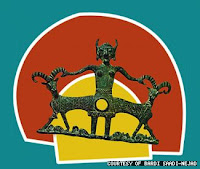
[Picture: This bronze statue from Luristan, in western Iran, dates from the 12th to the eighth century BCE. Photo: Courtesy of Bardi Saadi-Nejad].

Saturday, April 05, 2008

The Struggle of Our Time

By Jane Lampman, "Muslim reformer's 'heresy': The Islamic state is a dead end" -The Christian Science Monitor - Boston, MA, USA
Wednesday, April 2, 2008

Abdullahi Ahmed an-Naim has seen what can happen to an Islamic reformer: His mentor was executed in 1985 in Sudan; he himself had to flee the country.

Still, the self-described "Muslim heretic" has no trouble traveling the Islamic world spreading his controversial message:
There is no such thing as an Islamic state.

A secular state and human rights are essential for all societies so that Muslims and others can practice their faith freely, he tells his co-religionists.

"My motivation is in fact about being an honest, true-to-myself Muslim, rather than someone complying with state dictates," says Mr. Naim, a professor of law at Emory University in Atlanta since 1999. "I need the state to be neutral about religious doctrine so that I can be the Muslim I choose to be."

So committed is this scholar to opening the door to free debate within his faith that he helped organize the first "Muslim Heretics Conference" in Atlanta over the weekend. Some 75 Muslims, engaged in various reform projects, gathered to discuss issues related to sharia (Islamic law), democracy, and women's rights – and how to cope with dissent and its consequences.

"We celebrate heresy simply to promote innovative thinking," he says. "Every orthodoxy was at one time a heresy."

Naim's personal project involves what he calls "negotiating the future of sharia." As Islamic societies struggle to define themselves in a globalized world and some talk of creating Islamic states to codify sharia, he says the state and religion must be kept separate.

But religion should still have its place in political life, allowing Muslims to express principles of sharia as they see fit. He believes this is truly Islamic, and that articulating the reasons why will help ordinary Muslims not be taken in by political slogans.

"I know for a fact that Abdullahi has a following among young Muslims in places like Malaysia and Indonesia," says John Esposito, head of the Center for Muslim-Christian Understanding at Georgetown University in Washington, D.C. "These people are often marginalized in their societies, but over time, these positions can become mainstream."

Naim's view is not just a theory picked up in the United States, but the result of painful personal experience. "

As a Muslim from Sudan whose people have suffered tremendously from confusion over this issue, my mission is to clarify it so other Muslim societies don't go down the same road to come to the same dead end," he says in a phone interview.

He has watched Sudan's institutions virtually collapse under fundamentalist Islamic rule and seen the disillusionment firsthand.

While a law student at the University of Khartoum in 1967, Naim heard a talk by a Sufi Muslim thinker, Mahmoud Mohamed Taha. "That lecture turned my life around," he says, and he joined Taha's Islamic reform movement.

But when Sudanese strongman Jaafar al-Nimeiri was about to introduce sharia by decree in 1983, he jailed Taha, Naim, and others for 18 months. Taha was put on trial and executed.

The essence of the Sufi's message had been that certain verses in the Koran represented the universal, eternal message of Islam, while others were relevant to a particular historical context and no longer viable.

"Specifically [he argued] for equality for women, freedom of religion, and equality for non-Muslims," Naim says. After fleeing the country, he translated Taha's work, "The Second Message of Islam," into English.


Naim later became director of Africa Watch, monitoring human rights on the continent, and in 1995 began teaching at Emory. He's written books on human rights and sponsored social-change projects promoting human rights in local communities in Yemen, Tanzania, and Southeast Asia.

A new book just released in English, "Islam and the Secular State," represents the culmination of his life's work, he says.

Islam teaches that every Muslim stands before God and is responsible for making his own moral choices in observing sharia. The Koran does not prescribe a form of government, but speaks only of the community of Muslims. The book argues that there has never been an Islamic state.

"You will not find any reference to an Islamic state or to state enforcement of sharia before the mid-20th century – it's a post-colonial discourse based on a European-style state," he explains.

While Iran, for instance, claims to be a republic, implying popular sovereignty, a council of clerics is supposed to ensure that it is Islamic. But that council is made up of fallible humans as political as everyone else, he argues.

"How is it that 30 years after the revolution they cannot trust the Muslim citizens to make the choice as to who is likely to be faithful to Islamic values and to represent them?"

Further, Iran and Saudi Arabia both claim to be Islamic states, but to each other they are heresies, he adds. So what does Islamic mean? To call a state Islamic is to attempt to silence political or theological dissent, he says.

"Most Muslims have an intuitive feeling about this but can't articulate it, so when confronted by Islamists who say this is the will of God, they are defenseless," Naim says. "My hope is that with this book, we give people confidence to respond that "this is not Islam, it is your view of Islam."

For some time, Naim has been visiting countries across the Muslim world from Nigeria to Indonesia, testing his ideas in public gatherings, which may range from 25 to 800 people. Before he set out, early manuscripts of his book were translated into Indonesian, Bengali, French, Persian, Russian, Swahili, Turkish, and Urdu and uploaded onto a website.

Only once has he felt physically threatened – after a talk in northern Nigeria – although people have tried to shout him down. "I try to persuade gently, to give examples from Muslim history that people understand, and that helps," he says.

One huge challenge is the negative connotation in the Muslim world of "secularism," often seen as being antireligion.

Yet Radwan Masmoudi, director of the Center for the Study of Islam and Democracy in Washington, believes Naim's goal of separating political and religious institutions is what a majority of Muslims want. Gallup's recent global poll showed "that 80 to 90 percent of Muslims from Morocco to Indonesia want democracy," he says, but similar majorities also want sharia to be a source, or the only source, of law in their countries.

"This is the struggle of our time, coming up with a modern interpretation of sharia that is true to Islamic principles but also to democratic values," he adds.

[Picture from Professor Abdullahi Ahmed An-Na'im Website at Emory: http://people.law.emory.edu/~aannaim/. Photo: Prof. Rosalind Hackett]

[Link to the Official UN Declaration of Human Rights Home Page: http://www.unhchr.ch/udhr/index.htm].

Friday, April 04, 2008

The Ecstatic Faith of Rumi

By Cary McMullen, "Ms. Tippett, Meet Mr. Peabody" - The Ledger - Lakeland, FL, USA
Wednesday, April 2, 2008

It was announced today that Speaking of Faith, the excellent radio program from American Public Media, has been named a winner of the Peabody, the most prestigious award in electronic media.

The show features interviews with a wide range of personalities, all on the subject of, well, faith.

The award was given for a particular 2007 program, "The Ecstatic Faith of Rumi," about the 13th century Islamic mystic and poet, whose work is undergoing a revival right now.

You can hear archives of the show at its Web site, www.speakingoffaith.org.

Thursday, April 03, 2008

An Angel’s Wing Tied to a Donkey’s Tail

By Azam Nizamuddin, Esq., "The Heart of Tolerance: The Prophetic Paradigm Towards Inter-Religious Dialogue" - TAM The American Muslim - Bridgeton, MO, USA
Tuesday, April 1, 2008

The dramatic rise of religion in public discourse recently has given the global community pause to reflect on what role religion will play in modernity.

As communities continue to compete in the new process of globalization, communication, cooperation, and conflict will inevitably increase. As governments across the globe divert billions of dollars into areas of security, terrorism and war, little effort and money is being used to explore the possibility of peace and reconciliation.

The recent Anglo-American invasion and occupation of Iraq demonstrates that notions of peace and stability are as difficult to maintain as they were in 1941.

However, the last twenty years have witnessed the rise of religion and the use of religious symbols and rhetoric in various political discourses as well as in regional conflict. The adherents of religion view this recent phenomenon as a harbinger of divine will, a propitious sign from the Al-Mighty. Critics, however view this development with alarm and concern.

With the rise of extreme nationalism as well as religious assertiveness demonstrated by the Christian Coalition in America, to Hizbut Tehreer in Europe, the Likud Party in the 80s in Israel and of course the Hindutva movement in India, religious ideology, religious rhetoric, and religious identity continue to play major roles within local communities and globally.

(...)

While policy makers and states will continue to utilize religious ideology and symbolism to aggrandize their political agendas, those of us who have been involved in inter-religious dialogue must create new strategies to further develop dialogue and cooperation.

(...)

Each one of us must look to our own faith tradition to develop new strategies for formulating a public discourse on religion. For people of various religious traditions, there must be a framework where all can feel comfortable discussing each other’s faith experiences. Clearly, issues such as sectarian differences, eschatology, the transmigration of the soul, legal justice, and social structures, are simply too palpably close to home to simply ignore or broom under the carpet.

(...)

For Muslims, these concerns will inevitably involve the interpretation and use of sacred texts. From the Islamic perspective, this means the Quran and Hadith or the traditions of the Prophet Muhammad. Inevitably, this involves the recognition and realization that human beings consist of not only matter, but also of a spiritual dimension which must be properly developed in order to promote a civilized, tolerant, and peaceful worldview.

If we ignore the spiritual and beautiful aspect of our creation, then we risk losing the importance of civility within ourselves and the beauty of others.

From the Islamic perspective, God created human beings in his own image. After a brief period in the Divine presence or paradise, human beings were separated from God. The Quran says that human beings were created in a very high and pure state, but that then they were reduced to the low, animal-like state. Having fallen from the state of the best stature, human beings cannot regain the former state save through the Grace of God.

Even though human beings were separated from the Divine presence, they still possess the Divine qualities which separates them from the animals. Some thinkers have referred to this as the spirit, the intellect or even the heart, the seat of the knowledge of God.

The aim of Islamic theology and law is to remind human beings who they really are, which means that they are awakened from their dream which they refer to as their ordinary life, confining the soul to the prison of the ego.

Jalaluddin Rumi, the Muslim jurist and poet reminds us of this reality in an interesting metaphor:

Man’s situation is like this: an angel’s wing was brought and tied to a donkey’s tail so that the donkey perchance might also become an angel, thanks to the radiance of the angel’s company.

For Rumi, beauty is an essential component of religion and faith. When aesthetic value has little or no place in religious observance and practice, then the ugliness of religion fills the void.

Unfortunately, this leads human beings to forget the high rank to which they are assigned. They forget their spiritual dimension which allows them to be close to God. They forget that being close to God means being God’s friend or khalilullah, the name given to Abraham, the spiritual source for many monotheistic traditions.

Since the late 1990’s, the poet Jalaluddin Rumi became the most read poet in the United States. Much of his writings were made available to large American audiences by well constructed and easy to read translations of Rumi’s poetry by able scholars. Indeed, the Pakistani pop group Janoon even referenced Rumi as inspiration for much of its sufi sounds with tolerance and love themes.

Despite the popularity of Rumi in the West, however, what is often overlooked is that the belief, writings, and doctrines of Rumi stem from his focus on emulating the character and personality of the Prophet Muhammad.

It wasn’t that Rumi found themes of tolerance, love, compassion because he was removed from Islamic orthodoxy or practice. To the contrary, these themes, that people outside of Islam so admire and identify about Rumi (love, tolerance, and compassion), stem directly from Rumi’s attempts to incorporate the teachings of the Prophet Muhammad into his own life and teachings.

For example, several well known Prophetic traditions state:
Sahih Muslim - Book 47, Number 47.1.8: Yahya related to me from Malik that he had heard that the Messenger of Allah, may Allah bless him and grant him peace, said, “I was sent to perfect good character.”

Sahih Muslim - Book 47, Number 47.1.7: Yahya related to me from Malik that Yahya ibn Said said that he heard Said ibn al-Musayyab say, “Shall I tell you what is better than much prayer and sadaqa?” They said, “Yes.” He said, “Mending discord. And beware of hatred - it strips you (of your deen).”

Sahih Muslim - Book 47, Number 47.4.16: Yahya related to me from Malik from Ata ibn Abi Muslim that Abdullah al-Khurasani said, “The Messenger of Allah, may Allah bless him and grant him peace, said, ‘Shake hands and rancor will disappear. Give presents to each other and love each other and enmity will disappear.’ ”

The above-referenced traditions form the foundation of Islamic ethics and character development, also known as akhlaq. In Islam, the prophetic voice is not limited to the Seventh century life of the Prophet Muhammad. Prior to Muhammad, there were many prophets who established norms of behavior and practice.

For example, the life of the Prophet Abraham offers a rich example for our purposes this evening. By focusing on the character of Abraham, we can all appreciate the many fascinating aspects of his life. Worth particular attention for our purposes is the story of Abraham challenging his father’s idolatry. (See Surah Sha` ra, 26:69-92 ; and Surah Maryam, 19:41-50).

(...)

Islam’s Vision of Love
One of the other elements within Islamic thought that is readily seen in the works of the luminaries such as Jalaluddin Rumi and even Abu-Hamid al-Ghazali is the concept of love.

Today, the modern secular culture (what we term today as pop culture) is imbued solely with the concept of romantic love. Now, romantic love is to be distinguished from spiritual love.

In terms of literature, romantic love stems from those passionate stories of the troubadours which made their way from Southern European culture toward the end of the French enlightenment period, reflected in such Romantic works as Flaubert’s Madame Bovary.

Here we have a case of love which is forbidden both socially but also morally. The concept here betrays the very sense of loyalty to a spouse or of a contractual obligation. In fact, the very basis of romantic love is derived from a context of something which is unacceptable by its very nature and therefore disloyal.

To the contrary, the notion of love found in the essence of man’s relationship to God is one based on loyalty. It is love that is unconditional. The idea of love has its basis in the Quran, for God loves those that are pious and kind.

Chapter 3 - Imran
[31] - Say, (O Muhammad, to mankind): If ye love Allah, follow me; Allah will love you and forgive you your sins. Allah is Forgiving, Merciful.

[76] - Nay, but (the chosen of Allah is) he who fulfilleth his pledge and wardeth off (evil); for lo! Allah loveth those who ward off (evil).

[103] - And hold fast, all together, by the rope which Allah (stretches out for you), and be not divided among yourselves; and remember with gratitude Allah’s favour on you; for ye were enemies and He joined your hearts in love, so that by His Grace, ye became brethren; and ye were on the brink of the pit of Fire, and He saved you from it. Thus doth Allah make His Signs clear to you: That ye may be guided.

[148] - So Allah gave them the reward of the world and the good reward of the Hereafter. Allah loveth those whose deeds are good.

Chapter 5 - Maida
5:42 - “. . . But if thou judgest, judge between them with equity. Lo! Allah loveth the equitable.

5:54 - O you who believe! whoever from among you turns back from his religion, then Allah will bring a people, He shall love them and they shall love Him

5:93 . . . So be mindful of your duty to Allah and do good works; and again; be mindful of your duty, and believe; and once again: be mindful of your duty, and do right. Allah loveth the good.

In fact, the notion of brotherly love led to the notion of spiritual chivalry which was a very important component of Sufi orders in the classical Islamic period and which to a great degree exists today in the Muslim world.

Al-Ghazali says, the love of God is the highest of all topics and is the final aim. Human perfection resides in this, that the love of God should conquer a man’s heart and posses it wholly, and even if it does not possess it wholly it should predominate in the heart over other things. Love signifies the passing away of the individual self; it is an uncontrollable rapture, a God-sent grace which must be sought by ardent prayer and aspiration.

So how does one love God? From the spiritual perspective, loving God is not like loving through the other five senses such as seeing beauty with eyes or hearing something beautiful with the ears, but rather it is a sixth sense implanted in the heart which animals do not possess, through which we become aware of spiritual beauty and excellence.

Such love is directed not towards any outward form, but toward the inner character. However, love of God can only arise for those who have knowledge of God’s existence and who are aware of Him. Hence, knowledge of God is a prerequisite of love of God.

Love for God is also important for the here after. Al-Ghazali says, He who supposes that it is possible to enjoy happiness in the next world apart from the love of God is in error.

The enjoyment of God is happiness. But if he had no delight in God before, he will not delight in Him then, and if his joy in God was but slight before it will be but slight then. In brief, our future happiness will be in strict proportion to the degree in which we have loved God here.

Rabia – Love of God
She stated: “Oh God, if I worship you in fear of Hell, burn me in Hell; and if I worship you in hope of paradise exclude me from paradise; but if I worship you for your own sake then do not withhold your everlasting beauty.”

Recently, I was privileged to have the opportunity to visit Konya, the home of Rumi. Therefore, I think it is only fitting that I conclude with the words of Mevlana (“master” as he is often called.

Rumi offers us a beautiful poem which inspires the human spirit toward a filial relationship. He states:

Through love all this bitter will be sweet;
Through love all that is copper will be gold;
Through love all dregs will be turn to purest wine;
Through love all pain will turn to medicine;
Through love the dead will all become alive;
Through love the king will turn into a slave;

You know the value of every article of merchandise,
but if you do not know the value of your own soul,
it’s all foolishness.

You have come to know the fortunate and the inauspicious stars,
but you don’t know whether you yourself are fortunate or unlucky.

This, then is the essence of all sciences—that you should know who you will be when the Day of Judgment arrives.

Thus, by incorporating the concept of friend as beautifully exemplified in the character of the Prophets Muhammad and Abraham and the importance of love in the literature of Islamic tradition, we can continue on this journey toward meaningful inter-religious cooperation.

Wednesday, April 02, 2008

The Sufi Sense of Time

By Fred Kirshnit, "A Contemporary Tradition" - New York Sun - New York, NY, USA
Tuesday, April 1, 2008

Although the traditional and the contemporary are often at odds in today's classical music world, Robert Spano will offer a compromise when he brings his Atlanta Symphony Orchestra to Carnegie Hall on Saturday evening: a tradition of presenting the contemporary.

The work in question is the New York premiere of the Here and Now by Christopher Theofanidis.

Mr. Theofanidis teaches at the Peabody Conservatory of Music in Baltimore and was recently composer of the year for the Pittsburgh Symphony.

Commissioned by Mr. Spano himself, the Here and Now is a song cycle for chorus and orchestra based on the poetry of the 13th-century Sufi sage Jelaluddin Rumi.

While the work is an unusual composition, it is not surprising that the Atlanta Symphony is its vehicle; the symphony has been a leader in the introduction of contemporary works.

(...)

As for Mr. Theofanidis, the composer has said that this music reminds him of "Walt Whitman in the now." It does indeed reflect the Sufi sense of time, what cosmological scholar Dr. Arife Ellen Hammerle explains as "the intersection between the universe and the human being in a timeless dimension of space."

The 13 inventive songs range from a cappella chorus at the cycle's opening, to chorus and orchestra, to an epigrammatic soloist, and finally to one Technicolor duet.

In the fourth song, "All day and night, music," the chorus erupts into a multifaceted pealing of campanilian voices, individual bells tolling in the rarefied air.

Throughout the choral writing, there is clarity of line that allows for complex constructions to sound layered but not soupy. Mr. Theofanidis is especially adept at separating voices intelligently.

Song no. 7, "The one who pours is wilder than we," is a jazzy interlude. No. 9, "Drumsound rises," is reminiscent of ancient music — or, at least, reflects modern man's fantasy of how music must have sounded in the days of Christ.

The soloist is a baritone, and, for this concert, Mr. Spano has enlisted the services of one of the fastest rising stars in the operatic firmament, Nathan Gunn. Mr. Gunn's numbers serve as philosophical signposts for an otherwise decidedly non-euclidian journey.

Mr. Theofanidis resists the temptation to go Middle Eastern until the penultimate song, "The urgency of love," for soprano, tenor, chorus, and orchestra.

For this New York premiere, Mr. Spano will employ Hila Plitmann and Richard Clement, both of whom appear on his CD of the work.
[Picture: Whirling Dervish. Ebru Art by Dr. Mehmet Refii Kileci, http://www.kileci.net/. Photo: Sufi News].

Tuesday, April 01, 2008

"Sufism and Zaouias" at Ouezzane, Morocco

[From the French language press]:

La Zaouia Ouezzanya organise, du 28 mars au 6 avril à Ouezzane, le Moussem annuel de Moulay Abdallah Chérif, sous la devise "Invocation et pensée".

Le Matin, Maroc - lundi 31 mars 2008 - par MAP

The Zaouia Ouezzanya organizes, from March 28 to April 6 at Ouezzane, the annual Moussem [religious festival] of Moulay Abdallah Chérif, under the motto "Invocation and thought".

The Moussem was initiated under the High Patronage of His Majesty King Mohammed VI.

A series of spiritual, cultural and socio-economic activities are on the program.

A seminar entitled "Sufism and Zaouias" will be led by Academics and Theologians who will speak about "The Reality of Sufism" and "Zaouias: Past and Present".

Tuesday, April 15, 2008

The Strongest Weapon
No comments:
By Amanda Hamedany, "CULTURE: Martyrs and Scholars Meet in the Middle" - IPS News - Rome, Italy
Wednesday, April 9, 2008

Washington D.C., USA: In an age when suicide bombings and religious and ethnic riots comprise the bulk of the evening news, it seems as though compassion and compromise are more elusive than ever.

Buddha said that there are three poisons in this world: greed, anger, and ignorance. These poisons have the capacity to destroy individuals -- and societies -- unless they are checked by justice (the cure for greed), compassion (the cure for anger), and knowledge (the cure for ignorance).

Knowledge is perhaps the strongest -- and most difficult to wield -- weapon in the modern age. However, as vicious stereotypes increasingly replace truths and individuals are more likely to fear than to learn from others, it is the one of which society is in most need.

On Tuesday, the Muslim call to prayer could be heard from within the sanctuary of the Washington Hebrew Congregation in Washington, DC. Inside, men in kipahs and women in hijab sat with their families learning about interfaith dialogue.

The means of their education was a play entitled "Noor" by Ambassador Akbar Ahmed, the Ibn Khaldun chair of Islamic Studies at American University, former high commissioner of Pakistan, and one of the world's foremost teachers of interfaith dialogue.

In Arabic, noor means light. In Islam, it is one of the 99 names for Allah. In Ahmed's play, it is the name of an 18-year-old college girl abducted from the bazaar in Anytown, Middle East.

In the aftermath of Noor's disappearance, we meet her three brothers: Abdullah, a Sufi mystic who believes that prayer will bring Noor home; Ali, a modernist and a lawyer who believes that the surest way to bring Noor home safely is to go through the authorities; and Daoud, a disenchanted doctor who sees no way to bring Noor home except through violence.

These three brothers represent the three different, at times overlapping, at other times conflicting, branches of modern Islam. In the face of the encroaching West, each brother clings to his beliefs in hopes that it will deliver him.

"Islam is under siege," the actor playing Daoud shouts from the stage. "It is time for every Muslim to stand up and say 'no more'!"

Daoud's sentiments are echoed across much of the Middle East, especially in areas such as Palestine and the failed states of Afghanistan and Iraq. In these cultures, known by some scholars as "panic cultures" because of the perpetual state of anxiety in which they exist due to a lack of confidence in the future, the West is seen as having brought all three of Buddha's deadly poisons without any means of recourse.

With no means to combat what is seen as an invasion, an increasing number of individuals living in these desperate societies resort to violence. As Daoud shouts across the stage that the loss of his family's honour to the "Crusaders" must be avenged, it is alarming to think that this is a reflection of some of the sentiments Ahmed has heard during his many trips to the Middle East.

Ali, the middle brother, clings to his ideas of fair institutions and a modernised society as he looks to government officials to solve his family's woes. However, he soon realises that the institutions in which he places his faith barely exist - corruption and the self-interest of officials stain the establishments founded to bring justice to the people. Ali discovers that his ideals are exactly that - ideals. Disillusioned, he finds himself in the position of a lonely David versus the Goliath of injustice brought by the foreign "liberators".

Abdullah, the eldest brother, finds solace in his Sufi faith. He believes that, although the occupation of his state shows the negative side of the West, there are good people in the United States and Europe.

He believes that everyone can find hope and comfort in prayer.

"This is an amazing story that deals with the very real conflict that I have seen throughout the Middle East," says Frankie Martin, who recently spent a couple of months traveling through the Muslim world with Professor Ahmed. "Everyone feels the crisis, but everyone feels it in a different way. This humanises the struggle being experienced in the Muslim world."

And humanising can lead to understanding. Daoud is not simply a crazed radical - he is a brother, a man, helpless to defend his sister, his family, and his way of life. Ali is not ignorant of the world. He is simply disillusioned that the establishments for which U.S. citizens and Muslims alike fought so hard have failed to protect even the most innocent of individuals: his sister. Abdullah is not a cloudy-headed mystic, but a man of faith who must cling to his beliefs or else lose them forever.

"It is the ordinary Muslim that prevents us from becoming a slave nation with his blood," Daoud shouts from the stage of the synagogue sanctuary, in front of two oversized tablets bearing the Ten Commandments.

Even though there are countless individuals across the Middle East who feel helpless and angry like Daoud, hopeless and disillusioned like Ali, and confused and anxious like Abdullah, this presentation of "Noor" is a step towards combating the poisons.

At the discussion panel immediately following the play, numerous notables from different religious communities -- Muslim, Jewish, and Christian -- sat in a semi-circle on stage to discuss the future of inter-faith dialogue.

"The Prophet Mohammad once said that the ink of the scholar is more sacred than the blood of the martyr," said Rabbi M. Bruce Lustig as he opened the discussion. "We have seen that tonight."

Indeed, the ink of the scholar has planted the seed of knowledge -- the strongest weapon against the poisons that threaten to ravage the modern world.

[Picture from the Book: al-AsmA'ul-HusnA The 99 Beautiful Names of Allah by M.R. Bawa Muhaiyaddeen, The Fellowship Press, Philadelphia, PA].
Read More
A Country of Sufi Type Islam
No comments:
By Afzalur Rahman Khan, "A tendency to be criticized" - Weekly Blitz - Dhaka, Bangladesh
Thursday, April 10, 2008

Bangladesh Election Commission in a recent move are trying to incorporate some electoral rule where the contesting candidates shall be bared from starting election campaign after offering prayers in various holy shrines of saints, which has been in practice for past several decades.

It may be mentioned here that, Bangladesh, being a country of Sufi type Islam, has placed holy shrines and spiritual leaders in extremely important positions in personal and national lives.

But, for some years, a number of radical Islamists forces, including some communist, leftists and atheists are constantly conspiring to move the nation to different direction and convert the moderate Sufi Muslims in to extremist and militant Muslims with the ulterior motive of giving Bangladesh a bad name of radical nation.

(...)

Later a number of bombs were exploded in such holy places, one of which was also exploded at the Holy Shrine of Shahjalal, a famous Muslim saint in the Eastern part of the country.

British High Commissioner Anwar Chowdhury also fell victim of such attack and narrowly escaped dangerous plot of assassination.

Since such attack, various intelligence agencies are trying to identify the culprits behind such attack on a Bangladeshi born foreign envoy, who is not only working hard in further strengthening the existing relations between Dhaka and London, but also seen as a symbol of pride for the entire nation.

(...)

From the recent moves of the Election Commission in stopping people from seeking divine blessings from the Saints and Shrines before running in any election, evidently proves that, such elements inside the EC are no better than those militants of JMB or radical Islamist groups.

(...)

[Picture: "Nakshi Kantha", a traditional stitched quilt of Bengal. Photographer: Toufiq Parag. http://en.wikipedia.org/wiki/Bangladesh].
Read More

Monday, April 14, 2008

Words of Gratitude
No comments:


By Mohamed El Hebeishy (words and pictures), "In pictures: Sudan's whirling dervishes"- BBC, UK/Sudan
Wednesday, April 9, 2008

The weekly dervish ceremony near the capital, Khartoum, is considered one of Sudan's main tourist attractions, explains BBC News website reader Mohamed El Hebeishy.

Sufism is associated with both Sunni & Shia Islam. Those who practice it are called Sufis, or Dervishes.

Every Friday dervishes gather an hour before sunset around some of the big mosques in Khartoum and Omdurman. A circle is formed and the ritual begins.

The ceremony starts with the Madeeh - chanting words of gratitude to the Prophet Mohammed. The audience interacts with the chanters, dancing to the rhythms of the percussion instruments.

Then comes the Zikr, in which the dervishes repeat the word 'Allah' many times.

The dervishes start whirling around inside the circle. With the music, the fragrance of burning frankincense, the endless repetition of religious chants, and the dizziness, they go into a state of trance.

According to ancient belief, Sufism is about the purification of the soul in pursuit of inner peace.

The whirling dance came from the Mevlevi Order in Turkey, and is just one of the physical methods used to try to reach religious ecstasy.

While the more well known Mevlevi dervishes wear white robes, Sudanese dervishes are often dressed in green and red.

Sufism started in Baghdad, and spread to Persia, India, north Africa, and Spain.
Another feature of the Sudanese dervish is the wearing of beads. The dervish elder pictured here has 1,000 beads wrapped around his neck — quite a weight to carry.

The Sufi order known as Tariqa, Qadiriyyah is one of the most widespread in Sudan & north Africa. It was established by Abdul Qadir Jilani (1077-1166 AD), a native of the Iranian province of Gilan.

This mausoleum in Omdurman belongs to one of 19th century Qadiriyyah leaders, Hamad Al Nil.The ceremony is not all about devotional chanting, it is also a social and communal gathering where food is served for the needy.

Growing hair is a common practice among the dervishes, some keep it in dreadlocks while others just let it loose.

Although Sudan is in many ways a male-dominated society, women find themselves a place in the crowd. They gather in one corner wearing bright, colourful robes.

At the close of the ceremony, just before sunset, one of the dervishes walks round the gathered audience with frankincense - which is considered to be a type of blessing to the faithful.

[Click the title of the article to see all the eight pictures].
Read More

Sunday, April 13, 2008

A Source of Peace
No comments:
By Melanie M. Sidwell, "Sufi master to visit Longmont Muslim and speak in Denver" - Longmont Times-Call - Longmont, CO, USA
Friday, April 11, 2008

Series promotes interfaith dialogue: Sufi Master speaks in Denver

A Sufi master, Shaykh Muhammad Hisham Kabbani of the Naqshbandi Order, will speak in Denver this weekend during a free interfaith event about how religion is a source of peace, not conflict.

Kabbani is the keynote speaker during this weekend’s Abrahamic Initiative, an interfaith program sponsored by St. John’s Episcopal Cathedral in Denver with support from The Denver Foundation and Iliff School of Theology, said Greg Movisian, chairman of the steering committee.

(...)

Movisian, who helped to coordinate the Abrahamic Initiative, called Kabbani “a powerful and articulate speaker on this topic of peace from the Sufi tradition.”

“We’ve been focusing (recently) on the relationship between religion and violence and religion and peace,” Movisian said. “It’s just a very basic question: Does religion foster violence or peace? Does it do both? And under what conditions and circumstances?”

The initiative, which began in 2001, promotes interfaith dialogue.

Past topics include women in Islam, Iraq, the Palestinian-Israeli conflict, and the problem of evil and violence in holy texts such as the Bible, Torah and Quran.

“We’re not going to solve the Middle East crisis,” Movisian said, “but people in Denver are talking with each other about caring and understanding each other rather than seeing each other as the enemy.”

[Picture: Shaykh Muhammad Hisham Kabbani of Fenton, Mich., addresses a crowd while visiting the Islamic Center of Yuba City, Calif., in 2006. Photo: Chris Kaufman/Appeal-Democrat file].
Read More
Tested in Sufism
No comments:

By Erwida Maulia, "Govt wants lecturers to proctor nat'l exams" - The Jakarta Post - Jakarta, Indonesia
Wednesday, April 9, 2008

Jakarta: The government is recruiting university lecturers to proctor national exams for elementary, junior and senior high school students.

The lecturers will join so-called "independent watchdog teams" at the provincial and regency/municipal levels. They will be responsible for preventing the kind of large-scale cheating that has dogged the exams for years.

To finance the establishment and activities of the teams, the government has allocated Rp 57.9 billion (US$6.3 million) out of a total Rp 572.85 billion set aside for the national exam program.

"We're now calculating the number of teams and staff members needed for the entire nation; and we've started recruiting some lecturers," chairman of the National Education Standards Agency, Djemari Mardapi, said here Tuesday.

Djemari said the independent watchdog teams only existed at the provincial level last year, while this year teams would be available at the regency/municipal level.

Team members will oversee the exams, including supervising the photocopying of exam papers, storing the papers and distributing them to schools. They will also be responsible for managing the answer sheets.

The National Education Ministry hopes to have rectors of state universities coordinate each team at the provincial level, with lecturers from state and private universities as members of the teams at all three levels.

(...)

Students in the languages program will be tested in Indonesian literature, foreign languages and anthropology; and students in the Islamic program will have additional tests on Koran exegesis, science of hadith and Sufism.

National exams are used to determine the eligibility of final year students to pass on to the next level of education. They have over the years been fiercely criticized by the public.

Former Jakarta State University rector Winarno Surachman told The Jakarta Post last week that students' exam scores could not represent their actual competency.

Education expert Soedijarto said the exam was an "unfair system" as it was applied to all students in the country regardless of the disparities in the quality of education they had enjoyed.

[Picture of the Medan's Masjid Raya (The Great Mosque) from: http://en.wikipedia.org/wiki/Indonesia
Read More
Sufi Poetry Transforms the Reader
No comments:
[From the French language press]:

Du 17 au 24 avril 2008, Fès abritera la 2ème édition du Festival de la culture soufie.

Par Ilham Khalifi, "Faouzi Skali : «Remettre au goût du jour la culture soufie»" - Aujourd'hui Le Maroc - Casablanca, Maroc - vendredi, 4 avril 2008

Fez will host the 2nd edition of the Fez Festival of Sufi Culture, from the 17th to the 24th of April.

The article is an interview to the President of the Festival, Mr. Faouzi Skali, on the place of Sufism in today's society, its role in our globalised world, its much needed spiritual dimension.

This second edition of the Fez Festival of Sufi Culture coincides with the celebration of twelve centuries of the foundation of Fez.

"The site of the event, the Madrasa Bouânania, the Batha Museum… they assert our cultural and historical heritage" Mr. Skali said.

"The choice of the theme "East-West" will create a link with diversity. This is a way to banish this caricature image that is given of Islam" he said.

"We are a culture, a religion of sharing, tolerance, love, mutual help… For this new edition we call new artists, thinkers, scientists, from other continents, other cultural backgrounds" said Mr. Skali.

"The Festival is a tribute to the human being, a tribute to the wisdom that is at the heart of the Islamic civilization" he added.

About the role of the classical Sufi poetry, Mr. Faouzi Skali said: "Sufi poetry transforms those who read it in depth. It is a symbolic form of the human spiritual adventure.

Like all the great works of humanity, this way of thinking is just as vital in today's world than it was in the thirteenth century".

[Visit the Fez Festival's website here: http://www.par-chemins.org/].
Read More

Saturday, April 12, 2008

The Step Away from Oneself
No comments:
By Llewellyn Vaughan-Lee, "Nature of love is union, nature of ego is separation" - India Post - Union City, CA, USA
Wednesday, April 9, 2008

I want union with Him and He wants separation;
Thus I leave what I want so that His wish can come true.
- al-Ghazzali

The spiritual path begins when the heart is awakened to His eternal pres-ence. The Beloved looks into the heart of His lover and in that instant the lover knows the secret of divine union, that the lover and Beloved are one.

The glance of the Beloved carries the consciousness of His eternal presence. The Sufis call this glance the moment of tawba, the turning of the heart. The inner awareness of His presence turns the heart away from the world and back to God.

He calls us back to Him with a momentary glimpse of His face. This glimpse is love's most potent poison that begins our dying to the world, our journey back to God, for "How can I look at the world around me, how can I see it, if it hides the face of my Lover?" (Tweedie).

The inner awareness of union awakens us to the pain of separation.

When the heart knows that in its innermost essence it is united with God, we are confronted with our own isolation, with the knowledge that we are separate from God. It is only because we have been given a glimpse of union, had a sip of this divine wine, that we are made conscious of separation. Without the knowledge of union, how could we know that we are separate?

Without having experienced the bliss of His presence, how could we know the agony of our own isolation? The pain of longing is born from the glance of God. From the beginning of the path, the opposing states of separation and union are engraved into the heart and psyche of the spiritual wayfarer. The consciousness of union becomes the pain of separation that reminds us of our real Home.

The heart's remembrance of its Beloved is kept awake by the fire of longing. We long for Him whom we love, and the greater the love, the greater the pain of longing. Love and sadness become the substance of our inner existence.

In the words of 'Attar:
The pain of love became the medicine for every heart,
The difficulty could never be solved without love


Union and separation, love and longing, sweetness and despair, the polarities of the mystical path leave us bewildered and confused. Why are we left here behind the veils of separation when we know that separation is an illusion? Why are we caught in the prison of duality when our heart knows the deeper truth that 'everything is one'?

The more we meditate and pray, the more we remember Him Whom our heart loves, the more alienated we feel in a world that appears to have forgotten Him.

Somewhere we know what it is like to be loved beyond measure, and here we are left in a world where love is too often equated with demands and co-dependency. The eternal question of "Why are we here?" has an added poignancy when we have felt the infinite nearness of our real Home.

He Whom we love has abandoned us and only the pain of separation reminds us that somewhere He is 'closer to us than our very neck vein.' We carry the pain of remembrance in honor of our love, yet only too often we feel betrayed.

How can such a Beloved desert us? How can such a Beauty veil Her face? Doubts bombard us as the mind tries to convince us of the stupidity of our quest: to look for what you cannot find... to long for an invisible Beloved who has only brought you pain...

In many ways consciousness crucifies us on our search. The subtleties of torture with which the mind can torment are known to most travelers on the path of love. Underlying these difficulties is the fact that while the nature of love is to draw us to union, the nature of the ego is separation.

Love comes from the heart, the innermost core of our being which is our connection to the Absolute. Love is "the essence of the divine essence" and so dynamically pulls us towards oneness. But the ego is born out of separation.

The ego's existence is defined by being different: "I am different from you." The path towards union with God takes us away from the ego with its sense of separate existence and individual identity. This is why the Sufi says that the first step towards God is the step away from oneself.

The ego and the mind belong to a dimension of separation and duality. The ego exists through its sense of individuality and separation; the mind only functions through duality: through comparison and differentiation.

Love calls us to come away from ourselves and enter the state of oneness where only the Beloved exists.

[Picture from: http://www.goldensufi.org/articles.html].
Read More

Friday, April 11, 2008

A Space for Non-traditional Voices
No comments:
By Bettye Miller, "Indian Scholar to Discuss Myths of Islam" - UC Riverside - CA, USA
Monday, April 7, 2008

Riverside, California – Asghar Ali Engineer, an Islamic scholar and activist from Mumbai, India, will discuss “Myths About Islam” in a public lecture on Friday, April 18 at UC Riverside

Engineer will spend the week of April 14 at UCR, where he will meet with students, faculty and community activists.

He will conduct a faculty-student workshop, “Teaching about Islam: Issues and Challenges,” on Thursday, April 17. The workshop and lecture are free and open to the public.

Engineer also will conduct an interfaith dialogue, “Learning about Islam,” organized by the Inland Communities Chapter of the Fellowship of Reconciliation [for details of all events, see below].

Trained as a civil engineer, Engineer currently heads the Institute of Islamic Studies and Centre for Study of Society and Secularism in Mumbai. The center is a research institute and think tank that promotes interfaith dialogue and harmony in India.

He is the founding chairman of the Asian Muslim Action Network, an 18-year-old organization that brings together individuals, groups and associations of Muslims in Asia who subscribe to a progressive approach to Islam.

He has won national awards in India for promoting interfaith activities, including the Communal Harmony Award from the government of India.

In 2004 he was awarded the Right Livelihood Award (widely considered the “alternative Nobel Prize”) by the Swedish Parliament for promoting the values of religious and communal co-existence, tolerance and mutual understanding in South Asia.

“Dr. Engineer is unique not only in the breadth of his expertise, but also in bridging the divide between scholarship and activism,” said Farah Godrej, assistant professor of political science who is coordinating Engineer’s visit to UCR.

“Moreover, as a member of the minority Bohra Muslim community, Dr. Engineer can shed light on the ways in which alternative or marginal voices – other than the ‘mainstream’ Sunni or Shia strains of thought – can be heard within Islam.”

Engineer’s scholarship on Dawoodi Bohra and Sufi Muslims suggests that a deeper understanding of Islamic thought must include a space for non-traditional voices, Godrej said.

The selection of an Indian Muslim scholar to speak with students and faculty also seeks to shed light on the uniqueness of South Asian Islam, and on the ways in which Islam has evolved in its growth beyond the Arab world, Godrej said.

Engineer has written more than 40 books and many journal articles on topics related to Islam, such as the role of women, Islamic liberation theology, and Islam and modernity.

Among his books are “The Origin and Development of Islam,” “Islam and Its Relevance to Our Age,” “The Islamic State,” “Rights of Women in Islam,” “Sufism and Communal Harmony” and “Islam in South and South East Asia.”

His papers include “Developing Theology of Peace in Islam” and “The Concept of Compassion in Islam.” He also has lectured at numerous universities in the United States, Canada, Europe, South and Southeast Asia, and Australia.

The Islamic scholar’s visit is sponsored by the UCR Department of Political Science, Department of Religious Studies, Office of the Dean of the College of Humanities, Arts and Social Sciences, Public Policy Initiative and the Mellon Grant Speaker Series on “Gandhi and his Legacy”

[Visit the Institute of Islamic Studies and Centre for Study of Society and Secularism in Mumbai, India http://ecumene.org/IIS/csss.htm]

[Visit Professor Farah Godrej at UCR, Department of Political Science http://www.politicalscience.ucr.edu/people/faculty/godrej/index.html]

Details:
Asghar Ali Engineer, an Islamic scholar and activist from Mumbai, India, will discuss “Myths About Islam” in a public lecture on Friday, April 18, at 4:15 p.m. in Bourns Hall B118 at UC Riverside.

He will conduct a faculty-student workshop, “Teaching about Islam: Issues and Challenges,” on Thursday, April 17, at 2:15 p.m. in Humanities and Social Sciences 2212. The workshop and lecture are free and open to the public. Parking costs $6.

Engineer also will conduct an interfaith dialogue, “Learning about Islam,” organized by the Inland Communities Chapter of the Fellowship of Reconciliation, at 6 p.m. Wednesday, April 16, at the Downtown Library Auditorium, 3581 Mission Inn Ave.

For information contact the chapter at 951-682-5364 or redwoodgirl@sbcglobal.net
Read More
Touching Hearts
No comments:


Staff Report, "Of comebacks and causes" - The Times of India - India
Thursday, April 10, 2008

Delhi: The last time Chitrangada Singh was in town, she was helping out hubby Jyoti Randhawa at a golf camp for kids.

This time, she came for an art do that was organised in support of underprivileged children. Kiran Modi* and Timothy Bruce hosted this art do, and many from the art frat participated in the exhibition.

The evening was livened up by some live sufi music that everyone found very soulful.

Another feature of the do that touched everyone’s hearts was a song that a bunch of underprivileged children presented.

[Chitrangada Singh is an Indian film actress who is best known for starring in the critically acclaimed 2003 film Hazaaron Khwaishen Aisi http://en.wikipedia.org/wiki/Hazaaron_Khwaishen_Aisi

The movie's title is taken from the couplet of Urdu poet Mirza Ghalib http://en.wikipedia.org/wiki/Mirza_Ghalib]

* http://tinyurl.com/5ucbcq
Read More

Thursday, April 10, 2008

Wells, Faqirs and Shrines
No comments:
By Manzoor Qadir, "Roaming Around Lahore Takias no more: Lahore robbed of its tradition" - The Post - Lahore, Punjab, Pakistan
Tuesday, April 8, 2008

Lahore: Long, long ago, a tourist visiting Lahore saw sprawling, green and blossoming gardens all around the city and exclaimed, "Lahore is the city of gardens".

It appears that he had somehow failed to visit Lahore's Takias (rest houses). Had he cared to observe the kaleidoscopic range of Takias in Lahore, he would have declared otherwise.

(...)

In the good old days, Takias had great importance. All the doors of the city were closed just after the evening as a rule. Those travelers, who arrived at night could not enter city. So they use to stay in these Takias at night, where Takia attendants used to serve them well. The gates of the city were opened when the dawn broke.

Then these travelers entered the city. Besides, a new comer with no relative in the city used to stay in these Takias free of cost.

The duration of the stay at these rest houses was not limited as the person could stay here as long as he wished though he had to prove that he harbored no ill intentions. It is roughly estimated that Lahore had over one hundred Takias, most of which were named after the resident Faqirs as well as Sufi shrines.

During day time, elders and youth of adjacent areas used to pass their free moments or leisure in these Takias. Every Takia had a well of cold water, a Shrine or living Sufi, arena, a mosque, a bathroom and a sufficient place to take rest or to play indoor games were the main features of Takia.

Here people took baths and enjoyed Chausar (a game played with shells), chess and playing cards sitting on rugs. Thus these Takias were like clubs. These Takias served as community centres too because marriages, funerals and functions were held here. Punchayits were held for deciding minor disputes.

Every Takia had an arena for exercise where people use to take exercise and learn the art of wrestling. In modern terminology, these Takias were health clubs. The people here also loved to drink Sardai (a traditional drink of Lahorites that is made with milk, almonds and some seeds).

Gradually, time changed and Takias too were affected by the change. In no time, Bhang addicts and other types of dubious characters occupied these Takias. Elite of the city gave up sitting in these Takias and Takias visitors were not regarded as good persons. It did not happen to just one or two Takias but the majority of the Takias got afflicted.

(...)

However, a few old people still cherish the memory of these Takias when they had some significance and were considered the best place for the out door activities not only for the young people but also for the elderly people.

Talking to The Post, Muhammad Umar recalled that the senior citizens of the city and its adjacent localities used to hold special Qawali functions at the shrines of Takias and this practice still continues at some Takias.

He said that the Takias were the best choice for the locals to accommodate the guests and to serve them during community functions.

Takia was also a point where the locals gathered for offering prayers, Fateha for the departed souls, exercise, indoor games and Qawwali but alas, the city had been deprived of this institution too like other cherished tradition, he regretted.

Takias loss has robbed the city of its much-prized possession, he ended.
Read More

Wednesday, April 09, 2008

The Beautiful One
2 comments:


By Ahmet Kurucan, "‘The Garden of Truth’ by Seyyed Hossein Nasr" - Today's Zaman - Istanbul, Turkey/New Jersey, USA
Monday, April 7, 2008

I had previously heard him talk about various subjects on a number of different occasions, but this time it was different. "I will surely continue with my scholarly studies, but I will no longer be open to offers about writing books on this or that subject.

"I don't think I will work on another book. This is my last book," he said as he was promoting "The Garden of Truth." His is the first name or one of the first names that come to mind in relation to Islamic scholars living in the Western world or in connection with Islam in general or Sufism in particular.

Think about the seriousness with which academic work is conducted in the West, particularly in social science. He has gradually climbed all these academic steps to attain this position.

Almost all of his works are translated into Turkish, even before they are put into Persian. Yes, we are talking about Seyyed Hossein Nasr and will review his book, "The Garden of Truth." The subheading of the book elaborates on its subject: "The Vision and Promise of Sufism, Islam's Mystical Tradition."

What is the meaning of being human? Who are we? Why are we here? These are the questions that have intrigued people since the beginning of mankind. Answers have been sought and according to them, lifestyles have been developed.

In plain language, Nasr tells us, "Everybody should ask this question to themselves." His entire book revolves around this centuries-long question and Nasr, together with readers, seeks an answer to it. Sometimes, he gives us encyclopedic information; at times, he holds the hands of his readers and takes them on a journey into long past corridors of time.

Time and again, he leads readers to the depths of the heart or ushers them into the domain of reason. The most striking fact is that whether you are guided by the heart or by reason, these journeys always take place in a state of sobriety, free from intoxication.

This is a short journey, but it is sufficient to disrupt our mental and intellectual patterns. In this respect, it is considerably exhausting. And eventually, this journey comes to an end at the point that one decides "to become someone or to become no one."

Actually, what makes this journey exhausting is that we tend to stray from the intrinsic line, i.e., the road which is created by God and delineated by divine books and prophets, he says, stressing the fact that truth does not change from one individual to another or from an era to another.

He explains that he voices this unchanging truth using the Sufism's language in the book. This also explains, though a bit indirectly, why the book is titled "Garden of Truth."

In his book, Nasr provides an explanation for why almost all distinguished people who created everlasting works of calligraphy, painting, music or other fine arts or literature in the Islamic world all emerged among Sufis.

He describes Sufis as the people who feel the manifestation of God's attribute of "Cemil" (the Beautiful One) deep in their minds, hearts, bodies and consciences. This manifestation is reflected first in thought and then in art.

Nasr suggests that those who do not think in a positive way, those who do not show the reflection of God's name of the Beautiful One or of the Face of God (Cemal) or who do not see everything in the micro to macro cosmos from the perspective of "what they denote" not from the perspective of "what they seem to be," as Bediuzzaman puts it, cannot produce such works.

"The degree of this manifestation is directly proportional to the level of the person's interest in Sufism and how s/he has progressed based on this interest, the ranks or states s/he has achieved," he notes.

The book has four parts and six chapters. The first chapter focuses on the meaning of being human and the questions of who we are and what we are doing here, as we have already stated.

Part two starts with the second chapter, which is titled "Truth." It consists of four chapters. The second chapter explains how knowledge illuminates and delivers us from the bondage of ignorance. The third chapter is titled "Love and Beauty," and discusses the liberating, calming, attractive, consuming and other qualities of love, beauty and peace with emphasis on their human and divine aspects. The fourth chapter is titled "Goodness and Human Action," and focuses on the human ability to conform to divine will and norms. Finally, the fifth chapter shows us how to reach the garden of truth. As you might guess, this is explained with the help of a number of Sufi terms.

Part three shows us how to access the center, i.e., Sufism, and gives an account of the progress Sufism has made over time and what it can offer us. Nasr makes comparisons between past and contemporary Sufi understanding and practices in the Islamic and Western worlds.

Part four actually consists of two appendices that aim to give a short summary of the history of Sufism to the uninitiated. These appendices contain good, concise information about Sufis, from the first to the contemporary. They are particularly useful in that they present all this information in neatly organized categories.

No doubt this book will be a leading reference for those who take an interest in mysticism and Sufism. Despite his insistence on not writing another book, we can hope that this prolific writer will change his mind and publish more in the future.

"The Garden of Truth -- The Vision and Promise of Sufism, Islam's Mystical Tradition" by Seyyed Hossein Nasr, HarperOne, hardcover, 256 pp, 11.84 pounds in hardcover, ISBN: 978-0060797225
Read More
The Values It Says It Upholds.
No comments:
Yemen Times/Neue Zürcher Zeitung-Qantara.de, "Learning from the Enemy" - Translated from the German by Michael Lawton- Sana'a, Yemen/Zürich, Switzerland
Issue: (1144), Volume 18 , From 7 April 2008 to 9 April 2008

Geert Wilder's film "Fitna"
A calculated political provocation: politicians from both the Arab world and the EU have already protested against Wilders' anti-Koran film

For months, the information had been circulating that the Dutch right-wing populist politician, Geert Wilders, had made a film denouncing the Koran for its allegedly fascist character. Now the film has been made available on the internet – and, says Angela Schader, it largely tells us things we've read before.

Geert Wilders's "Fitna" was surrounded by mystery and argument until the last minute. No public broadcaster was prepared to show it; the website which was to have hosted it was suspended by its provider on March 22nd; a British internet portal copied the way "Fitna" was presented, and then declared the whole thing to be an April joke.

Last Thursday, the film was available for viewing briefly on www.liveleak.com, before the site's operators took it off after they received threats. But the video is already being distributed from other websites.

Wilders restrains himself from carrying out provocations which could be seen by Muslims as open sacrilege. At the start and at the end of the film, he shows the cartoon of Mohammed with a bomb in his turban (ticking dangerously in this version). The cartoon has recently been reprinted frequently following death threats against the cartoonist. And when at the start of the final section a hand begins to rip out a page of the Koran, the screen is blacked out – and we are told that the sound we can hear is merely that of a page being torn out of the telephone book.

Minor manipulations
This manipulative way of dealing with the Koran is more subtle than obviously destructive gestures. Of course the same old suras are quoted in connection with jihad and intolerance – whereby, in two cases, it is instructive to compare the quotations with the original.

In verse 60 of the eighth Sura, which calls for mobilisation against the unbelievers in order "to cause them to fear", the Arabic word is "turhibuna."In the context of the period in which the Koran was written, the translation given above would be quite adequate, but Wilders uses an English translation which blows the whole thing up so that it reads, "to strike terror – to strike terror into the hearts (of the enemy)."

Verse 56 of the fourth Sura paints an unedifying picture of the tortures which await unbelievers in hell: "See, We will burn in fire those who deny Our signs. As often as their skin is cooked, We will give them another skin, so that they will taste the punishment." In Wilders' version, the words "we" and "our" are given without capital letters, so that, when the quotation from the Koran is shown on screen directly following pictures of charred and lacerated terror victims, the words cease to those of God, but are put in the mouth of the Muslims.

Is this just an insignificant detail? Not if one knows the warning given by God to the Prophet: "It is for you to preach, and for Us to draw up the reckoning." (Sura 13, verse 40; there are similar formulation in Sura 3, verse 20 and Sura 64, verse 12).

By making these points, it is not intended to hide the aggressive potential which readers who are more used to the New Testament will identify in the Koran. But where just five verses are made to stand for the spirit of the entire text – as is the case with Wilders' film – then nuances begin to matter.

But it does not seem that Wilders is interested in making distinctions in his approach to religious material, otherwise he would have not have spoken in an interview for the "Spectator" magazine of "Afghan or Sufi or Pakistani law."

There never has been a Sufi justice system, and it is somewhat ironic that Wilders brings Sufism – the most open version of Islam, which is entirely directed towards the spiritual dimension – into connection with his much-criticised Sharia.

It's also amusing when he says in the same interview: "It would be good if there could be a new Koran, as there is a New Testament" – as if the rabbis, dissatisfied with the hard line of their holy book, had sat together and magicked the Christian Saviour out of a hat.

One-eyed
In the same way, "Fitna" – the Arabic word has a relatively wide range of meanings, ranging from "discord", and "dissension", via "civil war", to "conjuring" or "seduction" – cannot be seen as a serious attempt to deal with Islam, either on the religious or the social level.

The film, which claims to argue in favour of enlightened Western attitudes, in fact takes its cue fairly precisely from the propaganda works of the Islamists; the only difference is that it uses the familiar anti-Muslim polemic.

None of the old polemical images are missing here – there's the hate preacher and his fanaticised public; there are the video images of terror attacks, the beheading of a Western hostage or the shooting of an Afghan woman; there's the poisonous polemic against the Jews; there's a postcard montage featuring a collection of mosque buildings with the caption "Greetings from the Netherlands."

Context and differentiation are missing
What is missing (and what was not to be expected from Wilders) is contextualisation and differentiation. There is no mention of the fact that the majority of Muslim immigrants in Europe, whose increasing numbers are underlined with threatening statistics, take a position which is far distant from the kind of understanding of the their religion which is presented here.

(...)

A film which mixes together the nastiest excesses of Muslim fundamentalism and extremism cannot stand for "Islam" as a whole, as the film itself suggests it does. It deals with a phenomenon which, as every informed reader knows by now, is of relatively recent origin and is primarily fed by political and social grievances: a deep frustration which is turned disastrously into a fatally bigoted and reactionary way of reading the religious texts.

It goes of course without saying that this extremism has to be fought with all available effort. Whether all available means should be used: that is a debate which, if it were held seriously and with integrity, would be one way in which the West could demonstrate the values it says it upholds.
Read More
A Sufi Belongs to the Sect of God
No comments:
By Farida Khanam, "A Mystic Faith Soaked In Universal Love" - The Times of India - India
Monday, April 7, 2008

Sufism is the form which mysticism has taken in Islam. The term Sufism embraces the philosophy and practices in Islam which aims at direct communion between God and man. The Islamic values of love, peace and kindness, embodied in the Prophet of Islam were embraced by Sufis. They devoted their lives to spreading these virtues all around the world.

The original intention of Sufism was to deliver man from slavery to worldly passions by destroying the power of the flesh and uniting souls to God by spiritual ties. The Sufi movement's origins lie in asceticism. In one sense self-denial was a reaction to the worldliness of some of the faithful who were absorbed in the pursuit of worldly goals.

Sufis felt the need to help the poor and the helpless. During the reign of the Abbasids a rich minority enjoyed all the comforts of life, while the majority lived as poor peasants and labourers. Sufis reiterated that God was all-loving and all-merciful; that God wants people to love one another, be merciful and compassionate. They raised such questions as how we are justified in expecting love and compassion from God, while we have nothing to offer to our fellow- men but hate and ill will.

Sufis spread the message of harmony, brother-hood, peace and friendship. The Sufis hold that despairing of love and mercy is a greater fault than committing sin.

For, as we learn from traditions, everything in life is mortal, except for God and good deeds. All worldly things are characterised by impermanence. Good deeds alone can bring us salvation.

The Qur'an says: "Do not despair of My mercy. God turns to those who repent and surrender themselves to Him" (39:53).

Shaykh Nizamuddin Awliya devoted his life in saving mankind from sin and suffering. He believed that, in the eyes of God, no deed was of greater significance than freeing fellow human beings from their misery and helping the helpless.

Once someone asked Khwaja Moinuddin Chisti what was the highest form of religious devotion in the eyes of God. He replied: "Develop river-like generosity, sun-like bounty and earth-like hospitality".

Love is most important. Sufis conceive God as the beloved and man as the lover. According to Ibn Arabi, no religion ranks higher than the religion of love. Love is the source and the essence of all creeds. Therefore, a Sufi thinks that all the evil thoughts which breed dislike, hatred and religious division and prejudice must be replaced by love.

When he has come to his last stage of enlightenment, his self is annihilated in the complete sense. This is the stage when he comes closer to God, and naturally he becomes a servant to God's people.

He rises above vested interests, above all biases and predilections. A realised Sufi has no other interest but his love of God and world brotherhood.

Love of God is a process that purifies the human personality. That is, the soul comes to realise itself, in the sense that the latent natural potential of the soul is ultimately awakened and, in the words of the Qur'an, it becomes the 'serene' or 'pure soul'.

A heart filled with God's love will necessarily be filled with the love of other human beings, all the creatures of God. As Bayazid Bistami says: "A Sufi belongs to the sect of God".

The writer is a reader in the Islamic Studies department of Jamia Millia Islamia.
Read More

Tuesday, April 08, 2008

Turkey's Version of Islam
No comments:
By Avni Dogru MBA, "Turkey: Ruling a nation through fear" - Today's Zaman - New York/Istanbul, Turkey
Saturday, April 5, 2008

The recent bid by Turkey's chief prosecutor to have the Constitutional Court shut down the ruling Justice and Development Party (AK Party) is the latest manifestation of Turkey's extremist secular elite's fear of losing control over the republic.

It was a shock for many and the majority of Turks viewed it as a step backward in Turkey's democratization process and an embarrassment to the country's image. However, it actually is more of a milestone along the way to a mature, exemplary democracy.

A relatively young democracy, Turkey has come a long way through tumultuous times since its birth in 1923.

Turkey's founder, Mustafa Kemal Atatürk, was an unusually insightful leader, reforming his nation by changing its entire trajectory of development toward a goal of modernization and increased civil rights in an era when tyrannical waves were sweeping the world; namely, Mussolini in Italy, Hitler in Germany and later Franco in Spain. Yet, after his death Turkey faced three major military coups and even endured the execution of one prime minister and two ministers by a military junta following a coup in 1960.

While the Turkish military was once the main tool used to interrupt the democratic progress in Turkey, the judicial system has also been targeted for manipulation by Turkey's extremist secular elite. Without a fully independent legal system, Turkish courts have been used to suppress unwanted ideologies -- 26 political parties have been shut down by the same judges since 1954.

Today, Turkish democracy is at a very different point than even a decade ago and a military coup is no longer likely. The governing party, the AK Party, has done much to put the military under civilian control with the undeniable support of the EU. However, the judicial system continues to be manipulated by Turkey's elite, who pose as secularists, but represent the protectionist and autocratic ideologies of the 1930s.

They have become very uncomfortable with the AK Party's attempts to remove the headscarf ban at universities, as well as the party's support of the first civil constitution project. Since the current constitution was prepared by five generals after a coup in 1980, a civil constitution is a necessary step forward for Turkish democracy.

It is of note that Turkey adapted its secularism from the French "laïcité" in 1937. Unlike Anglo-Saxon secularism at play throughout America and most of Europe, which promotes freedom of thought and religion, laïcité is associated with obstructed religious freedom.

In February 2004, the French parliament banned religious symbols such as the Islamic headscarf, the Christian cross and the Jewish skullcap in public secondary schools. This law created a major social rift in France and was considered an audacious leadership move by many in secular countries around the world.

In Turkey's case, although it is not banned by the Constitution, the Constitutional Court relied on only a lower court's ruling after a coup in 1997 to enforce a ban on women wearing headscarves in universities.

To be sure, Turkey implemented a ban far more radical than the French. In France, it is still possible to wear headscarves at universities and private secondary schools, yet these basic rights were taken away from Turkish women without any checks and balances.

What many people don't know is that Turkey's version of Islam is not a threat to secularism in Turkey, as it is strongly tempered by the social integration of Muhammed Jelaluddin Rumi's philosophy of tolerance and Sufism.

This non-exclusionary leaning on the part of Turks makes for a healthier practice of the religion throughout the country compared with the rest of the world.

No matter what is shown as the reason to shut down the AK Party, the deeper political motives are quite different and hidden. Turkish society has been going through major social changes in the last decade, causing tension between Turkey's marginal elite, who see themselves above everyone and prefer the status quo and autocracy, and the rest of the Turkish citizens, who want more freedom and rights. Globalization and an open society threaten the 1930s protectionist policies.

As a result of the new economic boom, the fortified conservative middle class wants to have a say in the country's future. Meanwhile, Turkey's marginal elite is trying in every way possible not to share power. The root source of the fighting is this shifting power from the marginal elite to the people on the street.

In the past, the motto of "saving secularism" as an excuse to hoard power has always worked. But, if there was a real threat to secularism in Turkey, the results of a comparative study done by the Turkish Economic and Social Studies Foundation (TESEV), a leading Turkish think tank, in 1999 and late 2006 would show it.

The study shows that from 1999 to 2006, the percentage of Turkish citizens who would favor a Shariah-based religious regime dropped from 21 percent to 9 percent. In the same period, the percentage of women wearing a headscarf decreased by 9 percent even though this choice of dress became more visible in larger cities due to migration.

All democracies go through a maturation stage and face similar challenges.

Even though the chief prosecutor's bid against the AK Party challenges Turkish democracy in the short run, Turkey is not the same country that it was 10 years ago. The majority of Turks are now aware that their democratic gains are at stake with this bid. Accordingly, there is growing public sympathy for the AK Party.

Recent polls show the AK Party's approval rating has jumped from 47 percent in the July 2007 elections to between 60 and 70 percent after the recent court case. Turkey's elite is mired in so much fear that it does not even realize how much it is helping the AK Party gain power.

[Map from: US Department of State, Bureau of European and Eurasian Affairs http://www.state.gov/r/pa/ei/bgn/3432.htm#political].
Read More

Monday, April 07, 2008

Actions Speak Louder than Words

No comments:
By Yousuf Bhuvad, "Naqsbandia Foundation for Islamic education celebrates Mawlid un Nabi Conference" - NFIE - Chandler, AZ, USA
Monday, April 7, 2008


The Naqsbandia Foundation for Islamic Education [NFIE] celebrated the 5th annual Mawlid-un-Nabi Conference of the Chandler Community Center in Chandler, Arizona on March 29th, 2008.

A large number of the diversified Muslim community in the Phoenix metropolitan area attended this spiritual event.

The program started with the Quranic Recitation by Imam Didmar Faja who is the Imam of the Albanian American Islamic Center. Mohammed Bilal Siddiqui recited Hamd and Naat in the praises for Allah and his beloved prophet (PBUH).

The children from the Arizona Cultural Academy presented the choir reciting verses and poetry in the praise of Allah and his prophet (SAWS). Imam Muaz Redzic, Imam Islamic Center North East Valley introduced the theme of the Mawlid. The theme this year was the love for the prophet(PBUH).

The guest Naat reciter, Al-Haj Noor Mohammad Jarral, was one of the highlights of the Mawlid. He won the hearts of the audience by his Naat and Hamd creating a spiritual experience and serenity never seen before.

Dr. Ahmed Mirza, the secretary of NFIE, talked about the mission of the Naqsbandia Foundation for the Islamic education and how it has grown in the past few years.

The keynote speaker Shaykh Sayyed Muhammad bin Yahya Al-Hussayni Al-Ninowy, once again touched the hearts by his eloquent talk on the subject matter of love for the prophet Mohammed (SAWS).

The key message is that if we truly love the prophet (PBUH), we need to show it by our actions and not by words as actions speak louder than words.

Shaykh Sayyed Mohammed also conducted a questions and answers session with the audience covering Islamic Shariah and Fiqah.

Noor Mohammed Jarral, recited few Naats followed by Salat-o-Salaam and prayers by the Shaykh. The program ended with thanks and gratitude by Arif Kazmi for all the volunteers who helped make the event successful.

[Visit the NFIE website: http://www.nfie.com/].
Read More
Urs of Khawaja Ghulam Fareed
No comments:


Associated Press of Pakistan - The Post - Lahore, Punjab, Pakistan
Friday, April 4, 2008

Rajanpur: The 107th Urs of renowned Sufi poet and saint Hazrat Khawaja Ghulam Fareed will begin at Kot Mothan Sharif from Saturday, April the12th.

Auqaf department, district government, Khawaja Fareed World Council, Khawaja Fareed Foundation, Sadiqia Foundation, Khawaja Fareed Adbi-o-Saqafti Sangat, and PPP cultural wing have finalized their programmes to celebrate the Urs in a befitting manner.

Sajjada Nasheen Khawaja Moinuddin Mehboob Koreja chaired a meeting on Thursday to finalise the programmes and also formed organising committees to oversee arrangements for Urs ceremonies.

Mahafil-e-Sama, Mahafil-e-Qirat, Naat Khawani, seminars will be held during the three-day ceremonies.

[Stamp from:
http://www.pakpost.gov.pk/philately/stamps2001/khawaja_farid.html (with bio of Khawaja Fareed);
Read More

Sunday, April 06, 2008

A Thesis on Dream Interpretation in Sufism
No comments:
By Barbara Black, "Iranian studies launched with a minor" - Concordia Journal - Montreal, Quebec, Canada
Thursday, April 3, 2008

Concordia is developing a program in Iranian studies, starting with an undergraduate minor that is listed in the 2008-09 undergraduate calendar.

Its organizers intend that this initiative, which is unique in Canada, will grow into a full-fledged major program.

Professors Richard Foltz and Lynda Clarke want to establish Concordia as the premier centre for Iranian studies in Canada, making use of Montreal as a crossroads of Iranian immigration for the benefit of the community at large.

Although the minor is based in the Department of Religion, it is interdisciplinary, including anthropology, political science, gender studies, history and film. Students can choose from a wide range of courses.

Besides Islamists Lynda Clarke and Richard Foltz, the core faculty comprises linguist Mark Hale, sociologist Homa Hoodfar and Peter Rist, an expert on Iranian film. Also associated are classicist Annette Teffeteller and political scientist James Devine, a specialist in contemporary Iranian and Gulf politics.

(Foltz explained, “We realized that a lot of our students are interested in Iran and chose Concordia because we have a lot of Iranists [in the Department of Religion]. We decided to develop this into a strategic plan, to formalize what we are already doing.”

While Islam is an increasingly popular field of study in North America, Iranian studies has a very faint presence; there are only two active programs at U.S. universities. Pre-Islamic Persia was an astonishingly rich culture whose influence rivals that of ancient Greece.

Foltz, who has a PhD from Harvard, has just published a book called Iran creuset de religion (Iran, The Crucible of Religion), published by Laval University Press. In this and a previous book, Religions of the Silk Road (St. Martin’s Press, 1999), he traces the emergence, development and transmission of the world’s major religious traditions.

Clarke said Concordia’s Iranian studies initiative was inspired by the success of Centre for Canadian Irish Studies, which has used local community support and a stream of visiting speakers, scholars and organized events to build a highly visible interdisciplinary centre.

In fact, there are surprising affinities between Iran and Ireland, both local and historical. Both ethnic communities have a strong presence in Montreal and at Concordia, thanks to waves of immigration — in Ireland’s case, in the mid-19th century, in Iran’s, much more recently. Montreal now has about 16,000 citizens of Iranian descent, and Concordia’s Iranian Students Association is a very active organization.

There are historical connections, too, although they reach far back. “Iran” and “Eire,” the Celtic name for Ireland, have the same etymological root. Both peoples, among many others, can be traced to Indo-European roots. Iranians are not Arabs, and their language is Farsi, or Persian, not Arabic.

Iran-related research and teaching at Concordia reflects the extraordinarily broad impact of Iranian civilization on the world’s diverse cultures, from the Balkans to China and India over a span of some 3,000 years.

“Iranian civilization is much broader than Islam,” Clarke said.

The Concordia program will draw on the expertise of specialists in the Persian language, ancient Iranian languages, mythology and art. The organizers hope to raise sufficient funds to add specialists in Persian literature, history, art and architecture.

In the Department of Religion alone, Umberto Cicchetti, Eliza Tasbihi, Khadijeh Zolghadr and Linda Darwish are doing doctorates in Iranian studies with an emphasis on religion. Many other graduate students with Iranian interest are at work as well.

Tasbihi has just finished an MA on Iranian Islamic theosophy, and is presently working on Rumi, the highly popular 13th-century Sufi “poet of love.”

Cicchetti, a native-born Quebecer with no Iranian background, is doing a thesis on dream interpretation in Sufism. In fact, he is in Iran now.

He is one of many students the Department of Religion has helped to travel to Iran to study Persian and otherwise further his studies, the latest being a student in the School of Cinema, who is writing a thesis on Iranian film.

[Picture: This bronze statue from Luristan, in western Iran, dates from the 12th to the eighth century BCE. Photo: Courtesy of Bardi Saadi-Nejad].
Read More

Saturday, April 05, 2008

The Struggle of Our Time
2 comments:
By Jane Lampman, "Muslim reformer's 'heresy': The Islamic state is a dead end" -The Christian Science Monitor - Boston, MA, USA
Wednesday, April 2, 2008

Abdullahi Ahmed an-Naim has seen what can happen to an Islamic reformer: His mentor was executed in 1985 in Sudan; he himself had to flee the country.

Still, the self-described "Muslim heretic" has no trouble traveling the Islamic world spreading his controversial message:
There is no such thing as an Islamic state.

A secular state and human rights are essential for all societies so that Muslims and others can practice their faith freely, he tells his co-religionists.

"My motivation is in fact about being an honest, true-to-myself Muslim, rather than someone complying with state dictates," says Mr. Naim, a professor of law at Emory University in Atlanta since 1999. "I need the state to be neutral about religious doctrine so that I can be the Muslim I choose to be."

So committed is this scholar to opening the door to free debate within his faith that he helped organize the first "Muslim Heretics Conference" in Atlanta over the weekend. Some 75 Muslims, engaged in various reform projects, gathered to discuss issues related to sharia (Islamic law), democracy, and women's rights – and how to cope with dissent and its consequences.

"We celebrate heresy simply to promote innovative thinking," he says. "Every orthodoxy was at one time a heresy."

Naim's personal project involves what he calls "negotiating the future of sharia." As Islamic societies struggle to define themselves in a globalized world and some talk of creating Islamic states to codify sharia, he says the state and religion must be kept separate.

But religion should still have its place in political life, allowing Muslims to express principles of sharia as they see fit. He believes this is truly Islamic, and that articulating the reasons why will help ordinary Muslims not be taken in by political slogans.

"I know for a fact that Abdullahi has a following among young Muslims in places like Malaysia and Indonesia," says John Esposito, head of the Center for Muslim-Christian Understanding at Georgetown University in Washington, D.C. "These people are often marginalized in their societies, but over time, these positions can become mainstream."

Naim's view is not just a theory picked up in the United States, but the result of painful personal experience. "

As a Muslim from Sudan whose people have suffered tremendously from confusion over this issue, my mission is to clarify it so other Muslim societies don't go down the same road to come to the same dead end," he says in a phone interview.

He has watched Sudan's institutions virtually collapse under fundamentalist Islamic rule and seen the disillusionment firsthand.

While a law student at the University of Khartoum in 1967, Naim heard a talk by a Sufi Muslim thinker, Mahmoud Mohamed Taha. "That lecture turned my life around," he says, and he joined Taha's Islamic reform movement.

But when Sudanese strongman Jaafar al-Nimeiri was about to introduce sharia by decree in 1983, he jailed Taha, Naim, and others for 18 months. Taha was put on trial and executed.

The essence of the Sufi's message had been that certain verses in the Koran represented the universal, eternal message of Islam, while others were relevant to a particular historical context and no longer viable.

"Specifically [he argued] for equality for women, freedom of religion, and equality for non-Muslims," Naim says. After fleeing the country, he translated Taha's work, "The Second Message of Islam," into English.


Naim later became director of Africa Watch, monitoring human rights on the continent, and in 1995 began teaching at Emory. He's written books on human rights and sponsored social-change projects promoting human rights in local communities in Yemen, Tanzania, and Southeast Asia.

A new book just released in English, "Islam and the Secular State," represents the culmination of his life's work, he says.

Islam teaches that every Muslim stands before God and is responsible for making his own moral choices in observing sharia. The Koran does not prescribe a form of government, but speaks only of the community of Muslims. The book argues that there has never been an Islamic state.

"You will not find any reference to an Islamic state or to state enforcement of sharia before the mid-20th century – it's a post-colonial discourse based on a European-style state," he explains.

While Iran, for instance, claims to be a republic, implying popular sovereignty, a council of clerics is supposed to ensure that it is Islamic. But that council is made up of fallible humans as political as everyone else, he argues.

"How is it that 30 years after the revolution they cannot trust the Muslim citizens to make the choice as to who is likely to be faithful to Islamic values and to represent them?"

Further, Iran and Saudi Arabia both claim to be Islamic states, but to each other they are heresies, he adds. So what does Islamic mean? To call a state Islamic is to attempt to silence political or theological dissent, he says.

"Most Muslims have an intuitive feeling about this but can't articulate it, so when confronted by Islamists who say this is the will of God, they are defenseless," Naim says. "My hope is that with this book, we give people confidence to respond that "this is not Islam, it is your view of Islam."

For some time, Naim has been visiting countries across the Muslim world from Nigeria to Indonesia, testing his ideas in public gatherings, which may range from 25 to 800 people. Before he set out, early manuscripts of his book were translated into Indonesian, Bengali, French, Persian, Russian, Swahili, Turkish, and Urdu and uploaded onto a website.

Only once has he felt physically threatened – after a talk in northern Nigeria – although people have tried to shout him down. "I try to persuade gently, to give examples from Muslim history that people understand, and that helps," he says.

One huge challenge is the negative connotation in the Muslim world of "secularism," often seen as being antireligion.

Yet Radwan Masmoudi, director of the Center for the Study of Islam and Democracy in Washington, believes Naim's goal of separating political and religious institutions is what a majority of Muslims want. Gallup's recent global poll showed "that 80 to 90 percent of Muslims from Morocco to Indonesia want democracy," he says, but similar majorities also want sharia to be a source, or the only source, of law in their countries.

"This is the struggle of our time, coming up with a modern interpretation of sharia that is true to Islamic principles but also to democratic values," he adds.

[Picture from Professor Abdullahi Ahmed An-Na'im Website at Emory: http://people.law.emory.edu/~aannaim/. Photo: Prof. Rosalind Hackett]

[Link to the Official UN Declaration of Human Rights Home Page: http://www.unhchr.ch/udhr/index.htm].
Read More

Friday, April 04, 2008

The Ecstatic Faith of Rumi
No comments:
By Cary McMullen, "Ms. Tippett, Meet Mr. Peabody" - The Ledger - Lakeland, FL, USA
Wednesday, April 2, 2008

It was announced today that Speaking of Faith, the excellent radio program from American Public Media, has been named a winner of the Peabody, the most prestigious award in electronic media.

The show features interviews with a wide range of personalities, all on the subject of, well, faith.

The award was given for a particular 2007 program, "The Ecstatic Faith of Rumi," about the 13th century Islamic mystic and poet, whose work is undergoing a revival right now.

You can hear archives of the show at its Web site, www.speakingoffaith.org.
Read More

Thursday, April 03, 2008

An Angel’s Wing Tied to a Donkey’s Tail
No comments:
By Azam Nizamuddin, Esq., "The Heart of Tolerance: The Prophetic Paradigm Towards Inter-Religious Dialogue" - TAM The American Muslim - Bridgeton, MO, USA
Tuesday, April 1, 2008

The dramatic rise of religion in public discourse recently has given the global community pause to reflect on what role religion will play in modernity.

As communities continue to compete in the new process of globalization, communication, cooperation, and conflict will inevitably increase. As governments across the globe divert billions of dollars into areas of security, terrorism and war, little effort and money is being used to explore the possibility of peace and reconciliation.

The recent Anglo-American invasion and occupation of Iraq demonstrates that notions of peace and stability are as difficult to maintain as they were in 1941.

However, the last twenty years have witnessed the rise of religion and the use of religious symbols and rhetoric in various political discourses as well as in regional conflict. The adherents of religion view this recent phenomenon as a harbinger of divine will, a propitious sign from the Al-Mighty. Critics, however view this development with alarm and concern.

With the rise of extreme nationalism as well as religious assertiveness demonstrated by the Christian Coalition in America, to Hizbut Tehreer in Europe, the Likud Party in the 80s in Israel and of course the Hindutva movement in India, religious ideology, religious rhetoric, and religious identity continue to play major roles within local communities and globally.

(...)

While policy makers and states will continue to utilize religious ideology and symbolism to aggrandize their political agendas, those of us who have been involved in inter-religious dialogue must create new strategies to further develop dialogue and cooperation.

(...)

Each one of us must look to our own faith tradition to develop new strategies for formulating a public discourse on religion. For people of various religious traditions, there must be a framework where all can feel comfortable discussing each other’s faith experiences. Clearly, issues such as sectarian differences, eschatology, the transmigration of the soul, legal justice, and social structures, are simply too palpably close to home to simply ignore or broom under the carpet.

(...)

For Muslims, these concerns will inevitably involve the interpretation and use of sacred texts. From the Islamic perspective, this means the Quran and Hadith or the traditions of the Prophet Muhammad. Inevitably, this involves the recognition and realization that human beings consist of not only matter, but also of a spiritual dimension which must be properly developed in order to promote a civilized, tolerant, and peaceful worldview.

If we ignore the spiritual and beautiful aspect of our creation, then we risk losing the importance of civility within ourselves and the beauty of others.

From the Islamic perspective, God created human beings in his own image. After a brief period in the Divine presence or paradise, human beings were separated from God. The Quran says that human beings were created in a very high and pure state, but that then they were reduced to the low, animal-like state. Having fallen from the state of the best stature, human beings cannot regain the former state save through the Grace of God.

Even though human beings were separated from the Divine presence, they still possess the Divine qualities which separates them from the animals. Some thinkers have referred to this as the spirit, the intellect or even the heart, the seat of the knowledge of God.

The aim of Islamic theology and law is to remind human beings who they really are, which means that they are awakened from their dream which they refer to as their ordinary life, confining the soul to the prison of the ego.

Jalaluddin Rumi, the Muslim jurist and poet reminds us of this reality in an interesting metaphor:

Man’s situation is like this: an angel’s wing was brought and tied to a donkey’s tail so that the donkey perchance might also become an angel, thanks to the radiance of the angel’s company.

For Rumi, beauty is an essential component of religion and faith. When aesthetic value has little or no place in religious observance and practice, then the ugliness of religion fills the void.

Unfortunately, this leads human beings to forget the high rank to which they are assigned. They forget their spiritual dimension which allows them to be close to God. They forget that being close to God means being God’s friend or khalilullah, the name given to Abraham, the spiritual source for many monotheistic traditions.

Since the late 1990’s, the poet Jalaluddin Rumi became the most read poet in the United States. Much of his writings were made available to large American audiences by well constructed and easy to read translations of Rumi’s poetry by able scholars. Indeed, the Pakistani pop group Janoon even referenced Rumi as inspiration for much of its sufi sounds with tolerance and love themes.

Despite the popularity of Rumi in the West, however, what is often overlooked is that the belief, writings, and doctrines of Rumi stem from his focus on emulating the character and personality of the Prophet Muhammad.

It wasn’t that Rumi found themes of tolerance, love, compassion because he was removed from Islamic orthodoxy or practice. To the contrary, these themes, that people outside of Islam so admire and identify about Rumi (love, tolerance, and compassion), stem directly from Rumi’s attempts to incorporate the teachings of the Prophet Muhammad into his own life and teachings.

For example, several well known Prophetic traditions state:
Sahih Muslim - Book 47, Number 47.1.8: Yahya related to me from Malik that he had heard that the Messenger of Allah, may Allah bless him and grant him peace, said, “I was sent to perfect good character.”

Sahih Muslim - Book 47, Number 47.1.7: Yahya related to me from Malik that Yahya ibn Said said that he heard Said ibn al-Musayyab say, “Shall I tell you what is better than much prayer and sadaqa?” They said, “Yes.” He said, “Mending discord. And beware of hatred - it strips you (of your deen).”

Sahih Muslim - Book 47, Number 47.4.16: Yahya related to me from Malik from Ata ibn Abi Muslim that Abdullah al-Khurasani said, “The Messenger of Allah, may Allah bless him and grant him peace, said, ‘Shake hands and rancor will disappear. Give presents to each other and love each other and enmity will disappear.’ ”

The above-referenced traditions form the foundation of Islamic ethics and character development, also known as akhlaq. In Islam, the prophetic voice is not limited to the Seventh century life of the Prophet Muhammad. Prior to Muhammad, there were many prophets who established norms of behavior and practice.

For example, the life of the Prophet Abraham offers a rich example for our purposes this evening. By focusing on the character of Abraham, we can all appreciate the many fascinating aspects of his life. Worth particular attention for our purposes is the story of Abraham challenging his father’s idolatry. (See Surah Sha` ra, 26:69-92 ; and Surah Maryam, 19:41-50).

(...)

Islam’s Vision of Love
One of the other elements within Islamic thought that is readily seen in the works of the luminaries such as Jalaluddin Rumi and even Abu-Hamid al-Ghazali is the concept of love.

Today, the modern secular culture (what we term today as pop culture) is imbued solely with the concept of romantic love. Now, romantic love is to be distinguished from spiritual love.

In terms of literature, romantic love stems from those passionate stories of the troubadours which made their way from Southern European culture toward the end of the French enlightenment period, reflected in such Romantic works as Flaubert’s Madame Bovary.

Here we have a case of love which is forbidden both socially but also morally. The concept here betrays the very sense of loyalty to a spouse or of a contractual obligation. In fact, the very basis of romantic love is derived from a context of something which is unacceptable by its very nature and therefore disloyal.

To the contrary, the notion of love found in the essence of man’s relationship to God is one based on loyalty. It is love that is unconditional. The idea of love has its basis in the Quran, for God loves those that are pious and kind.

Chapter 3 - Imran
[31] - Say, (O Muhammad, to mankind): If ye love Allah, follow me; Allah will love you and forgive you your sins. Allah is Forgiving, Merciful.

[76] - Nay, but (the chosen of Allah is) he who fulfilleth his pledge and wardeth off (evil); for lo! Allah loveth those who ward off (evil).

[103] - And hold fast, all together, by the rope which Allah (stretches out for you), and be not divided among yourselves; and remember with gratitude Allah’s favour on you; for ye were enemies and He joined your hearts in love, so that by His Grace, ye became brethren; and ye were on the brink of the pit of Fire, and He saved you from it. Thus doth Allah make His Signs clear to you: That ye may be guided.

[148] - So Allah gave them the reward of the world and the good reward of the Hereafter. Allah loveth those whose deeds are good.

Chapter 5 - Maida
5:42 - “. . . But if thou judgest, judge between them with equity. Lo! Allah loveth the equitable.

5:54 - O you who believe! whoever from among you turns back from his religion, then Allah will bring a people, He shall love them and they shall love Him

5:93 . . . So be mindful of your duty to Allah and do good works; and again; be mindful of your duty, and believe; and once again: be mindful of your duty, and do right. Allah loveth the good.

In fact, the notion of brotherly love led to the notion of spiritual chivalry which was a very important component of Sufi orders in the classical Islamic period and which to a great degree exists today in the Muslim world.

Al-Ghazali says, the love of God is the highest of all topics and is the final aim. Human perfection resides in this, that the love of God should conquer a man’s heart and posses it wholly, and even if it does not possess it wholly it should predominate in the heart over other things. Love signifies the passing away of the individual self; it is an uncontrollable rapture, a God-sent grace which must be sought by ardent prayer and aspiration.

So how does one love God? From the spiritual perspective, loving God is not like loving through the other five senses such as seeing beauty with eyes or hearing something beautiful with the ears, but rather it is a sixth sense implanted in the heart which animals do not possess, through which we become aware of spiritual beauty and excellence.

Such love is directed not towards any outward form, but toward the inner character. However, love of God can only arise for those who have knowledge of God’s existence and who are aware of Him. Hence, knowledge of God is a prerequisite of love of God.

Love for God is also important for the here after. Al-Ghazali says, He who supposes that it is possible to enjoy happiness in the next world apart from the love of God is in error.

The enjoyment of God is happiness. But if he had no delight in God before, he will not delight in Him then, and if his joy in God was but slight before it will be but slight then. In brief, our future happiness will be in strict proportion to the degree in which we have loved God here.

Rabia – Love of God
She stated: “Oh God, if I worship you in fear of Hell, burn me in Hell; and if I worship you in hope of paradise exclude me from paradise; but if I worship you for your own sake then do not withhold your everlasting beauty.”

Recently, I was privileged to have the opportunity to visit Konya, the home of Rumi. Therefore, I think it is only fitting that I conclude with the words of Mevlana (“master” as he is often called.

Rumi offers us a beautiful poem which inspires the human spirit toward a filial relationship. He states:

Through love all this bitter will be sweet;
Through love all that is copper will be gold;
Through love all dregs will be turn to purest wine;
Through love all pain will turn to medicine;
Through love the dead will all become alive;
Through love the king will turn into a slave;

You know the value of every article of merchandise,
but if you do not know the value of your own soul,
it’s all foolishness.

You have come to know the fortunate and the inauspicious stars,
but you don’t know whether you yourself are fortunate or unlucky.

This, then is the essence of all sciences—that you should know who you will be when the Day of Judgment arrives.

Thus, by incorporating the concept of friend as beautifully exemplified in the character of the Prophets Muhammad and Abraham and the importance of love in the literature of Islamic tradition, we can continue on this journey toward meaningful inter-religious cooperation.
Read More

Wednesday, April 02, 2008

The Sufi Sense of Time
No comments:
By Fred Kirshnit, "A Contemporary Tradition" - New York Sun - New York, NY, USA
Tuesday, April 1, 2008

Although the traditional and the contemporary are often at odds in today's classical music world, Robert Spano will offer a compromise when he brings his Atlanta Symphony Orchestra to Carnegie Hall on Saturday evening: a tradition of presenting the contemporary.

The work in question is the New York premiere of the Here and Now by Christopher Theofanidis.

Mr. Theofanidis teaches at the Peabody Conservatory of Music in Baltimore and was recently composer of the year for the Pittsburgh Symphony.

Commissioned by Mr. Spano himself, the Here and Now is a song cycle for chorus and orchestra based on the poetry of the 13th-century Sufi sage Jelaluddin Rumi.

While the work is an unusual composition, it is not surprising that the Atlanta Symphony is its vehicle; the symphony has been a leader in the introduction of contemporary works.

(...)

As for Mr. Theofanidis, the composer has said that this music reminds him of "Walt Whitman in the now." It does indeed reflect the Sufi sense of time, what cosmological scholar Dr. Arife Ellen Hammerle explains as "the intersection between the universe and the human being in a timeless dimension of space."

The 13 inventive songs range from a cappella chorus at the cycle's opening, to chorus and orchestra, to an epigrammatic soloist, and finally to one Technicolor duet.

In the fourth song, "All day and night, music," the chorus erupts into a multifaceted pealing of campanilian voices, individual bells tolling in the rarefied air.

Throughout the choral writing, there is clarity of line that allows for complex constructions to sound layered but not soupy. Mr. Theofanidis is especially adept at separating voices intelligently.

Song no. 7, "The one who pours is wilder than we," is a jazzy interlude. No. 9, "Drumsound rises," is reminiscent of ancient music — or, at least, reflects modern man's fantasy of how music must have sounded in the days of Christ.

The soloist is a baritone, and, for this concert, Mr. Spano has enlisted the services of one of the fastest rising stars in the operatic firmament, Nathan Gunn. Mr. Gunn's numbers serve as philosophical signposts for an otherwise decidedly non-euclidian journey.

Mr. Theofanidis resists the temptation to go Middle Eastern until the penultimate song, "The urgency of love," for soprano, tenor, chorus, and orchestra.

For this New York premiere, Mr. Spano will employ Hila Plitmann and Richard Clement, both of whom appear on his CD of the work.
[Picture: Whirling Dervish. Ebru Art by Dr. Mehmet Refii Kileci, http://www.kileci.net/. Photo: Sufi News].
Read More

Tuesday, April 01, 2008

"Sufism and Zaouias" at Ouezzane, Morocco
No comments:
[From the French language press]:

La Zaouia Ouezzanya organise, du 28 mars au 6 avril à Ouezzane, le Moussem annuel de Moulay Abdallah Chérif, sous la devise "Invocation et pensée".

Le Matin, Maroc - lundi 31 mars 2008 - par MAP

The Zaouia Ouezzanya organizes, from March 28 to April 6 at Ouezzane, the annual Moussem [religious festival] of Moulay Abdallah Chérif, under the motto "Invocation and thought".

The Moussem was initiated under the High Patronage of His Majesty King Mohammed VI.

A series of spiritual, cultural and socio-economic activities are on the program.

A seminar entitled "Sufism and Zaouias" will be led by Academics and Theologians who will speak about "The Reality of Sufism" and "Zaouias: Past and Present".
Read More