By Press Trust Of India, *Thousands across Pakistan protest against Shrine bombings* - Hindustan Times - India
Saturday, July 3, 2010
Islamabad/Lahore: Hundreds of people Saturday joined protests across Pakistan against the suicide bombings of the Data Darbar shrine in Lahore, even as Prime Minister Yousuf Raza Gilani said militants were targeting cities to divert the people's attention from the war against terror.
Lahore remained in mourning for the second day for the terrorist attack on the shrine of Hazrat Ali Hajweri, considered the patron saint of the city. Forty-five people were killed and over 200 injured when two suicide bombers blew themselves at the shrine on Thursday.
At some places in Lahore, protests turned violent as demonstrators marched through the streets, burning tyres and forcing traders to close their businesses.
Police used batons to disperse them and arrested over a dozen protesters who were demanding that authorities should take action against extremist elements involved in the desecration of the shrine.
Protests were also organised in cities across Punjab, including Rawalpindi, Chakwal, Faisalabad and Multan, and at several places in southern Sindh province, including Karachi, Hyderabad and Larkana.
Life in many towns and cities were affected by strikes called by different organisations like the Sunni Tehrik and Jamaat Ahl-e-Sunnat.
Prime Minister Gilani, who visited the scene of the carnage amidst tight security, said that militants had been weakened by successful military operations and were now targeting cities to cause panic and divert the people's attention from the war against terrorism.
Military action is being launched wherever the government's writ is challenged, he said.
Terrorism is Pakistan's biggest problem and the federal and provincial governments must work jointly to tackle the menace, Gilani told reporters after meeting victims of Thursday's attack at Ganga Ram Hospital.
He said he had convened a special meeting on Monday to ascertain the causes of the latest attacks and to frame a strategy to counter them.
Gilani skirted questions about the need for an anti-militancy operation in southern Punjab and the provincial government's perceived failure to act against militants, saying a "blame game" should be avoided.
Major markets across Lahore remained closed to protest the terrorist attack and traffic on the city’s roads was thin. Lawyers boycotted courts across the province and the Sunni Tehrik organised protests in several cities.
Sunday, July 04, 2010
A Touching Synthesis
 By Feroz Ahmed Bakht, *The seer of harmony* - Deccan Herald - Bangalore, India
Sunday, June 27, 2010
Pilgrims, both Hindu and Muslim, are thronging the shrine of Sufi saint Khwaja Moinuddin Chishti at Ajmer to celebrate his 798th annual Urs.
At this Sufi congregation, the saint’s death anniversary is not an occasion of sadness but is indeed a celebration of the soul's union with God.
About 400,000 to 500,000 pilgrims visit Ajmer during the Urs, which will go on till June 30. The dargah (shrine) of the saint, who was popularly known as Khwaja Gharib Nawaz by his devotees from both communities, symbolises a touching synthesis of the hopes and prayers of various faiths and communities.
Revered for his simple teachings, ecumenical approach and eclectic philosophy, the saint believed that no spiritual exercise, penitence or prayer had greater value than bringing succour to distressed hearts and helping the needy. He directed all his efforts towards alleviation of human misery, and his mission was to provide consolation and emotional security to seekers, to help diffuse tension, and bring inner peace and tranquility within everyone's reach.
“Develop a river-like generosity, a sun-like bounty and an earth-like hospitality,” Chishti exhorted, stressing one’s life could have divine significance only if one firmly rejected all material attractions. Real happiness, according to him, lay not in accumulating money but in giving and spending it on others, helping those in need and never hurting the feelings of anyone, which was one of the two ways of exhibiting devotion - the other being prayers, fasting and the pilgrimage to Mecca.
Sheikh Moinuddin Chishti believed in pacifism and non-violence, contending violence created more problems than it solved.
In forgiveness, large-heartedness and tolerance lay the supreme talisman of man's happiness.
He advised his disciples to be good to their enemies too and often recited Persian verses to support his philosophy: “He who is not my friend, may God be his friend/ And he who bears ill-will against me, may his joys increase. He who puts thorns in my way on account of enmity/ May every flower that blossoms in the garden of his life be without thorns.”
“Forgive a person who has committed a wrong and thus eliminate your anger. Forgiveness and not retribution is the way to happiness in society,” he said.
Chishti of the Chishtiya order followed in the tradition of great Sufi leaders who came to India, beginning with Sheikh Ali-bin-Usmani, popularly known as Data Ganj Bakhsh.
Chishti had a number of prominent followers including Khwaja Qutubuddin Bakhtiyar Kaki of Ush (Turkmenistan), Sheikh Fariduddin Ganj Shakar of Multan, Sultan-ul-Mashaikh Hazrat Nizamuddin Mehboob-e-Ilahi of Badaun, Sheikh Naseeruddin Chiragh Dehlvi, Sheikh Sirajuddin Usman, Shah Burhanuddin Gharib and Syed Mohammed Gesu Daraz.
Chishti believed Islam meant submission to God and submission to God meant serving the creation of God without prejudice.
He also stressed self-control and self-criticism as the best methods of reducing tension in society.
When wronged, he would consider it a divine reprimand for something that had gone wrong.
He said, “If a man finds fault with me or accuses me of wrongdoing, I should first search my own heart and see whether that fault is in me. If it is, I should not be ashamed at being apprised of it by someone else. If I do not have that fault with me, I should be grateful to God that I have been protected and I should not find fault in others.”
A legend about him indicates that he observed day-long fasts and kept vigils at night for the whole of his life. His daily meal at the iftar (breaking of fast) was also a meagre amount.
Chishti was a true mystic and stood for everlasting values. That is why even today his shrine draws thousands of pilgrims of all faiths.
Saturday, July 03, 2010
A Better Person
 By Nahal Toosi, *In Pakistan, Islamic schools for women thrive* - Associate Press of Pakistan - Pakistan
Sunday, June 27, 2010
Islamabad: To its detractors, the Al-Huda chain of Islamic schools across Pakistan is a driver of conservative Islam, especially among the secular elite. But to the thousands who attend its classes across the country, it is a blessing.
Take Mariam Afzal, who says she was once so selfish she would take up two spots in a parking lot without a second thought. Back then, she knew little about Islam beyond the basic rituals. A decade later, the 30-year-old credits Al-Huda with turning her into the veil-wearing Quran teacher she is today.
"It has really helped me become a better person," she says.
Al-Huda's popularity and rapid growth — and the criticism of it as a promoter of intolerance and gender segregation — is a sign of Pakistan's swing away from the moderate, Sufi Islam-influenced sphere of South Asia toward the more conservative, Saudi-influenced Middle East.
That swing comes as religious observance is on the rise in many other Muslim countries, such as Egypt and Indonesia, especially after the Sept. 11, 2001, attacks in the U.S. put a magnifying glass on Islam and its adherents.
The appeal of conservative Islam to the Pakistani elite — the same elite that gave Pakistan a female prime minister, Benazir Bhutto — has been brought into focus following the attempted car bombing in New York's Times Square on May 1. The would-be bomber and most of a dozen others held were from educated, wealthier segments of the mostly impoverished country.
Founder Farhat Hashmi started Al-Huda (Arabic for "guidance") in her home with a small group of students in the early 1990s. Now it caters to women and girls in Pakistan and in elsewhere, including the U.S. and Canada, where Hashmi now lives.
Al-Huda is distinct in several ways from other groups in Pakistan offering classes on Islam.
It offers a structured curriculum and a range of programs, a strong brand name and administration, and it was conceived and run by women from the start, instead of being a branch of a male-dominated institution.
At its main campus in Islamabad, the Pakistani capital, women wearing uniforms of head scarves and long robes sit in rows and take notes as teachers lead lessons on the meaning of the Quran. Children scamper through the multistory facility. There's a library, concession stands, a range of pamphlets, books and audiotapes and even an 80-year-old member who acts as a therapist of sorts.
Women can sign up for full-fledged diploma courses, taught in Urdu and English, or they can be "listeners," just stopping by now and then. Schedules are flexible to attract working women, housewives and the young. Students can live on campus, and a bigger facility is being built on the edge of Islamabad.
Al-Huda administrators are vague on numbers, but Faiza Mushtaq, who is writing her dissertation on the movement, estimates at least 15,000 women have earned diplomas from Al-Huda in Pakistan alone since 1994.
Tuition fees are just a few dollars for three months of lessons, according to Mushtaq, and less for women who can't pay that much. Most of Al-Huda's revenue appears to come from sales of its materials and donations.
The school is particularly appealing because it teaches the Quran using Urdu and English translations as opposed to Arabic, which most Pakistanis don't know.
Its graduates, many of whom cover their faces and hair outside class, often return to their homes in distant cities and villages and start their own chapters of Al-Huda. Regular Al-Huda classes are held at dozens of branches in Pakistan, many of them run by a single graduate.
"My vision is that the Quran reaches everyone, because it is Allah's message to humanity," Hashmi, 52, said in an interview during a recent visit to Islamabad. Al-Huda is "a kind of women's empowerment program, and I think knowledge is the best way to empower women, especially spiritual knowledge."
Critics disagree.
Pervez Hoodbhoy, a nuclear scientist and critic of hard-line Islam, has written about the spread of religious conservatism in Pakistan, and has pointed to Hashmi as one of its principal forces.
The face-covering burqa, once a rarity in Islamabad, now has stores specializing it, he notes. Hoodbhoy says Al-Huda is engendering a mindset of segregation and submission for women that is shredding Pakistan's cultural fabric.
"Through ceaseless proselytizing and subtle pressure tactics, Al-Huda has brought a majority of my university's students under the burqa," Hoodbhoy said in an e-mail. "In comparison with students of earlier decades, they are less confident, less willing to ask questions in class, and most have become silent note-takers. To sing, dance, play sports or act in dramas is, of course, out of the question for these unfortunates."
People who have studied Al-Huda say it promotes a literal, conservative approach to the Quran, but that it is not as rigid as it could be. While women are taught that covering their hair and avoiding music is what Islam requires, they also are encouraged to earn professional degrees.
Mushtaq, who is earning her Ph.D. from Northwestern University in Illinois, said she never heard Al-Huda condone violence, but that it could at times promote intolerance.
"I've heard some classroom discussions where they were talking about how to deal with Christians and Hindus. They weren't advocating violence, but just how one should stay away from them or convert them — a very, very patronizing and superior attitude," said Mushtaq.
But she noted that Hashmi and Al-Huda had also been criticized by conservative male Muslim scholars who question the teachers' credentials and rebuke Hashmi, a married mother of four, for traveling without a male guardian and lecturing on TV and radio. They even cast aspersions on women studying outside the home.
Several Al-Huda participants said they joined to know more about Islam.
"We don't know anything about our religion, actually, and I wanted to learn," said Salma Khokhar, a 40-year-old housewife who is one of the most active students in Afzal's English-language class. "Al-Huda has changed me a lot. I've lost 43 pounds. I feel very focused. I pray. I talk to Allah."
Uzma Azmi, 46, who grew up on the secular side of a family with mixed degrees of religiosity, used to think Al-Huda was too rigid. But after months of sitting in on classes, she now says the school's critics are uninformed and unwilling to look past the veils.
Azmi drapes a scarf over her hair during class, but not in her daily life.
"I'm not going to cover my head right now, and these people don't force you. It has to come from within," she said, adding, "I don't think I'd be willing to give up music." (She likes classic rock and early reggae.)
Critics complain that Al-Huda is silent on subjects such as violence against women, attacks on non-Muslims or Islamist terrorism wrecking the country. Al-Huda says it is not a political organization, and that it's more effective to foster a better society through teaching Islam than issuing press releases.
Hashmi, who has a doctorate in Islamic studies from the University of Glasgow in Scotland, expressed dismay about the violence in Pakistan, and said the people who carry out suicide attacks were "misusing the name of Allah."
Some say it may be that as Al-Huda's reach grows, Hashmi's more moderate views aren't transmitted that well by graduates who set up their own classes, especially in less affluent, more remote areas.
Picture: In this photo taken July 25, 2008, a Pakistani religious female student takes notes during a class in Islamabad, Pakistan. Photo: AP/B.K.Bangash)
[Visit Al-Huda]
Saints Under Fire
By Editorial, *Saints under fire* - The Express Tribune - Quetta, Pakistan
Thursday, July 1, 2010
The peaceful men who preached tolerance and did so much to spread Islam across the subcontinent remain under fire centuries after their death.
Their graves and the shrines that stand around them, dotted across the country visited by millions each year seeking spiritual solace, are under threat.
Several days ago, Taliban militants bombed the shrine of Mian Umar Baba in Peshawar. The attack is the latest in a series of bombings at shrines. Last year the shrine of the popular Pashtu poet, Rehman Baba, was bombed. There have been at least two attacks on shrines in the Peshawar area since 2007, while militants in Buner forced the closure of a shrine in the area.
These bombings go beyond the issue of terrorism alone.
The loss of lives in some of the attacks is tragic; but it is obvious the militants are following a still more sinister agenda. They seek to change our way of life, the patterns of belief followed by people and the way they think.
It is a historical fact that the message of the Sufis, preaching acceptance for many kinds of belief and offering religious thought as a philosophy rather than a dogma, had great value in the context of the subcontinent, where so many religious groups and sects co-existed. They could live together in peace only if there was tolerance.
The hard line schools of religious thought brought in by the Taliban have contributed to the wave of violence we have seen, the growth in sectarian ill-will and of discrimination against minorities.
The attacks on Sufi saints and their shrines, shattering the sense of calm that marks many of such places, is another attempt to expand the culture of hatred that now permeates are lives.
We must challenge this attempt and do more to save the shrines which play a key role in the lives of people.
Thursday, July 1, 2010
The peaceful men who preached tolerance and did so much to spread Islam across the subcontinent remain under fire centuries after their death.
Their graves and the shrines that stand around them, dotted across the country visited by millions each year seeking spiritual solace, are under threat.
Several days ago, Taliban militants bombed the shrine of Mian Umar Baba in Peshawar. The attack is the latest in a series of bombings at shrines. Last year the shrine of the popular Pashtu poet, Rehman Baba, was bombed. There have been at least two attacks on shrines in the Peshawar area since 2007, while militants in Buner forced the closure of a shrine in the area.
These bombings go beyond the issue of terrorism alone.
The loss of lives in some of the attacks is tragic; but it is obvious the militants are following a still more sinister agenda. They seek to change our way of life, the patterns of belief followed by people and the way they think.
It is a historical fact that the message of the Sufis, preaching acceptance for many kinds of belief and offering religious thought as a philosophy rather than a dogma, had great value in the context of the subcontinent, where so many religious groups and sects co-existed. They could live together in peace only if there was tolerance.
The hard line schools of religious thought brought in by the Taliban have contributed to the wave of violence we have seen, the growth in sectarian ill-will and of discrimination against minorities.
The attacks on Sufi saints and their shrines, shattering the sense of calm that marks many of such places, is another attempt to expand the culture of hatred that now permeates are lives.
We must challenge this attempt and do more to save the shrines which play a key role in the lives of people.
Friday, July 02, 2010
Mesmerised
 By Staff Writer, *A performance that touches the soul* - Emirates Business 24 / 7 - Abu Dhabi, UAE
Saturday, June 26, 2010
UAE's Malhaar choir brings four Sufi thinkers to life.
Dubai was mesmerised when Malhaar, a UAE-based Indian choir group, and Theatrewallas, an Indian theatre group brought to life four Sufis (or thinkers) on Friday evening at a DSS 2010 event at Centrepoint theatre in Ductac, Mall of the Emirates.
Rooh-e-Ishq, which translates into 'in love with the soul' gave the audience a soulful experience with scintillating music, theatre, art and poetry, in a show that lasted for more than three hours.
The well-researched musical gave a fresh perspective on four Sufi thinkers - Rumi, Bulleh Shah, Amir Khusro and Kabir. At the end of the show, the audience gave a standing ovation to the entire cast and crew, who were aged between seven and seventy.
Famous musician from India, Gulam Ali, who played the string instrument, Sarangi, held the the audience spellbound and added a new dimension to the evening's performance. It was a rare treat for the audience in the UAE, given that such instruments are rarely played in India nowadays and can almost be termed a dying art.
Malhaar's founder director, Jogiraj Sikidar, said, "It was a humble attempt to kindle the music of your soul."
Towards the end of the evening, two paintings by an Indian artiste, Shrabany Brahmachary, were handed over by Malhaar to Manzil, a non-profit organisation, to help raise funds.
Picture: Mysitical shades of Sufism on canvas by Shrabani Brahmachary, an Indian artiste. Photo: Supplied / EB
Suicide Bombers Strike Sufi Shrine in Pakistan

By SABRINA TAVERNISE and WAQAR GILLANI, Published in the New York Times: July 2, 2010
(Picture--by K. M. Chaudary-- of family members mourning victims of a suicide bomb attack on Data Ganj Baksh, an important Sufi shrine in Lahore, Pakistan, on Thursday night.)
ISLAMABAD — The death toll rose to 42 on Friday after suicide bombers struck Pakistan’s most important Sufi shrine, a devastating attack by hard-line militants on the moderate, more flexible blend of Islam that is practiced by most Pakistanis
The two bombers attacked in the city of Lahore just before midnight, the peak worship time for the shrine, known as Data Ganj Baksh. Thousands of people were at the shrine at the time, according to the Pakistani police. In addition to the fatalities, about 175 people were injured, according to police officials.
The strike on such a revered place of worship seemed to enrage Pakistanis, who are growing weary of violence that has spiked in the past four years. On Friday, about 2,000 demonstrators marched through Lahore, calling on the government to do more to thwart militants, according to news reports from Pakistan.
The attack was part of a pattern of increased violence in Pakistan’s heartland, the province of Punjab, a troubling expansion of the Taliban insurgency tormenting the country’s western border.
“This is a barbaric attack,” wrote Raza Ahmed Rumi, a Pakistani expert on Sufism, on his Web site. The shrine, he said, “is not just another crowded place — it represents a millennia of tolerant Sufi Islam which is directly under attack by the puritans.”
The bombers detonated their explosives in the basement and inside the shrine, after a Sufi ceremony of singing and prayer, according to a witness, Muhamed Yusef, who was interviewed on Pakistani television. The police retrieved the heads of two of the bombers and estimated their ages as 17 and 22, the television reports said.
The blasts left a sickening scene of devastation. The Express 24/7 television network in Pakistan showed the shrine’s interior littered with bodies, prayer rugs and debris from the blast. Blood pooled on the white marble floor. Crowds gathered outside the shrine after the bombing, shouting, crying and protesting the attack.
“Those who still pretend that we are not a nation at war are complicit in these deaths,” said Farahnaz Ispahani, a spokeswoman for President Asif Ali Zardari.
Sufism is a mystical form of Islam brought into South Asia by wandering thinkers who spread the religion east from the Arabian Peninsula. They carried a message of equality that was deeply appealing to indigenous societies torn by caste and poverty. To this day, Sufi shrines stand out in Islam for allowing women free access.
In modern times, Pakistan’s Sufis have been challenged by a stricter form of Islam that dominates in Saudi Arabia. That orthodox, often political, Islam was encouraged in Pakistan in the 1980s by Gen. Mohammad Zia ul-Haq, the American-supported dictator. Since then, the fundamentalists’ aggressive stance has tended to eclipse that of their moderate kin, whose shrines and processions have become targets in the war here.
In March 2009, militants in western Pakistan blew up the Rahman Baba shrine, the burial place of a revered Sufi poet. Data Ganj Baksh, or Giver of Treasures, draws Muslims from all over Pakistan and is the symbol of Lahore, Pakistan’s cultural capital.
The shrine is dedicated to a Persian-speaking mystic, Ali bin Usman al-Hajveri, who journeyed to Lahore with Central Asian invaders in the 11th century. He settled outside the city, a stopover on the trade route to Delhi, started a meditation center and wrote a manual on Sufi practices.
“How long will we be mere spectators and see our great city blown to bits — culturally and physically?” Mr. Rumi wrote. He said that threats last year caused the shrine to close for a few days. “This time the worst of nightmares has come true.”
Of Love And Peace
 By Praveen Menon, *Sufism explained in song and dance* - The National - Dubai, UAE
Friday, June 25, 2010
Dubai: Indian traditional dance forms and musical themes were on display yesterday as a series of events were held in the emirate that included wide-ranged performances from Sufi singers to traditional Kathakali artists.
The Dubai Community Theatre and Arts Centre hosted “Rooh-e-Ishq”, a unique Asian musical, which had as its theme the idea of unravelling the world of Sufism through music, theatre and poetry.
Created by Malhaar, UAE’s Indian music choir, the show followed the journey of Sufism through myriad lands and languages. The musical depicted the life and works of Jalalud’din Rumi, Amir Khusro, Bulleh Shah and Kabir, four masters of Sufi.
It encompassed varieties of Sufi music from the traditional compositions in native languages to the contemporary facets of Sufi in Bollywood and pop-albums.
Organiser said that the musical’s aim was to convey the message of love and peace.
The music form is hugely popular in South Asian countries. Meanwhile Thiranottam, a cultural organisation from Kerala, hosted an evening with Kathakali artists from Kerala in Karama.
A musical session, lecture and demonstration was organised to display the traditional art form of Kerala. Famous Kathakali artist Kalanilayam Gopi and his team were the performers for the evening. Mr Gopi is a popular Kathakali exponent reputed for his skill in donning a wide range of characters of the Kathakali plays.
Picture: Indian traditional dance forms and musical themes on display during the Rooh-e-Ishq in Dubai. Photo: Paulo Vecina / The National
Thursday, July 01, 2010
'Sufiana'
 By A.M. Farouqi (Photos), *Sufiana – reaching for the divine* - The Hindu - India
Saturday, June 26, 2010
Sufi practices and spiritual compositions have greatly influenced Indian tradition and the socio-cultural aspects of life.
The Department of Culture organised a three-day 'Sufiana' festival in Bhopal recently.
[Click on the title of the article to launch the slideshow]
Picture: 'A Sufi is a lover of Truth' - Sufi singer Hansraj Hans at the 'Sufiana' festival. Photo: A.M. Faruqui
No Casualties
 By AFP, *Bomb damages wall of Jonah's burial place in Iraq's Mosul* - The Times Of India - India
Friday, June 25, 2010
Mosul: A bomb on Friday damaged the perimeter wall of the Nabi Yunes mosque in the northern Iraqi city of Mosul, revered by Christians as the burial place of the Biblical prophet Jonah, police said.
The explosion caused no casualties and the mosque itself was untouched, police said. The large mosque, built on the site of an earlier church, sits on a hill that marks one of the two main settlement mounds of ancient Nineveh, in the eastern part of modern Mosul.
It lies not far from the surviving walls and gates of the great Assyrian city constructed at the turn of the 7th century BC.
The mosque's current prayer leader, Sheikh Mohammed Abdul-Wahab Shammaa, is a follower of the mystic Sufi tradition of the Muslim faith which is anathema to hardline Islamists.
[Photo: Nabi Yunis (prophet Jonah) mosque on Al-Tawba mountain in Mosul City, Iraq. Picture: Wiki]
Mosul: A bomb on Friday damaged the perimeter wall of the Nabi Yunes mosque in the northern Iraqi city of Mosul, revered by Christians as the burial place of the Biblical prophet Jonah, police said.
The explosion caused no casualties and the mosque itself was untouched, police said. The large mosque, built on the site of an earlier church, sits on a hill that marks one of the two main settlement mounds of ancient Nineveh, in the eastern part of modern Mosul.
It lies not far from the surviving walls and gates of the great Assyrian city constructed at the turn of the 7th century BC.
The mosque's current prayer leader, Sheikh Mohammed Abdul-Wahab Shammaa, is a follower of the mystic Sufi tradition of the Muslim faith which is anathema to hardline Islamists.
[Photo: Nabi Yunis (prophet Jonah) mosque on Al-Tawba mountain in Mosul City, Iraq. Picture: Wiki]
Wednesday, June 30, 2010
Mammoth Work
 By Dr Amjad Parvez, *BOOK REVIEW: A mammoth venture* - Daily Times - Lahore, Pakistan
Thursday, June 24, 2010
Heer Damodar (4 volumes)
By Muzaffar A Ghaffar
Ferozesons (Pvt) Ltd;
Pp 427 (each volume); Rs 3,995
The publishers of the four volume-set, Heer Damodar, written by Muzaffar A Ghaffar, claim that the Within Reach series of the master works of Punjabi Sufi poetry is an attempt to bring the outstanding verses of major Punjabi Sufi poets to an English reading public.
The latest in this series is based on the story of Heer Ranjha. Muzaffar says that the origin of this tale is uncertain. Though references to Heer are found in Persian literature from the 13th century, it caught the imagination of the Punjabi public and Sufis from Shah Hussain (1538-1599) to Khawaja Ghulam Farid (1839-1901).
This fascination exists even today. Even filmmakers from the subcontinent have made many lovely movies based on this story. The best was a movie produced by Khawaja Khurshid Anwar.
Sufi saints have used the love of Heer and Ranjha symbolically or as a metaphor of love between man and God.
Muzaffar says that due to the lack of media in the past, this story had limited reach, relying on the oral tradition of transmission only, but with the present day improvement in literacy and media modes of transmission available at large, it has become the subject of an excellent research project and it was Muzaffar A Ghaffar who took it upon himself to carry out this magnanimous work; hence this voluminous and detailed magnum opus.
This work has appeared in four volumes, wherein the story of Heer Damodar has been written in different scripts by Muzaffar A Ghaffar.
It is not an easy task to document the oral tradition into Punjabi, written in the Arabic alphabet, and then translate it into the English and Gurmukhi languages. He must have spent many sleepless nights carrying out this work single-handedly.
It is amazing to look at the glossary provided at the end of each chapter, as it says a lot about this dedicated work. For example, the first word in the glossary is for stanza 1, line 1, Zaat: (drawn from jaat); suffix: tribe, caste, genus, species, breed (Page 28).
Notes add additional knowledge about the story. For example, about Stanza 70, it is said, “The scene now moves to the zeal and ardour of Noora’s forces. In a great rage they are psyching themselves with slogans of ‘Ali, Ali’. As the scene sinks in, the poet slips in comment: see how they come, see their carriage, see their procedure, their manner. Then he brings in a shipload of irony with an underlayer of an analogy: the speed of the legion is compared with the speeding of Noora’s boat going away from him. The legion ‘eats’ the journey, as was Noora’s boat gobbled by the Syaals. The legion of Noora is impetuous and spoiling for a clash. No one can water down or cool their resolve, their fervency. Six leagues pass and the legion are thirsty for blood.”
Muzaffar’s research also explores the time when the tale was said. He refers to Damodar’s clues such as chillum — water pipe — and says that tobacco was brought by the Portuguese in the 16th century. Another reference is that of Gurdas Guni’s reference of Heer in 1706. Damodar’s date of 1529 in the Bikrami Calendar, when Heer and Ranjha were united, works out to 1472 AD, which is long before the Mughals ruled.
Muzaffar questions whether Damodar deliberately doctored the date to remind us that this tale is make-believe. Or maybe the timing of this tale could be irrelevant.
This story is valid for all times to come Taking this opportunity, while going through the gigantic task of presenting Heer Damodar in various languages, Muzaffar has also gone into expressing his opinion on various domains of various genres of Sufi music and poetry.
For example, he says that most poets of the Punjabi Sufi tradition play with the sounds and meanings of the words simultaneously, using various tones and pitches of meaning. He adds that sometimes they purposefully build in paradoxes to enlarge their meaning or to reflect the psychological complexity of relationships.
Also “old” words sometimes deviate considerably in impact, connotation and denotation from their ‘original’ or etymological meaning.
As far as the kafi genre of verse is concerned, Muzaffar says that kafi is a song supposed to be sung. This reviewer would like to add here that most of the kafi sayers have also suggested a raag in which a particular kafi needed to be sung. Perhaps the reason was that the desired impact that a particular kafi needed to proffer was enhanced by the suggested raag in which that particular piece was to be crooned.
Regarding the works of Sufi saints, Muzaffar says that a Sufi is esoteric and aspires for and preserves to rid his adherents of egotism, greed, anger, lust and delusion, including self-delusion.
Often the Sufi way to do this is to singularly make one subservient to the order of nature or to the will of God.
The concept of wahdat ul wujood (unity of being) also took root in the minds of people as a reaction against the vertically rigid Hindu caste system that was negated by the Sufis.
They affirmed that acts of persistent piety by any individual would lead to spiritual fulfilment and salvation in this life (not the future one). This was one aspect of the path.
Coming back to the works being reviewed, Muzaffar says that he received encouragement to present the fast-paced screenplay of Heer Damodar due to his regular attendance of Najam Hussain Syed’s Sangat since 1989.
Muzaffar says that the editing of the texts, exploration of meanings and discussions in the Sangat are the foundation of his efforts made towards the Within Reach series of masterpieces of Sufi poetry; the latest among it being presenting the text in Nastaliq, Gurmukhi and Roman with an extensive glossary, poetic translation and line-by-line discourse.
This mammoth work must be commended.
The reviewer is based in Lahore and can be reached at doc_amjad@hotmail.com
Tuesday, June 29, 2010
An Act Of Grace
 By Nicholas Birch, *Sufism in Turkey: The Next Big Thing?* - Eurasia Net - New York, USA
Tuesday, June 22, 2010
A pretty garden and a table laden with cheese, ham and good bread: a typical summer evening scene on the Prince's Islands, a popular haunt for wealthy Istanbul residents.
But the dozen or so people sitting around the table haven't come to exchange polite gossip. For the past four hours, they have been listening intently to a popular Sufi mystic discoursing on the love of God.
"Bring unity to your heart and you create a temple of Allah, do that and you feel an irrepressible desire to dance," says the man, holding up his arms like a whirling dervish, clicking his fingers.
The past five years have seen a huge surge in interest in Sufism among urban, secular-minded Turks. Almost every television channel now has a program about Islamic mysticism. In bookshops, only books peddling conspiracy theories outsell the primers in Islamic mysticism and the new translations of Ibn-i Arabi.
Interest in Sufism surged last year, when novelist Elif Safak, best known in the West for being put on trial in 2006 because one of her fictional characters allegedly "insulted Turkishness," published her new book about an American Jewish woman's discovery of Rumi, the 13th century founder of the Mevlevi order of whirling dervishes.
Rumi, who was born in 1207 in what is now part of Tajikistan, spent most of his life in present-day Turkey. His teachings offer some of the best insight into Sufi practices ever written.
Brought out in the United States this spring, The 40 Rules of Love is one of the best selling novels in Turkey's history. With sales mounting above half a million, publishers even brought out a grey-jacketed version for male buyers too embarrassed to be seen holding the bright pink original edition.
In some ways, the wave of interest is surprising. In Turkey, since the founding of the Turkish Republic, official propaganda has presented mystical orders, or tarikat, as the main "reactionary" force opposed to secularism. Even today, many secular Turks respond to the word tarikat with a grimace of distaste.
Since the 1990s, however, secular fears have increasingly centered on political Islam. More and more, analysts argue, some strands of mysticism, including Sufism, are seen as a moderate alternative.
"For years, faced with Islamists telling them that people who did not pray five times a day were not Muslims, secular Turks would defend themselves by saying that the important thing was 'a clean heart,’" says journalist Murat Yalniz. "They find a similar message in Sufism."
A researcher on Sufism, Seyit Erkal says the new interest among the secular, urban group, often described as 'White Turks,' is a matter of image. "Islam in Turkey has long been presented as malign, dirty and primitive, and turning to religion is no easy affair for such [urbanized] people," he says. "What would you prefer? Beards, skull caps and dogmatism, or Rumi's slogan 'come, whoever you are?’"
Outlawed by the secular leaders of the Republic in 1925, mystical Islam never disappeared from Turkey. Arguably, it was the powerful, orthodox Nakshibendi mystical order that did most to turn Islam into the political force it is in Turkey today. From the 1960s on, though, Sufism faced increasing opposition from radical Islam, nourished by puritanical Salafi beliefs imported mainly from Egypt.
Islamist radicals consider the Sufi relationship between sheik and believer to be idolatrous, according to Ismail Kara, professor of Islamic thought at Marmara University in Istanbul. Like earlier generations of Islamist modernizers, they also saw mystical brotherhoods as one of the chief reasons why the Islamic world could not keep pace with the West.
"Islamism was a critique of Islamic history," Kara explains. "Islamists made a deliberate attempt to cut themselves off from traditions and the past. They saw tarikat [mystical orders] as obstructing their efforts to go back to the sources and start again."
Today, Islamist animosity is waning as younger Turkish Muslims increasingly question the correctness of reducing religion to a political ideology. "People have begun to ask what happened to the profound Islam of the Middle Ages," says Mahmut Erol Kilic, an expert on Sufism as Marmara University. "People have begun to ask how a culture which produced Avicenna, Ibn-i Arabi, Mevlana and Yunus Emre could have become so narrow."
Sufi leaders say that tolerance of the more heterodox sects has extended even to the Justice and Development Party [AKP] government, whose leaders, when young, were influenced by radical Islamism.
Even a decade ago, discussing the culture of tarikat on Turkish television was almost impossible, says Cemalnur Sargur, head of one branch of the Rifa'i sect, and Turkey's only female sheik. Today, she hosts two weekly television programs, including one on state television.
"Some say they are bigots, but mysticism is something that this government understands, and has opened the way for," she says.
But not everybody is happy about the increasing visibility of Sufism. Many Muslim intellectuals object to the way in which the Mevlevi brotherhood in particular has been turned into a marketing tool for Turkey's tourist board, its white-robed dervishes whirling in front of crowds of westerners sipping beer.
Elif Safak's 40 Rules of Love sparked a huge and occasionally vicious debate. Left-leaning critics accused her advocating passive fatalism in the face of increasing social inequality and injustice. Pointing out that she wrote her novel in English first, before having it translated into Turkish, Muslim intellectuals accused her of molding Sufi thought to suit a Western audience.
The novel does not "just hollow out our shared values, but dumps modernity's crudest and most specious beliefs into the hole," prominent Muslim intellectual Ducane Cundioglu complained in the Islamic daily Yeni Safak. "This Sufi literature is New Age ... kitsch."
Researcher Seyit Erkal thinks Cundioglu has a point. Secular Turks' interest in Sufism, he points out, really only took off after UNESCO proclaimed the Mevlevi sema, or whirling ceremony, a World Intangible Cultural Heritage in 2005. In honor of Rumi's 800th birthday, UNESCO also declared 2007 the Year of Mevlana and Tolerance.
"This is Sufism that comes from the West," Erkal says. "It is like a Turk drinking his first Turkish coffee in America."
Traditional Sufis would doubtless be horrified at what is going on in the garden on the Prince's Islands. At least two of those in attendance, Turks who studied in the United States, openly admit to being atheists. As the sun drops below the Marmara Sea, the host comes to the table carrying a bottle of Doluca Moskado, a pricey local white wine.
The man at the head of the table calls a halt to intricate discussions of the qualities of different Sufi saints, and holds up a wine glass. "The squalid life is not for the Sufi," he says. "The Sufi is a gourmet, a master of the art of living."
Adamant that there can be no Islamic mysticism without an acceptance of the foundations of Islam, the Koran, the Sunnah and religious law, or sharia, Cemalnur Sargur nonetheless shrugs her shoulders at such heterodoxy.
"There are a lot of wrong roads on the road to the Truth, and those who realize they are on the wrong road quickly find the right one," she says.
After Elif Safak's book came out, she adds, she received hundreds of telephone calls from people saying that they wanted to know more about Rumi's companion, Shems-e Tabrizi, one of the main figures in the novel.
"The mere fact of mentioning Shems' name in this world is an act of grace," she says.
Editor's note: Nicolas Birch specializes in Turkey, Iran and the Middle East.
[Picture: Sculpture depicting Shams Tabrizi located near his grave in Khoy, Iran. Photo: Fabien Dany - www.fabiendany.com]
Monday, June 28, 2010
Case Against Unknown
 By Manzoor Ali Shah, *Militants bomb Sufi saint’s shrine* - The Express Tribune - Pakistan; Tuesday, June 22, 2010
Taliban militants blew up the shrine of Mian Umar Baba in the jurisdiction of Chamkani police station early on Monday morning.
No causalities were reported, police said.
An official of the Chamkani police station told The Express Tribune that the attack took place at around 3 am, when an explosive device planted near the wall of the shrine, exploded.
A large number of devotees visit the shrine of the Sufi saint.
A Bomb Disposal Unit (BDU) official said militants used a timed device to blow up the shrine.
The bomb weighed around one-and-half kilo and was packed in a plastic can.
Police have registered a case against unknown militants. However, no arrests were made till the filing of this report.
This was the first attack on any shrine in Peshawar since March 5, 2009 when militants attacked the shrine of popular Pashto poet Rehman Baba.
The first ever attack on a shrine in Peshawar was reported on December 18, 2007 when militants blew up the shrine of Abdul Shakoor Malang Baba on GT Road. The shrine was badly damaged in the attack.
On March 03, 2008, militants belonging to the Lashkar-e-Islam attacked the 400-year-old shrine of Hazrat Abu Saeed Baba in Shaikhan village on the outskirts of Peshawar and killed 10 villagers.
Militants had also closed down the shrine of Pir Baba in Buner district in April last year and also blew up the shrine of Bahadar Baba in Nowshera district in March last year.
Analysts view such attacks on shrines and other cultural symbols as parting ways with established norms and values and as an attempt aimed at creating a new identity on the part of militants.
Picture: The shrine of Mian Umar Baba blown up by Taliban militants. Photo: Express
Sunday, June 27, 2010
With A Good Intent
 By Sidhaant Sharma, *Maestro's new move* - The Hindu - Chennai, India
Sunday, June 20, 2010
Ustad Shujaat Hussain Khan, celebrated sitar maestro, talks about his debut as a film music composer
Referred to as the greatest North Indian classical musician of his generation, Ustad Shujaat Hussain Khan is indeed a master of folk music and poetry.
Belonging to the Imdad Khan gharana of the sitar, he belongs to the seventh generation of musicians in family that boasts some of the greatest names in Hindustani music.
He is, without a doubt, a celebrated personality in the foreign arena with almost 50 musical releases and various laurels conferred on him by many Indian and international organisations.
And now the master steps into the Indian film industry as the music composer of the upcoming Hindi movie Mr Singh Mrs. Mehta.
Excerpts from a conversation with the maestro:
Can you tell us about the songs of the movie?
The movie has five ghazals, all very beautiful and soul-touching. Throughout my life, I have never been allowed to present the things that I associate with. I have never been asked to present what I am. This movie has given me chance to do so and the first two or three songs, especially, are in every sense, a part f my soul. I personally feel that the words and the tune have come together in every song, making the songs all the more beautiful.
Tell us about the singers associated with the songs of the movie
I have sung a song “Ae Khuda”. Besides this, there is a song sung by Roop Kumar Rathod. Also, Shreya Ghosal and K.K. have sung two versions of the same song. We have focused on different characterisation of each and every song. I feel that the music should be the base of the story and it should have the ability to tell the whole story on its own.
You are known for a unique voice suited for both folk music as well as poetry. So, do the songs of the movie have a mixture of both?
Absolutely, the songs do contain both the elements. Besides these two, there are elements of Geet, Ghazal and Sufi as well.
“Mr. Singh Mrs. Mehta” is a story based in London. Given that you had to fit in classical music, were you ever in two minds?
Never. This was never an issue since everyone involved with the movie had a clear outlook that the story was about Indian people. The thinking and the ideology is purely Indian. Hence, there was never a thought of being in two minds.
Nowadays, the phenomenon of ‘Rock Sufi' is in vogue. What it would be your take on that?
Some people with a hardcore approach may denounce that trend. But, I, for one would say that no music is bad as such. It is the extent to which that music touches your soul which makes it good or bad for you.
Elements of modernity are bound to come in with the advent of time. But, anything that is done to the music with a good intent is always welcome.
You are a celebrated artist in the foreign arena and now, you have made your Bollywood debut as well. So, what is the next step?
I am on the verge of finishing an album with Asha Bhosle in which the two of us are composing. There is one composition from my son as well. It is slated for a July release.
Picture: Sitar exponent Ustad Shujaat Khan. Photo: Shiv Kumar Pushpakar/The Hindu
Saturday, June 26, 2010
Gently Persuasive
 Michael Dwye, *Gentle voice of the love generation strikes a chord again with his music* - Sydney Morning Herald - Sydney, Australia
Monday, June 21, 2010
A young seeker named Cat Stevens ''picked up a couple of very important strands of the mysterious truth'' during his last tour of Australia in 1974.
Within two years they would lead him to a new faith and a new name - Yusuf Islam - and out of the music business for three decades.
In one of the most gently persuasive voices of the peace/love generation, the singer recalls a pair of random meetings with lingering wonder.
''She was a tall lady, 60 years old. Her name was Hestia Lovejoy and she turned me on to numerology. My next record was Numbers, as a direct result of that,'' he says. ''Another interesting thing was a book with a velvet cover that was given to me, a book of Rumi's poems. That was my first introduction to Sufism and that was quite important.''
Yusuf's retirement from music in 1976 was a sudden departure to fans, but the London-born Steven Georgiou maintains that his conversion to Islam was the culmination of a gradual discovery.
The assertion is borne out in the lyrics of old songs such as The Road to Find Out, from his landmark Tea for the Tillerman album of 1970, one of many classics he has enjoyed rediscovering since picking up his discarded guitar in 2002.
''It's amazing how seamless the process has been,'' he says. ''But you know, life is continuous. Each album represents a stage in my pathway of life.''
Yusuf weathered controversies after the fatwa against the British author Salman Rushdie in 1989. He also found himself briefly barred from the US in 2004 in a case of mistaken identity. Today he largely distances himself from a media seeking to cast him in the role of a political spokesman for Islam.
''I've been asked many questions in the past and to be honest, I'm not very successful at being a politician,'' he says. ''However, as a poet, as a singer, and as a spiritual person, I find lots of ways, I think, of fixing things.''
Yusuf is touring Australia for the first time in 36 years with his son, Yoriyos, whose '60s-style blues-rock band, Noxshi, is supporting on all dates. They perform tonight and on Wednesday at Sydney Entertainment Centre.
Picture: Return ... Yusuf Islam is touring with his son. Photo: Justin McManus
Friday, June 25, 2010
Rooh-e-Ishq
 By Reena Amos Dyes, *A divine evening of Sufism* - Emirates Business 24/7 - Abu Dhabi, UAE
Thursday, June 24, 2010
Indian choir Malhaar will perform a musical combining Sufi music, theatre and art this weekend.
Residents of Dubai with an ear for the unusual are in for a treat this Dubai Summer Surprises with Rooh-e-Ishq, a musical that combines Sufi music, theatre and art being held this weekend.
It is being performed by Malhaar, an Indian music choir in the UAE in association with Theatrewallas, a local theatre group, and Indian celebrity musicians - Gulam Ali and Shailesh Bhagawat also taking to the stage.
Rooh-e-Ishq, which roughly translates as "in love with the soul", will follow the birth of Sufism and its journey across the world through the ages.
For the uninitiated, Sufism is the mystical dimension of Islam in which Muslims seek to find divine love and knowledge through direct personal experience of God. They generally do this by shunning all worldly pleasures and devoting themselves to God. A practitioner of this tradition is generally known as a Sufi. The Sufi movement has spanned several continents and cultures over a millennium and sufis composed songs in devotion to God in Arabic, Persian, Turkish, Urdu and a dozen other languages.
Rooh-e-Ishq brings together the region's dancing dervishes and the qawwals (group singers) of Punjab. It features the life and works of four master Sufis of all time, Jalaluddin Rumi, Amir Khusro, Bulleh Shah and Kabir.
Jogiraj Sikidar, founder director of Malhaar, told Emirates Business: "I was exposed to Sufi music right from my childhood when I was living in Silchar, in Assam, as on many mornings I would be woken up by the sounds of a wandering minstrel singing Sufi songs.
"Then when I went to Delhi to do my graduation my interest in Sufi music deepened further as there I was exposed to Sufi music at the tomb of Amir Khusro.
"That's the time when I realised the depth of Sufi music and how it is still relevant. I decided that I would one day do a show that would present Sufi music in a contemporary form so that today's generation can connect with it. So when I set up Malhaar I decided that this was the time to do it and this show is the result of months of research and hard work."
The musical will unravel the mystical world of Sufism through three powerful media – music, theatre and poetry – and is divided into five segments.
The first four segments are a theatrical life sketch followed by a musical performance based on the four master Sufis. In the final segment, Malhaar will perform contemporary Sufi music from Indian film and pop albums. Each segment will be introduced by an anchor, who will also recite popular Sufi couplets.
Talking about the paintings that will be prominently displayed in the theatre during the show, Sikidar said: "We asked artists from the UAE and India to make paintings based on their understanding and representation of the Sufi masters and their music."
He said the paintings would be displayed in the theatre and form part of the backdrop on the stage.
"Later, in true Sufi tradition of charity, two of the paintings that have been made by Shrabani Brahmachary, a well-known artist from Delhi, will be auctioned and the proceeds from it will go to Manzil, the school for children with special needs."
The show will be held at 6.30pm tomorrow [today, Friday, June 25] at the Centrepoint Auditorium, Ductac, Mall of the Emirates. Tickets are priced at Dh50 and are available at the box-office and Gazebo and Kamat restaurants. For more, e-mail malhaar.choir@gmail.com.
Residents of Dubai with an ear for the unusual are in for a treat this Dubai Summer Surprises with Rooh-e-Ishq, a musical that combines Sufi music, theatre and art being held this weekend.
It is being performed by Malhaar, an Indian music choir in the UAE in association with Theatrewallas, a local theatre group, and Indian celebrity musicians - Gulam Ali and Shailesh Bhagawat also taking to the stage.
Rooh-e-Ishq, which roughly translates as "in love with the soul", will follow the birth of Sufism and its journey across the world through the ages.
For the uninitiated, Sufism is the mystical dimension of Islam in which Muslims seek to find divine love and knowledge through direct personal experience of God. They generally do this by shunning all worldly pleasures and devoting themselves to God. A practitioner of this tradition is generally known as a Sufi. The Sufi movement has spanned several continents and cultures over a millennium and sufis composed songs in devotion to God in Arabic, Persian, Turkish, Urdu and a dozen other languages.
Rooh-e-Ishq brings together the region's dancing dervishes and the qawwals (group singers) of Punjab. It features the life and works of four master Sufis of all time, Jalaluddin Rumi, Amir Khusro, Bulleh Shah and Kabir.
Jogiraj Sikidar, founder director of Malhaar, told Emirates Business: "I was exposed to Sufi music right from my childhood when I was living in Silchar, in Assam, as on many mornings I would be woken up by the sounds of a wandering minstrel singing Sufi songs.
"Then when I went to Delhi to do my graduation my interest in Sufi music deepened further as there I was exposed to Sufi music at the tomb of Amir Khusro.
"That's the time when I realised the depth of Sufi music and how it is still relevant. I decided that I would one day do a show that would present Sufi music in a contemporary form so that today's generation can connect with it. So when I set up Malhaar I decided that this was the time to do it and this show is the result of months of research and hard work."
The musical will unravel the mystical world of Sufism through three powerful media – music, theatre and poetry – and is divided into five segments.
The first four segments are a theatrical life sketch followed by a musical performance based on the four master Sufis. In the final segment, Malhaar will perform contemporary Sufi music from Indian film and pop albums. Each segment will be introduced by an anchor, who will also recite popular Sufi couplets.
Talking about the paintings that will be prominently displayed in the theatre during the show, Sikidar said: "We asked artists from the UAE and India to make paintings based on their understanding and representation of the Sufi masters and their music."
He said the paintings would be displayed in the theatre and form part of the backdrop on the stage.
"Later, in true Sufi tradition of charity, two of the paintings that have been made by Shrabani Brahmachary, a well-known artist from Delhi, will be auctioned and the proceeds from it will go to Manzil, the school for children with special needs."
The show will be held at 6.30pm tomorrow [today, Friday, June 25] at the Centrepoint Auditorium, Ductac, Mall of the Emirates. Tickets are priced at Dh50 and are available at the box-office and Gazebo and Kamat restaurants. For more, e-mail malhaar.choir@gmail.com.
The History Of Sufism
 By Ed Lake, *Cultural calendar: Sufi history lesson through music* - The National - Abu Dhabi, UAE
Saturday, June 19, 2010
The strangest of this week’s art events comes to the Mall of the Emirates on Friday.
I read the press release about it and was, I admit, perplexed. Not that it was badly written, not at all. Merely, the things it described were quite hard to imagine.
So I phoned up the event organiser and asked him what was going on. He spoke almost uninterruptedly for 15 minutes, clarifying certain details, sketching the history of his group and enlarging on the attractions laid out in the press release. The more I heard, the less I understood. I thanked him and hung up, and then fretted about how to write these next few paragraphs.
Allow me to attempt a description of the “unique Asian musical” Rooh-e-Ishq.
It arose out of rehearsals held by Malhaar, which claims to be the UAE’s first Indian music choir. The show will relate the history of Sufism, both in song and in theatrical interludes recounting the lives of four Sufi saints, Jalalud’din Rumi, Amir Khusro, Bulleh Shah and Kabir. There will also be poetry and paintings, the latter of which will have been created especially.
In all, 45 artists and performers will contribute to the show.
The choir employs western harmonies but, according to its director Jogiraj Sikidar, “Indian texture”.
The choir’s repertoire touches on both qawwali and Bollywood styles. There will also be an oudist and a player of an Indian instrument whose name I missed but which, I understand, is heard quite rarely these days.
The performance will last for three hours. Patience is clearly a prerequisite.
[Picture: Shams of Tabriz as portrayed in a 1500 painting in a page of a copy of Rumi's poem dedicated to Shams. BNF Paris. Photo: http://en.wikipedia.org/wiki/Rumi]
Thursday, June 24, 2010
I Unlearned
 By Rebecca Abrams, *Elif Shafak: Motherhood is sacred in Turkey* - The Guardian - London, UK
Saturday, June 19, 2010
Novelist Elif Shafak grew up with two very different models of Turkish motherhood – her modern, working, educated mother and her traditional, religious grandmother
Three months before her first child was born, Elif Shafak, Turkey's leading female novelist, found herself facing prosecution and a potential three-year prison sentence. Her crime? She was accused of insulting "Turkishness" in her novel, The Bastard of Istanbul, through a fictional character whose ancestors had been murdered in the Armenian genocide.
On the day of the trial, protesters inside and outside the courtroom jostled and slapped at the defendants – dozens of Turkish writers and intellectuals – shouting and throwing objects at them. "More disturbing than the actual trial," Shafak said at the time. "Very aggressive, very provocative."
The case was eventually dropped, only to be taken to a higher court. The trial took place a few months later. Shafak had just given birth and was not present. After a 40-minute hearing, she was acquitted.
After the case, Shafak fell into a postnatal depression that lasted for several months. Were the two linked, the legal ordeal and the postnatal depression? "I don't want to make too much of it," is all she will say, four years on. "The book was very well received, sold well and was read by a wide range of people – people who wouldn't normally break bread together. I gave readings, talks, book signings all over Turkey. People in England see only a very small part of the picture. Turkey is a complex, diverse society."
Shafak, 38, is clearly more comfortable finding other explanations for her postnatal depression. Her heart-shaped face, with its planed cheekbones and startling green eyes, becomes more animated as we move away from the topic of the trial. "I had led a very nomadic life before having children. I hadn't lived in the same house for more than a year, 18 months, my whole life. I'd lived out of suitcases. I lived an unconventional life. If I was writing a novel, it would become the most important thing in my life. I would stay in that story day and night, completely isolated from everything for several months. And then when it was finished, I'd emerge into the world once more. But that pattern of working is very difficult with children. Becoming a mother, I had to learn to become settled. But you can't ignore a book. It needs your full attention. If I ignore my novel for two days and I got back to it, she is cross with me. When I had my children, I had to change the rhythm of my writing."
She stops for a moment, then adds with wry understatement: "There was a period of panic."
Shafak is not the first novelist to struggle with the challenge of combining a writing life with a mothering life. As the novelist Bell Hooks put it: "One cannot have a family, even a non-traditional one, and be a committed artist without tremendous struggle."
Virginia Woolf's husband forbade her to have children at all, fearing that the combination of writing and raising children would destroy her already fragile mental equilibrium.
Out of her own panic, Shafak produced a powerful autobiographical novel about her experience of postnatal depression. "I called the book Black Milk because it shows that mother's milk is not always as white and spotless as society likes to think it is. And because out of that depression I was able to get inspiration. Out of that black milk I was able to develop some sort of ink."
Shafak's children are now three and two. "Motherhood has not slowed me up as a writer, but it has changed me," she says. In retrospect, she does not view the experience of postnatal depression negatively. "The first illusion of depression is that you are the only one who has ever been through it. The second illusion is that it will go on for ever. But depression is a golden opportunity to reassemble the pieces when they are broken. It made me look inside. And what I found inside me were six women – all quarrelling! Black Milk is their voices, arguing it out, making the transition from hierarchy to democracy."
Does the idealisation of motherhood make it harder for women in Turkey than here in Britain? Shafak ponders the question. "Motherhood is so sacred in Turkey. It must be perfect. There is no room for ups and downs."
But she also thinks that the experience is different for each generation, and that perhaps the adjustment to motherhood is harder for women with intellectual and professional aspirations.
"I grew up with two different models of womanhood: that of my mother, who was an educated working woman, very cultured and modern, and that of my grandmother, who was much more traditional, superstitious, religious. Women like my grandmother were, perhaps, better prepared for motherhood in some ways. Her generation would protect new mothers from jinn [a spirit in Muslim belief who could assume animal or human form] by not leaving them alone for a moment in the first month. For my mother's generation, it was harder. There was no room in their mental framework for the ups and downs. For my generation, too, motherhood has to be perfect."
Her husband, Eyüp Can, a journalist, has been a vital support. They share a commitment to an egalitarian marriage, and his involvement with the children is essential to her ability to maintain a balance between writing and bringing up children. Next year, she and Eyüp will be moving to the UK for several months while she works on her new book. They will share the childcare and her husband will commute between London and Istanbul. "If there were any competition between us, it wouldn't work. He is very unusual for a Turkish man."
Shafak's childhood was similarly peripatetic and international. Due to the demands of her mother's job, they were often physically apart, in different cities and different countries. Much of her childhood was spent living with her grandmother in Ankara. She was born in Strasbourg in 1971; her father was a philosopher and her mother a diplomat. Her parents separated soon after the birth and she was brought up by her mother.
"It took me a long time to overcome my anger towards my father for his absence. A very long time. Fury is a stimulating force, but in the long run, it is a destructive one. It's not good for the soul. I had a lot of fears in relation to my father, but the thing about fear is that if you exaggerate it, you start to believe it."
She is now on good terms with her father and her half-brothers by his second marriage. Her relationship with her mother is very close. "To be a woman diplomat and a single parent was not easy for my mother, but she is a very independent woman, very determined. The mother-daughter relationship is not composed of one colour only, but we are very good friends. There is huge love between us."
Already something of a celebrity in Turkey, Shafak is having an increasing impact on the international literary scene. She has a reputation for blending western and eastern elements in her fiction, and in her journalism she is a bold and outspoken critic of her country's politics. She is seen by many critics and readers as an exciting, innovative, politically challenging writer. Besides having won many literary awards in Turkey and abroad, she has a large and devoted readership.
"If people like your novels in Turkey, they take you into their hearts," she says. "My readers write to me about their personal lives: they invite me to their weddings; to share their most intimate joys and sorrows. I have a very strong connection with my readers. It is rewarding and very humbling."
Perhaps, too, her readers love her because she writes about things that touch so directly on their lives. Her new novel, The Forty Rules of Love, already a bestseller in Turkey, is concerned with questions of motherhood and selfhood. Ella Rubenstein, the middle-aged American housewife and mother at the heart of the novel, is unhappily married to an unfaithful and neglectful husband, and in thrall to the needs of her children. Her own life and needs and aspirations have been lost along the way, as has her belief in love.
Shafak has taken a significant risk in The Forty Rules of Love in making Ella a rather dull character, certainly at the start of the novel – the kind of woman you wouldn't want to have coffee with because you know she'll just drone on about the kids. Shafak agrees, but defends the decision. "I didn't want Ella to be extraordinary. I wanted her to be someone you could recognise instantly, whether you're a Muslim woman in a headscarf in Ankara or a Jewish woman in Boston. I wanted to write about the capacity for transformation even in uninspiring material."
If love is one of Shafak's themes, Sufism is the other. She first became interested in Sufism as a college student in her early 20s, and it has reverberated through her writing and her life ever since. In The Forty Rules of Love it takes centre stage as both theme and subject matter. The contemporary love story between Ella and Aziz, a Scottish Sufi novelist, is interwoven with a historical narrative set in 13th-century Turkey about Rumi, the Sufi poet, and his mentor, the mystic and dervish Shams of Tabriz.
"The more you read about Sufism, the more you have to listen. In time I became emotionally attached. When I was younger I wasn't interested in understanding the world. I only wanted to change it, through feminism or nihilism or environmentalism. But the more I read about Sufism the more I unlearned. Because that is what Sufism does to you, it makes you erase what you know, what you are so sure of. And then start thinking again. Not with your mind this time, but with your heart."
Sufism, motherhood, writing: Shafak feels she has found a way to align these three vital elements in her life.
"Writing is very lonely work. A novelist for years lives in an imaginary world, creating characters, killing them. It is very self-centred. It's a job that requires a big ego. But in Sufism there is no hierarchy. No one is superior to anyone else. Motherhood has changed me. Each book changes me and makes me a different person."
The Forty Rules of Love, by Elif Shafak, is published by Viking, £12.99. To order a copy for £9.99 (including UK mainland p&p), go to guardian.co.uk/bookshop or call 0330 333 6846
Picture: Elif Shafak. Photograph: Martin Godwin for the Guardian
Wednesday, June 23, 2010
Playing Through Me
 By Merrit Kennedy with reporting by Joe Lukawski, ** - Los Angeles Times - Los Angeles, CA, USA
Friday, June 18, 2010
The labyrinthine Arab-style medina of Fez, Morocco’s historical capital of trade, culture and religious life, was a remarkable space for the 16th Annual World Sacred Music Festival June 4-13.
The expansive and diverse event, with about 60 performances, took place in the walled city's public spaces, traditional palaces and places of worship.
The festival, originally started by Moroccan anthropologist Faouzi Skalli in 1994, seems to have spawned a growing worldwide trend of sacred music festivals, including the World Festival of Sacred Music in Los Angeles every three years.
Performers included Amadou and Mariam, a blind couple from Mali who have become international stars, and Jordi Savall, a Catalan composer who is a major figure in early music.
There also was an emphasis on providing space for endangered traditions. “Some of these artists are seemingly rejected by globalization, and their traditions are sometimes in danger of disappearing,” said Alain Weber, the artistic director of the festival.
“Sacred” took many forms, from the mystic Sufi poetry of Ustad Gholam Hossain of Afghanistan to the energetic rapping of Casa Crew from Morocco. Groups associated with religious institutions, such as the Baghdad-Jerusalem group, played traditional Jewish music of Baghdad. At the same time, there were numerous performances that are not typically described as “sacred.”
Casa Crew, a hip-hop group from Casablanca who rap in the Moroccan dialect of Arabic and use samplings of traditional Arabic music, profess that rap can be spiritual.
“When you have a universal message, you can’t always communicate it directly, but the melodies that accompany the message, that [engross you], give a sense of spirituality,” says group member Simo, who goes by the moniker MASTA FLOW. He acknowledged that “sometimes it’s like ‘pump it up,’ it’s not always spiritual, but rap can be sacred like Gnawa [a form of religious music practiced in North Africa] or any other kind of music.”
For Kiya Tbassian, who is trained in Persian music but whose group Constantinople currently is working in collaboration with Corsican polyphonic a cappella group Barbara Fortuna, “it is the process of trying to find one’s identity through music that is sacred.” Tbassian’s group Constantinople played an ensemble with Barbara Fortuna on Monday night, which was a fascinating fusion of Iranian art music with the polyphonic a cappella style; an Iranian sitar mixing with Christian Renaissance-style voices.
Parvathy Baul (pictured), a North Indian mystic, held an audience transfixed with her “meditation in motion” of chanting, whirling, stepping and drumming. “The highest order of art and human expression is through music, and the body is the flute, and the wind is blowing, and He is the one who is playing through me,” she said.
For the Bauls Order, who are inspired by Buddhism, Hinduism and Islam, the sacred is found through the act of performance.
The highly varied pricing of the concerts dramatically affected the type of crowd in attendance. The most expensive concerts were those in the evening at Bab Makina — the monumental gateway of the Royal Palace. With ticket prices of up to $55, these concerts were prohibitively expensive for many, resulting in empty sections on several nights. On Sunday night, the lively and athletic Drum Masters of Burundi played to a low-energy audience of tourists and Moroccan elites at Bab Makina.
Two blocks from the Palace gate, the plaza in front of Bab Boujloud (a major gate to the old walled city) teemed with crowds at free concerts every night.
On Sunday, Moroccan popular singer Najat Atabou had a young and boisterous crowd of about 5,000 dancing at the free concert. About half of the concerts were free, including Sufi music performances each night.
For many attendees Jordi Savall’s musical epic presenting the history of Jerusalem epitomized the message of harmony at the festival. The full orchestra included Israeli, Palestinian, Armenian and Greek musicians playing traditional instruments. The stunning and elaborate piece included poetry and religious texts from the many groups who have inhabited Jerusalem.
Chris Colucci, a sound designer and composer from Philadelphia, called this concert the “spirit of the festival,” which emphasized the “profound ways in which we’re all the same.”
Photo: Bengali mystic Parvathy Baul performing her “meditation in motion.” Credit: Omar Chennafi
Tuesday, June 22, 2010
A Focus On Religion
 By Vanessa Gomez Brake, *Sufi Leader, Peacemaker Buried in Jerusalem* - Illume - USA
Thursday, June 17, 2010
Jews, Christians and Muslims prayed together as regional Sufi leader, Sheikh Abdul Aziz Bukhari was laid to rest in his home in Old City Jerusalem.
On June 1 he passed away at the age of 61, after a long struggle with heart disease. Rabbis, Muslim and Druze sheiks, Christian clerics and lay people of diverse faiths paid respects at the mourning tent, which received visitors for three days.
Sheikh Bukhari was the head of the mystical Naqshabandi Holy Land Sufi Order and Uzbek community. In his lifetime, he became deeply engaged in interfaith peace activities, including co-founding Jerusalem Peacemakers, and participating in the Interfaith Coordinating Council in Israel, Interfaith Encounter Association and the Sulha Peace Project.
Some have said Sheikh Bukhari’s heart disease was due to the stresses of peace work. His teachings and practices had put him in danger on several occasions.
The Sufi leader believed in interfaith unity and nonviolent approaches to resolving conflicts. When faced with the reality of violence in the Middle East, he found inspiration in Islamic law and tradition, as well as in the writings of Gandhi, King and Mandela.
When asked when his interfaith peace work began, he recalled a phone call he received in 1999 from the Vatican. A Cardinal requested his participation in the upcoming millennium celebration. The plan was for a Catholic Cardinal, Rabbi David Rosen and the Sufi leader to lead a peace prayer on the Mount of Olives. It was this occasion that had Sheikh Bukhari become more seriously involved in interfaith efforts in the Holy Land.
In his own words, “What sets these peace efforts apart from the rest of Israel’s peace camp is a focus on religion, rather than politics, as the basis for dialogue and negotiation. Mainstream activists are largely secular.”
He had a vision that religion would win the peace: “It’s not religions that want peace…The people who believe in God, the religious people, the people who really want to implement God’s word, they can make the peace, they can make the changes, because if a politician stands and speaks, many people listen to him, but how many people agree with him? Very little. But when the religious leader who stands and speaks, they listen to him and they agree with him. The religious leader has a stronger role than a politician.”
On this topic he told one reporter in 2008:
Religious leaders have to take a role to work with the community on the grassroots, to help the people to find that violence will not solve our problem. The only way we do it by acting as a family, remembering that God created us to live here in peace and harmony, not to kill each other.
And for the last 9 years now I’ve been doing that, and we formed an organization called Jerusalem Peacemaker. We make activities to bring peoples together to sit and find a common language that we all love the Holy Land we all love the spirit, so we have to do something about it.
I had the chance to meet Sheikh Bukhari in Melbourne this past December. Thousands of people had descended on the Australian city for the Parliament of World Religions. People of various faith traditions from across the globe attended to learn from one another.
At the Parliament, Bukhari was on a panel with others from the Middle East to discuss ‘Religion, Conflict and Peace Building: The Case of Israel-WestBank-Gaza.’ The panelist told stories of how peacemakers in the Holy Land were working together to bridge the gulf between peoples.
Besides attending the panel discussion, I encountered the Sheikh in the press room as he was interviewed by Rachel Kohn, Australia’s leading journalist on religion. The two had met previously in his Jerusalem home in 2008. In that discussion, he outlines the history of his home and his family’s burial process.
We have our own graveyard in the garden here. So we never leave home, so we’re born here and we die here, and we’re buried here. So we have in my garden a small cemetery, its only for the family members, so we all get a chance to be buried inside the house and that’s one of the privileges we have that nobody else does…
It is a big room, about 4 by 4 under the ground and we lay them next to each other and by the time for the one who’s dead, he becomes just bones, so we move the bones aside and we lay next to it…
Sheikh Bukhari was thus wrapped in a white shroud, and buried in same grave as that of his grandfather, great-grandfather and the line of family sheikhs dating back to the 17th century.
His family had first migrated from Bukhara to Jerusalem in 1616 to establish a center to teach Sufism. Their home was built on the Via Dolorosa, the road that Jesus walked from the place of Pontius Pilate’s sentencing to his crucifixion.
He was a direct descendent of the Sunni scholar Imam Muhammad Ismail al-Bukhari of Bukhara, the ninth-century author of the hadith al-bukhari a collecter oral tradition that contains guidance about Islamic tradition and religious law and practice.
Bukhari’s family played a role in the political history of Jerusalem during the Ottoman era, when they were charged with overseeing the Islamic holy places in the Holy Land, including in Lebanon.
In his interview with Rachel Kohn, he had spoken of the many holy places in Jerusalem, including the Temple Mount for Christians, and the Wailing Wall of the Jews. Such sites are sources of contention in Israel, however Bukhari once said:
The place is not relevant to the worshipping, because God says ‘I gave you the whole earth to worship me on it.’ So any place, if I pray here in my house or anybody prays anywhere else, if I go to the church or the synagogue and I pray there, God will not say ‘No, you step out, you don’t belong here.’
…The place, it’s not relevant to the worshipping. If we are really sincere about God our holy places are the same…So the holy places, belong to God, not to us. …..If the mosque was here or there, or the temple was here or there, this is our own issue, but God says anywhere you pray, I’ll accept it. I accept it, so let’s not pinpoint issues that make complications…
Sheikh Bukhari is survived by a wife and six children, whose families are scattered across Jerusalem, Gaza and the US.
Jews, Christians and Muslims prayed together as regional Sufi leader, Sheikh Abdul Aziz Bukhari was laid to rest in his home in Old City Jerusalem.
On June 1 he passed away at the age of 61, after a long struggle with heart disease. Rabbis, Muslim and Druze sheiks, Christian clerics and lay people of diverse faiths paid respects at the mourning tent, which received visitors for three days.
Sheikh Bukhari was the head of the mystical Naqshabandi Holy Land Sufi Order and Uzbek community. In his lifetime, he became deeply engaged in interfaith peace activities, including co-founding Jerusalem Peacemakers, and participating in the Interfaith Coordinating Council in Israel, Interfaith Encounter Association and the Sulha Peace Project.
Some have said Sheikh Bukhari’s heart disease was due to the stresses of peace work. His teachings and practices had put him in danger on several occasions.
The Sufi leader believed in interfaith unity and nonviolent approaches to resolving conflicts. When faced with the reality of violence in the Middle East, he found inspiration in Islamic law and tradition, as well as in the writings of Gandhi, King and Mandela.
When asked when his interfaith peace work began, he recalled a phone call he received in 1999 from the Vatican. A Cardinal requested his participation in the upcoming millennium celebration. The plan was for a Catholic Cardinal, Rabbi David Rosen and the Sufi leader to lead a peace prayer on the Mount of Olives. It was this occasion that had Sheikh Bukhari become more seriously involved in interfaith efforts in the Holy Land.
In his own words, “What sets these peace efforts apart from the rest of Israel’s peace camp is a focus on religion, rather than politics, as the basis for dialogue and negotiation. Mainstream activists are largely secular.”
He had a vision that religion would win the peace: “It’s not religions that want peace…The people who believe in God, the religious people, the people who really want to implement God’s word, they can make the peace, they can make the changes, because if a politician stands and speaks, many people listen to him, but how many people agree with him? Very little. But when the religious leader who stands and speaks, they listen to him and they agree with him. The religious leader has a stronger role than a politician.”
On this topic he told one reporter in 2008:
Religious leaders have to take a role to work with the community on the grassroots, to help the people to find that violence will not solve our problem. The only way we do it by acting as a family, remembering that God created us to live here in peace and harmony, not to kill each other.
And for the last 9 years now I’ve been doing that, and we formed an organization called Jerusalem Peacemaker. We make activities to bring peoples together to sit and find a common language that we all love the Holy Land we all love the spirit, so we have to do something about it.
I had the chance to meet Sheikh Bukhari in Melbourne this past December. Thousands of people had descended on the Australian city for the Parliament of World Religions. People of various faith traditions from across the globe attended to learn from one another.
At the Parliament, Bukhari was on a panel with others from the Middle East to discuss ‘Religion, Conflict and Peace Building: The Case of Israel-WestBank-Gaza.’ The panelist told stories of how peacemakers in the Holy Land were working together to bridge the gulf between peoples.
Besides attending the panel discussion, I encountered the Sheikh in the press room as he was interviewed by Rachel Kohn, Australia’s leading journalist on religion. The two had met previously in his Jerusalem home in 2008. In that discussion, he outlines the history of his home and his family’s burial process.
We have our own graveyard in the garden here. So we never leave home, so we’re born here and we die here, and we’re buried here. So we have in my garden a small cemetery, its only for the family members, so we all get a chance to be buried inside the house and that’s one of the privileges we have that nobody else does…
It is a big room, about 4 by 4 under the ground and we lay them next to each other and by the time for the one who’s dead, he becomes just bones, so we move the bones aside and we lay next to it…
Sheikh Bukhari was thus wrapped in a white shroud, and buried in same grave as that of his grandfather, great-grandfather and the line of family sheikhs dating back to the 17th century.
His family had first migrated from Bukhara to Jerusalem in 1616 to establish a center to teach Sufism. Their home was built on the Via Dolorosa, the road that Jesus walked from the place of Pontius Pilate’s sentencing to his crucifixion.
He was a direct descendent of the Sunni scholar Imam Muhammad Ismail al-Bukhari of Bukhara, the ninth-century author of the hadith al-bukhari a collecter oral tradition that contains guidance about Islamic tradition and religious law and practice.
Bukhari’s family played a role in the political history of Jerusalem during the Ottoman era, when they were charged with overseeing the Islamic holy places in the Holy Land, including in Lebanon.
In his interview with Rachel Kohn, he had spoken of the many holy places in Jerusalem, including the Temple Mount for Christians, and the Wailing Wall of the Jews. Such sites are sources of contention in Israel, however Bukhari once said:
The place is not relevant to the worshipping, because God says ‘I gave you the whole earth to worship me on it.’ So any place, if I pray here in my house or anybody prays anywhere else, if I go to the church or the synagogue and I pray there, God will not say ‘No, you step out, you don’t belong here.’
…The place, it’s not relevant to the worshipping. If we are really sincere about God our holy places are the same…So the holy places, belong to God, not to us. …..If the mosque was here or there, or the temple was here or there, this is our own issue, but God says anywhere you pray, I’ll accept it. I accept it, so let’s not pinpoint issues that make complications…
Sheikh Bukhari is survived by a wife and six children, whose families are scattered across Jerusalem, Gaza and the US.
Monday, June 21, 2010
Dara - دارا
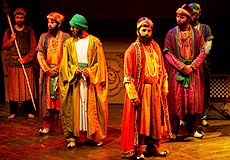 By Staff Reporter, *Premiere of ‘Dara’ at PNCA today* - The News International - Karachi, Pakistan
Thursday, June 17, 2010
Islamabad: The Ajoka Theatre Productions in collaboration with Pakistan National Council of the Arts (PNCA) will stage the premiere of the play ‘Dara’ here from June 17 to 19.
Based on the life and times of Mughal Prince Dara Shikoh, Ajoka’s new play is about the less-known but extremely dramatic and moving story of Dara Shikoh, eldest son of Emperor Shahjahan, who was imprisoned and executed by his younger brother Aurangzeb.
Dara was not only a crown prince, but also a poet, a painter and a Sufi. He wanted to build on the vision of Akbar the Great and bring the ruling Muslim elite closer to the local religions.
His search for the truth and shared teachings of all major religions is reflected in his scholarly works such as ‘Sakeena-tul-Aulia’, ‘Safina-tul-Aulia’ and ‘Majma-ul-Bahrain.’
The play also explores the existential conflict between Dara the crown prince, the Sufi and the poet.
The violent and devastating struggle between brothers Dara and Aurangzeb, the decisive role played by their sisters Jahan Ara and Roshan Ara, the spiritual challenge posed by the Sufi Sarmad to the authority of the ‘muftis’ and ‘qazis’ of the empire and the growing discontent among the masses are elements which make ‘Dara’ a gripping and powerful play.
Like all Ajoka’s plays, ‘Dara’ has a very relevant message for our contemporary times, said the organisers.
Islamabad: The Ajoka Theatre Productions in collaboration with Pakistan National Council of the Arts (PNCA) will stage the premiere of the play ‘Dara’ here from June 17 to 19.
Based on the life and times of Mughal Prince Dara Shikoh, Ajoka’s new play is about the less-known but extremely dramatic and moving story of Dara Shikoh, eldest son of Emperor Shahjahan, who was imprisoned and executed by his younger brother Aurangzeb.
Dara was not only a crown prince, but also a poet, a painter and a Sufi. He wanted to build on the vision of Akbar the Great and bring the ruling Muslim elite closer to the local religions.
His search for the truth and shared teachings of all major religions is reflected in his scholarly works such as ‘Sakeena-tul-Aulia’, ‘Safina-tul-Aulia’ and ‘Majma-ul-Bahrain.’
The play also explores the existential conflict between Dara the crown prince, the Sufi and the poet.
The violent and devastating struggle between brothers Dara and Aurangzeb, the decisive role played by their sisters Jahan Ara and Roshan Ara, the spiritual challenge posed by the Sufi Sarmad to the authority of the ‘muftis’ and ‘qazis’ of the empire and the growing discontent among the masses are elements which make ‘Dara’ a gripping and powerful play.
Like all Ajoka’s plays, ‘Dara’ has a very relevant message for our contemporary times, said the organisers.
[Picture from Ajoka Theatre]
Sunday, June 20, 2010
The Gift Of True Love
 By NDTV Corr., *Rajasthan remembers Laila, Majnu* - NDTV - India
Tuesday, June 15, 2010
On June 15 every year, a fair is held in Rajasthan near the India-Pakistan border in memory of the star-crossed lovers - Laila and Majnu - who are believed to be buried in a tomb there.
The legend of these two lovers has also influenced Sufi literature where the tale is a prototype of divine love - the beloved Laila is actually god or a divine lover worshipped by Majnu who is literally possessed by her love.
But in western Rajasthan, the story is symbolic of the composite culture of the sub continent. So in this fair, hundreds of people collect to ask for the blessing of the two lovers and the gift of true love in their lives.
"I heard there was a fair here so I came to see. It is said that whatever you ask for here, you get it," said a girl visiting the fair.
Before the Kargil conflict this shrine was also open to Pakistani visitors.
There are many variations to the legend of Laila and Majnu. In a version popular here Laila is forcibly married off to another man. Her husband challenges Majnu but as soon as his sword pierces Majnu's heart, it is Laila who dies.
The tomb of Laila and Majnu is a major attraction in these parts, therefore it's not surprising that even one of the BSF [Border Security Force] posts on this border is called the Majnu post.
On June 15 every year, a fair is held in Rajasthan near the India-Pakistan border in memory of the star-crossed lovers - Laila and Majnu - who are believed to be buried in a tomb there.
The legend of these two lovers has also influenced Sufi literature where the tale is a prototype of divine love - the beloved Laila is actually god or a divine lover worshipped by Majnu who is literally possessed by her love.
But in western Rajasthan, the story is symbolic of the composite culture of the sub continent. So in this fair, hundreds of people collect to ask for the blessing of the two lovers and the gift of true love in their lives.
"I heard there was a fair here so I came to see. It is said that whatever you ask for here, you get it," said a girl visiting the fair.
Before the Kargil conflict this shrine was also open to Pakistani visitors.
There are many variations to the legend of Laila and Majnu. In a version popular here Laila is forcibly married off to another man. Her husband challenges Majnu but as soon as his sword pierces Majnu's heart, it is Laila who dies.
The tomb of Laila and Majnu is a major attraction in these parts, therefore it's not surprising that even one of the BSF [Border Security Force] posts on this border is called the Majnu post.
Saturday, June 19, 2010
Sanctuary In The Temple
 By Robert Messenger, *Everyday Devotions * - The Wall Street Journal - NYC, NY, USA
Tuesday, June 15, 2010
In modern-day India, an astonishing variety of beliefs and rituals.
New York and London have been treated in recent seasons to major exhibitions of Chola bronzes. A thousand years ago, sculptors in southern India began creating exquisite devotional figures—most often depictions of the Hindu god Shiva and his consort Parvati.
The bronzes are palpably sensuous and, even now, undimmed by centuries of worship that involves draping the figures in silks and garlands; anointing them in butter, curds, milk and sandalwood paste; and parading them through villages and towns to show the gods their domain.
Among the most sublime art that the hand of man has produced, the bronzes remain part of a living religious tradition.
It turns out that they are part of still-living artistic tradition, too. In "Nine Lives," William Dalrymple introduces us to Srikanda Stpathy, a 35th-generation bronze caster directly descended from the stone carvers who first learned the art of bronze casting in the region of India called Tamil Nadu. The casting tradition has kept his family busy for 700 years, and his workshop has "a backlog of orders that would take at least a year to clear."
Such are the joys of "Nine Lives," in which Mr. Dalrymple profiles nine Indians and through them the variety of religions that thrive in our reportedly homogenized world. His subjects include a Jain nun, a Theyyam dancer, a sacred prostitute, a singer of ancient epics, a Sufi "lady fakir," a Tibetan monk who renounced his vows to fight the Chinese invaders and now lives in exile, a Tantric worshipper of the ferocious goddess Tara, and a blind Baul (wandering singer).
Mr. Dalrymple lets them all speak directly about their lives and beliefs, and he sketches along the way both their individual narratives and the history and literature of their faiths.
Discussing the meaning of Srikanda's work, Mr. Dalrymple ends up musing on the place of sex in Hinduism—noting that the Judeo- Christian Scriptures begin with the creation of light while Hinduism "begins its myth with the creation of Skama—sexual desire: in the beginning was desire, and desire was with God, and desire was God."
He cites a fourth-century poet-prince who tried to discern whether asceticism or sensuality was the true path to God: "Tell us decisively which we ought to attend upon," the poet says in one of his verses. "The sloping sides of the mountain in the wilderness? Or the buttocks of a woman abounding in passion?" In a later chapter in "Nine Lives," the Baul singer, part of a mystical Hindu tradition, seems to offer an answer: "Never plunge into the river of lust / For you will not reach the shore. / It is a river without banks, / Where typhoons rage, / And the current is strong."
Mr. Dalrymple calls "Nine Lives" a travel book, but it is more an episodic look at religion in the age of globalization. Turning away from the country's most pressing religious story—the battles between Hindus and Muslims that have shaped Indian politics for the past two decades as the secularism into which the country was born in 1947 has eroded—Mr. Dalrymple conveys the details of everyday worship and fulfills that hoary cliché of giving voice to the voiceless. Each of the figures he profiles exults in his faith, but most also fear the future.
In modern-day India, an astonishing variety of beliefs and rituals.
New York and London have been treated in recent seasons to major exhibitions of Chola bronzes. A thousand years ago, sculptors in southern India began creating exquisite devotional figures—most often depictions of the Hindu god Shiva and his consort Parvati.
The bronzes are palpably sensuous and, even now, undimmed by centuries of worship that involves draping the figures in silks and garlands; anointing them in butter, curds, milk and sandalwood paste; and parading them through villages and towns to show the gods their domain.
Among the most sublime art that the hand of man has produced, the bronzes remain part of a living religious tradition.
It turns out that they are part of still-living artistic tradition, too. In "Nine Lives," William Dalrymple introduces us to Srikanda Stpathy, a 35th-generation bronze caster directly descended from the stone carvers who first learned the art of bronze casting in the region of India called Tamil Nadu. The casting tradition has kept his family busy for 700 years, and his workshop has "a backlog of orders that would take at least a year to clear."
Such are the joys of "Nine Lives," in which Mr. Dalrymple profiles nine Indians and through them the variety of religions that thrive in our reportedly homogenized world. His subjects include a Jain nun, a Theyyam dancer, a sacred prostitute, a singer of ancient epics, a Sufi "lady fakir," a Tibetan monk who renounced his vows to fight the Chinese invaders and now lives in exile, a Tantric worshipper of the ferocious goddess Tara, and a blind Baul (wandering singer).
Mr. Dalrymple lets them all speak directly about their lives and beliefs, and he sketches along the way both their individual narratives and the history and literature of their faiths.
Discussing the meaning of Srikanda's work, Mr. Dalrymple ends up musing on the place of sex in Hinduism—noting that the Judeo- Christian Scriptures begin with the creation of light while Hinduism "begins its myth with the creation of Skama—sexual desire: in the beginning was desire, and desire was with God, and desire was God."
He cites a fourth-century poet-prince who tried to discern whether asceticism or sensuality was the true path to God: "Tell us decisively which we ought to attend upon," the poet says in one of his verses. "The sloping sides of the mountain in the wilderness? Or the buttocks of a woman abounding in passion?" In a later chapter in "Nine Lives," the Baul singer, part of a mystical Hindu tradition, seems to offer an answer: "Never plunge into the river of lust / For you will not reach the shore. / It is a river without banks, / Where typhoons rage, / And the current is strong."
Mr. Dalrymple calls "Nine Lives" a travel book, but it is more an episodic look at religion in the age of globalization. Turning away from the country's most pressing religious story—the battles between Hindus and Muslims that have shaped Indian politics for the past two decades as the secularism into which the country was born in 1947 has eroded—Mr. Dalrymple conveys the details of everyday worship and fulfills that hoary cliché of giving voice to the voiceless. Each of the figures he profiles exults in his faith, but most also fear the future.
As a child, Lal Peri twice escaped the violence engendered by the birth of Bangladesh and has since found sanctuary in the temple of Lal Shabhaz Qalander, a Sufi saint who preached religious tolerance in the 13th century. But she knows that this syncretic worship, and Sufism in general, is threatened by the exponential rise of fundamentalist Islam, supported by the Gulf states and the madrassa school system they have built throughout Pakistan.
Mr. Dalrymple goes to see the head of a new madrassa in the town, who speaks quite openly of his desire to destroy the Sufi temple and any variant type of Islam.
As close as Mr. Dalrymple comes to anger is in describing the dynamiting by Pakistani Taliban of a small shrine to the 17th-century Pashto poet-saint Rahman Baba at the foot of the Khyber Pass. Mr. Dalrymple had visited it often in the late 1980s while covering the war in Afghanistan and reveled in the way refugees gathered there to take solace in the poetry and music of the Sufis.
Modernity is another threat. The Theyyam dancer, Hari Das, works as both a well digger and a jail guard to make ends meet. The high point of his year is the two months when he travels to festivals incarnating deities and monsters as part of the Theyyam rites.
In an intense ritualist dance, the actors—dressed in fantastic and weighty costumes—are possessed by the Hindu deities they are incarnating. Yet as much as Hari Das wants his sons to master the physically demanding art, he knows that they can find better jobs through education.
It is the same for the sculptor Srikanda, whose son is interested in computers. As pained as he is by the thought of sundering a 700-year tradition, he acknowledges: "Our work here is very hard. Computer work is not so difficult, and it pays much more. . . . After all, as my son says, this is the age of computers. And as much as I might want otherwise, I can hardly tell him this is the age of the bronze caster."
It is, though, the age for writers like Mr. Dalrymple who fall in with the rhythms and languages of foreign lands. "Nine Lives" shows us lives hidden almost entirely from Western readers.
Another recent book, Alice Albinia's "Empires of the Indus," presents the cultural richness of the still fought-over lands around the Indus River—which flows from Tibet through India and Pakistan to the Arabian Sea—and manages to humanize Pakistan.
Such books open up the world in a compelling way.
Mr. Dalrymple goes to see the head of a new madrassa in the town, who speaks quite openly of his desire to destroy the Sufi temple and any variant type of Islam.
As close as Mr. Dalrymple comes to anger is in describing the dynamiting by Pakistani Taliban of a small shrine to the 17th-century Pashto poet-saint Rahman Baba at the foot of the Khyber Pass. Mr. Dalrymple had visited it often in the late 1980s while covering the war in Afghanistan and reveled in the way refugees gathered there to take solace in the poetry and music of the Sufis.
Modernity is another threat. The Theyyam dancer, Hari Das, works as both a well digger and a jail guard to make ends meet. The high point of his year is the two months when he travels to festivals incarnating deities and monsters as part of the Theyyam rites.
In an intense ritualist dance, the actors—dressed in fantastic and weighty costumes—are possessed by the Hindu deities they are incarnating. Yet as much as Hari Das wants his sons to master the physically demanding art, he knows that they can find better jobs through education.
It is the same for the sculptor Srikanda, whose son is interested in computers. As pained as he is by the thought of sundering a 700-year tradition, he acknowledges: "Our work here is very hard. Computer work is not so difficult, and it pays much more. . . . After all, as my son says, this is the age of computers. And as much as I might want otherwise, I can hardly tell him this is the age of the bronze caster."
It is, though, the age for writers like Mr. Dalrymple who fall in with the rhythms and languages of foreign lands. "Nine Lives" shows us lives hidden almost entirely from Western readers.
Another recent book, Alice Albinia's "Empires of the Indus," presents the cultural richness of the still fought-over lands around the Indus River—which flows from Tibet through India and Pakistan to the Arabian Sea—and manages to humanize Pakistan.
Such books open up the world in a compelling way.
Nine Lives
By William Dalrymple
Knopf, 276 pages, $26.95
Knopf, 276 pages, $26.95
Mr. Messenger is a senior editor at the Weekly Standard.
Friday, June 18, 2010
Scores Of Devotees
 By ANI, *Sonia Gandhi sends her offerings to Sufi saint's shrine* - One India - India
Monday, June 14, 2010
New Delhi/Ajmer: Congress President Sonia Gandhi on Monday sent a 'chaddar' to the shrine of Sufi saint Khwaja Moin-ud-din Chishti in Rajasthan's Ajmer city.
The cloth is to be offered at the shrine by Congress party leaders on the occasion of Urs.
'Urs' marks the death anniversary of Moin-ud-din Chishti, who is popularly referred to as 'Gharib Nawaz', or the 'messiah of the poor'.
Scores of devotees from all over India converge the shrine on the occasion.
Chishti, who is believed to have been born in 1142 AD, preached tolerance and unity of all religions. In 1236 AD, the saint entered his cell to pray in seclusion for six days, at the end of which he died. Since then Urs has been celebrated for six days every year.
It is believed that praying at the tomb of the saint fulfils a person's wishes. Devotees visiting the shrine offer fresh flowers as a symbol of their devotion. Some even go up to the extent of offering large amounts of money and expensive jewels.
Devotional music and recitations from Chishti's own works and other Sufi saints are presented in traditional Qawwali (chorus singing) style.
The annual event culminates with readings from the holy Quran and special prayers.
[Photo: http://www.dargahajmer.com/]
Subscribe to:
Posts (Atom)
Sunday, July 04, 2010
Mourning


No comments:
Labels:
saints and shrines
By Press Trust Of India, *Thousands across Pakistan protest against Shrine bombings* - Hindustan Times - India
Saturday, July 3, 2010
Islamabad/Lahore: Hundreds of people Saturday joined protests across Pakistan against the suicide bombings of the Data Darbar shrine in Lahore, even as Prime Minister Yousuf Raza Gilani said militants were targeting cities to divert the people's attention from the war against terror.
Lahore remained in mourning for the second day for the terrorist attack on the shrine of Hazrat Ali Hajweri, considered the patron saint of the city. Forty-five people were killed and over 200 injured when two suicide bombers blew themselves at the shrine on Thursday.
At some places in Lahore, protests turned violent as demonstrators marched through the streets, burning tyres and forcing traders to close their businesses.
Police used batons to disperse them and arrested over a dozen protesters who were demanding that authorities should take action against extremist elements involved in the desecration of the shrine.
Protests were also organised in cities across Punjab, including Rawalpindi, Chakwal, Faisalabad and Multan, and at several places in southern Sindh province, including Karachi, Hyderabad and Larkana.
Life in many towns and cities were affected by strikes called by different organisations like the Sunni Tehrik and Jamaat Ahl-e-Sunnat.
Prime Minister Gilani, who visited the scene of the carnage amidst tight security, said that militants had been weakened by successful military operations and were now targeting cities to cause panic and divert the people's attention from the war against terrorism.
Military action is being launched wherever the government's writ is challenged, he said.
Terrorism is Pakistan's biggest problem and the federal and provincial governments must work jointly to tackle the menace, Gilani told reporters after meeting victims of Thursday's attack at Ganga Ram Hospital.
He said he had convened a special meeting on Monday to ascertain the causes of the latest attacks and to frame a strategy to counter them.
Gilani skirted questions about the need for an anti-militancy operation in southern Punjab and the provincial government's perceived failure to act against militants, saying a "blame game" should be avoided.
Major markets across Lahore remained closed to protest the terrorist attack and traffic on the city’s roads was thin. Lawyers boycotted courts across the province and the Sunni Tehrik organised protests in several cities.
Read More
Saturday, July 3, 2010
Islamabad/Lahore: Hundreds of people Saturday joined protests across Pakistan against the suicide bombings of the Data Darbar shrine in Lahore, even as Prime Minister Yousuf Raza Gilani said militants were targeting cities to divert the people's attention from the war against terror.
Lahore remained in mourning for the second day for the terrorist attack on the shrine of Hazrat Ali Hajweri, considered the patron saint of the city. Forty-five people were killed and over 200 injured when two suicide bombers blew themselves at the shrine on Thursday.
At some places in Lahore, protests turned violent as demonstrators marched through the streets, burning tyres and forcing traders to close their businesses.
Police used batons to disperse them and arrested over a dozen protesters who were demanding that authorities should take action against extremist elements involved in the desecration of the shrine.
Protests were also organised in cities across Punjab, including Rawalpindi, Chakwal, Faisalabad and Multan, and at several places in southern Sindh province, including Karachi, Hyderabad and Larkana.
Life in many towns and cities were affected by strikes called by different organisations like the Sunni Tehrik and Jamaat Ahl-e-Sunnat.
Prime Minister Gilani, who visited the scene of the carnage amidst tight security, said that militants had been weakened by successful military operations and were now targeting cities to cause panic and divert the people's attention from the war against terrorism.
Military action is being launched wherever the government's writ is challenged, he said.
Terrorism is Pakistan's biggest problem and the federal and provincial governments must work jointly to tackle the menace, Gilani told reporters after meeting victims of Thursday's attack at Ganga Ram Hospital.
He said he had convened a special meeting on Monday to ascertain the causes of the latest attacks and to frame a strategy to counter them.
Gilani skirted questions about the need for an anti-militancy operation in southern Punjab and the provincial government's perceived failure to act against militants, saying a "blame game" should be avoided.
Major markets across Lahore remained closed to protest the terrorist attack and traffic on the city’s roads was thin. Lawyers boycotted courts across the province and the Sunni Tehrik organised protests in several cities.
A Touching Synthesis
 By Feroz Ahmed Bakht, *The seer of harmony* - Deccan Herald - Bangalore, India
Sunday, June 27, 2010
Pilgrims, both Hindu and Muslim, are thronging the shrine of Sufi saint Khwaja Moinuddin Chishti at Ajmer to celebrate his 798th annual Urs.
At this Sufi congregation, the saint’s death anniversary is not an occasion of sadness but is indeed a celebration of the soul's union with God.
About 400,000 to 500,000 pilgrims visit Ajmer during the Urs, which will go on till June 30. The dargah (shrine) of the saint, who was popularly known as Khwaja Gharib Nawaz by his devotees from both communities, symbolises a touching synthesis of the hopes and prayers of various faiths and communities.
Revered for his simple teachings, ecumenical approach and eclectic philosophy, the saint believed that no spiritual exercise, penitence or prayer had greater value than bringing succour to distressed hearts and helping the needy. He directed all his efforts towards alleviation of human misery, and his mission was to provide consolation and emotional security to seekers, to help diffuse tension, and bring inner peace and tranquility within everyone's reach.
“Develop a river-like generosity, a sun-like bounty and an earth-like hospitality,” Chishti exhorted, stressing one’s life could have divine significance only if one firmly rejected all material attractions. Real happiness, according to him, lay not in accumulating money but in giving and spending it on others, helping those in need and never hurting the feelings of anyone, which was one of the two ways of exhibiting devotion - the other being prayers, fasting and the pilgrimage to Mecca.
Sheikh Moinuddin Chishti believed in pacifism and non-violence, contending violence created more problems than it solved.
In forgiveness, large-heartedness and tolerance lay the supreme talisman of man's happiness.
He advised his disciples to be good to their enemies too and often recited Persian verses to support his philosophy: “He who is not my friend, may God be his friend/ And he who bears ill-will against me, may his joys increase. He who puts thorns in my way on account of enmity/ May every flower that blossoms in the garden of his life be without thorns.”
“Forgive a person who has committed a wrong and thus eliminate your anger. Forgiveness and not retribution is the way to happiness in society,” he said.
Chishti of the Chishtiya order followed in the tradition of great Sufi leaders who came to India, beginning with Sheikh Ali-bin-Usmani, popularly known as Data Ganj Bakhsh.
Chishti had a number of prominent followers including Khwaja Qutubuddin Bakhtiyar Kaki of Ush (Turkmenistan), Sheikh Fariduddin Ganj Shakar of Multan, Sultan-ul-Mashaikh Hazrat Nizamuddin Mehboob-e-Ilahi of Badaun, Sheikh Naseeruddin Chiragh Dehlvi, Sheikh Sirajuddin Usman, Shah Burhanuddin Gharib and Syed Mohammed Gesu Daraz.
Chishti believed Islam meant submission to God and submission to God meant serving the creation of God without prejudice.
He also stressed self-control and self-criticism as the best methods of reducing tension in society.
When wronged, he would consider it a divine reprimand for something that had gone wrong.
He said, “If a man finds fault with me or accuses me of wrongdoing, I should first search my own heart and see whether that fault is in me. If it is, I should not be ashamed at being apprised of it by someone else. If I do not have that fault with me, I should be grateful to God that I have been protected and I should not find fault in others.”
A legend about him indicates that he observed day-long fasts and kept vigils at night for the whole of his life. His daily meal at the iftar (breaking of fast) was also a meagre amount.
Chishti was a true mystic and stood for everlasting values. That is why even today his shrine draws thousands of pilgrims of all faiths.
Read More
No comments:
Labels:
saints and shrines
By Feroz Ahmed Bakht, *The seer of harmony* - Deccan Herald - Bangalore, IndiaSunday, June 27, 2010
Pilgrims, both Hindu and Muslim, are thronging the shrine of Sufi saint Khwaja Moinuddin Chishti at Ajmer to celebrate his 798th annual Urs.
At this Sufi congregation, the saint’s death anniversary is not an occasion of sadness but is indeed a celebration of the soul's union with God.
About 400,000 to 500,000 pilgrims visit Ajmer during the Urs, which will go on till June 30. The dargah (shrine) of the saint, who was popularly known as Khwaja Gharib Nawaz by his devotees from both communities, symbolises a touching synthesis of the hopes and prayers of various faiths and communities.
Revered for his simple teachings, ecumenical approach and eclectic philosophy, the saint believed that no spiritual exercise, penitence or prayer had greater value than bringing succour to distressed hearts and helping the needy. He directed all his efforts towards alleviation of human misery, and his mission was to provide consolation and emotional security to seekers, to help diffuse tension, and bring inner peace and tranquility within everyone's reach.
“Develop a river-like generosity, a sun-like bounty and an earth-like hospitality,” Chishti exhorted, stressing one’s life could have divine significance only if one firmly rejected all material attractions. Real happiness, according to him, lay not in accumulating money but in giving and spending it on others, helping those in need and never hurting the feelings of anyone, which was one of the two ways of exhibiting devotion - the other being prayers, fasting and the pilgrimage to Mecca.
Sheikh Moinuddin Chishti believed in pacifism and non-violence, contending violence created more problems than it solved.
In forgiveness, large-heartedness and tolerance lay the supreme talisman of man's happiness.
He advised his disciples to be good to their enemies too and often recited Persian verses to support his philosophy: “He who is not my friend, may God be his friend/ And he who bears ill-will against me, may his joys increase. He who puts thorns in my way on account of enmity/ May every flower that blossoms in the garden of his life be without thorns.”
“Forgive a person who has committed a wrong and thus eliminate your anger. Forgiveness and not retribution is the way to happiness in society,” he said.
Chishti of the Chishtiya order followed in the tradition of great Sufi leaders who came to India, beginning with Sheikh Ali-bin-Usmani, popularly known as Data Ganj Bakhsh.
Chishti had a number of prominent followers including Khwaja Qutubuddin Bakhtiyar Kaki of Ush (Turkmenistan), Sheikh Fariduddin Ganj Shakar of Multan, Sultan-ul-Mashaikh Hazrat Nizamuddin Mehboob-e-Ilahi of Badaun, Sheikh Naseeruddin Chiragh Dehlvi, Sheikh Sirajuddin Usman, Shah Burhanuddin Gharib and Syed Mohammed Gesu Daraz.
Chishti believed Islam meant submission to God and submission to God meant serving the creation of God without prejudice.
He also stressed self-control and self-criticism as the best methods of reducing tension in society.
When wronged, he would consider it a divine reprimand for something that had gone wrong.
He said, “If a man finds fault with me or accuses me of wrongdoing, I should first search my own heart and see whether that fault is in me. If it is, I should not be ashamed at being apprised of it by someone else. If I do not have that fault with me, I should be grateful to God that I have been protected and I should not find fault in others.”
A legend about him indicates that he observed day-long fasts and kept vigils at night for the whole of his life. His daily meal at the iftar (breaking of fast) was also a meagre amount.
Chishti was a true mystic and stood for everlasting values. That is why even today his shrine draws thousands of pilgrims of all faiths.
Saturday, July 03, 2010
A Better Person
 By Nahal Toosi, *In Pakistan, Islamic schools for women thrive* - Associate Press of Pakistan - Pakistan
Sunday, June 27, 2010
Islamabad: To its detractors, the Al-Huda chain of Islamic schools across Pakistan is a driver of conservative Islam, especially among the secular elite. But to the thousands who attend its classes across the country, it is a blessing.
Take Mariam Afzal, who says she was once so selfish she would take up two spots in a parking lot without a second thought. Back then, she knew little about Islam beyond the basic rituals. A decade later, the 30-year-old credits Al-Huda with turning her into the veil-wearing Quran teacher she is today.
"It has really helped me become a better person," she says.
Al-Huda's popularity and rapid growth — and the criticism of it as a promoter of intolerance and gender segregation — is a sign of Pakistan's swing away from the moderate, Sufi Islam-influenced sphere of South Asia toward the more conservative, Saudi-influenced Middle East.
That swing comes as religious observance is on the rise in many other Muslim countries, such as Egypt and Indonesia, especially after the Sept. 11, 2001, attacks in the U.S. put a magnifying glass on Islam and its adherents.
The appeal of conservative Islam to the Pakistani elite — the same elite that gave Pakistan a female prime minister, Benazir Bhutto — has been brought into focus following the attempted car bombing in New York's Times Square on May 1. The would-be bomber and most of a dozen others held were from educated, wealthier segments of the mostly impoverished country.
Founder Farhat Hashmi started Al-Huda (Arabic for "guidance") in her home with a small group of students in the early 1990s. Now it caters to women and girls in Pakistan and in elsewhere, including the U.S. and Canada, where Hashmi now lives.
Al-Huda is distinct in several ways from other groups in Pakistan offering classes on Islam.
It offers a structured curriculum and a range of programs, a strong brand name and administration, and it was conceived and run by women from the start, instead of being a branch of a male-dominated institution.
At its main campus in Islamabad, the Pakistani capital, women wearing uniforms of head scarves and long robes sit in rows and take notes as teachers lead lessons on the meaning of the Quran. Children scamper through the multistory facility. There's a library, concession stands, a range of pamphlets, books and audiotapes and even an 80-year-old member who acts as a therapist of sorts.
Women can sign up for full-fledged diploma courses, taught in Urdu and English, or they can be "listeners," just stopping by now and then. Schedules are flexible to attract working women, housewives and the young. Students can live on campus, and a bigger facility is being built on the edge of Islamabad.
Al-Huda administrators are vague on numbers, but Faiza Mushtaq, who is writing her dissertation on the movement, estimates at least 15,000 women have earned diplomas from Al-Huda in Pakistan alone since 1994.
Tuition fees are just a few dollars for three months of lessons, according to Mushtaq, and less for women who can't pay that much. Most of Al-Huda's revenue appears to come from sales of its materials and donations.
The school is particularly appealing because it teaches the Quran using Urdu and English translations as opposed to Arabic, which most Pakistanis don't know.
Its graduates, many of whom cover their faces and hair outside class, often return to their homes in distant cities and villages and start their own chapters of Al-Huda. Regular Al-Huda classes are held at dozens of branches in Pakistan, many of them run by a single graduate.
"My vision is that the Quran reaches everyone, because it is Allah's message to humanity," Hashmi, 52, said in an interview during a recent visit to Islamabad. Al-Huda is "a kind of women's empowerment program, and I think knowledge is the best way to empower women, especially spiritual knowledge."
Critics disagree.
Pervez Hoodbhoy, a nuclear scientist and critic of hard-line Islam, has written about the spread of religious conservatism in Pakistan, and has pointed to Hashmi as one of its principal forces.
The face-covering burqa, once a rarity in Islamabad, now has stores specializing it, he notes. Hoodbhoy says Al-Huda is engendering a mindset of segregation and submission for women that is shredding Pakistan's cultural fabric.
"Through ceaseless proselytizing and subtle pressure tactics, Al-Huda has brought a majority of my university's students under the burqa," Hoodbhoy said in an e-mail. "In comparison with students of earlier decades, they are less confident, less willing to ask questions in class, and most have become silent note-takers. To sing, dance, play sports or act in dramas is, of course, out of the question for these unfortunates."
People who have studied Al-Huda say it promotes a literal, conservative approach to the Quran, but that it is not as rigid as it could be. While women are taught that covering their hair and avoiding music is what Islam requires, they also are encouraged to earn professional degrees.
Mushtaq, who is earning her Ph.D. from Northwestern University in Illinois, said she never heard Al-Huda condone violence, but that it could at times promote intolerance.
"I've heard some classroom discussions where they were talking about how to deal with Christians and Hindus. They weren't advocating violence, but just how one should stay away from them or convert them — a very, very patronizing and superior attitude," said Mushtaq.
But she noted that Hashmi and Al-Huda had also been criticized by conservative male Muslim scholars who question the teachers' credentials and rebuke Hashmi, a married mother of four, for traveling without a male guardian and lecturing on TV and radio. They even cast aspersions on women studying outside the home.
Several Al-Huda participants said they joined to know more about Islam.
"We don't know anything about our religion, actually, and I wanted to learn," said Salma Khokhar, a 40-year-old housewife who is one of the most active students in Afzal's English-language class. "Al-Huda has changed me a lot. I've lost 43 pounds. I feel very focused. I pray. I talk to Allah."
Uzma Azmi, 46, who grew up on the secular side of a family with mixed degrees of religiosity, used to think Al-Huda was too rigid. But after months of sitting in on classes, she now says the school's critics are uninformed and unwilling to look past the veils.
Azmi drapes a scarf over her hair during class, but not in her daily life.
"I'm not going to cover my head right now, and these people don't force you. It has to come from within," she said, adding, "I don't think I'd be willing to give up music." (She likes classic rock and early reggae.)
Critics complain that Al-Huda is silent on subjects such as violence against women, attacks on non-Muslims or Islamist terrorism wrecking the country. Al-Huda says it is not a political organization, and that it's more effective to foster a better society through teaching Islam than issuing press releases.
Hashmi, who has a doctorate in Islamic studies from the University of Glasgow in Scotland, expressed dismay about the violence in Pakistan, and said the people who carry out suicide attacks were "misusing the name of Allah."
Some say it may be that as Al-Huda's reach grows, Hashmi's more moderate views aren't transmitted that well by graduates who set up their own classes, especially in less affluent, more remote areas.
Picture: In this photo taken July 25, 2008, a Pakistani religious female student takes notes during a class in Islamabad, Pakistan. Photo: AP/B.K.Bangash)
Read More
No comments:
Labels:
society
By Nahal Toosi, *In Pakistan, Islamic schools for women thrive* - Associate Press of Pakistan - PakistanSunday, June 27, 2010
Islamabad: To its detractors, the Al-Huda chain of Islamic schools across Pakistan is a driver of conservative Islam, especially among the secular elite. But to the thousands who attend its classes across the country, it is a blessing.
Take Mariam Afzal, who says she was once so selfish she would take up two spots in a parking lot without a second thought. Back then, she knew little about Islam beyond the basic rituals. A decade later, the 30-year-old credits Al-Huda with turning her into the veil-wearing Quran teacher she is today.
"It has really helped me become a better person," she says.
Al-Huda's popularity and rapid growth — and the criticism of it as a promoter of intolerance and gender segregation — is a sign of Pakistan's swing away from the moderate, Sufi Islam-influenced sphere of South Asia toward the more conservative, Saudi-influenced Middle East.
That swing comes as religious observance is on the rise in many other Muslim countries, such as Egypt and Indonesia, especially after the Sept. 11, 2001, attacks in the U.S. put a magnifying glass on Islam and its adherents.
The appeal of conservative Islam to the Pakistani elite — the same elite that gave Pakistan a female prime minister, Benazir Bhutto — has been brought into focus following the attempted car bombing in New York's Times Square on May 1. The would-be bomber and most of a dozen others held were from educated, wealthier segments of the mostly impoverished country.
Founder Farhat Hashmi started Al-Huda (Arabic for "guidance") in her home with a small group of students in the early 1990s. Now it caters to women and girls in Pakistan and in elsewhere, including the U.S. and Canada, where Hashmi now lives.
Al-Huda is distinct in several ways from other groups in Pakistan offering classes on Islam.
It offers a structured curriculum and a range of programs, a strong brand name and administration, and it was conceived and run by women from the start, instead of being a branch of a male-dominated institution.
At its main campus in Islamabad, the Pakistani capital, women wearing uniforms of head scarves and long robes sit in rows and take notes as teachers lead lessons on the meaning of the Quran. Children scamper through the multistory facility. There's a library, concession stands, a range of pamphlets, books and audiotapes and even an 80-year-old member who acts as a therapist of sorts.
Women can sign up for full-fledged diploma courses, taught in Urdu and English, or they can be "listeners," just stopping by now and then. Schedules are flexible to attract working women, housewives and the young. Students can live on campus, and a bigger facility is being built on the edge of Islamabad.
Al-Huda administrators are vague on numbers, but Faiza Mushtaq, who is writing her dissertation on the movement, estimates at least 15,000 women have earned diplomas from Al-Huda in Pakistan alone since 1994.
Tuition fees are just a few dollars for three months of lessons, according to Mushtaq, and less for women who can't pay that much. Most of Al-Huda's revenue appears to come from sales of its materials and donations.
The school is particularly appealing because it teaches the Quran using Urdu and English translations as opposed to Arabic, which most Pakistanis don't know.
Its graduates, many of whom cover their faces and hair outside class, often return to their homes in distant cities and villages and start their own chapters of Al-Huda. Regular Al-Huda classes are held at dozens of branches in Pakistan, many of them run by a single graduate.
"My vision is that the Quran reaches everyone, because it is Allah's message to humanity," Hashmi, 52, said in an interview during a recent visit to Islamabad. Al-Huda is "a kind of women's empowerment program, and I think knowledge is the best way to empower women, especially spiritual knowledge."
Critics disagree.
Pervez Hoodbhoy, a nuclear scientist and critic of hard-line Islam, has written about the spread of religious conservatism in Pakistan, and has pointed to Hashmi as one of its principal forces.
The face-covering burqa, once a rarity in Islamabad, now has stores specializing it, he notes. Hoodbhoy says Al-Huda is engendering a mindset of segregation and submission for women that is shredding Pakistan's cultural fabric.
"Through ceaseless proselytizing and subtle pressure tactics, Al-Huda has brought a majority of my university's students under the burqa," Hoodbhoy said in an e-mail. "In comparison with students of earlier decades, they are less confident, less willing to ask questions in class, and most have become silent note-takers. To sing, dance, play sports or act in dramas is, of course, out of the question for these unfortunates."
People who have studied Al-Huda say it promotes a literal, conservative approach to the Quran, but that it is not as rigid as it could be. While women are taught that covering their hair and avoiding music is what Islam requires, they also are encouraged to earn professional degrees.
Mushtaq, who is earning her Ph.D. from Northwestern University in Illinois, said she never heard Al-Huda condone violence, but that it could at times promote intolerance.
"I've heard some classroom discussions where they were talking about how to deal with Christians and Hindus. They weren't advocating violence, but just how one should stay away from them or convert them — a very, very patronizing and superior attitude," said Mushtaq.
But she noted that Hashmi and Al-Huda had also been criticized by conservative male Muslim scholars who question the teachers' credentials and rebuke Hashmi, a married mother of four, for traveling without a male guardian and lecturing on TV and radio. They even cast aspersions on women studying outside the home.
Several Al-Huda participants said they joined to know more about Islam.
"We don't know anything about our religion, actually, and I wanted to learn," said Salma Khokhar, a 40-year-old housewife who is one of the most active students in Afzal's English-language class. "Al-Huda has changed me a lot. I've lost 43 pounds. I feel very focused. I pray. I talk to Allah."
Uzma Azmi, 46, who grew up on the secular side of a family with mixed degrees of religiosity, used to think Al-Huda was too rigid. But after months of sitting in on classes, she now says the school's critics are uninformed and unwilling to look past the veils.
Azmi drapes a scarf over her hair during class, but not in her daily life.
"I'm not going to cover my head right now, and these people don't force you. It has to come from within," she said, adding, "I don't think I'd be willing to give up music." (She likes classic rock and early reggae.)
Critics complain that Al-Huda is silent on subjects such as violence against women, attacks on non-Muslims or Islamist terrorism wrecking the country. Al-Huda says it is not a political organization, and that it's more effective to foster a better society through teaching Islam than issuing press releases.
Hashmi, who has a doctorate in Islamic studies from the University of Glasgow in Scotland, expressed dismay about the violence in Pakistan, and said the people who carry out suicide attacks were "misusing the name of Allah."
Some say it may be that as Al-Huda's reach grows, Hashmi's more moderate views aren't transmitted that well by graduates who set up their own classes, especially in less affluent, more remote areas.
Picture: In this photo taken July 25, 2008, a Pakistani religious female student takes notes during a class in Islamabad, Pakistan. Photo: AP/B.K.Bangash)
[Visit Al-Huda]
Saints Under Fire
1 comment:
Labels:
society
By Editorial, *Saints under fire* - The Express Tribune - Quetta, Pakistan
Thursday, July 1, 2010
The peaceful men who preached tolerance and did so much to spread Islam across the subcontinent remain under fire centuries after their death.
Their graves and the shrines that stand around them, dotted across the country visited by millions each year seeking spiritual solace, are under threat.
Several days ago, Taliban militants bombed the shrine of Mian Umar Baba in Peshawar. The attack is the latest in a series of bombings at shrines. Last year the shrine of the popular Pashtu poet, Rehman Baba, was bombed. There have been at least two attacks on shrines in the Peshawar area since 2007, while militants in Buner forced the closure of a shrine in the area.
These bombings go beyond the issue of terrorism alone.
The loss of lives in some of the attacks is tragic; but it is obvious the militants are following a still more sinister agenda. They seek to change our way of life, the patterns of belief followed by people and the way they think.
It is a historical fact that the message of the Sufis, preaching acceptance for many kinds of belief and offering religious thought as a philosophy rather than a dogma, had great value in the context of the subcontinent, where so many religious groups and sects co-existed. They could live together in peace only if there was tolerance.
The hard line schools of religious thought brought in by the Taliban have contributed to the wave of violence we have seen, the growth in sectarian ill-will and of discrimination against minorities.
The attacks on Sufi saints and their shrines, shattering the sense of calm that marks many of such places, is another attempt to expand the culture of hatred that now permeates are lives.
We must challenge this attempt and do more to save the shrines which play a key role in the lives of people.
Read More
Thursday, July 1, 2010
The peaceful men who preached tolerance and did so much to spread Islam across the subcontinent remain under fire centuries after their death.
Their graves and the shrines that stand around them, dotted across the country visited by millions each year seeking spiritual solace, are under threat.
Several days ago, Taliban militants bombed the shrine of Mian Umar Baba in Peshawar. The attack is the latest in a series of bombings at shrines. Last year the shrine of the popular Pashtu poet, Rehman Baba, was bombed. There have been at least two attacks on shrines in the Peshawar area since 2007, while militants in Buner forced the closure of a shrine in the area.
These bombings go beyond the issue of terrorism alone.
The loss of lives in some of the attacks is tragic; but it is obvious the militants are following a still more sinister agenda. They seek to change our way of life, the patterns of belief followed by people and the way they think.
It is a historical fact that the message of the Sufis, preaching acceptance for many kinds of belief and offering religious thought as a philosophy rather than a dogma, had great value in the context of the subcontinent, where so many religious groups and sects co-existed. They could live together in peace only if there was tolerance.
The hard line schools of religious thought brought in by the Taliban have contributed to the wave of violence we have seen, the growth in sectarian ill-will and of discrimination against minorities.
The attacks on Sufi saints and their shrines, shattering the sense of calm that marks many of such places, is another attempt to expand the culture of hatred that now permeates are lives.
We must challenge this attempt and do more to save the shrines which play a key role in the lives of people.
Friday, July 02, 2010
Mesmerised
 By Staff Writer, *A performance that touches the soul* - Emirates Business 24 / 7 - Abu Dhabi, UAE
Saturday, June 26, 2010
UAE's Malhaar choir brings four Sufi thinkers to life.
Dubai was mesmerised when Malhaar, a UAE-based Indian choir group, and Theatrewallas, an Indian theatre group brought to life four Sufis (or thinkers) on Friday evening at a DSS 2010 event at Centrepoint theatre in Ductac, Mall of the Emirates.
Rooh-e-Ishq, which translates into 'in love with the soul' gave the audience a soulful experience with scintillating music, theatre, art and poetry, in a show that lasted for more than three hours.
The well-researched musical gave a fresh perspective on four Sufi thinkers - Rumi, Bulleh Shah, Amir Khusro and Kabir. At the end of the show, the audience gave a standing ovation to the entire cast and crew, who were aged between seven and seventy.
Famous musician from India, Gulam Ali, who played the string instrument, Sarangi, held the the audience spellbound and added a new dimension to the evening's performance. It was a rare treat for the audience in the UAE, given that such instruments are rarely played in India nowadays and can almost be termed a dying art.
Malhaar's founder director, Jogiraj Sikidar, said, "It was a humble attempt to kindle the music of your soul."
Towards the end of the evening, two paintings by an Indian artiste, Shrabany Brahmachary, were handed over by Malhaar to Manzil, a non-profit organisation, to help raise funds.
Picture: Mysitical shades of Sufism on canvas by Shrabani Brahmachary, an Indian artiste. Photo: Supplied / EB
Read More
No comments:
Labels:
art and arts
By Staff Writer, *A performance that touches the soul* - Emirates Business 24 / 7 - Abu Dhabi, UAESaturday, June 26, 2010
UAE's Malhaar choir brings four Sufi thinkers to life.
Dubai was mesmerised when Malhaar, a UAE-based Indian choir group, and Theatrewallas, an Indian theatre group brought to life four Sufis (or thinkers) on Friday evening at a DSS 2010 event at Centrepoint theatre in Ductac, Mall of the Emirates.
Rooh-e-Ishq, which translates into 'in love with the soul' gave the audience a soulful experience with scintillating music, theatre, art and poetry, in a show that lasted for more than three hours.
The well-researched musical gave a fresh perspective on four Sufi thinkers - Rumi, Bulleh Shah, Amir Khusro and Kabir. At the end of the show, the audience gave a standing ovation to the entire cast and crew, who were aged between seven and seventy.
Famous musician from India, Gulam Ali, who played the string instrument, Sarangi, held the the audience spellbound and added a new dimension to the evening's performance. It was a rare treat for the audience in the UAE, given that such instruments are rarely played in India nowadays and can almost be termed a dying art.
Malhaar's founder director, Jogiraj Sikidar, said, "It was a humble attempt to kindle the music of your soul."
Towards the end of the evening, two paintings by an Indian artiste, Shrabany Brahmachary, were handed over by Malhaar to Manzil, a non-profit organisation, to help raise funds.
Picture: Mysitical shades of Sufism on canvas by Shrabani Brahmachary, an Indian artiste. Photo: Supplied / EB
Suicide Bombers Strike Sufi Shrine in Pakistan
By SABRINA TAVERNISE and WAQAR GILLANI, Published in the New York Times: July 2, 2010
(Picture--by K. M. Chaudary-- of family members mourning victims of a suicide bomb attack on Data Ganj Baksh, an important Sufi shrine in Lahore, Pakistan, on Thursday night.)
ISLAMABAD — The death toll rose to 42 on Friday after suicide bombers struck Pakistan’s most important Sufi shrine, a devastating attack by hard-line militants on the moderate, more flexible blend of Islam that is practiced by most Pakistanis
The two bombers attacked in the city of Lahore just before midnight, the peak worship time for the shrine, known as Data Ganj Baksh. Thousands of people were at the shrine at the time, according to the Pakistani police. In addition to the fatalities, about 175 people were injured, according to police officials.
The strike on such a revered place of worship seemed to enrage Pakistanis, who are growing weary of violence that has spiked in the past four years. On Friday, about 2,000 demonstrators marched through Lahore, calling on the government to do more to thwart militants, according to news reports from Pakistan.
The attack was part of a pattern of increased violence in Pakistan’s heartland, the province of Punjab, a troubling expansion of the Taliban insurgency tormenting the country’s western border.
“This is a barbaric attack,” wrote Raza Ahmed Rumi, a Pakistani expert on Sufism, on his Web site. The shrine, he said, “is not just another crowded place — it represents a millennia of tolerant Sufi Islam which is directly under attack by the puritans.”
The bombers detonated their explosives in the basement and inside the shrine, after a Sufi ceremony of singing and prayer, according to a witness, Muhamed Yusef, who was interviewed on Pakistani television. The police retrieved the heads of two of the bombers and estimated their ages as 17 and 22, the television reports said.
The blasts left a sickening scene of devastation. The Express 24/7 television network in Pakistan showed the shrine’s interior littered with bodies, prayer rugs and debris from the blast. Blood pooled on the white marble floor. Crowds gathered outside the shrine after the bombing, shouting, crying and protesting the attack.
“Those who still pretend that we are not a nation at war are complicit in these deaths,” said Farahnaz Ispahani, a spokeswoman for President Asif Ali Zardari.
Sufism is a mystical form of Islam brought into South Asia by wandering thinkers who spread the religion east from the Arabian Peninsula. They carried a message of equality that was deeply appealing to indigenous societies torn by caste and poverty. To this day, Sufi shrines stand out in Islam for allowing women free access.
In modern times, Pakistan’s Sufis have been challenged by a stricter form of Islam that dominates in Saudi Arabia. That orthodox, often political, Islam was encouraged in Pakistan in the 1980s by Gen. Mohammad Zia ul-Haq, the American-supported dictator. Since then, the fundamentalists’ aggressive stance has tended to eclipse that of their moderate kin, whose shrines and processions have become targets in the war here.
In March 2009, militants in western Pakistan blew up the Rahman Baba shrine, the burial place of a revered Sufi poet. Data Ganj Baksh, or Giver of Treasures, draws Muslims from all over Pakistan and is the symbol of Lahore, Pakistan’s cultural capital.
The shrine is dedicated to a Persian-speaking mystic, Ali bin Usman al-Hajveri, who journeyed to Lahore with Central Asian invaders in the 11th century. He settled outside the city, a stopover on the trade route to Delhi, started a meditation center and wrote a manual on Sufi practices.
“How long will we be mere spectators and see our great city blown to bits — culturally and physically?” Mr. Rumi wrote. He said that threats last year caused the shrine to close for a few days. “This time the worst of nightmares has come true.”
Read More
By SABRINA TAVERNISE and WAQAR GILLANI, Published in the New York Times: July 2, 2010
(Picture--by K. M. Chaudary-- of family members mourning victims of a suicide bomb attack on Data Ganj Baksh, an important Sufi shrine in Lahore, Pakistan, on Thursday night.)
ISLAMABAD — The death toll rose to 42 on Friday after suicide bombers struck Pakistan’s most important Sufi shrine, a devastating attack by hard-line militants on the moderate, more flexible blend of Islam that is practiced by most Pakistanis
The two bombers attacked in the city of Lahore just before midnight, the peak worship time for the shrine, known as Data Ganj Baksh. Thousands of people were at the shrine at the time, according to the Pakistani police. In addition to the fatalities, about 175 people were injured, according to police officials.
The strike on such a revered place of worship seemed to enrage Pakistanis, who are growing weary of violence that has spiked in the past four years. On Friday, about 2,000 demonstrators marched through Lahore, calling on the government to do more to thwart militants, according to news reports from Pakistan.
The attack was part of a pattern of increased violence in Pakistan’s heartland, the province of Punjab, a troubling expansion of the Taliban insurgency tormenting the country’s western border.
“This is a barbaric attack,” wrote Raza Ahmed Rumi, a Pakistani expert on Sufism, on his Web site. The shrine, he said, “is not just another crowded place — it represents a millennia of tolerant Sufi Islam which is directly under attack by the puritans.”
The bombers detonated their explosives in the basement and inside the shrine, after a Sufi ceremony of singing and prayer, according to a witness, Muhamed Yusef, who was interviewed on Pakistani television. The police retrieved the heads of two of the bombers and estimated their ages as 17 and 22, the television reports said.
The blasts left a sickening scene of devastation. The Express 24/7 television network in Pakistan showed the shrine’s interior littered with bodies, prayer rugs and debris from the blast. Blood pooled on the white marble floor. Crowds gathered outside the shrine after the bombing, shouting, crying and protesting the attack.
“Those who still pretend that we are not a nation at war are complicit in these deaths,” said Farahnaz Ispahani, a spokeswoman for President Asif Ali Zardari.
Sufism is a mystical form of Islam brought into South Asia by wandering thinkers who spread the religion east from the Arabian Peninsula. They carried a message of equality that was deeply appealing to indigenous societies torn by caste and poverty. To this day, Sufi shrines stand out in Islam for allowing women free access.
In modern times, Pakistan’s Sufis have been challenged by a stricter form of Islam that dominates in Saudi Arabia. That orthodox, often political, Islam was encouraged in Pakistan in the 1980s by Gen. Mohammad Zia ul-Haq, the American-supported dictator. Since then, the fundamentalists’ aggressive stance has tended to eclipse that of their moderate kin, whose shrines and processions have become targets in the war here.
In March 2009, militants in western Pakistan blew up the Rahman Baba shrine, the burial place of a revered Sufi poet. Data Ganj Baksh, or Giver of Treasures, draws Muslims from all over Pakistan and is the symbol of Lahore, Pakistan’s cultural capital.
The shrine is dedicated to a Persian-speaking mystic, Ali bin Usman al-Hajveri, who journeyed to Lahore with Central Asian invaders in the 11th century. He settled outside the city, a stopover on the trade route to Delhi, started a meditation center and wrote a manual on Sufi practices.
“How long will we be mere spectators and see our great city blown to bits — culturally and physically?” Mr. Rumi wrote. He said that threats last year caused the shrine to close for a few days. “This time the worst of nightmares has come true.”
Of Love And Peace
 By Praveen Menon, *Sufism explained in song and dance* - The National - Dubai, UAE
Friday, June 25, 2010
Dubai: Indian traditional dance forms and musical themes were on display yesterday as a series of events were held in the emirate that included wide-ranged performances from Sufi singers to traditional Kathakali artists.
The Dubai Community Theatre and Arts Centre hosted “Rooh-e-Ishq”, a unique Asian musical, which had as its theme the idea of unravelling the world of Sufism through music, theatre and poetry.
Created by Malhaar, UAE’s Indian music choir, the show followed the journey of Sufism through myriad lands and languages. The musical depicted the life and works of Jalalud’din Rumi, Amir Khusro, Bulleh Shah and Kabir, four masters of Sufi.
It encompassed varieties of Sufi music from the traditional compositions in native languages to the contemporary facets of Sufi in Bollywood and pop-albums.
Organiser said that the musical’s aim was to convey the message of love and peace.
The music form is hugely popular in South Asian countries. Meanwhile Thiranottam, a cultural organisation from Kerala, hosted an evening with Kathakali artists from Kerala in Karama.
A musical session, lecture and demonstration was organised to display the traditional art form of Kerala. Famous Kathakali artist Kalanilayam Gopi and his team were the performers for the evening. Mr Gopi is a popular Kathakali exponent reputed for his skill in donning a wide range of characters of the Kathakali plays.
Picture: Indian traditional dance forms and musical themes on display during the Rooh-e-Ishq in Dubai. Photo: Paulo Vecina / The National
Read More
No comments:
Labels:
art and arts
By Praveen Menon, *Sufism explained in song and dance* - The National - Dubai, UAEFriday, June 25, 2010
Dubai: Indian traditional dance forms and musical themes were on display yesterday as a series of events were held in the emirate that included wide-ranged performances from Sufi singers to traditional Kathakali artists.
The Dubai Community Theatre and Arts Centre hosted “Rooh-e-Ishq”, a unique Asian musical, which had as its theme the idea of unravelling the world of Sufism through music, theatre and poetry.
Created by Malhaar, UAE’s Indian music choir, the show followed the journey of Sufism through myriad lands and languages. The musical depicted the life and works of Jalalud’din Rumi, Amir Khusro, Bulleh Shah and Kabir, four masters of Sufi.
It encompassed varieties of Sufi music from the traditional compositions in native languages to the contemporary facets of Sufi in Bollywood and pop-albums.
Organiser said that the musical’s aim was to convey the message of love and peace.
The music form is hugely popular in South Asian countries. Meanwhile Thiranottam, a cultural organisation from Kerala, hosted an evening with Kathakali artists from Kerala in Karama.
A musical session, lecture and demonstration was organised to display the traditional art form of Kerala. Famous Kathakali artist Kalanilayam Gopi and his team were the performers for the evening. Mr Gopi is a popular Kathakali exponent reputed for his skill in donning a wide range of characters of the Kathakali plays.
Picture: Indian traditional dance forms and musical themes on display during the Rooh-e-Ishq in Dubai. Photo: Paulo Vecina / The National
Thursday, July 01, 2010
'Sufiana'
 By A.M. Farouqi (Photos), *Sufiana – reaching for the divine* - The Hindu - India
Saturday, June 26, 2010
Sufi practices and spiritual compositions have greatly influenced Indian tradition and the socio-cultural aspects of life.
The Department of Culture organised a three-day 'Sufiana' festival in Bhopal recently.
[Click on the title of the article to launch the slideshow]
Picture: 'A Sufi is a lover of Truth' - Sufi singer Hansraj Hans at the 'Sufiana' festival. Photo: A.M. Faruqui
Read More
No comments:
Labels:
events
By A.M. Farouqi (Photos), *Sufiana – reaching for the divine* - The Hindu - IndiaSaturday, June 26, 2010
Sufi practices and spiritual compositions have greatly influenced Indian tradition and the socio-cultural aspects of life.
The Department of Culture organised a three-day 'Sufiana' festival in Bhopal recently.
[Click on the title of the article to launch the slideshow]
Picture: 'A Sufi is a lover of Truth' - Sufi singer Hansraj Hans at the 'Sufiana' festival. Photo: A.M. Faruqui
No Casualties
 By AFP, *Bomb damages wall of Jonah's burial place in Iraq's Mosul* - The Times Of India - India
Read More
No comments:
Labels:
saints and shrines
By AFP, *Bomb damages wall of Jonah's burial place in Iraq's Mosul* - The Times Of India - IndiaFriday, June 25, 2010
Mosul: A bomb on Friday damaged the perimeter wall of the Nabi Yunes mosque in the northern Iraqi city of Mosul, revered by Christians as the burial place of the Biblical prophet Jonah, police said.
The explosion caused no casualties and the mosque itself was untouched, police said. The large mosque, built on the site of an earlier church, sits on a hill that marks one of the two main settlement mounds of ancient Nineveh, in the eastern part of modern Mosul.
It lies not far from the surviving walls and gates of the great Assyrian city constructed at the turn of the 7th century BC.
The mosque's current prayer leader, Sheikh Mohammed Abdul-Wahab Shammaa, is a follower of the mystic Sufi tradition of the Muslim faith which is anathema to hardline Islamists.
[Photo: Nabi Yunis (prophet Jonah) mosque on Al-Tawba mountain in Mosul City, Iraq. Picture: Wiki]
Mosul: A bomb on Friday damaged the perimeter wall of the Nabi Yunes mosque in the northern Iraqi city of Mosul, revered by Christians as the burial place of the Biblical prophet Jonah, police said.
The explosion caused no casualties and the mosque itself was untouched, police said. The large mosque, built on the site of an earlier church, sits on a hill that marks one of the two main settlement mounds of ancient Nineveh, in the eastern part of modern Mosul.
It lies not far from the surviving walls and gates of the great Assyrian city constructed at the turn of the 7th century BC.
The mosque's current prayer leader, Sheikh Mohammed Abdul-Wahab Shammaa, is a follower of the mystic Sufi tradition of the Muslim faith which is anathema to hardline Islamists.
[Photo: Nabi Yunis (prophet Jonah) mosque on Al-Tawba mountain in Mosul City, Iraq. Picture: Wiki]
Wednesday, June 30, 2010
Mammoth Work
 By Dr Amjad Parvez, *BOOK REVIEW: A mammoth venture* - Daily Times - Lahore, Pakistan
Thursday, June 24, 2010
Heer Damodar (4 volumes)
By Muzaffar A Ghaffar
Ferozesons (Pvt) Ltd;
Pp 427 (each volume); Rs 3,995
The publishers of the four volume-set, Heer Damodar, written by Muzaffar A Ghaffar, claim that the Within Reach series of the master works of Punjabi Sufi poetry is an attempt to bring the outstanding verses of major Punjabi Sufi poets to an English reading public.
The latest in this series is based on the story of Heer Ranjha. Muzaffar says that the origin of this tale is uncertain. Though references to Heer are found in Persian literature from the 13th century, it caught the imagination of the Punjabi public and Sufis from Shah Hussain (1538-1599) to Khawaja Ghulam Farid (1839-1901).
This fascination exists even today. Even filmmakers from the subcontinent have made many lovely movies based on this story. The best was a movie produced by Khawaja Khurshid Anwar.
Sufi saints have used the love of Heer and Ranjha symbolically or as a metaphor of love between man and God.
Muzaffar says that due to the lack of media in the past, this story had limited reach, relying on the oral tradition of transmission only, but with the present day improvement in literacy and media modes of transmission available at large, it has become the subject of an excellent research project and it was Muzaffar A Ghaffar who took it upon himself to carry out this magnanimous work; hence this voluminous and detailed magnum opus.
This work has appeared in four volumes, wherein the story of Heer Damodar has been written in different scripts by Muzaffar A Ghaffar.
It is not an easy task to document the oral tradition into Punjabi, written in the Arabic alphabet, and then translate it into the English and Gurmukhi languages. He must have spent many sleepless nights carrying out this work single-handedly.
It is amazing to look at the glossary provided at the end of each chapter, as it says a lot about this dedicated work. For example, the first word in the glossary is for stanza 1, line 1, Zaat: (drawn from jaat); suffix: tribe, caste, genus, species, breed (Page 28).
Notes add additional knowledge about the story. For example, about Stanza 70, it is said, “The scene now moves to the zeal and ardour of Noora’s forces. In a great rage they are psyching themselves with slogans of ‘Ali, Ali’. As the scene sinks in, the poet slips in comment: see how they come, see their carriage, see their procedure, their manner. Then he brings in a shipload of irony with an underlayer of an analogy: the speed of the legion is compared with the speeding of Noora’s boat going away from him. The legion ‘eats’ the journey, as was Noora’s boat gobbled by the Syaals. The legion of Noora is impetuous and spoiling for a clash. No one can water down or cool their resolve, their fervency. Six leagues pass and the legion are thirsty for blood.”
Muzaffar’s research also explores the time when the tale was said. He refers to Damodar’s clues such as chillum — water pipe — and says that tobacco was brought by the Portuguese in the 16th century. Another reference is that of Gurdas Guni’s reference of Heer in 1706. Damodar’s date of 1529 in the Bikrami Calendar, when Heer and Ranjha were united, works out to 1472 AD, which is long before the Mughals ruled.
Muzaffar questions whether Damodar deliberately doctored the date to remind us that this tale is make-believe. Or maybe the timing of this tale could be irrelevant.
This story is valid for all times to come Taking this opportunity, while going through the gigantic task of presenting Heer Damodar in various languages, Muzaffar has also gone into expressing his opinion on various domains of various genres of Sufi music and poetry.
For example, he says that most poets of the Punjabi Sufi tradition play with the sounds and meanings of the words simultaneously, using various tones and pitches of meaning. He adds that sometimes they purposefully build in paradoxes to enlarge their meaning or to reflect the psychological complexity of relationships.
Also “old” words sometimes deviate considerably in impact, connotation and denotation from their ‘original’ or etymological meaning.
As far as the kafi genre of verse is concerned, Muzaffar says that kafi is a song supposed to be sung. This reviewer would like to add here that most of the kafi sayers have also suggested a raag in which a particular kafi needed to be sung. Perhaps the reason was that the desired impact that a particular kafi needed to proffer was enhanced by the suggested raag in which that particular piece was to be crooned.
Regarding the works of Sufi saints, Muzaffar says that a Sufi is esoteric and aspires for and preserves to rid his adherents of egotism, greed, anger, lust and delusion, including self-delusion.
Often the Sufi way to do this is to singularly make one subservient to the order of nature or to the will of God.
The concept of wahdat ul wujood (unity of being) also took root in the minds of people as a reaction against the vertically rigid Hindu caste system that was negated by the Sufis.
They affirmed that acts of persistent piety by any individual would lead to spiritual fulfilment and salvation in this life (not the future one). This was one aspect of the path.
Coming back to the works being reviewed, Muzaffar says that he received encouragement to present the fast-paced screenplay of Heer Damodar due to his regular attendance of Najam Hussain Syed’s Sangat since 1989.
Muzaffar says that the editing of the texts, exploration of meanings and discussions in the Sangat are the foundation of his efforts made towards the Within Reach series of masterpieces of Sufi poetry; the latest among it being presenting the text in Nastaliq, Gurmukhi and Roman with an extensive glossary, poetic translation and line-by-line discourse.
This mammoth work must be commended.
The reviewer is based in Lahore and can be reached at doc_amjad@hotmail.com
Read More
No comments:
Labels:
review
By Dr Amjad Parvez, *BOOK REVIEW: A mammoth venture* - Daily Times - Lahore, PakistanThursday, June 24, 2010
Heer Damodar (4 volumes)
By Muzaffar A Ghaffar
Ferozesons (Pvt) Ltd;
Pp 427 (each volume); Rs 3,995
The publishers of the four volume-set, Heer Damodar, written by Muzaffar A Ghaffar, claim that the Within Reach series of the master works of Punjabi Sufi poetry is an attempt to bring the outstanding verses of major Punjabi Sufi poets to an English reading public.
The latest in this series is based on the story of Heer Ranjha. Muzaffar says that the origin of this tale is uncertain. Though references to Heer are found in Persian literature from the 13th century, it caught the imagination of the Punjabi public and Sufis from Shah Hussain (1538-1599) to Khawaja Ghulam Farid (1839-1901).
This fascination exists even today. Even filmmakers from the subcontinent have made many lovely movies based on this story. The best was a movie produced by Khawaja Khurshid Anwar.
Sufi saints have used the love of Heer and Ranjha symbolically or as a metaphor of love between man and God.
Muzaffar says that due to the lack of media in the past, this story had limited reach, relying on the oral tradition of transmission only, but with the present day improvement in literacy and media modes of transmission available at large, it has become the subject of an excellent research project and it was Muzaffar A Ghaffar who took it upon himself to carry out this magnanimous work; hence this voluminous and detailed magnum opus.
This work has appeared in four volumes, wherein the story of Heer Damodar has been written in different scripts by Muzaffar A Ghaffar.
It is not an easy task to document the oral tradition into Punjabi, written in the Arabic alphabet, and then translate it into the English and Gurmukhi languages. He must have spent many sleepless nights carrying out this work single-handedly.
It is amazing to look at the glossary provided at the end of each chapter, as it says a lot about this dedicated work. For example, the first word in the glossary is for stanza 1, line 1, Zaat: (drawn from jaat); suffix: tribe, caste, genus, species, breed (Page 28).
Notes add additional knowledge about the story. For example, about Stanza 70, it is said, “The scene now moves to the zeal and ardour of Noora’s forces. In a great rage they are psyching themselves with slogans of ‘Ali, Ali’. As the scene sinks in, the poet slips in comment: see how they come, see their carriage, see their procedure, their manner. Then he brings in a shipload of irony with an underlayer of an analogy: the speed of the legion is compared with the speeding of Noora’s boat going away from him. The legion ‘eats’ the journey, as was Noora’s boat gobbled by the Syaals. The legion of Noora is impetuous and spoiling for a clash. No one can water down or cool their resolve, their fervency. Six leagues pass and the legion are thirsty for blood.”
Muzaffar’s research also explores the time when the tale was said. He refers to Damodar’s clues such as chillum — water pipe — and says that tobacco was brought by the Portuguese in the 16th century. Another reference is that of Gurdas Guni’s reference of Heer in 1706. Damodar’s date of 1529 in the Bikrami Calendar, when Heer and Ranjha were united, works out to 1472 AD, which is long before the Mughals ruled.
Muzaffar questions whether Damodar deliberately doctored the date to remind us that this tale is make-believe. Or maybe the timing of this tale could be irrelevant.
This story is valid for all times to come Taking this opportunity, while going through the gigantic task of presenting Heer Damodar in various languages, Muzaffar has also gone into expressing his opinion on various domains of various genres of Sufi music and poetry.
For example, he says that most poets of the Punjabi Sufi tradition play with the sounds and meanings of the words simultaneously, using various tones and pitches of meaning. He adds that sometimes they purposefully build in paradoxes to enlarge their meaning or to reflect the psychological complexity of relationships.
Also “old” words sometimes deviate considerably in impact, connotation and denotation from their ‘original’ or etymological meaning.
As far as the kafi genre of verse is concerned, Muzaffar says that kafi is a song supposed to be sung. This reviewer would like to add here that most of the kafi sayers have also suggested a raag in which a particular kafi needed to be sung. Perhaps the reason was that the desired impact that a particular kafi needed to proffer was enhanced by the suggested raag in which that particular piece was to be crooned.
Regarding the works of Sufi saints, Muzaffar says that a Sufi is esoteric and aspires for and preserves to rid his adherents of egotism, greed, anger, lust and delusion, including self-delusion.
Often the Sufi way to do this is to singularly make one subservient to the order of nature or to the will of God.
The concept of wahdat ul wujood (unity of being) also took root in the minds of people as a reaction against the vertically rigid Hindu caste system that was negated by the Sufis.
They affirmed that acts of persistent piety by any individual would lead to spiritual fulfilment and salvation in this life (not the future one). This was one aspect of the path.
Coming back to the works being reviewed, Muzaffar says that he received encouragement to present the fast-paced screenplay of Heer Damodar due to his regular attendance of Najam Hussain Syed’s Sangat since 1989.
Muzaffar says that the editing of the texts, exploration of meanings and discussions in the Sangat are the foundation of his efforts made towards the Within Reach series of masterpieces of Sufi poetry; the latest among it being presenting the text in Nastaliq, Gurmukhi and Roman with an extensive glossary, poetic translation and line-by-line discourse.
This mammoth work must be commended.
The reviewer is based in Lahore and can be reached at doc_amjad@hotmail.com
Tuesday, June 29, 2010
An Act Of Grace
 By Nicholas Birch, *Sufism in Turkey: The Next Big Thing?* - Eurasia Net - New York, USA
Tuesday, June 22, 2010
A pretty garden and a table laden with cheese, ham and good bread: a typical summer evening scene on the Prince's Islands, a popular haunt for wealthy Istanbul residents.
But the dozen or so people sitting around the table haven't come to exchange polite gossip. For the past four hours, they have been listening intently to a popular Sufi mystic discoursing on the love of God.
"Bring unity to your heart and you create a temple of Allah, do that and you feel an irrepressible desire to dance," says the man, holding up his arms like a whirling dervish, clicking his fingers.
The past five years have seen a huge surge in interest in Sufism among urban, secular-minded Turks. Almost every television channel now has a program about Islamic mysticism. In bookshops, only books peddling conspiracy theories outsell the primers in Islamic mysticism and the new translations of Ibn-i Arabi.
Interest in Sufism surged last year, when novelist Elif Safak, best known in the West for being put on trial in 2006 because one of her fictional characters allegedly "insulted Turkishness," published her new book about an American Jewish woman's discovery of Rumi, the 13th century founder of the Mevlevi order of whirling dervishes.
Rumi, who was born in 1207 in what is now part of Tajikistan, spent most of his life in present-day Turkey. His teachings offer some of the best insight into Sufi practices ever written.
Brought out in the United States this spring, The 40 Rules of Love is one of the best selling novels in Turkey's history. With sales mounting above half a million, publishers even brought out a grey-jacketed version for male buyers too embarrassed to be seen holding the bright pink original edition.
In some ways, the wave of interest is surprising. In Turkey, since the founding of the Turkish Republic, official propaganda has presented mystical orders, or tarikat, as the main "reactionary" force opposed to secularism. Even today, many secular Turks respond to the word tarikat with a grimace of distaste.
Since the 1990s, however, secular fears have increasingly centered on political Islam. More and more, analysts argue, some strands of mysticism, including Sufism, are seen as a moderate alternative.
"For years, faced with Islamists telling them that people who did not pray five times a day were not Muslims, secular Turks would defend themselves by saying that the important thing was 'a clean heart,’" says journalist Murat Yalniz. "They find a similar message in Sufism."
A researcher on Sufism, Seyit Erkal says the new interest among the secular, urban group, often described as 'White Turks,' is a matter of image. "Islam in Turkey has long been presented as malign, dirty and primitive, and turning to religion is no easy affair for such [urbanized] people," he says. "What would you prefer? Beards, skull caps and dogmatism, or Rumi's slogan 'come, whoever you are?’"
Outlawed by the secular leaders of the Republic in 1925, mystical Islam never disappeared from Turkey. Arguably, it was the powerful, orthodox Nakshibendi mystical order that did most to turn Islam into the political force it is in Turkey today. From the 1960s on, though, Sufism faced increasing opposition from radical Islam, nourished by puritanical Salafi beliefs imported mainly from Egypt.
Islamist radicals consider the Sufi relationship between sheik and believer to be idolatrous, according to Ismail Kara, professor of Islamic thought at Marmara University in Istanbul. Like earlier generations of Islamist modernizers, they also saw mystical brotherhoods as one of the chief reasons why the Islamic world could not keep pace with the West.
"Islamism was a critique of Islamic history," Kara explains. "Islamists made a deliberate attempt to cut themselves off from traditions and the past. They saw tarikat [mystical orders] as obstructing their efforts to go back to the sources and start again."
Today, Islamist animosity is waning as younger Turkish Muslims increasingly question the correctness of reducing religion to a political ideology. "People have begun to ask what happened to the profound Islam of the Middle Ages," says Mahmut Erol Kilic, an expert on Sufism as Marmara University. "People have begun to ask how a culture which produced Avicenna, Ibn-i Arabi, Mevlana and Yunus Emre could have become so narrow."
Sufi leaders say that tolerance of the more heterodox sects has extended even to the Justice and Development Party [AKP] government, whose leaders, when young, were influenced by radical Islamism.
Even a decade ago, discussing the culture of tarikat on Turkish television was almost impossible, says Cemalnur Sargur, head of one branch of the Rifa'i sect, and Turkey's only female sheik. Today, she hosts two weekly television programs, including one on state television.
"Some say they are bigots, but mysticism is something that this government understands, and has opened the way for," she says.
But not everybody is happy about the increasing visibility of Sufism. Many Muslim intellectuals object to the way in which the Mevlevi brotherhood in particular has been turned into a marketing tool for Turkey's tourist board, its white-robed dervishes whirling in front of crowds of westerners sipping beer.
Elif Safak's 40 Rules of Love sparked a huge and occasionally vicious debate. Left-leaning critics accused her advocating passive fatalism in the face of increasing social inequality and injustice. Pointing out that she wrote her novel in English first, before having it translated into Turkish, Muslim intellectuals accused her of molding Sufi thought to suit a Western audience.
The novel does not "just hollow out our shared values, but dumps modernity's crudest and most specious beliefs into the hole," prominent Muslim intellectual Ducane Cundioglu complained in the Islamic daily Yeni Safak. "This Sufi literature is New Age ... kitsch."
Researcher Seyit Erkal thinks Cundioglu has a point. Secular Turks' interest in Sufism, he points out, really only took off after UNESCO proclaimed the Mevlevi sema, or whirling ceremony, a World Intangible Cultural Heritage in 2005. In honor of Rumi's 800th birthday, UNESCO also declared 2007 the Year of Mevlana and Tolerance.
"This is Sufism that comes from the West," Erkal says. "It is like a Turk drinking his first Turkish coffee in America."
Traditional Sufis would doubtless be horrified at what is going on in the garden on the Prince's Islands. At least two of those in attendance, Turks who studied in the United States, openly admit to being atheists. As the sun drops below the Marmara Sea, the host comes to the table carrying a bottle of Doluca Moskado, a pricey local white wine.
The man at the head of the table calls a halt to intricate discussions of the qualities of different Sufi saints, and holds up a wine glass. "The squalid life is not for the Sufi," he says. "The Sufi is a gourmet, a master of the art of living."
Adamant that there can be no Islamic mysticism without an acceptance of the foundations of Islam, the Koran, the Sunnah and religious law, or sharia, Cemalnur Sargur nonetheless shrugs her shoulders at such heterodoxy.
"There are a lot of wrong roads on the road to the Truth, and those who realize they are on the wrong road quickly find the right one," she says.
After Elif Safak's book came out, she adds, she received hundreds of telephone calls from people saying that they wanted to know more about Rumi's companion, Shems-e Tabrizi, one of the main figures in the novel.
"The mere fact of mentioning Shems' name in this world is an act of grace," she says.
Editor's note: Nicolas Birch specializes in Turkey, Iran and the Middle East.
[Picture: Sculpture depicting Shams Tabrizi located near his grave in Khoy, Iran. Photo: Fabien Dany - www.fabiendany.com]
Read More
No comments:
Labels:
society
By Nicholas Birch, *Sufism in Turkey: The Next Big Thing?* - Eurasia Net - New York, USATuesday, June 22, 2010
A pretty garden and a table laden with cheese, ham and good bread: a typical summer evening scene on the Prince's Islands, a popular haunt for wealthy Istanbul residents.
But the dozen or so people sitting around the table haven't come to exchange polite gossip. For the past four hours, they have been listening intently to a popular Sufi mystic discoursing on the love of God.
"Bring unity to your heart and you create a temple of Allah, do that and you feel an irrepressible desire to dance," says the man, holding up his arms like a whirling dervish, clicking his fingers.
The past five years have seen a huge surge in interest in Sufism among urban, secular-minded Turks. Almost every television channel now has a program about Islamic mysticism. In bookshops, only books peddling conspiracy theories outsell the primers in Islamic mysticism and the new translations of Ibn-i Arabi.
Interest in Sufism surged last year, when novelist Elif Safak, best known in the West for being put on trial in 2006 because one of her fictional characters allegedly "insulted Turkishness," published her new book about an American Jewish woman's discovery of Rumi, the 13th century founder of the Mevlevi order of whirling dervishes.
Rumi, who was born in 1207 in what is now part of Tajikistan, spent most of his life in present-day Turkey. His teachings offer some of the best insight into Sufi practices ever written.
Brought out in the United States this spring, The 40 Rules of Love is one of the best selling novels in Turkey's history. With sales mounting above half a million, publishers even brought out a grey-jacketed version for male buyers too embarrassed to be seen holding the bright pink original edition.
In some ways, the wave of interest is surprising. In Turkey, since the founding of the Turkish Republic, official propaganda has presented mystical orders, or tarikat, as the main "reactionary" force opposed to secularism. Even today, many secular Turks respond to the word tarikat with a grimace of distaste.
Since the 1990s, however, secular fears have increasingly centered on political Islam. More and more, analysts argue, some strands of mysticism, including Sufism, are seen as a moderate alternative.
"For years, faced with Islamists telling them that people who did not pray five times a day were not Muslims, secular Turks would defend themselves by saying that the important thing was 'a clean heart,’" says journalist Murat Yalniz. "They find a similar message in Sufism."
A researcher on Sufism, Seyit Erkal says the new interest among the secular, urban group, often described as 'White Turks,' is a matter of image. "Islam in Turkey has long been presented as malign, dirty and primitive, and turning to religion is no easy affair for such [urbanized] people," he says. "What would you prefer? Beards, skull caps and dogmatism, or Rumi's slogan 'come, whoever you are?’"
Outlawed by the secular leaders of the Republic in 1925, mystical Islam never disappeared from Turkey. Arguably, it was the powerful, orthodox Nakshibendi mystical order that did most to turn Islam into the political force it is in Turkey today. From the 1960s on, though, Sufism faced increasing opposition from radical Islam, nourished by puritanical Salafi beliefs imported mainly from Egypt.
Islamist radicals consider the Sufi relationship between sheik and believer to be idolatrous, according to Ismail Kara, professor of Islamic thought at Marmara University in Istanbul. Like earlier generations of Islamist modernizers, they also saw mystical brotherhoods as one of the chief reasons why the Islamic world could not keep pace with the West.
"Islamism was a critique of Islamic history," Kara explains. "Islamists made a deliberate attempt to cut themselves off from traditions and the past. They saw tarikat [mystical orders] as obstructing their efforts to go back to the sources and start again."
Today, Islamist animosity is waning as younger Turkish Muslims increasingly question the correctness of reducing religion to a political ideology. "People have begun to ask what happened to the profound Islam of the Middle Ages," says Mahmut Erol Kilic, an expert on Sufism as Marmara University. "People have begun to ask how a culture which produced Avicenna, Ibn-i Arabi, Mevlana and Yunus Emre could have become so narrow."
Sufi leaders say that tolerance of the more heterodox sects has extended even to the Justice and Development Party [AKP] government, whose leaders, when young, were influenced by radical Islamism.
Even a decade ago, discussing the culture of tarikat on Turkish television was almost impossible, says Cemalnur Sargur, head of one branch of the Rifa'i sect, and Turkey's only female sheik. Today, she hosts two weekly television programs, including one on state television.
"Some say they are bigots, but mysticism is something that this government understands, and has opened the way for," she says.
But not everybody is happy about the increasing visibility of Sufism. Many Muslim intellectuals object to the way in which the Mevlevi brotherhood in particular has been turned into a marketing tool for Turkey's tourist board, its white-robed dervishes whirling in front of crowds of westerners sipping beer.
Elif Safak's 40 Rules of Love sparked a huge and occasionally vicious debate. Left-leaning critics accused her advocating passive fatalism in the face of increasing social inequality and injustice. Pointing out that she wrote her novel in English first, before having it translated into Turkish, Muslim intellectuals accused her of molding Sufi thought to suit a Western audience.
The novel does not "just hollow out our shared values, but dumps modernity's crudest and most specious beliefs into the hole," prominent Muslim intellectual Ducane Cundioglu complained in the Islamic daily Yeni Safak. "This Sufi literature is New Age ... kitsch."
Researcher Seyit Erkal thinks Cundioglu has a point. Secular Turks' interest in Sufism, he points out, really only took off after UNESCO proclaimed the Mevlevi sema, or whirling ceremony, a World Intangible Cultural Heritage in 2005. In honor of Rumi's 800th birthday, UNESCO also declared 2007 the Year of Mevlana and Tolerance.
"This is Sufism that comes from the West," Erkal says. "It is like a Turk drinking his first Turkish coffee in America."
Traditional Sufis would doubtless be horrified at what is going on in the garden on the Prince's Islands. At least two of those in attendance, Turks who studied in the United States, openly admit to being atheists. As the sun drops below the Marmara Sea, the host comes to the table carrying a bottle of Doluca Moskado, a pricey local white wine.
The man at the head of the table calls a halt to intricate discussions of the qualities of different Sufi saints, and holds up a wine glass. "The squalid life is not for the Sufi," he says. "The Sufi is a gourmet, a master of the art of living."
Adamant that there can be no Islamic mysticism without an acceptance of the foundations of Islam, the Koran, the Sunnah and religious law, or sharia, Cemalnur Sargur nonetheless shrugs her shoulders at such heterodoxy.
"There are a lot of wrong roads on the road to the Truth, and those who realize they are on the wrong road quickly find the right one," she says.
After Elif Safak's book came out, she adds, she received hundreds of telephone calls from people saying that they wanted to know more about Rumi's companion, Shems-e Tabrizi, one of the main figures in the novel.
"The mere fact of mentioning Shems' name in this world is an act of grace," she says.
Editor's note: Nicolas Birch specializes in Turkey, Iran and the Middle East.
[Picture: Sculpture depicting Shams Tabrizi located near his grave in Khoy, Iran. Photo: Fabien Dany - www.fabiendany.com]
Monday, June 28, 2010
Case Against Unknown
 By Manzoor Ali Shah, *Militants bomb Sufi saint’s shrine* - The Express Tribune - Pakistan; Tuesday, June 22, 2010
Taliban militants blew up the shrine of Mian Umar Baba in the jurisdiction of Chamkani police station early on Monday morning.
No causalities were reported, police said.
An official of the Chamkani police station told The Express Tribune that the attack took place at around 3 am, when an explosive device planted near the wall of the shrine, exploded.
A large number of devotees visit the shrine of the Sufi saint.
A Bomb Disposal Unit (BDU) official said militants used a timed device to blow up the shrine.
The bomb weighed around one-and-half kilo and was packed in a plastic can.
Police have registered a case against unknown militants. However, no arrests were made till the filing of this report.
This was the first attack on any shrine in Peshawar since March 5, 2009 when militants attacked the shrine of popular Pashto poet Rehman Baba.
The first ever attack on a shrine in Peshawar was reported on December 18, 2007 when militants blew up the shrine of Abdul Shakoor Malang Baba on GT Road. The shrine was badly damaged in the attack.
On March 03, 2008, militants belonging to the Lashkar-e-Islam attacked the 400-year-old shrine of Hazrat Abu Saeed Baba in Shaikhan village on the outskirts of Peshawar and killed 10 villagers.
Militants had also closed down the shrine of Pir Baba in Buner district in April last year and also blew up the shrine of Bahadar Baba in Nowshera district in March last year.
Analysts view such attacks on shrines and other cultural symbols as parting ways with established norms and values and as an attempt aimed at creating a new identity on the part of militants.
Picture: The shrine of Mian Umar Baba blown up by Taliban militants. Photo: Express
Read More
No comments:
Labels:
saints and shrines
By Manzoor Ali Shah, *Militants bomb Sufi saint’s shrine* - The Express Tribune - Pakistan; Tuesday, June 22, 2010Taliban militants blew up the shrine of Mian Umar Baba in the jurisdiction of Chamkani police station early on Monday morning.
No causalities were reported, police said.
An official of the Chamkani police station told The Express Tribune that the attack took place at around 3 am, when an explosive device planted near the wall of the shrine, exploded.
A large number of devotees visit the shrine of the Sufi saint.
A Bomb Disposal Unit (BDU) official said militants used a timed device to blow up the shrine.
The bomb weighed around one-and-half kilo and was packed in a plastic can.
Police have registered a case against unknown militants. However, no arrests were made till the filing of this report.
This was the first attack on any shrine in Peshawar since March 5, 2009 when militants attacked the shrine of popular Pashto poet Rehman Baba.
The first ever attack on a shrine in Peshawar was reported on December 18, 2007 when militants blew up the shrine of Abdul Shakoor Malang Baba on GT Road. The shrine was badly damaged in the attack.
On March 03, 2008, militants belonging to the Lashkar-e-Islam attacked the 400-year-old shrine of Hazrat Abu Saeed Baba in Shaikhan village on the outskirts of Peshawar and killed 10 villagers.
Militants had also closed down the shrine of Pir Baba in Buner district in April last year and also blew up the shrine of Bahadar Baba in Nowshera district in March last year.
Analysts view such attacks on shrines and other cultural symbols as parting ways with established norms and values and as an attempt aimed at creating a new identity on the part of militants.
Picture: The shrine of Mian Umar Baba blown up by Taliban militants. Photo: Express
Sunday, June 27, 2010
With A Good Intent
 By Sidhaant Sharma, *Maestro's new move* - The Hindu - Chennai, India
Sunday, June 20, 2010
Ustad Shujaat Hussain Khan, celebrated sitar maestro, talks about his debut as a film music composer
Referred to as the greatest North Indian classical musician of his generation, Ustad Shujaat Hussain Khan is indeed a master of folk music and poetry.
Belonging to the Imdad Khan gharana of the sitar, he belongs to the seventh generation of musicians in family that boasts some of the greatest names in Hindustani music.
He is, without a doubt, a celebrated personality in the foreign arena with almost 50 musical releases and various laurels conferred on him by many Indian and international organisations.
And now the master steps into the Indian film industry as the music composer of the upcoming Hindi movie Mr Singh Mrs. Mehta.
Excerpts from a conversation with the maestro:
Can you tell us about the songs of the movie?
The movie has five ghazals, all very beautiful and soul-touching. Throughout my life, I have never been allowed to present the things that I associate with. I have never been asked to present what I am. This movie has given me chance to do so and the first two or three songs, especially, are in every sense, a part f my soul. I personally feel that the words and the tune have come together in every song, making the songs all the more beautiful.
Tell us about the singers associated with the songs of the movie
I have sung a song “Ae Khuda”. Besides this, there is a song sung by Roop Kumar Rathod. Also, Shreya Ghosal and K.K. have sung two versions of the same song. We have focused on different characterisation of each and every song. I feel that the music should be the base of the story and it should have the ability to tell the whole story on its own.
You are known for a unique voice suited for both folk music as well as poetry. So, do the songs of the movie have a mixture of both?
Absolutely, the songs do contain both the elements. Besides these two, there are elements of Geet, Ghazal and Sufi as well.
“Mr. Singh Mrs. Mehta” is a story based in London. Given that you had to fit in classical music, were you ever in two minds?
Never. This was never an issue since everyone involved with the movie had a clear outlook that the story was about Indian people. The thinking and the ideology is purely Indian. Hence, there was never a thought of being in two minds.
Nowadays, the phenomenon of ‘Rock Sufi' is in vogue. What it would be your take on that?
Some people with a hardcore approach may denounce that trend. But, I, for one would say that no music is bad as such. It is the extent to which that music touches your soul which makes it good or bad for you.
Elements of modernity are bound to come in with the advent of time. But, anything that is done to the music with a good intent is always welcome.
You are a celebrated artist in the foreign arena and now, you have made your Bollywood debut as well. So, what is the next step?
I am on the verge of finishing an album with Asha Bhosle in which the two of us are composing. There is one composition from my son as well. It is slated for a July release.
Picture: Sitar exponent Ustad Shujaat Khan. Photo: Shiv Kumar Pushpakar/The Hindu
Read More
No comments:
Labels:
music
By Sidhaant Sharma, *Maestro's new move* - The Hindu - Chennai, IndiaSunday, June 20, 2010
Ustad Shujaat Hussain Khan, celebrated sitar maestro, talks about his debut as a film music composer
Referred to as the greatest North Indian classical musician of his generation, Ustad Shujaat Hussain Khan is indeed a master of folk music and poetry.
Belonging to the Imdad Khan gharana of the sitar, he belongs to the seventh generation of musicians in family that boasts some of the greatest names in Hindustani music.
He is, without a doubt, a celebrated personality in the foreign arena with almost 50 musical releases and various laurels conferred on him by many Indian and international organisations.
And now the master steps into the Indian film industry as the music composer of the upcoming Hindi movie Mr Singh Mrs. Mehta.
Excerpts from a conversation with the maestro:
Can you tell us about the songs of the movie?
The movie has five ghazals, all very beautiful and soul-touching. Throughout my life, I have never been allowed to present the things that I associate with. I have never been asked to present what I am. This movie has given me chance to do so and the first two or three songs, especially, are in every sense, a part f my soul. I personally feel that the words and the tune have come together in every song, making the songs all the more beautiful.
Tell us about the singers associated with the songs of the movie
I have sung a song “Ae Khuda”. Besides this, there is a song sung by Roop Kumar Rathod. Also, Shreya Ghosal and K.K. have sung two versions of the same song. We have focused on different characterisation of each and every song. I feel that the music should be the base of the story and it should have the ability to tell the whole story on its own.
You are known for a unique voice suited for both folk music as well as poetry. So, do the songs of the movie have a mixture of both?
Absolutely, the songs do contain both the elements. Besides these two, there are elements of Geet, Ghazal and Sufi as well.
“Mr. Singh Mrs. Mehta” is a story based in London. Given that you had to fit in classical music, were you ever in two minds?
Never. This was never an issue since everyone involved with the movie had a clear outlook that the story was about Indian people. The thinking and the ideology is purely Indian. Hence, there was never a thought of being in two minds.
Nowadays, the phenomenon of ‘Rock Sufi' is in vogue. What it would be your take on that?
Some people with a hardcore approach may denounce that trend. But, I, for one would say that no music is bad as such. It is the extent to which that music touches your soul which makes it good or bad for you.
Elements of modernity are bound to come in with the advent of time. But, anything that is done to the music with a good intent is always welcome.
You are a celebrated artist in the foreign arena and now, you have made your Bollywood debut as well. So, what is the next step?
I am on the verge of finishing an album with Asha Bhosle in which the two of us are composing. There is one composition from my son as well. It is slated for a July release.
Picture: Sitar exponent Ustad Shujaat Khan. Photo: Shiv Kumar Pushpakar/The Hindu
Saturday, June 26, 2010
Gently Persuasive
 Michael Dwye, *Gentle voice of the love generation strikes a chord again with his music* - Sydney Morning Herald - Sydney, Australia
Monday, June 21, 2010
A young seeker named Cat Stevens ''picked up a couple of very important strands of the mysterious truth'' during his last tour of Australia in 1974.
Within two years they would lead him to a new faith and a new name - Yusuf Islam - and out of the music business for three decades.
In one of the most gently persuasive voices of the peace/love generation, the singer recalls a pair of random meetings with lingering wonder.
''She was a tall lady, 60 years old. Her name was Hestia Lovejoy and she turned me on to numerology. My next record was Numbers, as a direct result of that,'' he says. ''Another interesting thing was a book with a velvet cover that was given to me, a book of Rumi's poems. That was my first introduction to Sufism and that was quite important.''
Yusuf's retirement from music in 1976 was a sudden departure to fans, but the London-born Steven Georgiou maintains that his conversion to Islam was the culmination of a gradual discovery.
The assertion is borne out in the lyrics of old songs such as The Road to Find Out, from his landmark Tea for the Tillerman album of 1970, one of many classics he has enjoyed rediscovering since picking up his discarded guitar in 2002.
''It's amazing how seamless the process has been,'' he says. ''But you know, life is continuous. Each album represents a stage in my pathway of life.''
Yusuf weathered controversies after the fatwa against the British author Salman Rushdie in 1989. He also found himself briefly barred from the US in 2004 in a case of mistaken identity. Today he largely distances himself from a media seeking to cast him in the role of a political spokesman for Islam.
''I've been asked many questions in the past and to be honest, I'm not very successful at being a politician,'' he says. ''However, as a poet, as a singer, and as a spiritual person, I find lots of ways, I think, of fixing things.''
Yusuf is touring Australia for the first time in 36 years with his son, Yoriyos, whose '60s-style blues-rock band, Noxshi, is supporting on all dates. They perform tonight and on Wednesday at Sydney Entertainment Centre.
Picture: Return ... Yusuf Islam is touring with his son. Photo: Justin McManus
Read More
No comments:
Labels:
music
Michael Dwye, *Gentle voice of the love generation strikes a chord again with his music* - Sydney Morning Herald - Sydney, AustraliaMonday, June 21, 2010
A young seeker named Cat Stevens ''picked up a couple of very important strands of the mysterious truth'' during his last tour of Australia in 1974.
Within two years they would lead him to a new faith and a new name - Yusuf Islam - and out of the music business for three decades.
In one of the most gently persuasive voices of the peace/love generation, the singer recalls a pair of random meetings with lingering wonder.
''She was a tall lady, 60 years old. Her name was Hestia Lovejoy and she turned me on to numerology. My next record was Numbers, as a direct result of that,'' he says. ''Another interesting thing was a book with a velvet cover that was given to me, a book of Rumi's poems. That was my first introduction to Sufism and that was quite important.''
Yusuf's retirement from music in 1976 was a sudden departure to fans, but the London-born Steven Georgiou maintains that his conversion to Islam was the culmination of a gradual discovery.
The assertion is borne out in the lyrics of old songs such as The Road to Find Out, from his landmark Tea for the Tillerman album of 1970, one of many classics he has enjoyed rediscovering since picking up his discarded guitar in 2002.
''It's amazing how seamless the process has been,'' he says. ''But you know, life is continuous. Each album represents a stage in my pathway of life.''
Yusuf weathered controversies after the fatwa against the British author Salman Rushdie in 1989. He also found himself briefly barred from the US in 2004 in a case of mistaken identity. Today he largely distances himself from a media seeking to cast him in the role of a political spokesman for Islam.
''I've been asked many questions in the past and to be honest, I'm not very successful at being a politician,'' he says. ''However, as a poet, as a singer, and as a spiritual person, I find lots of ways, I think, of fixing things.''
Yusuf is touring Australia for the first time in 36 years with his son, Yoriyos, whose '60s-style blues-rock band, Noxshi, is supporting on all dates. They perform tonight and on Wednesday at Sydney Entertainment Centre.
Picture: Return ... Yusuf Islam is touring with his son. Photo: Justin McManus
Friday, June 25, 2010
Rooh-e-Ishq
 By Reena Amos Dyes, *A divine evening of Sufism* - Emirates Business 24/7 - Abu Dhabi, UAE
Thursday, June 24, 2010
Read More
No comments:
Labels:
art and arts
By Reena Amos Dyes, *A divine evening of Sufism* - Emirates Business 24/7 - Abu Dhabi, UAEThursday, June 24, 2010
Indian choir Malhaar will perform a musical combining Sufi music, theatre and art this weekend.
Residents of Dubai with an ear for the unusual are in for a treat this Dubai Summer Surprises with Rooh-e-Ishq, a musical that combines Sufi music, theatre and art being held this weekend.
It is being performed by Malhaar, an Indian music choir in the UAE in association with Theatrewallas, a local theatre group, and Indian celebrity musicians - Gulam Ali and Shailesh Bhagawat also taking to the stage.
Rooh-e-Ishq, which roughly translates as "in love with the soul", will follow the birth of Sufism and its journey across the world through the ages.
For the uninitiated, Sufism is the mystical dimension of Islam in which Muslims seek to find divine love and knowledge through direct personal experience of God. They generally do this by shunning all worldly pleasures and devoting themselves to God. A practitioner of this tradition is generally known as a Sufi. The Sufi movement has spanned several continents and cultures over a millennium and sufis composed songs in devotion to God in Arabic, Persian, Turkish, Urdu and a dozen other languages.
Rooh-e-Ishq brings together the region's dancing dervishes and the qawwals (group singers) of Punjab. It features the life and works of four master Sufis of all time, Jalaluddin Rumi, Amir Khusro, Bulleh Shah and Kabir.
Jogiraj Sikidar, founder director of Malhaar, told Emirates Business: "I was exposed to Sufi music right from my childhood when I was living in Silchar, in Assam, as on many mornings I would be woken up by the sounds of a wandering minstrel singing Sufi songs.
"Then when I went to Delhi to do my graduation my interest in Sufi music deepened further as there I was exposed to Sufi music at the tomb of Amir Khusro.
"That's the time when I realised the depth of Sufi music and how it is still relevant. I decided that I would one day do a show that would present Sufi music in a contemporary form so that today's generation can connect with it. So when I set up Malhaar I decided that this was the time to do it and this show is the result of months of research and hard work."
The musical will unravel the mystical world of Sufism through three powerful media – music, theatre and poetry – and is divided into five segments.
The first four segments are a theatrical life sketch followed by a musical performance based on the four master Sufis. In the final segment, Malhaar will perform contemporary Sufi music from Indian film and pop albums. Each segment will be introduced by an anchor, who will also recite popular Sufi couplets.
Talking about the paintings that will be prominently displayed in the theatre during the show, Sikidar said: "We asked artists from the UAE and India to make paintings based on their understanding and representation of the Sufi masters and their music."
He said the paintings would be displayed in the theatre and form part of the backdrop on the stage.
"Later, in true Sufi tradition of charity, two of the paintings that have been made by Shrabani Brahmachary, a well-known artist from Delhi, will be auctioned and the proceeds from it will go to Manzil, the school for children with special needs."
The show will be held at 6.30pm tomorrow [today, Friday, June 25] at the Centrepoint Auditorium, Ductac, Mall of the Emirates. Tickets are priced at Dh50 and are available at the box-office and Gazebo and Kamat restaurants. For more, e-mail malhaar.choir@gmail.com.
Residents of Dubai with an ear for the unusual are in for a treat this Dubai Summer Surprises with Rooh-e-Ishq, a musical that combines Sufi music, theatre and art being held this weekend.
It is being performed by Malhaar, an Indian music choir in the UAE in association with Theatrewallas, a local theatre group, and Indian celebrity musicians - Gulam Ali and Shailesh Bhagawat also taking to the stage.
Rooh-e-Ishq, which roughly translates as "in love with the soul", will follow the birth of Sufism and its journey across the world through the ages.
For the uninitiated, Sufism is the mystical dimension of Islam in which Muslims seek to find divine love and knowledge through direct personal experience of God. They generally do this by shunning all worldly pleasures and devoting themselves to God. A practitioner of this tradition is generally known as a Sufi. The Sufi movement has spanned several continents and cultures over a millennium and sufis composed songs in devotion to God in Arabic, Persian, Turkish, Urdu and a dozen other languages.
Rooh-e-Ishq brings together the region's dancing dervishes and the qawwals (group singers) of Punjab. It features the life and works of four master Sufis of all time, Jalaluddin Rumi, Amir Khusro, Bulleh Shah and Kabir.
Jogiraj Sikidar, founder director of Malhaar, told Emirates Business: "I was exposed to Sufi music right from my childhood when I was living in Silchar, in Assam, as on many mornings I would be woken up by the sounds of a wandering minstrel singing Sufi songs.
"Then when I went to Delhi to do my graduation my interest in Sufi music deepened further as there I was exposed to Sufi music at the tomb of Amir Khusro.
"That's the time when I realised the depth of Sufi music and how it is still relevant. I decided that I would one day do a show that would present Sufi music in a contemporary form so that today's generation can connect with it. So when I set up Malhaar I decided that this was the time to do it and this show is the result of months of research and hard work."
The musical will unravel the mystical world of Sufism through three powerful media – music, theatre and poetry – and is divided into five segments.
The first four segments are a theatrical life sketch followed by a musical performance based on the four master Sufis. In the final segment, Malhaar will perform contemporary Sufi music from Indian film and pop albums. Each segment will be introduced by an anchor, who will also recite popular Sufi couplets.
Talking about the paintings that will be prominently displayed in the theatre during the show, Sikidar said: "We asked artists from the UAE and India to make paintings based on their understanding and representation of the Sufi masters and their music."
He said the paintings would be displayed in the theatre and form part of the backdrop on the stage.
"Later, in true Sufi tradition of charity, two of the paintings that have been made by Shrabani Brahmachary, a well-known artist from Delhi, will be auctioned and the proceeds from it will go to Manzil, the school for children with special needs."
The show will be held at 6.30pm tomorrow [today, Friday, June 25] at the Centrepoint Auditorium, Ductac, Mall of the Emirates. Tickets are priced at Dh50 and are available at the box-office and Gazebo and Kamat restaurants. For more, e-mail malhaar.choir@gmail.com.
The History Of Sufism
 By Ed Lake, *Cultural calendar: Sufi history lesson through music* - The National - Abu Dhabi, UAE
Saturday, June 19, 2010
The strangest of this week’s art events comes to the Mall of the Emirates on Friday.
I read the press release about it and was, I admit, perplexed. Not that it was badly written, not at all. Merely, the things it described were quite hard to imagine.
So I phoned up the event organiser and asked him what was going on. He spoke almost uninterruptedly for 15 minutes, clarifying certain details, sketching the history of his group and enlarging on the attractions laid out in the press release. The more I heard, the less I understood. I thanked him and hung up, and then fretted about how to write these next few paragraphs.
Allow me to attempt a description of the “unique Asian musical” Rooh-e-Ishq.
It arose out of rehearsals held by Malhaar, which claims to be the UAE’s first Indian music choir. The show will relate the history of Sufism, both in song and in theatrical interludes recounting the lives of four Sufi saints, Jalalud’din Rumi, Amir Khusro, Bulleh Shah and Kabir. There will also be poetry and paintings, the latter of which will have been created especially.
In all, 45 artists and performers will contribute to the show.
The choir employs western harmonies but, according to its director Jogiraj Sikidar, “Indian texture”.
The choir’s repertoire touches on both qawwali and Bollywood styles. There will also be an oudist and a player of an Indian instrument whose name I missed but which, I understand, is heard quite rarely these days.
The performance will last for three hours. Patience is clearly a prerequisite.
[Picture: Shams of Tabriz as portrayed in a 1500 painting in a page of a copy of Rumi's poem dedicated to Shams. BNF Paris. Photo: http://en.wikipedia.org/wiki/Rumi]
Read More
No comments:
Labels:
art and arts
By Ed Lake, *Cultural calendar: Sufi history lesson through music* - The National - Abu Dhabi, UAESaturday, June 19, 2010
The strangest of this week’s art events comes to the Mall of the Emirates on Friday.
I read the press release about it and was, I admit, perplexed. Not that it was badly written, not at all. Merely, the things it described were quite hard to imagine.
So I phoned up the event organiser and asked him what was going on. He spoke almost uninterruptedly for 15 minutes, clarifying certain details, sketching the history of his group and enlarging on the attractions laid out in the press release. The more I heard, the less I understood. I thanked him and hung up, and then fretted about how to write these next few paragraphs.
Allow me to attempt a description of the “unique Asian musical” Rooh-e-Ishq.
It arose out of rehearsals held by Malhaar, which claims to be the UAE’s first Indian music choir. The show will relate the history of Sufism, both in song and in theatrical interludes recounting the lives of four Sufi saints, Jalalud’din Rumi, Amir Khusro, Bulleh Shah and Kabir. There will also be poetry and paintings, the latter of which will have been created especially.
In all, 45 artists and performers will contribute to the show.
The choir employs western harmonies but, according to its director Jogiraj Sikidar, “Indian texture”.
The choir’s repertoire touches on both qawwali and Bollywood styles. There will also be an oudist and a player of an Indian instrument whose name I missed but which, I understand, is heard quite rarely these days.
The performance will last for three hours. Patience is clearly a prerequisite.
[Picture: Shams of Tabriz as portrayed in a 1500 painting in a page of a copy of Rumi's poem dedicated to Shams. BNF Paris. Photo: http://en.wikipedia.org/wiki/Rumi]
Thursday, June 24, 2010
I Unlearned
 By Rebecca Abrams, *Elif Shafak: Motherhood is sacred in Turkey* - The Guardian - London, UK
Saturday, June 19, 2010
Novelist Elif Shafak grew up with two very different models of Turkish motherhood – her modern, working, educated mother and her traditional, religious grandmother
Three months before her first child was born, Elif Shafak, Turkey's leading female novelist, found herself facing prosecution and a potential three-year prison sentence. Her crime? She was accused of insulting "Turkishness" in her novel, The Bastard of Istanbul, through a fictional character whose ancestors had been murdered in the Armenian genocide.
On the day of the trial, protesters inside and outside the courtroom jostled and slapped at the defendants – dozens of Turkish writers and intellectuals – shouting and throwing objects at them. "More disturbing than the actual trial," Shafak said at the time. "Very aggressive, very provocative."
The case was eventually dropped, only to be taken to a higher court. The trial took place a few months later. Shafak had just given birth and was not present. After a 40-minute hearing, she was acquitted.
After the case, Shafak fell into a postnatal depression that lasted for several months. Were the two linked, the legal ordeal and the postnatal depression? "I don't want to make too much of it," is all she will say, four years on. "The book was very well received, sold well and was read by a wide range of people – people who wouldn't normally break bread together. I gave readings, talks, book signings all over Turkey. People in England see only a very small part of the picture. Turkey is a complex, diverse society."
Shafak, 38, is clearly more comfortable finding other explanations for her postnatal depression. Her heart-shaped face, with its planed cheekbones and startling green eyes, becomes more animated as we move away from the topic of the trial. "I had led a very nomadic life before having children. I hadn't lived in the same house for more than a year, 18 months, my whole life. I'd lived out of suitcases. I lived an unconventional life. If I was writing a novel, it would become the most important thing in my life. I would stay in that story day and night, completely isolated from everything for several months. And then when it was finished, I'd emerge into the world once more. But that pattern of working is very difficult with children. Becoming a mother, I had to learn to become settled. But you can't ignore a book. It needs your full attention. If I ignore my novel for two days and I got back to it, she is cross with me. When I had my children, I had to change the rhythm of my writing."
She stops for a moment, then adds with wry understatement: "There was a period of panic."
Shafak is not the first novelist to struggle with the challenge of combining a writing life with a mothering life. As the novelist Bell Hooks put it: "One cannot have a family, even a non-traditional one, and be a committed artist without tremendous struggle."
Virginia Woolf's husband forbade her to have children at all, fearing that the combination of writing and raising children would destroy her already fragile mental equilibrium.
Out of her own panic, Shafak produced a powerful autobiographical novel about her experience of postnatal depression. "I called the book Black Milk because it shows that mother's milk is not always as white and spotless as society likes to think it is. And because out of that depression I was able to get inspiration. Out of that black milk I was able to develop some sort of ink."
Shafak's children are now three and two. "Motherhood has not slowed me up as a writer, but it has changed me," she says. In retrospect, she does not view the experience of postnatal depression negatively. "The first illusion of depression is that you are the only one who has ever been through it. The second illusion is that it will go on for ever. But depression is a golden opportunity to reassemble the pieces when they are broken. It made me look inside. And what I found inside me were six women – all quarrelling! Black Milk is their voices, arguing it out, making the transition from hierarchy to democracy."
Does the idealisation of motherhood make it harder for women in Turkey than here in Britain? Shafak ponders the question. "Motherhood is so sacred in Turkey. It must be perfect. There is no room for ups and downs."
But she also thinks that the experience is different for each generation, and that perhaps the adjustment to motherhood is harder for women with intellectual and professional aspirations.
"I grew up with two different models of womanhood: that of my mother, who was an educated working woman, very cultured and modern, and that of my grandmother, who was much more traditional, superstitious, religious. Women like my grandmother were, perhaps, better prepared for motherhood in some ways. Her generation would protect new mothers from jinn [a spirit in Muslim belief who could assume animal or human form] by not leaving them alone for a moment in the first month. For my mother's generation, it was harder. There was no room in their mental framework for the ups and downs. For my generation, too, motherhood has to be perfect."
Her husband, Eyüp Can, a journalist, has been a vital support. They share a commitment to an egalitarian marriage, and his involvement with the children is essential to her ability to maintain a balance between writing and bringing up children. Next year, she and Eyüp will be moving to the UK for several months while she works on her new book. They will share the childcare and her husband will commute between London and Istanbul. "If there were any competition between us, it wouldn't work. He is very unusual for a Turkish man."
Shafak's childhood was similarly peripatetic and international. Due to the demands of her mother's job, they were often physically apart, in different cities and different countries. Much of her childhood was spent living with her grandmother in Ankara. She was born in Strasbourg in 1971; her father was a philosopher and her mother a diplomat. Her parents separated soon after the birth and she was brought up by her mother.
"It took me a long time to overcome my anger towards my father for his absence. A very long time. Fury is a stimulating force, but in the long run, it is a destructive one. It's not good for the soul. I had a lot of fears in relation to my father, but the thing about fear is that if you exaggerate it, you start to believe it."
She is now on good terms with her father and her half-brothers by his second marriage. Her relationship with her mother is very close. "To be a woman diplomat and a single parent was not easy for my mother, but she is a very independent woman, very determined. The mother-daughter relationship is not composed of one colour only, but we are very good friends. There is huge love between us."
Already something of a celebrity in Turkey, Shafak is having an increasing impact on the international literary scene. She has a reputation for blending western and eastern elements in her fiction, and in her journalism she is a bold and outspoken critic of her country's politics. She is seen by many critics and readers as an exciting, innovative, politically challenging writer. Besides having won many literary awards in Turkey and abroad, she has a large and devoted readership.
"If people like your novels in Turkey, they take you into their hearts," she says. "My readers write to me about their personal lives: they invite me to their weddings; to share their most intimate joys and sorrows. I have a very strong connection with my readers. It is rewarding and very humbling."
Perhaps, too, her readers love her because she writes about things that touch so directly on their lives. Her new novel, The Forty Rules of Love, already a bestseller in Turkey, is concerned with questions of motherhood and selfhood. Ella Rubenstein, the middle-aged American housewife and mother at the heart of the novel, is unhappily married to an unfaithful and neglectful husband, and in thrall to the needs of her children. Her own life and needs and aspirations have been lost along the way, as has her belief in love.
Shafak has taken a significant risk in The Forty Rules of Love in making Ella a rather dull character, certainly at the start of the novel – the kind of woman you wouldn't want to have coffee with because you know she'll just drone on about the kids. Shafak agrees, but defends the decision. "I didn't want Ella to be extraordinary. I wanted her to be someone you could recognise instantly, whether you're a Muslim woman in a headscarf in Ankara or a Jewish woman in Boston. I wanted to write about the capacity for transformation even in uninspiring material."
If love is one of Shafak's themes, Sufism is the other. She first became interested in Sufism as a college student in her early 20s, and it has reverberated through her writing and her life ever since. In The Forty Rules of Love it takes centre stage as both theme and subject matter. The contemporary love story between Ella and Aziz, a Scottish Sufi novelist, is interwoven with a historical narrative set in 13th-century Turkey about Rumi, the Sufi poet, and his mentor, the mystic and dervish Shams of Tabriz.
"The more you read about Sufism, the more you have to listen. In time I became emotionally attached. When I was younger I wasn't interested in understanding the world. I only wanted to change it, through feminism or nihilism or environmentalism. But the more I read about Sufism the more I unlearned. Because that is what Sufism does to you, it makes you erase what you know, what you are so sure of. And then start thinking again. Not with your mind this time, but with your heart."
Sufism, motherhood, writing: Shafak feels she has found a way to align these three vital elements in her life.
"Writing is very lonely work. A novelist for years lives in an imaginary world, creating characters, killing them. It is very self-centred. It's a job that requires a big ego. But in Sufism there is no hierarchy. No one is superior to anyone else. Motherhood has changed me. Each book changes me and makes me a different person."
The Forty Rules of Love, by Elif Shafak, is published by Viking, £12.99. To order a copy for £9.99 (including UK mainland p&p), go to guardian.co.uk/bookshop or call 0330 333 6846
Picture: Elif Shafak. Photograph: Martin Godwin for the Guardian
Read More
No comments:
Labels:
art and arts
By Rebecca Abrams, *Elif Shafak: Motherhood is sacred in Turkey* - The Guardian - London, UKSaturday, June 19, 2010
Novelist Elif Shafak grew up with two very different models of Turkish motherhood – her modern, working, educated mother and her traditional, religious grandmother
Three months before her first child was born, Elif Shafak, Turkey's leading female novelist, found herself facing prosecution and a potential three-year prison sentence. Her crime? She was accused of insulting "Turkishness" in her novel, The Bastard of Istanbul, through a fictional character whose ancestors had been murdered in the Armenian genocide.
On the day of the trial, protesters inside and outside the courtroom jostled and slapped at the defendants – dozens of Turkish writers and intellectuals – shouting and throwing objects at them. "More disturbing than the actual trial," Shafak said at the time. "Very aggressive, very provocative."
The case was eventually dropped, only to be taken to a higher court. The trial took place a few months later. Shafak had just given birth and was not present. After a 40-minute hearing, she was acquitted.
After the case, Shafak fell into a postnatal depression that lasted for several months. Were the two linked, the legal ordeal and the postnatal depression? "I don't want to make too much of it," is all she will say, four years on. "The book was very well received, sold well and was read by a wide range of people – people who wouldn't normally break bread together. I gave readings, talks, book signings all over Turkey. People in England see only a very small part of the picture. Turkey is a complex, diverse society."
Shafak, 38, is clearly more comfortable finding other explanations for her postnatal depression. Her heart-shaped face, with its planed cheekbones and startling green eyes, becomes more animated as we move away from the topic of the trial. "I had led a very nomadic life before having children. I hadn't lived in the same house for more than a year, 18 months, my whole life. I'd lived out of suitcases. I lived an unconventional life. If I was writing a novel, it would become the most important thing in my life. I would stay in that story day and night, completely isolated from everything for several months. And then when it was finished, I'd emerge into the world once more. But that pattern of working is very difficult with children. Becoming a mother, I had to learn to become settled. But you can't ignore a book. It needs your full attention. If I ignore my novel for two days and I got back to it, she is cross with me. When I had my children, I had to change the rhythm of my writing."
She stops for a moment, then adds with wry understatement: "There was a period of panic."
Shafak is not the first novelist to struggle with the challenge of combining a writing life with a mothering life. As the novelist Bell Hooks put it: "One cannot have a family, even a non-traditional one, and be a committed artist without tremendous struggle."
Virginia Woolf's husband forbade her to have children at all, fearing that the combination of writing and raising children would destroy her already fragile mental equilibrium.
Out of her own panic, Shafak produced a powerful autobiographical novel about her experience of postnatal depression. "I called the book Black Milk because it shows that mother's milk is not always as white and spotless as society likes to think it is. And because out of that depression I was able to get inspiration. Out of that black milk I was able to develop some sort of ink."
Shafak's children are now three and two. "Motherhood has not slowed me up as a writer, but it has changed me," she says. In retrospect, she does not view the experience of postnatal depression negatively. "The first illusion of depression is that you are the only one who has ever been through it. The second illusion is that it will go on for ever. But depression is a golden opportunity to reassemble the pieces when they are broken. It made me look inside. And what I found inside me were six women – all quarrelling! Black Milk is their voices, arguing it out, making the transition from hierarchy to democracy."
Does the idealisation of motherhood make it harder for women in Turkey than here in Britain? Shafak ponders the question. "Motherhood is so sacred in Turkey. It must be perfect. There is no room for ups and downs."
But she also thinks that the experience is different for each generation, and that perhaps the adjustment to motherhood is harder for women with intellectual and professional aspirations.
"I grew up with two different models of womanhood: that of my mother, who was an educated working woman, very cultured and modern, and that of my grandmother, who was much more traditional, superstitious, religious. Women like my grandmother were, perhaps, better prepared for motherhood in some ways. Her generation would protect new mothers from jinn [a spirit in Muslim belief who could assume animal or human form] by not leaving them alone for a moment in the first month. For my mother's generation, it was harder. There was no room in their mental framework for the ups and downs. For my generation, too, motherhood has to be perfect."
Her husband, Eyüp Can, a journalist, has been a vital support. They share a commitment to an egalitarian marriage, and his involvement with the children is essential to her ability to maintain a balance between writing and bringing up children. Next year, she and Eyüp will be moving to the UK for several months while she works on her new book. They will share the childcare and her husband will commute between London and Istanbul. "If there were any competition between us, it wouldn't work. He is very unusual for a Turkish man."
Shafak's childhood was similarly peripatetic and international. Due to the demands of her mother's job, they were often physically apart, in different cities and different countries. Much of her childhood was spent living with her grandmother in Ankara. She was born in Strasbourg in 1971; her father was a philosopher and her mother a diplomat. Her parents separated soon after the birth and she was brought up by her mother.
"It took me a long time to overcome my anger towards my father for his absence. A very long time. Fury is a stimulating force, but in the long run, it is a destructive one. It's not good for the soul. I had a lot of fears in relation to my father, but the thing about fear is that if you exaggerate it, you start to believe it."
She is now on good terms with her father and her half-brothers by his second marriage. Her relationship with her mother is very close. "To be a woman diplomat and a single parent was not easy for my mother, but she is a very independent woman, very determined. The mother-daughter relationship is not composed of one colour only, but we are very good friends. There is huge love between us."
Already something of a celebrity in Turkey, Shafak is having an increasing impact on the international literary scene. She has a reputation for blending western and eastern elements in her fiction, and in her journalism she is a bold and outspoken critic of her country's politics. She is seen by many critics and readers as an exciting, innovative, politically challenging writer. Besides having won many literary awards in Turkey and abroad, she has a large and devoted readership.
"If people like your novels in Turkey, they take you into their hearts," she says. "My readers write to me about their personal lives: they invite me to their weddings; to share their most intimate joys and sorrows. I have a very strong connection with my readers. It is rewarding and very humbling."
Perhaps, too, her readers love her because she writes about things that touch so directly on their lives. Her new novel, The Forty Rules of Love, already a bestseller in Turkey, is concerned with questions of motherhood and selfhood. Ella Rubenstein, the middle-aged American housewife and mother at the heart of the novel, is unhappily married to an unfaithful and neglectful husband, and in thrall to the needs of her children. Her own life and needs and aspirations have been lost along the way, as has her belief in love.
Shafak has taken a significant risk in The Forty Rules of Love in making Ella a rather dull character, certainly at the start of the novel – the kind of woman you wouldn't want to have coffee with because you know she'll just drone on about the kids. Shafak agrees, but defends the decision. "I didn't want Ella to be extraordinary. I wanted her to be someone you could recognise instantly, whether you're a Muslim woman in a headscarf in Ankara or a Jewish woman in Boston. I wanted to write about the capacity for transformation even in uninspiring material."
If love is one of Shafak's themes, Sufism is the other. She first became interested in Sufism as a college student in her early 20s, and it has reverberated through her writing and her life ever since. In The Forty Rules of Love it takes centre stage as both theme and subject matter. The contemporary love story between Ella and Aziz, a Scottish Sufi novelist, is interwoven with a historical narrative set in 13th-century Turkey about Rumi, the Sufi poet, and his mentor, the mystic and dervish Shams of Tabriz.
"The more you read about Sufism, the more you have to listen. In time I became emotionally attached. When I was younger I wasn't interested in understanding the world. I only wanted to change it, through feminism or nihilism or environmentalism. But the more I read about Sufism the more I unlearned. Because that is what Sufism does to you, it makes you erase what you know, what you are so sure of. And then start thinking again. Not with your mind this time, but with your heart."
Sufism, motherhood, writing: Shafak feels she has found a way to align these three vital elements in her life.
"Writing is very lonely work. A novelist for years lives in an imaginary world, creating characters, killing them. It is very self-centred. It's a job that requires a big ego. But in Sufism there is no hierarchy. No one is superior to anyone else. Motherhood has changed me. Each book changes me and makes me a different person."
The Forty Rules of Love, by Elif Shafak, is published by Viking, £12.99. To order a copy for £9.99 (including UK mainland p&p), go to guardian.co.uk/bookshop or call 0330 333 6846
Picture: Elif Shafak. Photograph: Martin Godwin for the Guardian
Wednesday, June 23, 2010
Playing Through Me
By Merrit Kennedy with reporting by Joe Lukawski, ** - Los Angeles Times - Los Angeles, CA, USA
Friday, June 18, 2010
The labyrinthine Arab-style medina of Fez, Morocco’s historical capital of trade, culture and religious life, was a remarkable space for the 16th Annual World Sacred Music Festival June 4-13.
The expansive and diverse event, with about 60 performances, took place in the walled city's public spaces, traditional palaces and places of worship.
The festival, originally started by Moroccan anthropologist Faouzi Skalli in 1994, seems to have spawned a growing worldwide trend of sacred music festivals, including the World Festival of Sacred Music in Los Angeles every three years.
Performers included Amadou and Mariam, a blind couple from Mali who have become international stars, and Jordi Savall, a Catalan composer who is a major figure in early music.
There also was an emphasis on providing space for endangered traditions. “Some of these artists are seemingly rejected by globalization, and their traditions are sometimes in danger of disappearing,” said Alain Weber, the artistic director of the festival.
“Sacred” took many forms, from the mystic Sufi poetry of Ustad Gholam Hossain of Afghanistan to the energetic rapping of Casa Crew from Morocco. Groups associated with religious institutions, such as the Baghdad-Jerusalem group, played traditional Jewish music of Baghdad. At the same time, there were numerous performances that are not typically described as “sacred.”
Casa Crew, a hip-hop group from Casablanca who rap in the Moroccan dialect of Arabic and use samplings of traditional Arabic music, profess that rap can be spiritual.
“When you have a universal message, you can’t always communicate it directly, but the melodies that accompany the message, that [engross you], give a sense of spirituality,” says group member Simo, who goes by the moniker MASTA FLOW. He acknowledged that “sometimes it’s like ‘pump it up,’ it’s not always spiritual, but rap can be sacred like Gnawa [a form of religious music practiced in North Africa] or any other kind of music.”
For Kiya Tbassian, who is trained in Persian music but whose group Constantinople currently is working in collaboration with Corsican polyphonic a cappella group Barbara Fortuna, “it is the process of trying to find one’s identity through music that is sacred.” Tbassian’s group Constantinople played an ensemble with Barbara Fortuna on Monday night, which was a fascinating fusion of Iranian art music with the polyphonic a cappella style; an Iranian sitar mixing with Christian Renaissance-style voices.
Parvathy Baul (pictured), a North Indian mystic, held an audience transfixed with her “meditation in motion” of chanting, whirling, stepping and drumming. “The highest order of art and human expression is through music, and the body is the flute, and the wind is blowing, and He is the one who is playing through me,” she said.
For the Bauls Order, who are inspired by Buddhism, Hinduism and Islam, the sacred is found through the act of performance.
The highly varied pricing of the concerts dramatically affected the type of crowd in attendance. The most expensive concerts were those in the evening at Bab Makina — the monumental gateway of the Royal Palace. With ticket prices of up to $55, these concerts were prohibitively expensive for many, resulting in empty sections on several nights. On Sunday night, the lively and athletic Drum Masters of Burundi played to a low-energy audience of tourists and Moroccan elites at Bab Makina.
Two blocks from the Palace gate, the plaza in front of Bab Boujloud (a major gate to the old walled city) teemed with crowds at free concerts every night.
On Sunday, Moroccan popular singer Najat Atabou had a young and boisterous crowd of about 5,000 dancing at the free concert. About half of the concerts were free, including Sufi music performances each night.
For many attendees Jordi Savall’s musical epic presenting the history of Jerusalem epitomized the message of harmony at the festival. The full orchestra included Israeli, Palestinian, Armenian and Greek musicians playing traditional instruments. The stunning and elaborate piece included poetry and religious texts from the many groups who have inhabited Jerusalem.
Chris Colucci, a sound designer and composer from Philadelphia, called this concert the “spirit of the festival,” which emphasized the “profound ways in which we’re all the same.”
Photo: Bengali mystic Parvathy Baul performing her “meditation in motion.” Credit: Omar Chennafi
Read More
No comments:
Labels:
music
By Merrit Kennedy with reporting by Joe Lukawski, ** - Los Angeles Times - Los Angeles, CA, USAFriday, June 18, 2010
The labyrinthine Arab-style medina of Fez, Morocco’s historical capital of trade, culture and religious life, was a remarkable space for the 16th Annual World Sacred Music Festival June 4-13.
The expansive and diverse event, with about 60 performances, took place in the walled city's public spaces, traditional palaces and places of worship.
The festival, originally started by Moroccan anthropologist Faouzi Skalli in 1994, seems to have spawned a growing worldwide trend of sacred music festivals, including the World Festival of Sacred Music in Los Angeles every three years.
Performers included Amadou and Mariam, a blind couple from Mali who have become international stars, and Jordi Savall, a Catalan composer who is a major figure in early music.
There also was an emphasis on providing space for endangered traditions. “Some of these artists are seemingly rejected by globalization, and their traditions are sometimes in danger of disappearing,” said Alain Weber, the artistic director of the festival.
“Sacred” took many forms, from the mystic Sufi poetry of Ustad Gholam Hossain of Afghanistan to the energetic rapping of Casa Crew from Morocco. Groups associated with religious institutions, such as the Baghdad-Jerusalem group, played traditional Jewish music of Baghdad. At the same time, there were numerous performances that are not typically described as “sacred.”
Casa Crew, a hip-hop group from Casablanca who rap in the Moroccan dialect of Arabic and use samplings of traditional Arabic music, profess that rap can be spiritual.
“When you have a universal message, you can’t always communicate it directly, but the melodies that accompany the message, that [engross you], give a sense of spirituality,” says group member Simo, who goes by the moniker MASTA FLOW. He acknowledged that “sometimes it’s like ‘pump it up,’ it’s not always spiritual, but rap can be sacred like Gnawa [a form of religious music practiced in North Africa] or any other kind of music.”
For Kiya Tbassian, who is trained in Persian music but whose group Constantinople currently is working in collaboration with Corsican polyphonic a cappella group Barbara Fortuna, “it is the process of trying to find one’s identity through music that is sacred.” Tbassian’s group Constantinople played an ensemble with Barbara Fortuna on Monday night, which was a fascinating fusion of Iranian art music with the polyphonic a cappella style; an Iranian sitar mixing with Christian Renaissance-style voices.
Parvathy Baul (pictured), a North Indian mystic, held an audience transfixed with her “meditation in motion” of chanting, whirling, stepping and drumming. “The highest order of art and human expression is through music, and the body is the flute, and the wind is blowing, and He is the one who is playing through me,” she said.
For the Bauls Order, who are inspired by Buddhism, Hinduism and Islam, the sacred is found through the act of performance.
The highly varied pricing of the concerts dramatically affected the type of crowd in attendance. The most expensive concerts were those in the evening at Bab Makina — the monumental gateway of the Royal Palace. With ticket prices of up to $55, these concerts were prohibitively expensive for many, resulting in empty sections on several nights. On Sunday night, the lively and athletic Drum Masters of Burundi played to a low-energy audience of tourists and Moroccan elites at Bab Makina.
Two blocks from the Palace gate, the plaza in front of Bab Boujloud (a major gate to the old walled city) teemed with crowds at free concerts every night.
On Sunday, Moroccan popular singer Najat Atabou had a young and boisterous crowd of about 5,000 dancing at the free concert. About half of the concerts were free, including Sufi music performances each night.
For many attendees Jordi Savall’s musical epic presenting the history of Jerusalem epitomized the message of harmony at the festival. The full orchestra included Israeli, Palestinian, Armenian and Greek musicians playing traditional instruments. The stunning and elaborate piece included poetry and religious texts from the many groups who have inhabited Jerusalem.
Chris Colucci, a sound designer and composer from Philadelphia, called this concert the “spirit of the festival,” which emphasized the “profound ways in which we’re all the same.”
Photo: Bengali mystic Parvathy Baul performing her “meditation in motion.” Credit: Omar Chennafi
Tuesday, June 22, 2010
A Focus On Religion
 By Vanessa Gomez Brake, *Sufi Leader, Peacemaker Buried in Jerusalem* - Illume - USA
Read More
No comments:
Labels:
people
By Vanessa Gomez Brake, *Sufi Leader, Peacemaker Buried in Jerusalem* - Illume - USAThursday, June 17, 2010
Jews, Christians and Muslims prayed together as regional Sufi leader, Sheikh Abdul Aziz Bukhari was laid to rest in his home in Old City Jerusalem.
On June 1 he passed away at the age of 61, after a long struggle with heart disease. Rabbis, Muslim and Druze sheiks, Christian clerics and lay people of diverse faiths paid respects at the mourning tent, which received visitors for three days.
Sheikh Bukhari was the head of the mystical Naqshabandi Holy Land Sufi Order and Uzbek community. In his lifetime, he became deeply engaged in interfaith peace activities, including co-founding Jerusalem Peacemakers, and participating in the Interfaith Coordinating Council in Israel, Interfaith Encounter Association and the Sulha Peace Project.
Some have said Sheikh Bukhari’s heart disease was due to the stresses of peace work. His teachings and practices had put him in danger on several occasions.
The Sufi leader believed in interfaith unity and nonviolent approaches to resolving conflicts. When faced with the reality of violence in the Middle East, he found inspiration in Islamic law and tradition, as well as in the writings of Gandhi, King and Mandela.
When asked when his interfaith peace work began, he recalled a phone call he received in 1999 from the Vatican. A Cardinal requested his participation in the upcoming millennium celebration. The plan was for a Catholic Cardinal, Rabbi David Rosen and the Sufi leader to lead a peace prayer on the Mount of Olives. It was this occasion that had Sheikh Bukhari become more seriously involved in interfaith efforts in the Holy Land.
In his own words, “What sets these peace efforts apart from the rest of Israel’s peace camp is a focus on religion, rather than politics, as the basis for dialogue and negotiation. Mainstream activists are largely secular.”
He had a vision that religion would win the peace: “It’s not religions that want peace…The people who believe in God, the religious people, the people who really want to implement God’s word, they can make the peace, they can make the changes, because if a politician stands and speaks, many people listen to him, but how many people agree with him? Very little. But when the religious leader who stands and speaks, they listen to him and they agree with him. The religious leader has a stronger role than a politician.”
On this topic he told one reporter in 2008:
Religious leaders have to take a role to work with the community on the grassroots, to help the people to find that violence will not solve our problem. The only way we do it by acting as a family, remembering that God created us to live here in peace and harmony, not to kill each other.
And for the last 9 years now I’ve been doing that, and we formed an organization called Jerusalem Peacemaker. We make activities to bring peoples together to sit and find a common language that we all love the Holy Land we all love the spirit, so we have to do something about it.
I had the chance to meet Sheikh Bukhari in Melbourne this past December. Thousands of people had descended on the Australian city for the Parliament of World Religions. People of various faith traditions from across the globe attended to learn from one another.
At the Parliament, Bukhari was on a panel with others from the Middle East to discuss ‘Religion, Conflict and Peace Building: The Case of Israel-WestBank-Gaza.’ The panelist told stories of how peacemakers in the Holy Land were working together to bridge the gulf between peoples.
Besides attending the panel discussion, I encountered the Sheikh in the press room as he was interviewed by Rachel Kohn, Australia’s leading journalist on religion. The two had met previously in his Jerusalem home in 2008. In that discussion, he outlines the history of his home and his family’s burial process.
We have our own graveyard in the garden here. So we never leave home, so we’re born here and we die here, and we’re buried here. So we have in my garden a small cemetery, its only for the family members, so we all get a chance to be buried inside the house and that’s one of the privileges we have that nobody else does…
It is a big room, about 4 by 4 under the ground and we lay them next to each other and by the time for the one who’s dead, he becomes just bones, so we move the bones aside and we lay next to it…
Sheikh Bukhari was thus wrapped in a white shroud, and buried in same grave as that of his grandfather, great-grandfather and the line of family sheikhs dating back to the 17th century.
His family had first migrated from Bukhara to Jerusalem in 1616 to establish a center to teach Sufism. Their home was built on the Via Dolorosa, the road that Jesus walked from the place of Pontius Pilate’s sentencing to his crucifixion.
He was a direct descendent of the Sunni scholar Imam Muhammad Ismail al-Bukhari of Bukhara, the ninth-century author of the hadith al-bukhari a collecter oral tradition that contains guidance about Islamic tradition and religious law and practice.
Bukhari’s family played a role in the political history of Jerusalem during the Ottoman era, when they were charged with overseeing the Islamic holy places in the Holy Land, including in Lebanon.
In his interview with Rachel Kohn, he had spoken of the many holy places in Jerusalem, including the Temple Mount for Christians, and the Wailing Wall of the Jews. Such sites are sources of contention in Israel, however Bukhari once said:
The place is not relevant to the worshipping, because God says ‘I gave you the whole earth to worship me on it.’ So any place, if I pray here in my house or anybody prays anywhere else, if I go to the church or the synagogue and I pray there, God will not say ‘No, you step out, you don’t belong here.’
…The place, it’s not relevant to the worshipping. If we are really sincere about God our holy places are the same…So the holy places, belong to God, not to us. …..If the mosque was here or there, or the temple was here or there, this is our own issue, but God says anywhere you pray, I’ll accept it. I accept it, so let’s not pinpoint issues that make complications…
Sheikh Bukhari is survived by a wife and six children, whose families are scattered across Jerusalem, Gaza and the US.
Jews, Christians and Muslims prayed together as regional Sufi leader, Sheikh Abdul Aziz Bukhari was laid to rest in his home in Old City Jerusalem.
On June 1 he passed away at the age of 61, after a long struggle with heart disease. Rabbis, Muslim and Druze sheiks, Christian clerics and lay people of diverse faiths paid respects at the mourning tent, which received visitors for three days.
Sheikh Bukhari was the head of the mystical Naqshabandi Holy Land Sufi Order and Uzbek community. In his lifetime, he became deeply engaged in interfaith peace activities, including co-founding Jerusalem Peacemakers, and participating in the Interfaith Coordinating Council in Israel, Interfaith Encounter Association and the Sulha Peace Project.
Some have said Sheikh Bukhari’s heart disease was due to the stresses of peace work. His teachings and practices had put him in danger on several occasions.
The Sufi leader believed in interfaith unity and nonviolent approaches to resolving conflicts. When faced with the reality of violence in the Middle East, he found inspiration in Islamic law and tradition, as well as in the writings of Gandhi, King and Mandela.
When asked when his interfaith peace work began, he recalled a phone call he received in 1999 from the Vatican. A Cardinal requested his participation in the upcoming millennium celebration. The plan was for a Catholic Cardinal, Rabbi David Rosen and the Sufi leader to lead a peace prayer on the Mount of Olives. It was this occasion that had Sheikh Bukhari become more seriously involved in interfaith efforts in the Holy Land.
In his own words, “What sets these peace efforts apart from the rest of Israel’s peace camp is a focus on religion, rather than politics, as the basis for dialogue and negotiation. Mainstream activists are largely secular.”
He had a vision that religion would win the peace: “It’s not religions that want peace…The people who believe in God, the religious people, the people who really want to implement God’s word, they can make the peace, they can make the changes, because if a politician stands and speaks, many people listen to him, but how many people agree with him? Very little. But when the religious leader who stands and speaks, they listen to him and they agree with him. The religious leader has a stronger role than a politician.”
On this topic he told one reporter in 2008:
Religious leaders have to take a role to work with the community on the grassroots, to help the people to find that violence will not solve our problem. The only way we do it by acting as a family, remembering that God created us to live here in peace and harmony, not to kill each other.
And for the last 9 years now I’ve been doing that, and we formed an organization called Jerusalem Peacemaker. We make activities to bring peoples together to sit and find a common language that we all love the Holy Land we all love the spirit, so we have to do something about it.
I had the chance to meet Sheikh Bukhari in Melbourne this past December. Thousands of people had descended on the Australian city for the Parliament of World Religions. People of various faith traditions from across the globe attended to learn from one another.
At the Parliament, Bukhari was on a panel with others from the Middle East to discuss ‘Religion, Conflict and Peace Building: The Case of Israel-WestBank-Gaza.’ The panelist told stories of how peacemakers in the Holy Land were working together to bridge the gulf between peoples.
Besides attending the panel discussion, I encountered the Sheikh in the press room as he was interviewed by Rachel Kohn, Australia’s leading journalist on religion. The two had met previously in his Jerusalem home in 2008. In that discussion, he outlines the history of his home and his family’s burial process.
We have our own graveyard in the garden here. So we never leave home, so we’re born here and we die here, and we’re buried here. So we have in my garden a small cemetery, its only for the family members, so we all get a chance to be buried inside the house and that’s one of the privileges we have that nobody else does…
It is a big room, about 4 by 4 under the ground and we lay them next to each other and by the time for the one who’s dead, he becomes just bones, so we move the bones aside and we lay next to it…
Sheikh Bukhari was thus wrapped in a white shroud, and buried in same grave as that of his grandfather, great-grandfather and the line of family sheikhs dating back to the 17th century.
His family had first migrated from Bukhara to Jerusalem in 1616 to establish a center to teach Sufism. Their home was built on the Via Dolorosa, the road that Jesus walked from the place of Pontius Pilate’s sentencing to his crucifixion.
He was a direct descendent of the Sunni scholar Imam Muhammad Ismail al-Bukhari of Bukhara, the ninth-century author of the hadith al-bukhari a collecter oral tradition that contains guidance about Islamic tradition and religious law and practice.
Bukhari’s family played a role in the political history of Jerusalem during the Ottoman era, when they were charged with overseeing the Islamic holy places in the Holy Land, including in Lebanon.
In his interview with Rachel Kohn, he had spoken of the many holy places in Jerusalem, including the Temple Mount for Christians, and the Wailing Wall of the Jews. Such sites are sources of contention in Israel, however Bukhari once said:
The place is not relevant to the worshipping, because God says ‘I gave you the whole earth to worship me on it.’ So any place, if I pray here in my house or anybody prays anywhere else, if I go to the church or the synagogue and I pray there, God will not say ‘No, you step out, you don’t belong here.’
…The place, it’s not relevant to the worshipping. If we are really sincere about God our holy places are the same…So the holy places, belong to God, not to us. …..If the mosque was here or there, or the temple was here or there, this is our own issue, but God says anywhere you pray, I’ll accept it. I accept it, so let’s not pinpoint issues that make complications…
Sheikh Bukhari is survived by a wife and six children, whose families are scattered across Jerusalem, Gaza and the US.
Monday, June 21, 2010
Dara - دارا
 By Staff Reporter, *Premiere of ‘Dara’ at PNCA today* - The News International - Karachi, Pakistan
Read More
No comments:
Labels:
art and arts
By Staff Reporter, *Premiere of ‘Dara’ at PNCA today* - The News International - Karachi, PakistanThursday, June 17, 2010
Islamabad: The Ajoka Theatre Productions in collaboration with Pakistan National Council of the Arts (PNCA) will stage the premiere of the play ‘Dara’ here from June 17 to 19.
Based on the life and times of Mughal Prince Dara Shikoh, Ajoka’s new play is about the less-known but extremely dramatic and moving story of Dara Shikoh, eldest son of Emperor Shahjahan, who was imprisoned and executed by his younger brother Aurangzeb.
Dara was not only a crown prince, but also a poet, a painter and a Sufi. He wanted to build on the vision of Akbar the Great and bring the ruling Muslim elite closer to the local religions.
His search for the truth and shared teachings of all major religions is reflected in his scholarly works such as ‘Sakeena-tul-Aulia’, ‘Safina-tul-Aulia’ and ‘Majma-ul-Bahrain.’
The play also explores the existential conflict between Dara the crown prince, the Sufi and the poet.
The violent and devastating struggle between brothers Dara and Aurangzeb, the decisive role played by their sisters Jahan Ara and Roshan Ara, the spiritual challenge posed by the Sufi Sarmad to the authority of the ‘muftis’ and ‘qazis’ of the empire and the growing discontent among the masses are elements which make ‘Dara’ a gripping and powerful play.
Like all Ajoka’s plays, ‘Dara’ has a very relevant message for our contemporary times, said the organisers.
Islamabad: The Ajoka Theatre Productions in collaboration with Pakistan National Council of the Arts (PNCA) will stage the premiere of the play ‘Dara’ here from June 17 to 19.
Based on the life and times of Mughal Prince Dara Shikoh, Ajoka’s new play is about the less-known but extremely dramatic and moving story of Dara Shikoh, eldest son of Emperor Shahjahan, who was imprisoned and executed by his younger brother Aurangzeb.
Dara was not only a crown prince, but also a poet, a painter and a Sufi. He wanted to build on the vision of Akbar the Great and bring the ruling Muslim elite closer to the local religions.
His search for the truth and shared teachings of all major religions is reflected in his scholarly works such as ‘Sakeena-tul-Aulia’, ‘Safina-tul-Aulia’ and ‘Majma-ul-Bahrain.’
The play also explores the existential conflict between Dara the crown prince, the Sufi and the poet.
The violent and devastating struggle between brothers Dara and Aurangzeb, the decisive role played by their sisters Jahan Ara and Roshan Ara, the spiritual challenge posed by the Sufi Sarmad to the authority of the ‘muftis’ and ‘qazis’ of the empire and the growing discontent among the masses are elements which make ‘Dara’ a gripping and powerful play.
Like all Ajoka’s plays, ‘Dara’ has a very relevant message for our contemporary times, said the organisers.
[Picture from Ajoka Theatre]
Sunday, June 20, 2010
The Gift Of True Love
 By NDTV Corr., *Rajasthan remembers Laila, Majnu* - NDTV - India
Read More
No comments:
Labels:
events
By NDTV Corr., *Rajasthan remembers Laila, Majnu* - NDTV - IndiaTuesday, June 15, 2010
On June 15 every year, a fair is held in Rajasthan near the India-Pakistan border in memory of the star-crossed lovers - Laila and Majnu - who are believed to be buried in a tomb there.
The legend of these two lovers has also influenced Sufi literature where the tale is a prototype of divine love - the beloved Laila is actually god or a divine lover worshipped by Majnu who is literally possessed by her love.
But in western Rajasthan, the story is symbolic of the composite culture of the sub continent. So in this fair, hundreds of people collect to ask for the blessing of the two lovers and the gift of true love in their lives.
"I heard there was a fair here so I came to see. It is said that whatever you ask for here, you get it," said a girl visiting the fair.
Before the Kargil conflict this shrine was also open to Pakistani visitors.
There are many variations to the legend of Laila and Majnu. In a version popular here Laila is forcibly married off to another man. Her husband challenges Majnu but as soon as his sword pierces Majnu's heart, it is Laila who dies.
The tomb of Laila and Majnu is a major attraction in these parts, therefore it's not surprising that even one of the BSF [Border Security Force] posts on this border is called the Majnu post.
On June 15 every year, a fair is held in Rajasthan near the India-Pakistan border in memory of the star-crossed lovers - Laila and Majnu - who are believed to be buried in a tomb there.
The legend of these two lovers has also influenced Sufi literature where the tale is a prototype of divine love - the beloved Laila is actually god or a divine lover worshipped by Majnu who is literally possessed by her love.
But in western Rajasthan, the story is symbolic of the composite culture of the sub continent. So in this fair, hundreds of people collect to ask for the blessing of the two lovers and the gift of true love in their lives.
"I heard there was a fair here so I came to see. It is said that whatever you ask for here, you get it," said a girl visiting the fair.
Before the Kargil conflict this shrine was also open to Pakistani visitors.
There are many variations to the legend of Laila and Majnu. In a version popular here Laila is forcibly married off to another man. Her husband challenges Majnu but as soon as his sword pierces Majnu's heart, it is Laila who dies.
The tomb of Laila and Majnu is a major attraction in these parts, therefore it's not surprising that even one of the BSF [Border Security Force] posts on this border is called the Majnu post.
Saturday, June 19, 2010
Sanctuary In The Temple
 By Robert Messenger, *Everyday Devotions * - The Wall Street Journal - NYC, NY, USA
Read More
No comments:
Labels:
review
By Robert Messenger, *Everyday Devotions * - The Wall Street Journal - NYC, NY, USATuesday, June 15, 2010
In modern-day India, an astonishing variety of beliefs and rituals.
New York and London have been treated in recent seasons to major exhibitions of Chola bronzes. A thousand years ago, sculptors in southern India began creating exquisite devotional figures—most often depictions of the Hindu god Shiva and his consort Parvati.
The bronzes are palpably sensuous and, even now, undimmed by centuries of worship that involves draping the figures in silks and garlands; anointing them in butter, curds, milk and sandalwood paste; and parading them through villages and towns to show the gods their domain.
Among the most sublime art that the hand of man has produced, the bronzes remain part of a living religious tradition.
It turns out that they are part of still-living artistic tradition, too. In "Nine Lives," William Dalrymple introduces us to Srikanda Stpathy, a 35th-generation bronze caster directly descended from the stone carvers who first learned the art of bronze casting in the region of India called Tamil Nadu. The casting tradition has kept his family busy for 700 years, and his workshop has "a backlog of orders that would take at least a year to clear."
Such are the joys of "Nine Lives," in which Mr. Dalrymple profiles nine Indians and through them the variety of religions that thrive in our reportedly homogenized world. His subjects include a Jain nun, a Theyyam dancer, a sacred prostitute, a singer of ancient epics, a Sufi "lady fakir," a Tibetan monk who renounced his vows to fight the Chinese invaders and now lives in exile, a Tantric worshipper of the ferocious goddess Tara, and a blind Baul (wandering singer).
Mr. Dalrymple lets them all speak directly about their lives and beliefs, and he sketches along the way both their individual narratives and the history and literature of their faiths.
Discussing the meaning of Srikanda's work, Mr. Dalrymple ends up musing on the place of sex in Hinduism—noting that the Judeo- Christian Scriptures begin with the creation of light while Hinduism "begins its myth with the creation of Skama—sexual desire: in the beginning was desire, and desire was with God, and desire was God."
He cites a fourth-century poet-prince who tried to discern whether asceticism or sensuality was the true path to God: "Tell us decisively which we ought to attend upon," the poet says in one of his verses. "The sloping sides of the mountain in the wilderness? Or the buttocks of a woman abounding in passion?" In a later chapter in "Nine Lives," the Baul singer, part of a mystical Hindu tradition, seems to offer an answer: "Never plunge into the river of lust / For you will not reach the shore. / It is a river without banks, / Where typhoons rage, / And the current is strong."
Mr. Dalrymple calls "Nine Lives" a travel book, but it is more an episodic look at religion in the age of globalization. Turning away from the country's most pressing religious story—the battles between Hindus and Muslims that have shaped Indian politics for the past two decades as the secularism into which the country was born in 1947 has eroded—Mr. Dalrymple conveys the details of everyday worship and fulfills that hoary cliché of giving voice to the voiceless. Each of the figures he profiles exults in his faith, but most also fear the future.
In modern-day India, an astonishing variety of beliefs and rituals.
New York and London have been treated in recent seasons to major exhibitions of Chola bronzes. A thousand years ago, sculptors in southern India began creating exquisite devotional figures—most often depictions of the Hindu god Shiva and his consort Parvati.
The bronzes are palpably sensuous and, even now, undimmed by centuries of worship that involves draping the figures in silks and garlands; anointing them in butter, curds, milk and sandalwood paste; and parading them through villages and towns to show the gods their domain.
Among the most sublime art that the hand of man has produced, the bronzes remain part of a living religious tradition.
It turns out that they are part of still-living artistic tradition, too. In "Nine Lives," William Dalrymple introduces us to Srikanda Stpathy, a 35th-generation bronze caster directly descended from the stone carvers who first learned the art of bronze casting in the region of India called Tamil Nadu. The casting tradition has kept his family busy for 700 years, and his workshop has "a backlog of orders that would take at least a year to clear."
Such are the joys of "Nine Lives," in which Mr. Dalrymple profiles nine Indians and through them the variety of religions that thrive in our reportedly homogenized world. His subjects include a Jain nun, a Theyyam dancer, a sacred prostitute, a singer of ancient epics, a Sufi "lady fakir," a Tibetan monk who renounced his vows to fight the Chinese invaders and now lives in exile, a Tantric worshipper of the ferocious goddess Tara, and a blind Baul (wandering singer).
Mr. Dalrymple lets them all speak directly about their lives and beliefs, and he sketches along the way both their individual narratives and the history and literature of their faiths.
Discussing the meaning of Srikanda's work, Mr. Dalrymple ends up musing on the place of sex in Hinduism—noting that the Judeo- Christian Scriptures begin with the creation of light while Hinduism "begins its myth with the creation of Skama—sexual desire: in the beginning was desire, and desire was with God, and desire was God."
He cites a fourth-century poet-prince who tried to discern whether asceticism or sensuality was the true path to God: "Tell us decisively which we ought to attend upon," the poet says in one of his verses. "The sloping sides of the mountain in the wilderness? Or the buttocks of a woman abounding in passion?" In a later chapter in "Nine Lives," the Baul singer, part of a mystical Hindu tradition, seems to offer an answer: "Never plunge into the river of lust / For you will not reach the shore. / It is a river without banks, / Where typhoons rage, / And the current is strong."
Mr. Dalrymple calls "Nine Lives" a travel book, but it is more an episodic look at religion in the age of globalization. Turning away from the country's most pressing religious story—the battles between Hindus and Muslims that have shaped Indian politics for the past two decades as the secularism into which the country was born in 1947 has eroded—Mr. Dalrymple conveys the details of everyday worship and fulfills that hoary cliché of giving voice to the voiceless. Each of the figures he profiles exults in his faith, but most also fear the future.
As a child, Lal Peri twice escaped the violence engendered by the birth of Bangladesh and has since found sanctuary in the temple of Lal Shabhaz Qalander, a Sufi saint who preached religious tolerance in the 13th century. But she knows that this syncretic worship, and Sufism in general, is threatened by the exponential rise of fundamentalist Islam, supported by the Gulf states and the madrassa school system they have built throughout Pakistan.
Mr. Dalrymple goes to see the head of a new madrassa in the town, who speaks quite openly of his desire to destroy the Sufi temple and any variant type of Islam.
As close as Mr. Dalrymple comes to anger is in describing the dynamiting by Pakistani Taliban of a small shrine to the 17th-century Pashto poet-saint Rahman Baba at the foot of the Khyber Pass. Mr. Dalrymple had visited it often in the late 1980s while covering the war in Afghanistan and reveled in the way refugees gathered there to take solace in the poetry and music of the Sufis.
Modernity is another threat. The Theyyam dancer, Hari Das, works as both a well digger and a jail guard to make ends meet. The high point of his year is the two months when he travels to festivals incarnating deities and monsters as part of the Theyyam rites.
In an intense ritualist dance, the actors—dressed in fantastic and weighty costumes—are possessed by the Hindu deities they are incarnating. Yet as much as Hari Das wants his sons to master the physically demanding art, he knows that they can find better jobs through education.
It is the same for the sculptor Srikanda, whose son is interested in computers. As pained as he is by the thought of sundering a 700-year tradition, he acknowledges: "Our work here is very hard. Computer work is not so difficult, and it pays much more. . . . After all, as my son says, this is the age of computers. And as much as I might want otherwise, I can hardly tell him this is the age of the bronze caster."
It is, though, the age for writers like Mr. Dalrymple who fall in with the rhythms and languages of foreign lands. "Nine Lives" shows us lives hidden almost entirely from Western readers.
Another recent book, Alice Albinia's "Empires of the Indus," presents the cultural richness of the still fought-over lands around the Indus River—which flows from Tibet through India and Pakistan to the Arabian Sea—and manages to humanize Pakistan.
Such books open up the world in a compelling way.
Mr. Dalrymple goes to see the head of a new madrassa in the town, who speaks quite openly of his desire to destroy the Sufi temple and any variant type of Islam.
As close as Mr. Dalrymple comes to anger is in describing the dynamiting by Pakistani Taliban of a small shrine to the 17th-century Pashto poet-saint Rahman Baba at the foot of the Khyber Pass. Mr. Dalrymple had visited it often in the late 1980s while covering the war in Afghanistan and reveled in the way refugees gathered there to take solace in the poetry and music of the Sufis.
Modernity is another threat. The Theyyam dancer, Hari Das, works as both a well digger and a jail guard to make ends meet. The high point of his year is the two months when he travels to festivals incarnating deities and monsters as part of the Theyyam rites.
In an intense ritualist dance, the actors—dressed in fantastic and weighty costumes—are possessed by the Hindu deities they are incarnating. Yet as much as Hari Das wants his sons to master the physically demanding art, he knows that they can find better jobs through education.
It is the same for the sculptor Srikanda, whose son is interested in computers. As pained as he is by the thought of sundering a 700-year tradition, he acknowledges: "Our work here is very hard. Computer work is not so difficult, and it pays much more. . . . After all, as my son says, this is the age of computers. And as much as I might want otherwise, I can hardly tell him this is the age of the bronze caster."
It is, though, the age for writers like Mr. Dalrymple who fall in with the rhythms and languages of foreign lands. "Nine Lives" shows us lives hidden almost entirely from Western readers.
Another recent book, Alice Albinia's "Empires of the Indus," presents the cultural richness of the still fought-over lands around the Indus River—which flows from Tibet through India and Pakistan to the Arabian Sea—and manages to humanize Pakistan.
Such books open up the world in a compelling way.
Nine Lives
By William Dalrymple
Knopf, 276 pages, $26.95
Knopf, 276 pages, $26.95
Mr. Messenger is a senior editor at the Weekly Standard.
Friday, June 18, 2010
Scores Of Devotees
 By ANI, *Sonia Gandhi sends her offerings to Sufi saint's shrine* - One India - India
Monday, June 14, 2010
New Delhi/Ajmer: Congress President Sonia Gandhi on Monday sent a 'chaddar' to the shrine of Sufi saint Khwaja Moin-ud-din Chishti in Rajasthan's Ajmer city.
The cloth is to be offered at the shrine by Congress party leaders on the occasion of Urs.
'Urs' marks the death anniversary of Moin-ud-din Chishti, who is popularly referred to as 'Gharib Nawaz', or the 'messiah of the poor'.
Scores of devotees from all over India converge the shrine on the occasion.
Chishti, who is believed to have been born in 1142 AD, preached tolerance and unity of all religions. In 1236 AD, the saint entered his cell to pray in seclusion for six days, at the end of which he died. Since then Urs has been celebrated for six days every year.
It is believed that praying at the tomb of the saint fulfils a person's wishes. Devotees visiting the shrine offer fresh flowers as a symbol of their devotion. Some even go up to the extent of offering large amounts of money and expensive jewels.
Devotional music and recitations from Chishti's own works and other Sufi saints are presented in traditional Qawwali (chorus singing) style.
The annual event culminates with readings from the holy Quran and special prayers.
[Photo: http://www.dargahajmer.com/]
Read More
No comments:
Labels:
saints and shrines
By ANI, *Sonia Gandhi sends her offerings to Sufi saint's shrine* - One India - IndiaMonday, June 14, 2010
New Delhi/Ajmer: Congress President Sonia Gandhi on Monday sent a 'chaddar' to the shrine of Sufi saint Khwaja Moin-ud-din Chishti in Rajasthan's Ajmer city.
The cloth is to be offered at the shrine by Congress party leaders on the occasion of Urs.
'Urs' marks the death anniversary of Moin-ud-din Chishti, who is popularly referred to as 'Gharib Nawaz', or the 'messiah of the poor'.
Scores of devotees from all over India converge the shrine on the occasion.
Chishti, who is believed to have been born in 1142 AD, preached tolerance and unity of all religions. In 1236 AD, the saint entered his cell to pray in seclusion for six days, at the end of which he died. Since then Urs has been celebrated for six days every year.
It is believed that praying at the tomb of the saint fulfils a person's wishes. Devotees visiting the shrine offer fresh flowers as a symbol of their devotion. Some even go up to the extent of offering large amounts of money and expensive jewels.
Devotional music and recitations from Chishti's own works and other Sufi saints are presented in traditional Qawwali (chorus singing) style.
The annual event culminates with readings from the holy Quran and special prayers.
[Photo: http://www.dargahajmer.com/]
Subscribe to:
Posts (Atom)

 Posts
Posts


