By Mumtaz Ahmad Numani, *Sufis in India* - Greater Kashmir - Srinagar, India; Monday, February 13, 2012
Sufis in India: Qadiri Order received a wider acceptance in the valley of Kashmir
Based on her doctoral dissertation submitted to the Department of History, AMU, Aligarh, the present book is a wonderful study of the 16th and 18thc Sufis of the Qadiri order in India.
Bilgrami accepts the notion that every mystic concept derives its strength from the following two precepts:
1) The faith and conviction that there is one Reality behind this phenomenal world and that (2) man is a part of that Reality, direct communion with ultimate Reality is possible through a deep devotion to it.
Thus she, as many, too defines Sufism as: a tendency directed towards the realization of Divine love, a mode of thinking and feeling based on inward purification and Divine contemplation. To further she motivates us that, this kind of intuition enables a person to exercise his/her emotional and spiritual faculties.
Bilgrami also draws our attention to look at the controversy and misunderstanding that is about the origin of Islamic mysticism. Different scholars, as she writes, have attributed its rise and growth to different foreign influences on Islam. But she clearly shows her understanding with Massignon and Nicholson, [the two outstanding scholars of modern age], who have pointed out that, only the teachings of ‘Quran’ and ‘ Hadith’ form the real basis of Sufism in Islam.
Bilgrami’s work comprises five chapters that weave together an incisive textual analysis of Persian and Urdu sources, short readings on biographical sketches of the Qadiri Sufis in India and fieldwork, all that shows her extended effort to keep her Doctoral dissertation in good accuracy without oversimplifying the matter.
In her Doctoral dissertation, Bilgrami purposefully addresses one particular subject of Sufism, that is, the history of Qadiri order in India [During 16th and 18thc]. More than this, Bilgrami also shows her typical comprehension of the different Sufi Silsilahs other than Qadiri. To add it more, she has been finalizing that the three characteristics which distinguish Qadiri Sufis from the Sufis of other Orders were: (1) Religious orthodoxy, (2) Urbanism and (3) Distinct Arab character.
In the very Introduction, Bilgrami introduces us with the source material she has used for her Doctoral dissertation. According to her, the literature produced on Qadiri Silsilah, can be divided into three categories: (a) Biographical accounts of the Saints, (b) works on mystic Ideologies and Practices, and(c) Poetical works.
Chapter 1 introduces us with the biographical accounts of the earliest Sufis who played their selfless role in promoting and establishing the Qadiri Order in India. The Order, we go on now, know that, sprung from the Khanwada Tartawsiyya, and it traces its origin to ‘Abdu’l-Qadir Jilani, who is also called Hasanu’l-Husayni, on account of his descent, on his mother’s side Husayn and on his father’s side from Hasan, Muhammad’s grandsons.
Jilan was a district south of the Caspian Sea, where ‘Abdu’l-Qadir was born in 1078 A.D. At the age of eighteen he went to Baghdad and became a disciple of Abu-Sa’id Mubarak Mukharrami. Abdu’l-Qadir lived in Baghdad till he died in 1166 A.D. He had been given more than 99 titles, the chief and the best are: Pir-i-Piran [or Chief of the Saints], Pir-i-Dastgir [or The Saint my helper], Ghawsu’l-A’Zam [or The Great Refuge] and Mahbub-i-Subhani [or The Beloved of Allah]. Thus, as Bilgrami says, he had been projected by his admirers as a superman possessing miraculous powers and a great source of blessings for those who wished success in their mundane affairs, and of inspiration to those who yearned for communion with Allah.
Bilgrami shifts our attention to bring us know that, in India, the life story of Delhi Sultanate and the History of Chishti and Suharwardi Silsilah run parallel.
It is surprising [to know] that these two Salasil declined almost simultaneously with the disintegration of Delhi Sultanate. Thus she too, as other, admits that the fifteenth century can be fixed as the date of Introduction of the Qadiri Silsilah in India. But as we, she too is disappointed to express that, due to the paucity of authentic information, it is difficult to determine as to who was the original founder of this Silsilah in India. The names of Saiyid Ahmad Baghdadi, Shah Nimatullah Wali, Saiyid Yusufuddin and Saiyid Muhammad Ghaus, are mentioned by most of the writers’ writes she. Despite this, she verily accepts that, in Northern India, the Qadiri Silsilah was organised by Makhdum Muhammad Ghaus [the founder of Uchch Branch of Qadiri Silsilah], and in South, the Silsilah spread through the Multani branch whose founder was Shaikh Ibrahim Multani, the son of Shaikh Fatullah.
Chapter 2 develops a well detailed account of the Qadiri Silsilah in Deccan, which Bilgrami does mention, [that] was the first and the earlier centre of the Qadiri Silsilah in India. Like 1st, this Chapter too, contains the biographical sketches of the Sufis of Qadiri Silsilah who lived and worked in various parts of the Deccan.
Chapter 3rd and 4th produces a good detailed account of the Qadiri Silsilah in Sind, Punjab, Delhi, Agra, Malwa and Gujarat. The biographies of Qadiri Sufis who established themselves in these places throw light on their proselytizing activities and the progress of the Silsilah in their respective regions.
Chapter 5 is a devout of completely devoted to the teachings and attitude of the Qadiri Sufis in general in India and particularly in Kashmir.
Islam in Kashmir was introduced by Muslim missionaries and Sufis. Its Sufi roots are syncretic, reaching back not only to the Prophet of Islam but to the ancient rishis and the Buddhist tradition that preceded them. The truth is that, even if, the Qadiri Order descended late in Kashmir, yet in short time, it was able to establish its profound roots as according to Bilgrami, no other Silsilah could do it in the valley of Kashmir.
In other words, she moves with the notion that, Qadiri Order received a wider acceptance in the valley of Kashmir. And, it won’t be incorrect to say, Mughals were fond of visiting Kashmir. We had Shahjahan, Dara Shukoh, Jahan Ara and several courtiers of the Imperial court who were deeply devoted to the famous Qadiri Sufi Mulla Shah in Kashmir, writes she.
It is reported in Nuskha-i- Ahwal-i Shahi says Bilgrami, Dara Shukoh and Jahan Ara, erected a Mosque, a Khanqah and a residential school of Sufism for their spiritual mentor and maser, known as Mulla Shah Badakhshi, in Kashmir.
This Chapter shows a special attention of what Bilgrami is giving the biographical sketches of the Sufis of Qadiri Order who lived in different parts of Kashmir between sixteenth and eighteenth centuries. The teachings of the Qadiri Sufis were based on some fundamental doctrines and concepts of religion, which constitute the whole structure of Islamic mysticism, like: Wahdat (Divine Unity), Ruyat (Beautific vision), Shariat (Law), Tariqat (Path), Haqiqat (Truth), Iman (Faith) and Ishq (Love).
The Sufis of Qadiri Silsilah ardently followed the doctrine of Wahdat-ul-Wujud (Unity of Being), which Bilgrami writes, forms the core and kernel of Islamic mysticism.
In India, the attitude of the Sufis toward the State differed not only from Silsilah to Silsilah, but also from Sufi to Sufi. In this changing motion, the Qadiri Sufis could not go on developing a constant attitude towards the state and rulers of the day. Some of them maintained the accuracy of their founder [of the Order] by keeping aloof from the court politics and did not accept any financial help from the rulers, and depended solely for their livelihood on Futuh (Unasked for charity).
In view of this background, Bilgrami divides the Sufis of the Qadiri Silsilah into two broad categories: (1) one set of Qadiri Sufis remained aloof from din and noise of materialistic world and spent their time in devotion and prayers. And (2) the other set received favours from the kings and officers and maintained cordial relations with them.
In conclusion, Bilgrami is sure to put that, in the eighteenth century, even if the Mughal Empire started declining, yet the Qadiri Silsilah continued to flourish and played an important role in stabilizing the society. She argues that, the Sufis of this Order infused a new spirit of harmony and mutual understanding among the discordant elements of the society and worked for reducing social and religious differences.
My criticism, if at all, is only that, though the contents of the book reveals to have only five chapters, but in reality, the book comprises seven separate full chapters besides conclusion, which perhaps, I assume is partly an error of miscalculation and partly is something misleading...? Perhaps, Bilgrami also escapes to mention in detail about the founder [Abdu’l-Qadir Jilani] of Qadiri Order, what I suppose: is needed to be reproduced at length.
And my handful appreciation is that, at the end of each chapter, we do have a long detailed list of foot notes, not only this, at the end, a powerful bibliography is in itself a sign of making this work an indispensable starting point for further study of the Qadiri Order in India. Though, the overall text is written in lucid language, yet, indeed it is more pioneering.
Briefing it, needless to say that, in India, the literature on Sufism of this [Qadiri] Order is richer and more textured as a result of this thought-provoking work.
Mumtaz Ahmad Numani is Research scholar, A.M.U., Aligarh, India. Email: mumtaz_numani08@rediffmail.com
Author: Fatima Zehra Bilgrami
*History of the Qadiri Order in India [During 16th & 18thc]*
Publisher: Idarah-i Adabiyat-i Delli, 2005 - Religion - 398 pages
Tuesday, February 21, 2012
Monday, February 20, 2012
Hope for Peace
By Jaskiran Kapoor, *Ustad Eltaf Hussain Sarahang bridges Afghanistan and the rest of the world with his soulful voice* - The Indian Express / Kabul Express - India; Monday, February 13, 2012
Ustad Eltaf Hussain Sarahang bridges Afghanistan and the rest of the world with his soulful voice
The year was 2009. A grey haired, bespectacled man found himself making a journey back home. It had been 20 years since he had last seen his country, Kabul. Twenty years of living in India and then the US, yearning for his “sar-zameen”, Ustad Eltaf Hussain Sarahang prayed for peace, for visiting his land one more time and breathe in its air, walk its cobbled streets and relive old memories.
“War has torn apart a city that was once the cradle of civilization, where the arts and music flourished in the court of King Zahir Shah. The theatre, the poets, writers, singers and artists filled Kabul and its many colourful soirees with rich words and soulful music. It was a glorious life, which is scarred, wounded and lost to many now,” narrates Eltaf, who was also the royal musician in the Afghan King’s court back then.
In the city for a concert as part of Pracheen Kala Kendra’s monthly Baithak Programme, this renowned vocalist of the Patiala Gharana from Afghanistan, considers himself a link, a bridge between the old and new, the present and ancient Indo-Afghan cultural heritage.
“Now that there is hope of peace, many people are coming back to Afghanistan and bringing with them a new culture, a new wave of thought,” says Eltaf, welcoming this change, one that’s progressive and yet rooted in Afghani traditions.
A man of learning, Hussain belongs to a lineage of great musicians. His grandfather was Ustad Ghulam Hussain Sarahang, and his guru was his father, Sartaj-e-Mausiqui, Ustad Mohammed Hussain Sarahang. On his own, Ustad Eltaf Hussain is a musical expert on the Sufi thought, particularly of the renowned Sufi poet, Abdul Qadir Bedil.
“Sufism is a difficult path and not all can walk it,” he says, adding how it should not be tampered with and retained as it is, simple and sincere.
Like Kabul, Eltaf shares his second home, India. “It was India, its people who gave us shelter when we were in trouble,” he recalls his days in Mumbai, when he was here on a music scholarship, and made friends with Raj Kapoor, Dilip Kumar, Shabana Azmi, Mithun Chakraborty and with city’s ML Koser, the director of Pracheen Kala Kendra.
Back in Kabul, he was Director of the Urdu Service of Kabul Radio, teaching music at the Kabul University, learning Hindi, singing at concerts etc. It was in the ‘80s, after being enlisted in the Afghan army, that he sustained serious injuries, putting a halt to his music career for several years. The dark days, however, continue to haunt him and his family.
“The world made a monster of Afghanistan. Any activity and the blame would come on us,” he says and adds how they are still eyed with suspicion in the US.
“Politics is based on lies, and politicians are liars,” he makes a strong comment, and chooses to leave all that behind and move on with his wife and seven children, in a new life, now in Toronto, Canada.
“In the last couple of years, I have been visiting Kabul, and will continue to do so.”
He is now training his son, Yama Sarahang, who is following in his father’s footsteps. “I will go to Kabul, whenever I’m ready with my music,” says Yama.
[Picture: Portrait of Mohammed Zahir Shah (d. 2007), the last King of Afghanistan. Photo: Wiki.]
Ustad Eltaf Hussain Sarahang bridges Afghanistan and the rest of the world with his soulful voice
The year was 2009. A grey haired, bespectacled man found himself making a journey back home. It had been 20 years since he had last seen his country, Kabul. Twenty years of living in India and then the US, yearning for his “sar-zameen”, Ustad Eltaf Hussain Sarahang prayed for peace, for visiting his land one more time and breathe in its air, walk its cobbled streets and relive old memories.
“War has torn apart a city that was once the cradle of civilization, where the arts and music flourished in the court of King Zahir Shah. The theatre, the poets, writers, singers and artists filled Kabul and its many colourful soirees with rich words and soulful music. It was a glorious life, which is scarred, wounded and lost to many now,” narrates Eltaf, who was also the royal musician in the Afghan King’s court back then.
In the city for a concert as part of Pracheen Kala Kendra’s monthly Baithak Programme, this renowned vocalist of the Patiala Gharana from Afghanistan, considers himself a link, a bridge between the old and new, the present and ancient Indo-Afghan cultural heritage.
“Now that there is hope of peace, many people are coming back to Afghanistan and bringing with them a new culture, a new wave of thought,” says Eltaf, welcoming this change, one that’s progressive and yet rooted in Afghani traditions.
A man of learning, Hussain belongs to a lineage of great musicians. His grandfather was Ustad Ghulam Hussain Sarahang, and his guru was his father, Sartaj-e-Mausiqui, Ustad Mohammed Hussain Sarahang. On his own, Ustad Eltaf Hussain is a musical expert on the Sufi thought, particularly of the renowned Sufi poet, Abdul Qadir Bedil.
“Sufism is a difficult path and not all can walk it,” he says, adding how it should not be tampered with and retained as it is, simple and sincere.
Like Kabul, Eltaf shares his second home, India. “It was India, its people who gave us shelter when we were in trouble,” he recalls his days in Mumbai, when he was here on a music scholarship, and made friends with Raj Kapoor, Dilip Kumar, Shabana Azmi, Mithun Chakraborty and with city’s ML Koser, the director of Pracheen Kala Kendra.
Back in Kabul, he was Director of the Urdu Service of Kabul Radio, teaching music at the Kabul University, learning Hindi, singing at concerts etc. It was in the ‘80s, after being enlisted in the Afghan army, that he sustained serious injuries, putting a halt to his music career for several years. The dark days, however, continue to haunt him and his family.
“The world made a monster of Afghanistan. Any activity and the blame would come on us,” he says and adds how they are still eyed with suspicion in the US.
“Politics is based on lies, and politicians are liars,” he makes a strong comment, and chooses to leave all that behind and move on with his wife and seven children, in a new life, now in Toronto, Canada.
“In the last couple of years, I have been visiting Kabul, and will continue to do so.”
He is now training his son, Yama Sarahang, who is following in his father’s footsteps. “I will go to Kabul, whenever I’m ready with my music,” says Yama.
[Picture: Portrait of Mohammed Zahir Shah (d. 2007), the last King of Afghanistan. Photo: Wiki.]
Sunday, February 19, 2012
Deep Respect
By Ali Khan, *India's sacred spaces are tapestries of culture* - The Guardian - London, UK; Thursday, February 9, 2012
India's sacred spaces are tapestries of culture: Shrines can serve as unique 'binding' social institutions, bringing people of different faiths together not out of toleration but respect
Dargah or religious shrines are one of the most precious legacies of Indian and indeed Islamic history. Most of the dargahs in India are the shrines of Sufi saints but many are also replicas of the shrines of the prophet's family. In India, like in many other parts of the world, it is fashionable to talk of the "composite culture" or "implicit secularism" of the various faiths present in India, a visit to any of these shrines tells a very different story. One such set of shrines is in Hussain Tekri, a sleepy town near Jaora in Madhya Pradesh.
In the 19th century after an alleged miracle, the Nawab of Jaora commissioned the building of the dargahs, which are approximate architectural replicas of the shrines of the prophet's cousin and son-in-law Ali, Ali's wife Fatima, his daughter Zainab, his sons Hussain and Abbas and his grand-daughter Sakina. The original shrines are located in Iraq, Saudi Arabia and Syria. Today Hussain Tekri is a thriving spiritual centre that provides solace and relief for the droves of people who visit it every year. The shrines are particularly renowned as they are visited not only by Shias and Sunnis but also by people from other faiths from all over India. Many people believe that visiting these shrines can cure those with mental illnesses. Of course, the reluctance in some societies to accept mental illness as anything other than a spiritual malady is another discussion, but what is clear is that these shrines provide a space in which mentally unwell people are at least acknowledged and not just hidden away.
I decided to drive from Udaipur in Rajasthan to Jaora in Madhya Pradesh with a Hindu family who wanted to visit the shrine. They had already visited Ajmer Sharif, the shrine of a 13th-century Sufi mystic in Rajasthan, which still attracts hundreds of thousands of people a year. One of the men confided in me that his prayers had been answered by the ghareeb navaaz, or the helper of the poor. The younger boys had just finished their morning puja or prayers under the cascading roots of a banyan tree and were adorned with bright-red tilaks, the red marks that many devout Hindus put on their foreheads. The tilak is placed at the Ajna Chakra or the space between the two eyebrows, which is meant to represent the mind's eye.
Upon arriving the boys announced that they did not have anything to cover their heads and so we bought some white skull-caps, which the vendor proudly announced were made in China. The shrines are all built within a large area and, as with any religious centre, a large number of shops and cafes have sprung up around the area. Strikingly, however, the shops and restaurants were not only run by Muslims but there were also Hindu shopkeepers, distinct because of the posters that adorned their shops. The shrines themselves were buzzing with activity and were covered with a hazy swirl of incense smoke. The shrine of Abbas in particular was full of people who had chained themselves to a railing or had bound their feet together while patiently waiting for Abbas to intercede on their behalf to God. Others swayed to and fro uttering gibberish while their relatives prayed fervently for their mental health. Yet others were lying outside the shrines covered in mud from the neighbouring fields, hoping that this would cure them of their afflictions.
Of course, there are many Muslims, both Shia and Sunni, and indeed Hindus, who would take issue with the practices of those who visit the shrines, and it is not the aim of this article to discuss whether these practices are indeed permissible according to classical doctrines. However, what is important is that the many people who travel to these shrines do identify themselves as rooted in a particular religious tradition. The day I was there I met Kshatriyas of the warrior caste from Rajasthan, Sunnis from Lucknow, Shias from Bombay and tribal animists from Gujarat. Although the shrines are associated with figures that are mistakenly often only associated with the Shia religious traditions they are run and managed by Sunnis who belong to various Sufi orders.
What struck me in particular was that the throngs of people from various religions who were visiting the shrine that day were not exhibiting the kind of "secularism" that is so often the subject of intellectual debate. Rather they approached the shrines while being very much rooted in their own faith. It was not by compromising some aspect of their religion that they went to the shrine but rather their rootedness in a certain tradition necessitated the respect of the other pilgrims from a different faiths. Instead of speaking of a composite or syncretic culture, then, which implies that some aspects of the traditions are lost or compromised in their fusion, it is better to speak of Indian society as a tapestry; each distinctive thread has its own unique colour and the various colours unite to provide a profound and vibrant whole without compromising on the essence of the other colours.
Shrines, then, serve as unique "binding" social institutions that provide a "sacred" space in which people can come together and pray while often being surrounded by people of a different tradition. The harmony, which results, is not because of toleration; a word that implies a certain amount of negativity as one only tolerates that which is bearable. Rather it is because of the deep respect that people have for their own faith and therefore necessarily also have for those from a different faith.
Today many groups within most religions insist that their particular interpretation is the only true path and often institutions like these shrines are the target of their vitriolic rhetoric and violent actions. Indeed there have even been attacks on such shrines. In today's increasingly violent world, it is crucial to preserve these "sacred spaces", which seamlessly unite people from such different backgrounds and faiths.
Picture: Sufi Muslims gather at the shrine of the saint Nizam-Ud-Din Chishti. Photo: David Levene / The Guardian
India's sacred spaces are tapestries of culture: Shrines can serve as unique 'binding' social institutions, bringing people of different faiths together not out of toleration but respect
Dargah or religious shrines are one of the most precious legacies of Indian and indeed Islamic history. Most of the dargahs in India are the shrines of Sufi saints but many are also replicas of the shrines of the prophet's family. In India, like in many other parts of the world, it is fashionable to talk of the "composite culture" or "implicit secularism" of the various faiths present in India, a visit to any of these shrines tells a very different story. One such set of shrines is in Hussain Tekri, a sleepy town near Jaora in Madhya Pradesh.
In the 19th century after an alleged miracle, the Nawab of Jaora commissioned the building of the dargahs, which are approximate architectural replicas of the shrines of the prophet's cousin and son-in-law Ali, Ali's wife Fatima, his daughter Zainab, his sons Hussain and Abbas and his grand-daughter Sakina. The original shrines are located in Iraq, Saudi Arabia and Syria. Today Hussain Tekri is a thriving spiritual centre that provides solace and relief for the droves of people who visit it every year. The shrines are particularly renowned as they are visited not only by Shias and Sunnis but also by people from other faiths from all over India. Many people believe that visiting these shrines can cure those with mental illnesses. Of course, the reluctance in some societies to accept mental illness as anything other than a spiritual malady is another discussion, but what is clear is that these shrines provide a space in which mentally unwell people are at least acknowledged and not just hidden away.
I decided to drive from Udaipur in Rajasthan to Jaora in Madhya Pradesh with a Hindu family who wanted to visit the shrine. They had already visited Ajmer Sharif, the shrine of a 13th-century Sufi mystic in Rajasthan, which still attracts hundreds of thousands of people a year. One of the men confided in me that his prayers had been answered by the ghareeb navaaz, or the helper of the poor. The younger boys had just finished their morning puja or prayers under the cascading roots of a banyan tree and were adorned with bright-red tilaks, the red marks that many devout Hindus put on their foreheads. The tilak is placed at the Ajna Chakra or the space between the two eyebrows, which is meant to represent the mind's eye.
Upon arriving the boys announced that they did not have anything to cover their heads and so we bought some white skull-caps, which the vendor proudly announced were made in China. The shrines are all built within a large area and, as with any religious centre, a large number of shops and cafes have sprung up around the area. Strikingly, however, the shops and restaurants were not only run by Muslims but there were also Hindu shopkeepers, distinct because of the posters that adorned their shops. The shrines themselves were buzzing with activity and were covered with a hazy swirl of incense smoke. The shrine of Abbas in particular was full of people who had chained themselves to a railing or had bound their feet together while patiently waiting for Abbas to intercede on their behalf to God. Others swayed to and fro uttering gibberish while their relatives prayed fervently for their mental health. Yet others were lying outside the shrines covered in mud from the neighbouring fields, hoping that this would cure them of their afflictions.
Of course, there are many Muslims, both Shia and Sunni, and indeed Hindus, who would take issue with the practices of those who visit the shrines, and it is not the aim of this article to discuss whether these practices are indeed permissible according to classical doctrines. However, what is important is that the many people who travel to these shrines do identify themselves as rooted in a particular religious tradition. The day I was there I met Kshatriyas of the warrior caste from Rajasthan, Sunnis from Lucknow, Shias from Bombay and tribal animists from Gujarat. Although the shrines are associated with figures that are mistakenly often only associated with the Shia religious traditions they are run and managed by Sunnis who belong to various Sufi orders.
What struck me in particular was that the throngs of people from various religions who were visiting the shrine that day were not exhibiting the kind of "secularism" that is so often the subject of intellectual debate. Rather they approached the shrines while being very much rooted in their own faith. It was not by compromising some aspect of their religion that they went to the shrine but rather their rootedness in a certain tradition necessitated the respect of the other pilgrims from a different faiths. Instead of speaking of a composite or syncretic culture, then, which implies that some aspects of the traditions are lost or compromised in their fusion, it is better to speak of Indian society as a tapestry; each distinctive thread has its own unique colour and the various colours unite to provide a profound and vibrant whole without compromising on the essence of the other colours.
Shrines, then, serve as unique "binding" social institutions that provide a "sacred" space in which people can come together and pray while often being surrounded by people of a different tradition. The harmony, which results, is not because of toleration; a word that implies a certain amount of negativity as one only tolerates that which is bearable. Rather it is because of the deep respect that people have for their own faith and therefore necessarily also have for those from a different faith.
Today many groups within most religions insist that their particular interpretation is the only true path and often institutions like these shrines are the target of their vitriolic rhetoric and violent actions. Indeed there have even been attacks on such shrines. In today's increasingly violent world, it is crucial to preserve these "sacred spaces", which seamlessly unite people from such different backgrounds and faiths.
Picture: Sufi Muslims gather at the shrine of the saint Nizam-Ud-Din Chishti. Photo: David Levene / The Guardian
Saturday, February 18, 2012
We Need Prayers
By Rafiu Oriyomi, *Prophet’s Birthday Solaces Nigeria Muslims* - On Islam / Islam Online - Doha, Qatar - Wednesday, February 8, 2012
Abuja: As their country is ravaged by deadly unrest, Nigeria’s Muslims have marked the birth of Prophet Muhammad (peace and blessing be upon him) with prayers for peace in Africa’s most populous nation.
“We mark this occasion of the birthday of Prophet Muhammad with mixed feelings,” Professor Lakin Akintola, a prominent Muslim rights activist, told OnIslam.net.
“While we thank Almighty Allah for enabling many Nigerians to witness the occasion, we are filled with sadness at the thought of avoidable loss of lives through indiscriminate bombing and shooting of innocent Nigerians.”
Muslims around the world marked the Prophet’s birthday earlier this week.
But the occasion was celebrated by Nigerian Muslims with mixed feelings of joy and sorrow as the country is rocked by attacks by the militant group Boko Haram.
“We are in despair over the senseless killing of Nigerians by fellow Nigerians and the sacrilegious invasion of churches,” said Akintola.
“We cannot be celebrating while fellow Nigerians are weeping over their dead and maimed.
“We therefore mourn with our mourning brothers and sisters wherever the bereaved may be. We pray that Allah will give all the affected families the strength to bear their losses.”
Marking the occasion, Nigerian authorities declared Monday, February 6, a national holiday.
President Goodluck Jonathan called on Muslims to pray for enduring peace, progress and stability in the country, a call echoed by Nigerian Muslim leaders.
“This year's Mauludul-Nabiyyi calls for sober reflections. It calls for prayers for our dear country,” Akintola said.
“Nigeria today is at the crossroads. The foundation of this country is shaking. We are now exactly where we were in 1967.
“We need prayers more than anything else to escape a bloody interregnum as witnessed between 1967 and 1971. Nigeria is living between two wars. We therefore urge all religious groups to pray for peace and tranquility.”
The Nigeria Supreme Council of Islamic Affairs, the country’s highest Muslim body, also echoed a similar call.
“As we mark the birthday of the Prophet of Allah, it bears stating here that he stood for human liberation and non-discrimination irrespective of class, race and creed,” Dr. Abdul-Lateef Adegbite, the NSCIA scribe, said.
“We therefore must unite against the inhuman and purely anti-Islam violent campaign of Boko Haram which hides under Islam to perpetrate violence.”
“As is now clear, the group is fighting for God knows what as it presses ahead its monstrous campaign that spares nobody, including Muslims. So we call on our brothers and sisters nationwide to join government to route Boko Haram.”
Carnivals
Sufi groups in Nigeria, however, are gearing up to hold carnival-like celebrations to mark the Prophet’s birthday.
Two leading Sufi groups, the Tijaniyyah and Quadiriyah Brotherhoods, have announced February 18 to flag off this year’s grand celebrations.
The annual Maulid “presents a yearly opportunity for Muslims to reflect on the essence of the Holy Prophet, especially the mercy that his birth brought to the world, and his mission which is Islam,” Khaleefah Hadi Muhammad Awwal, son to the late revered Tijanniyah leader Sheikh Muhammad Awwal, told OnIslam.net.
“For us Sufis, Maulid is not a bid’ah (innovation). If we celebrate lesser human beings and commemorate national days, why won’t we celebrate the birth, life and time of the Prophet of Allah who brought guidance and blessings to humanity?”
Nigerian Sufis commence their celebrations of the Prophet’s birthday with the recitation of the Burdah nabiyy (a poem that praises the Prophet by well-known Imam Busayri) and Taniyah (another poem by Senegalese Muslim scholar Sheikh Ibrahim Niyas) at the dawn of every days of Rabiul-Awwal (the 3rd month of Islamic calendar).
The recitation ends at the close of the Prophet’s month.
Such celebrations sometimes involve group wears (cloths), known in local parlance as aso ebi, by members of the respective brotherhoods.
The Maulid celebrations are often criticized by some Nigerian Muslim groups as The Muslim Congress (TMC) as evil innovation.
The highpoint of the events always feature different lecture sessions centering on the life and times of the Prophet and contemporary issues affecting Muslims, Qur’anic competitions and Dhikri sessions.
Prominent politicians sometimes attend the Sufi celebrations to shore up their image ahead the next poll.
“This year it would be 45 years that we, Quadiriyah Abeokuta branch in Southern Nigeria, an offshoot of the Kano headquarters, have been marking the Prophet’s birthday,” said Khaleefah Abdurahman Al-Bashir, from the Quadiriyah Brotherhood.
“We are taking the celebration to the next level. In that sense, we have secured land to build schools and hospital as a way of contributing to the society. That was the spirit of the Holy Prophet.
“Also, a subcommittee of the Annual Maulid has been mandated to visit some motherless babies’ homes to show affection and the love of Islam. We are also visiting prisons and remand centers.”
Picture: Nigerian Muslims marked the Prophet's birthday with prayers for peace in their violence-ravaged country. Photo: File photo.
Abuja: As their country is ravaged by deadly unrest, Nigeria’s Muslims have marked the birth of Prophet Muhammad (peace and blessing be upon him) with prayers for peace in Africa’s most populous nation.
“We mark this occasion of the birthday of Prophet Muhammad with mixed feelings,” Professor Lakin Akintola, a prominent Muslim rights activist, told OnIslam.net.
“While we thank Almighty Allah for enabling many Nigerians to witness the occasion, we are filled with sadness at the thought of avoidable loss of lives through indiscriminate bombing and shooting of innocent Nigerians.”
Muslims around the world marked the Prophet’s birthday earlier this week.
But the occasion was celebrated by Nigerian Muslims with mixed feelings of joy and sorrow as the country is rocked by attacks by the militant group Boko Haram.
“We are in despair over the senseless killing of Nigerians by fellow Nigerians and the sacrilegious invasion of churches,” said Akintola.
“We cannot be celebrating while fellow Nigerians are weeping over their dead and maimed.
“We therefore mourn with our mourning brothers and sisters wherever the bereaved may be. We pray that Allah will give all the affected families the strength to bear their losses.”
Marking the occasion, Nigerian authorities declared Monday, February 6, a national holiday.
President Goodluck Jonathan called on Muslims to pray for enduring peace, progress and stability in the country, a call echoed by Nigerian Muslim leaders.
“This year's Mauludul-Nabiyyi calls for sober reflections. It calls for prayers for our dear country,” Akintola said.
“Nigeria today is at the crossroads. The foundation of this country is shaking. We are now exactly where we were in 1967.
“We need prayers more than anything else to escape a bloody interregnum as witnessed between 1967 and 1971. Nigeria is living between two wars. We therefore urge all religious groups to pray for peace and tranquility.”
The Nigeria Supreme Council of Islamic Affairs, the country’s highest Muslim body, also echoed a similar call.
“As we mark the birthday of the Prophet of Allah, it bears stating here that he stood for human liberation and non-discrimination irrespective of class, race and creed,” Dr. Abdul-Lateef Adegbite, the NSCIA scribe, said.
“We therefore must unite against the inhuman and purely anti-Islam violent campaign of Boko Haram which hides under Islam to perpetrate violence.”
“As is now clear, the group is fighting for God knows what as it presses ahead its monstrous campaign that spares nobody, including Muslims. So we call on our brothers and sisters nationwide to join government to route Boko Haram.”
Carnivals
Sufi groups in Nigeria, however, are gearing up to hold carnival-like celebrations to mark the Prophet’s birthday.
Two leading Sufi groups, the Tijaniyyah and Quadiriyah Brotherhoods, have announced February 18 to flag off this year’s grand celebrations.
The annual Maulid “presents a yearly opportunity for Muslims to reflect on the essence of the Holy Prophet, especially the mercy that his birth brought to the world, and his mission which is Islam,” Khaleefah Hadi Muhammad Awwal, son to the late revered Tijanniyah leader Sheikh Muhammad Awwal, told OnIslam.net.
“For us Sufis, Maulid is not a bid’ah (innovation). If we celebrate lesser human beings and commemorate national days, why won’t we celebrate the birth, life and time of the Prophet of Allah who brought guidance and blessings to humanity?”
Nigerian Sufis commence their celebrations of the Prophet’s birthday with the recitation of the Burdah nabiyy (a poem that praises the Prophet by well-known Imam Busayri) and Taniyah (another poem by Senegalese Muslim scholar Sheikh Ibrahim Niyas) at the dawn of every days of Rabiul-Awwal (the 3rd month of Islamic calendar).
The recitation ends at the close of the Prophet’s month.
Such celebrations sometimes involve group wears (cloths), known in local parlance as aso ebi, by members of the respective brotherhoods.
The Maulid celebrations are often criticized by some Nigerian Muslim groups as The Muslim Congress (TMC) as evil innovation.
The highpoint of the events always feature different lecture sessions centering on the life and times of the Prophet and contemporary issues affecting Muslims, Qur’anic competitions and Dhikri sessions.
Prominent politicians sometimes attend the Sufi celebrations to shore up their image ahead the next poll.
“This year it would be 45 years that we, Quadiriyah Abeokuta branch in Southern Nigeria, an offshoot of the Kano headquarters, have been marking the Prophet’s birthday,” said Khaleefah Abdurahman Al-Bashir, from the Quadiriyah Brotherhood.
“We are taking the celebration to the next level. In that sense, we have secured land to build schools and hospital as a way of contributing to the society. That was the spirit of the Holy Prophet.
“Also, a subcommittee of the Annual Maulid has been mandated to visit some motherless babies’ homes to show affection and the love of Islam. We are also visiting prisons and remand centers.”
Picture: Nigerian Muslims marked the Prophet's birthday with prayers for peace in their violence-ravaged country. Photo: File photo.
Friday, February 17, 2012
Made in Pakistan
By Jill Valley-Orlando, *Caravanserai Brings “Made in Pakistan” to American Audiences* - Knight Vision International - Scarborough, ME, USA; Monday, February 6, 2012
Caravanserai Brings “Made in Pakistan” to American Audiences
World-renowned documentary producer and director Ayesha Khan continues her nation-wide five city tour to present her award winning film, Made in Pakistan.
Ms. Khan’s film residency is part of Caravanserai: A place where cultures meet, a groundbreaking artistic and cultural exchange program presented by Arts Midwest, the nonprofit Regional Arts Organization (RAO) serving America’s upper Midwest.
Caravanserai is funded by a one million dollar grant from the Doris Duke Foundation for Islamic Art (DDFIA) Building Bridges program.
During her US tour filmmaker Ayesha Khan will screen and discuss her insightful and surprising documentary film Made in Pakistan which follows the lives of four young, middle-class Pakistanis during Pervez Musharraf’s state of emergency in 2007.
Winner of the Audience Choice Award for Best Documentary at the South Asian International Film Festival in New York, Made in Pakistan is a riveting glimpse into life in Pakistan—a country where politics, fashion, religion, debate and tradition intermingle.
Programming for Caravanserai began in October 2011 with a tour of Qawal Najmuddin Saifuddin & Brothers and percussion masters Tari Khan Ensemble.
Following the film residencies for Ayesha Khan and Made in Pakistan, Caravanserai will continue with concerts by celebrated contemporary folk singers Arif Lohar and Arooj Aftab.
Click here to the Calendar of Events.
Caravanserai Brings “Made in Pakistan” to American Audiences
World-renowned documentary producer and director Ayesha Khan continues her nation-wide five city tour to present her award winning film, Made in Pakistan.
Ms. Khan’s film residency is part of Caravanserai: A place where cultures meet, a groundbreaking artistic and cultural exchange program presented by Arts Midwest, the nonprofit Regional Arts Organization (RAO) serving America’s upper Midwest.
Caravanserai is funded by a one million dollar grant from the Doris Duke Foundation for Islamic Art (DDFIA) Building Bridges program.
During her US tour filmmaker Ayesha Khan will screen and discuss her insightful and surprising documentary film Made in Pakistan which follows the lives of four young, middle-class Pakistanis during Pervez Musharraf’s state of emergency in 2007.
Winner of the Audience Choice Award for Best Documentary at the South Asian International Film Festival in New York, Made in Pakistan is a riveting glimpse into life in Pakistan—a country where politics, fashion, religion, debate and tradition intermingle.
Programming for Caravanserai began in October 2011 with a tour of Qawal Najmuddin Saifuddin & Brothers and percussion masters Tari Khan Ensemble.
Following the film residencies for Ayesha Khan and Made in Pakistan, Caravanserai will continue with concerts by celebrated contemporary folk singers Arif Lohar and Arooj Aftab.
Click here to the Calendar of Events.
Thursday, February 16, 2012
A Key Attraction
By Nivi Shrivastava, *Sufi comics draw on spiritual tales* - The Asian Age - India; Saturday, February 4, 2012
Sufi comics draw on spiritual tales
The Second edition of Comic Con India will be held at Dilli Haat from Feb 17-19, and book lovers will get a chance to check out exciting new books and comics. One of the key attractions this year are the Sufi Comics that already have a strong fan following on the Internet.
“It started as an experiment when we first posted an online edition of the Sufi comic strip,” reveals Mohammed Ali Vakil, the co-author of the book.
He says, “My brother and I grew up in Dubai, and we attended a madrasa in the evenings. There stories and anecdotes from the holy Quran were narrated to us to teach us moral values and virtues like charity, honour and respect. For sometime we maintained a personal blog and shared these stories. Later, we made them into web comics and surprisingly got a lot of positive reviews for it. People who wanted to learn about the religion find it very useful. We did the art work and now we have already got offers to translate it into other international languages like German, Russian and French.”
The Bengaluru-based Vakil brothers are full-time property developers, but they find time to design and plan the comics.
Co-author Mohammed Arif Vakil says, “These comics have excerpts from the Quran and we selected other popular stories and characters to reach out to a wider audience. The first book has 40 Sufi comic stories and it is also available in iPad and as web comics. The present comics are in black and white, but the next edition will be in colour. We have the coloured web edition also and it is amazing how word of mouth has already popularised the Sufi comics among readers.”
A lot of people are also intrigued by the idea of Sufi Comics that illustrate the spiritual truths in the teachings of Islam.
Salman Mirza, a student at DU, feels it is a great idea. He says, “It is a good idea and I feel a lot of people will be interested in reading about the popular stories that tell us about the history and religious aspect of Islam. I have seen the web version of the Sufi comics and I found them really informative.”
Mohit Singh, a student at DSAC, also thinks that comic versions of religious stories are a great idea to promote moral values among children.
He says, “I think Sufi comics are a good option for people who want to know more about Islamic culture. A lot of children as well as adults, who can’t understand or read the Quran, will find this simpler version an easier option to gain a better understanding of the basic tenets of the religion.”
Sufi comics draw on spiritual tales
The Second edition of Comic Con India will be held at Dilli Haat from Feb 17-19, and book lovers will get a chance to check out exciting new books and comics. One of the key attractions this year are the Sufi Comics that already have a strong fan following on the Internet.
“It started as an experiment when we first posted an online edition of the Sufi comic strip,” reveals Mohammed Ali Vakil, the co-author of the book.
He says, “My brother and I grew up in Dubai, and we attended a madrasa in the evenings. There stories and anecdotes from the holy Quran were narrated to us to teach us moral values and virtues like charity, honour and respect. For sometime we maintained a personal blog and shared these stories. Later, we made them into web comics and surprisingly got a lot of positive reviews for it. People who wanted to learn about the religion find it very useful. We did the art work and now we have already got offers to translate it into other international languages like German, Russian and French.”
The Bengaluru-based Vakil brothers are full-time property developers, but they find time to design and plan the comics.
Co-author Mohammed Arif Vakil says, “These comics have excerpts from the Quran and we selected other popular stories and characters to reach out to a wider audience. The first book has 40 Sufi comic stories and it is also available in iPad and as web comics. The present comics are in black and white, but the next edition will be in colour. We have the coloured web edition also and it is amazing how word of mouth has already popularised the Sufi comics among readers.”
A lot of people are also intrigued by the idea of Sufi Comics that illustrate the spiritual truths in the teachings of Islam.
Salman Mirza, a student at DU, feels it is a great idea. He says, “It is a good idea and I feel a lot of people will be interested in reading about the popular stories that tell us about the history and religious aspect of Islam. I have seen the web version of the Sufi comics and I found them really informative.”
Mohit Singh, a student at DSAC, also thinks that comic versions of religious stories are a great idea to promote moral values among children.
He says, “I think Sufi comics are a good option for people who want to know more about Islamic culture. A lot of children as well as adults, who can’t understand or read the Quran, will find this simpler version an easier option to gain a better understanding of the basic tenets of the religion.”
Wednesday, February 15, 2012
Heading to Lefka
By Staff Reporter, *Revered Turkish Cypriot religious leader ailing* Cyprus Mail - Nicosia, Cyprus; Wednesday, February 8, 2012
Revered Turkish Cypriot religious leader ailing
Hundreds of followers gathered outside the commune of Turkish Cypriot Sufi mystic Sheikh Nazim Kibrisli in Lefka yesterday after a sudden decline in the religious leader’s health Monday night.
Nazim, 89, leads the Naqshbandi Haqqani Sufi Islamic order that boasts hundreds of thousands of followers worldwide. He claims to be the direct descendent of the 11th century Sufi saint Abdul Qadir Jilani and 13th century mystical poet Jalauddin Rumi.
According to reports, doctors were called to Nazim’s dergah, or religious commune, after an embolism in one of his lungs caused him breathing difficulties. Despite efforts to move him to hospital on Monday night, the still-conscious Sheikh refused to go. Doctors are believed to be at his side.
Last night, well-wishers from around the world were said to be heading to Lefka to join prayers for the Sheikh’s wellbeing.
Despite his international appeal, Nazim has been widely shunned by the staunchly secular Turkish Cypriot community. Since the 1950s he has been barred from preaching in mosques in Cyprus. However, to his international audience he is revered as a saint.
It is unclear who will succeed him as leader of the Naqshbandi order.
[Picture from Sufilive, the Official Media Library of Mawlana Shaykh Nazim Adil al-Haqqani and the Naqshbandi-Haqqani Sufi Order.]
Revered Turkish Cypriot religious leader ailing
Hundreds of followers gathered outside the commune of Turkish Cypriot Sufi mystic Sheikh Nazim Kibrisli in Lefka yesterday after a sudden decline in the religious leader’s health Monday night.
Nazim, 89, leads the Naqshbandi Haqqani Sufi Islamic order that boasts hundreds of thousands of followers worldwide. He claims to be the direct descendent of the 11th century Sufi saint Abdul Qadir Jilani and 13th century mystical poet Jalauddin Rumi.
According to reports, doctors were called to Nazim’s dergah, or religious commune, after an embolism in one of his lungs caused him breathing difficulties. Despite efforts to move him to hospital on Monday night, the still-conscious Sheikh refused to go. Doctors are believed to be at his side.
Last night, well-wishers from around the world were said to be heading to Lefka to join prayers for the Sheikh’s wellbeing.
Despite his international appeal, Nazim has been widely shunned by the staunchly secular Turkish Cypriot community. Since the 1950s he has been barred from preaching in mosques in Cyprus. However, to his international audience he is revered as a saint.
It is unclear who will succeed him as leader of the Naqshbandi order.
[Picture from Sufilive, the Official Media Library of Mawlana Shaykh Nazim Adil al-Haqqani and the Naqshbandi-Haqqani Sufi Order.]
Tuesday, February 14, 2012
You Can't Stop It
By Tom Heneghan, *Libyan Sufis mark Prophet's birthday despite tension* - Reuters Africa - Tripoli, Libya; Saturday, February 4, 2012
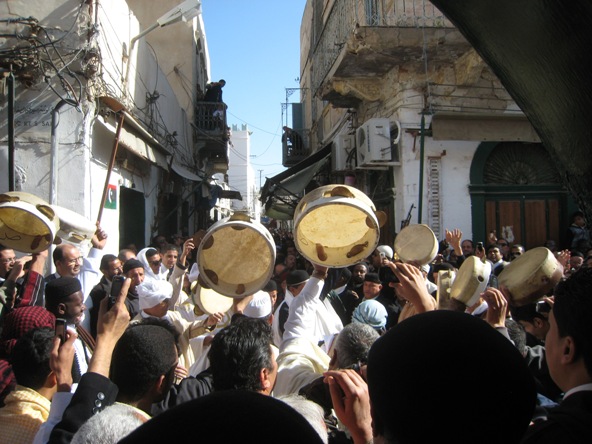
Libyan Sufis staged a joyous parade through the heart of Tripoli on Saturday to mark the Prophet Mohammad's birthday, defying radical Salafi Muslims pressuring them to scrap the centuries-old tradition.
Chanting hymns to the beat of drums and cymbals, marchers choked the narrow alleys of the walled old town to celebrate the feast of Mawlid, a favorite event for the pious Sufis whose spirituality is an integral part of North African Islam.
The celebrations were the first since the fall last August of Muammar Gaddafi, who kept religion under firm control during his 42-year dictatorship, and went ahead despite concerns that hardliners might attack the marchers as heretics.
The tension between the traditional Sufis and the Salafis, a group influenced by Saudi Wahhabis and other ultra-conservative foreign Islamists, has become a key divide in Libyan politics as parties begin to form to contest free elections in June.
"We fought the tyrant (Gaddafi) because he was a dictator and we don't want anyone like him to govern us again," said biology teacher Mohammad Aref. "We are the majority."
Emhemed Elashhab, the sheikh (Islamic scholar) at one Islamic school where marchers assembled, said there were fewer than 2,000 violent Islamists in Libya. "All normal people are against their ideas," he said.
EITHER BATS OR THIEVES
Sufism, a mystical strain among both Sunnis and Shi'ites, dates back to Islam's early days. Apart from the standard prayers, Sufi devotions include singing hymns, chanting the names of God or dancing to heighten awareness of the divine.
Sufis also build shrines to revered holy men and scholars and make pilgrimages to them. Hardline Islamists consider these practices grave sins that must be stopped, by force if needed.
One night last month, extremists bulldozed through a wall of an old cemetery in the eastern city of Benghazi, destroyed its tombs and carried off 29 bodies of respected sages and scholars. They also demolished a nearby Sufi school.
"The extremists have taken advantage of the lack of order," said Jamel Abdul Muhi, a Sufi in Tripoli. "Those who work in the dark are either bats or thieves. They are cowards."
In Benghazi, hundreds of Sufis marched to a main square flanked by 30 armed militiamen for security. Jumaa Mohammad Al-Sharif, an Islamic school teacher, said the procession was also a protest against last month's grave desecrations.
"We caught some people who destroyed the zawiya (Islamic school) and disrespected the graves and handed them over to the authorities, but we were surprised when we later learned they had been released," he said.
Hisham Krekshi, deputy chairman of the Tripoli Local Council, expressed satisfaction the march was taking place peacefully despite concerns about reprisals from hardliners, who spread pamphlets in recent days urging people to shun the event.
"This has been around for 14 centuries, you can't stop it," he said in one of the main souks, where the gold traders and cloth merchants had shut their shops for the day.
INCENSE AND ALMOND MILK
Festivities in Tripoli began with Sufi devotions in traditional Islamic schools in the old town. At Zawiya Kabira, the largest one, men chanted rounds of rousing hymns in an incense-filled room while other distributed almond milk and biscuits to those outside.
Boys lit firecrackers as lines of men danced out of the school and down the alleys, with women watching from balconies and doorways as the procession passed.
"Beloved Prophet of God, be the enemy of all His enemies," was one of the slogans they chanted in Sufi-style repetition.
At one point, marchers spilled out onto Martyrs Square, the old Green Square where Gaddafi used to address his supporters.
Najat Al-Mughrabi, waiting with other women at a corner to watch their sons march by, said she was not afraid of the extremists. "They couldn't do anything before (under Gaddafi), how can they do anything now?" she asked.
Even if the Mawlid holiday passes without incident, Sufi leaders say they remain concerned because many post-Gaddafi religious officials have Salafi leanings and have been appointing like-minded imams to mosques around the country.
Salafi preaching is also widespread on Libyan television and radio, they say, which raises concerns among Sufis that they are being outflanked by a new and more political form of Islam.
(For more on faith and ethics, see the Reuters religion blog Faithworld.)
(Additional reporting by Marie-Louise Gumuchian and Taha Zargoun in Tripoli and Mohammad Al-Tommy in Benghazi.)
Libyan Sufis staged a joyous parade through the heart of Tripoli on Saturday to mark the Prophet Mohammad's birthday, defying radical Salafi Muslims pressuring them to scrap the centuries-old tradition.
Chanting hymns to the beat of drums and cymbals, marchers choked the narrow alleys of the walled old town to celebrate the feast of Mawlid, a favorite event for the pious Sufis whose spirituality is an integral part of North African Islam.
The celebrations were the first since the fall last August of Muammar Gaddafi, who kept religion under firm control during his 42-year dictatorship, and went ahead despite concerns that hardliners might attack the marchers as heretics.
The tension between the traditional Sufis and the Salafis, a group influenced by Saudi Wahhabis and other ultra-conservative foreign Islamists, has become a key divide in Libyan politics as parties begin to form to contest free elections in June.
"We fought the tyrant (Gaddafi) because he was a dictator and we don't want anyone like him to govern us again," said biology teacher Mohammad Aref. "We are the majority."
Emhemed Elashhab, the sheikh (Islamic scholar) at one Islamic school where marchers assembled, said there were fewer than 2,000 violent Islamists in Libya. "All normal people are against their ideas," he said.
EITHER BATS OR THIEVES
Sufism, a mystical strain among both Sunnis and Shi'ites, dates back to Islam's early days. Apart from the standard prayers, Sufi devotions include singing hymns, chanting the names of God or dancing to heighten awareness of the divine.
Sufis also build shrines to revered holy men and scholars and make pilgrimages to them. Hardline Islamists consider these practices grave sins that must be stopped, by force if needed.
One night last month, extremists bulldozed through a wall of an old cemetery in the eastern city of Benghazi, destroyed its tombs and carried off 29 bodies of respected sages and scholars. They also demolished a nearby Sufi school.
"The extremists have taken advantage of the lack of order," said Jamel Abdul Muhi, a Sufi in Tripoli. "Those who work in the dark are either bats or thieves. They are cowards."
In Benghazi, hundreds of Sufis marched to a main square flanked by 30 armed militiamen for security. Jumaa Mohammad Al-Sharif, an Islamic school teacher, said the procession was also a protest against last month's grave desecrations.
"We caught some people who destroyed the zawiya (Islamic school) and disrespected the graves and handed them over to the authorities, but we were surprised when we later learned they had been released," he said.
Hisham Krekshi, deputy chairman of the Tripoli Local Council, expressed satisfaction the march was taking place peacefully despite concerns about reprisals from hardliners, who spread pamphlets in recent days urging people to shun the event.
"This has been around for 14 centuries, you can't stop it," he said in one of the main souks, where the gold traders and cloth merchants had shut their shops for the day.
INCENSE AND ALMOND MILK
Festivities in Tripoli began with Sufi devotions in traditional Islamic schools in the old town. At Zawiya Kabira, the largest one, men chanted rounds of rousing hymns in an incense-filled room while other distributed almond milk and biscuits to those outside.
Boys lit firecrackers as lines of men danced out of the school and down the alleys, with women watching from balconies and doorways as the procession passed.
"Beloved Prophet of God, be the enemy of all His enemies," was one of the slogans they chanted in Sufi-style repetition.
At one point, marchers spilled out onto Martyrs Square, the old Green Square where Gaddafi used to address his supporters.
Najat Al-Mughrabi, waiting with other women at a corner to watch their sons march by, said she was not afraid of the extremists. "They couldn't do anything before (under Gaddafi), how can they do anything now?" she asked.
Even if the Mawlid holiday passes without incident, Sufi leaders say they remain concerned because many post-Gaddafi religious officials have Salafi leanings and have been appointing like-minded imams to mosques around the country.
Salafi preaching is also widespread on Libyan television and radio, they say, which raises concerns among Sufis that they are being outflanked by a new and more political form of Islam.
(For more on faith and ethics, see the Reuters religion blog Faithworld.)
(Additional reporting by Marie-Louise Gumuchian and Taha Zargoun in Tripoli and Mohammad Al-Tommy in Benghazi.)
Monday, February 13, 2012
Al-Mawlid Special Sweets
By Zuliekha Abdul Raziq, *Al-Mawlid al-Nabawi’ (the Prophet’s birthday) .. Revival of Spirits and Hearts* - Sudan Vision - Khartoum, Sudan; Saturday, February 4th, 2012
One of the largest gatherings in Sudan is the annual celebration of ‘al-Mawlid al-Nabawi’ (the Prophet’s birthday).
The ‘Mawlid’ in Sudan is commemorated in a festive ambience and involves ‘zikir’, ‘madih’, drumming sessions and other forms of performances.
The open-air venues are decorated with lights, floors are furnished with prayer rugs and Sufi flags are positioned all around the area. From children who enjoy the assorted sweets and candy in the shapes of brides and knights in horses, to adults who sip sweet tea and engage in the Sufi ceremonials, to travelers, tourists and photographers who attend to experience the local religious carnival, the ‘Mawlid’ is attended by people from all ages, orders and ethnicities.
The ‘Mawlid’ even welcomes non-Sufis, who are often present in large numbers. The richer members of the community donate food, and the less fortunate mingle with the rest, enjoy free meals, juice and tea, and join in the chants.
While each Sufi order has its own distinct style, all are, to an extent, similar in terms of their impeccable hospitality, generosity and provoking a mood of spiritual joyousness among the masses.
There’s a common belief in Sudan, “If a family does not have at least one Sufi member, it’s not Sudanese.” This may indubitably be the case, granted that Sudan has more Sufi Muslims than any other country in the world, and the number is expanding. Sufism is noticeably entrenched in the Sudanese community, and many think of it as a way of life.
‘Zikir’ (exercises of remembrance) and ‘madih nabawi’ (poems in praise of the Prophet) are often heard on the streets, in public buses and taxis, in shops and restaurants, and on local radio stations and television channels.
‘Zikir’ and other Sufi practices form part of the weekly Sufi rituals which bring together Sufis from all walks of life, regardless of class and other differences.
Al-Mawlid is accompanied by preparations in the market as the commercial movement flourish during the days of the celebrations and even after that. The demand on local and imported candies increases and the families express keenness to buy Al-Mawlid special sweets and candies to their kids.
Several families in Khartoum State are famous in manufacturing Al-Mawlid special sweets, such as Sayed Makki, Arman, Al-Sir Al-Maghrabi, Yousif Al-Faki and others.
Sudan Vision met with Uncle Mirghani Musa Mohammed who is specialized in Al-Mawlid sweets manufacturing and in particular Al-Mawlid Bride and the horses.
He explained how he inherited the job from his grandfathers adding that the manufacturing is very expensive due to the hikes in the prices of sugar.
[Click on the title to the original article with more pictures (ed.)]
One of the largest gatherings in Sudan is the annual celebration of ‘al-Mawlid al-Nabawi’ (the Prophet’s birthday).
The ‘Mawlid’ in Sudan is commemorated in a festive ambience and involves ‘zikir’, ‘madih’, drumming sessions and other forms of performances.
The open-air venues are decorated with lights, floors are furnished with prayer rugs and Sufi flags are positioned all around the area. From children who enjoy the assorted sweets and candy in the shapes of brides and knights in horses, to adults who sip sweet tea and engage in the Sufi ceremonials, to travelers, tourists and photographers who attend to experience the local religious carnival, the ‘Mawlid’ is attended by people from all ages, orders and ethnicities.
The ‘Mawlid’ even welcomes non-Sufis, who are often present in large numbers. The richer members of the community donate food, and the less fortunate mingle with the rest, enjoy free meals, juice and tea, and join in the chants.
While each Sufi order has its own distinct style, all are, to an extent, similar in terms of their impeccable hospitality, generosity and provoking a mood of spiritual joyousness among the masses.
There’s a common belief in Sudan, “If a family does not have at least one Sufi member, it’s not Sudanese.” This may indubitably be the case, granted that Sudan has more Sufi Muslims than any other country in the world, and the number is expanding. Sufism is noticeably entrenched in the Sudanese community, and many think of it as a way of life.
‘Zikir’ (exercises of remembrance) and ‘madih nabawi’ (poems in praise of the Prophet) are often heard on the streets, in public buses and taxis, in shops and restaurants, and on local radio stations and television channels.
‘Zikir’ and other Sufi practices form part of the weekly Sufi rituals which bring together Sufis from all walks of life, regardless of class and other differences.
Al-Mawlid is accompanied by preparations in the market as the commercial movement flourish during the days of the celebrations and even after that. The demand on local and imported candies increases and the families express keenness to buy Al-Mawlid special sweets and candies to their kids.
Several families in Khartoum State are famous in manufacturing Al-Mawlid special sweets, such as Sayed Makki, Arman, Al-Sir Al-Maghrabi, Yousif Al-Faki and others.
Sudan Vision met with Uncle Mirghani Musa Mohammed who is specialized in Al-Mawlid sweets manufacturing and in particular Al-Mawlid Bride and the horses.
He explained how he inherited the job from his grandfathers adding that the manufacturing is very expensive due to the hikes in the prices of sugar.
[Click on the title to the original article with more pictures (ed.)]
Friday, February 10, 2012
Part of the Same Spirit
By Nancy Pasternack, *Yuba-Sutter spaghetti dinners benefit those in need* - Appeal Democrat - CA, USA; Monday, January 23, 2012
They weren't intended to coincide. But two spaghetti dinner events scheduled for Feb. 11 are intended to benefit the area's homeless and needy.
An annual dinner sponsored by the Yuba City Kiwanis will raise money for Hands of Hope, which provides resources for local homeless families.
The Kiwanis club dinner is the fourth such fundraising effort for Hands of Hope. Last year's dinner raised more than $3,000, according to Gennis Zeller, who is helping coordinate the event.
And a Tierra Buena couple with ties to the Yuba City Islamic Center have organized an event through St. John's Episcopal Church to feed the homeless that same night in Marysville.
Victor Krambo said the two events have the same goal of reaching out to the poor. He hopes the free hot meal in Marysville will become a monthly event.
"Our interest in doing this comes from our faith," he said of his ties to Islam, and to Sufism, the Muslim sect to which he and his wife, Rahma Krambo, belong.
But the Feb. 11 event is intended as an interfaith effort, Krambo said.
"All religious traditions encourage charity, and looking after the poor," he said. "It's not any different for a Christian or Jewish or Buddhist person. We are our brother's keeper and are responsible for each other as human beings."
The mosque in Yuba City does not have a state-certified commercial kitchen, which is necessary to cook large-scale meals for public consumption. So Krambo and a handful of his friends are collaborating with members of the Episcopal Church at Eighth and D streets, he said.
Krambo and his wife are active community volunteers, and their work includes involvement with Hands of Hope.
"It's part of the same spirit," said Victor Krambo. "We have to find ways to give our time, our wealth, and our compassion."
Some of the clients who seek services from Hands of Hope, he said, are not so different from the presently well-clothed and fed.
"You've got people living in their cars now who had a nice house five years ago. Some don't have extended families to help them," Krambo said.
"You have people in the river bottoms because they don't have good credit," he said. "It's easy to be judgmental, and I can kick dirt and spit with the best of them, but we don't know the whole story behind somebody's life."
[Visit Hands of Hope.
Picture from the Islamic Center of Yuba City website.]
They weren't intended to coincide. But two spaghetti dinner events scheduled for Feb. 11 are intended to benefit the area's homeless and needy.
An annual dinner sponsored by the Yuba City Kiwanis will raise money for Hands of Hope, which provides resources for local homeless families.
The Kiwanis club dinner is the fourth such fundraising effort for Hands of Hope. Last year's dinner raised more than $3,000, according to Gennis Zeller, who is helping coordinate the event.
And a Tierra Buena couple with ties to the Yuba City Islamic Center have organized an event through St. John's Episcopal Church to feed the homeless that same night in Marysville.
Victor Krambo said the two events have the same goal of reaching out to the poor. He hopes the free hot meal in Marysville will become a monthly event.
"Our interest in doing this comes from our faith," he said of his ties to Islam, and to Sufism, the Muslim sect to which he and his wife, Rahma Krambo, belong.
But the Feb. 11 event is intended as an interfaith effort, Krambo said.
"All religious traditions encourage charity, and looking after the poor," he said. "It's not any different for a Christian or Jewish or Buddhist person. We are our brother's keeper and are responsible for each other as human beings."
The mosque in Yuba City does not have a state-certified commercial kitchen, which is necessary to cook large-scale meals for public consumption. So Krambo and a handful of his friends are collaborating with members of the Episcopal Church at Eighth and D streets, he said.
Krambo and his wife are active community volunteers, and their work includes involvement with Hands of Hope.
"It's part of the same spirit," said Victor Krambo. "We have to find ways to give our time, our wealth, and our compassion."
Some of the clients who seek services from Hands of Hope, he said, are not so different from the presently well-clothed and fed.
"You've got people living in their cars now who had a nice house five years ago. Some don't have extended families to help them," Krambo said.
"You have people in the river bottoms because they don't have good credit," he said. "It's easy to be judgmental, and I can kick dirt and spit with the best of them, but we don't know the whole story behind somebody's life."
[Visit Hands of Hope.
Picture from the Islamic Center of Yuba City website.]
Thursday, February 09, 2012
Turned into a Shoe Market
By Staff Reporter, *Revealed: Anarkali shops illegally built on saint’s property* - The Nation - Pakistan; Wednesday, February 1st, 2012
Revealed: Anarkali shops illegally built on saint’s property
The representatives of an organisation working for conservation of heritage have revealed that the original property belonging to Hazrat Mian Mir, a famous Sufi saint who resided in Lahore, was located in Anarkali Bazaar.
“The property has now been turned into a shoe market,” they said at a press conference held at Lahore Press Club on Tuesday.
Lohkot Cultural and Heritage Society Chairman Rao Javid Iqbal, Pakistan Sikh Gurdwara Parbandhak Committee Chairman Sardar Sham Singh, Pandit Lal Khokar, Faqir Saifuddin, Hajid Ronaq Ali and others demanded that the Punjab Government constitute a committee to investigate the issue and retrieve the saint’s land from the illegal occupants.
Showing documental proof to the journalists regarding the custody of the property by Hazrat Mian Mir (RA), they said that they would move a court if the provincial government did not pay any attention towards this serious issue. According to them, about 12 shops on the right side of the entry point to the Anakali Bazaar were built illegally on the saint’s property.
Till 1950s, they said, there were a mosque, a Chillagah, a worship place, and a well where the Sufi saint used to pray. Later on, they added, all these signs disappeared. The revenue record clearly narrated the shifting of the property from Mian Mir (RA) to the current owners, they added.
Meanwhile, Punjab Minister for Auqaf Haji Ehsanuddin Qureshi on Tuesday inaugurated the 388th annual Urs celebrations of Sufi saint Hazrat Mian Mir Sahib (RA). The Minister along with others laid chaddar on the shrine of Sufi saint and offered dua for the prosperity, development and peace in the country.
Addressing after the inauguration, the Minister said that the government was paying special attention to the provision of best facilities to the devotees and to look after the shrines. He said that Auqaf Department is spending money collected at the shrines on the welfare of deserving people and the devotees.
The Minister said that strict security arrangements with 300 security personal have been made and no one would be allowed to enter the shrine without proper checking. Qureshi said that Ulema and mushaikh should create tolerance among the masses by promoting teachings of the saints in the society.
He said that in the present situation, brotherhood can be maintained among various segments of the society by promoting teachings of Sufis and saints.
Director General, Director Administration and Manager Auqaf besides Ulema and a large number of people were also present on the occasion.
Revealed: Anarkali shops illegally built on saint’s property
The representatives of an organisation working for conservation of heritage have revealed that the original property belonging to Hazrat Mian Mir, a famous Sufi saint who resided in Lahore, was located in Anarkali Bazaar.
“The property has now been turned into a shoe market,” they said at a press conference held at Lahore Press Club on Tuesday.
Lohkot Cultural and Heritage Society Chairman Rao Javid Iqbal, Pakistan Sikh Gurdwara Parbandhak Committee Chairman Sardar Sham Singh, Pandit Lal Khokar, Faqir Saifuddin, Hajid Ronaq Ali and others demanded that the Punjab Government constitute a committee to investigate the issue and retrieve the saint’s land from the illegal occupants.
Showing documental proof to the journalists regarding the custody of the property by Hazrat Mian Mir (RA), they said that they would move a court if the provincial government did not pay any attention towards this serious issue. According to them, about 12 shops on the right side of the entry point to the Anakali Bazaar were built illegally on the saint’s property.
Till 1950s, they said, there were a mosque, a Chillagah, a worship place, and a well where the Sufi saint used to pray. Later on, they added, all these signs disappeared. The revenue record clearly narrated the shifting of the property from Mian Mir (RA) to the current owners, they added.
Meanwhile, Punjab Minister for Auqaf Haji Ehsanuddin Qureshi on Tuesday inaugurated the 388th annual Urs celebrations of Sufi saint Hazrat Mian Mir Sahib (RA). The Minister along with others laid chaddar on the shrine of Sufi saint and offered dua for the prosperity, development and peace in the country.
Addressing after the inauguration, the Minister said that the government was paying special attention to the provision of best facilities to the devotees and to look after the shrines. He said that Auqaf Department is spending money collected at the shrines on the welfare of deserving people and the devotees.
The Minister said that strict security arrangements with 300 security personal have been made and no one would be allowed to enter the shrine without proper checking. Qureshi said that Ulema and mushaikh should create tolerance among the masses by promoting teachings of the saints in the society.
He said that in the present situation, brotherhood can be maintained among various segments of the society by promoting teachings of Sufis and saints.
Director General, Director Administration and Manager Auqaf besides Ulema and a large number of people were also present on the occasion.
Wednesday, February 08, 2012
It Is In The Music
By Nick McGregor, *British axeman Richard Thompson turns it up a notch* - StAugustine.com 7 Surf-Drift - Saint Augustine, FL, USA; Tuesdy, January 31, 2012
British axeman Richard Thompson turns it up a notch: Performer and his Electric Trio come to Ponte Vedra Concert Hall on Feb. 2
Although guitar legend Richard Thompson is well-known for his groundbreaking folk career, his current tour finds the 62-year-old London singer/songwriter performing with his Electric Trio.
Of course, Thompson has always had a keen flair for the unexpected, making his name with pioneering Brit-folk outfit Fairport Convention in the late '60s before abruptly quitting the group in 1971. Thompson then married his frequent musical collaborator Linda Peters in 1972 and put their relationship on full public view with hit albums I Want To See The Bright Lights Tonight, Hokey Pokey, and Pour Down Like Silver. But by 1975, the couple had withdrawn from the public eye to join a Sufi Islam commune.
In the mid-'80s, Thompson further shocked his British compatriots by moving to California, where he ignited a successful solo career that’s always enjoyed cult status with hardcore folk fans, music critics and guitar nerds alike. By the early 2000s, Thompson had shed his major-label past to go it alone as an independent artist marketing and selling his own albums, which actually increased his profile and sales. And in 2006, Thompson took a Playboy Magazine request for a “Best Songs of the Millennium” list seriously, coming up with his 1,000 Years of Popular Music CD and tour.
Drift caught up with the effusive Thompson to talk about Celtic influences, Beyonce, the Queen of England and the real meaning of Islam.
Drift: Your past tours have often been themed, Richard. Is there any such plan on the current tour with your Electric Trio?
Richard Thompson: Hopefully we’ll be playing some new material we haven’t done before, some selections off the last album, and then a whole bunch of stuff going back through the years. Back through the decades, actually — help!
Drift: You’ve been playing music for nearly 50 years. What first sparked your interest in the guitar?
RT: The guitar was a popular instrument when I was a small kid in the ‘50s, and I wanted one but no one took me seriously. I saw Eddie Cochran and Buddy Holly and on TV looking very cool with guitar, and I finally got one when I was 11 years old. I first played in an instrumental band doing The Ventures kind of stuff, then I was in a school band for a few years, and then at 18 I turned professional in the psychedelic clubs around London.
Drift: Your first big band, Fairport Convention, is considered one of the most seminal British bands in folk history. Did you realize at the time that you were redefining the music?
RT: Starting to play more British-style music was a deliberate policy — something that we did think about and were conscious of. We were also aware that what we were doing was quite different. Revolutionary, really. And I still subscribe to that style — the hybrid of rock ‘n’ roll and Celtic and English traditional forms.
Drift: Growing up in London, where did those decidedly rural influences come from?
RT: I think my music does have a slightly different slant, with a strong Celtic influence. That’s the stuff I grew up listening to in a traditional Scottish family, so it’s in the mix somewhere.
Drift: Do you find it hard to find 45 years after beginning your musical career to still find songwriting inspiration?
RT: No, because I’m not in a crowded field. If I were a country artist I’d think, ”Oh my God, I only have three chords and topics!” Broken hearts, honky-tonks, and C, F, and G. How many combinations can there be, and how many songwriters are there in Nashville, and how many songs do they each write in the year? It must be hundreds of thousands, and many of them probably sound remarkable similar [laughs]. There are a few great ones, I’m sure, but I’m in a much less crowded field, where there are only so many people with the interests that I have. It’s actually kind of a wide-open field, and I keep thinking of things that other people haven’t tried before — and that I haven’t tried before. So I’m always finding inspiration.
Drift: When you created the 1000 Years of Popular Music CD and tour you certainly went a ways back to find inspiration — all the way back to 1068, actually. Is it challenging to adapt music that old for modern tastes?
RT: It’s definitely tough — really impossible. But the attempt that we make at is not bad considering that other people haven’t been able to do it any better. If you take somebody who specializes in classical music, they couldn’t do popular music. And if you take somebody that specializes in early music, well, past the 1600s they start to founder [laughs]. I think we do not a bad job of taking a huge range of styles and turning it into an interesting experience. And I hate to say it, but it is educational, and eye opening sometimes, even for us doing the research because we stumble across these really beautiful songs that get lost as time marches on and fashions change. Go back to the 17th or 18th century and there are these wonderful things just waiting to be dusted off.
Drift: When you created the 1000 Years of Popular Music CD and tour you certainly went a ways back to find inspiration — all the way back to 1068, actually. Is it challenging to adapt music that old for modern tastes?
RT: It’s definitely tough — really impossible. But the attempt that we make at is not bad considering that other people haven’t been able to do it any better. If you take somebody who specializes in classical music, they couldn’t do popular music. And if you take somebody that specializes in early music, well, past the 1600s they start to founder [laughs]. I think we do not a bad job of taking a huge range of styles and turning it into an interesting experience. And I hate to say it, but it is educational, and eye opening sometimes, even for us doing the research because we stumble across these really beautiful songs that get lost as time marches on and fashions change. Go back to the 17th or 18th century and there are these wonderful things just waiting to be dusted off.
Drift: And I assume some of those songs come from the grand American folk tradition, right?
RT: Yes, we do some American folk songs because we don’t want our American audiences to feel left out or neglected. Of course American folk forms are based on European forms that became customized to the America, lifestyle and landscape. And the American musical genius starts to appear around the turn of the last century with things like jazz, a wonderful American art form.
Drift: You moved to the U.S. in the mid-'80s. What prompted your relocation, and do you miss Britain?
RT: Well, I married an American and it seemed a more logical place to live at the time. If you can stay out of prison, it’s a remarkable easy country to live in, as long as you stay on the right side of the law. I do miss the UK, but I get back at least once a year, which is probably enough. The thing I don’t miss is the weather from October to April — sometimes October to September.
Drift: You’ve been a devout Sufi Muslim since the ‘70s. How has that affected your music, and what are your thoughts on the misconceptions of Islam around the world?
RT: Whatever you believe in informs everything that you do really, so it is in there somewhere in the music. It’s not on the surface, but the morality is underlying the music I should imagine. And what the Western world sees of Islam is radical Islam and nuts like Al Qaeda, who as far as I’m concerned are so far outside of and beyond Islam. Islam is supposed to be about balance, generosity, and mercy; violence is really supposed to be the absolute last resort. Islam means peace for heaven’s sake, so let’s have some, please.
Drift: You’ve won scores of awards over the course of your career. Do any stand out more than others?
RT: Well last year I got an OBE from the Queen of England, which is about two degrees below knighthood on the pecking order but fantastic all the same. I also received a doctorate from Aberdeen University, so call me Dr. Thompson. That sounds good.
Drift: For most of your career you recorded for major labels, but over the last decade you’ve been a devoted independent artist. Does that allow you more freedom?
RT: I get a lot more freedom to make the records that I want to make. There are no other opinions; I don’t have to listen to record execs justifying their jobs. The musical landscape has totally changed in the last 20 years, and record labels are irrelevant to most people now. Unless you’re Beyoncé or something, they don’t really serve a purpose, so I think it’s all about small, independent labels and marketing music in different ways. I mean, crikey, in another five years everything could be free anyway. We could see the end of the CD very soon.
Drift: For you, and for folk music as a whole, it seems like touring and the live performance has always been more important.
RT: I’ve always seen performing as the focus of what I do and recordings as an adjunct. I’m glad people come to concerts, because for me the greatest thrill is playing in front of an audience. I mentioned Beyonce rather flippantly, but she puts on a good show with the lights and the dancing and the music, making a whole tapestry of things that to some people is the pinnacle of entertainment. But I’m more in a field where it’s one person with a guitar — a much more intimate thing that still works I hope.
Drift: You toured through St. Augustine last year. Do you always get a good response in Florida?
RT: We usually have really good experiences in Florida, and I enjoyed the show in St. Augustine last year at the Gamble Rogers Festival. It was fantastic and really nice; that festival is all about stories, because Gamble was a great storyteller. I always enjoy St. Augustine as a place to visit as well.
***
Richard Thompson Electric Trio performs with Sam Pacetti on Thursday, Feb. 2 at Ponte Vedra Concert Hall, 1050 A1A North, Ponte Vedra Beach. Tickets range from $39.50 to $52.50 for reserved seating. Doors open at 7 p.m. and the show starts at 8 p.m. For more info, go to www.PVConcertHall.com or call 209-0399.
***
For free Richard Thompson audio downloads, click here.
***
Picture: Richard Thompson. Photo: Ron Sleznak.
British axeman Richard Thompson turns it up a notch: Performer and his Electric Trio come to Ponte Vedra Concert Hall on Feb. 2
Although guitar legend Richard Thompson is well-known for his groundbreaking folk career, his current tour finds the 62-year-old London singer/songwriter performing with his Electric Trio.
Of course, Thompson has always had a keen flair for the unexpected, making his name with pioneering Brit-folk outfit Fairport Convention in the late '60s before abruptly quitting the group in 1971. Thompson then married his frequent musical collaborator Linda Peters in 1972 and put their relationship on full public view with hit albums I Want To See The Bright Lights Tonight, Hokey Pokey, and Pour Down Like Silver. But by 1975, the couple had withdrawn from the public eye to join a Sufi Islam commune.
In the mid-'80s, Thompson further shocked his British compatriots by moving to California, where he ignited a successful solo career that’s always enjoyed cult status with hardcore folk fans, music critics and guitar nerds alike. By the early 2000s, Thompson had shed his major-label past to go it alone as an independent artist marketing and selling his own albums, which actually increased his profile and sales. And in 2006, Thompson took a Playboy Magazine request for a “Best Songs of the Millennium” list seriously, coming up with his 1,000 Years of Popular Music CD and tour.
Drift caught up with the effusive Thompson to talk about Celtic influences, Beyonce, the Queen of England and the real meaning of Islam.
Drift: Your past tours have often been themed, Richard. Is there any such plan on the current tour with your Electric Trio?
Richard Thompson: Hopefully we’ll be playing some new material we haven’t done before, some selections off the last album, and then a whole bunch of stuff going back through the years. Back through the decades, actually — help!
Drift: You’ve been playing music for nearly 50 years. What first sparked your interest in the guitar?
RT: The guitar was a popular instrument when I was a small kid in the ‘50s, and I wanted one but no one took me seriously. I saw Eddie Cochran and Buddy Holly and on TV looking very cool with guitar, and I finally got one when I was 11 years old. I first played in an instrumental band doing The Ventures kind of stuff, then I was in a school band for a few years, and then at 18 I turned professional in the psychedelic clubs around London.
Drift: Your first big band, Fairport Convention, is considered one of the most seminal British bands in folk history. Did you realize at the time that you were redefining the music?
RT: Starting to play more British-style music was a deliberate policy — something that we did think about and were conscious of. We were also aware that what we were doing was quite different. Revolutionary, really. And I still subscribe to that style — the hybrid of rock ‘n’ roll and Celtic and English traditional forms.
Drift: Growing up in London, where did those decidedly rural influences come from?
RT: I think my music does have a slightly different slant, with a strong Celtic influence. That’s the stuff I grew up listening to in a traditional Scottish family, so it’s in the mix somewhere.
Drift: Do you find it hard to find 45 years after beginning your musical career to still find songwriting inspiration?
RT: No, because I’m not in a crowded field. If I were a country artist I’d think, ”Oh my God, I only have three chords and topics!” Broken hearts, honky-tonks, and C, F, and G. How many combinations can there be, and how many songwriters are there in Nashville, and how many songs do they each write in the year? It must be hundreds of thousands, and many of them probably sound remarkable similar [laughs]. There are a few great ones, I’m sure, but I’m in a much less crowded field, where there are only so many people with the interests that I have. It’s actually kind of a wide-open field, and I keep thinking of things that other people haven’t tried before — and that I haven’t tried before. So I’m always finding inspiration.
Drift: When you created the 1000 Years of Popular Music CD and tour you certainly went a ways back to find inspiration — all the way back to 1068, actually. Is it challenging to adapt music that old for modern tastes?
RT: It’s definitely tough — really impossible. But the attempt that we make at is not bad considering that other people haven’t been able to do it any better. If you take somebody who specializes in classical music, they couldn’t do popular music. And if you take somebody that specializes in early music, well, past the 1600s they start to founder [laughs]. I think we do not a bad job of taking a huge range of styles and turning it into an interesting experience. And I hate to say it, but it is educational, and eye opening sometimes, even for us doing the research because we stumble across these really beautiful songs that get lost as time marches on and fashions change. Go back to the 17th or 18th century and there are these wonderful things just waiting to be dusted off.
Drift: When you created the 1000 Years of Popular Music CD and tour you certainly went a ways back to find inspiration — all the way back to 1068, actually. Is it challenging to adapt music that old for modern tastes?
RT: It’s definitely tough — really impossible. But the attempt that we make at is not bad considering that other people haven’t been able to do it any better. If you take somebody who specializes in classical music, they couldn’t do popular music. And if you take somebody that specializes in early music, well, past the 1600s they start to founder [laughs]. I think we do not a bad job of taking a huge range of styles and turning it into an interesting experience. And I hate to say it, but it is educational, and eye opening sometimes, even for us doing the research because we stumble across these really beautiful songs that get lost as time marches on and fashions change. Go back to the 17th or 18th century and there are these wonderful things just waiting to be dusted off.
Drift: And I assume some of those songs come from the grand American folk tradition, right?
RT: Yes, we do some American folk songs because we don’t want our American audiences to feel left out or neglected. Of course American folk forms are based on European forms that became customized to the America, lifestyle and landscape. And the American musical genius starts to appear around the turn of the last century with things like jazz, a wonderful American art form.
Drift: You moved to the U.S. in the mid-'80s. What prompted your relocation, and do you miss Britain?
RT: Well, I married an American and it seemed a more logical place to live at the time. If you can stay out of prison, it’s a remarkable easy country to live in, as long as you stay on the right side of the law. I do miss the UK, but I get back at least once a year, which is probably enough. The thing I don’t miss is the weather from October to April — sometimes October to September.
Drift: You’ve been a devout Sufi Muslim since the ‘70s. How has that affected your music, and what are your thoughts on the misconceptions of Islam around the world?
RT: Whatever you believe in informs everything that you do really, so it is in there somewhere in the music. It’s not on the surface, but the morality is underlying the music I should imagine. And what the Western world sees of Islam is radical Islam and nuts like Al Qaeda, who as far as I’m concerned are so far outside of and beyond Islam. Islam is supposed to be about balance, generosity, and mercy; violence is really supposed to be the absolute last resort. Islam means peace for heaven’s sake, so let’s have some, please.
Drift: You’ve won scores of awards over the course of your career. Do any stand out more than others?
RT: Well last year I got an OBE from the Queen of England, which is about two degrees below knighthood on the pecking order but fantastic all the same. I also received a doctorate from Aberdeen University, so call me Dr. Thompson. That sounds good.
Drift: For most of your career you recorded for major labels, but over the last decade you’ve been a devoted independent artist. Does that allow you more freedom?
RT: I get a lot more freedom to make the records that I want to make. There are no other opinions; I don’t have to listen to record execs justifying their jobs. The musical landscape has totally changed in the last 20 years, and record labels are irrelevant to most people now. Unless you’re Beyoncé or something, they don’t really serve a purpose, so I think it’s all about small, independent labels and marketing music in different ways. I mean, crikey, in another five years everything could be free anyway. We could see the end of the CD very soon.
Drift: For you, and for folk music as a whole, it seems like touring and the live performance has always been more important.
RT: I’ve always seen performing as the focus of what I do and recordings as an adjunct. I’m glad people come to concerts, because for me the greatest thrill is playing in front of an audience. I mentioned Beyonce rather flippantly, but she puts on a good show with the lights and the dancing and the music, making a whole tapestry of things that to some people is the pinnacle of entertainment. But I’m more in a field where it’s one person with a guitar — a much more intimate thing that still works I hope.
Drift: You toured through St. Augustine last year. Do you always get a good response in Florida?
RT: We usually have really good experiences in Florida, and I enjoyed the show in St. Augustine last year at the Gamble Rogers Festival. It was fantastic and really nice; that festival is all about stories, because Gamble was a great storyteller. I always enjoy St. Augustine as a place to visit as well.
***
Richard Thompson Electric Trio performs with Sam Pacetti on Thursday, Feb. 2 at Ponte Vedra Concert Hall, 1050 A1A North, Ponte Vedra Beach. Tickets range from $39.50 to $52.50 for reserved seating. Doors open at 7 p.m. and the show starts at 8 p.m. For more info, go to www.PVConcertHall.com or call 209-0399.
***
For free Richard Thompson audio downloads, click here.
***
Picture: Richard Thompson. Photo: Ron Sleznak.
Tuesday, February 07, 2012
A Libya of Diversity
By Tom Heneghan, *Freed from Gaddafi, Libyan Sufis face violent Islamists* - Reuters Africa - Tripoli, Libya; Wednesday, February 1st, 2012
Tripoli: Freed from Muammar Gaddafi's 42-year dictatorship, Libya's Sufi Muslims find themselves under renewed pressure from violent Islamists who have been attacking them and their beliefs as heretical.
The desecration of graves belonging to Sufi saints and sages in recent months have put the peaceful Sufis on the defensive, prompting some to post armed guards at their mosques and lodges to ward off hardline thugs.
But the birthday of Islam's Prophet Mohammad, one of the highpoints in the Sufi calendar, is on Saturday and Libyan Sufis are determined to take their traditional processions through the streets to show they will not be cowed.
At a meeting of Sufi scholars to plan the celebrations, Sheikh Adl Al-Aref Al-Hadad said even being driven out of his zawiyah (Islamic school) late last year by Islamists known as Salafis would not deter him from marching.
"I'm worried but I'm not afraid," said Al-Hadad, whose Tripoli school was stormed by armed men who burned its library, destroyed office equipment and dug up graves of sages buried there. They turned the school into a Salafi mosque.
On January 13, extremists crashed a bulldozer through the walls of the old cemetery in the eastern city of Benghazi, destroyed its tombs and carried off 29 bodies of respected sages and scholars. They also demolished a nearby Sufi school.
Sheikh Khaled Mohammad Saidan, whose Dargut Pasha Mosque faces Tripoli's port, said most Islamists in post-Gaddafi Libya disagreed with Sufis, but peacefully. "But there are no police around and you never know what some people might do," he added.
PIETY OR IDOLATRY?
Sufi lodges from around Tripoli will march on Saturday through narrow alleys of the walled old town, waving flags and chanting poems in praise of Mohammad to the beat of cymbals, drums and tambourines.
To the puritanical Salafis, these practices amount to bida (innovation) and shirk (idolatry), both grave sins that must be stopped, by force if necessary.
Sufism, a mystical strain in both Sunni and Shi'ite Islam, dates back to the early days of the faith. Apart from their prayers, Sufi devotions include singing hymns, chanting the names of God or dancing to heighten awareness of the divine.
Revered saints, scholars and holy people are buried in shrines and some are honoured with annual pilgrimages. While many Islamic scholars say this is admissible, puritanical schools of Islam such as Saudi Arabia's Wahhabis or the Afghan Taliban consider it heretical.
As pious and peaceful believers, Sufis have been easy targets for violent Islamists seeking political power. The Pakistani Taliban have attacked Sufi shrines and mosques there in recent years and Salafi attacks on Sufis broke out last year after Egypt's protesters toppled President Hosni Mubarak.
GADDAFI'S BIZARRE ISLAM
Gaddafi had a bizarre and fickle relationship with Islam, using it when it boosted his authority but suppressing it whenever faith seemed to be the first step towards dissent. At one point in the 1980s, anyone going to morning prayers in a mosque risked arrest as a religious extremist.
The dictator denied there was a split between Sunnis and Shi'ites. He blew hot and cold on the Prophet's birthday event known as Mawlid, sometimes limiting it in Libya but leading mass celebrations in African cities in his self-appointed role as a pan-African and pan-Islamic leader.
Traditional religious schools were shut and religious education was reduced to a few basics about Islam and heavy emphasis on memorising the Koran.
Gaddafi even abolished the Dar al Ifta, the central authority for issuing religious rulings or fatwas, and Libya offered no such advice to its Muslims from 1978 until the office was restored after rebels chased him from power last August.
"He did everything but give people carpets and say pray to him rather than Allah," one imam remarked.
All this undermined Libya's traditional Islam, a balanced Sunni version with Sufi influences. Some Muslims began looking abroad for inspiration, especially to Saudi Arabia, and brought back a more austere Islam that mixed up the religious landscape.
"Nobody knows anymore what they are," said Sufi theologian Aref Ali Nayed when asked what the majority was in Libyan Islam. "We have 42 years of Gaddafi to thank for that."
OUTFLANKED POLITICALLY
Libya's Sufis also worry they are being outflanked politically. Many new religious officials have Salafi leanings, they say, and are appointing Salafi imams to mosques vacated by pro-Gaddafi preachers. Salafi preaching is now widespread on Libyan television and radio, they say.
Salafis have also begun denouncing traditional imams to the authorities, prompting them to be replaced by hardliners. "About half the imams here have been replaced by Salafis," said one imam at a large Tripoli mosque where Salafis in the congregation are campaigning against celebrating Mawlid.
Political parties are starting to form, including the Muslim Brotherhood. Libyan Salafis have not yet announced if they plan to launch a party and contest elections, as in Egypt.
Sheikh Mohammad Jafari, whose mosque is pockmarked from the fighting over Gaddafi's Bab Al-Azizaya compound just across the street, said Sufis had to stand up for their beliefs.
"Sufis uphold the values of love and brotherhood," he said. "We believe in dialogue and difference of opinions. We want to build a Libya of diversity."
Tripoli: Freed from Muammar Gaddafi's 42-year dictatorship, Libya's Sufi Muslims find themselves under renewed pressure from violent Islamists who have been attacking them and their beliefs as heretical.
The desecration of graves belonging to Sufi saints and sages in recent months have put the peaceful Sufis on the defensive, prompting some to post armed guards at their mosques and lodges to ward off hardline thugs.
But the birthday of Islam's Prophet Mohammad, one of the highpoints in the Sufi calendar, is on Saturday and Libyan Sufis are determined to take their traditional processions through the streets to show they will not be cowed.
At a meeting of Sufi scholars to plan the celebrations, Sheikh Adl Al-Aref Al-Hadad said even being driven out of his zawiyah (Islamic school) late last year by Islamists known as Salafis would not deter him from marching.
"I'm worried but I'm not afraid," said Al-Hadad, whose Tripoli school was stormed by armed men who burned its library, destroyed office equipment and dug up graves of sages buried there. They turned the school into a Salafi mosque.
On January 13, extremists crashed a bulldozer through the walls of the old cemetery in the eastern city of Benghazi, destroyed its tombs and carried off 29 bodies of respected sages and scholars. They also demolished a nearby Sufi school.
Sheikh Khaled Mohammad Saidan, whose Dargut Pasha Mosque faces Tripoli's port, said most Islamists in post-Gaddafi Libya disagreed with Sufis, but peacefully. "But there are no police around and you never know what some people might do," he added.
PIETY OR IDOLATRY?
Sufi lodges from around Tripoli will march on Saturday through narrow alleys of the walled old town, waving flags and chanting poems in praise of Mohammad to the beat of cymbals, drums and tambourines.
To the puritanical Salafis, these practices amount to bida (innovation) and shirk (idolatry), both grave sins that must be stopped, by force if necessary.
Sufism, a mystical strain in both Sunni and Shi'ite Islam, dates back to the early days of the faith. Apart from their prayers, Sufi devotions include singing hymns, chanting the names of God or dancing to heighten awareness of the divine.
Revered saints, scholars and holy people are buried in shrines and some are honoured with annual pilgrimages. While many Islamic scholars say this is admissible, puritanical schools of Islam such as Saudi Arabia's Wahhabis or the Afghan Taliban consider it heretical.
As pious and peaceful believers, Sufis have been easy targets for violent Islamists seeking political power. The Pakistani Taliban have attacked Sufi shrines and mosques there in recent years and Salafi attacks on Sufis broke out last year after Egypt's protesters toppled President Hosni Mubarak.
GADDAFI'S BIZARRE ISLAM
Gaddafi had a bizarre and fickle relationship with Islam, using it when it boosted his authority but suppressing it whenever faith seemed to be the first step towards dissent. At one point in the 1980s, anyone going to morning prayers in a mosque risked arrest as a religious extremist.
The dictator denied there was a split between Sunnis and Shi'ites. He blew hot and cold on the Prophet's birthday event known as Mawlid, sometimes limiting it in Libya but leading mass celebrations in African cities in his self-appointed role as a pan-African and pan-Islamic leader.
Traditional religious schools were shut and religious education was reduced to a few basics about Islam and heavy emphasis on memorising the Koran.
Gaddafi even abolished the Dar al Ifta, the central authority for issuing religious rulings or fatwas, and Libya offered no such advice to its Muslims from 1978 until the office was restored after rebels chased him from power last August.
"He did everything but give people carpets and say pray to him rather than Allah," one imam remarked.
All this undermined Libya's traditional Islam, a balanced Sunni version with Sufi influences. Some Muslims began looking abroad for inspiration, especially to Saudi Arabia, and brought back a more austere Islam that mixed up the religious landscape.
"Nobody knows anymore what they are," said Sufi theologian Aref Ali Nayed when asked what the majority was in Libyan Islam. "We have 42 years of Gaddafi to thank for that."
OUTFLANKED POLITICALLY
Libya's Sufis also worry they are being outflanked politically. Many new religious officials have Salafi leanings, they say, and are appointing Salafi imams to mosques vacated by pro-Gaddafi preachers. Salafi preaching is now widespread on Libyan television and radio, they say.
Salafis have also begun denouncing traditional imams to the authorities, prompting them to be replaced by hardliners. "About half the imams here have been replaced by Salafis," said one imam at a large Tripoli mosque where Salafis in the congregation are campaigning against celebrating Mawlid.
Political parties are starting to form, including the Muslim Brotherhood. Libyan Salafis have not yet announced if they plan to launch a party and contest elections, as in Egypt.
Sheikh Mohammad Jafari, whose mosque is pockmarked from the fighting over Gaddafi's Bab Al-Azizaya compound just across the street, said Sufis had to stand up for their beliefs.
"Sufis uphold the values of love and brotherhood," he said. "We believe in dialogue and difference of opinions. We want to build a Libya of diversity."
Monday, February 06, 2012
The First Drop of Rain
By Sher Alam Shinwari, *Perspective: Spiritual homecoming* - Dawn.Com - Karachi, Pakistan; Sunday, January 29, 2012
According to popular belief, the great mystic poet Rahman Baba was born in the early 17th century during the time of Mughal Emperor Aurangzeb Alamgir and he received-religious education from Mullah Yousaf in Kohat, but made the village of Bahadar Kalay in the outskirts of Peshawar his permanent abode.
Unfortunately, a major portion of Raman Baba’s life remains shrouded in mystery with researchers yet to discover its many hidden aspects.
Entertainment-starved Peshawariites watched the play seeped in spiritualism, philosophy and humility, based on the life of the Sufi poet who for centuries has continued to inspire generations of Pakhtuns.
With a cast of 30-plus playing out different major and minor roles, the play opened with a few college students glorifying their favourite rock stars during a photo exhibition. A fakir baba (holy man) draws their attention to a local hero who reigns over souls and not just the hearts and minds of men. The story goes in flashback mode to show Abdur Rahman, a child putting forth intelligent questions to his father, Abdul Sattar, regarding the jirga and other social customs of the Pakhtuns. The bright, sensitive child grows up to become a religious scholar well-aware of his environment.
For centuries, Rahman Baba was treated as an ascetic but progressive critics discovered in him a mystic revloutionary and social reformer who not only challenged the power and pelf of his rival landlord cousins, Aziz Khan and Shamroz Khan, but also decried Mughal pride. He bequeathed his own land to poor widows and orphans on the basis of poetic references found in his diwan.
Although the three-hour play was free of glitches, a few criticised the plot for laying too much stress on religiosity of the Sufi mystic. The universal message of Rahman Baba was played out by a befitting set, stage lighting, sound effects and veteran histrionics by seasoned stage and TV actors such as Iftikhar Qaiser, Umar Daraz, Javed Babar, Ishrat Abbas, Said Rahman Sheno, Zahida Tunha, Meena Shams, Riaz Akhtar, Uazir Sherpao, Salim Shauq, Obaid and Kalim Khan.
In an exclusive chat with Images on Sunday, play director Ajab Gul said, “The play has a mega cast due to it being a mega project. I took it as a challenge with all the shortcomings of theatrical architectonics. I dared to stage a classic play based on the message of a well-loved Sufi mystic of the Pakhtuns, and surprisingly the audience who are totally unaware of the traditions of theatre were spellbound and quite responsive.”
Actor Iftikhar Qaiser who played Rahman Baba said, “It was not only a character, it was a soul-stirring experience. Abaseen Yousafzai, the scriptwriter, treated it very differently.”
The Afghan Consul-General in Peshawar, Syed Mohammad Ibrahimkhel, and the Afghan Envoy to European Union, Kamal Gul, were among the audience. The latter came all the way from Brussels, Belgium, to watch the play and hopes to take the play to Kabul after consulting the Afghan Federal Culture Minister, Makhdoom Raheen. “I told the Afghan envoy that it could be made possible after taking it up with Pakistan’s culture ministry, if is done it will help in cementing cultural ties between the two countries,” Gul said. It will soon be available on DVD with English dubbing and subtitles.
The play also raises questions regarding the misquotation of Rahman Baba’s couplets on public transport, thereby pointing to poor knowledge by a university professor who takes a group of students to the shrine of the Sufi poet encroached upon by drug addicts, thereby inviting the wrath of militants who blew up a part of it in March 2009. The play comes to an end with the transformation of Palvasha, a carefree young Pakhtun girl, as she marries Jamal who is a great admirer of Rahman Baba.
In Jamal is represented the sentiments of present-day Pakhtuns who believe explosions cannot destroy the vision of everlasting peace and tolerance because the same lives on in our hearts. The KPK Minister for Information and Culture Mian Iftikhar Hussain said on the occasion that Rahman Baba was just the first drop of rain which will hopefully be followed by a heavy downpour of plays focusing on prominent heroes of the soil in order to promote peace and defeat militancy.
Rahman Baba is directed by Ajab Gul and written by Abaseen Yousafzai
According to popular belief, the great mystic poet Rahman Baba was born in the early 17th century during the time of Mughal Emperor Aurangzeb Alamgir and he received-religious education from Mullah Yousaf in Kohat, but made the village of Bahadar Kalay in the outskirts of Peshawar his permanent abode.
Unfortunately, a major portion of Raman Baba’s life remains shrouded in mystery with researchers yet to discover its many hidden aspects.
Entertainment-starved Peshawariites watched the play seeped in spiritualism, philosophy and humility, based on the life of the Sufi poet who for centuries has continued to inspire generations of Pakhtuns.
With a cast of 30-plus playing out different major and minor roles, the play opened with a few college students glorifying their favourite rock stars during a photo exhibition. A fakir baba (holy man) draws their attention to a local hero who reigns over souls and not just the hearts and minds of men. The story goes in flashback mode to show Abdur Rahman, a child putting forth intelligent questions to his father, Abdul Sattar, regarding the jirga and other social customs of the Pakhtuns. The bright, sensitive child grows up to become a religious scholar well-aware of his environment.
For centuries, Rahman Baba was treated as an ascetic but progressive critics discovered in him a mystic revloutionary and social reformer who not only challenged the power and pelf of his rival landlord cousins, Aziz Khan and Shamroz Khan, but also decried Mughal pride. He bequeathed his own land to poor widows and orphans on the basis of poetic references found in his diwan.
Although the three-hour play was free of glitches, a few criticised the plot for laying too much stress on religiosity of the Sufi mystic. The universal message of Rahman Baba was played out by a befitting set, stage lighting, sound effects and veteran histrionics by seasoned stage and TV actors such as Iftikhar Qaiser, Umar Daraz, Javed Babar, Ishrat Abbas, Said Rahman Sheno, Zahida Tunha, Meena Shams, Riaz Akhtar, Uazir Sherpao, Salim Shauq, Obaid and Kalim Khan.
In an exclusive chat with Images on Sunday, play director Ajab Gul said, “The play has a mega cast due to it being a mega project. I took it as a challenge with all the shortcomings of theatrical architectonics. I dared to stage a classic play based on the message of a well-loved Sufi mystic of the Pakhtuns, and surprisingly the audience who are totally unaware of the traditions of theatre were spellbound and quite responsive.”
Actor Iftikhar Qaiser who played Rahman Baba said, “It was not only a character, it was a soul-stirring experience. Abaseen Yousafzai, the scriptwriter, treated it very differently.”
The Afghan Consul-General in Peshawar, Syed Mohammad Ibrahimkhel, and the Afghan Envoy to European Union, Kamal Gul, were among the audience. The latter came all the way from Brussels, Belgium, to watch the play and hopes to take the play to Kabul after consulting the Afghan Federal Culture Minister, Makhdoom Raheen. “I told the Afghan envoy that it could be made possible after taking it up with Pakistan’s culture ministry, if is done it will help in cementing cultural ties between the two countries,” Gul said. It will soon be available on DVD with English dubbing and subtitles.
The play also raises questions regarding the misquotation of Rahman Baba’s couplets on public transport, thereby pointing to poor knowledge by a university professor who takes a group of students to the shrine of the Sufi poet encroached upon by drug addicts, thereby inviting the wrath of militants who blew up a part of it in March 2009. The play comes to an end with the transformation of Palvasha, a carefree young Pakhtun girl, as she marries Jamal who is a great admirer of Rahman Baba.
In Jamal is represented the sentiments of present-day Pakhtuns who believe explosions cannot destroy the vision of everlasting peace and tolerance because the same lives on in our hearts. The KPK Minister for Information and Culture Mian Iftikhar Hussain said on the occasion that Rahman Baba was just the first drop of rain which will hopefully be followed by a heavy downpour of plays focusing on prominent heroes of the soil in order to promote peace and defeat militancy.
Rahman Baba is directed by Ajab Gul and written by Abaseen Yousafzai
Sunday, February 05, 2012
‘Tansen al Zaman'
By Syeda Farida, *Remembering Sufi mystic Hazrat Inayat Khan* - The Hindu - India; Sunday, January 29, 2012
Remembering Sufi mystic Hazrat Inayat Khan
Hyderabad: February 5 marks the Urs of Sufi teacher Hazrat Inayat Khan that will be held at his mausoleum in Delhi. As a part of this event, special Sufi trails are being organised by international tour operators for followers of this Indian mystic who took Sufism to the West.
Abu Hashim Madani's dargah in Purana Pul and Aastan-e-Kaleemi in Tolichowki (both in old Hyderabad) — mausoleums of the great teachers of Hazrat Inayat Khan feature prominently on the list.
It was in Hyderabad that the musician became a spiritual guru. His grandson Zia Inayat Khan, in his work A Pearl in Wine: Essays on the Life, Music and Sufism of Hazrat Inayat Khan, chronicles Hazrat Inayat Khan's stay in the city.
A noted veena artiste and composer, Hazrat Inayat Khan was patronised by the sixth Nizam, Mehboob Ali Pasha. He received rave reviews from officials in the royal court and the lofty title of ‘Tansen al Zaman' [Tansen of the Time] from the Nizam himself. During his stay in Hyderabad, he penned Minar -i-Musiqar — a treatise on music and had plans to open his own music school on the lines of the Gayanshala in Baroda started by his maternal grandfather Mawlabakhsh, a maestro in Hindustani and Carnatic music traditions alike.
Many would not know that Noor Inayat Khan, the World War II hero executed by the Germans in the Dachau Concentration Camp, was the daughter of Hazrat Inayat Khan and Ora Ray Baker.
Life changing meeting
A chance meeting with his spiritual teachers, Abu Hashim Madani and Syed Mohammed Hasan Jeeli Kaleemi, the latter a Sufi master in the then Tolichowki village, changed his life though.
“Madani was a follower of my grandfather as was Hazrat Inayat Khan. Inayat Khan delved into Sufism during his stay in Hyderabad,” said Syed Mohd. Rasheed-ul Hasan Jeeli Kaleemi, popularly known as Pir Rasheed — the only living descendant of the Chishti order founded by his grandfather Syed Mohammad Hasan Jeeli Kaleemi.
“Hazrat Inayat Khan travelled extensively. He held summer school on Sufism in Suresnes, France and went to Russia and England. The Sufi order founded by him there is now called the Sufi Order International, headquartered in the U.S. He returned to India in 1927 and died after a brief illness. His body was laid to rest near the dargah of Nizamuddin Auliya. His son Vilayat Inayat Khan was my father Syed Mohd. Fakhrul Hasan Jeeli Kaleemi's disciple,” recollected Pir Rasheed, as he got ready to leave for Hazrat Inayat Khan's Urs.
Today Hope Project, started by Vilayat Inayat Khan, takes up community health, livelihood and education-related works in the slums near Hazrat Nizamuddin dargah keeping Hazrat Inayat Khan's Sufi philosophy as a guiding principle.
But sadly for the city that saw Inayat Khan's transformation from a musician into a mystic and then a mureed or disciple, his teacher Madani's tomb in the old city lies in a decrepit condition with the history unheard of by many in its vicinity.
Picture: A portrait of Hazrat Inayat Khan. Photo: Special Arrangement/The Hindu.
Remembering Sufi mystic Hazrat Inayat Khan
Hyderabad: February 5 marks the Urs of Sufi teacher Hazrat Inayat Khan that will be held at his mausoleum in Delhi. As a part of this event, special Sufi trails are being organised by international tour operators for followers of this Indian mystic who took Sufism to the West.
Abu Hashim Madani's dargah in Purana Pul and Aastan-e-Kaleemi in Tolichowki (both in old Hyderabad) — mausoleums of the great teachers of Hazrat Inayat Khan feature prominently on the list.
It was in Hyderabad that the musician became a spiritual guru. His grandson Zia Inayat Khan, in his work A Pearl in Wine: Essays on the Life, Music and Sufism of Hazrat Inayat Khan, chronicles Hazrat Inayat Khan's stay in the city.
A noted veena artiste and composer, Hazrat Inayat Khan was patronised by the sixth Nizam, Mehboob Ali Pasha. He received rave reviews from officials in the royal court and the lofty title of ‘Tansen al Zaman' [Tansen of the Time] from the Nizam himself. During his stay in Hyderabad, he penned Minar -i-Musiqar — a treatise on music and had plans to open his own music school on the lines of the Gayanshala in Baroda started by his maternal grandfather Mawlabakhsh, a maestro in Hindustani and Carnatic music traditions alike.
Many would not know that Noor Inayat Khan, the World War II hero executed by the Germans in the Dachau Concentration Camp, was the daughter of Hazrat Inayat Khan and Ora Ray Baker.
Life changing meeting
A chance meeting with his spiritual teachers, Abu Hashim Madani and Syed Mohammed Hasan Jeeli Kaleemi, the latter a Sufi master in the then Tolichowki village, changed his life though.
“Madani was a follower of my grandfather as was Hazrat Inayat Khan. Inayat Khan delved into Sufism during his stay in Hyderabad,” said Syed Mohd. Rasheed-ul Hasan Jeeli Kaleemi, popularly known as Pir Rasheed — the only living descendant of the Chishti order founded by his grandfather Syed Mohammad Hasan Jeeli Kaleemi.
“Hazrat Inayat Khan travelled extensively. He held summer school on Sufism in Suresnes, France and went to Russia and England. The Sufi order founded by him there is now called the Sufi Order International, headquartered in the U.S. He returned to India in 1927 and died after a brief illness. His body was laid to rest near the dargah of Nizamuddin Auliya. His son Vilayat Inayat Khan was my father Syed Mohd. Fakhrul Hasan Jeeli Kaleemi's disciple,” recollected Pir Rasheed, as he got ready to leave for Hazrat Inayat Khan's Urs.
Today Hope Project, started by Vilayat Inayat Khan, takes up community health, livelihood and education-related works in the slums near Hazrat Nizamuddin dargah keeping Hazrat Inayat Khan's Sufi philosophy as a guiding principle.
But sadly for the city that saw Inayat Khan's transformation from a musician into a mystic and then a mureed or disciple, his teacher Madani's tomb in the old city lies in a decrepit condition with the history unheard of by many in its vicinity.
Picture: A portrait of Hazrat Inayat Khan. Photo: Special Arrangement/The Hindu.
Saturday, February 04, 2012
Attitudes Are Changing
By Noah Blaser, *Alevis look to European Court of Human Rights for cemevi recognition* - Today's Zaman - Istanbul, Turkey; Sun, January 29, 2012
Alevis look to European Court of Human Rights for cemevi recognition
In a bid to gain official governmental recognition for Alevi houses of worship, a prominent Alevi civil group has petitioned the European Court of Human Rights to help end what it defines as “decades of official discrimination” against the 6-12 million strong minority community.
In an exclusive interview Thursday with Sunday’s Zaman, İzzettin Doğan, president of the Alevi association Cem Foundation, said that he had officially petitioned the European Court of Human Rights in the wake of an Ankara court ruling earlier this month that found “no legal basis” for the recognition of Alevi places of worship, known as cemevis, in existing Turkish law.
The petition is the latest development in the frustrated quest of Alevis to gain recognition for cemevis in a Sunni-majority nation. “This issue cannot be left to the opinion of the government. This is a basic human right; it is the right to freedom of religion,” said Doğan.
Alevis practice a form of Shiite Islam that mixes Sufism with ancient traditions of Anatolian folk culture into a form of worship largely unique to present-day Turkey. Just what defines Alevism, however, varies widely within the religious community. “Some see it as simply a different practice of Islam; others see it as a completely different religion. Others say it is the very essence of Islam,” İstanbul Şehir University assistant professor of social sciences Talha Köse told Sunday’s Zaman on Thursday.
The religion’s unorthodox practices have for years made it the target of a state that has left Alevism out of text books on religion, has constructed mosques rather than cemevis in Alevi villages and has refused to recognize Alevis as a religious community distinct from orthodox Islam. Alevism has technically been banned in Turkey since the 1925 Closure of Dervish Lodges Law, which shuttered the country’s dervish and Sufi orders as the early republican state sought to limit the reach of both orthodox and non-orthodox forms of Islam.
Despite decades of state opposition to the Alevi community, however, Doğan’s petition to the European Court of Human Rights comes at a time when both Alevi foundations and voices from within the government say that attitudes are changing and a historic turn for Alevi rights may be nearer than imagined. “Mentalities are definitely changing, and the flow of change is going to be for the benefit of cemevis,” said Şule Toktaş, an assistant professor at Kadir Has University and coauthor of a recent Foundation for Political, Economic and Social Research (SETA) report on Alevism and the Turkish government.
Government reforms: built to pass?
If Alevism remains unrecognized by the state, it will certainly not be for a lack of talk. In 2009, the Turkish government announced an “Alevi opening” and made plans to hold a number of informal talks that would bring together prominent members of the Alevi community and high-ranking government ministers.
Sunday’s Zaman predicted in 2009 it was very likely after the year’s round of talks “Alevi dedes, or spiritual leaders, [would be] included on the payroll of the Religious Affairs Directorate and the Culture Ministry,” and further stated that cemevis might soon be listed “as places of worship whose utility bills are paid for by the state.”
2009 even saw the visit of President Abdullah Gül to a Tunceli cemevi -- the first president to ever visit an Alevi place of worship -- which was seen as an “implicit recognition” of the status of cemevis.
Yet Doğan and other Alevi leaders have said that talks, and the opening in general, have so far lacked concrete steps. “We talked with the [Labor and Social Security Minister], Faruk Çelik, several times. The legal status of cemevis was among the paramount topics and most officials from the Directorate of Religious Affairs agreed to the recognition of cemevis as houses of worship in legal terms,” Doğan said. “Yet when it comes to taking action, no one appears to dare because of the political pragmatism concerning Sunni votes.”
Doğan’s assessment of a government unwilling to reform is also indicative of the prevailing opinion in the Alevi community that the Directorate of Religious Affairs, which long allowed the state to regulate Islam in Turkey, is committed to maintaining Sunni power at the expense of Alevis.
“The majority of Alevis are against any effort by the Directorate of Religious Affairs,” said Şehir University Professor Köse. “They believe it doesn’t serve them -- they believe it is the main institution of Sunni power in Turkey. I don’t think that changing its policies will bring any positive change. In fact, with the announcement of the ‘Alevi opening,’ perhaps as many as two-thirds of Alevis thought the move was yet another escalation by the directorate against Alevis.”
The Religious Affairs Directorate neither allocates funds for Alevi activities nor pays the salaries of Alevi religious leaders. In effect, the directorate’s budget is reserved for the Sunni community.
Members of Turkey’s Alevi community also acknowledge a widespread loathing for the ministry that decades of resentment has created. According to prominent Alevi rights activist Hasan Saltık, such convictions have led to divisions in the community and hindered its ability to forward its own rights agenda. “There has long been a rift in the Alevi community between those who are loyal to the establishment and those who oppose it. It has prevented the improvement of rights and, in truth, the state knows this and exploits it,” he told Sunday’s Zaman.
Any attempt to reverse such suspicions among the Alevi community regarding the state may mean that major steps will be needed in the near future. “The state can do one thing right now to resolve the issue -- that’s a new constitution which protects Alevi rights, and this includes the committed protection of Alevis in years to come,” said professor Köse.
Others are more optimistic. “Gas costs and other expenses for cemevis will likely in a year’s time be covered by the Directorate of Religious Affairs, as it tries to adhere to a recent request from the European Commission. Things and mentalities are going to change,” said Toktaş.
Beyond grassroots
If progress for Alevis has stalled at the national level, however, in recent months it has seen impressive gains in province-by-province campaigns to win municipal recognition of cemevis.
In early January a request was submitted to the Mersin provincial council by a local Alevi advocacy group to request compensation for utility expenses from the municipality. In a remarkable show of solidarity, the Mersin council ratified the proposition unanimously. Even though Mersin Mayor Hasan Güzeloğlu voted down the proposition in the days following, numerous Alevi civil groups around Turkey soon announced plans to petition their own municipalities.
On Jan. 18, the Şanlıurfa branch of the Alevi Cultural Foundation officially requested to have some municipal funds to cover the cost of a newly constructed cemevi, a request the provincial foundation’s head, Kemal Atalar, says Şanlıurfa’s municipal council and mayor have looked upon “warmly.”
“The motion [for cemevi recognition] did not pass the governor in Mersin. But we don’t think there’s a chance of [a rejection] happening this time. We as Alevis show respect to all faiths; now we want others to show respect to our beliefs,” Atalar told the İhlas news agency on Wednesday.
But such steps, though encouraging, may not be enough for lasting change, say activists. “The status of cemevis is not the sort of thing which can be solved province by province on account of some good will measures. It warrants a serious decision from the government,” said Alevi activist Cafer Solgun to Sunday’s Zaman.
With Doğan’s appeal to the European Court of Human Rights, such change may be on the way. “I am sure that the court will decide in our favor; there can be no question when it comes to such abuses,” says Doğan.
If the European Court of Human Rights does mandate change, it will likely be a welcome step for a religious community which has for so many years found itself at odds with the state and Sunni society.
Picture: Cemevis have become the focal point of an Alevi activist group’s attempt to win broader rights from the government. The group says its attempt to win official recognition for cemevis is emblematic of the wider struggle of the Alevis. Photo: Sunday’s Zaman, Kürşat Bayhan.
Alevis look to European Court of Human Rights for cemevi recognition
In a bid to gain official governmental recognition for Alevi houses of worship, a prominent Alevi civil group has petitioned the European Court of Human Rights to help end what it defines as “decades of official discrimination” against the 6-12 million strong minority community.
In an exclusive interview Thursday with Sunday’s Zaman, İzzettin Doğan, president of the Alevi association Cem Foundation, said that he had officially petitioned the European Court of Human Rights in the wake of an Ankara court ruling earlier this month that found “no legal basis” for the recognition of Alevi places of worship, known as cemevis, in existing Turkish law.
The petition is the latest development in the frustrated quest of Alevis to gain recognition for cemevis in a Sunni-majority nation. “This issue cannot be left to the opinion of the government. This is a basic human right; it is the right to freedom of religion,” said Doğan.
Alevis practice a form of Shiite Islam that mixes Sufism with ancient traditions of Anatolian folk culture into a form of worship largely unique to present-day Turkey. Just what defines Alevism, however, varies widely within the religious community. “Some see it as simply a different practice of Islam; others see it as a completely different religion. Others say it is the very essence of Islam,” İstanbul Şehir University assistant professor of social sciences Talha Köse told Sunday’s Zaman on Thursday.
The religion’s unorthodox practices have for years made it the target of a state that has left Alevism out of text books on religion, has constructed mosques rather than cemevis in Alevi villages and has refused to recognize Alevis as a religious community distinct from orthodox Islam. Alevism has technically been banned in Turkey since the 1925 Closure of Dervish Lodges Law, which shuttered the country’s dervish and Sufi orders as the early republican state sought to limit the reach of both orthodox and non-orthodox forms of Islam.
Despite decades of state opposition to the Alevi community, however, Doğan’s petition to the European Court of Human Rights comes at a time when both Alevi foundations and voices from within the government say that attitudes are changing and a historic turn for Alevi rights may be nearer than imagined. “Mentalities are definitely changing, and the flow of change is going to be for the benefit of cemevis,” said Şule Toktaş, an assistant professor at Kadir Has University and coauthor of a recent Foundation for Political, Economic and Social Research (SETA) report on Alevism and the Turkish government.
Government reforms: built to pass?
If Alevism remains unrecognized by the state, it will certainly not be for a lack of talk. In 2009, the Turkish government announced an “Alevi opening” and made plans to hold a number of informal talks that would bring together prominent members of the Alevi community and high-ranking government ministers.
Sunday’s Zaman predicted in 2009 it was very likely after the year’s round of talks “Alevi dedes, or spiritual leaders, [would be] included on the payroll of the Religious Affairs Directorate and the Culture Ministry,” and further stated that cemevis might soon be listed “as places of worship whose utility bills are paid for by the state.”
2009 even saw the visit of President Abdullah Gül to a Tunceli cemevi -- the first president to ever visit an Alevi place of worship -- which was seen as an “implicit recognition” of the status of cemevis.
Yet Doğan and other Alevi leaders have said that talks, and the opening in general, have so far lacked concrete steps. “We talked with the [Labor and Social Security Minister], Faruk Çelik, several times. The legal status of cemevis was among the paramount topics and most officials from the Directorate of Religious Affairs agreed to the recognition of cemevis as houses of worship in legal terms,” Doğan said. “Yet when it comes to taking action, no one appears to dare because of the political pragmatism concerning Sunni votes.”
Doğan’s assessment of a government unwilling to reform is also indicative of the prevailing opinion in the Alevi community that the Directorate of Religious Affairs, which long allowed the state to regulate Islam in Turkey, is committed to maintaining Sunni power at the expense of Alevis.
“The majority of Alevis are against any effort by the Directorate of Religious Affairs,” said Şehir University Professor Köse. “They believe it doesn’t serve them -- they believe it is the main institution of Sunni power in Turkey. I don’t think that changing its policies will bring any positive change. In fact, with the announcement of the ‘Alevi opening,’ perhaps as many as two-thirds of Alevis thought the move was yet another escalation by the directorate against Alevis.”
The Religious Affairs Directorate neither allocates funds for Alevi activities nor pays the salaries of Alevi religious leaders. In effect, the directorate’s budget is reserved for the Sunni community.
Members of Turkey’s Alevi community also acknowledge a widespread loathing for the ministry that decades of resentment has created. According to prominent Alevi rights activist Hasan Saltık, such convictions have led to divisions in the community and hindered its ability to forward its own rights agenda. “There has long been a rift in the Alevi community between those who are loyal to the establishment and those who oppose it. It has prevented the improvement of rights and, in truth, the state knows this and exploits it,” he told Sunday’s Zaman.
Any attempt to reverse such suspicions among the Alevi community regarding the state may mean that major steps will be needed in the near future. “The state can do one thing right now to resolve the issue -- that’s a new constitution which protects Alevi rights, and this includes the committed protection of Alevis in years to come,” said professor Köse.
Others are more optimistic. “Gas costs and other expenses for cemevis will likely in a year’s time be covered by the Directorate of Religious Affairs, as it tries to adhere to a recent request from the European Commission. Things and mentalities are going to change,” said Toktaş.
Beyond grassroots
If progress for Alevis has stalled at the national level, however, in recent months it has seen impressive gains in province-by-province campaigns to win municipal recognition of cemevis.
In early January a request was submitted to the Mersin provincial council by a local Alevi advocacy group to request compensation for utility expenses from the municipality. In a remarkable show of solidarity, the Mersin council ratified the proposition unanimously. Even though Mersin Mayor Hasan Güzeloğlu voted down the proposition in the days following, numerous Alevi civil groups around Turkey soon announced plans to petition their own municipalities.
On Jan. 18, the Şanlıurfa branch of the Alevi Cultural Foundation officially requested to have some municipal funds to cover the cost of a newly constructed cemevi, a request the provincial foundation’s head, Kemal Atalar, says Şanlıurfa’s municipal council and mayor have looked upon “warmly.”
“The motion [for cemevi recognition] did not pass the governor in Mersin. But we don’t think there’s a chance of [a rejection] happening this time. We as Alevis show respect to all faiths; now we want others to show respect to our beliefs,” Atalar told the İhlas news agency on Wednesday.
But such steps, though encouraging, may not be enough for lasting change, say activists. “The status of cemevis is not the sort of thing which can be solved province by province on account of some good will measures. It warrants a serious decision from the government,” said Alevi activist Cafer Solgun to Sunday’s Zaman.
With Doğan’s appeal to the European Court of Human Rights, such change may be on the way. “I am sure that the court will decide in our favor; there can be no question when it comes to such abuses,” says Doğan.
If the European Court of Human Rights does mandate change, it will likely be a welcome step for a religious community which has for so many years found itself at odds with the state and Sunni society.
Picture: Cemevis have become the focal point of an Alevi activist group’s attempt to win broader rights from the government. The group says its attempt to win official recognition for cemevis is emblematic of the wider struggle of the Alevis. Photo: Sunday’s Zaman, Kürşat Bayhan.
Friday, February 03, 2012
A Deep Impact
By Professor Hamid Naseem Rafiabadi, *Upcoming Event: A three day international seminar on “Shah-i-Hamadan* - Kashmir Watch - Brussels, Belgium; Saturday, January 28, 2011
A three day international seminar on “Shah-i-Hamadan’s Contribution to Learning and Society” Insha Allah, on 13-15 March 2012 in the University of Kashmir, Srinagar, J & K, India.
Sayyid Ali Hamadani (RA), commonly known as Shah-i-Hamadan (Lord of Hamadan) was a remarkable personality of the 14th century Muslim world. He was a profound Sufi scholar, committed social reformer, distinguished political theoretician and a dynamic preacher of Islam.
Born in 1314 AD at Hamadan (West Central Iran) Sayyid Ali Hamadani got his early education from his maternal uncle, Alau-ud-Din, learning the Quran and other elementary Islamic sciences and was also introduced to Shaykh Muzdaqani and Taqi ud-Daula Ali Dusti (the disciples of celebrated saint Alau-ud-Daula Simanani); from them he attained more training in the knowledge of Islamic spirituality (tasawwuf).
After these accomplishments Sayyid Ali travelled extensively to a number of countries of the world for the preaching of Islam as well as interacting with the other leading Muslim Sufis and scholars of his time. This endowed Sayyid Ali with a charismatic personality of Islam who came to Kashmir in 1373 A.D. along with other seven hundred religious and artistic figures (sadat) and made a deep impact upon the people of Kashmir.
Having evolved himself as an erudite scholar and saintly (Sufi) figure of his times, Mir Sayyid Ali made a valuable contribution to the preaching and teaching of Islam and introduced social and ethical reforms in the society.
This is propounded in his works (rasa`l) whose number is more than one hundred and even biographical literature about him also has documented it considerably.
Among them Zakhirat ul Muluk, Mirat ul Taibin, Siyr-ul Talibin, Fatutiyah, Minhaj-ul Arifin, Risala Muktubat Amiria, Hal al-Fasus, Risalah I`tiqadiyah, al-Nasakh wa al-Mansukh fil Quran al-majid, Insan-i-Kamil and Sharah Asma-al-Husna are worth mentioning.
Some of these are brief while the others are of detailed nature and chiefly deal with the themes of Tasawwuf (mysticism) Imaniyat and Ibadat (Beliefs and Ritual Practices), Scholastic and religious sciences and Social and political ethics.
All this constitutes Sayyid Ali's distinguished contribution in promoting Islamic learning, knowledge and social reform and renders him a special place in the intellectual and civilizational history of Islam.
Not only a common man was made acquainted with the religious fundamentals, but men showing sincerity to religion were exposed to its exoteric and esoteric depths by following the path of saluk and the elites and rulers were specially approached and given the counsels of adhering to piety and social justice of Islam.
This is evident throughout his tours to various countries particularly through his influential role in reforming Kashmiri society on religious norms.
Nevertheless the contribution from Sayyid Ali Hamadani to the promotion of Islamic learning, sciences and society is valuable as it made lasting imprints on the world societies in general and Kashmir society in particular.
To examine and discuss the nature of these dimensions of Sayyid Ali Hamadani, our Institute is organising a three day international seminar on “Shah-i-Hamadan’s Contribution to Learning and Society” Insha Allah, on 13-15 March 2012 in the University of Kashmir, Srinagar.
We are expecting participation of eminent researchers on Syed Ali Hamadani(RA) and Sufism from various countries like Tajikistan Uzbekistan, Turkey, Malaysia and Iran apart from some European researchers, as we are receiving encouraging feed backs from all of them regularly through internet.
Moreover a galaxy of scholars from Aligarh International Islamic University Malaysia, Muslim University, Delhi University, Jamia Millia Islamia, Jamia Hamdard New Delhi, JNU New Delhi, Maulana Abul Kalam Azad National Urdu University Hyderabad, Osmania University Hyderabad, Hyderabad, Mumbai University, Darul Huda Kerala, Islamic University for Science and Technology Awantipora, Darul Uloom Qasmia Srinagar, etc. are expected to present their research papers during this three day international seminar, first of its kind in Kashmir.
The international seminar is being attended by eminent scholars from representatives of research foundations like Shah-i-Hamadan Research Foundation (SHRF) Kashmir etc. etc. and very prominent scholars and ulama of Kashmir.
We have sent invitation letters to all embassies of Islamic countries and have tried to reach out to maximum people in this regard to make this conference a historical one and academically very fruitful event.
One of the important features of this conference will be that about twenty manuscripts in Arabic and Persian authored by Shah-i-Hamadan (RA) are being translated into English and Urdu, and the gist of the contents of which will be presented in form of papers by the researchers during the seminar.
I have been fortunate to procure about 45 copies of manuscripts of Syed Ali Hamadani (RA) in Arabic and Persian for our departmental library last year; these manuscripts were found in London libraries Tashkent, Rampur AMU Aligarh Tonk and other places and are now safely placed after proper binding in a section of our library in Ghosh-i-Shah-i-Hamadan (RA).
We invite the papers from the scholars/experts in the concerned fields across the world for contributing a paper to the seminar relating to any one of the following broader themes of the topic.
The abstract of the paper comprising 150-250 words must reach to us by or before 10 February 2012 and full paper (4000-5000 words) up to 20 February 2012 at shseminar2012@gmail.com, or Director Prof. Hamidullah Marazi, Email: -hamidnaseem@gmail.com ,Contact No: -9419061177,Co-ordinator:Dr. Abdul Rashid Bhat ,Email: -dr_a_r_bhat@rediffmail.com ,Contact No: -99065176987
Broader Themes of the Seminar
1. Social Thought
2. As a Reformer of Society/A Reformist Thinker
3. Political Thought/Shariah (Islamic Law)
4. Tasawwuf (Sufism)
5. Islamic Learning/sciences (Ulum al-Quran, Hadith, Fiqh)
6. Intellectual Legacies of Islam: Ghazzali and Shah-i-Hamadan
7. Sufi Legacies of Islam: Ibn Arabi, Shah-i-Hamadan, Shaykh al-Alam and Shaykh Hamza Makhdum
8. Legacy of Islamic Political Thought: Nizam ud-Din Tusi and Shah-i- Hamadan
9. Economic Development
10. Shah-i-Hamadan and Iqbal
11. Relevance of Shah-i-Hamadan’s Thought in the Contemporary Society
12. Critical Study of Shah-i-Hamadan’s Works
13. Critical Study of Academic Works/Writings on Shah-i-Hamadan
[Picture: University of Kashmir.]
A three day international seminar on “Shah-i-Hamadan’s Contribution to Learning and Society” Insha Allah, on 13-15 March 2012 in the University of Kashmir, Srinagar, J & K, India.
Sayyid Ali Hamadani (RA), commonly known as Shah-i-Hamadan (Lord of Hamadan) was a remarkable personality of the 14th century Muslim world. He was a profound Sufi scholar, committed social reformer, distinguished political theoretician and a dynamic preacher of Islam.
Born in 1314 AD at Hamadan (West Central Iran) Sayyid Ali Hamadani got his early education from his maternal uncle, Alau-ud-Din, learning the Quran and other elementary Islamic sciences and was also introduced to Shaykh Muzdaqani and Taqi ud-Daula Ali Dusti (the disciples of celebrated saint Alau-ud-Daula Simanani); from them he attained more training in the knowledge of Islamic spirituality (tasawwuf).
After these accomplishments Sayyid Ali travelled extensively to a number of countries of the world for the preaching of Islam as well as interacting with the other leading Muslim Sufis and scholars of his time. This endowed Sayyid Ali with a charismatic personality of Islam who came to Kashmir in 1373 A.D. along with other seven hundred religious and artistic figures (sadat) and made a deep impact upon the people of Kashmir.
Having evolved himself as an erudite scholar and saintly (Sufi) figure of his times, Mir Sayyid Ali made a valuable contribution to the preaching and teaching of Islam and introduced social and ethical reforms in the society.
This is propounded in his works (rasa`l) whose number is more than one hundred and even biographical literature about him also has documented it considerably.
Among them Zakhirat ul Muluk, Mirat ul Taibin, Siyr-ul Talibin, Fatutiyah, Minhaj-ul Arifin, Risala Muktubat Amiria, Hal al-Fasus, Risalah I`tiqadiyah, al-Nasakh wa al-Mansukh fil Quran al-majid, Insan-i-Kamil and Sharah Asma-al-Husna are worth mentioning.
Some of these are brief while the others are of detailed nature and chiefly deal with the themes of Tasawwuf (mysticism) Imaniyat and Ibadat (Beliefs and Ritual Practices), Scholastic and religious sciences and Social and political ethics.
All this constitutes Sayyid Ali's distinguished contribution in promoting Islamic learning, knowledge and social reform and renders him a special place in the intellectual and civilizational history of Islam.
Not only a common man was made acquainted with the religious fundamentals, but men showing sincerity to religion were exposed to its exoteric and esoteric depths by following the path of saluk and the elites and rulers were specially approached and given the counsels of adhering to piety and social justice of Islam.
This is evident throughout his tours to various countries particularly through his influential role in reforming Kashmiri society on religious norms.
Nevertheless the contribution from Sayyid Ali Hamadani to the promotion of Islamic learning, sciences and society is valuable as it made lasting imprints on the world societies in general and Kashmir society in particular.
To examine and discuss the nature of these dimensions of Sayyid Ali Hamadani, our Institute is organising a three day international seminar on “Shah-i-Hamadan’s Contribution to Learning and Society” Insha Allah, on 13-15 March 2012 in the University of Kashmir, Srinagar.
We are expecting participation of eminent researchers on Syed Ali Hamadani(RA) and Sufism from various countries like Tajikistan Uzbekistan, Turkey, Malaysia and Iran apart from some European researchers, as we are receiving encouraging feed backs from all of them regularly through internet.
Moreover a galaxy of scholars from Aligarh International Islamic University Malaysia, Muslim University, Delhi University, Jamia Millia Islamia, Jamia Hamdard New Delhi, JNU New Delhi, Maulana Abul Kalam Azad National Urdu University Hyderabad, Osmania University Hyderabad, Hyderabad, Mumbai University, Darul Huda Kerala, Islamic University for Science and Technology Awantipora, Darul Uloom Qasmia Srinagar, etc. are expected to present their research papers during this three day international seminar, first of its kind in Kashmir.
The international seminar is being attended by eminent scholars from representatives of research foundations like Shah-i-Hamadan Research Foundation (SHRF) Kashmir etc. etc. and very prominent scholars and ulama of Kashmir.
We have sent invitation letters to all embassies of Islamic countries and have tried to reach out to maximum people in this regard to make this conference a historical one and academically very fruitful event.
One of the important features of this conference will be that about twenty manuscripts in Arabic and Persian authored by Shah-i-Hamadan (RA) are being translated into English and Urdu, and the gist of the contents of which will be presented in form of papers by the researchers during the seminar.
I have been fortunate to procure about 45 copies of manuscripts of Syed Ali Hamadani (RA) in Arabic and Persian for our departmental library last year; these manuscripts were found in London libraries Tashkent, Rampur AMU Aligarh Tonk and other places and are now safely placed after proper binding in a section of our library in Ghosh-i-Shah-i-Hamadan (RA).
We invite the papers from the scholars/experts in the concerned fields across the world for contributing a paper to the seminar relating to any one of the following broader themes of the topic.
The abstract of the paper comprising 150-250 words must reach to us by or before 10 February 2012 and full paper (4000-5000 words) up to 20 February 2012 at shseminar2012@gmail.com, or Director Prof. Hamidullah Marazi, Email: -hamidnaseem@gmail.com ,Contact No: -9419061177,Co-ordinator:Dr. Abdul Rashid Bhat ,Email: -dr_a_r_bhat@rediffmail.com ,Contact No: -99065176987
Broader Themes of the Seminar
1. Social Thought
2. As a Reformer of Society/A Reformist Thinker
3. Political Thought/Shariah (Islamic Law)
4. Tasawwuf (Sufism)
5. Islamic Learning/sciences (Ulum al-Quran, Hadith, Fiqh)
6. Intellectual Legacies of Islam: Ghazzali and Shah-i-Hamadan
7. Sufi Legacies of Islam: Ibn Arabi, Shah-i-Hamadan, Shaykh al-Alam and Shaykh Hamza Makhdum
8. Legacy of Islamic Political Thought: Nizam ud-Din Tusi and Shah-i- Hamadan
9. Economic Development
10. Shah-i-Hamadan and Iqbal
11. Relevance of Shah-i-Hamadan’s Thought in the Contemporary Society
12. Critical Study of Shah-i-Hamadan’s Works
13. Critical Study of Academic Works/Writings on Shah-i-Hamadan
[Picture: University of Kashmir.]
Thursday, February 02, 2012
A Huge Scope
By Anubhuti Vishnoi, *A tourist circuit for every religion, and one that integrates all* - Indian Express - India; Wednesday, January 25, 2012
A tourist circuit for every religion, and one that integrates all
Seven new tourist circuits will be developed across the country to facilitate travel to and stay at religious places. Work has already begun to prepare detailed project reports for Sufi, Buddhist & Jain, Christian, Sikh, Hinduism and Sarva Dharma circuits.
The Sufi circuit will include Delhi, Agra, Fatehpur Sikri, Bijapur, Shirdi, Aurangabad, and the Awadh region, besides the dargahs in J&K, Punjab, Haryana and Uttarkahnad.
The Christian circuit will have the churches of Goa, Kerala and Tamil Nadu.
The Sarv Dharma Circuit, to promote national integration, will be aligned along Tirupathi-Chennai-Velankanni-Nagoor and Vaishnodevi - Golden Temple-Sacred Heart Church (Delhi)-Nizamuddin.
“India is home to a number of religions and there is a huge scope in terms of boosting tourism to religious places. Our aim is to facilitate a packaged tour like experience to tourists complete with stay and entertainment options. We have already engaged consultants to work on these circuits and hope to engage state governments in the project,” Tourism Minister Subodh Kant Sahay said.
Sahay’s ministry has already held a round of discussions on the Sufi circuit with industry stakeholders and some Sufi exponents, sources confirmed.
The ministry wants projects under this scheme to follow a comprehensive approach incorporating all facilities required by a tourist.
The Ministry of Tourism has already identified 35 destinations for Phase I and will cover another 89 in Phase II.
Consultants engaged by the ministry will help identify gaps in infrastructure and amenities, assess investment requirement and possible source of funds and also evolve business models for investment and operations.
Picture: Nizamuddin Awliya with Three Attendants; Folio from a Khamsa (Quintet) by Amir Khusraw Dihlavi; ca. 1450 or earlier; Sultanate period; Opaque watercolor and ink on paper H: 32.7 W: 24.2 cm. Photo: Wiki.
A tourist circuit for every religion, and one that integrates all
Seven new tourist circuits will be developed across the country to facilitate travel to and stay at religious places. Work has already begun to prepare detailed project reports for Sufi, Buddhist & Jain, Christian, Sikh, Hinduism and Sarva Dharma circuits.
The Sufi circuit will include Delhi, Agra, Fatehpur Sikri, Bijapur, Shirdi, Aurangabad, and the Awadh region, besides the dargahs in J&K, Punjab, Haryana and Uttarkahnad.
The Christian circuit will have the churches of Goa, Kerala and Tamil Nadu.
The Sarv Dharma Circuit, to promote national integration, will be aligned along Tirupathi-Chennai-Velankanni-Nagoor and Vaishnodevi - Golden Temple-Sacred Heart Church (Delhi)-Nizamuddin.
“India is home to a number of religions and there is a huge scope in terms of boosting tourism to religious places. Our aim is to facilitate a packaged tour like experience to tourists complete with stay and entertainment options. We have already engaged consultants to work on these circuits and hope to engage state governments in the project,” Tourism Minister Subodh Kant Sahay said.
Sahay’s ministry has already held a round of discussions on the Sufi circuit with industry stakeholders and some Sufi exponents, sources confirmed.
The ministry wants projects under this scheme to follow a comprehensive approach incorporating all facilities required by a tourist.
The Ministry of Tourism has already identified 35 destinations for Phase I and will cover another 89 in Phase II.
Consultants engaged by the ministry will help identify gaps in infrastructure and amenities, assess investment requirement and possible source of funds and also evolve business models for investment and operations.
Picture: Nizamuddin Awliya with Three Attendants; Folio from a Khamsa (Quintet) by Amir Khusraw Dihlavi; ca. 1450 or earlier; Sultanate period; Opaque watercolor and ink on paper H: 32.7 W: 24.2 cm. Photo: Wiki.
Wednesday, February 01, 2012
Weekend of Exploration
By Urban Dervish, *Sufi Teachers Share Experiences of the Soul's Journey, Oakland CA* - Baraka Institute - CA, USA; Saturday, January 28, 2012
Becoming Fully Human: Sufi Teachers Share Experiences of the Soul's Journey. Cemalnur Sargut, Robert Abdul Hayy Darr, Camille & Kabir Helminski
Friday Evening March 23-Mid-day Sunday March 25
ICCNC (Islamic Cultural Center of Northern California),
1433 Madison St Oakland, CA 94612-4314
Cemalnur Sargut, one of the most inspired and respected spiritual teachers of Turkey, will make a rare appearance in the United States. Through her very being she is a living example of Divine Love and Wisdom.
Robert Abdul Hayy Darr, describes himself as "a teacher of Sufism for an
ordinary life." He studied the Afghan Sufi path of the late Ustad Raz Mohammed Zaray, and is the author of The Spy of The Heart, and the translator of Shabistari's Garden of Mystery.
Shaikh Kabir and Camille Helminski of the Mevlevi Tradition founded by Rumi, are internationally respected Sufi teachers and authors. Their most recent book is The Rumi Daybook (Shambhala, 2012).
Weekend of exploration: talks, music, spiritual practice, and friendship.
"The purpose of the Baraka Institute is to bring together authentic spiritual teachers from various lineages to explore all aspects of spiritual life and practice. We believe humanity is at a defining moment, facing unprecedented challenges, in need of traditional wisdom, as well as a fresh perspective on how that wisdom is to be lived today." ~Kabir Helminski
Friday night 8-10. "Introduction: A Spirituality Adequate to the Times."
Saturday, Registration 9-9:30, Sessions: 9:30-6 PM. Lunch provided.
Sunday, 9:30-12:30 Final Sessions and Conclusion.
All inclusive registration: $165 (at the door).
To register in advance on the Internet: $150.
Becoming Fully Human: Sufi Teachers Share Experiences of the Soul's Journey. Cemalnur Sargut, Robert Abdul Hayy Darr, Camille & Kabir Helminski
Friday Evening March 23-Mid-day Sunday March 25
ICCNC (Islamic Cultural Center of Northern California),
1433 Madison St Oakland, CA 94612-4314
Cemalnur Sargut, one of the most inspired and respected spiritual teachers of Turkey, will make a rare appearance in the United States. Through her very being she is a living example of Divine Love and Wisdom.
Robert Abdul Hayy Darr, describes himself as "a teacher of Sufism for an
ordinary life." He studied the Afghan Sufi path of the late Ustad Raz Mohammed Zaray, and is the author of The Spy of The Heart, and the translator of Shabistari's Garden of Mystery.
Shaikh Kabir and Camille Helminski of the Mevlevi Tradition founded by Rumi, are internationally respected Sufi teachers and authors. Their most recent book is The Rumi Daybook (Shambhala, 2012).
Weekend of exploration: talks, music, spiritual practice, and friendship.
"The purpose of the Baraka Institute is to bring together authentic spiritual teachers from various lineages to explore all aspects of spiritual life and practice. We believe humanity is at a defining moment, facing unprecedented challenges, in need of traditional wisdom, as well as a fresh perspective on how that wisdom is to be lived today." ~Kabir Helminski
Friday night 8-10. "Introduction: A Spirituality Adequate to the Times."
Saturday, Registration 9-9:30, Sessions: 9:30-6 PM. Lunch provided.
Sunday, 9:30-12:30 Final Sessions and Conclusion.
All inclusive registration: $165 (at the door).
To register in advance on the Internet: $150.
Subscribe to:
Posts (Atom)
Tuesday, February 21, 2012
A Thought-provoking Work
By Mumtaz Ahmad Numani, *Sufis in India* - Greater Kashmir - Srinagar, India; Monday, February 13, 2012
Sufis in India: Qadiri Order received a wider acceptance in the valley of Kashmir
Based on her doctoral dissertation submitted to the Department of History, AMU, Aligarh, the present book is a wonderful study of the 16th and 18thc Sufis of the Qadiri order in India.
Bilgrami accepts the notion that every mystic concept derives its strength from the following two precepts:
1) The faith and conviction that there is one Reality behind this phenomenal world and that (2) man is a part of that Reality, direct communion with ultimate Reality is possible through a deep devotion to it.
Thus she, as many, too defines Sufism as: a tendency directed towards the realization of Divine love, a mode of thinking and feeling based on inward purification and Divine contemplation. To further she motivates us that, this kind of intuition enables a person to exercise his/her emotional and spiritual faculties.
Bilgrami also draws our attention to look at the controversy and misunderstanding that is about the origin of Islamic mysticism. Different scholars, as she writes, have attributed its rise and growth to different foreign influences on Islam. But she clearly shows her understanding with Massignon and Nicholson, [the two outstanding scholars of modern age], who have pointed out that, only the teachings of ‘Quran’ and ‘ Hadith’ form the real basis of Sufism in Islam.
Bilgrami’s work comprises five chapters that weave together an incisive textual analysis of Persian and Urdu sources, short readings on biographical sketches of the Qadiri Sufis in India and fieldwork, all that shows her extended effort to keep her Doctoral dissertation in good accuracy without oversimplifying the matter.
In her Doctoral dissertation, Bilgrami purposefully addresses one particular subject of Sufism, that is, the history of Qadiri order in India [During 16th and 18thc]. More than this, Bilgrami also shows her typical comprehension of the different Sufi Silsilahs other than Qadiri. To add it more, she has been finalizing that the three characteristics which distinguish Qadiri Sufis from the Sufis of other Orders were: (1) Religious orthodoxy, (2) Urbanism and (3) Distinct Arab character.
In the very Introduction, Bilgrami introduces us with the source material she has used for her Doctoral dissertation. According to her, the literature produced on Qadiri Silsilah, can be divided into three categories: (a) Biographical accounts of the Saints, (b) works on mystic Ideologies and Practices, and(c) Poetical works.
Chapter 1 introduces us with the biographical accounts of the earliest Sufis who played their selfless role in promoting and establishing the Qadiri Order in India. The Order, we go on now, know that, sprung from the Khanwada Tartawsiyya, and it traces its origin to ‘Abdu’l-Qadir Jilani, who is also called Hasanu’l-Husayni, on account of his descent, on his mother’s side Husayn and on his father’s side from Hasan, Muhammad’s grandsons.
Jilan was a district south of the Caspian Sea, where ‘Abdu’l-Qadir was born in 1078 A.D. At the age of eighteen he went to Baghdad and became a disciple of Abu-Sa’id Mubarak Mukharrami. Abdu’l-Qadir lived in Baghdad till he died in 1166 A.D. He had been given more than 99 titles, the chief and the best are: Pir-i-Piran [or Chief of the Saints], Pir-i-Dastgir [or The Saint my helper], Ghawsu’l-A’Zam [or The Great Refuge] and Mahbub-i-Subhani [or The Beloved of Allah]. Thus, as Bilgrami says, he had been projected by his admirers as a superman possessing miraculous powers and a great source of blessings for those who wished success in their mundane affairs, and of inspiration to those who yearned for communion with Allah.
Bilgrami shifts our attention to bring us know that, in India, the life story of Delhi Sultanate and the History of Chishti and Suharwardi Silsilah run parallel.
It is surprising [to know] that these two Salasil declined almost simultaneously with the disintegration of Delhi Sultanate. Thus she too, as other, admits that the fifteenth century can be fixed as the date of Introduction of the Qadiri Silsilah in India. But as we, she too is disappointed to express that, due to the paucity of authentic information, it is difficult to determine as to who was the original founder of this Silsilah in India. The names of Saiyid Ahmad Baghdadi, Shah Nimatullah Wali, Saiyid Yusufuddin and Saiyid Muhammad Ghaus, are mentioned by most of the writers’ writes she. Despite this, she verily accepts that, in Northern India, the Qadiri Silsilah was organised by Makhdum Muhammad Ghaus [the founder of Uchch Branch of Qadiri Silsilah], and in South, the Silsilah spread through the Multani branch whose founder was Shaikh Ibrahim Multani, the son of Shaikh Fatullah.
Chapter 2 develops a well detailed account of the Qadiri Silsilah in Deccan, which Bilgrami does mention, [that] was the first and the earlier centre of the Qadiri Silsilah in India. Like 1st, this Chapter too, contains the biographical sketches of the Sufis of Qadiri Silsilah who lived and worked in various parts of the Deccan.
Chapter 3rd and 4th produces a good detailed account of the Qadiri Silsilah in Sind, Punjab, Delhi, Agra, Malwa and Gujarat. The biographies of Qadiri Sufis who established themselves in these places throw light on their proselytizing activities and the progress of the Silsilah in their respective regions.
Chapter 5 is a devout of completely devoted to the teachings and attitude of the Qadiri Sufis in general in India and particularly in Kashmir.
Islam in Kashmir was introduced by Muslim missionaries and Sufis. Its Sufi roots are syncretic, reaching back not only to the Prophet of Islam but to the ancient rishis and the Buddhist tradition that preceded them. The truth is that, even if, the Qadiri Order descended late in Kashmir, yet in short time, it was able to establish its profound roots as according to Bilgrami, no other Silsilah could do it in the valley of Kashmir.
In other words, she moves with the notion that, Qadiri Order received a wider acceptance in the valley of Kashmir. And, it won’t be incorrect to say, Mughals were fond of visiting Kashmir. We had Shahjahan, Dara Shukoh, Jahan Ara and several courtiers of the Imperial court who were deeply devoted to the famous Qadiri Sufi Mulla Shah in Kashmir, writes she.
It is reported in Nuskha-i- Ahwal-i Shahi says Bilgrami, Dara Shukoh and Jahan Ara, erected a Mosque, a Khanqah and a residential school of Sufism for their spiritual mentor and maser, known as Mulla Shah Badakhshi, in Kashmir.
This Chapter shows a special attention of what Bilgrami is giving the biographical sketches of the Sufis of Qadiri Order who lived in different parts of Kashmir between sixteenth and eighteenth centuries. The teachings of the Qadiri Sufis were based on some fundamental doctrines and concepts of religion, which constitute the whole structure of Islamic mysticism, like: Wahdat (Divine Unity), Ruyat (Beautific vision), Shariat (Law), Tariqat (Path), Haqiqat (Truth), Iman (Faith) and Ishq (Love).
The Sufis of Qadiri Silsilah ardently followed the doctrine of Wahdat-ul-Wujud (Unity of Being), which Bilgrami writes, forms the core and kernel of Islamic mysticism.
In India, the attitude of the Sufis toward the State differed not only from Silsilah to Silsilah, but also from Sufi to Sufi. In this changing motion, the Qadiri Sufis could not go on developing a constant attitude towards the state and rulers of the day. Some of them maintained the accuracy of their founder [of the Order] by keeping aloof from the court politics and did not accept any financial help from the rulers, and depended solely for their livelihood on Futuh (Unasked for charity).
In view of this background, Bilgrami divides the Sufis of the Qadiri Silsilah into two broad categories: (1) one set of Qadiri Sufis remained aloof from din and noise of materialistic world and spent their time in devotion and prayers. And (2) the other set received favours from the kings and officers and maintained cordial relations with them.
In conclusion, Bilgrami is sure to put that, in the eighteenth century, even if the Mughal Empire started declining, yet the Qadiri Silsilah continued to flourish and played an important role in stabilizing the society. She argues that, the Sufis of this Order infused a new spirit of harmony and mutual understanding among the discordant elements of the society and worked for reducing social and religious differences.
My criticism, if at all, is only that, though the contents of the book reveals to have only five chapters, but in reality, the book comprises seven separate full chapters besides conclusion, which perhaps, I assume is partly an error of miscalculation and partly is something misleading...? Perhaps, Bilgrami also escapes to mention in detail about the founder [Abdu’l-Qadir Jilani] of Qadiri Order, what I suppose: is needed to be reproduced at length.
And my handful appreciation is that, at the end of each chapter, we do have a long detailed list of foot notes, not only this, at the end, a powerful bibliography is in itself a sign of making this work an indispensable starting point for further study of the Qadiri Order in India. Though, the overall text is written in lucid language, yet, indeed it is more pioneering.
Briefing it, needless to say that, in India, the literature on Sufism of this [Qadiri] Order is richer and more textured as a result of this thought-provoking work.
Mumtaz Ahmad Numani is Research scholar, A.M.U., Aligarh, India. Email: mumtaz_numani08@rediffmail.com
Author: Fatima Zehra Bilgrami
*History of the Qadiri Order in India [During 16th & 18thc]*
Publisher: Idarah-i Adabiyat-i Delli, 2005 - Religion - 398 pages
Read More
Sufis in India: Qadiri Order received a wider acceptance in the valley of Kashmir
Based on her doctoral dissertation submitted to the Department of History, AMU, Aligarh, the present book is a wonderful study of the 16th and 18thc Sufis of the Qadiri order in India.
Bilgrami accepts the notion that every mystic concept derives its strength from the following two precepts:
1) The faith and conviction that there is one Reality behind this phenomenal world and that (2) man is a part of that Reality, direct communion with ultimate Reality is possible through a deep devotion to it.
Thus she, as many, too defines Sufism as: a tendency directed towards the realization of Divine love, a mode of thinking and feeling based on inward purification and Divine contemplation. To further she motivates us that, this kind of intuition enables a person to exercise his/her emotional and spiritual faculties.
Bilgrami also draws our attention to look at the controversy and misunderstanding that is about the origin of Islamic mysticism. Different scholars, as she writes, have attributed its rise and growth to different foreign influences on Islam. But she clearly shows her understanding with Massignon and Nicholson, [the two outstanding scholars of modern age], who have pointed out that, only the teachings of ‘Quran’ and ‘ Hadith’ form the real basis of Sufism in Islam.
Bilgrami’s work comprises five chapters that weave together an incisive textual analysis of Persian and Urdu sources, short readings on biographical sketches of the Qadiri Sufis in India and fieldwork, all that shows her extended effort to keep her Doctoral dissertation in good accuracy without oversimplifying the matter.
In her Doctoral dissertation, Bilgrami purposefully addresses one particular subject of Sufism, that is, the history of Qadiri order in India [During 16th and 18thc]. More than this, Bilgrami also shows her typical comprehension of the different Sufi Silsilahs other than Qadiri. To add it more, she has been finalizing that the three characteristics which distinguish Qadiri Sufis from the Sufis of other Orders were: (1) Religious orthodoxy, (2) Urbanism and (3) Distinct Arab character.
In the very Introduction, Bilgrami introduces us with the source material she has used for her Doctoral dissertation. According to her, the literature produced on Qadiri Silsilah, can be divided into three categories: (a) Biographical accounts of the Saints, (b) works on mystic Ideologies and Practices, and(c) Poetical works.
Chapter 1 introduces us with the biographical accounts of the earliest Sufis who played their selfless role in promoting and establishing the Qadiri Order in India. The Order, we go on now, know that, sprung from the Khanwada Tartawsiyya, and it traces its origin to ‘Abdu’l-Qadir Jilani, who is also called Hasanu’l-Husayni, on account of his descent, on his mother’s side Husayn and on his father’s side from Hasan, Muhammad’s grandsons.
Jilan was a district south of the Caspian Sea, where ‘Abdu’l-Qadir was born in 1078 A.D. At the age of eighteen he went to Baghdad and became a disciple of Abu-Sa’id Mubarak Mukharrami. Abdu’l-Qadir lived in Baghdad till he died in 1166 A.D. He had been given more than 99 titles, the chief and the best are: Pir-i-Piran [or Chief of the Saints], Pir-i-Dastgir [or The Saint my helper], Ghawsu’l-A’Zam [or The Great Refuge] and Mahbub-i-Subhani [or The Beloved of Allah]. Thus, as Bilgrami says, he had been projected by his admirers as a superman possessing miraculous powers and a great source of blessings for those who wished success in their mundane affairs, and of inspiration to those who yearned for communion with Allah.
Bilgrami shifts our attention to bring us know that, in India, the life story of Delhi Sultanate and the History of Chishti and Suharwardi Silsilah run parallel.
It is surprising [to know] that these two Salasil declined almost simultaneously with the disintegration of Delhi Sultanate. Thus she too, as other, admits that the fifteenth century can be fixed as the date of Introduction of the Qadiri Silsilah in India. But as we, she too is disappointed to express that, due to the paucity of authentic information, it is difficult to determine as to who was the original founder of this Silsilah in India. The names of Saiyid Ahmad Baghdadi, Shah Nimatullah Wali, Saiyid Yusufuddin and Saiyid Muhammad Ghaus, are mentioned by most of the writers’ writes she. Despite this, she verily accepts that, in Northern India, the Qadiri Silsilah was organised by Makhdum Muhammad Ghaus [the founder of Uchch Branch of Qadiri Silsilah], and in South, the Silsilah spread through the Multani branch whose founder was Shaikh Ibrahim Multani, the son of Shaikh Fatullah.
Chapter 2 develops a well detailed account of the Qadiri Silsilah in Deccan, which Bilgrami does mention, [that] was the first and the earlier centre of the Qadiri Silsilah in India. Like 1st, this Chapter too, contains the biographical sketches of the Sufis of Qadiri Silsilah who lived and worked in various parts of the Deccan.
Chapter 3rd and 4th produces a good detailed account of the Qadiri Silsilah in Sind, Punjab, Delhi, Agra, Malwa and Gujarat. The biographies of Qadiri Sufis who established themselves in these places throw light on their proselytizing activities and the progress of the Silsilah in their respective regions.
Chapter 5 is a devout of completely devoted to the teachings and attitude of the Qadiri Sufis in general in India and particularly in Kashmir.
Islam in Kashmir was introduced by Muslim missionaries and Sufis. Its Sufi roots are syncretic, reaching back not only to the Prophet of Islam but to the ancient rishis and the Buddhist tradition that preceded them. The truth is that, even if, the Qadiri Order descended late in Kashmir, yet in short time, it was able to establish its profound roots as according to Bilgrami, no other Silsilah could do it in the valley of Kashmir.
In other words, she moves with the notion that, Qadiri Order received a wider acceptance in the valley of Kashmir. And, it won’t be incorrect to say, Mughals were fond of visiting Kashmir. We had Shahjahan, Dara Shukoh, Jahan Ara and several courtiers of the Imperial court who were deeply devoted to the famous Qadiri Sufi Mulla Shah in Kashmir, writes she.
It is reported in Nuskha-i- Ahwal-i Shahi says Bilgrami, Dara Shukoh and Jahan Ara, erected a Mosque, a Khanqah and a residential school of Sufism for their spiritual mentor and maser, known as Mulla Shah Badakhshi, in Kashmir.
This Chapter shows a special attention of what Bilgrami is giving the biographical sketches of the Sufis of Qadiri Order who lived in different parts of Kashmir between sixteenth and eighteenth centuries. The teachings of the Qadiri Sufis were based on some fundamental doctrines and concepts of religion, which constitute the whole structure of Islamic mysticism, like: Wahdat (Divine Unity), Ruyat (Beautific vision), Shariat (Law), Tariqat (Path), Haqiqat (Truth), Iman (Faith) and Ishq (Love).
The Sufis of Qadiri Silsilah ardently followed the doctrine of Wahdat-ul-Wujud (Unity of Being), which Bilgrami writes, forms the core and kernel of Islamic mysticism.
In India, the attitude of the Sufis toward the State differed not only from Silsilah to Silsilah, but also from Sufi to Sufi. In this changing motion, the Qadiri Sufis could not go on developing a constant attitude towards the state and rulers of the day. Some of them maintained the accuracy of their founder [of the Order] by keeping aloof from the court politics and did not accept any financial help from the rulers, and depended solely for their livelihood on Futuh (Unasked for charity).
In view of this background, Bilgrami divides the Sufis of the Qadiri Silsilah into two broad categories: (1) one set of Qadiri Sufis remained aloof from din and noise of materialistic world and spent their time in devotion and prayers. And (2) the other set received favours from the kings and officers and maintained cordial relations with them.
In conclusion, Bilgrami is sure to put that, in the eighteenth century, even if the Mughal Empire started declining, yet the Qadiri Silsilah continued to flourish and played an important role in stabilizing the society. She argues that, the Sufis of this Order infused a new spirit of harmony and mutual understanding among the discordant elements of the society and worked for reducing social and religious differences.
My criticism, if at all, is only that, though the contents of the book reveals to have only five chapters, but in reality, the book comprises seven separate full chapters besides conclusion, which perhaps, I assume is partly an error of miscalculation and partly is something misleading...? Perhaps, Bilgrami also escapes to mention in detail about the founder [Abdu’l-Qadir Jilani] of Qadiri Order, what I suppose: is needed to be reproduced at length.
And my handful appreciation is that, at the end of each chapter, we do have a long detailed list of foot notes, not only this, at the end, a powerful bibliography is in itself a sign of making this work an indispensable starting point for further study of the Qadiri Order in India. Though, the overall text is written in lucid language, yet, indeed it is more pioneering.
Briefing it, needless to say that, in India, the literature on Sufism of this [Qadiri] Order is richer and more textured as a result of this thought-provoking work.
Mumtaz Ahmad Numani is Research scholar, A.M.U., Aligarh, India. Email: mumtaz_numani08@rediffmail.com
Author: Fatima Zehra Bilgrami
*History of the Qadiri Order in India [During 16th & 18thc]*
Publisher: Idarah-i Adabiyat-i Delli, 2005 - Religion - 398 pages
Monday, February 20, 2012
Hope for Peace
By Jaskiran Kapoor, *Ustad Eltaf Hussain Sarahang bridges Afghanistan and the rest of the world with his soulful voice* - The Indian Express / Kabul Express - India; Monday, February 13, 2012
Ustad Eltaf Hussain Sarahang bridges Afghanistan and the rest of the world with his soulful voice
The year was 2009. A grey haired, bespectacled man found himself making a journey back home. It had been 20 years since he had last seen his country, Kabul. Twenty years of living in India and then the US, yearning for his “sar-zameen”, Ustad Eltaf Hussain Sarahang prayed for peace, for visiting his land one more time and breathe in its air, walk its cobbled streets and relive old memories.
“War has torn apart a city that was once the cradle of civilization, where the arts and music flourished in the court of King Zahir Shah. The theatre, the poets, writers, singers and artists filled Kabul and its many colourful soirees with rich words and soulful music. It was a glorious life, which is scarred, wounded and lost to many now,” narrates Eltaf, who was also the royal musician in the Afghan King’s court back then.
In the city for a concert as part of Pracheen Kala Kendra’s monthly Baithak Programme, this renowned vocalist of the Patiala Gharana from Afghanistan, considers himself a link, a bridge between the old and new, the present and ancient Indo-Afghan cultural heritage.
“Now that there is hope of peace, many people are coming back to Afghanistan and bringing with them a new culture, a new wave of thought,” says Eltaf, welcoming this change, one that’s progressive and yet rooted in Afghani traditions.
A man of learning, Hussain belongs to a lineage of great musicians. His grandfather was Ustad Ghulam Hussain Sarahang, and his guru was his father, Sartaj-e-Mausiqui, Ustad Mohammed Hussain Sarahang. On his own, Ustad Eltaf Hussain is a musical expert on the Sufi thought, particularly of the renowned Sufi poet, Abdul Qadir Bedil.
“Sufism is a difficult path and not all can walk it,” he says, adding how it should not be tampered with and retained as it is, simple and sincere.
Like Kabul, Eltaf shares his second home, India. “It was India, its people who gave us shelter when we were in trouble,” he recalls his days in Mumbai, when he was here on a music scholarship, and made friends with Raj Kapoor, Dilip Kumar, Shabana Azmi, Mithun Chakraborty and with city’s ML Koser, the director of Pracheen Kala Kendra.
Back in Kabul, he was Director of the Urdu Service of Kabul Radio, teaching music at the Kabul University, learning Hindi, singing at concerts etc. It was in the ‘80s, after being enlisted in the Afghan army, that he sustained serious injuries, putting a halt to his music career for several years. The dark days, however, continue to haunt him and his family.
“The world made a monster of Afghanistan. Any activity and the blame would come on us,” he says and adds how they are still eyed with suspicion in the US.
“Politics is based on lies, and politicians are liars,” he makes a strong comment, and chooses to leave all that behind and move on with his wife and seven children, in a new life, now in Toronto, Canada.
“In the last couple of years, I have been visiting Kabul, and will continue to do so.”
He is now training his son, Yama Sarahang, who is following in his father’s footsteps. “I will go to Kabul, whenever I’m ready with my music,” says Yama.
[Picture: Portrait of Mohammed Zahir Shah (d. 2007), the last King of Afghanistan. Photo: Wiki.]
Read More
Ustad Eltaf Hussain Sarahang bridges Afghanistan and the rest of the world with his soulful voice
The year was 2009. A grey haired, bespectacled man found himself making a journey back home. It had been 20 years since he had last seen his country, Kabul. Twenty years of living in India and then the US, yearning for his “sar-zameen”, Ustad Eltaf Hussain Sarahang prayed for peace, for visiting his land one more time and breathe in its air, walk its cobbled streets and relive old memories.
“War has torn apart a city that was once the cradle of civilization, where the arts and music flourished in the court of King Zahir Shah. The theatre, the poets, writers, singers and artists filled Kabul and its many colourful soirees with rich words and soulful music. It was a glorious life, which is scarred, wounded and lost to many now,” narrates Eltaf, who was also the royal musician in the Afghan King’s court back then.
In the city for a concert as part of Pracheen Kala Kendra’s monthly Baithak Programme, this renowned vocalist of the Patiala Gharana from Afghanistan, considers himself a link, a bridge between the old and new, the present and ancient Indo-Afghan cultural heritage.
“Now that there is hope of peace, many people are coming back to Afghanistan and bringing with them a new culture, a new wave of thought,” says Eltaf, welcoming this change, one that’s progressive and yet rooted in Afghani traditions.
A man of learning, Hussain belongs to a lineage of great musicians. His grandfather was Ustad Ghulam Hussain Sarahang, and his guru was his father, Sartaj-e-Mausiqui, Ustad Mohammed Hussain Sarahang. On his own, Ustad Eltaf Hussain is a musical expert on the Sufi thought, particularly of the renowned Sufi poet, Abdul Qadir Bedil.
“Sufism is a difficult path and not all can walk it,” he says, adding how it should not be tampered with and retained as it is, simple and sincere.
Like Kabul, Eltaf shares his second home, India. “It was India, its people who gave us shelter when we were in trouble,” he recalls his days in Mumbai, when he was here on a music scholarship, and made friends with Raj Kapoor, Dilip Kumar, Shabana Azmi, Mithun Chakraborty and with city’s ML Koser, the director of Pracheen Kala Kendra.
Back in Kabul, he was Director of the Urdu Service of Kabul Radio, teaching music at the Kabul University, learning Hindi, singing at concerts etc. It was in the ‘80s, after being enlisted in the Afghan army, that he sustained serious injuries, putting a halt to his music career for several years. The dark days, however, continue to haunt him and his family.
“The world made a monster of Afghanistan. Any activity and the blame would come on us,” he says and adds how they are still eyed with suspicion in the US.
“Politics is based on lies, and politicians are liars,” he makes a strong comment, and chooses to leave all that behind and move on with his wife and seven children, in a new life, now in Toronto, Canada.
“In the last couple of years, I have been visiting Kabul, and will continue to do so.”
He is now training his son, Yama Sarahang, who is following in his father’s footsteps. “I will go to Kabul, whenever I’m ready with my music,” says Yama.
[Picture: Portrait of Mohammed Zahir Shah (d. 2007), the last King of Afghanistan. Photo: Wiki.]
Sunday, February 19, 2012
Deep Respect
By Ali Khan, *India's sacred spaces are tapestries of culture* - The Guardian - London, UK; Thursday, February 9, 2012
India's sacred spaces are tapestries of culture: Shrines can serve as unique 'binding' social institutions, bringing people of different faiths together not out of toleration but respect
Dargah or religious shrines are one of the most precious legacies of Indian and indeed Islamic history. Most of the dargahs in India are the shrines of Sufi saints but many are also replicas of the shrines of the prophet's family. In India, like in many other parts of the world, it is fashionable to talk of the "composite culture" or "implicit secularism" of the various faiths present in India, a visit to any of these shrines tells a very different story. One such set of shrines is in Hussain Tekri, a sleepy town near Jaora in Madhya Pradesh.
In the 19th century after an alleged miracle, the Nawab of Jaora commissioned the building of the dargahs, which are approximate architectural replicas of the shrines of the prophet's cousin and son-in-law Ali, Ali's wife Fatima, his daughter Zainab, his sons Hussain and Abbas and his grand-daughter Sakina. The original shrines are located in Iraq, Saudi Arabia and Syria. Today Hussain Tekri is a thriving spiritual centre that provides solace and relief for the droves of people who visit it every year. The shrines are particularly renowned as they are visited not only by Shias and Sunnis but also by people from other faiths from all over India. Many people believe that visiting these shrines can cure those with mental illnesses. Of course, the reluctance in some societies to accept mental illness as anything other than a spiritual malady is another discussion, but what is clear is that these shrines provide a space in which mentally unwell people are at least acknowledged and not just hidden away.
I decided to drive from Udaipur in Rajasthan to Jaora in Madhya Pradesh with a Hindu family who wanted to visit the shrine. They had already visited Ajmer Sharif, the shrine of a 13th-century Sufi mystic in Rajasthan, which still attracts hundreds of thousands of people a year. One of the men confided in me that his prayers had been answered by the ghareeb navaaz, or the helper of the poor. The younger boys had just finished their morning puja or prayers under the cascading roots of a banyan tree and were adorned with bright-red tilaks, the red marks that many devout Hindus put on their foreheads. The tilak is placed at the Ajna Chakra or the space between the two eyebrows, which is meant to represent the mind's eye.
Upon arriving the boys announced that they did not have anything to cover their heads and so we bought some white skull-caps, which the vendor proudly announced were made in China. The shrines are all built within a large area and, as with any religious centre, a large number of shops and cafes have sprung up around the area. Strikingly, however, the shops and restaurants were not only run by Muslims but there were also Hindu shopkeepers, distinct because of the posters that adorned their shops. The shrines themselves were buzzing with activity and were covered with a hazy swirl of incense smoke. The shrine of Abbas in particular was full of people who had chained themselves to a railing or had bound their feet together while patiently waiting for Abbas to intercede on their behalf to God. Others swayed to and fro uttering gibberish while their relatives prayed fervently for their mental health. Yet others were lying outside the shrines covered in mud from the neighbouring fields, hoping that this would cure them of their afflictions.
Of course, there are many Muslims, both Shia and Sunni, and indeed Hindus, who would take issue with the practices of those who visit the shrines, and it is not the aim of this article to discuss whether these practices are indeed permissible according to classical doctrines. However, what is important is that the many people who travel to these shrines do identify themselves as rooted in a particular religious tradition. The day I was there I met Kshatriyas of the warrior caste from Rajasthan, Sunnis from Lucknow, Shias from Bombay and tribal animists from Gujarat. Although the shrines are associated with figures that are mistakenly often only associated with the Shia religious traditions they are run and managed by Sunnis who belong to various Sufi orders.
What struck me in particular was that the throngs of people from various religions who were visiting the shrine that day were not exhibiting the kind of "secularism" that is so often the subject of intellectual debate. Rather they approached the shrines while being very much rooted in their own faith. It was not by compromising some aspect of their religion that they went to the shrine but rather their rootedness in a certain tradition necessitated the respect of the other pilgrims from a different faiths. Instead of speaking of a composite or syncretic culture, then, which implies that some aspects of the traditions are lost or compromised in their fusion, it is better to speak of Indian society as a tapestry; each distinctive thread has its own unique colour and the various colours unite to provide a profound and vibrant whole without compromising on the essence of the other colours.
Shrines, then, serve as unique "binding" social institutions that provide a "sacred" space in which people can come together and pray while often being surrounded by people of a different tradition. The harmony, which results, is not because of toleration; a word that implies a certain amount of negativity as one only tolerates that which is bearable. Rather it is because of the deep respect that people have for their own faith and therefore necessarily also have for those from a different faith.
Today many groups within most religions insist that their particular interpretation is the only true path and often institutions like these shrines are the target of their vitriolic rhetoric and violent actions. Indeed there have even been attacks on such shrines. In today's increasingly violent world, it is crucial to preserve these "sacred spaces", which seamlessly unite people from such different backgrounds and faiths.
Picture: Sufi Muslims gather at the shrine of the saint Nizam-Ud-Din Chishti. Photo: David Levene / The Guardian
Read More
India's sacred spaces are tapestries of culture: Shrines can serve as unique 'binding' social institutions, bringing people of different faiths together not out of toleration but respect
Dargah or religious shrines are one of the most precious legacies of Indian and indeed Islamic history. Most of the dargahs in India are the shrines of Sufi saints but many are also replicas of the shrines of the prophet's family. In India, like in many other parts of the world, it is fashionable to talk of the "composite culture" or "implicit secularism" of the various faiths present in India, a visit to any of these shrines tells a very different story. One such set of shrines is in Hussain Tekri, a sleepy town near Jaora in Madhya Pradesh.
In the 19th century after an alleged miracle, the Nawab of Jaora commissioned the building of the dargahs, which are approximate architectural replicas of the shrines of the prophet's cousin and son-in-law Ali, Ali's wife Fatima, his daughter Zainab, his sons Hussain and Abbas and his grand-daughter Sakina. The original shrines are located in Iraq, Saudi Arabia and Syria. Today Hussain Tekri is a thriving spiritual centre that provides solace and relief for the droves of people who visit it every year. The shrines are particularly renowned as they are visited not only by Shias and Sunnis but also by people from other faiths from all over India. Many people believe that visiting these shrines can cure those with mental illnesses. Of course, the reluctance in some societies to accept mental illness as anything other than a spiritual malady is another discussion, but what is clear is that these shrines provide a space in which mentally unwell people are at least acknowledged and not just hidden away.
I decided to drive from Udaipur in Rajasthan to Jaora in Madhya Pradesh with a Hindu family who wanted to visit the shrine. They had already visited Ajmer Sharif, the shrine of a 13th-century Sufi mystic in Rajasthan, which still attracts hundreds of thousands of people a year. One of the men confided in me that his prayers had been answered by the ghareeb navaaz, or the helper of the poor. The younger boys had just finished their morning puja or prayers under the cascading roots of a banyan tree and were adorned with bright-red tilaks, the red marks that many devout Hindus put on their foreheads. The tilak is placed at the Ajna Chakra or the space between the two eyebrows, which is meant to represent the mind's eye.
Upon arriving the boys announced that they did not have anything to cover their heads and so we bought some white skull-caps, which the vendor proudly announced were made in China. The shrines are all built within a large area and, as with any religious centre, a large number of shops and cafes have sprung up around the area. Strikingly, however, the shops and restaurants were not only run by Muslims but there were also Hindu shopkeepers, distinct because of the posters that adorned their shops. The shrines themselves were buzzing with activity and were covered with a hazy swirl of incense smoke. The shrine of Abbas in particular was full of people who had chained themselves to a railing or had bound their feet together while patiently waiting for Abbas to intercede on their behalf to God. Others swayed to and fro uttering gibberish while their relatives prayed fervently for their mental health. Yet others were lying outside the shrines covered in mud from the neighbouring fields, hoping that this would cure them of their afflictions.
Of course, there are many Muslims, both Shia and Sunni, and indeed Hindus, who would take issue with the practices of those who visit the shrines, and it is not the aim of this article to discuss whether these practices are indeed permissible according to classical doctrines. However, what is important is that the many people who travel to these shrines do identify themselves as rooted in a particular religious tradition. The day I was there I met Kshatriyas of the warrior caste from Rajasthan, Sunnis from Lucknow, Shias from Bombay and tribal animists from Gujarat. Although the shrines are associated with figures that are mistakenly often only associated with the Shia religious traditions they are run and managed by Sunnis who belong to various Sufi orders.
What struck me in particular was that the throngs of people from various religions who were visiting the shrine that day were not exhibiting the kind of "secularism" that is so often the subject of intellectual debate. Rather they approached the shrines while being very much rooted in their own faith. It was not by compromising some aspect of their religion that they went to the shrine but rather their rootedness in a certain tradition necessitated the respect of the other pilgrims from a different faiths. Instead of speaking of a composite or syncretic culture, then, which implies that some aspects of the traditions are lost or compromised in their fusion, it is better to speak of Indian society as a tapestry; each distinctive thread has its own unique colour and the various colours unite to provide a profound and vibrant whole without compromising on the essence of the other colours.
Shrines, then, serve as unique "binding" social institutions that provide a "sacred" space in which people can come together and pray while often being surrounded by people of a different tradition. The harmony, which results, is not because of toleration; a word that implies a certain amount of negativity as one only tolerates that which is bearable. Rather it is because of the deep respect that people have for their own faith and therefore necessarily also have for those from a different faith.
Today many groups within most religions insist that their particular interpretation is the only true path and often institutions like these shrines are the target of their vitriolic rhetoric and violent actions. Indeed there have even been attacks on such shrines. In today's increasingly violent world, it is crucial to preserve these "sacred spaces", which seamlessly unite people from such different backgrounds and faiths.
Picture: Sufi Muslims gather at the shrine of the saint Nizam-Ud-Din Chishti. Photo: David Levene / The Guardian
Saturday, February 18, 2012
We Need Prayers
By Rafiu Oriyomi, *Prophet’s Birthday Solaces Nigeria Muslims* - On Islam / Islam Online - Doha, Qatar - Wednesday, February 8, 2012
Abuja: As their country is ravaged by deadly unrest, Nigeria’s Muslims have marked the birth of Prophet Muhammad (peace and blessing be upon him) with prayers for peace in Africa’s most populous nation.
“We mark this occasion of the birthday of Prophet Muhammad with mixed feelings,” Professor Lakin Akintola, a prominent Muslim rights activist, told OnIslam.net.
“While we thank Almighty Allah for enabling many Nigerians to witness the occasion, we are filled with sadness at the thought of avoidable loss of lives through indiscriminate bombing and shooting of innocent Nigerians.”
Muslims around the world marked the Prophet’s birthday earlier this week.
But the occasion was celebrated by Nigerian Muslims with mixed feelings of joy and sorrow as the country is rocked by attacks by the militant group Boko Haram.
“We are in despair over the senseless killing of Nigerians by fellow Nigerians and the sacrilegious invasion of churches,” said Akintola.
“We cannot be celebrating while fellow Nigerians are weeping over their dead and maimed.
“We therefore mourn with our mourning brothers and sisters wherever the bereaved may be. We pray that Allah will give all the affected families the strength to bear their losses.”
Marking the occasion, Nigerian authorities declared Monday, February 6, a national holiday.
President Goodluck Jonathan called on Muslims to pray for enduring peace, progress and stability in the country, a call echoed by Nigerian Muslim leaders.
“This year's Mauludul-Nabiyyi calls for sober reflections. It calls for prayers for our dear country,” Akintola said.
“Nigeria today is at the crossroads. The foundation of this country is shaking. We are now exactly where we were in 1967.
“We need prayers more than anything else to escape a bloody interregnum as witnessed between 1967 and 1971. Nigeria is living between two wars. We therefore urge all religious groups to pray for peace and tranquility.”
The Nigeria Supreme Council of Islamic Affairs, the country’s highest Muslim body, also echoed a similar call.
“As we mark the birthday of the Prophet of Allah, it bears stating here that he stood for human liberation and non-discrimination irrespective of class, race and creed,” Dr. Abdul-Lateef Adegbite, the NSCIA scribe, said.
“We therefore must unite against the inhuman and purely anti-Islam violent campaign of Boko Haram which hides under Islam to perpetrate violence.”
“As is now clear, the group is fighting for God knows what as it presses ahead its monstrous campaign that spares nobody, including Muslims. So we call on our brothers and sisters nationwide to join government to route Boko Haram.”
Carnivals
Sufi groups in Nigeria, however, are gearing up to hold carnival-like celebrations to mark the Prophet’s birthday.
Two leading Sufi groups, the Tijaniyyah and Quadiriyah Brotherhoods, have announced February 18 to flag off this year’s grand celebrations.
The annual Maulid “presents a yearly opportunity for Muslims to reflect on the essence of the Holy Prophet, especially the mercy that his birth brought to the world, and his mission which is Islam,” Khaleefah Hadi Muhammad Awwal, son to the late revered Tijanniyah leader Sheikh Muhammad Awwal, told OnIslam.net.
“For us Sufis, Maulid is not a bid’ah (innovation). If we celebrate lesser human beings and commemorate national days, why won’t we celebrate the birth, life and time of the Prophet of Allah who brought guidance and blessings to humanity?”
Nigerian Sufis commence their celebrations of the Prophet’s birthday with the recitation of the Burdah nabiyy (a poem that praises the Prophet by well-known Imam Busayri) and Taniyah (another poem by Senegalese Muslim scholar Sheikh Ibrahim Niyas) at the dawn of every days of Rabiul-Awwal (the 3rd month of Islamic calendar).
The recitation ends at the close of the Prophet’s month.
Such celebrations sometimes involve group wears (cloths), known in local parlance as aso ebi, by members of the respective brotherhoods.
The Maulid celebrations are often criticized by some Nigerian Muslim groups as The Muslim Congress (TMC) as evil innovation.
The highpoint of the events always feature different lecture sessions centering on the life and times of the Prophet and contemporary issues affecting Muslims, Qur’anic competitions and Dhikri sessions.
Prominent politicians sometimes attend the Sufi celebrations to shore up their image ahead the next poll.
“This year it would be 45 years that we, Quadiriyah Abeokuta branch in Southern Nigeria, an offshoot of the Kano headquarters, have been marking the Prophet’s birthday,” said Khaleefah Abdurahman Al-Bashir, from the Quadiriyah Brotherhood.
“We are taking the celebration to the next level. In that sense, we have secured land to build schools and hospital as a way of contributing to the society. That was the spirit of the Holy Prophet.
“Also, a subcommittee of the Annual Maulid has been mandated to visit some motherless babies’ homes to show affection and the love of Islam. We are also visiting prisons and remand centers.”
Picture: Nigerian Muslims marked the Prophet's birthday with prayers for peace in their violence-ravaged country. Photo: File photo.
Read More
Abuja: As their country is ravaged by deadly unrest, Nigeria’s Muslims have marked the birth of Prophet Muhammad (peace and blessing be upon him) with prayers for peace in Africa’s most populous nation.
“We mark this occasion of the birthday of Prophet Muhammad with mixed feelings,” Professor Lakin Akintola, a prominent Muslim rights activist, told OnIslam.net.
“While we thank Almighty Allah for enabling many Nigerians to witness the occasion, we are filled with sadness at the thought of avoidable loss of lives through indiscriminate bombing and shooting of innocent Nigerians.”
Muslims around the world marked the Prophet’s birthday earlier this week.
But the occasion was celebrated by Nigerian Muslims with mixed feelings of joy and sorrow as the country is rocked by attacks by the militant group Boko Haram.
“We are in despair over the senseless killing of Nigerians by fellow Nigerians and the sacrilegious invasion of churches,” said Akintola.
“We cannot be celebrating while fellow Nigerians are weeping over their dead and maimed.
“We therefore mourn with our mourning brothers and sisters wherever the bereaved may be. We pray that Allah will give all the affected families the strength to bear their losses.”
Marking the occasion, Nigerian authorities declared Monday, February 6, a national holiday.
President Goodluck Jonathan called on Muslims to pray for enduring peace, progress and stability in the country, a call echoed by Nigerian Muslim leaders.
“This year's Mauludul-Nabiyyi calls for sober reflections. It calls for prayers for our dear country,” Akintola said.
“Nigeria today is at the crossroads. The foundation of this country is shaking. We are now exactly where we were in 1967.
“We need prayers more than anything else to escape a bloody interregnum as witnessed between 1967 and 1971. Nigeria is living between two wars. We therefore urge all religious groups to pray for peace and tranquility.”
The Nigeria Supreme Council of Islamic Affairs, the country’s highest Muslim body, also echoed a similar call.
“As we mark the birthday of the Prophet of Allah, it bears stating here that he stood for human liberation and non-discrimination irrespective of class, race and creed,” Dr. Abdul-Lateef Adegbite, the NSCIA scribe, said.
“We therefore must unite against the inhuman and purely anti-Islam violent campaign of Boko Haram which hides under Islam to perpetrate violence.”
“As is now clear, the group is fighting for God knows what as it presses ahead its monstrous campaign that spares nobody, including Muslims. So we call on our brothers and sisters nationwide to join government to route Boko Haram.”
Carnivals
Sufi groups in Nigeria, however, are gearing up to hold carnival-like celebrations to mark the Prophet’s birthday.
Two leading Sufi groups, the Tijaniyyah and Quadiriyah Brotherhoods, have announced February 18 to flag off this year’s grand celebrations.
The annual Maulid “presents a yearly opportunity for Muslims to reflect on the essence of the Holy Prophet, especially the mercy that his birth brought to the world, and his mission which is Islam,” Khaleefah Hadi Muhammad Awwal, son to the late revered Tijanniyah leader Sheikh Muhammad Awwal, told OnIslam.net.
“For us Sufis, Maulid is not a bid’ah (innovation). If we celebrate lesser human beings and commemorate national days, why won’t we celebrate the birth, life and time of the Prophet of Allah who brought guidance and blessings to humanity?”
Nigerian Sufis commence their celebrations of the Prophet’s birthday with the recitation of the Burdah nabiyy (a poem that praises the Prophet by well-known Imam Busayri) and Taniyah (another poem by Senegalese Muslim scholar Sheikh Ibrahim Niyas) at the dawn of every days of Rabiul-Awwal (the 3rd month of Islamic calendar).
The recitation ends at the close of the Prophet’s month.
Such celebrations sometimes involve group wears (cloths), known in local parlance as aso ebi, by members of the respective brotherhoods.
The Maulid celebrations are often criticized by some Nigerian Muslim groups as The Muslim Congress (TMC) as evil innovation.
The highpoint of the events always feature different lecture sessions centering on the life and times of the Prophet and contemporary issues affecting Muslims, Qur’anic competitions and Dhikri sessions.
Prominent politicians sometimes attend the Sufi celebrations to shore up their image ahead the next poll.
“This year it would be 45 years that we, Quadiriyah Abeokuta branch in Southern Nigeria, an offshoot of the Kano headquarters, have been marking the Prophet’s birthday,” said Khaleefah Abdurahman Al-Bashir, from the Quadiriyah Brotherhood.
“We are taking the celebration to the next level. In that sense, we have secured land to build schools and hospital as a way of contributing to the society. That was the spirit of the Holy Prophet.
“Also, a subcommittee of the Annual Maulid has been mandated to visit some motherless babies’ homes to show affection and the love of Islam. We are also visiting prisons and remand centers.”
Picture: Nigerian Muslims marked the Prophet's birthday with prayers for peace in their violence-ravaged country. Photo: File photo.
Friday, February 17, 2012
Made in Pakistan
By Jill Valley-Orlando, *Caravanserai Brings “Made in Pakistan” to American Audiences* - Knight Vision International - Scarborough, ME, USA; Monday, February 6, 2012
Caravanserai Brings “Made in Pakistan” to American Audiences
World-renowned documentary producer and director Ayesha Khan continues her nation-wide five city tour to present her award winning film, Made in Pakistan.
Ms. Khan’s film residency is part of Caravanserai: A place where cultures meet, a groundbreaking artistic and cultural exchange program presented by Arts Midwest, the nonprofit Regional Arts Organization (RAO) serving America’s upper Midwest.
Caravanserai is funded by a one million dollar grant from the Doris Duke Foundation for Islamic Art (DDFIA) Building Bridges program.
During her US tour filmmaker Ayesha Khan will screen and discuss her insightful and surprising documentary film Made in Pakistan which follows the lives of four young, middle-class Pakistanis during Pervez Musharraf’s state of emergency in 2007.
Winner of the Audience Choice Award for Best Documentary at the South Asian International Film Festival in New York, Made in Pakistan is a riveting glimpse into life in Pakistan—a country where politics, fashion, religion, debate and tradition intermingle.
Programming for Caravanserai began in October 2011 with a tour of Qawal Najmuddin Saifuddin & Brothers and percussion masters Tari Khan Ensemble.
Following the film residencies for Ayesha Khan and Made in Pakistan, Caravanserai will continue with concerts by celebrated contemporary folk singers Arif Lohar and Arooj Aftab.
Click here to the Calendar of Events.
Read More
Caravanserai Brings “Made in Pakistan” to American Audiences
World-renowned documentary producer and director Ayesha Khan continues her nation-wide five city tour to present her award winning film, Made in Pakistan.
Ms. Khan’s film residency is part of Caravanserai: A place where cultures meet, a groundbreaking artistic and cultural exchange program presented by Arts Midwest, the nonprofit Regional Arts Organization (RAO) serving America’s upper Midwest.
Caravanserai is funded by a one million dollar grant from the Doris Duke Foundation for Islamic Art (DDFIA) Building Bridges program.
During her US tour filmmaker Ayesha Khan will screen and discuss her insightful and surprising documentary film Made in Pakistan which follows the lives of four young, middle-class Pakistanis during Pervez Musharraf’s state of emergency in 2007.
Winner of the Audience Choice Award for Best Documentary at the South Asian International Film Festival in New York, Made in Pakistan is a riveting glimpse into life in Pakistan—a country where politics, fashion, religion, debate and tradition intermingle.
Programming for Caravanserai began in October 2011 with a tour of Qawal Najmuddin Saifuddin & Brothers and percussion masters Tari Khan Ensemble.
Following the film residencies for Ayesha Khan and Made in Pakistan, Caravanserai will continue with concerts by celebrated contemporary folk singers Arif Lohar and Arooj Aftab.
Click here to the Calendar of Events.
Thursday, February 16, 2012
A Key Attraction
By Nivi Shrivastava, *Sufi comics draw on spiritual tales* - The Asian Age - India; Saturday, February 4, 2012
Sufi comics draw on spiritual tales
The Second edition of Comic Con India will be held at Dilli Haat from Feb 17-19, and book lovers will get a chance to check out exciting new books and comics. One of the key attractions this year are the Sufi Comics that already have a strong fan following on the Internet.
“It started as an experiment when we first posted an online edition of the Sufi comic strip,” reveals Mohammed Ali Vakil, the co-author of the book.
He says, “My brother and I grew up in Dubai, and we attended a madrasa in the evenings. There stories and anecdotes from the holy Quran were narrated to us to teach us moral values and virtues like charity, honour and respect. For sometime we maintained a personal blog and shared these stories. Later, we made them into web comics and surprisingly got a lot of positive reviews for it. People who wanted to learn about the religion find it very useful. We did the art work and now we have already got offers to translate it into other international languages like German, Russian and French.”
The Bengaluru-based Vakil brothers are full-time property developers, but they find time to design and plan the comics.
Co-author Mohammed Arif Vakil says, “These comics have excerpts from the Quran and we selected other popular stories and characters to reach out to a wider audience. The first book has 40 Sufi comic stories and it is also available in iPad and as web comics. The present comics are in black and white, but the next edition will be in colour. We have the coloured web edition also and it is amazing how word of mouth has already popularised the Sufi comics among readers.”
A lot of people are also intrigued by the idea of Sufi Comics that illustrate the spiritual truths in the teachings of Islam.
Salman Mirza, a student at DU, feels it is a great idea. He says, “It is a good idea and I feel a lot of people will be interested in reading about the popular stories that tell us about the history and religious aspect of Islam. I have seen the web version of the Sufi comics and I found them really informative.”
Mohit Singh, a student at DSAC, also thinks that comic versions of religious stories are a great idea to promote moral values among children.
He says, “I think Sufi comics are a good option for people who want to know more about Islamic culture. A lot of children as well as adults, who can’t understand or read the Quran, will find this simpler version an easier option to gain a better understanding of the basic tenets of the religion.”
Read More
Sufi comics draw on spiritual tales
The Second edition of Comic Con India will be held at Dilli Haat from Feb 17-19, and book lovers will get a chance to check out exciting new books and comics. One of the key attractions this year are the Sufi Comics that already have a strong fan following on the Internet.
“It started as an experiment when we first posted an online edition of the Sufi comic strip,” reveals Mohammed Ali Vakil, the co-author of the book.
He says, “My brother and I grew up in Dubai, and we attended a madrasa in the evenings. There stories and anecdotes from the holy Quran were narrated to us to teach us moral values and virtues like charity, honour and respect. For sometime we maintained a personal blog and shared these stories. Later, we made them into web comics and surprisingly got a lot of positive reviews for it. People who wanted to learn about the religion find it very useful. We did the art work and now we have already got offers to translate it into other international languages like German, Russian and French.”
The Bengaluru-based Vakil brothers are full-time property developers, but they find time to design and plan the comics.
Co-author Mohammed Arif Vakil says, “These comics have excerpts from the Quran and we selected other popular stories and characters to reach out to a wider audience. The first book has 40 Sufi comic stories and it is also available in iPad and as web comics. The present comics are in black and white, but the next edition will be in colour. We have the coloured web edition also and it is amazing how word of mouth has already popularised the Sufi comics among readers.”
A lot of people are also intrigued by the idea of Sufi Comics that illustrate the spiritual truths in the teachings of Islam.
Salman Mirza, a student at DU, feels it is a great idea. He says, “It is a good idea and I feel a lot of people will be interested in reading about the popular stories that tell us about the history and religious aspect of Islam. I have seen the web version of the Sufi comics and I found them really informative.”
Mohit Singh, a student at DSAC, also thinks that comic versions of religious stories are a great idea to promote moral values among children.
He says, “I think Sufi comics are a good option for people who want to know more about Islamic culture. A lot of children as well as adults, who can’t understand or read the Quran, will find this simpler version an easier option to gain a better understanding of the basic tenets of the religion.”
Wednesday, February 15, 2012
Heading to Lefka
By Staff Reporter, *Revered Turkish Cypriot religious leader ailing* Cyprus Mail - Nicosia, Cyprus; Wednesday, February 8, 2012
Revered Turkish Cypriot religious leader ailing
Hundreds of followers gathered outside the commune of Turkish Cypriot Sufi mystic Sheikh Nazim Kibrisli in Lefka yesterday after a sudden decline in the religious leader’s health Monday night.
Nazim, 89, leads the Naqshbandi Haqqani Sufi Islamic order that boasts hundreds of thousands of followers worldwide. He claims to be the direct descendent of the 11th century Sufi saint Abdul Qadir Jilani and 13th century mystical poet Jalauddin Rumi.
According to reports, doctors were called to Nazim’s dergah, or religious commune, after an embolism in one of his lungs caused him breathing difficulties. Despite efforts to move him to hospital on Monday night, the still-conscious Sheikh refused to go. Doctors are believed to be at his side.
Last night, well-wishers from around the world were said to be heading to Lefka to join prayers for the Sheikh’s wellbeing.
Despite his international appeal, Nazim has been widely shunned by the staunchly secular Turkish Cypriot community. Since the 1950s he has been barred from preaching in mosques in Cyprus. However, to his international audience he is revered as a saint.
It is unclear who will succeed him as leader of the Naqshbandi order.
[Picture from Sufilive, the Official Media Library of Mawlana Shaykh Nazim Adil al-Haqqani and the Naqshbandi-Haqqani Sufi Order.]
Read More
Revered Turkish Cypriot religious leader ailing
Hundreds of followers gathered outside the commune of Turkish Cypriot Sufi mystic Sheikh Nazim Kibrisli in Lefka yesterday after a sudden decline in the religious leader’s health Monday night.
Nazim, 89, leads the Naqshbandi Haqqani Sufi Islamic order that boasts hundreds of thousands of followers worldwide. He claims to be the direct descendent of the 11th century Sufi saint Abdul Qadir Jilani and 13th century mystical poet Jalauddin Rumi.
According to reports, doctors were called to Nazim’s dergah, or religious commune, after an embolism in one of his lungs caused him breathing difficulties. Despite efforts to move him to hospital on Monday night, the still-conscious Sheikh refused to go. Doctors are believed to be at his side.
Last night, well-wishers from around the world were said to be heading to Lefka to join prayers for the Sheikh’s wellbeing.
Despite his international appeal, Nazim has been widely shunned by the staunchly secular Turkish Cypriot community. Since the 1950s he has been barred from preaching in mosques in Cyprus. However, to his international audience he is revered as a saint.
It is unclear who will succeed him as leader of the Naqshbandi order.
[Picture from Sufilive, the Official Media Library of Mawlana Shaykh Nazim Adil al-Haqqani and the Naqshbandi-Haqqani Sufi Order.]
Tuesday, February 14, 2012
You Can't Stop It
By Tom Heneghan, *Libyan Sufis mark Prophet's birthday despite tension* - Reuters Africa - Tripoli, Libya; Saturday, February 4, 2012
Libyan Sufis staged a joyous parade through the heart of Tripoli on Saturday to mark the Prophet Mohammad's birthday, defying radical Salafi Muslims pressuring them to scrap the centuries-old tradition.
Chanting hymns to the beat of drums and cymbals, marchers choked the narrow alleys of the walled old town to celebrate the feast of Mawlid, a favorite event for the pious Sufis whose spirituality is an integral part of North African Islam.
The celebrations were the first since the fall last August of Muammar Gaddafi, who kept religion under firm control during his 42-year dictatorship, and went ahead despite concerns that hardliners might attack the marchers as heretics.
The tension between the traditional Sufis and the Salafis, a group influenced by Saudi Wahhabis and other ultra-conservative foreign Islamists, has become a key divide in Libyan politics as parties begin to form to contest free elections in June.
"We fought the tyrant (Gaddafi) because he was a dictator and we don't want anyone like him to govern us again," said biology teacher Mohammad Aref. "We are the majority."
Emhemed Elashhab, the sheikh (Islamic scholar) at one Islamic school where marchers assembled, said there were fewer than 2,000 violent Islamists in Libya. "All normal people are against their ideas," he said.
EITHER BATS OR THIEVES
Sufism, a mystical strain among both Sunnis and Shi'ites, dates back to Islam's early days. Apart from the standard prayers, Sufi devotions include singing hymns, chanting the names of God or dancing to heighten awareness of the divine.
Sufis also build shrines to revered holy men and scholars and make pilgrimages to them. Hardline Islamists consider these practices grave sins that must be stopped, by force if needed.
One night last month, extremists bulldozed through a wall of an old cemetery in the eastern city of Benghazi, destroyed its tombs and carried off 29 bodies of respected sages and scholars. They also demolished a nearby Sufi school.
"The extremists have taken advantage of the lack of order," said Jamel Abdul Muhi, a Sufi in Tripoli. "Those who work in the dark are either bats or thieves. They are cowards."
In Benghazi, hundreds of Sufis marched to a main square flanked by 30 armed militiamen for security. Jumaa Mohammad Al-Sharif, an Islamic school teacher, said the procession was also a protest against last month's grave desecrations.
"We caught some people who destroyed the zawiya (Islamic school) and disrespected the graves and handed them over to the authorities, but we were surprised when we later learned they had been released," he said.
Hisham Krekshi, deputy chairman of the Tripoli Local Council, expressed satisfaction the march was taking place peacefully despite concerns about reprisals from hardliners, who spread pamphlets in recent days urging people to shun the event.
"This has been around for 14 centuries, you can't stop it," he said in one of the main souks, where the gold traders and cloth merchants had shut their shops for the day.
INCENSE AND ALMOND MILK
Festivities in Tripoli began with Sufi devotions in traditional Islamic schools in the old town. At Zawiya Kabira, the largest one, men chanted rounds of rousing hymns in an incense-filled room while other distributed almond milk and biscuits to those outside.
Boys lit firecrackers as lines of men danced out of the school and down the alleys, with women watching from balconies and doorways as the procession passed.
"Beloved Prophet of God, be the enemy of all His enemies," was one of the slogans they chanted in Sufi-style repetition.
At one point, marchers spilled out onto Martyrs Square, the old Green Square where Gaddafi used to address his supporters.
Najat Al-Mughrabi, waiting with other women at a corner to watch their sons march by, said she was not afraid of the extremists. "They couldn't do anything before (under Gaddafi), how can they do anything now?" she asked.
Even if the Mawlid holiday passes without incident, Sufi leaders say they remain concerned because many post-Gaddafi religious officials have Salafi leanings and have been appointing like-minded imams to mosques around the country.
Salafi preaching is also widespread on Libyan television and radio, they say, which raises concerns among Sufis that they are being outflanked by a new and more political form of Islam.
(For more on faith and ethics, see the Reuters religion blog Faithworld.)
(Additional reporting by Marie-Louise Gumuchian and Taha Zargoun in Tripoli and Mohammad Al-Tommy in Benghazi.)
Read More
Libyan Sufis staged a joyous parade through the heart of Tripoli on Saturday to mark the Prophet Mohammad's birthday, defying radical Salafi Muslims pressuring them to scrap the centuries-old tradition.
Chanting hymns to the beat of drums and cymbals, marchers choked the narrow alleys of the walled old town to celebrate the feast of Mawlid, a favorite event for the pious Sufis whose spirituality is an integral part of North African Islam.
The celebrations were the first since the fall last August of Muammar Gaddafi, who kept religion under firm control during his 42-year dictatorship, and went ahead despite concerns that hardliners might attack the marchers as heretics.
The tension between the traditional Sufis and the Salafis, a group influenced by Saudi Wahhabis and other ultra-conservative foreign Islamists, has become a key divide in Libyan politics as parties begin to form to contest free elections in June.
"We fought the tyrant (Gaddafi) because he was a dictator and we don't want anyone like him to govern us again," said biology teacher Mohammad Aref. "We are the majority."
Emhemed Elashhab, the sheikh (Islamic scholar) at one Islamic school where marchers assembled, said there were fewer than 2,000 violent Islamists in Libya. "All normal people are against their ideas," he said.
EITHER BATS OR THIEVES
Sufism, a mystical strain among both Sunnis and Shi'ites, dates back to Islam's early days. Apart from the standard prayers, Sufi devotions include singing hymns, chanting the names of God or dancing to heighten awareness of the divine.
Sufis also build shrines to revered holy men and scholars and make pilgrimages to them. Hardline Islamists consider these practices grave sins that must be stopped, by force if needed.
One night last month, extremists bulldozed through a wall of an old cemetery in the eastern city of Benghazi, destroyed its tombs and carried off 29 bodies of respected sages and scholars. They also demolished a nearby Sufi school.
"The extremists have taken advantage of the lack of order," said Jamel Abdul Muhi, a Sufi in Tripoli. "Those who work in the dark are either bats or thieves. They are cowards."
In Benghazi, hundreds of Sufis marched to a main square flanked by 30 armed militiamen for security. Jumaa Mohammad Al-Sharif, an Islamic school teacher, said the procession was also a protest against last month's grave desecrations.
"We caught some people who destroyed the zawiya (Islamic school) and disrespected the graves and handed them over to the authorities, but we were surprised when we later learned they had been released," he said.
Hisham Krekshi, deputy chairman of the Tripoli Local Council, expressed satisfaction the march was taking place peacefully despite concerns about reprisals from hardliners, who spread pamphlets in recent days urging people to shun the event.
"This has been around for 14 centuries, you can't stop it," he said in one of the main souks, where the gold traders and cloth merchants had shut their shops for the day.
INCENSE AND ALMOND MILK
Festivities in Tripoli began with Sufi devotions in traditional Islamic schools in the old town. At Zawiya Kabira, the largest one, men chanted rounds of rousing hymns in an incense-filled room while other distributed almond milk and biscuits to those outside.
Boys lit firecrackers as lines of men danced out of the school and down the alleys, with women watching from balconies and doorways as the procession passed.
"Beloved Prophet of God, be the enemy of all His enemies," was one of the slogans they chanted in Sufi-style repetition.
At one point, marchers spilled out onto Martyrs Square, the old Green Square where Gaddafi used to address his supporters.
Najat Al-Mughrabi, waiting with other women at a corner to watch their sons march by, said she was not afraid of the extremists. "They couldn't do anything before (under Gaddafi), how can they do anything now?" she asked.
Even if the Mawlid holiday passes without incident, Sufi leaders say they remain concerned because many post-Gaddafi religious officials have Salafi leanings and have been appointing like-minded imams to mosques around the country.
Salafi preaching is also widespread on Libyan television and radio, they say, which raises concerns among Sufis that they are being outflanked by a new and more political form of Islam.
(For more on faith and ethics, see the Reuters religion blog Faithworld.)
(Additional reporting by Marie-Louise Gumuchian and Taha Zargoun in Tripoli and Mohammad Al-Tommy in Benghazi.)
Monday, February 13, 2012
Al-Mawlid Special Sweets
By Zuliekha Abdul Raziq, *Al-Mawlid al-Nabawi’ (the Prophet’s birthday) .. Revival of Spirits and Hearts* - Sudan Vision - Khartoum, Sudan; Saturday, February 4th, 2012
One of the largest gatherings in Sudan is the annual celebration of ‘al-Mawlid al-Nabawi’ (the Prophet’s birthday).
The ‘Mawlid’ in Sudan is commemorated in a festive ambience and involves ‘zikir’, ‘madih’, drumming sessions and other forms of performances.
The open-air venues are decorated with lights, floors are furnished with prayer rugs and Sufi flags are positioned all around the area. From children who enjoy the assorted sweets and candy in the shapes of brides and knights in horses, to adults who sip sweet tea and engage in the Sufi ceremonials, to travelers, tourists and photographers who attend to experience the local religious carnival, the ‘Mawlid’ is attended by people from all ages, orders and ethnicities.
The ‘Mawlid’ even welcomes non-Sufis, who are often present in large numbers. The richer members of the community donate food, and the less fortunate mingle with the rest, enjoy free meals, juice and tea, and join in the chants.
While each Sufi order has its own distinct style, all are, to an extent, similar in terms of their impeccable hospitality, generosity and provoking a mood of spiritual joyousness among the masses.
There’s a common belief in Sudan, “If a family does not have at least one Sufi member, it’s not Sudanese.” This may indubitably be the case, granted that Sudan has more Sufi Muslims than any other country in the world, and the number is expanding. Sufism is noticeably entrenched in the Sudanese community, and many think of it as a way of life.
‘Zikir’ (exercises of remembrance) and ‘madih nabawi’ (poems in praise of the Prophet) are often heard on the streets, in public buses and taxis, in shops and restaurants, and on local radio stations and television channels.
‘Zikir’ and other Sufi practices form part of the weekly Sufi rituals which bring together Sufis from all walks of life, regardless of class and other differences.
Al-Mawlid is accompanied by preparations in the market as the commercial movement flourish during the days of the celebrations and even after that. The demand on local and imported candies increases and the families express keenness to buy Al-Mawlid special sweets and candies to their kids.
Several families in Khartoum State are famous in manufacturing Al-Mawlid special sweets, such as Sayed Makki, Arman, Al-Sir Al-Maghrabi, Yousif Al-Faki and others.
Sudan Vision met with Uncle Mirghani Musa Mohammed who is specialized in Al-Mawlid sweets manufacturing and in particular Al-Mawlid Bride and the horses.
He explained how he inherited the job from his grandfathers adding that the manufacturing is very expensive due to the hikes in the prices of sugar.
[Click on the title to the original article with more pictures (ed.)]
Read More
One of the largest gatherings in Sudan is the annual celebration of ‘al-Mawlid al-Nabawi’ (the Prophet’s birthday).
The ‘Mawlid’ in Sudan is commemorated in a festive ambience and involves ‘zikir’, ‘madih’, drumming sessions and other forms of performances.
The open-air venues are decorated with lights, floors are furnished with prayer rugs and Sufi flags are positioned all around the area. From children who enjoy the assorted sweets and candy in the shapes of brides and knights in horses, to adults who sip sweet tea and engage in the Sufi ceremonials, to travelers, tourists and photographers who attend to experience the local religious carnival, the ‘Mawlid’ is attended by people from all ages, orders and ethnicities.
The ‘Mawlid’ even welcomes non-Sufis, who are often present in large numbers. The richer members of the community donate food, and the less fortunate mingle with the rest, enjoy free meals, juice and tea, and join in the chants.
While each Sufi order has its own distinct style, all are, to an extent, similar in terms of their impeccable hospitality, generosity and provoking a mood of spiritual joyousness among the masses.
There’s a common belief in Sudan, “If a family does not have at least one Sufi member, it’s not Sudanese.” This may indubitably be the case, granted that Sudan has more Sufi Muslims than any other country in the world, and the number is expanding. Sufism is noticeably entrenched in the Sudanese community, and many think of it as a way of life.
‘Zikir’ (exercises of remembrance) and ‘madih nabawi’ (poems in praise of the Prophet) are often heard on the streets, in public buses and taxis, in shops and restaurants, and on local radio stations and television channels.
‘Zikir’ and other Sufi practices form part of the weekly Sufi rituals which bring together Sufis from all walks of life, regardless of class and other differences.
Al-Mawlid is accompanied by preparations in the market as the commercial movement flourish during the days of the celebrations and even after that. The demand on local and imported candies increases and the families express keenness to buy Al-Mawlid special sweets and candies to their kids.
Several families in Khartoum State are famous in manufacturing Al-Mawlid special sweets, such as Sayed Makki, Arman, Al-Sir Al-Maghrabi, Yousif Al-Faki and others.
Sudan Vision met with Uncle Mirghani Musa Mohammed who is specialized in Al-Mawlid sweets manufacturing and in particular Al-Mawlid Bride and the horses.
He explained how he inherited the job from his grandfathers adding that the manufacturing is very expensive due to the hikes in the prices of sugar.
[Click on the title to the original article with more pictures (ed.)]
Friday, February 10, 2012
Part of the Same Spirit
By Nancy Pasternack, *Yuba-Sutter spaghetti dinners benefit those in need* - Appeal Democrat - CA, USA; Monday, January 23, 2012
They weren't intended to coincide. But two spaghetti dinner events scheduled for Feb. 11 are intended to benefit the area's homeless and needy.
An annual dinner sponsored by the Yuba City Kiwanis will raise money for Hands of Hope, which provides resources for local homeless families.
The Kiwanis club dinner is the fourth such fundraising effort for Hands of Hope. Last year's dinner raised more than $3,000, according to Gennis Zeller, who is helping coordinate the event.
And a Tierra Buena couple with ties to the Yuba City Islamic Center have organized an event through St. John's Episcopal Church to feed the homeless that same night in Marysville.
Victor Krambo said the two events have the same goal of reaching out to the poor. He hopes the free hot meal in Marysville will become a monthly event.
"Our interest in doing this comes from our faith," he said of his ties to Islam, and to Sufism, the Muslim sect to which he and his wife, Rahma Krambo, belong.
But the Feb. 11 event is intended as an interfaith effort, Krambo said.
"All religious traditions encourage charity, and looking after the poor," he said. "It's not any different for a Christian or Jewish or Buddhist person. We are our brother's keeper and are responsible for each other as human beings."
The mosque in Yuba City does not have a state-certified commercial kitchen, which is necessary to cook large-scale meals for public consumption. So Krambo and a handful of his friends are collaborating with members of the Episcopal Church at Eighth and D streets, he said.
Krambo and his wife are active community volunteers, and their work includes involvement with Hands of Hope.
"It's part of the same spirit," said Victor Krambo. "We have to find ways to give our time, our wealth, and our compassion."
Some of the clients who seek services from Hands of Hope, he said, are not so different from the presently well-clothed and fed.
"You've got people living in their cars now who had a nice house five years ago. Some don't have extended families to help them," Krambo said.
"You have people in the river bottoms because they don't have good credit," he said. "It's easy to be judgmental, and I can kick dirt and spit with the best of them, but we don't know the whole story behind somebody's life."
[Visit Hands of Hope.
Picture from the Islamic Center of Yuba City website.]
Read More
They weren't intended to coincide. But two spaghetti dinner events scheduled for Feb. 11 are intended to benefit the area's homeless and needy.
An annual dinner sponsored by the Yuba City Kiwanis will raise money for Hands of Hope, which provides resources for local homeless families.
The Kiwanis club dinner is the fourth such fundraising effort for Hands of Hope. Last year's dinner raised more than $3,000, according to Gennis Zeller, who is helping coordinate the event.
And a Tierra Buena couple with ties to the Yuba City Islamic Center have organized an event through St. John's Episcopal Church to feed the homeless that same night in Marysville.
Victor Krambo said the two events have the same goal of reaching out to the poor. He hopes the free hot meal in Marysville will become a monthly event.
"Our interest in doing this comes from our faith," he said of his ties to Islam, and to Sufism, the Muslim sect to which he and his wife, Rahma Krambo, belong.
But the Feb. 11 event is intended as an interfaith effort, Krambo said.
"All religious traditions encourage charity, and looking after the poor," he said. "It's not any different for a Christian or Jewish or Buddhist person. We are our brother's keeper and are responsible for each other as human beings."
The mosque in Yuba City does not have a state-certified commercial kitchen, which is necessary to cook large-scale meals for public consumption. So Krambo and a handful of his friends are collaborating with members of the Episcopal Church at Eighth and D streets, he said.
Krambo and his wife are active community volunteers, and their work includes involvement with Hands of Hope.
"It's part of the same spirit," said Victor Krambo. "We have to find ways to give our time, our wealth, and our compassion."
Some of the clients who seek services from Hands of Hope, he said, are not so different from the presently well-clothed and fed.
"You've got people living in their cars now who had a nice house five years ago. Some don't have extended families to help them," Krambo said.
"You have people in the river bottoms because they don't have good credit," he said. "It's easy to be judgmental, and I can kick dirt and spit with the best of them, but we don't know the whole story behind somebody's life."
[Visit Hands of Hope.
Picture from the Islamic Center of Yuba City website.]
Thursday, February 09, 2012
Turned into a Shoe Market
By Staff Reporter, *Revealed: Anarkali shops illegally built on saint’s property* - The Nation - Pakistan; Wednesday, February 1st, 2012
Revealed: Anarkali shops illegally built on saint’s property
The representatives of an organisation working for conservation of heritage have revealed that the original property belonging to Hazrat Mian Mir, a famous Sufi saint who resided in Lahore, was located in Anarkali Bazaar.
“The property has now been turned into a shoe market,” they said at a press conference held at Lahore Press Club on Tuesday.
Lohkot Cultural and Heritage Society Chairman Rao Javid Iqbal, Pakistan Sikh Gurdwara Parbandhak Committee Chairman Sardar Sham Singh, Pandit Lal Khokar, Faqir Saifuddin, Hajid Ronaq Ali and others demanded that the Punjab Government constitute a committee to investigate the issue and retrieve the saint’s land from the illegal occupants.
Showing documental proof to the journalists regarding the custody of the property by Hazrat Mian Mir (RA), they said that they would move a court if the provincial government did not pay any attention towards this serious issue. According to them, about 12 shops on the right side of the entry point to the Anakali Bazaar were built illegally on the saint’s property.
Till 1950s, they said, there were a mosque, a Chillagah, a worship place, and a well where the Sufi saint used to pray. Later on, they added, all these signs disappeared. The revenue record clearly narrated the shifting of the property from Mian Mir (RA) to the current owners, they added.
Meanwhile, Punjab Minister for Auqaf Haji Ehsanuddin Qureshi on Tuesday inaugurated the 388th annual Urs celebrations of Sufi saint Hazrat Mian Mir Sahib (RA). The Minister along with others laid chaddar on the shrine of Sufi saint and offered dua for the prosperity, development and peace in the country.
Addressing after the inauguration, the Minister said that the government was paying special attention to the provision of best facilities to the devotees and to look after the shrines. He said that Auqaf Department is spending money collected at the shrines on the welfare of deserving people and the devotees.
The Minister said that strict security arrangements with 300 security personal have been made and no one would be allowed to enter the shrine without proper checking. Qureshi said that Ulema and mushaikh should create tolerance among the masses by promoting teachings of the saints in the society.
He said that in the present situation, brotherhood can be maintained among various segments of the society by promoting teachings of Sufis and saints.
Director General, Director Administration and Manager Auqaf besides Ulema and a large number of people were also present on the occasion.
Read More
Revealed: Anarkali shops illegally built on saint’s property
The representatives of an organisation working for conservation of heritage have revealed that the original property belonging to Hazrat Mian Mir, a famous Sufi saint who resided in Lahore, was located in Anarkali Bazaar.
“The property has now been turned into a shoe market,” they said at a press conference held at Lahore Press Club on Tuesday.
Lohkot Cultural and Heritage Society Chairman Rao Javid Iqbal, Pakistan Sikh Gurdwara Parbandhak Committee Chairman Sardar Sham Singh, Pandit Lal Khokar, Faqir Saifuddin, Hajid Ronaq Ali and others demanded that the Punjab Government constitute a committee to investigate the issue and retrieve the saint’s land from the illegal occupants.
Showing documental proof to the journalists regarding the custody of the property by Hazrat Mian Mir (RA), they said that they would move a court if the provincial government did not pay any attention towards this serious issue. According to them, about 12 shops on the right side of the entry point to the Anakali Bazaar were built illegally on the saint’s property.
Till 1950s, they said, there were a mosque, a Chillagah, a worship place, and a well where the Sufi saint used to pray. Later on, they added, all these signs disappeared. The revenue record clearly narrated the shifting of the property from Mian Mir (RA) to the current owners, they added.
Meanwhile, Punjab Minister for Auqaf Haji Ehsanuddin Qureshi on Tuesday inaugurated the 388th annual Urs celebrations of Sufi saint Hazrat Mian Mir Sahib (RA). The Minister along with others laid chaddar on the shrine of Sufi saint and offered dua for the prosperity, development and peace in the country.
Addressing after the inauguration, the Minister said that the government was paying special attention to the provision of best facilities to the devotees and to look after the shrines. He said that Auqaf Department is spending money collected at the shrines on the welfare of deserving people and the devotees.
The Minister said that strict security arrangements with 300 security personal have been made and no one would be allowed to enter the shrine without proper checking. Qureshi said that Ulema and mushaikh should create tolerance among the masses by promoting teachings of the saints in the society.
He said that in the present situation, brotherhood can be maintained among various segments of the society by promoting teachings of Sufis and saints.
Director General, Director Administration and Manager Auqaf besides Ulema and a large number of people were also present on the occasion.
Wednesday, February 08, 2012
It Is In The Music
By Nick McGregor, *British axeman Richard Thompson turns it up a notch* - StAugustine.com 7 Surf-Drift - Saint Augustine, FL, USA; Tuesdy, January 31, 2012
British axeman Richard Thompson turns it up a notch: Performer and his Electric Trio come to Ponte Vedra Concert Hall on Feb. 2
Although guitar legend Richard Thompson is well-known for his groundbreaking folk career, his current tour finds the 62-year-old London singer/songwriter performing with his Electric Trio.
Of course, Thompson has always had a keen flair for the unexpected, making his name with pioneering Brit-folk outfit Fairport Convention in the late '60s before abruptly quitting the group in 1971. Thompson then married his frequent musical collaborator Linda Peters in 1972 and put their relationship on full public view with hit albums I Want To See The Bright Lights Tonight, Hokey Pokey, and Pour Down Like Silver. But by 1975, the couple had withdrawn from the public eye to join a Sufi Islam commune.
In the mid-'80s, Thompson further shocked his British compatriots by moving to California, where he ignited a successful solo career that’s always enjoyed cult status with hardcore folk fans, music critics and guitar nerds alike. By the early 2000s, Thompson had shed his major-label past to go it alone as an independent artist marketing and selling his own albums, which actually increased his profile and sales. And in 2006, Thompson took a Playboy Magazine request for a “Best Songs of the Millennium” list seriously, coming up with his 1,000 Years of Popular Music CD and tour.
Drift caught up with the effusive Thompson to talk about Celtic influences, Beyonce, the Queen of England and the real meaning of Islam.
Drift: Your past tours have often been themed, Richard. Is there any such plan on the current tour with your Electric Trio?
Richard Thompson: Hopefully we’ll be playing some new material we haven’t done before, some selections off the last album, and then a whole bunch of stuff going back through the years. Back through the decades, actually — help!
Drift: You’ve been playing music for nearly 50 years. What first sparked your interest in the guitar?
RT: The guitar was a popular instrument when I was a small kid in the ‘50s, and I wanted one but no one took me seriously. I saw Eddie Cochran and Buddy Holly and on TV looking very cool with guitar, and I finally got one when I was 11 years old. I first played in an instrumental band doing The Ventures kind of stuff, then I was in a school band for a few years, and then at 18 I turned professional in the psychedelic clubs around London.
Drift: Your first big band, Fairport Convention, is considered one of the most seminal British bands in folk history. Did you realize at the time that you were redefining the music?
RT: Starting to play more British-style music was a deliberate policy — something that we did think about and were conscious of. We were also aware that what we were doing was quite different. Revolutionary, really. And I still subscribe to that style — the hybrid of rock ‘n’ roll and Celtic and English traditional forms.
Drift: Growing up in London, where did those decidedly rural influences come from?
RT: I think my music does have a slightly different slant, with a strong Celtic influence. That’s the stuff I grew up listening to in a traditional Scottish family, so it’s in the mix somewhere.
Drift: Do you find it hard to find 45 years after beginning your musical career to still find songwriting inspiration?
RT: No, because I’m not in a crowded field. If I were a country artist I’d think, ”Oh my God, I only have three chords and topics!” Broken hearts, honky-tonks, and C, F, and G. How many combinations can there be, and how many songwriters are there in Nashville, and how many songs do they each write in the year? It must be hundreds of thousands, and many of them probably sound remarkable similar [laughs]. There are a few great ones, I’m sure, but I’m in a much less crowded field, where there are only so many people with the interests that I have. It’s actually kind of a wide-open field, and I keep thinking of things that other people haven’t tried before — and that I haven’t tried before. So I’m always finding inspiration.
Drift: When you created the 1000 Years of Popular Music CD and tour you certainly went a ways back to find inspiration — all the way back to 1068, actually. Is it challenging to adapt music that old for modern tastes?
RT: It’s definitely tough — really impossible. But the attempt that we make at is not bad considering that other people haven’t been able to do it any better. If you take somebody who specializes in classical music, they couldn’t do popular music. And if you take somebody that specializes in early music, well, past the 1600s they start to founder [laughs]. I think we do not a bad job of taking a huge range of styles and turning it into an interesting experience. And I hate to say it, but it is educational, and eye opening sometimes, even for us doing the research because we stumble across these really beautiful songs that get lost as time marches on and fashions change. Go back to the 17th or 18th century and there are these wonderful things just waiting to be dusted off.
Drift: When you created the 1000 Years of Popular Music CD and tour you certainly went a ways back to find inspiration — all the way back to 1068, actually. Is it challenging to adapt music that old for modern tastes?
RT: It’s definitely tough — really impossible. But the attempt that we make at is not bad considering that other people haven’t been able to do it any better. If you take somebody who specializes in classical music, they couldn’t do popular music. And if you take somebody that specializes in early music, well, past the 1600s they start to founder [laughs]. I think we do not a bad job of taking a huge range of styles and turning it into an interesting experience. And I hate to say it, but it is educational, and eye opening sometimes, even for us doing the research because we stumble across these really beautiful songs that get lost as time marches on and fashions change. Go back to the 17th or 18th century and there are these wonderful things just waiting to be dusted off.
Drift: And I assume some of those songs come from the grand American folk tradition, right?
RT: Yes, we do some American folk songs because we don’t want our American audiences to feel left out or neglected. Of course American folk forms are based on European forms that became customized to the America, lifestyle and landscape. And the American musical genius starts to appear around the turn of the last century with things like jazz, a wonderful American art form.
Drift: You moved to the U.S. in the mid-'80s. What prompted your relocation, and do you miss Britain?
RT: Well, I married an American and it seemed a more logical place to live at the time. If you can stay out of prison, it’s a remarkable easy country to live in, as long as you stay on the right side of the law. I do miss the UK, but I get back at least once a year, which is probably enough. The thing I don’t miss is the weather from October to April — sometimes October to September.
Drift: You’ve been a devout Sufi Muslim since the ‘70s. How has that affected your music, and what are your thoughts on the misconceptions of Islam around the world?
RT: Whatever you believe in informs everything that you do really, so it is in there somewhere in the music. It’s not on the surface, but the morality is underlying the music I should imagine. And what the Western world sees of Islam is radical Islam and nuts like Al Qaeda, who as far as I’m concerned are so far outside of and beyond Islam. Islam is supposed to be about balance, generosity, and mercy; violence is really supposed to be the absolute last resort. Islam means peace for heaven’s sake, so let’s have some, please.
Drift: You’ve won scores of awards over the course of your career. Do any stand out more than others?
RT: Well last year I got an OBE from the Queen of England, which is about two degrees below knighthood on the pecking order but fantastic all the same. I also received a doctorate from Aberdeen University, so call me Dr. Thompson. That sounds good.
Drift: For most of your career you recorded for major labels, but over the last decade you’ve been a devoted independent artist. Does that allow you more freedom?
RT: I get a lot more freedom to make the records that I want to make. There are no other opinions; I don’t have to listen to record execs justifying their jobs. The musical landscape has totally changed in the last 20 years, and record labels are irrelevant to most people now. Unless you’re Beyoncé or something, they don’t really serve a purpose, so I think it’s all about small, independent labels and marketing music in different ways. I mean, crikey, in another five years everything could be free anyway. We could see the end of the CD very soon.
Drift: For you, and for folk music as a whole, it seems like touring and the live performance has always been more important.
RT: I’ve always seen performing as the focus of what I do and recordings as an adjunct. I’m glad people come to concerts, because for me the greatest thrill is playing in front of an audience. I mentioned Beyonce rather flippantly, but she puts on a good show with the lights and the dancing and the music, making a whole tapestry of things that to some people is the pinnacle of entertainment. But I’m more in a field where it’s one person with a guitar — a much more intimate thing that still works I hope.
Drift: You toured through St. Augustine last year. Do you always get a good response in Florida?
RT: We usually have really good experiences in Florida, and I enjoyed the show in St. Augustine last year at the Gamble Rogers Festival. It was fantastic and really nice; that festival is all about stories, because Gamble was a great storyteller. I always enjoy St. Augustine as a place to visit as well.
***
Richard Thompson Electric Trio performs with Sam Pacetti on Thursday, Feb. 2 at Ponte Vedra Concert Hall, 1050 A1A North, Ponte Vedra Beach. Tickets range from $39.50 to $52.50 for reserved seating. Doors open at 7 p.m. and the show starts at 8 p.m. For more info, go to www.PVConcertHall.com or call 209-0399.
***
For free Richard Thompson audio downloads, click here.
***
Picture: Richard Thompson. Photo: Ron Sleznak.
Read More
British axeman Richard Thompson turns it up a notch: Performer and his Electric Trio come to Ponte Vedra Concert Hall on Feb. 2
Although guitar legend Richard Thompson is well-known for his groundbreaking folk career, his current tour finds the 62-year-old London singer/songwriter performing with his Electric Trio.
Of course, Thompson has always had a keen flair for the unexpected, making his name with pioneering Brit-folk outfit Fairport Convention in the late '60s before abruptly quitting the group in 1971. Thompson then married his frequent musical collaborator Linda Peters in 1972 and put their relationship on full public view with hit albums I Want To See The Bright Lights Tonight, Hokey Pokey, and Pour Down Like Silver. But by 1975, the couple had withdrawn from the public eye to join a Sufi Islam commune.
In the mid-'80s, Thompson further shocked his British compatriots by moving to California, where he ignited a successful solo career that’s always enjoyed cult status with hardcore folk fans, music critics and guitar nerds alike. By the early 2000s, Thompson had shed his major-label past to go it alone as an independent artist marketing and selling his own albums, which actually increased his profile and sales. And in 2006, Thompson took a Playboy Magazine request for a “Best Songs of the Millennium” list seriously, coming up with his 1,000 Years of Popular Music CD and tour.
Drift caught up with the effusive Thompson to talk about Celtic influences, Beyonce, the Queen of England and the real meaning of Islam.
Drift: Your past tours have often been themed, Richard. Is there any such plan on the current tour with your Electric Trio?
Richard Thompson: Hopefully we’ll be playing some new material we haven’t done before, some selections off the last album, and then a whole bunch of stuff going back through the years. Back through the decades, actually — help!
Drift: You’ve been playing music for nearly 50 years. What first sparked your interest in the guitar?
RT: The guitar was a popular instrument when I was a small kid in the ‘50s, and I wanted one but no one took me seriously. I saw Eddie Cochran and Buddy Holly and on TV looking very cool with guitar, and I finally got one when I was 11 years old. I first played in an instrumental band doing The Ventures kind of stuff, then I was in a school band for a few years, and then at 18 I turned professional in the psychedelic clubs around London.
Drift: Your first big band, Fairport Convention, is considered one of the most seminal British bands in folk history. Did you realize at the time that you were redefining the music?
RT: Starting to play more British-style music was a deliberate policy — something that we did think about and were conscious of. We were also aware that what we were doing was quite different. Revolutionary, really. And I still subscribe to that style — the hybrid of rock ‘n’ roll and Celtic and English traditional forms.
Drift: Growing up in London, where did those decidedly rural influences come from?
RT: I think my music does have a slightly different slant, with a strong Celtic influence. That’s the stuff I grew up listening to in a traditional Scottish family, so it’s in the mix somewhere.
Drift: Do you find it hard to find 45 years after beginning your musical career to still find songwriting inspiration?
RT: No, because I’m not in a crowded field. If I were a country artist I’d think, ”Oh my God, I only have three chords and topics!” Broken hearts, honky-tonks, and C, F, and G. How many combinations can there be, and how many songwriters are there in Nashville, and how many songs do they each write in the year? It must be hundreds of thousands, and many of them probably sound remarkable similar [laughs]. There are a few great ones, I’m sure, but I’m in a much less crowded field, where there are only so many people with the interests that I have. It’s actually kind of a wide-open field, and I keep thinking of things that other people haven’t tried before — and that I haven’t tried before. So I’m always finding inspiration.
Drift: When you created the 1000 Years of Popular Music CD and tour you certainly went a ways back to find inspiration — all the way back to 1068, actually. Is it challenging to adapt music that old for modern tastes?
RT: It’s definitely tough — really impossible. But the attempt that we make at is not bad considering that other people haven’t been able to do it any better. If you take somebody who specializes in classical music, they couldn’t do popular music. And if you take somebody that specializes in early music, well, past the 1600s they start to founder [laughs]. I think we do not a bad job of taking a huge range of styles and turning it into an interesting experience. And I hate to say it, but it is educational, and eye opening sometimes, even for us doing the research because we stumble across these really beautiful songs that get lost as time marches on and fashions change. Go back to the 17th or 18th century and there are these wonderful things just waiting to be dusted off.
Drift: When you created the 1000 Years of Popular Music CD and tour you certainly went a ways back to find inspiration — all the way back to 1068, actually. Is it challenging to adapt music that old for modern tastes?
RT: It’s definitely tough — really impossible. But the attempt that we make at is not bad considering that other people haven’t been able to do it any better. If you take somebody who specializes in classical music, they couldn’t do popular music. And if you take somebody that specializes in early music, well, past the 1600s they start to founder [laughs]. I think we do not a bad job of taking a huge range of styles and turning it into an interesting experience. And I hate to say it, but it is educational, and eye opening sometimes, even for us doing the research because we stumble across these really beautiful songs that get lost as time marches on and fashions change. Go back to the 17th or 18th century and there are these wonderful things just waiting to be dusted off.
Drift: And I assume some of those songs come from the grand American folk tradition, right?
RT: Yes, we do some American folk songs because we don’t want our American audiences to feel left out or neglected. Of course American folk forms are based on European forms that became customized to the America, lifestyle and landscape. And the American musical genius starts to appear around the turn of the last century with things like jazz, a wonderful American art form.
Drift: You moved to the U.S. in the mid-'80s. What prompted your relocation, and do you miss Britain?
RT: Well, I married an American and it seemed a more logical place to live at the time. If you can stay out of prison, it’s a remarkable easy country to live in, as long as you stay on the right side of the law. I do miss the UK, but I get back at least once a year, which is probably enough. The thing I don’t miss is the weather from October to April — sometimes October to September.
Drift: You’ve been a devout Sufi Muslim since the ‘70s. How has that affected your music, and what are your thoughts on the misconceptions of Islam around the world?
RT: Whatever you believe in informs everything that you do really, so it is in there somewhere in the music. It’s not on the surface, but the morality is underlying the music I should imagine. And what the Western world sees of Islam is radical Islam and nuts like Al Qaeda, who as far as I’m concerned are so far outside of and beyond Islam. Islam is supposed to be about balance, generosity, and mercy; violence is really supposed to be the absolute last resort. Islam means peace for heaven’s sake, so let’s have some, please.
Drift: You’ve won scores of awards over the course of your career. Do any stand out more than others?
RT: Well last year I got an OBE from the Queen of England, which is about two degrees below knighthood on the pecking order but fantastic all the same. I also received a doctorate from Aberdeen University, so call me Dr. Thompson. That sounds good.
Drift: For most of your career you recorded for major labels, but over the last decade you’ve been a devoted independent artist. Does that allow you more freedom?
RT: I get a lot more freedom to make the records that I want to make. There are no other opinions; I don’t have to listen to record execs justifying their jobs. The musical landscape has totally changed in the last 20 years, and record labels are irrelevant to most people now. Unless you’re Beyoncé or something, they don’t really serve a purpose, so I think it’s all about small, independent labels and marketing music in different ways. I mean, crikey, in another five years everything could be free anyway. We could see the end of the CD very soon.
Drift: For you, and for folk music as a whole, it seems like touring and the live performance has always been more important.
RT: I’ve always seen performing as the focus of what I do and recordings as an adjunct. I’m glad people come to concerts, because for me the greatest thrill is playing in front of an audience. I mentioned Beyonce rather flippantly, but she puts on a good show with the lights and the dancing and the music, making a whole tapestry of things that to some people is the pinnacle of entertainment. But I’m more in a field where it’s one person with a guitar — a much more intimate thing that still works I hope.
Drift: You toured through St. Augustine last year. Do you always get a good response in Florida?
RT: We usually have really good experiences in Florida, and I enjoyed the show in St. Augustine last year at the Gamble Rogers Festival. It was fantastic and really nice; that festival is all about stories, because Gamble was a great storyteller. I always enjoy St. Augustine as a place to visit as well.
***
Richard Thompson Electric Trio performs with Sam Pacetti on Thursday, Feb. 2 at Ponte Vedra Concert Hall, 1050 A1A North, Ponte Vedra Beach. Tickets range from $39.50 to $52.50 for reserved seating. Doors open at 7 p.m. and the show starts at 8 p.m. For more info, go to www.PVConcertHall.com or call 209-0399.
***
For free Richard Thompson audio downloads, click here.
***
Picture: Richard Thompson. Photo: Ron Sleznak.
Tuesday, February 07, 2012
A Libya of Diversity
By Tom Heneghan, *Freed from Gaddafi, Libyan Sufis face violent Islamists* - Reuters Africa - Tripoli, Libya; Wednesday, February 1st, 2012
Tripoli: Freed from Muammar Gaddafi's 42-year dictatorship, Libya's Sufi Muslims find themselves under renewed pressure from violent Islamists who have been attacking them and their beliefs as heretical.
The desecration of graves belonging to Sufi saints and sages in recent months have put the peaceful Sufis on the defensive, prompting some to post armed guards at their mosques and lodges to ward off hardline thugs.
But the birthday of Islam's Prophet Mohammad, one of the highpoints in the Sufi calendar, is on Saturday and Libyan Sufis are determined to take their traditional processions through the streets to show they will not be cowed.
At a meeting of Sufi scholars to plan the celebrations, Sheikh Adl Al-Aref Al-Hadad said even being driven out of his zawiyah (Islamic school) late last year by Islamists known as Salafis would not deter him from marching.
"I'm worried but I'm not afraid," said Al-Hadad, whose Tripoli school was stormed by armed men who burned its library, destroyed office equipment and dug up graves of sages buried there. They turned the school into a Salafi mosque.
On January 13, extremists crashed a bulldozer through the walls of the old cemetery in the eastern city of Benghazi, destroyed its tombs and carried off 29 bodies of respected sages and scholars. They also demolished a nearby Sufi school.
Sheikh Khaled Mohammad Saidan, whose Dargut Pasha Mosque faces Tripoli's port, said most Islamists in post-Gaddafi Libya disagreed with Sufis, but peacefully. "But there are no police around and you never know what some people might do," he added.
PIETY OR IDOLATRY?
Sufi lodges from around Tripoli will march on Saturday through narrow alleys of the walled old town, waving flags and chanting poems in praise of Mohammad to the beat of cymbals, drums and tambourines.
To the puritanical Salafis, these practices amount to bida (innovation) and shirk (idolatry), both grave sins that must be stopped, by force if necessary.
Sufism, a mystical strain in both Sunni and Shi'ite Islam, dates back to the early days of the faith. Apart from their prayers, Sufi devotions include singing hymns, chanting the names of God or dancing to heighten awareness of the divine.
Revered saints, scholars and holy people are buried in shrines and some are honoured with annual pilgrimages. While many Islamic scholars say this is admissible, puritanical schools of Islam such as Saudi Arabia's Wahhabis or the Afghan Taliban consider it heretical.
As pious and peaceful believers, Sufis have been easy targets for violent Islamists seeking political power. The Pakistani Taliban have attacked Sufi shrines and mosques there in recent years and Salafi attacks on Sufis broke out last year after Egypt's protesters toppled President Hosni Mubarak.
GADDAFI'S BIZARRE ISLAM
Gaddafi had a bizarre and fickle relationship with Islam, using it when it boosted his authority but suppressing it whenever faith seemed to be the first step towards dissent. At one point in the 1980s, anyone going to morning prayers in a mosque risked arrest as a religious extremist.
The dictator denied there was a split between Sunnis and Shi'ites. He blew hot and cold on the Prophet's birthday event known as Mawlid, sometimes limiting it in Libya but leading mass celebrations in African cities in his self-appointed role as a pan-African and pan-Islamic leader.
Traditional religious schools were shut and religious education was reduced to a few basics about Islam and heavy emphasis on memorising the Koran.
Gaddafi even abolished the Dar al Ifta, the central authority for issuing religious rulings or fatwas, and Libya offered no such advice to its Muslims from 1978 until the office was restored after rebels chased him from power last August.
"He did everything but give people carpets and say pray to him rather than Allah," one imam remarked.
All this undermined Libya's traditional Islam, a balanced Sunni version with Sufi influences. Some Muslims began looking abroad for inspiration, especially to Saudi Arabia, and brought back a more austere Islam that mixed up the religious landscape.
"Nobody knows anymore what they are," said Sufi theologian Aref Ali Nayed when asked what the majority was in Libyan Islam. "We have 42 years of Gaddafi to thank for that."
OUTFLANKED POLITICALLY
Libya's Sufis also worry they are being outflanked politically. Many new religious officials have Salafi leanings, they say, and are appointing Salafi imams to mosques vacated by pro-Gaddafi preachers. Salafi preaching is now widespread on Libyan television and radio, they say.
Salafis have also begun denouncing traditional imams to the authorities, prompting them to be replaced by hardliners. "About half the imams here have been replaced by Salafis," said one imam at a large Tripoli mosque where Salafis in the congregation are campaigning against celebrating Mawlid.
Political parties are starting to form, including the Muslim Brotherhood. Libyan Salafis have not yet announced if they plan to launch a party and contest elections, as in Egypt.
Sheikh Mohammad Jafari, whose mosque is pockmarked from the fighting over Gaddafi's Bab Al-Azizaya compound just across the street, said Sufis had to stand up for their beliefs.
"Sufis uphold the values of love and brotherhood," he said. "We believe in dialogue and difference of opinions. We want to build a Libya of diversity."
Read More
Tripoli: Freed from Muammar Gaddafi's 42-year dictatorship, Libya's Sufi Muslims find themselves under renewed pressure from violent Islamists who have been attacking them and their beliefs as heretical.
The desecration of graves belonging to Sufi saints and sages in recent months have put the peaceful Sufis on the defensive, prompting some to post armed guards at their mosques and lodges to ward off hardline thugs.
But the birthday of Islam's Prophet Mohammad, one of the highpoints in the Sufi calendar, is on Saturday and Libyan Sufis are determined to take their traditional processions through the streets to show they will not be cowed.
At a meeting of Sufi scholars to plan the celebrations, Sheikh Adl Al-Aref Al-Hadad said even being driven out of his zawiyah (Islamic school) late last year by Islamists known as Salafis would not deter him from marching.
"I'm worried but I'm not afraid," said Al-Hadad, whose Tripoli school was stormed by armed men who burned its library, destroyed office equipment and dug up graves of sages buried there. They turned the school into a Salafi mosque.
On January 13, extremists crashed a bulldozer through the walls of the old cemetery in the eastern city of Benghazi, destroyed its tombs and carried off 29 bodies of respected sages and scholars. They also demolished a nearby Sufi school.
Sheikh Khaled Mohammad Saidan, whose Dargut Pasha Mosque faces Tripoli's port, said most Islamists in post-Gaddafi Libya disagreed with Sufis, but peacefully. "But there are no police around and you never know what some people might do," he added.
PIETY OR IDOLATRY?
Sufi lodges from around Tripoli will march on Saturday through narrow alleys of the walled old town, waving flags and chanting poems in praise of Mohammad to the beat of cymbals, drums and tambourines.
To the puritanical Salafis, these practices amount to bida (innovation) and shirk (idolatry), both grave sins that must be stopped, by force if necessary.
Sufism, a mystical strain in both Sunni and Shi'ite Islam, dates back to the early days of the faith. Apart from their prayers, Sufi devotions include singing hymns, chanting the names of God or dancing to heighten awareness of the divine.
Revered saints, scholars and holy people are buried in shrines and some are honoured with annual pilgrimages. While many Islamic scholars say this is admissible, puritanical schools of Islam such as Saudi Arabia's Wahhabis or the Afghan Taliban consider it heretical.
As pious and peaceful believers, Sufis have been easy targets for violent Islamists seeking political power. The Pakistani Taliban have attacked Sufi shrines and mosques there in recent years and Salafi attacks on Sufis broke out last year after Egypt's protesters toppled President Hosni Mubarak.
GADDAFI'S BIZARRE ISLAM
Gaddafi had a bizarre and fickle relationship with Islam, using it when it boosted his authority but suppressing it whenever faith seemed to be the first step towards dissent. At one point in the 1980s, anyone going to morning prayers in a mosque risked arrest as a religious extremist.
The dictator denied there was a split between Sunnis and Shi'ites. He blew hot and cold on the Prophet's birthday event known as Mawlid, sometimes limiting it in Libya but leading mass celebrations in African cities in his self-appointed role as a pan-African and pan-Islamic leader.
Traditional religious schools were shut and religious education was reduced to a few basics about Islam and heavy emphasis on memorising the Koran.
Gaddafi even abolished the Dar al Ifta, the central authority for issuing religious rulings or fatwas, and Libya offered no such advice to its Muslims from 1978 until the office was restored after rebels chased him from power last August.
"He did everything but give people carpets and say pray to him rather than Allah," one imam remarked.
All this undermined Libya's traditional Islam, a balanced Sunni version with Sufi influences. Some Muslims began looking abroad for inspiration, especially to Saudi Arabia, and brought back a more austere Islam that mixed up the religious landscape.
"Nobody knows anymore what they are," said Sufi theologian Aref Ali Nayed when asked what the majority was in Libyan Islam. "We have 42 years of Gaddafi to thank for that."
OUTFLANKED POLITICALLY
Libya's Sufis also worry they are being outflanked politically. Many new religious officials have Salafi leanings, they say, and are appointing Salafi imams to mosques vacated by pro-Gaddafi preachers. Salafi preaching is now widespread on Libyan television and radio, they say.
Salafis have also begun denouncing traditional imams to the authorities, prompting them to be replaced by hardliners. "About half the imams here have been replaced by Salafis," said one imam at a large Tripoli mosque where Salafis in the congregation are campaigning against celebrating Mawlid.
Political parties are starting to form, including the Muslim Brotherhood. Libyan Salafis have not yet announced if they plan to launch a party and contest elections, as in Egypt.
Sheikh Mohammad Jafari, whose mosque is pockmarked from the fighting over Gaddafi's Bab Al-Azizaya compound just across the street, said Sufis had to stand up for their beliefs.
"Sufis uphold the values of love and brotherhood," he said. "We believe in dialogue and difference of opinions. We want to build a Libya of diversity."
Monday, February 06, 2012
The First Drop of Rain
By Sher Alam Shinwari, *Perspective: Spiritual homecoming* - Dawn.Com - Karachi, Pakistan; Sunday, January 29, 2012
According to popular belief, the great mystic poet Rahman Baba was born in the early 17th century during the time of Mughal Emperor Aurangzeb Alamgir and he received-religious education from Mullah Yousaf in Kohat, but made the village of Bahadar Kalay in the outskirts of Peshawar his permanent abode.
Unfortunately, a major portion of Raman Baba’s life remains shrouded in mystery with researchers yet to discover its many hidden aspects.
Entertainment-starved Peshawariites watched the play seeped in spiritualism, philosophy and humility, based on the life of the Sufi poet who for centuries has continued to inspire generations of Pakhtuns.
With a cast of 30-plus playing out different major and minor roles, the play opened with a few college students glorifying their favourite rock stars during a photo exhibition. A fakir baba (holy man) draws their attention to a local hero who reigns over souls and not just the hearts and minds of men. The story goes in flashback mode to show Abdur Rahman, a child putting forth intelligent questions to his father, Abdul Sattar, regarding the jirga and other social customs of the Pakhtuns. The bright, sensitive child grows up to become a religious scholar well-aware of his environment.
For centuries, Rahman Baba was treated as an ascetic but progressive critics discovered in him a mystic revloutionary and social reformer who not only challenged the power and pelf of his rival landlord cousins, Aziz Khan and Shamroz Khan, but also decried Mughal pride. He bequeathed his own land to poor widows and orphans on the basis of poetic references found in his diwan.
Although the three-hour play was free of glitches, a few criticised the plot for laying too much stress on religiosity of the Sufi mystic. The universal message of Rahman Baba was played out by a befitting set, stage lighting, sound effects and veteran histrionics by seasoned stage and TV actors such as Iftikhar Qaiser, Umar Daraz, Javed Babar, Ishrat Abbas, Said Rahman Sheno, Zahida Tunha, Meena Shams, Riaz Akhtar, Uazir Sherpao, Salim Shauq, Obaid and Kalim Khan.
In an exclusive chat with Images on Sunday, play director Ajab Gul said, “The play has a mega cast due to it being a mega project. I took it as a challenge with all the shortcomings of theatrical architectonics. I dared to stage a classic play based on the message of a well-loved Sufi mystic of the Pakhtuns, and surprisingly the audience who are totally unaware of the traditions of theatre were spellbound and quite responsive.”
Actor Iftikhar Qaiser who played Rahman Baba said, “It was not only a character, it was a soul-stirring experience. Abaseen Yousafzai, the scriptwriter, treated it very differently.”
The Afghan Consul-General in Peshawar, Syed Mohammad Ibrahimkhel, and the Afghan Envoy to European Union, Kamal Gul, were among the audience. The latter came all the way from Brussels, Belgium, to watch the play and hopes to take the play to Kabul after consulting the Afghan Federal Culture Minister, Makhdoom Raheen. “I told the Afghan envoy that it could be made possible after taking it up with Pakistan’s culture ministry, if is done it will help in cementing cultural ties between the two countries,” Gul said. It will soon be available on DVD with English dubbing and subtitles.
The play also raises questions regarding the misquotation of Rahman Baba’s couplets on public transport, thereby pointing to poor knowledge by a university professor who takes a group of students to the shrine of the Sufi poet encroached upon by drug addicts, thereby inviting the wrath of militants who blew up a part of it in March 2009. The play comes to an end with the transformation of Palvasha, a carefree young Pakhtun girl, as she marries Jamal who is a great admirer of Rahman Baba.
In Jamal is represented the sentiments of present-day Pakhtuns who believe explosions cannot destroy the vision of everlasting peace and tolerance because the same lives on in our hearts. The KPK Minister for Information and Culture Mian Iftikhar Hussain said on the occasion that Rahman Baba was just the first drop of rain which will hopefully be followed by a heavy downpour of plays focusing on prominent heroes of the soil in order to promote peace and defeat militancy.
Rahman Baba is directed by Ajab Gul and written by Abaseen Yousafzai
Read More
According to popular belief, the great mystic poet Rahman Baba was born in the early 17th century during the time of Mughal Emperor Aurangzeb Alamgir and he received-religious education from Mullah Yousaf in Kohat, but made the village of Bahadar Kalay in the outskirts of Peshawar his permanent abode.
Unfortunately, a major portion of Raman Baba’s life remains shrouded in mystery with researchers yet to discover its many hidden aspects.
Entertainment-starved Peshawariites watched the play seeped in spiritualism, philosophy and humility, based on the life of the Sufi poet who for centuries has continued to inspire generations of Pakhtuns.
With a cast of 30-plus playing out different major and minor roles, the play opened with a few college students glorifying their favourite rock stars during a photo exhibition. A fakir baba (holy man) draws their attention to a local hero who reigns over souls and not just the hearts and minds of men. The story goes in flashback mode to show Abdur Rahman, a child putting forth intelligent questions to his father, Abdul Sattar, regarding the jirga and other social customs of the Pakhtuns. The bright, sensitive child grows up to become a religious scholar well-aware of his environment.
For centuries, Rahman Baba was treated as an ascetic but progressive critics discovered in him a mystic revloutionary and social reformer who not only challenged the power and pelf of his rival landlord cousins, Aziz Khan and Shamroz Khan, but also decried Mughal pride. He bequeathed his own land to poor widows and orphans on the basis of poetic references found in his diwan.
Although the three-hour play was free of glitches, a few criticised the plot for laying too much stress on religiosity of the Sufi mystic. The universal message of Rahman Baba was played out by a befitting set, stage lighting, sound effects and veteran histrionics by seasoned stage and TV actors such as Iftikhar Qaiser, Umar Daraz, Javed Babar, Ishrat Abbas, Said Rahman Sheno, Zahida Tunha, Meena Shams, Riaz Akhtar, Uazir Sherpao, Salim Shauq, Obaid and Kalim Khan.
In an exclusive chat with Images on Sunday, play director Ajab Gul said, “The play has a mega cast due to it being a mega project. I took it as a challenge with all the shortcomings of theatrical architectonics. I dared to stage a classic play based on the message of a well-loved Sufi mystic of the Pakhtuns, and surprisingly the audience who are totally unaware of the traditions of theatre were spellbound and quite responsive.”
Actor Iftikhar Qaiser who played Rahman Baba said, “It was not only a character, it was a soul-stirring experience. Abaseen Yousafzai, the scriptwriter, treated it very differently.”
The Afghan Consul-General in Peshawar, Syed Mohammad Ibrahimkhel, and the Afghan Envoy to European Union, Kamal Gul, were among the audience. The latter came all the way from Brussels, Belgium, to watch the play and hopes to take the play to Kabul after consulting the Afghan Federal Culture Minister, Makhdoom Raheen. “I told the Afghan envoy that it could be made possible after taking it up with Pakistan’s culture ministry, if is done it will help in cementing cultural ties between the two countries,” Gul said. It will soon be available on DVD with English dubbing and subtitles.
The play also raises questions regarding the misquotation of Rahman Baba’s couplets on public transport, thereby pointing to poor knowledge by a university professor who takes a group of students to the shrine of the Sufi poet encroached upon by drug addicts, thereby inviting the wrath of militants who blew up a part of it in March 2009. The play comes to an end with the transformation of Palvasha, a carefree young Pakhtun girl, as she marries Jamal who is a great admirer of Rahman Baba.
In Jamal is represented the sentiments of present-day Pakhtuns who believe explosions cannot destroy the vision of everlasting peace and tolerance because the same lives on in our hearts. The KPK Minister for Information and Culture Mian Iftikhar Hussain said on the occasion that Rahman Baba was just the first drop of rain which will hopefully be followed by a heavy downpour of plays focusing on prominent heroes of the soil in order to promote peace and defeat militancy.
Rahman Baba is directed by Ajab Gul and written by Abaseen Yousafzai
Sunday, February 05, 2012
‘Tansen al Zaman'
By Syeda Farida, *Remembering Sufi mystic Hazrat Inayat Khan* - The Hindu - India; Sunday, January 29, 2012
Remembering Sufi mystic Hazrat Inayat Khan
Hyderabad: February 5 marks the Urs of Sufi teacher Hazrat Inayat Khan that will be held at his mausoleum in Delhi. As a part of this event, special Sufi trails are being organised by international tour operators for followers of this Indian mystic who took Sufism to the West.
Abu Hashim Madani's dargah in Purana Pul and Aastan-e-Kaleemi in Tolichowki (both in old Hyderabad) — mausoleums of the great teachers of Hazrat Inayat Khan feature prominently on the list.
It was in Hyderabad that the musician became a spiritual guru. His grandson Zia Inayat Khan, in his work A Pearl in Wine: Essays on the Life, Music and Sufism of Hazrat Inayat Khan, chronicles Hazrat Inayat Khan's stay in the city.
A noted veena artiste and composer, Hazrat Inayat Khan was patronised by the sixth Nizam, Mehboob Ali Pasha. He received rave reviews from officials in the royal court and the lofty title of ‘Tansen al Zaman' [Tansen of the Time] from the Nizam himself. During his stay in Hyderabad, he penned Minar -i-Musiqar — a treatise on music and had plans to open his own music school on the lines of the Gayanshala in Baroda started by his maternal grandfather Mawlabakhsh, a maestro in Hindustani and Carnatic music traditions alike.
Many would not know that Noor Inayat Khan, the World War II hero executed by the Germans in the Dachau Concentration Camp, was the daughter of Hazrat Inayat Khan and Ora Ray Baker.
Life changing meeting
A chance meeting with his spiritual teachers, Abu Hashim Madani and Syed Mohammed Hasan Jeeli Kaleemi, the latter a Sufi master in the then Tolichowki village, changed his life though.
“Madani was a follower of my grandfather as was Hazrat Inayat Khan. Inayat Khan delved into Sufism during his stay in Hyderabad,” said Syed Mohd. Rasheed-ul Hasan Jeeli Kaleemi, popularly known as Pir Rasheed — the only living descendant of the Chishti order founded by his grandfather Syed Mohammad Hasan Jeeli Kaleemi.
“Hazrat Inayat Khan travelled extensively. He held summer school on Sufism in Suresnes, France and went to Russia and England. The Sufi order founded by him there is now called the Sufi Order International, headquartered in the U.S. He returned to India in 1927 and died after a brief illness. His body was laid to rest near the dargah of Nizamuddin Auliya. His son Vilayat Inayat Khan was my father Syed Mohd. Fakhrul Hasan Jeeli Kaleemi's disciple,” recollected Pir Rasheed, as he got ready to leave for Hazrat Inayat Khan's Urs.
Today Hope Project, started by Vilayat Inayat Khan, takes up community health, livelihood and education-related works in the slums near Hazrat Nizamuddin dargah keeping Hazrat Inayat Khan's Sufi philosophy as a guiding principle.
But sadly for the city that saw Inayat Khan's transformation from a musician into a mystic and then a mureed or disciple, his teacher Madani's tomb in the old city lies in a decrepit condition with the history unheard of by many in its vicinity.
Picture: A portrait of Hazrat Inayat Khan. Photo: Special Arrangement/The Hindu.
Read More
Remembering Sufi mystic Hazrat Inayat Khan
Hyderabad: February 5 marks the Urs of Sufi teacher Hazrat Inayat Khan that will be held at his mausoleum in Delhi. As a part of this event, special Sufi trails are being organised by international tour operators for followers of this Indian mystic who took Sufism to the West.
Abu Hashim Madani's dargah in Purana Pul and Aastan-e-Kaleemi in Tolichowki (both in old Hyderabad) — mausoleums of the great teachers of Hazrat Inayat Khan feature prominently on the list.
It was in Hyderabad that the musician became a spiritual guru. His grandson Zia Inayat Khan, in his work A Pearl in Wine: Essays on the Life, Music and Sufism of Hazrat Inayat Khan, chronicles Hazrat Inayat Khan's stay in the city.
A noted veena artiste and composer, Hazrat Inayat Khan was patronised by the sixth Nizam, Mehboob Ali Pasha. He received rave reviews from officials in the royal court and the lofty title of ‘Tansen al Zaman' [Tansen of the Time] from the Nizam himself. During his stay in Hyderabad, he penned Minar -i-Musiqar — a treatise on music and had plans to open his own music school on the lines of the Gayanshala in Baroda started by his maternal grandfather Mawlabakhsh, a maestro in Hindustani and Carnatic music traditions alike.
Many would not know that Noor Inayat Khan, the World War II hero executed by the Germans in the Dachau Concentration Camp, was the daughter of Hazrat Inayat Khan and Ora Ray Baker.
Life changing meeting
A chance meeting with his spiritual teachers, Abu Hashim Madani and Syed Mohammed Hasan Jeeli Kaleemi, the latter a Sufi master in the then Tolichowki village, changed his life though.
“Madani was a follower of my grandfather as was Hazrat Inayat Khan. Inayat Khan delved into Sufism during his stay in Hyderabad,” said Syed Mohd. Rasheed-ul Hasan Jeeli Kaleemi, popularly known as Pir Rasheed — the only living descendant of the Chishti order founded by his grandfather Syed Mohammad Hasan Jeeli Kaleemi.
“Hazrat Inayat Khan travelled extensively. He held summer school on Sufism in Suresnes, France and went to Russia and England. The Sufi order founded by him there is now called the Sufi Order International, headquartered in the U.S. He returned to India in 1927 and died after a brief illness. His body was laid to rest near the dargah of Nizamuddin Auliya. His son Vilayat Inayat Khan was my father Syed Mohd. Fakhrul Hasan Jeeli Kaleemi's disciple,” recollected Pir Rasheed, as he got ready to leave for Hazrat Inayat Khan's Urs.
Today Hope Project, started by Vilayat Inayat Khan, takes up community health, livelihood and education-related works in the slums near Hazrat Nizamuddin dargah keeping Hazrat Inayat Khan's Sufi philosophy as a guiding principle.
But sadly for the city that saw Inayat Khan's transformation from a musician into a mystic and then a mureed or disciple, his teacher Madani's tomb in the old city lies in a decrepit condition with the history unheard of by many in its vicinity.
Picture: A portrait of Hazrat Inayat Khan. Photo: Special Arrangement/The Hindu.
Saturday, February 04, 2012
Attitudes Are Changing
By Noah Blaser, *Alevis look to European Court of Human Rights for cemevi recognition* - Today's Zaman - Istanbul, Turkey; Sun, January 29, 2012
Alevis look to European Court of Human Rights for cemevi recognition
In a bid to gain official governmental recognition for Alevi houses of worship, a prominent Alevi civil group has petitioned the European Court of Human Rights to help end what it defines as “decades of official discrimination” against the 6-12 million strong minority community.
In an exclusive interview Thursday with Sunday’s Zaman, İzzettin Doğan, president of the Alevi association Cem Foundation, said that he had officially petitioned the European Court of Human Rights in the wake of an Ankara court ruling earlier this month that found “no legal basis” for the recognition of Alevi places of worship, known as cemevis, in existing Turkish law.
The petition is the latest development in the frustrated quest of Alevis to gain recognition for cemevis in a Sunni-majority nation. “This issue cannot be left to the opinion of the government. This is a basic human right; it is the right to freedom of religion,” said Doğan.
Alevis practice a form of Shiite Islam that mixes Sufism with ancient traditions of Anatolian folk culture into a form of worship largely unique to present-day Turkey. Just what defines Alevism, however, varies widely within the religious community. “Some see it as simply a different practice of Islam; others see it as a completely different religion. Others say it is the very essence of Islam,” İstanbul Şehir University assistant professor of social sciences Talha Köse told Sunday’s Zaman on Thursday.
The religion’s unorthodox practices have for years made it the target of a state that has left Alevism out of text books on religion, has constructed mosques rather than cemevis in Alevi villages and has refused to recognize Alevis as a religious community distinct from orthodox Islam. Alevism has technically been banned in Turkey since the 1925 Closure of Dervish Lodges Law, which shuttered the country’s dervish and Sufi orders as the early republican state sought to limit the reach of both orthodox and non-orthodox forms of Islam.
Despite decades of state opposition to the Alevi community, however, Doğan’s petition to the European Court of Human Rights comes at a time when both Alevi foundations and voices from within the government say that attitudes are changing and a historic turn for Alevi rights may be nearer than imagined. “Mentalities are definitely changing, and the flow of change is going to be for the benefit of cemevis,” said Şule Toktaş, an assistant professor at Kadir Has University and coauthor of a recent Foundation for Political, Economic and Social Research (SETA) report on Alevism and the Turkish government.
Government reforms: built to pass?
If Alevism remains unrecognized by the state, it will certainly not be for a lack of talk. In 2009, the Turkish government announced an “Alevi opening” and made plans to hold a number of informal talks that would bring together prominent members of the Alevi community and high-ranking government ministers.
Sunday’s Zaman predicted in 2009 it was very likely after the year’s round of talks “Alevi dedes, or spiritual leaders, [would be] included on the payroll of the Religious Affairs Directorate and the Culture Ministry,” and further stated that cemevis might soon be listed “as places of worship whose utility bills are paid for by the state.”
2009 even saw the visit of President Abdullah Gül to a Tunceli cemevi -- the first president to ever visit an Alevi place of worship -- which was seen as an “implicit recognition” of the status of cemevis.
Yet Doğan and other Alevi leaders have said that talks, and the opening in general, have so far lacked concrete steps. “We talked with the [Labor and Social Security Minister], Faruk Çelik, several times. The legal status of cemevis was among the paramount topics and most officials from the Directorate of Religious Affairs agreed to the recognition of cemevis as houses of worship in legal terms,” Doğan said. “Yet when it comes to taking action, no one appears to dare because of the political pragmatism concerning Sunni votes.”
Doğan’s assessment of a government unwilling to reform is also indicative of the prevailing opinion in the Alevi community that the Directorate of Religious Affairs, which long allowed the state to regulate Islam in Turkey, is committed to maintaining Sunni power at the expense of Alevis.
“The majority of Alevis are against any effort by the Directorate of Religious Affairs,” said Şehir University Professor Köse. “They believe it doesn’t serve them -- they believe it is the main institution of Sunni power in Turkey. I don’t think that changing its policies will bring any positive change. In fact, with the announcement of the ‘Alevi opening,’ perhaps as many as two-thirds of Alevis thought the move was yet another escalation by the directorate against Alevis.”
The Religious Affairs Directorate neither allocates funds for Alevi activities nor pays the salaries of Alevi religious leaders. In effect, the directorate’s budget is reserved for the Sunni community.
Members of Turkey’s Alevi community also acknowledge a widespread loathing for the ministry that decades of resentment has created. According to prominent Alevi rights activist Hasan Saltık, such convictions have led to divisions in the community and hindered its ability to forward its own rights agenda. “There has long been a rift in the Alevi community between those who are loyal to the establishment and those who oppose it. It has prevented the improvement of rights and, in truth, the state knows this and exploits it,” he told Sunday’s Zaman.
Any attempt to reverse such suspicions among the Alevi community regarding the state may mean that major steps will be needed in the near future. “The state can do one thing right now to resolve the issue -- that’s a new constitution which protects Alevi rights, and this includes the committed protection of Alevis in years to come,” said professor Köse.
Others are more optimistic. “Gas costs and other expenses for cemevis will likely in a year’s time be covered by the Directorate of Religious Affairs, as it tries to adhere to a recent request from the European Commission. Things and mentalities are going to change,” said Toktaş.
Beyond grassroots
If progress for Alevis has stalled at the national level, however, in recent months it has seen impressive gains in province-by-province campaigns to win municipal recognition of cemevis.
In early January a request was submitted to the Mersin provincial council by a local Alevi advocacy group to request compensation for utility expenses from the municipality. In a remarkable show of solidarity, the Mersin council ratified the proposition unanimously. Even though Mersin Mayor Hasan Güzeloğlu voted down the proposition in the days following, numerous Alevi civil groups around Turkey soon announced plans to petition their own municipalities.
On Jan. 18, the Şanlıurfa branch of the Alevi Cultural Foundation officially requested to have some municipal funds to cover the cost of a newly constructed cemevi, a request the provincial foundation’s head, Kemal Atalar, says Şanlıurfa’s municipal council and mayor have looked upon “warmly.”
“The motion [for cemevi recognition] did not pass the governor in Mersin. But we don’t think there’s a chance of [a rejection] happening this time. We as Alevis show respect to all faiths; now we want others to show respect to our beliefs,” Atalar told the İhlas news agency on Wednesday.
But such steps, though encouraging, may not be enough for lasting change, say activists. “The status of cemevis is not the sort of thing which can be solved province by province on account of some good will measures. It warrants a serious decision from the government,” said Alevi activist Cafer Solgun to Sunday’s Zaman.
With Doğan’s appeal to the European Court of Human Rights, such change may be on the way. “I am sure that the court will decide in our favor; there can be no question when it comes to such abuses,” says Doğan.
If the European Court of Human Rights does mandate change, it will likely be a welcome step for a religious community which has for so many years found itself at odds with the state and Sunni society.
Picture: Cemevis have become the focal point of an Alevi activist group’s attempt to win broader rights from the government. The group says its attempt to win official recognition for cemevis is emblematic of the wider struggle of the Alevis. Photo: Sunday’s Zaman, Kürşat Bayhan.
Read More
Alevis look to European Court of Human Rights for cemevi recognition
In a bid to gain official governmental recognition for Alevi houses of worship, a prominent Alevi civil group has petitioned the European Court of Human Rights to help end what it defines as “decades of official discrimination” against the 6-12 million strong minority community.
In an exclusive interview Thursday with Sunday’s Zaman, İzzettin Doğan, president of the Alevi association Cem Foundation, said that he had officially petitioned the European Court of Human Rights in the wake of an Ankara court ruling earlier this month that found “no legal basis” for the recognition of Alevi places of worship, known as cemevis, in existing Turkish law.
The petition is the latest development in the frustrated quest of Alevis to gain recognition for cemevis in a Sunni-majority nation. “This issue cannot be left to the opinion of the government. This is a basic human right; it is the right to freedom of religion,” said Doğan.
Alevis practice a form of Shiite Islam that mixes Sufism with ancient traditions of Anatolian folk culture into a form of worship largely unique to present-day Turkey. Just what defines Alevism, however, varies widely within the religious community. “Some see it as simply a different practice of Islam; others see it as a completely different religion. Others say it is the very essence of Islam,” İstanbul Şehir University assistant professor of social sciences Talha Köse told Sunday’s Zaman on Thursday.
The religion’s unorthodox practices have for years made it the target of a state that has left Alevism out of text books on religion, has constructed mosques rather than cemevis in Alevi villages and has refused to recognize Alevis as a religious community distinct from orthodox Islam. Alevism has technically been banned in Turkey since the 1925 Closure of Dervish Lodges Law, which shuttered the country’s dervish and Sufi orders as the early republican state sought to limit the reach of both orthodox and non-orthodox forms of Islam.
Despite decades of state opposition to the Alevi community, however, Doğan’s petition to the European Court of Human Rights comes at a time when both Alevi foundations and voices from within the government say that attitudes are changing and a historic turn for Alevi rights may be nearer than imagined. “Mentalities are definitely changing, and the flow of change is going to be for the benefit of cemevis,” said Şule Toktaş, an assistant professor at Kadir Has University and coauthor of a recent Foundation for Political, Economic and Social Research (SETA) report on Alevism and the Turkish government.
Government reforms: built to pass?
If Alevism remains unrecognized by the state, it will certainly not be for a lack of talk. In 2009, the Turkish government announced an “Alevi opening” and made plans to hold a number of informal talks that would bring together prominent members of the Alevi community and high-ranking government ministers.
Sunday’s Zaman predicted in 2009 it was very likely after the year’s round of talks “Alevi dedes, or spiritual leaders, [would be] included on the payroll of the Religious Affairs Directorate and the Culture Ministry,” and further stated that cemevis might soon be listed “as places of worship whose utility bills are paid for by the state.”
2009 even saw the visit of President Abdullah Gül to a Tunceli cemevi -- the first president to ever visit an Alevi place of worship -- which was seen as an “implicit recognition” of the status of cemevis.
Yet Doğan and other Alevi leaders have said that talks, and the opening in general, have so far lacked concrete steps. “We talked with the [Labor and Social Security Minister], Faruk Çelik, several times. The legal status of cemevis was among the paramount topics and most officials from the Directorate of Religious Affairs agreed to the recognition of cemevis as houses of worship in legal terms,” Doğan said. “Yet when it comes to taking action, no one appears to dare because of the political pragmatism concerning Sunni votes.”
Doğan’s assessment of a government unwilling to reform is also indicative of the prevailing opinion in the Alevi community that the Directorate of Religious Affairs, which long allowed the state to regulate Islam in Turkey, is committed to maintaining Sunni power at the expense of Alevis.
“The majority of Alevis are against any effort by the Directorate of Religious Affairs,” said Şehir University Professor Köse. “They believe it doesn’t serve them -- they believe it is the main institution of Sunni power in Turkey. I don’t think that changing its policies will bring any positive change. In fact, with the announcement of the ‘Alevi opening,’ perhaps as many as two-thirds of Alevis thought the move was yet another escalation by the directorate against Alevis.”
The Religious Affairs Directorate neither allocates funds for Alevi activities nor pays the salaries of Alevi religious leaders. In effect, the directorate’s budget is reserved for the Sunni community.
Members of Turkey’s Alevi community also acknowledge a widespread loathing for the ministry that decades of resentment has created. According to prominent Alevi rights activist Hasan Saltık, such convictions have led to divisions in the community and hindered its ability to forward its own rights agenda. “There has long been a rift in the Alevi community between those who are loyal to the establishment and those who oppose it. It has prevented the improvement of rights and, in truth, the state knows this and exploits it,” he told Sunday’s Zaman.
Any attempt to reverse such suspicions among the Alevi community regarding the state may mean that major steps will be needed in the near future. “The state can do one thing right now to resolve the issue -- that’s a new constitution which protects Alevi rights, and this includes the committed protection of Alevis in years to come,” said professor Köse.
Others are more optimistic. “Gas costs and other expenses for cemevis will likely in a year’s time be covered by the Directorate of Religious Affairs, as it tries to adhere to a recent request from the European Commission. Things and mentalities are going to change,” said Toktaş.
Beyond grassroots
If progress for Alevis has stalled at the national level, however, in recent months it has seen impressive gains in province-by-province campaigns to win municipal recognition of cemevis.
In early January a request was submitted to the Mersin provincial council by a local Alevi advocacy group to request compensation for utility expenses from the municipality. In a remarkable show of solidarity, the Mersin council ratified the proposition unanimously. Even though Mersin Mayor Hasan Güzeloğlu voted down the proposition in the days following, numerous Alevi civil groups around Turkey soon announced plans to petition their own municipalities.
On Jan. 18, the Şanlıurfa branch of the Alevi Cultural Foundation officially requested to have some municipal funds to cover the cost of a newly constructed cemevi, a request the provincial foundation’s head, Kemal Atalar, says Şanlıurfa’s municipal council and mayor have looked upon “warmly.”
“The motion [for cemevi recognition] did not pass the governor in Mersin. But we don’t think there’s a chance of [a rejection] happening this time. We as Alevis show respect to all faiths; now we want others to show respect to our beliefs,” Atalar told the İhlas news agency on Wednesday.
But such steps, though encouraging, may not be enough for lasting change, say activists. “The status of cemevis is not the sort of thing which can be solved province by province on account of some good will measures. It warrants a serious decision from the government,” said Alevi activist Cafer Solgun to Sunday’s Zaman.
With Doğan’s appeal to the European Court of Human Rights, such change may be on the way. “I am sure that the court will decide in our favor; there can be no question when it comes to such abuses,” says Doğan.
If the European Court of Human Rights does mandate change, it will likely be a welcome step for a religious community which has for so many years found itself at odds with the state and Sunni society.
Picture: Cemevis have become the focal point of an Alevi activist group’s attempt to win broader rights from the government. The group says its attempt to win official recognition for cemevis is emblematic of the wider struggle of the Alevis. Photo: Sunday’s Zaman, Kürşat Bayhan.
Friday, February 03, 2012
A Deep Impact
By Professor Hamid Naseem Rafiabadi, *Upcoming Event: A three day international seminar on “Shah-i-Hamadan* - Kashmir Watch - Brussels, Belgium; Saturday, January 28, 2011
A three day international seminar on “Shah-i-Hamadan’s Contribution to Learning and Society” Insha Allah, on 13-15 March 2012 in the University of Kashmir, Srinagar, J & K, India.
Sayyid Ali Hamadani (RA), commonly known as Shah-i-Hamadan (Lord of Hamadan) was a remarkable personality of the 14th century Muslim world. He was a profound Sufi scholar, committed social reformer, distinguished political theoretician and a dynamic preacher of Islam.
Born in 1314 AD at Hamadan (West Central Iran) Sayyid Ali Hamadani got his early education from his maternal uncle, Alau-ud-Din, learning the Quran and other elementary Islamic sciences and was also introduced to Shaykh Muzdaqani and Taqi ud-Daula Ali Dusti (the disciples of celebrated saint Alau-ud-Daula Simanani); from them he attained more training in the knowledge of Islamic spirituality (tasawwuf).
After these accomplishments Sayyid Ali travelled extensively to a number of countries of the world for the preaching of Islam as well as interacting with the other leading Muslim Sufis and scholars of his time. This endowed Sayyid Ali with a charismatic personality of Islam who came to Kashmir in 1373 A.D. along with other seven hundred religious and artistic figures (sadat) and made a deep impact upon the people of Kashmir.
Having evolved himself as an erudite scholar and saintly (Sufi) figure of his times, Mir Sayyid Ali made a valuable contribution to the preaching and teaching of Islam and introduced social and ethical reforms in the society.
This is propounded in his works (rasa`l) whose number is more than one hundred and even biographical literature about him also has documented it considerably.
Among them Zakhirat ul Muluk, Mirat ul Taibin, Siyr-ul Talibin, Fatutiyah, Minhaj-ul Arifin, Risala Muktubat Amiria, Hal al-Fasus, Risalah I`tiqadiyah, al-Nasakh wa al-Mansukh fil Quran al-majid, Insan-i-Kamil and Sharah Asma-al-Husna are worth mentioning.
Some of these are brief while the others are of detailed nature and chiefly deal with the themes of Tasawwuf (mysticism) Imaniyat and Ibadat (Beliefs and Ritual Practices), Scholastic and religious sciences and Social and political ethics.
All this constitutes Sayyid Ali's distinguished contribution in promoting Islamic learning, knowledge and social reform and renders him a special place in the intellectual and civilizational history of Islam.
Not only a common man was made acquainted with the religious fundamentals, but men showing sincerity to religion were exposed to its exoteric and esoteric depths by following the path of saluk and the elites and rulers were specially approached and given the counsels of adhering to piety and social justice of Islam.
This is evident throughout his tours to various countries particularly through his influential role in reforming Kashmiri society on religious norms.
Nevertheless the contribution from Sayyid Ali Hamadani to the promotion of Islamic learning, sciences and society is valuable as it made lasting imprints on the world societies in general and Kashmir society in particular.
To examine and discuss the nature of these dimensions of Sayyid Ali Hamadani, our Institute is organising a three day international seminar on “Shah-i-Hamadan’s Contribution to Learning and Society” Insha Allah, on 13-15 March 2012 in the University of Kashmir, Srinagar.
We are expecting participation of eminent researchers on Syed Ali Hamadani(RA) and Sufism from various countries like Tajikistan Uzbekistan, Turkey, Malaysia and Iran apart from some European researchers, as we are receiving encouraging feed backs from all of them regularly through internet.
Moreover a galaxy of scholars from Aligarh International Islamic University Malaysia, Muslim University, Delhi University, Jamia Millia Islamia, Jamia Hamdard New Delhi, JNU New Delhi, Maulana Abul Kalam Azad National Urdu University Hyderabad, Osmania University Hyderabad, Hyderabad, Mumbai University, Darul Huda Kerala, Islamic University for Science and Technology Awantipora, Darul Uloom Qasmia Srinagar, etc. are expected to present their research papers during this three day international seminar, first of its kind in Kashmir.
The international seminar is being attended by eminent scholars from representatives of research foundations like Shah-i-Hamadan Research Foundation (SHRF) Kashmir etc. etc. and very prominent scholars and ulama of Kashmir.
We have sent invitation letters to all embassies of Islamic countries and have tried to reach out to maximum people in this regard to make this conference a historical one and academically very fruitful event.
One of the important features of this conference will be that about twenty manuscripts in Arabic and Persian authored by Shah-i-Hamadan (RA) are being translated into English and Urdu, and the gist of the contents of which will be presented in form of papers by the researchers during the seminar.
I have been fortunate to procure about 45 copies of manuscripts of Syed Ali Hamadani (RA) in Arabic and Persian for our departmental library last year; these manuscripts were found in London libraries Tashkent, Rampur AMU Aligarh Tonk and other places and are now safely placed after proper binding in a section of our library in Ghosh-i-Shah-i-Hamadan (RA).
We invite the papers from the scholars/experts in the concerned fields across the world for contributing a paper to the seminar relating to any one of the following broader themes of the topic.
The abstract of the paper comprising 150-250 words must reach to us by or before 10 February 2012 and full paper (4000-5000 words) up to 20 February 2012 at shseminar2012@gmail.com, or Director Prof. Hamidullah Marazi, Email: -hamidnaseem@gmail.com ,Contact No: -9419061177,Co-ordinator:Dr. Abdul Rashid Bhat ,Email: -dr_a_r_bhat@rediffmail.com ,Contact No: -99065176987
Broader Themes of the Seminar
1. Social Thought
2. As a Reformer of Society/A Reformist Thinker
3. Political Thought/Shariah (Islamic Law)
4. Tasawwuf (Sufism)
5. Islamic Learning/sciences (Ulum al-Quran, Hadith, Fiqh)
6. Intellectual Legacies of Islam: Ghazzali and Shah-i-Hamadan
7. Sufi Legacies of Islam: Ibn Arabi, Shah-i-Hamadan, Shaykh al-Alam and Shaykh Hamza Makhdum
8. Legacy of Islamic Political Thought: Nizam ud-Din Tusi and Shah-i- Hamadan
9. Economic Development
10. Shah-i-Hamadan and Iqbal
11. Relevance of Shah-i-Hamadan’s Thought in the Contemporary Society
12. Critical Study of Shah-i-Hamadan’s Works
13. Critical Study of Academic Works/Writings on Shah-i-Hamadan
[Picture: University of Kashmir.]
Read More
A three day international seminar on “Shah-i-Hamadan’s Contribution to Learning and Society” Insha Allah, on 13-15 March 2012 in the University of Kashmir, Srinagar, J & K, India.
Sayyid Ali Hamadani (RA), commonly known as Shah-i-Hamadan (Lord of Hamadan) was a remarkable personality of the 14th century Muslim world. He was a profound Sufi scholar, committed social reformer, distinguished political theoretician and a dynamic preacher of Islam.
Born in 1314 AD at Hamadan (West Central Iran) Sayyid Ali Hamadani got his early education from his maternal uncle, Alau-ud-Din, learning the Quran and other elementary Islamic sciences and was also introduced to Shaykh Muzdaqani and Taqi ud-Daula Ali Dusti (the disciples of celebrated saint Alau-ud-Daula Simanani); from them he attained more training in the knowledge of Islamic spirituality (tasawwuf).
After these accomplishments Sayyid Ali travelled extensively to a number of countries of the world for the preaching of Islam as well as interacting with the other leading Muslim Sufis and scholars of his time. This endowed Sayyid Ali with a charismatic personality of Islam who came to Kashmir in 1373 A.D. along with other seven hundred religious and artistic figures (sadat) and made a deep impact upon the people of Kashmir.
Having evolved himself as an erudite scholar and saintly (Sufi) figure of his times, Mir Sayyid Ali made a valuable contribution to the preaching and teaching of Islam and introduced social and ethical reforms in the society.
This is propounded in his works (rasa`l) whose number is more than one hundred and even biographical literature about him also has documented it considerably.
Among them Zakhirat ul Muluk, Mirat ul Taibin, Siyr-ul Talibin, Fatutiyah, Minhaj-ul Arifin, Risala Muktubat Amiria, Hal al-Fasus, Risalah I`tiqadiyah, al-Nasakh wa al-Mansukh fil Quran al-majid, Insan-i-Kamil and Sharah Asma-al-Husna are worth mentioning.
Some of these are brief while the others are of detailed nature and chiefly deal with the themes of Tasawwuf (mysticism) Imaniyat and Ibadat (Beliefs and Ritual Practices), Scholastic and religious sciences and Social and political ethics.
All this constitutes Sayyid Ali's distinguished contribution in promoting Islamic learning, knowledge and social reform and renders him a special place in the intellectual and civilizational history of Islam.
Not only a common man was made acquainted with the religious fundamentals, but men showing sincerity to religion were exposed to its exoteric and esoteric depths by following the path of saluk and the elites and rulers were specially approached and given the counsels of adhering to piety and social justice of Islam.
This is evident throughout his tours to various countries particularly through his influential role in reforming Kashmiri society on religious norms.
Nevertheless the contribution from Sayyid Ali Hamadani to the promotion of Islamic learning, sciences and society is valuable as it made lasting imprints on the world societies in general and Kashmir society in particular.
To examine and discuss the nature of these dimensions of Sayyid Ali Hamadani, our Institute is organising a three day international seminar on “Shah-i-Hamadan’s Contribution to Learning and Society” Insha Allah, on 13-15 March 2012 in the University of Kashmir, Srinagar.
We are expecting participation of eminent researchers on Syed Ali Hamadani(RA) and Sufism from various countries like Tajikistan Uzbekistan, Turkey, Malaysia and Iran apart from some European researchers, as we are receiving encouraging feed backs from all of them regularly through internet.
Moreover a galaxy of scholars from Aligarh International Islamic University Malaysia, Muslim University, Delhi University, Jamia Millia Islamia, Jamia Hamdard New Delhi, JNU New Delhi, Maulana Abul Kalam Azad National Urdu University Hyderabad, Osmania University Hyderabad, Hyderabad, Mumbai University, Darul Huda Kerala, Islamic University for Science and Technology Awantipora, Darul Uloom Qasmia Srinagar, etc. are expected to present their research papers during this three day international seminar, first of its kind in Kashmir.
The international seminar is being attended by eminent scholars from representatives of research foundations like Shah-i-Hamadan Research Foundation (SHRF) Kashmir etc. etc. and very prominent scholars and ulama of Kashmir.
We have sent invitation letters to all embassies of Islamic countries and have tried to reach out to maximum people in this regard to make this conference a historical one and academically very fruitful event.
One of the important features of this conference will be that about twenty manuscripts in Arabic and Persian authored by Shah-i-Hamadan (RA) are being translated into English and Urdu, and the gist of the contents of which will be presented in form of papers by the researchers during the seminar.
I have been fortunate to procure about 45 copies of manuscripts of Syed Ali Hamadani (RA) in Arabic and Persian for our departmental library last year; these manuscripts were found in London libraries Tashkent, Rampur AMU Aligarh Tonk and other places and are now safely placed after proper binding in a section of our library in Ghosh-i-Shah-i-Hamadan (RA).
We invite the papers from the scholars/experts in the concerned fields across the world for contributing a paper to the seminar relating to any one of the following broader themes of the topic.
The abstract of the paper comprising 150-250 words must reach to us by or before 10 February 2012 and full paper (4000-5000 words) up to 20 February 2012 at shseminar2012@gmail.com, or Director Prof. Hamidullah Marazi, Email: -hamidnaseem@gmail.com ,Contact No: -9419061177,Co-ordinator:Dr. Abdul Rashid Bhat ,Email: -dr_a_r_bhat@rediffmail.com ,Contact No: -99065176987
Broader Themes of the Seminar
1. Social Thought
2. As a Reformer of Society/A Reformist Thinker
3. Political Thought/Shariah (Islamic Law)
4. Tasawwuf (Sufism)
5. Islamic Learning/sciences (Ulum al-Quran, Hadith, Fiqh)
6. Intellectual Legacies of Islam: Ghazzali and Shah-i-Hamadan
7. Sufi Legacies of Islam: Ibn Arabi, Shah-i-Hamadan, Shaykh al-Alam and Shaykh Hamza Makhdum
8. Legacy of Islamic Political Thought: Nizam ud-Din Tusi and Shah-i- Hamadan
9. Economic Development
10. Shah-i-Hamadan and Iqbal
11. Relevance of Shah-i-Hamadan’s Thought in the Contemporary Society
12. Critical Study of Shah-i-Hamadan’s Works
13. Critical Study of Academic Works/Writings on Shah-i-Hamadan
[Picture: University of Kashmir.]
Thursday, February 02, 2012
A Huge Scope
By Anubhuti Vishnoi, *A tourist circuit for every religion, and one that integrates all* - Indian Express - India; Wednesday, January 25, 2012
A tourist circuit for every religion, and one that integrates all
Seven new tourist circuits will be developed across the country to facilitate travel to and stay at religious places. Work has already begun to prepare detailed project reports for Sufi, Buddhist & Jain, Christian, Sikh, Hinduism and Sarva Dharma circuits.
The Sufi circuit will include Delhi, Agra, Fatehpur Sikri, Bijapur, Shirdi, Aurangabad, and the Awadh region, besides the dargahs in J&K, Punjab, Haryana and Uttarkahnad.
The Christian circuit will have the churches of Goa, Kerala and Tamil Nadu.
The Sarv Dharma Circuit, to promote national integration, will be aligned along Tirupathi-Chennai-Velankanni-Nagoor and Vaishnodevi - Golden Temple-Sacred Heart Church (Delhi)-Nizamuddin.
“India is home to a number of religions and there is a huge scope in terms of boosting tourism to religious places. Our aim is to facilitate a packaged tour like experience to tourists complete with stay and entertainment options. We have already engaged consultants to work on these circuits and hope to engage state governments in the project,” Tourism Minister Subodh Kant Sahay said.
Sahay’s ministry has already held a round of discussions on the Sufi circuit with industry stakeholders and some Sufi exponents, sources confirmed.
The ministry wants projects under this scheme to follow a comprehensive approach incorporating all facilities required by a tourist.
The Ministry of Tourism has already identified 35 destinations for Phase I and will cover another 89 in Phase II.
Consultants engaged by the ministry will help identify gaps in infrastructure and amenities, assess investment requirement and possible source of funds and also evolve business models for investment and operations.
Picture: Nizamuddin Awliya with Three Attendants; Folio from a Khamsa (Quintet) by Amir Khusraw Dihlavi; ca. 1450 or earlier; Sultanate period; Opaque watercolor and ink on paper H: 32.7 W: 24.2 cm. Photo: Wiki.
Read More
A tourist circuit for every religion, and one that integrates all
Seven new tourist circuits will be developed across the country to facilitate travel to and stay at religious places. Work has already begun to prepare detailed project reports for Sufi, Buddhist & Jain, Christian, Sikh, Hinduism and Sarva Dharma circuits.
The Sufi circuit will include Delhi, Agra, Fatehpur Sikri, Bijapur, Shirdi, Aurangabad, and the Awadh region, besides the dargahs in J&K, Punjab, Haryana and Uttarkahnad.
The Christian circuit will have the churches of Goa, Kerala and Tamil Nadu.
The Sarv Dharma Circuit, to promote national integration, will be aligned along Tirupathi-Chennai-Velankanni-Nagoor and Vaishnodevi - Golden Temple-Sacred Heart Church (Delhi)-Nizamuddin.
“India is home to a number of religions and there is a huge scope in terms of boosting tourism to religious places. Our aim is to facilitate a packaged tour like experience to tourists complete with stay and entertainment options. We have already engaged consultants to work on these circuits and hope to engage state governments in the project,” Tourism Minister Subodh Kant Sahay said.
Sahay’s ministry has already held a round of discussions on the Sufi circuit with industry stakeholders and some Sufi exponents, sources confirmed.
The ministry wants projects under this scheme to follow a comprehensive approach incorporating all facilities required by a tourist.
The Ministry of Tourism has already identified 35 destinations for Phase I and will cover another 89 in Phase II.
Consultants engaged by the ministry will help identify gaps in infrastructure and amenities, assess investment requirement and possible source of funds and also evolve business models for investment and operations.
Picture: Nizamuddin Awliya with Three Attendants; Folio from a Khamsa (Quintet) by Amir Khusraw Dihlavi; ca. 1450 or earlier; Sultanate period; Opaque watercolor and ink on paper H: 32.7 W: 24.2 cm. Photo: Wiki.
Wednesday, February 01, 2012
Weekend of Exploration
By Urban Dervish, *Sufi Teachers Share Experiences of the Soul's Journey, Oakland CA* - Baraka Institute - CA, USA; Saturday, January 28, 2012
Becoming Fully Human: Sufi Teachers Share Experiences of the Soul's Journey. Cemalnur Sargut, Robert Abdul Hayy Darr, Camille & Kabir Helminski
Friday Evening March 23-Mid-day Sunday March 25
ICCNC (Islamic Cultural Center of Northern California),
1433 Madison St Oakland, CA 94612-4314
Cemalnur Sargut, one of the most inspired and respected spiritual teachers of Turkey, will make a rare appearance in the United States. Through her very being she is a living example of Divine Love and Wisdom.
Robert Abdul Hayy Darr, describes himself as "a teacher of Sufism for an
ordinary life." He studied the Afghan Sufi path of the late Ustad Raz Mohammed Zaray, and is the author of The Spy of The Heart, and the translator of Shabistari's Garden of Mystery.
Shaikh Kabir and Camille Helminski of the Mevlevi Tradition founded by Rumi, are internationally respected Sufi teachers and authors. Their most recent book is The Rumi Daybook (Shambhala, 2012).
Weekend of exploration: talks, music, spiritual practice, and friendship.
"The purpose of the Baraka Institute is to bring together authentic spiritual teachers from various lineages to explore all aspects of spiritual life and practice. We believe humanity is at a defining moment, facing unprecedented challenges, in need of traditional wisdom, as well as a fresh perspective on how that wisdom is to be lived today." ~Kabir Helminski
Friday night 8-10. "Introduction: A Spirituality Adequate to the Times."
Saturday, Registration 9-9:30, Sessions: 9:30-6 PM. Lunch provided.
Sunday, 9:30-12:30 Final Sessions and Conclusion.
All inclusive registration: $165 (at the door).
To register in advance on the Internet: $150.
Read More
Becoming Fully Human: Sufi Teachers Share Experiences of the Soul's Journey. Cemalnur Sargut, Robert Abdul Hayy Darr, Camille & Kabir Helminski
Friday Evening March 23-Mid-day Sunday March 25
ICCNC (Islamic Cultural Center of Northern California),
1433 Madison St Oakland, CA 94612-4314
Cemalnur Sargut, one of the most inspired and respected spiritual teachers of Turkey, will make a rare appearance in the United States. Through her very being she is a living example of Divine Love and Wisdom.
Robert Abdul Hayy Darr, describes himself as "a teacher of Sufism for an
ordinary life." He studied the Afghan Sufi path of the late Ustad Raz Mohammed Zaray, and is the author of The Spy of The Heart, and the translator of Shabistari's Garden of Mystery.
Shaikh Kabir and Camille Helminski of the Mevlevi Tradition founded by Rumi, are internationally respected Sufi teachers and authors. Their most recent book is The Rumi Daybook (Shambhala, 2012).
Weekend of exploration: talks, music, spiritual practice, and friendship.
"The purpose of the Baraka Institute is to bring together authentic spiritual teachers from various lineages to explore all aspects of spiritual life and practice. We believe humanity is at a defining moment, facing unprecedented challenges, in need of traditional wisdom, as well as a fresh perspective on how that wisdom is to be lived today." ~Kabir Helminski
Friday night 8-10. "Introduction: A Spirituality Adequate to the Times."
Saturday, Registration 9-9:30, Sessions: 9:30-6 PM. Lunch provided.
Sunday, 9:30-12:30 Final Sessions and Conclusion.
All inclusive registration: $165 (at the door).
To register in advance on the Internet: $150.
Subscribe to:
Posts (Atom)